

The most repeated advice about a generator commissioning report is simple: run the set under load for a couple of hours, write down the readings, get the sheet signed, and open the gas valve. That sequence produces a startup log. A commissioning report is a different document, and the difference shows up months later during an outage, when nobody can say whether the transfer switch was ever tested at full load or whether the temporary gas supply held pressure for the length of the run.
A generator that starts and carries load has demonstrated two things. Everything else in the emergency power system, including the controls, interlocks, transfer equipment, fuel delivery and operating procedure, is still unproven. The report is where each of those gets proven on paper, with a date, an instrument reading and a name attached.
Sites running on mobile CNG or LNG while the permanent service is built carry the widest version of this gap. The fuel system is often the least documented part of the most critical test.
Core Sections Every Generator Commissioning Report Needs
Seven parts carry the weight of the document. Print this table, put it beside a draft report, and mark each row as present or missing.
| Report section | What it records | Evidence attached |
|---|---|---|
| Site and equipment identification | Unit ID, nameplate standby and prime ratings, site address | Nameplate photos, one-line diagram |
| Pre-start and fuel checks | Gas supply pressure, regulator settings, leak tests, emergency shutdown location | Leak-test log, pressure readings |
| Functional tests | Cold start, automatic transfer and retransfer, load pickup | Timed test logs, instrument readings |
| Load test results | Voltage, frequency, current, kW and power factor at each load level | Load bank printouts, trend data |
| Safety and alarm checks | Low-fuel alarms, protective trips, exhaust clearance, ventilation | Alarm test records, photographs |
| Deficiencies and retests | Each defect, its status, owner, deadline and retest result | Corrective action forms, retest logs |
| Sign-off | Signatures from contractor, commissioning agent, owner and authority having jurisdiction | Signed certificates, appended attachments |
Site and equipment identification fixes the frame for every later number. A report that tested the machine at prime rating but labels it standby is describing a test that didn't happen.
Pre-start and fuel checks hold the gas supply pressure, regulator settings, leak-test results and the emergency shutdown location, backed by the leak-test log and the pressure readings themselves.
Functional tests cover cold start, automatic transfer, retransfer and load pickup, with timed logs and the instrument readings taken during each step.
Load test results belong beside the load bank printout, not summarized in a sentence. The same applies to safety and alarm checks, where a photograph of the annunciator and a record of each trip test do more than a tick.
Deficiencies and retests turn a list of problems into a tracked record, and sign-off is what makes the whole document an acceptance rather than an observation.
A blank row is a gap, and a reviewer will find it. So will the technician who inherits the building.
The practical test: if a new facilities team could read the report next year and repeat the same test from it, every row is filled. If they'd have to call someone to ask what the load bank was set to, the report is missing a row or a value, and the missing part is the part that gets argued about.
Why the Report Must Prove More Than an Engine Start
A generator that starts on the first crank and accepts load has cleared the easy part. The signature on the commissioning report is a claim about the entire emergency-power chain: fuel supply, transfer, load acceptance, sustained running, protection. An engine start proves only that the starting system worked once.
Aviation crews don't sign off a powerplant because it started. They sign off a ground run against a checklist that names what was observed at each setting.

Building systems commissioning grew around the same discipline. The NEBB review of ASHRAE's commissioning history traces it from the ASHRAE commissioning committee formed in 1982, through the term "commissioning" coined in 1985, to ASHRAE Guideline 0 published in 2005 and Standard 202 adopted in 2013. For generator work, that lineage sets the bar: documented evidence that design intent, installation, controls, safety interlocks, transfer equipment, load performance and operating procedures were verified. A startup checklist makes a narrower claim.
The failure record shows why the wider claim matters. An NRC review of emergency and alternative AC power failures covering 1999 to 2001 identified 383 functional failure reports, 275 involving emergency diesel generators. Across 13,772 start demands and 11,843 load-run demands, the maximum-likelihood failure rate was 5.45 × 10⁻³ per start demand and 3.55 × 10⁻³ per load-run demand.
Both rates are high enough to matter. A report that records only a successful start leaves the load-run rate untested, and that rate covers transfer, load acceptance and sustained running. The temporary gas supply belongs in the same evidence chain: a trailer, gas box or mobile unit feeding the generator is part of the system under test, not site infrastructure outside the report. If the report does not show supply pressure at the generator inlet through the loaded run, the start result proves less than it appears to.
So the report should treat each stage as its own test with its own result. Cold start. Automatic start signal. Transfer switch operation. Voltage and frequency stabilization. Step-load response. Protection trips. Fuel and cooling performance. Extended loaded run. A reader can then see which stage was proven and which was never reached.
Pre-Start, Fuel Supply and Safety Checks to Record
The pre-start record decides whether a temporary gas installation is defensible or just risky with a signature under it. Walk the site in this order.
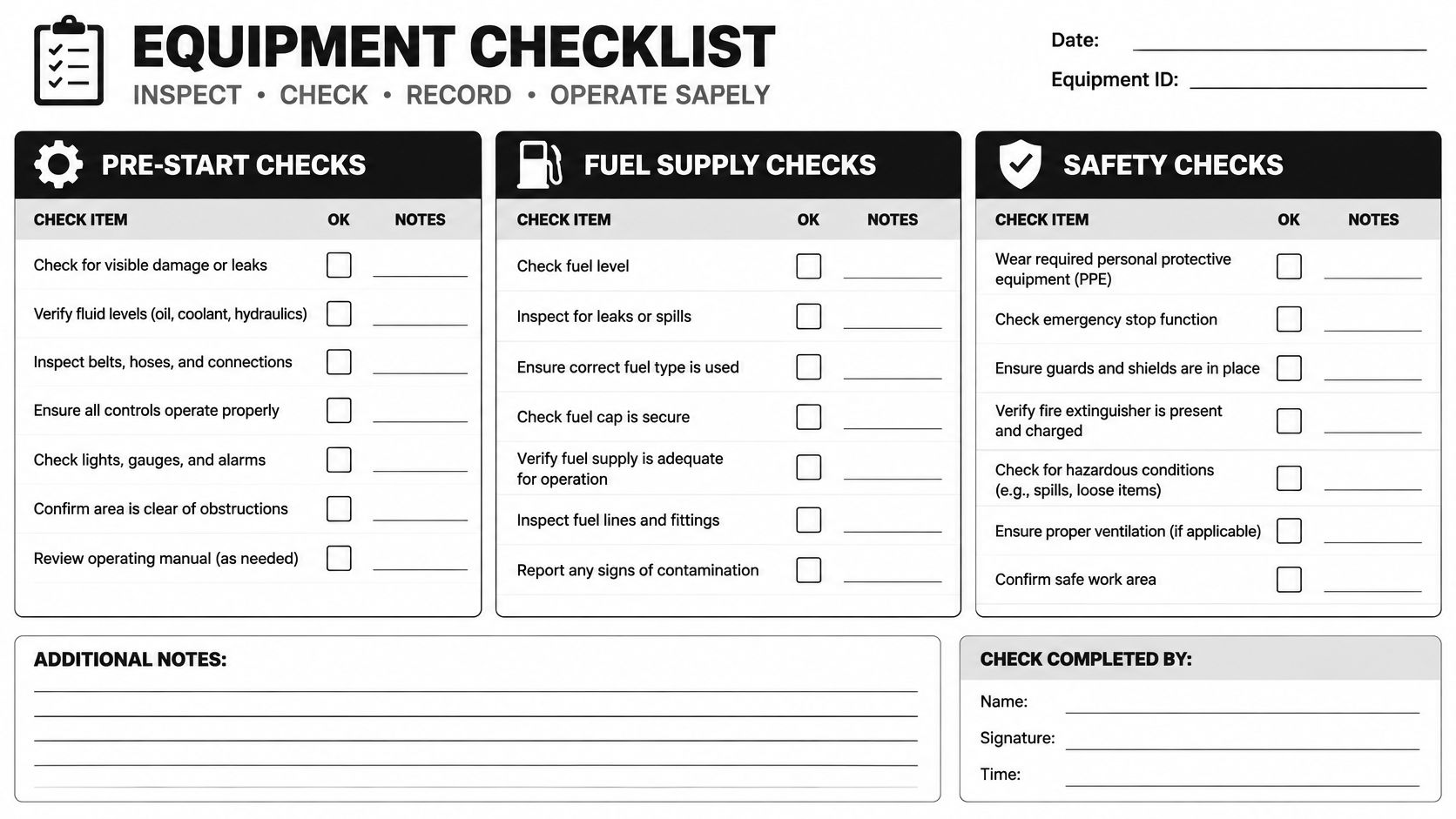
- Unit identification and nameplate ratings. Photograph the nameplate and record both the standby and prime ratings, rather than typing from memory. Every derating argument later depends on this line.
- Gas supply pressure and regulator settings. Measure at the regulator and again at the generator inlet, and write both numbers down. A low-pressure trip six weeks later can then be traced to a condition that existed before the first start.
- Piping and hose inspection, then a leak test at each connection. A leak found before start is a wrench and five minutes. A leak found after start is a hunt with the engine running. Connection equipment, gas flow testing and leak testing are available from Blue Gas Express on a service contract basis, which keeps the step on a schedule instead of on whoever is free that morning.
- Emergency shutdown location and test. Location matters as much as function, because the person who needs it is in a hurry and probably isn't the technician.
- Ventilation, exhaust clearance, grounding, bonding and weather protection. An exhaust path that recirculates into the intake is a hazard no load test will reveal. It has to be checked with the unit off, on paper, with a photograph.
- Connected load against generator capacity. Add up the loads you intend to transfer, including motor starting, and confirm they fit.
Mobile and temporary natural gas deployments need this section to tie fuel verification directly to electrical performance. Cummins' guidance on NFPA 110 testing and service requirements%20NFPA%20110%20Testing%20and%20service%20requirements%20for%20Standby%20Power%20Systems_12.15.2020.pdf) calls for recording ambient temperature, altitude and fuel grade alongside rated-load certification, because those conditions change what the unit can produce.
State the acceptance criteria before testing starts. Rated voltage and frequency stability, successful protection operation, required transfer time, no gas leakage, no unsafe exhaust recirculation, no unresolved critical defects. A criterion written after the test is a criterion written to fit the result.
Practical rule: if the site has a permit-to-test process, attach the permit to the pre-start record. Teams that run gas and electrical work together get more from a set of example health and safety programs than from another page of prose in the report.
Functional and Load Tests to Document Step by Step
The functional test is where reports thin out fastest. A paragraph saying the unit started on command and ran for two hours tells a reader nothing about transfer time, load pickup, or whether the alarms worked.
| Test stage | Load level | Duration | Readings to record |
|---|---|---|---|
| Cold-start functional test | No load | Until voltage and frequency stabilize | Start time, time to rated voltage and frequency |
| Automatic transfer and retransfer | Simulated utility failure | Through the load run, then retransfer | Transfer time, retransfer time, load pickup |
| Load test stage 1 | 30% of rated kW | 30 minutes | Voltage, frequency, current, kW, power factor |
| Load test stage 2 | 50% of rated kW | 30 minutes | Same readings, trended at set intervals |
| Load test stage 3 | 100% of rated kW | 60 minutes | Same readings plus oil pressure and coolant temperature |
The cold start and the transfer
Record two times for the cold start: when the signal was given, and when the set reached rated voltage and frequency. Those numbers become the baseline for every future test, so take them from the same instrument each year and note which instrument it was.
The transfer stage needs the simulated utility failure, generator start, automatic-transfer-switch operation, transfer time, emergency-load pickup, load shedding, load priority and retransfer to normal power. Where two sets run in parallel, add synchronization and load sharing. Where they don't, say so in one line, because a reviewer will otherwise assume the stage was skipped rather than deemed not applicable.
The three load stages
For an emergency power supply system, the Garner and Chisholm paper on EPSS commissioning recommends recording electrical measurements and generator operating values during the test and verifying that all components operate together as a system. The NFPA 110 style acceptance sequence splits cleanly: 30% of rated kW for 30 minutes, 50% for 30 minutes, and 100% for 60 minutes.
Supplemental load banks cover the common case where building demand can't reach those levels. Put the load bank's calibration certificate in the record and note the intervals at which readings were taken, typically every 15 minutes and more often across the step to full load. Trend voltage, frequency, current, kW, power factor, oil pressure, coolant temperature and exhaust condition at each interval, and log every alarm or fault with the time it appeared.
Pass conditions a reviewer can check without asking
Write the pass condition for each stage before the test. For the cold start, rated voltage and frequency reached within the time the specification allows. For transfer, the time inside the required limit with the emergency load picked up cleanly. For each load stage, no protection trip, no fuel pressure excursion outside the stated band, temperatures and pressures inside the manufacturer's envelope, and no unresolved critical defect.
A tick box tells a reader that someone was satisfied. A number tells a reader what satisfied them.
Baseline and Trend Data for Comparing Future Tests
The report is also a measuring stick, and that's the use most owners never get out of it. A later annual test can look fine on the day while performance has declined, because a reading only means something against the value recorded at handover.
The generator and emergency power system maintenance checklist points at the same idea: readings and signed records are only worth what the next test can compare them against. Store these values as the baseline.
- Start time and time to rated voltage and frequency. A start that creeps from eight seconds to fifteen is telling you about batteries, fuel pressure or the starter before either fails.
- Transfer and retransfer times. A gradual drift here usually means a switch setting, a worn mechanism or a control timer, and all three are cheaper to fix before an outage.
- Voltage and frequency dip at each step load. A deeper dip at the same load points to the governor or the excitation system.
- Power factor, oil pressure, coolant temperature and exhaust observations. These catch load-related problems that a voltage reading alone hides.
- Battery and charger readings. A weak battery passes a warm-weather test and fails the first cold morning.
- Fuel quality, ambient temperature and altitude. Without them, a reading taken on a different day isn't comparable, and the comparison is the whole point.
- Unresolved deficiencies carried forward, with an owner and a deadline attached.
Retest triggers to name in the report
Name the events that force a fresh test rather than waiting for the calendar: a repair to the generator, switchgear or fuel system; a change in connected load or load priority; a change in the fuel supply, including the switch from temporary to permanent service; and any transfer failure or unplanned outage.
Testing more often isn't automatically better. Testing against the actual risk profile and the actual load is.
Recording Deficiencies, Corrective Actions and Retests
Every deviation gets a status, a name and a date. A report that lists defects without those three things is a complaint, not a record.
| Status | Meaning | Required record |
|---|---|---|
| Accepted | Meets the stated acceptance criteria | Test result and signed date |
| Conditional | Operates, but a defect must be fixed before handover | Corrective action, owner, deadline, retest evidence |
| Failed | Does not meet a criterion | Root cause, repair, retest of the failed stage before sign-off |
What each defect record carries
Write the defect description, the stage where it appeared, the classification, the corrective action taken, the person responsible, the deadline, and the retest date and its result. A conditional item stays open on the report until a retest closes it. A failed item blocks sign-off until the stage is repeated and passes, which is why the classification has to be honest at the time rather than adjusted at the end.
Say the low-fuel alarm doesn't sound when the test drops supply pressure to the trip point. That's a failed item, not a note in the margin. The retest log has to show the alarm sounding at the set level, and the sign-off page can't be dated before that retest.
Attach the evidence to the defect
Photographs, updated settings and certificates belong next to the defect record, not in a separate folder the reviewer has to request. For anything involving a hot connection, a failed breaker or a warm terminal in the transfer equipment, an infrared inspection report template shows the fields worth copying: location, load at the time of the scan, reference and faulted temperature, and the repair reference. That structure keeps a thermal finding tied to the same corrective action list as everything else.
Close the section with a short table of open items. Three columns are enough: defect, owner, deadline. Anyone picking up the report can see what's still live without reading the whole document.
Sign-Off Pages and the Handover Package
Sign-off is not a formality at the back of the binder. It is the point where the report becomes evidence that the emergency-power system, including the temporary gas supply, was installed, tested and accepted. Four signatures, in this order, and no skipping the sequence.
- Contractor or installer confirms the installation matches the design and that the test results are complete.
- Commissioning agent confirms every test stage was witnessed or reviewed and that every defect carries a status.
- Owner or facility representative accepts the system and the handover conditions, including any conditional item with its deadline.
- Authority having jurisdiction signs where local rules require it, which in many jurisdictions is the signature that lets the building move forward.
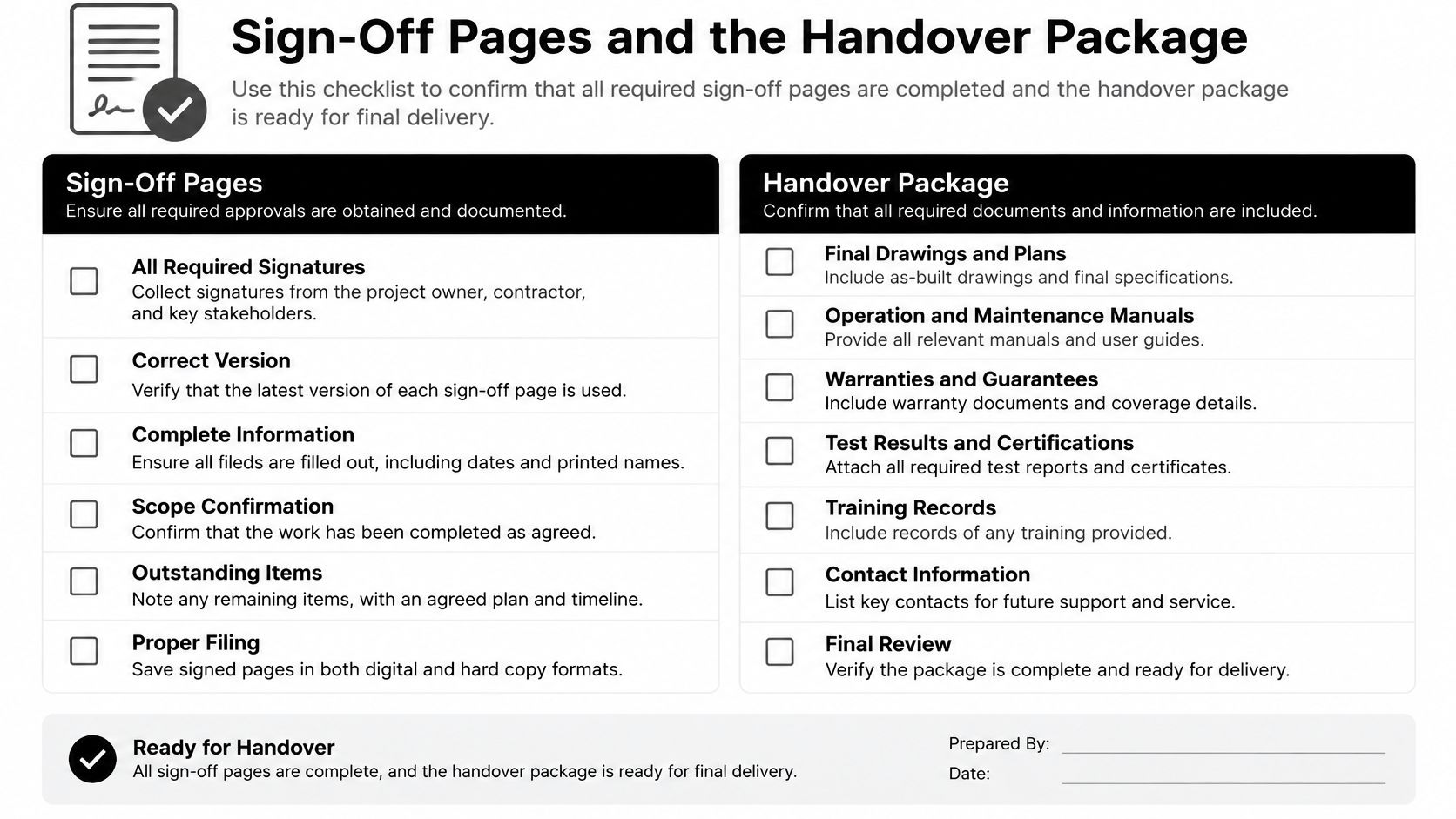
The attachment list
Tick each one before the package leaves the office.
- One-line diagrams reflecting the installation as built, not as designed.
- Final settings for the transfer switch, protective relays, regulators and alarms.
- Calibration certificates for meters and load banks.
- Photographs of the generator, the fuel connection, the exhaust termination and the shutdown station. The temporary gas supply and its changeover point belong in that set, not left as an assumption.
- The leak-test record, with the test pressure, hold time and the person who ran it.
- The alarm and trip test record, item by item.
- The open items list, with owners and deadlines.
The signed copy should carry a date and a version number. A QR code on the printed cover that opens the current revision settles which copy is live. For the print side, the same version-control rule applies as when adding QR codes to brochures to a campaign: one master, one live revision.
Store the original with the facility's compliance records, send a scanned copy to the commissioning agent, and keep a working copy in the maintenance file. The next test starts from that copy. If the package cannot show the fuel connection, the settings that protect it, and the signatures in sequence, I would not call it a handover document. It is a test sheet with a cover.
Deciding Whether the Report Is Ready for Gas Supply
Work the five checks in order. The report clears or it does not.
- Every row in the quick-reference table has data, and each piece of evidence sits against the correct row.
- Each load stage ran for its stated duration, with readings at fixed intervals rather than once at the end.
- Every defect carries a status of accepted, conditional or failed. Any failed stage was repeated and passed before sign-off.
- Baseline values and test conditions, including ambient temperature, altitude and fuel grade, stay with the report for comparison.
- The four signatures and the full attachment list are present, and the signed copy shows its version and date.
A short load test proves the engine can carry load for minutes. It does not prove the fuel system can hold pressure through an extended outage. Fuel pressure, vaporization, delivery scheduling and site access decide whether the generator keeps running when the outage outlasts the test. The report has to show that side of the system.
If any check fails, the report goes back to the commissioning agent and the gas stays off. If all five pass, the report becomes the handover record and the reference point for every future test. Put the planned test schedule against the sections of this guide before the test date, so no stage is missing when the crew arrives.
Blue Gas Express supplies temporary CNG and LNG to sites where permanent gas service is not ready, and works alongside your commissioning team on the fuel side of the handover record: supply pressure at the regulator and generator inlet, leak-test results, runtime estimates and a contingency plan if a delivery slips. If you need gas on site while the utility line is still under construction, Blue Gas Express can deploy a mobile unit within a few hours of your request.