

Compressed gas is gas held in a sealed vessel at pressure above normal atmospheric pressure, allowing a large volume to fit in a smaller container. That pressure is both useful and hazardous. A cylinder should retain residual pressure to help prevent contamination, and it must be removed from service when its test date has passed.
Two vessels on the same site can belong to very different systems. A welding oxygen cylinder has its own valve, regulator, and inspection requirements. A tube trailer supplying a building's gas line while the utility completes a permanent connection requires different equipment and procedures.
Which system are you handling? The answer determines the storage rules, testing intervals, paperwork, and emergency response that apply. A cylinder, a CNG trailer, and an LNG site all hold gas, but they do not share the same requirements.
What Compressed Gas Is and Why Pressure Matters
A bicycle pump shows the basic idea: pushing its handle compresses air into a smaller space, warming it and making it push back harder. A steel cylinder stores gas by the same principle, at much higher pressure. For example, natural gas cylinders may have a service pressure near 200 bar, roughly 3,000 psi. That rating describes the vessel's pressure limit, not the reading you should expect from a partly used cylinder.
Compression packs gas into less space. If the same amount of gas occupies one-tenth the volume, its density rises about tenfold. The amount of gas stays the same; its volume shrinks. That is the practical benefit, and the pressure inside the vessel is the reason it must be handled carefully.
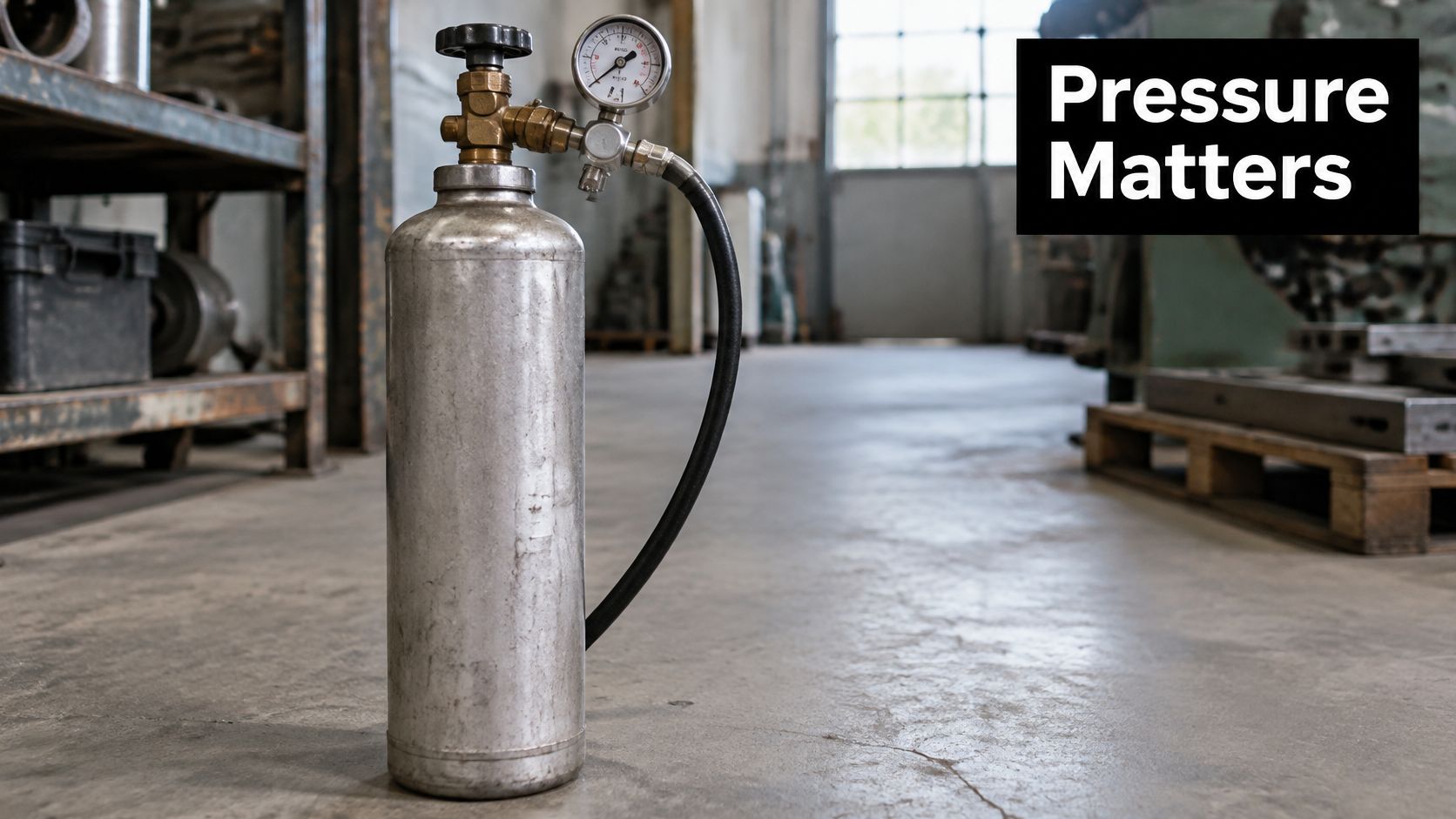
The term “compressed gas” covers different storage systems. A compressed gas remains gaseous at ordinary ambient temperatures. Liquefied natural gas (LNG) is methane cooled to about -162°C so it becomes liquid. The molecule is the same, but the storage conditions, equipment and handling procedures differ.
How the cylinder became a standard
The modern high-pressure cylinder took shape around 1890. The Compressed Gas Association's centenary history records that Mannesmann in Germany introduced steel cylinders without seams around that time. Removing the seams allowed cylinders to hold higher pressures, making it practical to transport gases such as oxygen, nitrogen, hydrogen and acetylene.
The CGA was founded in 1913 to develop safety standards for compressed gas handling, and federal workplace rules sit on top of that today, with dedicated provisions for acetylene, hydrogen, oxygen and nitrous oxide.
Medical oxygen uses pressurized gas too, with controls suited to its medical application. For an example of how oxygen is used in treatment, read about how chamber oxygen therapy works.
Common Compressed Gases and Their Typical Pressures
“Compressed gas” covers several different storage systems. A welding cylinder, a CNG trailer, and an LNG site do not hold gas in the same way, so their pressures and handling needs differ. The ranges below are typical examples, not substitutes for the rating and contents shown on a specific vessel.
| Gas | Typical storage pressure | Common use |
|---|---|---|
| Methane (natural gas as CNG) | 200 to 250 bar (about 2,900 to 3,600 psi) | Vehicle fuel and temporary building supply |
| Oxygen | 138 to 182 bar (2,000 to 2,640 psi) | Welding, cutting and medical use |
| Nitrogen | 138 to 182 bar (2,000 to 2,640 psi) | Purging and inert blanketing |
| Argon | 138 to 182 bar (2,000 to 2,640 psi) | Welding shielding gas |
| Hydrogen | 200 to 350 bar (2,900 to 5,000 psi) | Fuel cells and industrial processes |
| Acetylene | Dissolved in acetone inside a porous mass | Welding and cutting |
What service pressure actually means
A cylinder's stamped service pressure is its rated pressure when full under specified reference conditions. It is not necessarily the pressure of every fill or the reading you will see after gas has been drawn off. A gauge measures pressure, not the amount of gas remaining.
Acetylene shows why storage method matters as much as the number. It is dissolved in acetone within a porous mass because acetylene held alone at high pressure is unstable. Its cylinder and handling requirements therefore differ from those for nitrogen.
Reading the table before you connect
Use the table to identify a typical range, then check the actual cylinder label and test stamp before connecting equipment. The gas identity and vessel rating must match the intended use.
If the label and delivery paperwork disagree, stop and contact the supplier. Confirming the contents before connection helps prevent a dangerous mismatch.
For a separate example of how gas is used in packaging, canning explained for craft beer lovers describes a canning process.
How Compressed Gas Is Stored and Moved
Four vessel types cover almost everything you'll meet. Single cylinders carry small loads to wherever the work is. Manifolds or banks tie several cylinders together for steady demand. Multi-tube trailers move bulk gas to a site and stay connected only as long as the load needs them. Cryogenic tanks hold the liquefied gases, where the vessel's real job is keeping the contents cold rather than merely pressurised.
The pressure question that trips people up isn't the maximum. It's the minimum. NIST's compressed gases safety guidance states that cylinders should not normally be depleted below 172 kPa (25 psig). Keeping that residual pressure stops atmospheric moisture and contaminants from entering a nearly empty vessel, which protects gas quality and slows internal corrosion.
| Pressure state | What it means | Required action |
|---|---|---|
| Full, at rated service pressure | Normal working supply | Confirm the label and gauge reading before connecting |
| Above 172 kPa (25 psig) | Still usable, but the amount is shrinking | Track the draw rate and book the refill early |
| At 172 kPa (25 psig) | Residual minimum reached | Close the valve, isolate the equipment, arrange inspection or refill |
| Below 172 kPa (25 psig) | Outside normal use | Stop use and follow the supplier's procedure for refill or inspection |
A gauge reading above zero is not a fuel gauge. Pressure can stay high while the usable quantity has already become too small for the job, especially on a cold morning when the appliance is drawing hard. Treat the gauge as a condition indicator and track consumption separately, by run hours or by weighing, depending on the vessel.
Build the residual threshold into delivery planning, low-pressure alarms, changeover procedures and worker training. Retro-fitting it later means someone has to remember a rule under time pressure, which is exactly when rules get skipped.
What to do at the threshold: close the cylinder valve before the vessel reaches its residual minimum, isolate the equipment, and arrange inspection or a controlled refill under your supplier's procedure.
Residual requirements vary by cylinder type, gas and service, so the vessel specification and the gas-specific rules always take priority. Restraint hardware matters too, and cylinder safety hardware for wellness centers shows the stands and brackets that keep tall cylinders upright where they're used.
How Compressed Gas Supplies Natural Gas Temporarily
How can a building use natural gas before its permanent pipeline is ready? A temporary system connects a gas supply to the building's line, with the equipment sized to match the demand. Blue Gas Express rents mobile natural gas systems while customers wait for permanent service or where pipelines are unavailable.
The setup depends on the project. A Natural Gas Box can serve model homes while subdivision sales are underway or a permanent line is delayed. Boxes stay in place, and a trailer unit refills them directly without moving them. As demand grows, the supply can scale from one box to several, or to a mobile gas unit.
For larger needs, Blue Gas Express provides LNG containers, vaporizers, odorizers, large regulators and pipeline sections that work together as a complete system. The company matches a mobile unit's size to the gas capacity and flow rate required by the customer's equipment. Its temporary equipment ranges from small boxes and 16-foot trailers to semi-truck loads.
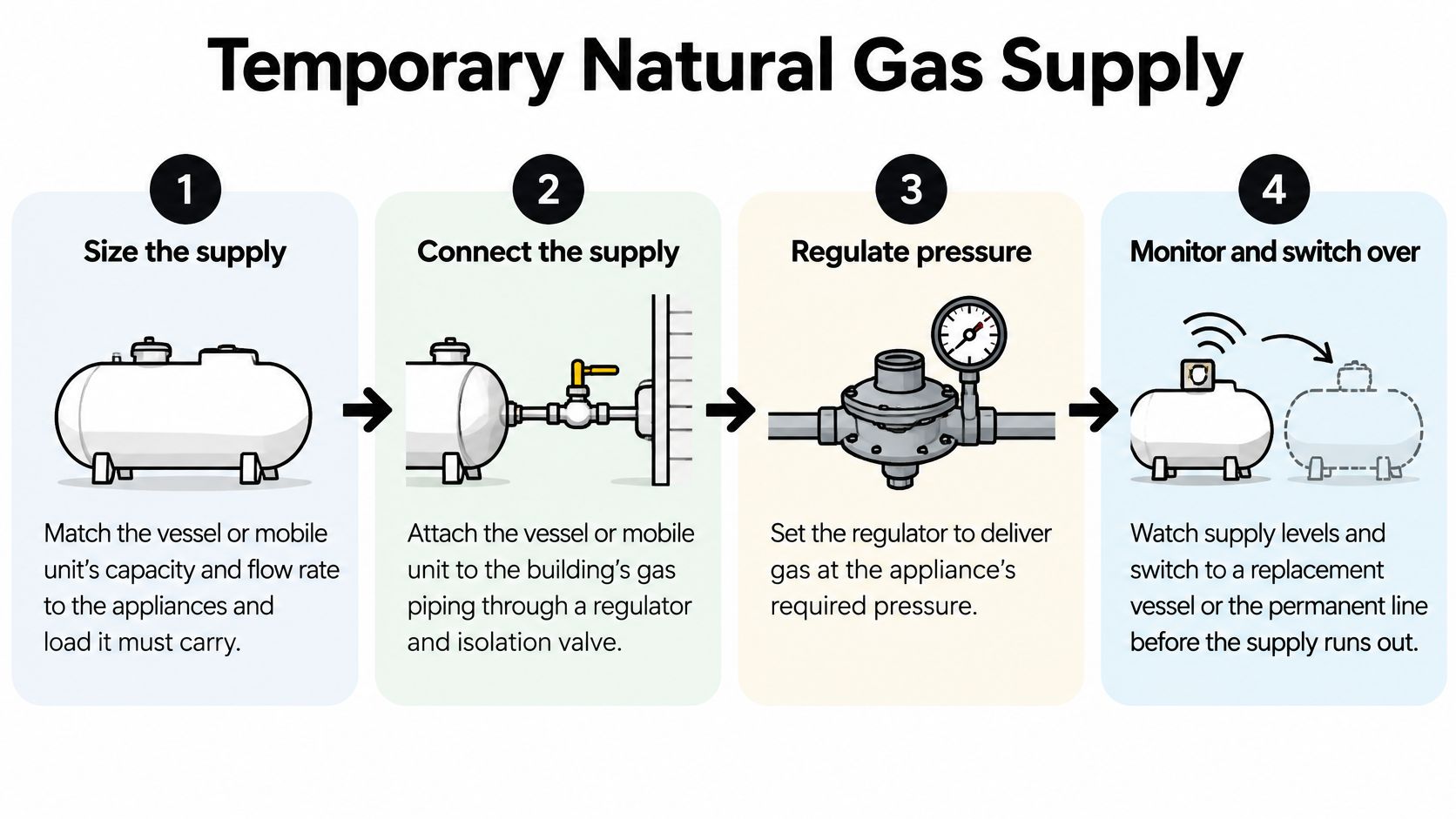
The gas delivered by mobile units is pipeline-quality natural gas from the utility. Blue Gas Express coordinates with gas utilities on temporary service and the transition to permanent supply. Its systems connect to commercial, industrial or residential natural gas lines, and its fleet provides service until the utility's permanent pipeline is functional.
For planning, compare the gas the equipment will use with the supply's capacity and flow rate. Then estimate how long the available supply will last at that draw, and arrange refills or a changeover before it runs short. LNG can also supplement gas vapor supply during periods of high consumption, facility maintenance or an interrupted gas flow.
Safety Risks Every Compressed Gas User Should Control
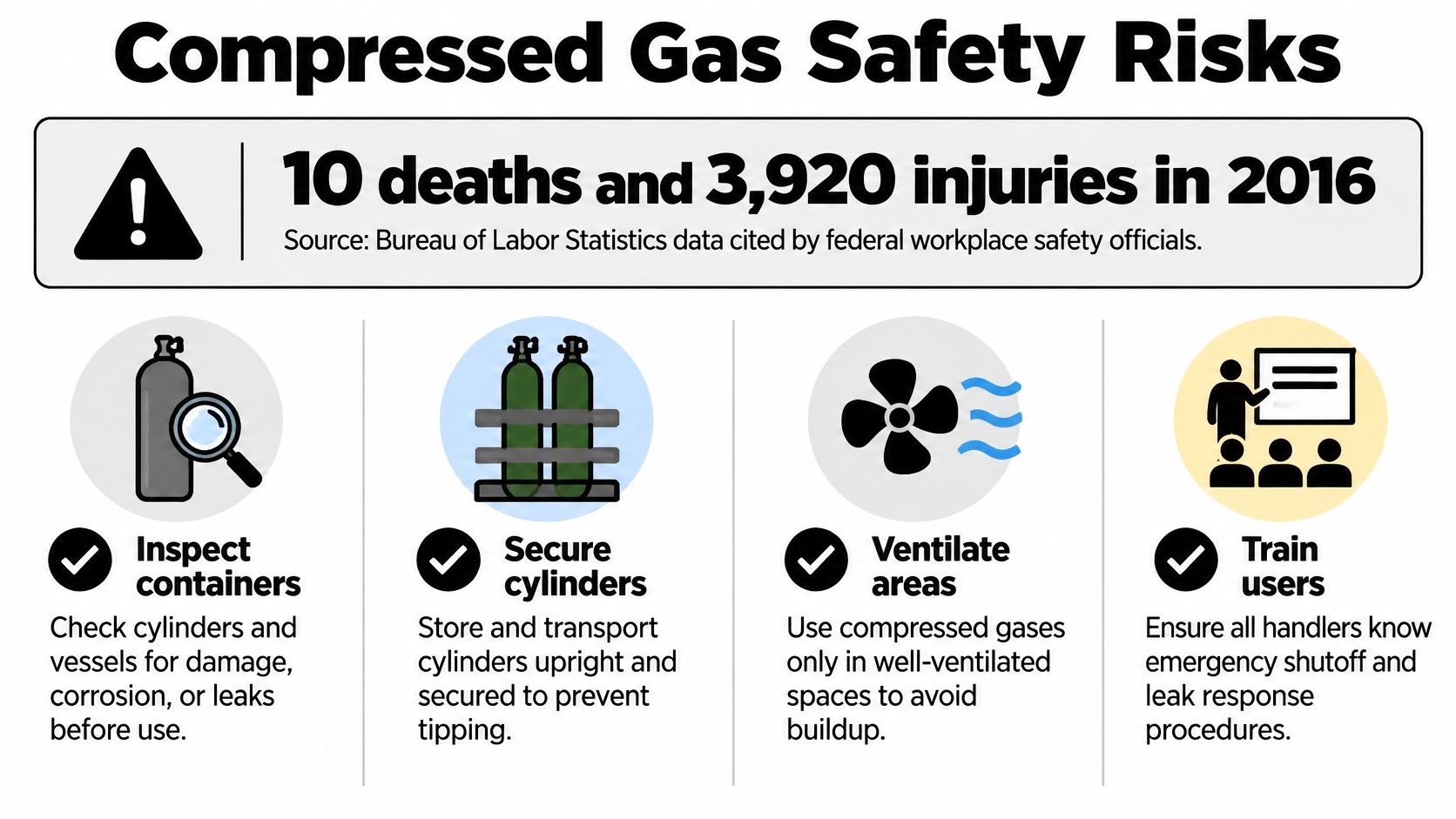
Could a cylinder falling over, a leak in a closed room, or a damaged valve turn stored gas into an immediate hazard? A federal workplace-safety fact sheet on cylinder storage reports that pressurised containers were associated with 10 deaths and 3,920 injuries in 2016, based on Bureau of Labor Statistics data. Cylinders can also tip, release gas if a valve is sheared, displace oxygen, or contribute to fires, explosions and toxic exposures.
Start with controls that are easy to check on site:
- Restrain every cylinder. Secure it to a fixed structure so it cannot fall. A cone does not prevent a cylinder from tipping.
- Read the label. Identify the contents by the cylinder label, not by the colour of its shoulder.
- Inspect before use. Check for damage, corrosion, dents near the valve and obvious leaks when a cylinder changes hands. Visual inspection is a practical first check; OSHA 29 CFR 1910.101 is a starting point for confirming employer obligations.
- Keep cylinders out of traffic routes. Store them away from elevators, stairs and gangways where they could be struck.
- Ventilate enclosed spaces. Nitrogen and argon can displace oxygen without a smell or warning. A basement purge calls for airflow and an oxygen meter, not just an open door.
- Train people who make connections. Handling cylinders and connecting regulators should be done by trained staff.
- Check the test date. NIST guidance states that most cylinders require hydrostatic or ultrasonic testing every 5 years, while certain steel cylinders may be tested every 10 years.
A cylinder is a pressure vessel as well as a gas container. Its contents store energy; dropping, heating or opening the vessel too quickly can release that energy in a dangerous way.
For a temporary supply, reliable operation depends on documented inspections, secure placement, pressure management, ventilation and trained handling. These controls help prevent an avoidable failure during the period the supply is in use.
Which Rules Apply and What to Confirm Before Delivery
Ask five people on a site who regulates the gas supply and you'll get five answers, and most of them will be wrong for that particular installation.
| Installation type | Main rules to check | Who usually decides |
|---|---|---|
| Welding cylinder bank on a job site | OSHA 29 CFR 1910.101 and local fire code | Federal OSHA or state plan agency, and local fire official |
| Temporary CNG trailer or mobile unit | Fire code, state utility rules and local permits | Authority having jurisdiction and the gas utility |
| LNG storage and vaporizer connected to a federally regulated pipeline | 49 CFR Part 193 | PHMSA, with state regulators |
| LNG site not tied to a federally regulated pipeline | State and fire-code requirements | State and local fire marshal |
| Customer piping after the regulator | Local plumbing and gas code | Local inspector |
The table is short on purpose, because no single federal citation covers a whole installation. Regulatory responsibility shifts with the fuel, the facility design, the location, the gas source and the end use. PHMSA's LNG regulatory documents set out the split: LNG facilities can fall under PHMSA, FERC, the U.S. Coast Guard and state utility regulators, and 49 CFR Part 193 specifically covers certain LNG facilities connected to federally regulated pipeline systems. A site that isn't connected to such a system usually answers to state, fire-code, environmental and occupational-safety requirements instead.
Why temporary doesn't mean lightly regulated
Shorter service doesn't remove facility obligations. A CNG cylinder, an LNG tank, a vaporizer, the pressure regulation, the temporary piping and the customer's own equipment each sit inside a different rule, and swapping one for another changes which authority has a say. Assuming the whole package is covered because the fuel is familiar is how projects end up with equipment on site and no approved plan for it.
The pre-delivery checklist
- Identify the authority having jurisdiction for your installation type before you order anything, and get the answer from that office rather than from a forum.
- Confirm the permit, inspection, setback, training and emergency-plan requirements in writing, including who signs off and how long the review takes.
- Ask for the fill procedure and residual-pressure rule in writing, plus the refill schedule that keeps the load running through your busiest week.
- Agree the changeover date with the utility, so the move from temporary supply to permanent service is planned rather than improvised. We coordinate with gas utilities as a matter of routine, which is how the switch usually lands on the agreed day.
Never infer compliance from fuel type alone. Two sites burning the same molecule can sit under different regulators, different setback distances and different emergency plans. Call the authority having jurisdiction, get the requirements named, and only then book delivery.
We rent mobile natural gas units sized to the load you're running, and we keep buildings, subdivisions and construction sites supplied while a permanent gas line is designed, permitted and installed. We partner with gas utilities, including Dominion Energy and Piedmont Natural Gas, so the handover to permanent service happens on schedule instead of leaving a gap. Visit Blue Gas Express to match a unit to your gas capacity and flow rate.