

A generator arrives on a trailer and gets set on a concrete pad. The electricians land the feeders, the transfer switch gets labeled, and by mid afternoon the set is ready to run. Then someone asks the only question that matters. Where is the gas coming from?
On a lot of sites the answer is "not yet." The permanent main is weeks out, or the meter is set but not turned on, or the utility is still working through a pressure upgrade on the street. The commissioning schedule for the rooftop units, the boiler and the backup set does not move because a pipe isn't finished.
That gap is where an industrial natural gas generator does real work, and it's also where most of the confusion lives. The term covers everything from a 60 kW stoichiometric package to a 2 MW lean-burn unit to a gas turbine, and those machines don't share fuel pressure, efficiency or start behavior. Get the machine right and you've solved half the problem. The other half is what feeds it.
Industrial Natural Gas Generator Types at a Glance
Open three spec sheets side by side and the term stops looking like one machine. One set burns its fuel the way a car engine does. Another runs on far more air than the chemistry strictly needs. A third sits closer to a jet engine bolted to a gearbox. Each one turns methane into megawatts its own way.
An industrial natural gas generator is a spark-ignited reciprocating engine or a gas turbine built to carry process load at commercial or industrial scale. Its fuel volume, inlet pressure and duty cycle put it in a different class from a home standby unit, which exists to carry a furnace fan and some lighting circuits.
| Configuration | Typical scale | Efficiency | Best role |
|---|---|---|---|
| Stoichiometric reciprocating engine | Small sets | Lowest electrical efficiency of the group | Backup power and light commissioning loads |
| Lean-burn reciprocating engine | Multi-megawatt sets | Highest reciprocating efficiency near rated load | Continuous industrial power near rated load |
| Simple-cycle combustion turbine | Large peak and emergency sets | Lower than combined cycle, because exhaust heat is not recovered | Fast start for peaks and short emergencies |
| Combined-cycle gas plant | Plants of at least 1 MW class | Higher than simple cycle, from steam made with exhaust heat | Sustained output from a permanent site |
| CHP reciprocating engine with heat recovery | Sites that can use heat and power together | Most of the fuel's energy becomes useful work | Process heat plus electricity when loads match |
Read the table by runtime first. A small stoichiometric engine turns a smaller share of each unit of gas into electricity, which is acceptable for holding up a commissioning load or a light steady draw. A large lean-burn engine converts a noticeably larger share once it runs near its rating, so it buys each kilowatt-hour with less gas. Where a site can put recovered jacket water and exhaust heat to use, a CHP set turns most of the fuel's energy into useful work, on one condition: the heat demand and the electrical demand have to rise and fall together.
What U.S. generation data says about these configurations
None of this is boutique equipment. In 2022, utility-scale plants in the United States produced about 4.23 trillion kilowatt-hours, natural gas supplied 38.9% of utility-scale generation and 43.3% of net summer generating capacity (the largest capacity category in the national fleet), and combined-cycle plants delivered 33.8% of generation while single-cycle combustion turbines added 3.6%, all in data covering plants of at least 1 MW, according to the U.S. Energy Information Administration. Those are grid assets carrying real duty, which is why the same engine families keep turning up as site power.
A combined-cycle plant is a power station arrangement. It earns its efficiency by pushing turbine exhaust through a heat recovery boiler and a second turbine, and that steam cycle needs a permanent home. Simple-cycle turbines start faster, so they serve peaks and emergency support rather than baseload.
Every row in the table assumes gas arrives at the inlet. Sagging pressure, a utility curtailment notice or a main that is still under construction stops a gas engine the same way an empty tank stops a diesel unit. The set on the pad is only as dependable as the supply behind the meter, and where the permanent line is not ready, a temporary mobile gas unit or an LNG vaporization skid has to be sized to the same load and hours as the engine it feeds.
Pick your row from two inputs: how many hours the set will run, and whether anything on site can use the heat. Nameplate kilowatts alone point you at the wrong machine.
How a Gas Engine Makes Plant Power
Light a camp stove and you've already done the hard part. Gas arrives, mixes with air, a spark lights it, and heat comes out. A reciprocating gas engine is the same idea with a piston in the way, and once you can picture the stove and a car engine, the rest of the machine follows in a straight line from the street to the breaker.
A gas train starts at the meter. Pipeline-quality natural gas, which is mostly methane, passes a regulator that drops pressure to what the engine expects, then shutoff valves, a sediment trap and a final regulator before the mixer or the fuel-injection system. Everything downstream assumes the inlet pressure stays inside a band. When it doesn't, the set trips or derates, and no amount of control programming fixes it.
Combustion, rotation, electricity
In a reciprocating set the mixer blends gas with air, the piston compresses the charge, and a spark plug fires it. The expanding charge drives the piston down, the connecting rod turns the crankshaft, and the crankshaft spins an alternator. Stoichiometric means the air and fuel sit close to the chemically complete ratio. Lean-burn means substantial extra air, which burns cooler, suppresses nitrogen oxides at the source, and is how the large engines reach the efficiency figures in the table above.
The path from fuel to breaker runs in a fixed order, and each step depends on the one before it.
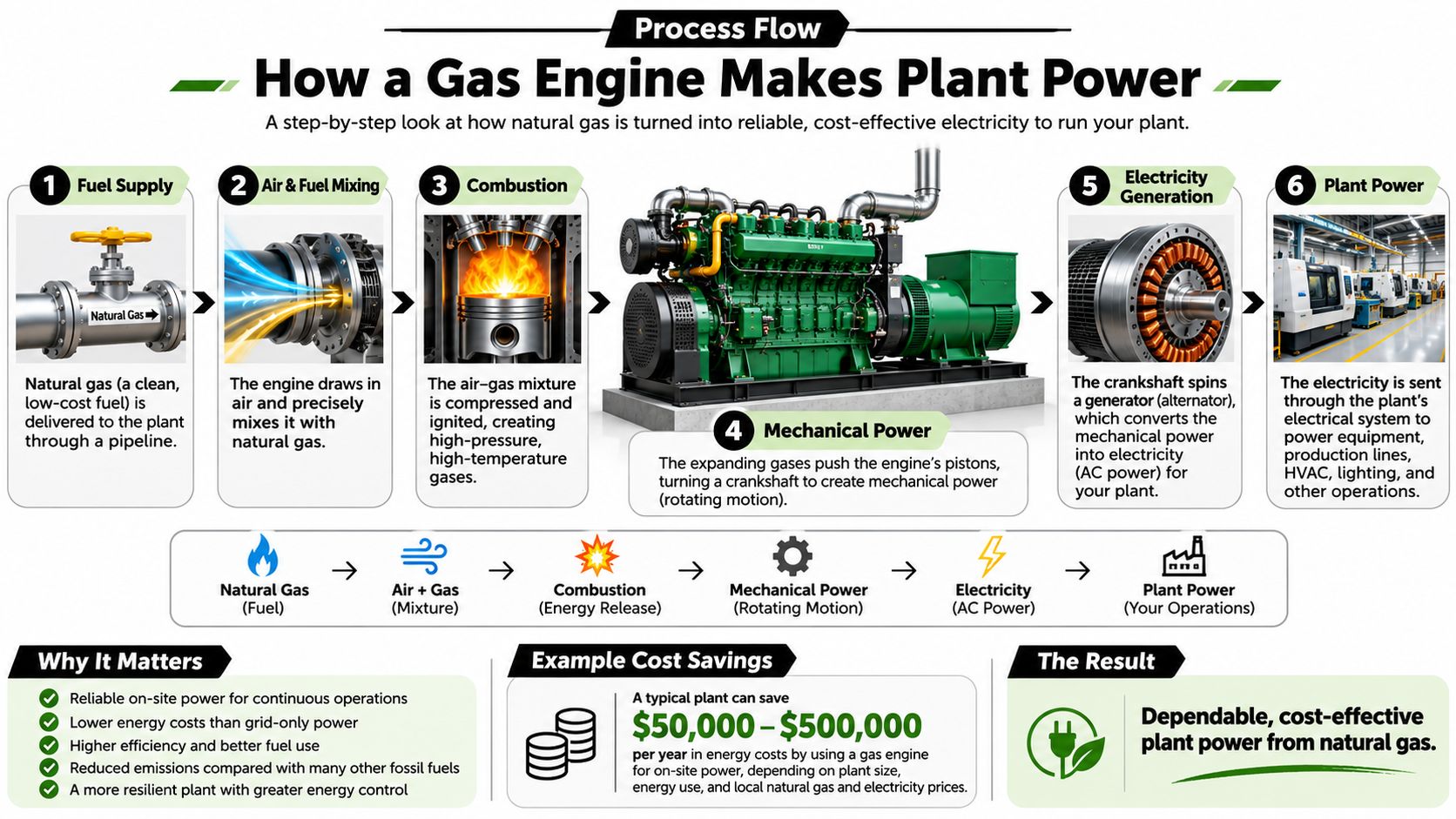
A gas turbine is the second picture. A compressor squeezes air, a combustor burns gas in the compressed air, and the hot gas spins a turbine on the same shaft, with the alternator driven off that shaft or through a gearbox. Its exhaust is hot enough to boil water for a second turbine in a combined-cycle plant, which is exactly why that configuration beats a simple-cycle machine on fuel per kilowatt-hour.
On a reciprocating engine the same waste heat leaves through the exhaust and the jacket water. Capture it and you have CHP, provided a process wants the hot water or steam. If nothing does, that heat is a cost with no offset.
The output that matters is kilowatts at the breaker, at the voltage and frequency the site's switchgear expects. Heat is a second product and it only counts when it displaces fuel the site would otherwise buy. Every decision that follows, inlet pressure, load profile, temporary fuel, is about keeping this chain inside the range the engine was built for.
Fuel Pressure and Gas Supply Paths
The set can pass every electrical test and still fail on fuel. A cold snap arrives, the utility sheds interruptible load, inlet pressure sags below the engine's minimum, and the generator trips while the building goes dark. The machine is healthy. The gas is no longer arriving at the pressure the gas train was built to accept.
That is the line between pipeline availability and deliverability. A connected generator works like a runner with a good pair of shoes and no air: the engine may be ready, but the fuel path decides whether it can work. Run four checks before the pad, trench and outage plan harden into schedule.
- Read the engine data sheet. Find the minimum and maximum inlet pressure at the gas train, plus the required heating value and gas composition. Check those limits at full load with every other gas appliance on the service running, because boiler, heater and process demand can pull pressure down when the generator needs it most.
- Size the regulator and meter for full-load flow. Idle flow proves nothing. A service that carries a light commissioning load can starve the same set when it picks up real production load, and an undersized supply is a common reason a commissioned generator fails its first genuine outage.
- Ask the utility what happens in an emergency. Firm service, an interruptible rate and a priority classification are three different promises. Get the curtailment answer in writing before pour day, and ask whether maintenance, a peak event or an unfinished lateral can interrupt flow.
- Choose the path that matches load, hours and site access. The generator nameplate does not choose the fuel plan. The load profile does.
| Fuel path | Best fit | What must be on site | Limit |
|---|---|---|---|
| Utility pipeline gas | Continuous operation after the main is in service | Meter and regulator sized for full-load flow, with pressure inside the engine spec | Curtailment, low pressure, a planned outage or an unfinished line |
| Mobile compressed natural gas | Commissioning, short outages, small to moderate loads | Trailer or container, regulation down to engine pressure, pipeline-quality gas | Storage and trailer count run out on large or long loads |
| LNG vaporization | Large industrial or municipal loads, and peak-vapor gaps | LNG containers, vaporizers, odorizers, large regulators, pipe sections | Needs space, vaporizer capacity and a permitting path |
Mobile gas is the bridge for hours to days: delayed mains, line maintenance, early commissioning, model homes, rooftop units, ambient heat and backup sets. The fuel still has to arrive as pipeline-quality gas and step down to the pressure the engine expects. When several mobile units become too small for a large industrial load, LNG becomes the practical path: containers feed vaporizers, odorizer and regulators, then a short pipe run supplies the site as one system. It also covers peak-vapor gaps when consumption spikes, a peak-shaving facility is under maintenance or gas flow is accidentally disrupted.
Site logistics decide the calendar as much as the fuel does. Keep the trench, meter set, regulator, gas train and tie-in date in one sequence, and treat conduit or communications work as a schedule dependency only where it shares the corridor; a fiber-optic network construction partner may control a dig window, but the fuel-path question stays the same: what reaches the gas train, at what pressure, for how many hours.
Decision rule: match the supply to the load, the hours of runtime, the site access and whether vaporization is required. A fuel plan sized to the nameplate alone is a guess with paperwork.
Plants and Jobs That Depend on Gas Power
Five jobs come up again and again, and they don't rank equally in difficulty.
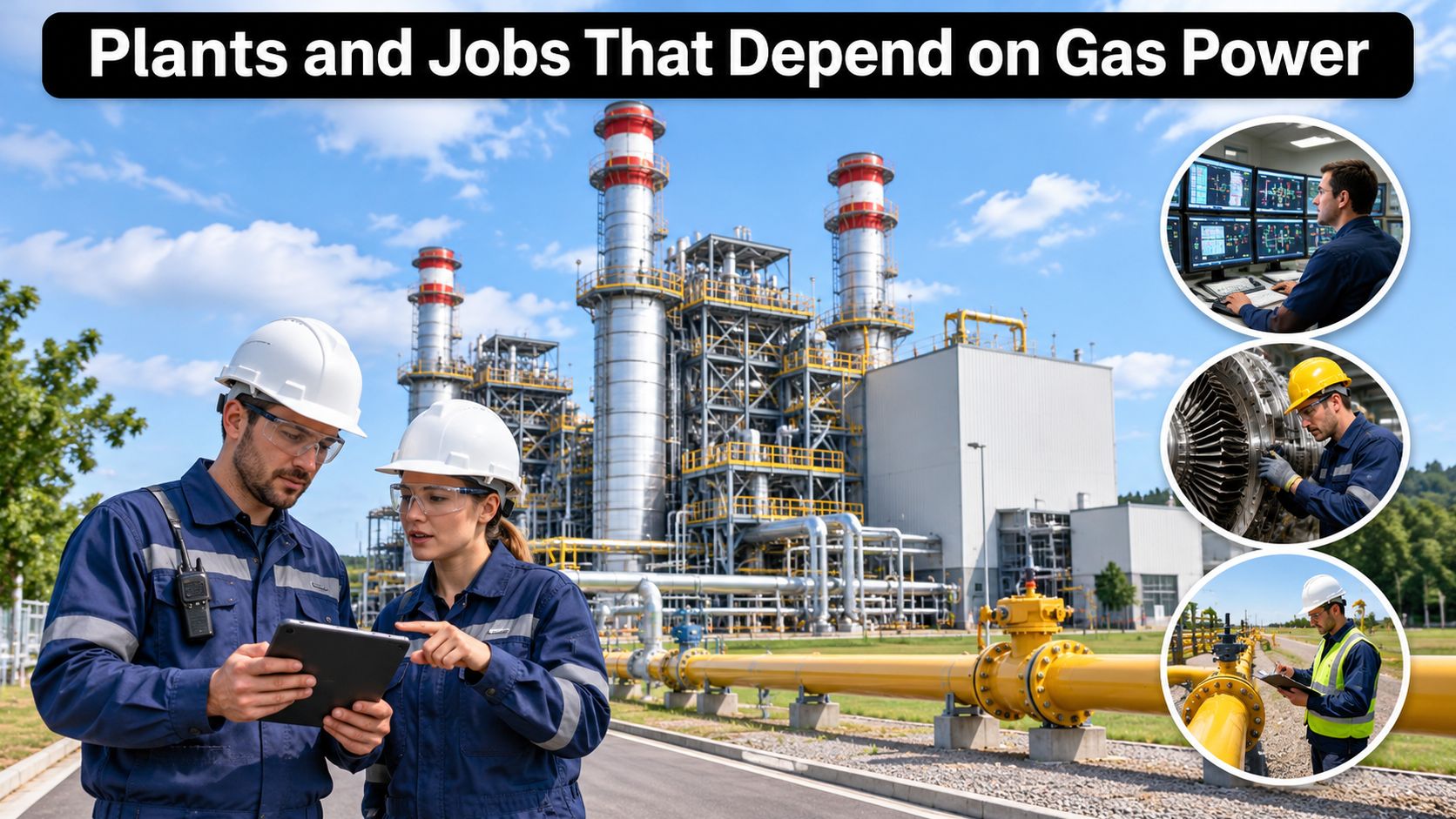
Construction and fit-out. Rooftop units, ambient heat and the generator itself all need commissioning so a building can chase an occupancy date while the utility main is still weeks out. The load is modest and the hours are short, which is the easiest case to serve.
Industrial process. Boilers, asphalt melting, lumber drying, forging, steam plants and water treatment care about hours of heat and power, not a thirty-second emergency start. A furnace that cools down mid-batch costs more than the fuel.
Manufacturing yards. Railcar shops and auto-parts plants belong in the same group when a press or a heat-treat line cannot wait on a line extension. The set is running real production load, often for days.
Municipal and campus sites. Wastewater plants, incinerators and campus steam systems use gas generation for continuity when grid work or a cooling spike would otherwise idle the plant.
Backup for a critical commercial building. This one is different from the other four. The set may sit idle for months and then has to accept fuel at full pressure on the worst day of the year.
The wider system backs up that pattern. Natural gas remained the world's second-largest source of electricity in 2024 and has supplied more than 20% of global electricity for over two decades, according to the International Energy Agency. Gas-fired generation rose by about 170 TWh, roughly 2.5% year over year, while total global electricity consumption rose nearly 1,100 TWh. A temporary gas-fueled set is a normal bridge wherever an outage or a late main would stop work.
Air permitting runs alongside all five jobs and often sets the calendar. A new gas plant's authorization can become a project milestone in its own right, as NeoTeo's coverage of Texas air permits shows. The global natural gas generator market was valued at USD 10.9 billion in 2025, according to Grand View Research, which tells you how much of this work is routine rather than exceptional.
Match each job to a supply path you've already chosen. Small commissioning loads suit a short CNG bridge. Large process loads want LNG vaporization or a finished pipeline.
Sizing So the Engine Stays Efficient
A 40% efficient machine does not deliver 40% when it loafs. That single sentence explains most of the fuel bills that surprise people.
DOE and NREL technology characterization data put stoichiometric engines below 100 kW at roughly 28% LHV electrical efficiency, while lean-burn engines above 2 MW can exceed 40% LHV, as the NREL technology characterization sets out. At a fixed electrical load the difference is real money: the 40% unit burns substantially less fuel for the same kilowatts, which shrinks the fuel supply you have to bring to site, whether that's CNG trailers or an LNG system.
Where efficiency goes at low load
The advantage erodes as load drops. Fixed parasitic loads keep drawing power, the throttle works against a partly closed intake, and the expansion stroke is poorly used, so each of those takes a larger share of the fuel going in. NREL's modeling specifically notes significant gas consumption from low part-load operation, which is the opposite of what a fuel budget built on nameplate efficiency assumes.
Practical rule: two sets carrying 60% each will beat one oversized set carrying 20% all week, on fuel and on maintenance.
Prefer two or more smaller sets, or a staged plant, so the engines running sit inside their efficient band. A single large lean-burn set makes sense only when the process load is steady and high for long stretches. Count recovered heat only when the site uses it, and only up to that 70 to 80% total useful-energy band, which requires thermal and electrical demand to move together rather than in opposite directions.
The four numbers to log during commissioning
Keep a written record as the set runs: fuel pressure at the gas train, gas composition, kilowatt load, and hourly fuel use. With those four you can calculate actual LHV efficiency instead of trusting a nameplate or a spec sheet, and you can see how the number moves as load moves.
If the measured efficiency lands far below the row you picked, the set isn't bad. It's oversized or underloaded. The fix is staging, or a smaller bridge unit that runs near its rating, not a bigger fuel trailer feeding a machine that can't use it well.
Why a Gas Line Does Not Guarantee Runtime
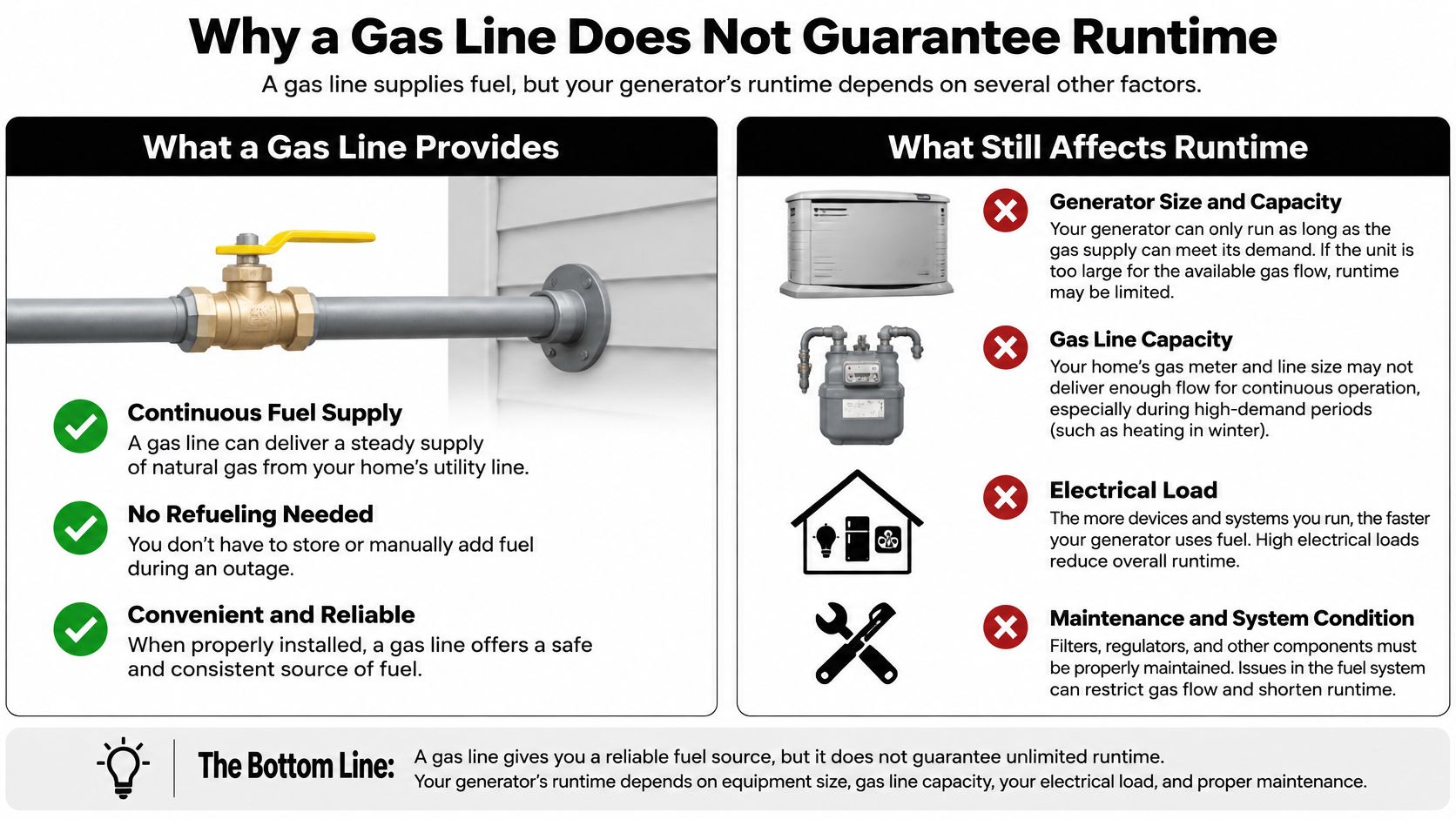
Skip the on-site diesel tank and the generator gets simpler. It does not automatically get more reliable. A utility-connected natural gas generator is only as available as the pressure at its inlet, and pressure answers to a system the site doesn't control.
Two cases get confused. A finished main with adequate regulator capacity, firm or priority service and no curtailment can beat diesel over long runtimes, because refueling stops being a job anyone has to manage. The same set fails where a fueled diesel set would keep running: pressure drops below specification, a severe-weather curtailment hits, the utility schedules an outage, or the construction main was never tied in at all.
Dual-fuel capability is the hedge, when the engine can take a second fuel. It isn't a feature you assume every nameplate carries, and it changes the permit picture and the site's stored fuel requirements.
Temporary deployment is its own category, not a small variation on permanent standby. EPA materials on stationary combustion turbines identify stationary turbines at industrial sources as regulated emission sources and separately recognize temporary combustion-turbine applications. That means the permitting and emissions status of a short bridge has to be confirmed for the actual deployment, never copied over from the site's standby permit and assumed to cover a different machine running for a different period.
Ordinary pipeline availability is not guaranteed fuel deliverability, and the difference shows up on the coldest morning of the year.
Verify five things before you rely on the pipe: minimum pressure at full load, regulator capacity against full-load flow, curtailment priority, whether the engine can run a second fuel, and a contingency fuel volume sized to the outage you're covering rather than a generic figure.
The verdict depends on the situation. Pipeline gas is the right answer when deliverability is confirmed in writing and the pressure holds under load. A temporary CNG or LNG bridge is the right answer when the line is late, out of service, or too small for the load. Diesel stays in view when gas pressure cannot be guaranteed and the engine has no second fuel.
Confirm Fuel Before Generator Commissioning
Three numbers before anyone starts the set. Write them down: expected kilowatt load, how many hours the permanent main will be missing, and the engine's minimum inlet pressure from the data sheet.
If those hours are short and the load is modest, a mobile gas unit that ties into the building or the meter covers generator commissioning, rooftop equipment and ambient heat, so the schedule stops depending on a utility crew's calendar. If several mobile units would be too small for the industrial load, step up to a turn-key LNG vaporization plant instead of stacking trailers past the point they make sense. Blue Gas Express rents that full range across North Carolina, South Carolina, Tennessee and Virginia for line-install delays and maintenance outages, from mobile units for early commissioning to LNG containers, vaporizers, odorizers, large regulators and pipe sections working together as one system.
The same bridge covers a utility outage or a peak-vapor shortfall, then comes off when the permanent line is fully operational. Match the load and the gap in days to one of those two supply sizes, confirm pressure against the engine sheet, and schedule the fuel before the commissioning window opens rather than after the first failed start.
Blue Gas Express provides mobile natural gas units and turn-key LNG vaporization plants across North Carolina, South Carolina, Tennessee and Virginia, sized to the load and the days you're waiting on a permanent main. If a generator is sitting on a pad with no live gas line, or a maintenance outage is about to idle an industrial natural gas generator, we can have fuel on site and pressure confirmed against the engine's spec. Visit Blue Gas Express to plan the bridge before your commissioning window closes.