

The commercial kitchen is finished, the boiler is sitting on its pad, and the occupancy permit is stuck because the utility gas line is still weeks away. Crews are ready, the inspector is booked, and nobody can light a burner. That gap is exactly where LNG delivery earns its keep: cold liquid gas arrives by truck, sits in a tank, and becomes usable gas on site while the permanent line is late, shut for maintenance, or not there at all.
Why LNG Delivery Fills a Temporary Gas Gap
Say a builder has finished a commercial kitchen. The hood, the ranges, and the boiler are installed, but the utility's gas line is six weeks late. The boiler can't be commissioned, the occupancy permit is on hold, and every idle day costs the owner rent and payroll.
LNG delivery means natural gas chilled to about -162°C (-260°F) until it becomes a liquid. At atmospheric pressure that liquid takes up roughly 1/600 of the volume of the same gas. One trailer can therefore carry enough energy to run a site that has no pipeline at all.
Think of the liquid as a tightly packed suitcase. The gas is the same clothes unfolded across a room. You move the suitcase. You unpack it only when you need to wear something.
Readers usually meet this setup in three situations.
- A delayed line installation: construction is done, and the utility connection is not.
- A maintenance outage: an existing line is cut, repaired, or replaced, and the building still needs gas.
- An area never served by pipelines: there is no main to wait for, so the supply has to come by road.
We bring LNG on site from liquefaction plants where we hold contracts, and we use it while customers wait for a permanent line or in places pipelines don't reach. Mobile units can go anywhere in the US, with full service across North Carolina, South Carolina, Tennessee, and Virginia.
Before you order, ask one question. Do you need this gas for weeks, or for years? A short gap and a permanent off-pipeline supply are different jobs, and the answer changes tank size, delivery frequency, and how much reserve you should hold.
How LNG Travels From Plant to Site
LNG delivery is a chain of handoffs. Each stage has one job and one control point. Miss that check and the failure shows up later, often as low pressure on the morning you need gas most.
| Stage | What Happens | What Keeps It Reliable and Safe |
|---|---|---|
| Liquefaction | Natural gas is chilled to about -162°C (-260°F) and becomes a liquid at the plant | Plant output and contracted volume |
| Loading | Liquid is transferred into a cryogenic tanker | Hose and coupling inspection, pressure and level checks |
| Road transport | Double-wall, vacuum-insulated tanker carries the cargo | Tanker certification, insulation and boil-off on the route |
| Unloading | Transfer hose connects the tanker to the on-site storage tank | Exclusion zone, grounding and bonding, emergency isolation access |
| On-site storage | Cryogenic tank holds the liquid while heat leaks in | Dwell time, tank pressure and boil-off handling |
| Vaporization | Vaporizer turns the liquid back into gas | Vaporizer sized for peak demand and unloading flow |
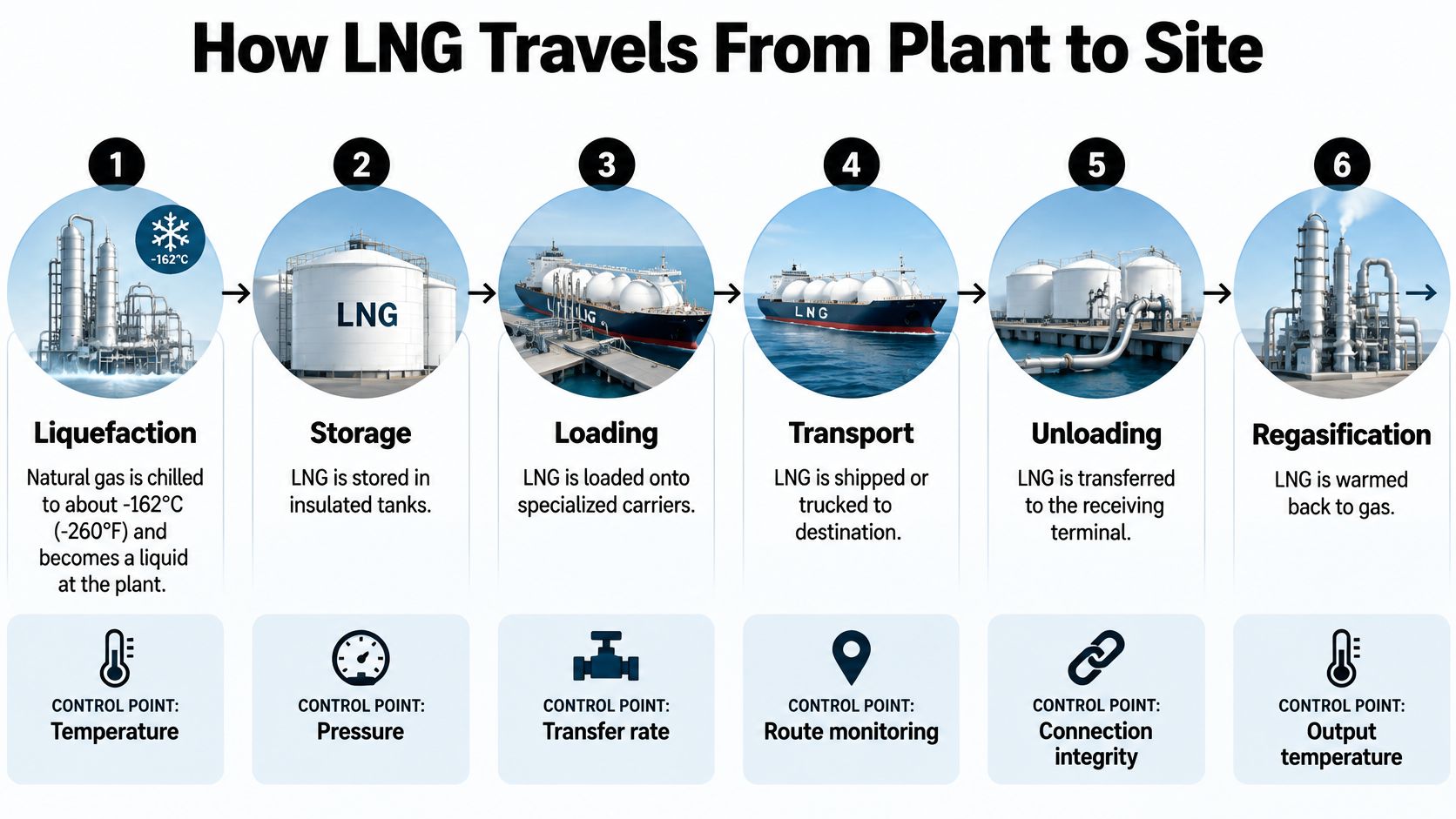
Walk the six handoffs
Liquefaction happens at the plant. Gas is chilled until it is liquid, and the check is simple: plant output has to match the contracted volume. A short load becomes a short week on site.
Loading moves that liquid into a cryogenic tanker. Inspect hoses and couplings, and confirm pressure and level, before the truck leaves the rack. The shipping papers should match the cargo. The main types of bills of lading tell you who shipped the load, who receives it, and what was declared, so a mismatch is caught before the truck is on the highway.
Road transport uses a double-wall, vacuum-insulated tanker. Confirm the certification and the boil-off you should expect on that route, including summer heat and any wait at the gate.
Unloading is a hose between the tanker and your tank. Verify the exclusion zone, grounding and bonding, and a clear path to emergency isolation. If traffic on a temporary site blocks that path, stop and reset the layout.
On-site storage holds the liquid while heat leaks in. Track dwell time, tank pressure, and how boil-off is handled. A tank that sits all week is not the same tank that was full on Monday.
Vaporization turns liquid back into gas. The vaporizer has to be sized for peak demand and for the extra flow during unloading, not for a quiet average hour.
Why the truck still matters
Ocean shipping and a jobsite trailer are not the same business. According to the U.S. Energy Information Administration, nearly all U.S. LNG exports moved by carrier in 2023, while about 0.69 Bcf went by truck in ISO containers to Canada and Mexico, and 88% of that trucked volume went to Mexico. Road delivery is a small niche beside marine trade, which is why each local handoff has to be checked on its own. A trailer can arrive Monday, the tank can hold the liquid through the week, and the vaporizer can be the thing that carries a cold-morning peak. Trace those six stages on your own delivery paperwork before you sign for the load.
Inside a Cryogenic Tanker on the Road
A cryogenic tanker works like a thermos bottle scaled up to trailer size. Its job is to hold a liquid near cryogenic temperature through a multi-hour drive while heat pushes in from every side.
What the wall is doing
A road tanker for this service is double-wall and vacuum-insulated. The vacuum space cuts conductive and convective heat gain, so ambient air does less work on the cargo. The Petroleum and Natural Gas Regulatory Board technical standards/D.4.%20LNG%20T4S%20Regulations/20250723-LNG-T4S-Post-Amendment.docx) call for tankers designed and tested for cryogenic service, with an inner vessel and piping that tolerate temperatures near -162°C.
Ordinary carbon steel is the wrong metal here. Exposed to this liquid, it can turn brittle, and a brittle joint can fail without a crack the driver can see from the cab. Joints have to be qualified for cryogenic service, and the tanker plus its hoses, valves, and instruments should carry certification for that service before a site accepts the load.
Practical rule: If the carrier can't name the certification and the last insulation inspection, don't start the transfer.
A summer run, on paper
Take a bulk trailer loaded at the plant in the morning. The route runs half a day in summer heat, with a stop at a weigh station and a wait at your gate. Heat still enters through pumps, piping, and the small leak the vacuum did not stop. Arrival pressure sits a little higher, and some liquid has become boil-off. That vapor belongs in the delivery plan, and the operator who opens the valve should already expect it.
Each leg of the run has its own control point: loading, the road, the wait at the gate. Each leg also has a failure mode, and heat gain is the thread connecting all three. A well-built tanker lowers the risk, but the site still owns its half of the handoff. Keep people and vehicles outside the thermal exclusion zone around containers and transfer systems, because radiant heat from a fire is the hazard that zone is built for. Temporary sites change layout fast, so yesterday's cone line may not match today's truck path.
Ask the carrier three questions before you accept the delivery.
- Which certification applies to this tanker and its transfer gear?
- How are the insulation and joints inspected, and when was the last check?
- What boil-off does this route typically produce, including the wait you expect at the site?
Storing LNG and Turning It Back Into Gas
The liquid does not sit still. It stays near -162°C (-260°F), and every hour it waits, heat comes in from the air, from pumps, and from pressure changes. That heat makes boil-off gas (BOG). BOG raises tank pressure and can shrink the liquid you still have to send to the burner.
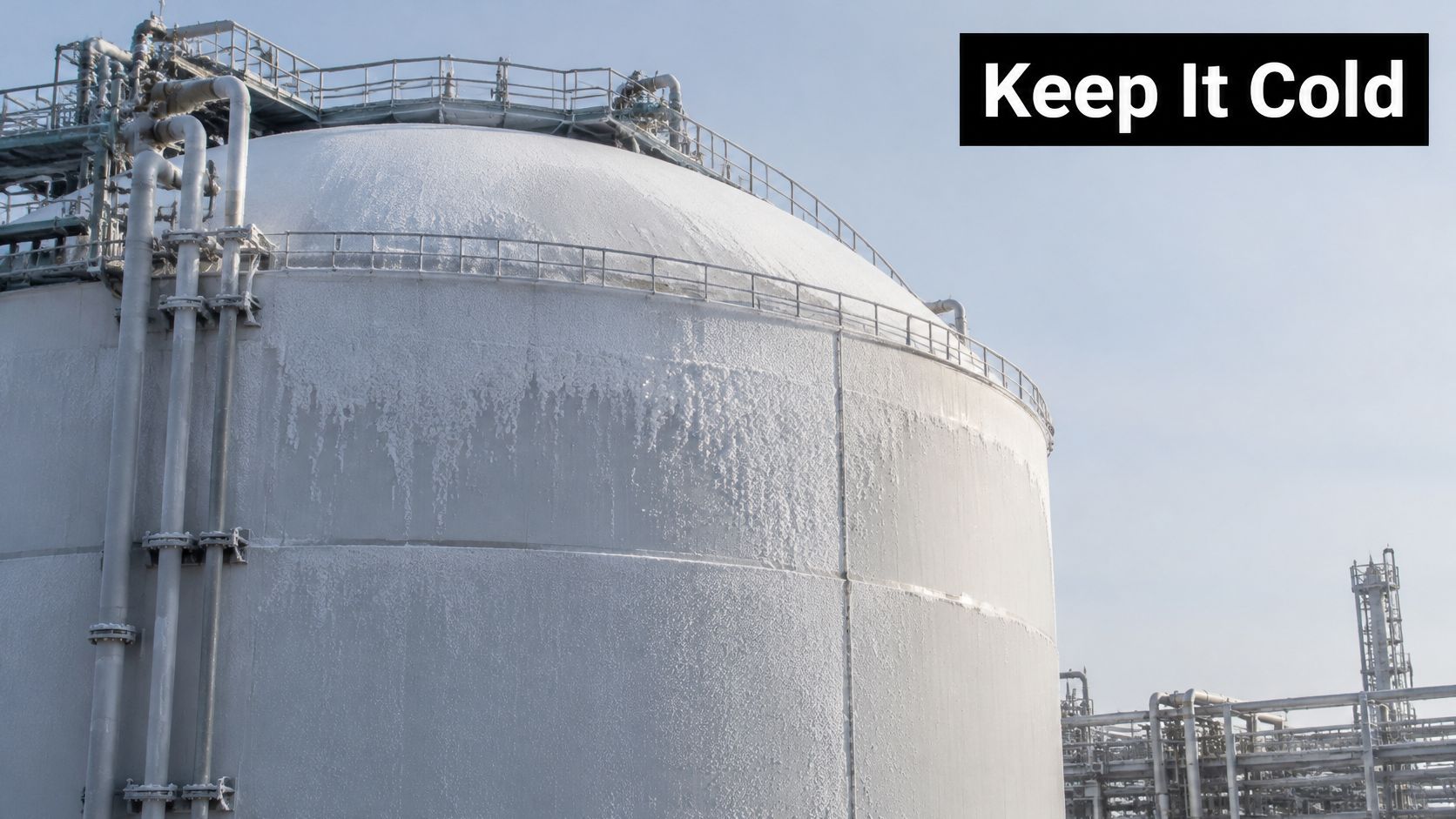
The IFC environmental, health, and safety guidelines for LNG facilities put liquid density at about 420–490 kg/m³. That density is why a mobile tank can cover real demand where a pipeline isn't available. It is also why pressure management can't be an afterthought. Plan around three dwell-time variables: how long the tank waits, how long the transfer takes, and how much gas the site will draw.
Three ways to handle boil-off
- Consume it. Send BOG through the vaporizer with the rest of the gas the site is already using.
- Collect it. IFC guidance recommends a vapor-recovery or compression system sized for the vapor you expect.
- Flare or vent only in an emergency. Those are not routine operating modes.
Size the vaporizer for the peak
The vaporizer is the unpacking step. Liquid goes in, pipeline-quality gas comes out, and an odorizer can put the familiar warning smell back into gas that left the plant without one. For temporary construction, industrial, or backup use, the vaporizer, the pressure-regulation train, and the downstream piping need to cover peak gas demand and the transient flow during unloading. That pairing is what keeps pressure from sagging when a generator starts or a freeze-protection load comes on.
A site with a short unloading window and a hard morning heating peak is the usual trap. If the vaporizer is rated for the day's average, it will be undersized at 7 a.m., right when the boiler and the makeup-air unit start together. Rate it for that peak, then confirm the regulation train can pass the same flow.
A reserve you can count
Before commissioning, check three things: vaporizer rating against peak load, the tank pressure trend over the last day, and the downstream regulators and piping.
Estimate days of autonomy before the next unloading. Take the usable liquid, subtract the liquid lost to boil-off, and divide by the site's average daily gas draw, counting boil-off as part of what leaves the tank.
For example, a tank with 20,000 gallons of usable liquid, a 2,000-gallon daily draw, and 200 gallons of boil-off a day has about 9 days of cover: 20,000 divided by 2,200. That nine-day figure is the number you carry into the replenishment trigger, not a cushion you discover when the gauge is already low.
Site Safety Controls That Prevent Accidents
LNG is odorless in its natural state, so a leak gives you no warning smell. The first release is cold vapor, heavier than air, and it can pool near the ground. That pool is both a fire hazard and an asphyxiation hazard. People expect a gas smell. This liquid doesn't provide one until an odorizer has done its job downstream.
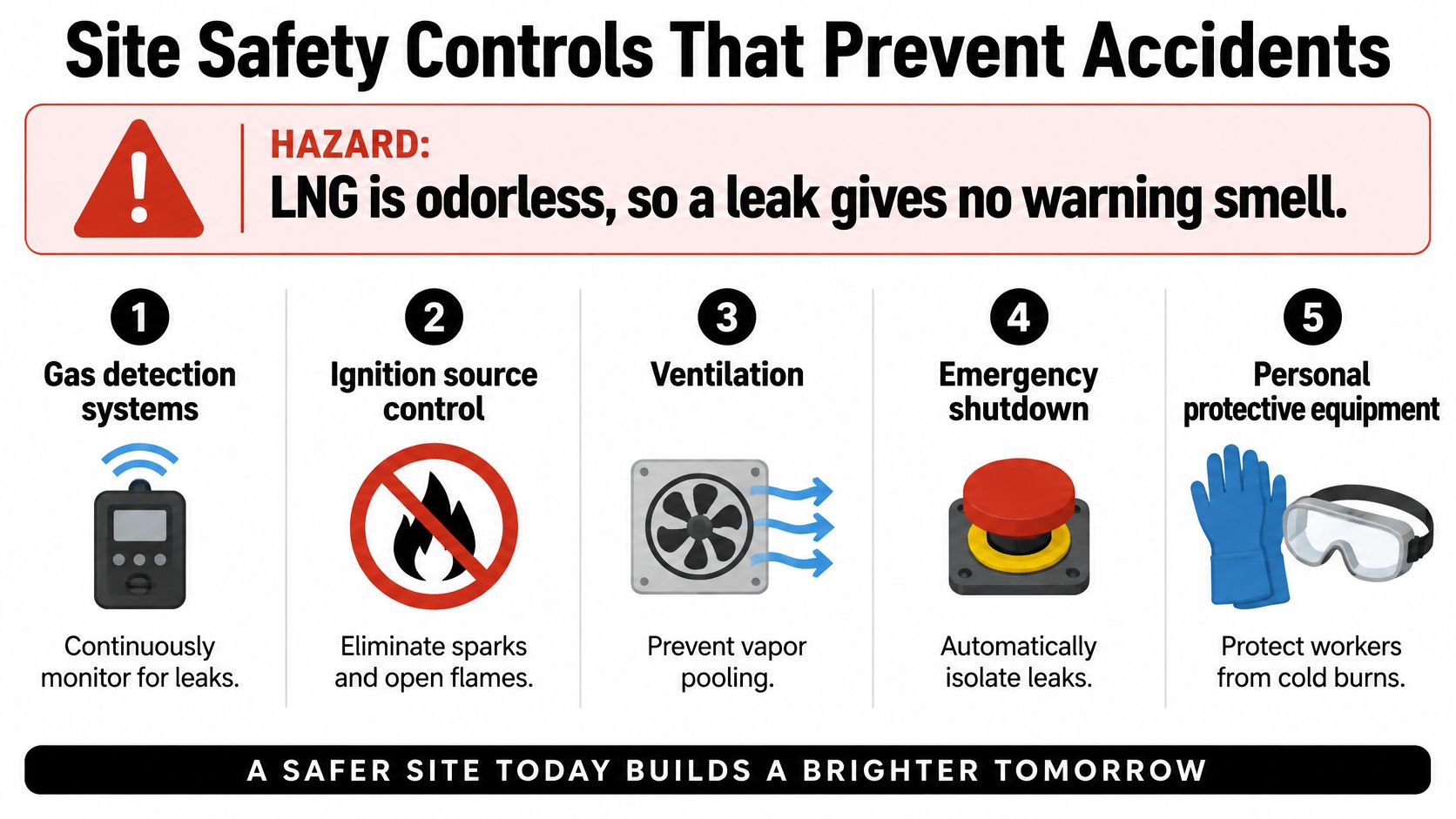
Controls and the reason for each
- Methane detection at low and high points: vapor can hug the ground, then warm and rise, so one sensor height misses a layer.
- Floor- and ceiling-level ventilation where equipment is enclosed: moving air stops a pocket from forming under a skid or inside a manifold shed.
- Ignition control, with bonding and grounding where required: no hot work, no idling engines inside the zone, and a bond so a hose doesn't become a spark path.
- A thermal exclusion zone around containers and transfer systems: it is sized for radiant heat if a fire starts, not for convenience of the laydown yard.
- Clear access to emergency isolation valves: a blocked valve is the same as no valve when a hose fails.
- Hose and coupling inspection before every transfer: look for frost patterns that don't match the flow, damaged threads, and missing gaskets.
- Pressure and level instruments that read correctly: compare the tanker gauge to the tank gauge before you open the valve.
- A cryogenic-burn briefing for everyone on site that day: liquid and cold metal injure skin on contact, including people who are only spotting the truck.
Temporary sites are the hard case. Layouts and traffic change between deliveries, so these controls get re-checked every time, not only at commissioning. A crew office placed upwind of the transfer pad is a different problem from one parked beside the hose. Where people have to work next to the equipment, modular buildings for hazardous work sites keep the occupied space out of the vapor path instead of using a job trailer that was dropped wherever the crane had room.
Walk the pad with the driver and the site lead before a single valve opens. If either person can't point to the isolation valve, the transfer waits.
Pre-transfer sequence: confirm tanker-to-site compatibility, set the exclusion zone, ground and bond, inspect hose and couplings, verify pressure and level, test that detection and ventilation are on, brief the crew on cold-burn hazards, then open the valve with both people still in position to stop.
LNG Versus CNG, Diesel and Pipeline Gas
No single fuel wins every gap. Match the option to distance, load size, whether you can handle cryogenic liquid, and how long the need will last.
| Option | Best Fit | Main Trade-off |
|---|---|---|
| Pipeline gas | Permanent service once the utility line is installed | Waits on utility line installation |
| Mobile LNG | Large loads at sites with no pipeline or during outages | Cryogenic handling and boil-off |
| Temporary CNG | Shorter distances and smaller loads | Less energy per trailer than LNG |
| Diesel generator | Short-term backup power | Fuel cost, emissions and noise |
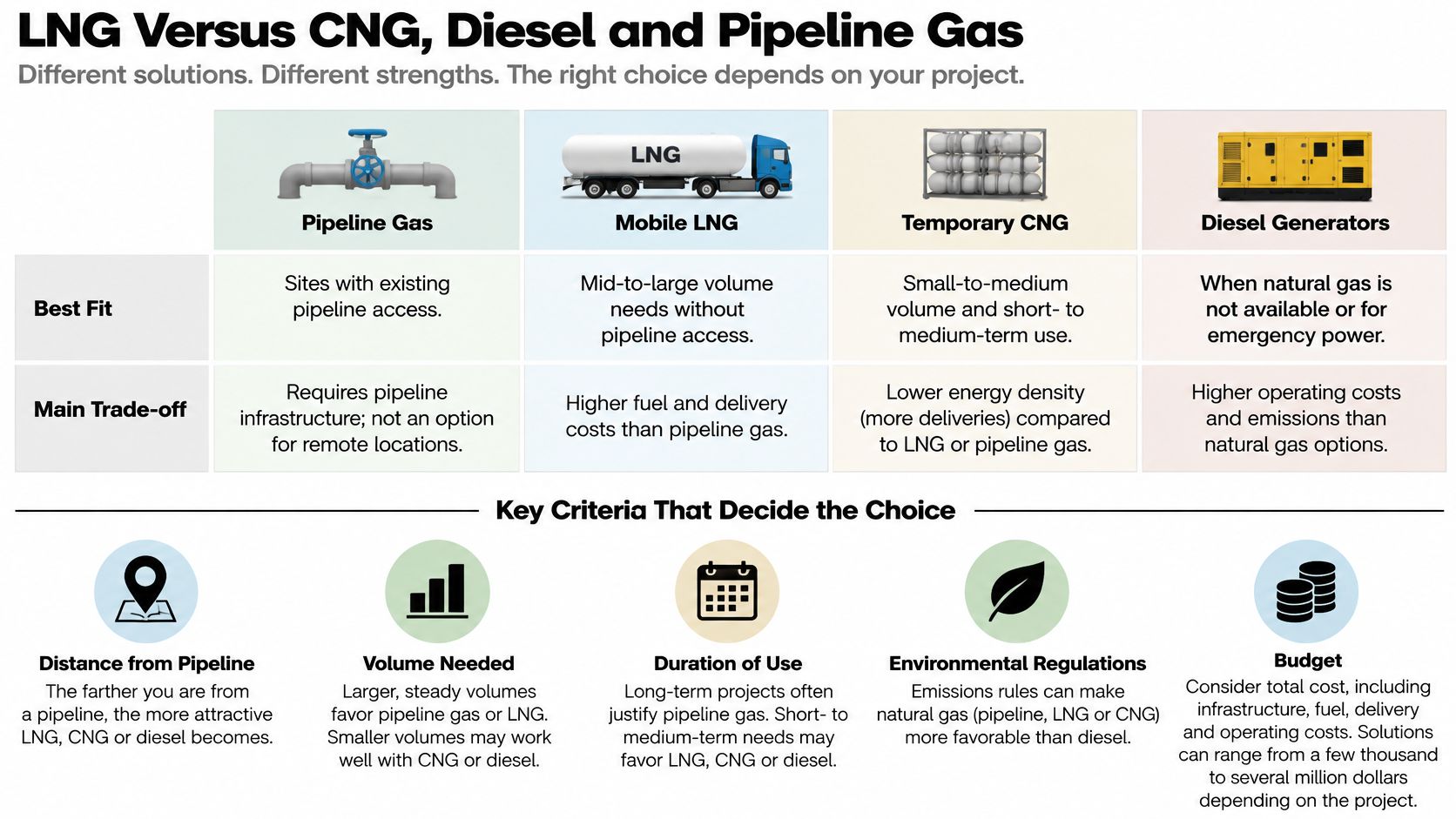
Pipeline gas is the right end state when a main is coming. You wait on the utility's schedule, and you don't take on tanks, vapor, or extra truck trips. Until that line is live, the building still needs another supply.
Mobile LNG fits a large load with no pipeline, or a line that is out for repair. One delivery carries a lot of energy. You accept cryogenic handling, boil-off, and the safety controls that go with them.
Temporary CNG fits a shorter haul and a smaller load. Compressed gas skips cryogenic service. Each trailer holds less energy, so a big boiler will see more truck trips.
A diesel generator fits when the need is electricity for a few days, not gas at the burner. You trade fuel cost, exhaust, and noise for equipment most sites already know how to run.
The emissions the table leaves out
Combustion at the burner is only part of the ledger. Count liquefaction energy, truck miles, transfer losses, methane slip, how boil-off is managed, and how often you unload. The International Energy Agency's Gas Market Report for the first quarter of 2026 forecasts more than 7% global LNG production growth in 2026, or over 40 bcm, with North America responsible for more than 85% of that increase. The same outlook projects roughly 345 bcm per year of additional export capacity from 2025–2030 projects already under construction. Extra nameplate capacity can improve availability. It doesn't tell you the greenhouse-gas intensity of your temporary chain, and sanctions and project limits mean nameplate capacity isn't the same as gas you can really receive.
LNG's energy density can offset trucking emissions when one delivery replaces many trips to a large, distant site. On a short run with a small load, CNG is often the cleaner operations choice because you skip the cryogenic step.
Verdict by situation: use LNG for a long gap at a large site with no pipeline. Use CNG for a short run and a small load. Use a diesel generator when you need backup power, not gas supply.
Run the cost as delivered cost per usable unit of energy. Add the commodity, the trucking, the boil-off you won't burn, and the standby time. A cheap molecule that loses a slice to vapor, plus an extra trip, is not the cheap option.
Plan Your Reserve Days Before the Tanker Arrives
New liquefaction plants do not guarantee a truck on Thursday. Shipping time, a handful of export points, a chokepoint, a full terminal, or thin inventory can all stall a load that looked available on paper.
The International Energy Agency's Gas Market Report for the second quarter of 2026 reported that global LNG trade grew 12% year over year through October–February 2026, yet deliveries fell 10% year over year in the first 20 days of April after Middle Eastern supply disruptions. The same report notes that storage-site deliveries tend to decline once inventories fall below 30% of working capacity. A market that looks well supplied can still leave a jobsite short.
That is a site problem, not a headline. Your nine-day example only helps if the next tanker can arrive before day nine, including a cold snap or a delayed ship.
Four steps before you are thin
- Set minimum reserve days for the critical load. Heat, process gas, and a commissioning boiler don't share one number. Use the load you can't shut off.
- Set a replenishment trigger above that floor. If cover is about nine days, order when you still have those nine days, not when the tank is nearly empty. Lead time during a disruption is longer than the brochure says.
- Confirm dual-fuel readiness on generators or heating, so a late truck doesn't stop the building.
- Agree an escalation path for a delayed line installation or a maintenance outage. Name who calls the utility, who calls the carrier, and who can switch fuels.
A mobile unit can be rented while you wait for a permanent gas line, or where no pipeline exists. We match the size of that unit to the gas capacity and flow speed of the equipment you need to supply, from a small box up through a trailer when the load grows. For a line that's open for repair, vaporized LNG can be injected into the downstream section so customers stay on gas while the pipe is replaced. Utilities use that same pattern for farm taps, municipal construction, and cuts caused by digging.
The sales team can build a custom quote once you can describe the load, how long you need it, and the equipment you have to gas up. Call +1 (919) 238-3426 or email sales@bluegasexpress.com before the reserve, not after the boiler is cold.
Blue Gas Express rents mobile natural gas for buildings and pipelines, including LNG delivery when a line is late, out for maintenance, or not available at all. We size the unit to the equipment you need to run and stay with the job until permanent utility service is ready. Visit Blue Gas Express to talk through your site and ask the sales team for a quote.