

You're standing in a building that's nearly finished. The rooftop units are set, the lights work, and the inspection is booked, but the permanent gas line isn't live yet. Or you're running a plant where an outage would stop production, spoil product, or leave tenants without elevators and heat.
That's the moment a natural gas generator stops being a catalog item and becomes a scheduling problem. You need power you can test, commission and trust, and you need gas arriving at the right pressure for as long as the load runs.
The machine itself is straightforward. The confusion usually starts with fuel. A generator that starts on a calm morning can still struggle during a cold peak, a long runtime, or a delayed utility connection if nobody checked flow, pressure and backup supply first.
How a Natural Gas Generator Turns Gas Into Power
A natural gas generator is an engine-driven set that burns natural gas to turn a shaft, and that shaft turns an alternator to produce electricity. Think of the engine like a gas stove burner that releases heat in a controlled way, except the released energy drives a rotating shaft instead of heating a pan.
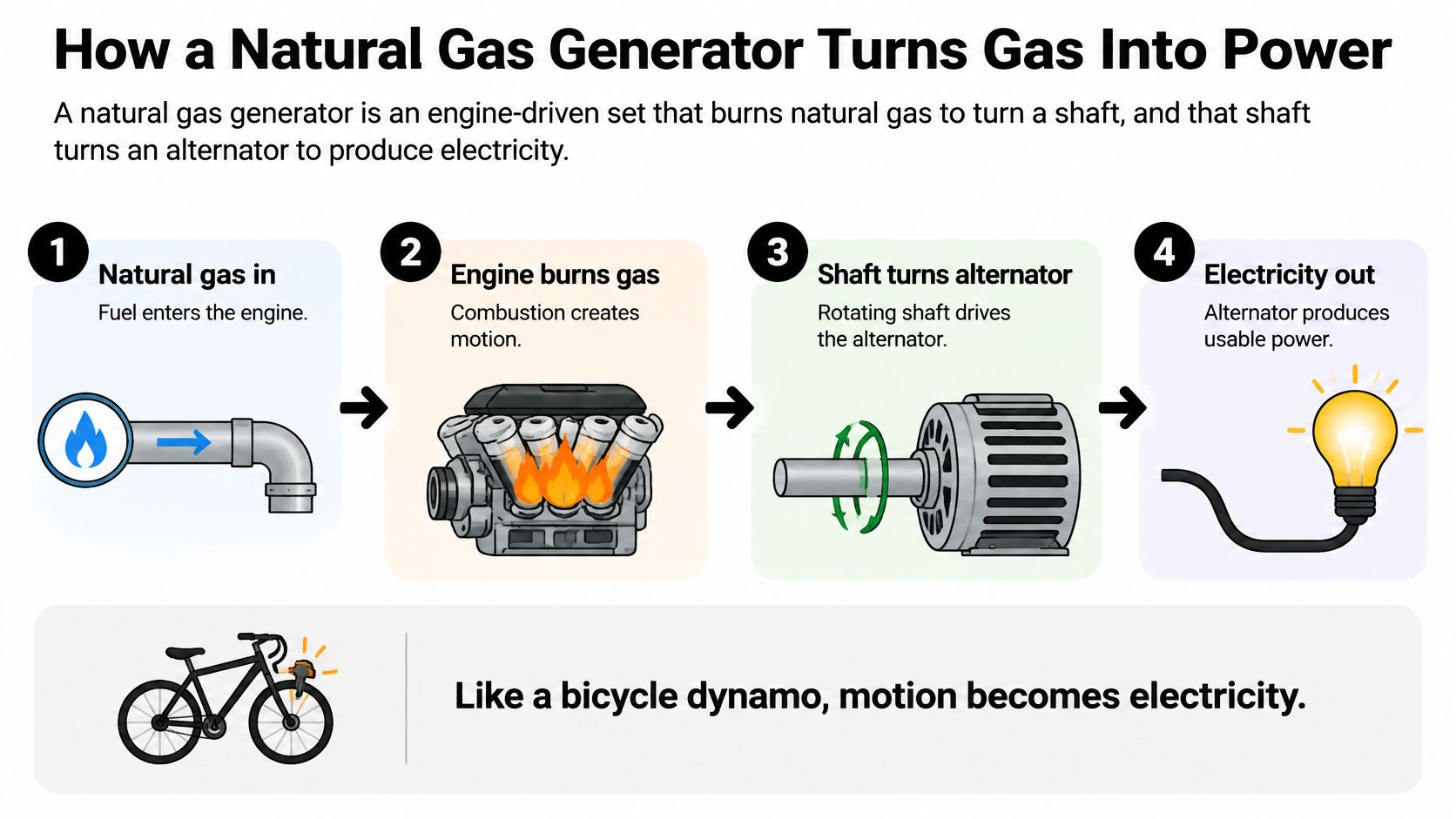
The Five Step Chain
- Regulate the gas: The regulator drops supply line pressure to the level the engine needs. If pressure is too low or swings under load, output drops.
- Mix gas and air: Gas and combustion air mix in a set ratio before entering the combustion chamber. The right ratio keeps combustion stable and complete.
- Make motion: Combustion pushes pistons in a reciprocating engine or spins blades in a turbine. Either way, heat becomes mechanical rotation.
- Turn the alternator: The shaft turns the alternator rotor inside a magnetic field. That motion produces alternating current.
- Hold power steady: Controls hold voltage and frequency steady for the connected load. When load rises, the engine must feed more fuel and air without losing speed.
Engine, Turbine and Combined Cycle
Reciprocating engine sets suit smaller, flexible loads and mobile use because they start quickly and follow changing demand. Gas turbines suit larger output where a steady, high-volume machine makes sense. Combined-cycle plants add a steam turbine that uses exhaust heat, which is why they convert more fuel into electricity.
That efficiency gap shows at utility scale. The U.S. Energy Information Administration review of gas-fired generation reports that combined-cycle units consumed approximately 80% of the natural gas used for electric power generation but produced 85% of all natural-gas-fired electricity in 2019. In that same year, natural-gas-fired generators made up 43% of operating U.S. electricity-generating capacity and produced 39% of total electricity generation.
If you understand the chain, you can spot the failure points. Pressure, air-fuel balance and load all affect whether the shaft keeps turning at the speed the alternator needs.
A small building set and a utility combined-cycle plant aren't the same machine, but they obey the same logic. Gas in, controlled burn, rotation, electricity out. Break any link and the final step suffers.
Pipeline, CNG and LNG Fuel Options Compared
A generator is only as dependable as its fuel arrival. Three arrangements cover most sites, and the table below is the quick lookup for how each one delivers gas, where it fits, and where it can let you down.
Natural gas generator fuel options by site need
| Fuel option | How gas arrives | Best fit | Main limit |
|---|---|---|---|
| Pipeline connection | Utility line through the building meter and regulator | Permanent sites with a working gas line | Output depends on line pressure and capacity during peak demand |
| Compressed natural gas (CNG) | Trailer-delivered gas connected to the site line | Temporary supply during line installation or outages | Depends on delivery and refill scheduling |
| Liquefied natural gas (LNG) | Cryogenic liquid vaporized on site | High-demand periods and sites away from pipelines | Needs vaporization equipment and storage handling |
The Pressure Check People Skip
Gas must reach the generator at the pressure its nameplate specifies. A line can look adequate at idle and sag when the generator loads up alongside rooftop units, boilers or kitchen equipment. That's why meter size, regulator rating and line pressure all need confirming before connection, not after a failed start.
Collect three values before you commit to a setup:
- Required gas flow: The generator's demand in cubic feet per hour at the load you'll run.
- Line pressure at the meter: The pressure available where you'll connect, checked under realistic site demand.
- Regulator rated capacity: Whether the regulator can pass the required flow without choking the engine.
If you're altering building gas lines or adding a connection point, licensed gas work matters for both safety and inspection. For example, you can book gas fitting with Total Plumbing for that type of line work, then confirm the completed installation against the generator nameplate before commissioning.
A pipeline is continuous, which is its strength. It's also shared, which means cold-weather peaks and competing heating demand can expose a weak meter or undersized branch. CNG and LNG don't depend on that street line in the same way, but they depend on delivery schedules, on-site storage and someone watching remaining supply.
Practical rule: Don't ask only whether gas is present. Ask whether enough gas arrives, at the right pressure, for the full runtime.
Before connection, run a simple check. Confirm the flow requirement, verify pressure at the meter, and write down the backup supply plan if the primary source falls short.
Common Commercial and Industrial Uses
Sites don't all need a natural gas generator for the same reason. Grouping uses by the problem you're solving makes sizing and fuel planning much clearer.
Power Before the Permanent Service Is Ready
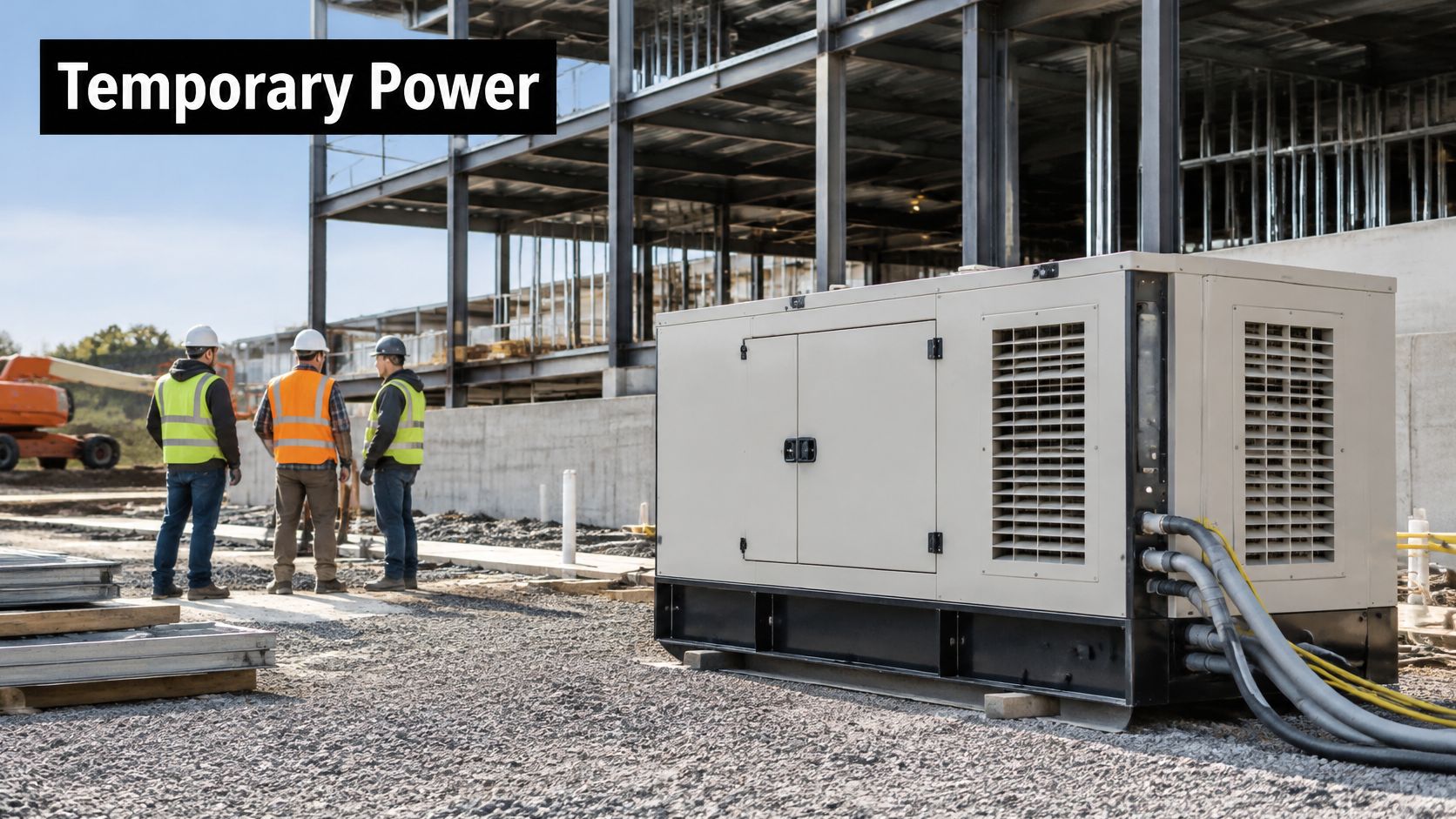
Construction sites often need temporary power while a permanent connection or grid service is pending. Say a warehouse shell is closed in, but the crew still needs lighting, tools and temporary heat to finish interiors. A generator keeps work moving instead of tying the schedule to a utility date nobody on site controls.
Commissioning is a related but different job. A new building can run gas-fired rooftop units, generators and ambient heating before its permanent gas line is connected, so equipment is tested early. A contractor proving a rooftop unit starts, heats and shuts down correctly before the meter is set can fix faults while trades are still mobilized.
Backup, Peak and Heat Duties
Commercial buildings use standby power to support critical loads during outages. This could include life safety systems, refrigeration in a grocery store, or pumps and controls in a multifamily building. The load list is usually short, defined, and essential.
Industrial facilities may run generators during peak demand or when grid supply is constrained. A plant that can't afford a mid-shift stoppage treats generation as production protection, not just emergency equipment. Readers who want regional context on gas-based industry can also consult the CloudOrbis guide to Calgary energy for how energy supply shapes industrial operations.
Freeze prevention and temporary heat round out the list. At sites waiting on utility work, heat protects piping, finishes and stored materials during cold snaps.
These site uses sit on a mature fuel system. The U.S. Energy Information Administration page on U.S. electricity generation reports natural gas supplied about 1,802 billion kilowatt-hours of approximately 4,178 billion kilowatt-hours generated by U.S. utility-scale facilities in 2023, a 43% share. Those figures describe utility-scale generation, not mobile rentals, so use them as evidence of infrastructure and operating experience, not as a promise about one specific set.
Fuel Efficiency and Heat Recovery Explained
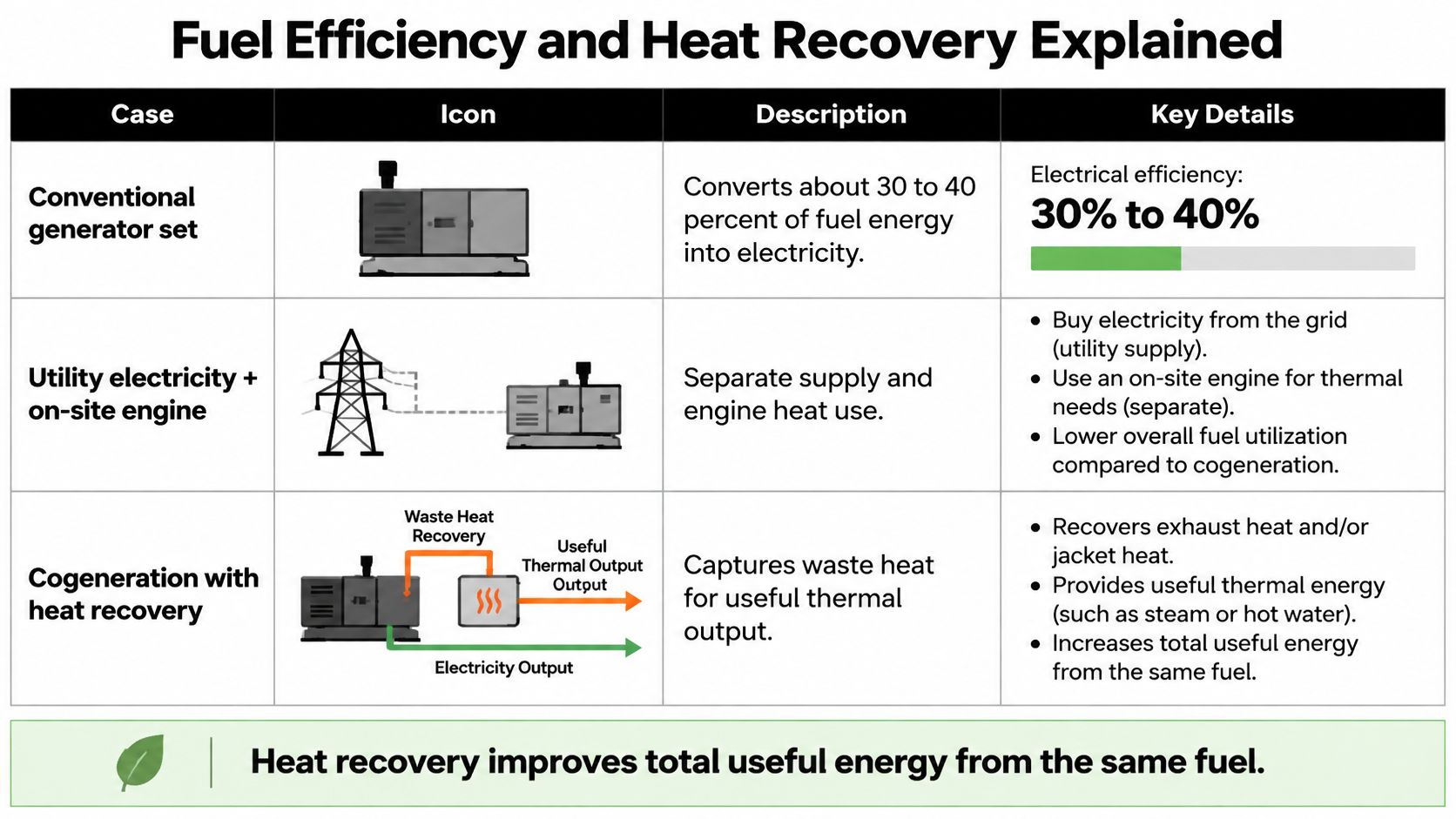
Efficiency claims confuse buyers because a generator can be judged on electricity alone or on electricity plus useful heat. The table separates those cases so you're comparing the same thing.
Fuel-to-useful-energy efficiency by generator configuration
| Configuration | Heat recovered | Total fuel efficiency |
|---|---|---|
| Conventional generator set | No | 30-40% (electricity only) |
| Utility electricity plus on-site boiler | Yes, through the boiler | Approximately 50% |
| Combined heat and power (CHP) | Yes, from exhaust and jacket heat | 75% or higher |
Why Recovered Heat Changes the Math
A conventional set turns only part of the fuel into electricity and rejects the rest as exhaust and jacket heat. A combined heat and power system captures that exhaust and jacket heat and uses it for steam, hot water or process heating. You're not creating extra fuel energy, you're wasting less of it.
The Department of Energy CHP catalog hosted by Oak Ridge National Laboratory reports conventional generator sets convert roughly 30–40% of the fuel's energy into electricity, while CHP can achieve total fuel efficiencies of 75% or higher, compared with approximately 50% for utility electricity combined with an on-site boiler. Facilities pairing continuous electrical and thermal loads, including sites focused on sustainable data center efficiency, get the clearest benefit because both outputs get used.
Who Benefits and Who Doesn't
Plants and large buildings with continuous hot water, steam or process heat gain the most. A site with little heat demand may not realize the advantage at all, because recovered heat only counts when something needs it at that moment.
Size to the electrical and thermal loads that occur at the same time, not just the largest kilowatt rating. Say a winter construction site needs power for tools and lighting while heaters prevent freezing and cure materials. That coincident heat load can justify recovery, while the same site in summer might reject most of it.
Run a short test before you pay for heat recovery. Estimate how many hours per day the site needs useful heat, then check whether that heat load runs alongside the electrical load. If the two rarely overlap, a simpler set may be the honest choice.
Emissions and Permits Before You Commission
Natural gas is often sold as cleaner than diesel. It usually produces lower particulate and nitrogen oxide emissions, but it is not emissions-free, permit-free or climate-neutral. That distinction matters before commissioning, not after an inspector asks for paperwork.
What Comes Out of the Exhaust
The U.S. EPA page on engine exhaust states gas engines and turbines emit conventional pollutants including NOx, SOx, carbon monoxide, and volatile organic compounds, and methane can arise from incomplete combustion, fuel-supply leaks, or equipment malfunctions. So the question isn't whether emissions exist. It's how much, from this machine, under your runtime and fuel arrangement.
Combustion design and tuning drive the numbers. The EPA catalog of CHP technologies for combustion turbines reports gas turbines using lean-premixed, dry-low-NOx combustion can achieve NOx concentrations below 25 parts per million, with laboratory results as low as 9 ppm at 15% oxygen, while reported carbon monoxide concentrations are typically 10–50 ppm. Lean premixing lowers peak flame temperature, which suppresses thermal NOx.
Here's the catch readers miss. The same lean strategy can increase combustion instability or incomplete-combustion CO if air-fuel control is poorly tuned or operating conditions vary. A clean full-load reading doesn't guarantee clean operation at light load, during starts, or when fuel pressure drifts.
Runtime Changes the Permit Picture
Emergency standby is not the same duty as prime or continuous operation. A unit that runs briefly during outages has a different emission load and often different permit thresholds than one running daily for peak demand or temporary prime power. Local air authorities can also impose different thresholds, so a setup accepted in one jurisdiction may need more controls or documentation in another.
Methane deserves separate attention from exhaust CO and NOx. Leaks in the fuel supply, loose connections and malfunctioning equipment can release unburned gas before combustion ever happens. Good commissioning therefore includes leak checks, ventilation checks and a record of who tested what.
Before commissioning, request this document set:
- Emissions data at intended load: Results across the load range you'll run, not only at full load.
- Oxygen-correction basis: The basis used for ppm values, so comparisons are valid.
- Local permit thresholds: Written confirmation for standby versus prime or continuous use.
- Site assessments: Exhaust-stack dispersion, ventilation details and leak detection results.
- Recordkeeping plan: Documentation for NOx, CO, VOC, particulate matter and methane-related risks.
The emissions case for a natural gas generator depends on technology, operating profile, local rules and upstream fuel integrity. Get those four items in writing and the cleaner claim becomes something you can defend.
When Pipeline Gas Is Not Enough and How to Pick a Fuel Setup
A generator can start normally on pipeline gas and still fail later. Pressure can fall as neighborhood heating demand climbs, a constrained pipeline can limit flow, or the utility can prioritize residential heating during severe weather. The engine doesn't care why gas stopped arriving at its regulator. It just loses power.
Reliability depends on pipeline capacity, line pressure, weather, transportation rights and competing heating demand. Treating the gas utility as an unlimited fuel tank is the most common planning error with a natural gas generator.
Evidence That Pipeline Supply Is Conditional
The NERC 2025 board input letter package identified natural-gas supply and transportation risk, coordination between gas and electric markets, and generator winterization as major reliability risks in 2025. It also cites a 2025 Northeast study that found most gas-fired generators in New York and New England lacked firm gas-transportation entitlements, and under the study's most disruptive scenarios approximately 3,600 MW of generation in New York City and 1,000 MW on Long Island could lose gas service.
Your building set isn't a regional power plant, but the lesson scales down cleanly. If your supply is interruptible, undersized or exposed to winter peaks, resilience isn't built into the connection. You have to plan it.
A standby generator with an unexamined gas supply is a hope, not a backup plan.
The Six Step Decision Sequence
Run these steps on any construction site, commercial building or industrial facility before you pick equipment:
- Confirm load and duration: List the electrical load, any thermal load, and the hours per day each runs. A two-hour commissioning test and a three-day outage need different fuel plans.
- Check flow and pressure: Read required gas flow from the generator nameplate and check line pressure at the meter under load. Confirm the regulator can deliver both together.
- Define the duty: Decide whether the unit is standby or continuous. Permits, emissions documentation and maintenance expectations differ with runtime.
- Match the fuel: Choose pipeline gas for a stable permanent supply, CNG for temporary supply, or LNG for high-demand or remote periods. Match storage and refill timing to your longest credible runtime.
- Collect emissions documents: Gather load-range emissions data, confirm local permit thresholds, and verify leak detection, ventilation and exhaust dispersion. Do this before the unit is on the pad.
- Set switch triggers: Define the pressure drop, remaining fuel level, weather forecast or utility notice that triggers a move to backup fuel. Assign a named person to make that call.
Pay special attention to step 6. Many sites buy redundancy and then lose time deciding when to use it. A trigger written in advance turns a debate during an outage into a simple execution step.
Winter exposure deserves its own line in your notes. If the generator must run during the same cold snap that's driving heating demand across the area, test your assumptions against that day, not against an average day. Ask the utility what happens to your class of service during curtailment and whether firm transportation is available or needed.
For sites where pipeline gas isn't sufficient, temporary mobile supply fills the gap. Blue Gas Express rents mobile natural gas for buildings and pipelines, providing it while customers wait for a permanent gas line or in areas not served by gas pipelines, with temporary equipment in many sizes from small boxes and 16ft trailers to semi truck loads. That range lets the fuel setup match the flow your generator needs instead of forcing one fixed package.
Your next action is specific. Bring the six answers to a provider and request a written fuel plan before the commissioning date. If the plan doesn't name flow, pressure, runtime, permits and switch triggers, it isn't finished yet.
If your generator, rooftop units or temporary heat are ready before the permanent gas line is, we can supply mobile CNG and LNG that connects to your building meter or regulator and keeps commissioning and occupancy on schedule. Tell us your required flow, pressure and runtime, and we'll size a temporary gas setup to match. Visit Blue Gas Express to start that fuel plan today.