

The most common advice about LNG vs propane is to compare the price per gallon and pick the cheaper fuel. That can lead to the wrong choice: the fuels are quoted in different units, and the site's actual cost depends on the energy it receives, peak hourly demand, delivery logistics, and equipment requirements.
The more useful comparison starts with two questions: How many Btu must the site receive during its peak hour, and what will each fuel cost per delivered Btu? Those measures reveal trade-offs a gallon-price comparison hides.
LNG and Propane at a Glance
LNG is purified natural gas, primarily methane, chilled to about −260°F until it becomes a liquid. Propane is a liquefied petroleum gas, or LPG, composed primarily of propane and related hydrocarbons, stored as a liquid under pressure at ordinary temperatures.
| Property | LNG | Propane |
|---|---|---|
| Composition | Purified methane | Propane and related hydrocarbons (LPG) |
| Storage state | Cryogenic liquid at about −260°F | Pressurized liquid at ambient temperature |
| Energy per US liquid gallon | About 80,000 Btu | About 91,500 Btu |
| Liquid-to-vapor volume ratio | About 1/600 | About 1/270 |
| Vessel type | Vacuum-insulated cryogenic tanks | Pressure-rated tanks and cylinders |
| Unit of sale | Mass, liquid volume, or energy equivalent | Gallons, pounds, or cylinders |
| Burner compatibility | Not interchangeable with propane | Not interchangeable with LNG |
The energy figures are approximate planning values, not a substitute for the fuel specification on a quote. The U.S. Department of Energy's Alternative Fuels Data Center fuel-comparison chart reports that 5.37 pounds of LNG contain the energy of one gasoline-gallon equivalent, while propane provides 73% of the energy in one gasoline gallon. That comparison is useful for understanding relative energy content, but it doesn't establish the exact heating value of every delivered LNG supply.
The two fuels are not drop-in substitutes, so any switch requires equipment checks.
How to read the table
The table answers the first question, what distinguishes the fuels at a glance. The following sections explain what the differences mean for energy, logistics, cost, safety, and site choice.
The storage methods point to the broad operational roles. LNG can serve high-volume natural-gas loads where cryogenic equipment and delivery make sense. Propane's pressurized tanks and cylinders can suit dispersed, smaller, and backup loads where a simpler storage arrangement is valuable. Neither description alone determines the better fit: the site's peak demand and supply conditions do.
Energy Density and What It Means for Sizing
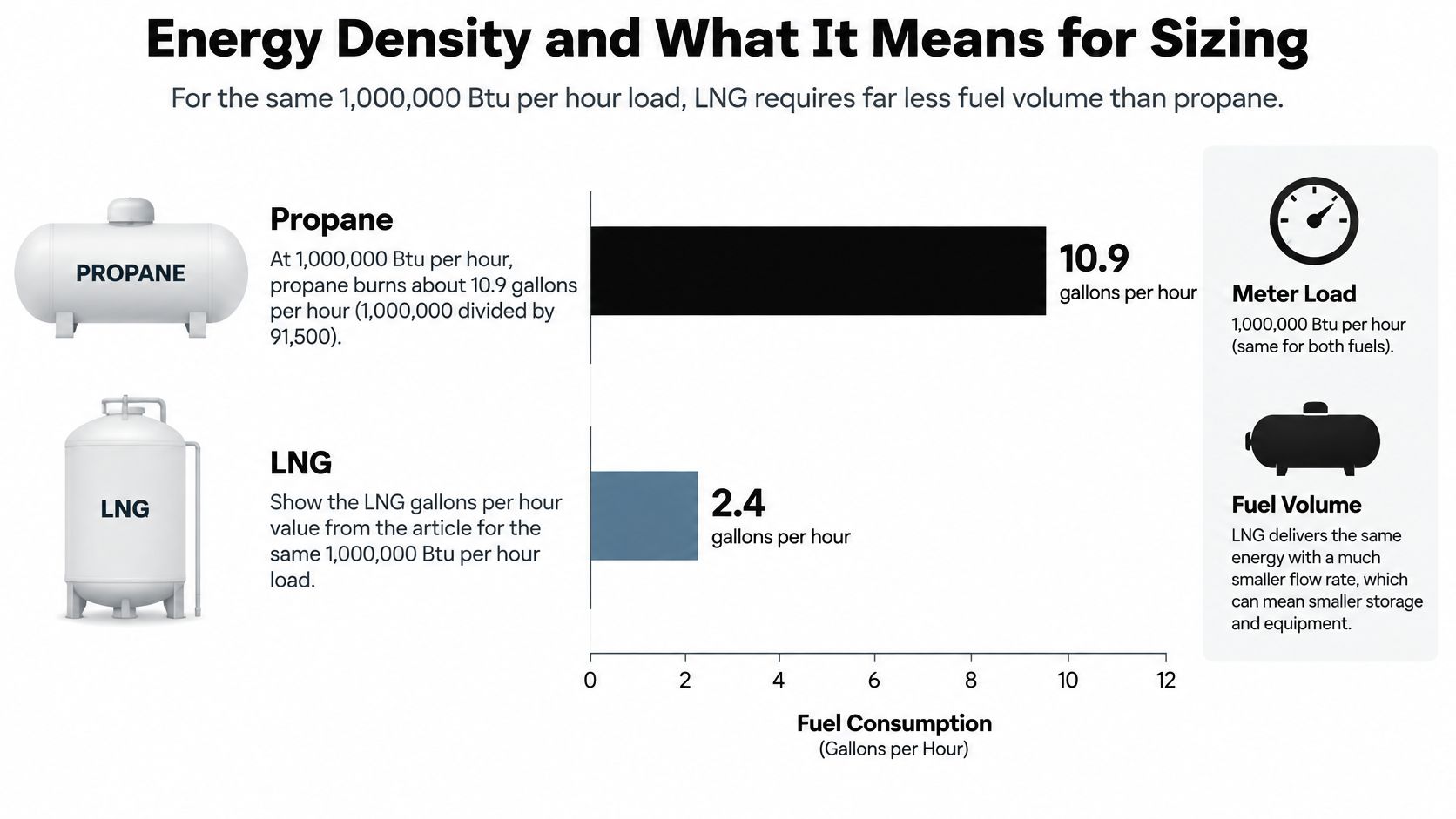
For a peak load of 1,000,000 Btu per hour, the approximate fuel volumes are 10.9 US gallons of propane per hour and 12.5 US gallons of LNG per hour. The calculation divides the hourly demand by each fuel's approximate energy content per gallon. At these assumptions, LNG requires more liquid gallons to supply the same hourly energy.
| Fuel | Energy per US gallon | Gallons per hour at peak |
|---|---|---|
| Propane | About 91,500 Btu | About 10.9 |
| LNG | About 80,000 Btu | About 12.5 |
These figures compare liquid gallons under specific approximate Btu-per-gallon assumptions. LNG's storage advantage is different: liquefaction reduces natural gas to a fraction of its gaseous volume, supporting transport and storage where pipeline supply is unavailable.
Make the units comparable
The Alternative Fuels Data Center's fuel-properties information states that 5.37 pounds of LNG have the same energy as one gasoline-gallon equivalent, while propane provides 73% of the energy in one gasoline-gallon equivalent. That corresponds to about 1.37 gallons of propane for the same energy as one gasoline-gallon equivalent.
A gallon alone does not establish how much useful energy a fuel delivers. LNG may be quoted by mass, liquid volume, or energy equivalent, so compare delivered cost per Btu or MMBtu using the heating value on the quote. The per-gallon figures above are planning estimates, not a substitute for that specification.
Sizing rule: Size supply around peak burner demand, not average consumption or nominal tank capacity. A system that covers average daily use may still fall short during a short period of high demand.
Peak hourly burn rate therefore affects both fuel quantity and the supply system's required delivery capacity. Convert the available quantity of each fuel to energy-equivalent units, then compare it with the equipment's peak demand.
Storage, Transport and Delivery Requirements
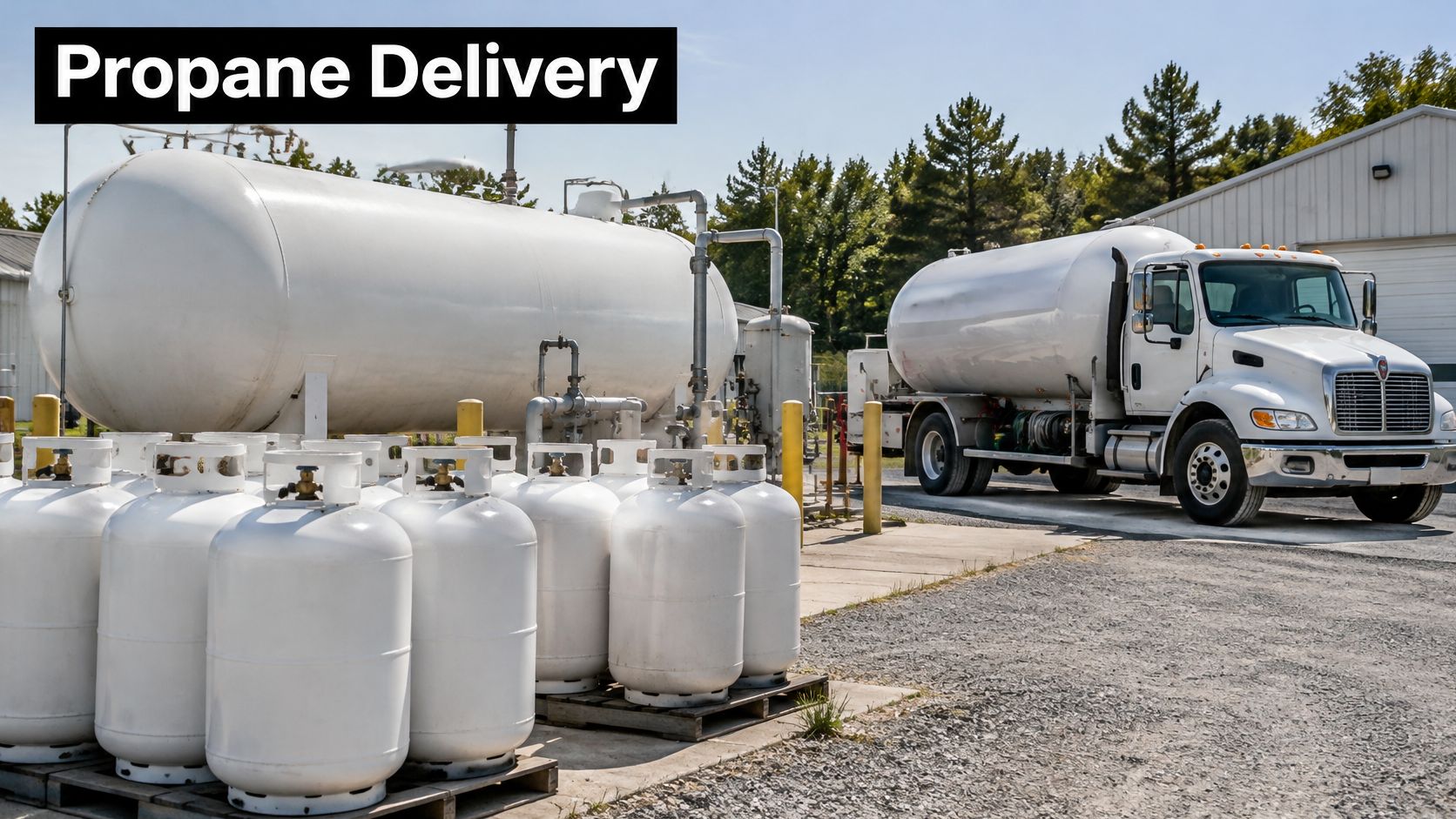
Propane has a distributed supply chain built around pressure-rated tanks and cylinders. It can be stored as a pressurized liquid without cryogenic refrigeration, then replenished by delivery trucks or through established supply networks. That arrangement can work well for dispersed residential, commercial, agricultural, and backup demand.
LNG requires a different chain: natural gas must be liquefied, transported in cryogenic equipment, stored in insulated tanks, and vaporized before it enters an appliance line. The U.S. Energy Information Administration's description of LNG infrastructure explains that LNG's extremely low temperature calls for specialized vacuum-insulated storage vessels. Its equipment and logistics can be justified when the site needs substantial gas volumes or pipeline service is unavailable, delayed, or interrupted.
Plan the whole supply chain
For an LNG installation, containers, vaporizers, odorizers, large regulators, and pipeline sections must work together as one system. Blue Gas Express provides those components as a complete LNG system. The vaporizer's capacity matters as much as the storage vessel: fuel must be converted to gas at a rate that can meet the site's peak flow.
Both fuels need replenishment on a schedule tied to consumption. Remote level monitoring can estimate when a mobile unit will run low, allowing a replacement to arrive before the supply is exhausted. A delivery plan should account for the busiest operating period, not just a typical day.
Use this checklist when arranging a temporary supply:
- Placement and clearances: Confirm where the tank or container can sit and what space must remain around it.
- Truck access: Check the delivery route, turning room, and ability to reach the connection point.
- Peak-load delivery frequency: Estimate how often fuel must arrive during the highest-use period.
- Vaporizer capacity: Compare the equipment's vaporization rate with the site's peak gas flow.
- Interruption response: Agree on what happens if a delivery is delayed or the supply is interrupted.
Cost Factors Beyond the Price per Gallon
A headline fuel price can look decisive while comparing unlike things. In December 2023, Japanese-Korean LNG was priced at $11.52 per MMBtu, while U.S. residential propane reached $2.47 per gallon during the week of December 25, according to the Federal Reserve Bank of Dallas energy indicators. Those prices describe different markets and units, so they shouldn't be treated as competing site quotes without conversion.
Using the approximate propane energy value in the earlier table, $2.47 per gallon works out to roughly $27 per MMBtu for fuel alone. That arithmetic gives a common unit for comparison, but the result still doesn't make the market prices equivalent: one is a Japanese-Korean LNG price and the other is a U.S. residential propane price. A project decision needs delivered quotes for the actual location and load.
| Cost factor | LNG | Propane | Check before ordering |
|---|---|---|---|
| Price basis | Often quoted per MMBtu or unit mass | Often quoted per gallon | Convert both to delivered cost per Btu |
| Delivery | Cryogenic tanker deliveries; frequency depends on distance | Pressure-rated truck or cylinder deliveries | Ask for delivery frequency at peak load |
| Equipment | Containers, vaporizers, regulators, and odorizers | Tanks or cylinders with regulators | Compare the full installed system cost |
| Load size | Suited to high, sustained gas throughput | Practical for smaller loads | Match the fuel to peak burner demand |
| Boil-off and vapor control | Managed in cryogenic storage | Managed through vapor-space controls | Include in operating cost |
Build a delivered-cost comparison
LNG can replace propane, diesel, and fuel oil for industrial users, particularly where the operation needs a large, sustained gas supply. That doesn't make LNG automatically cheaper. The installed equipment, delivery distance, vaporization capacity, and continuity of supply can all affect what the site pays to receive usable energy.
Use the same calculation for each quote:
Delivered cost per Btu = (fuel cost + delivery + equipment rental + vaporization and losses) ÷ energy delivered over the contract.
Ask each supplier to state the fuel's heating value, the quantity included, delivery charges, equipment charges, and any costs associated with vaporization or fuel loss. Then compare the resulting cost per Btu alongside operational fit. A lower fuel-only price can be outweighed by equipment or delivery costs, while a higher quote may support a load or delivery pattern the alternative can't reliably meet.
Safety and Equipment Compatibility Checks
The fuel label alone does not determine whether a burner can use a gas safely. Burner heat input depends on fuel properties and the opening through which gas flows. A representative LNG stream has a Wobbe index of about 52.8 MJ/Sm³ (1,417 BTU/scf), compared with about 74.8 MJ/Sm³ (2,008 BTU/scf) for propane, roughly 42% higher. The Wobbe index reference explains how the measure estimates heat input through a fixed orifice. Because LNG composition varies by source, request the delivered gas's certified heating value and Wobbe range.
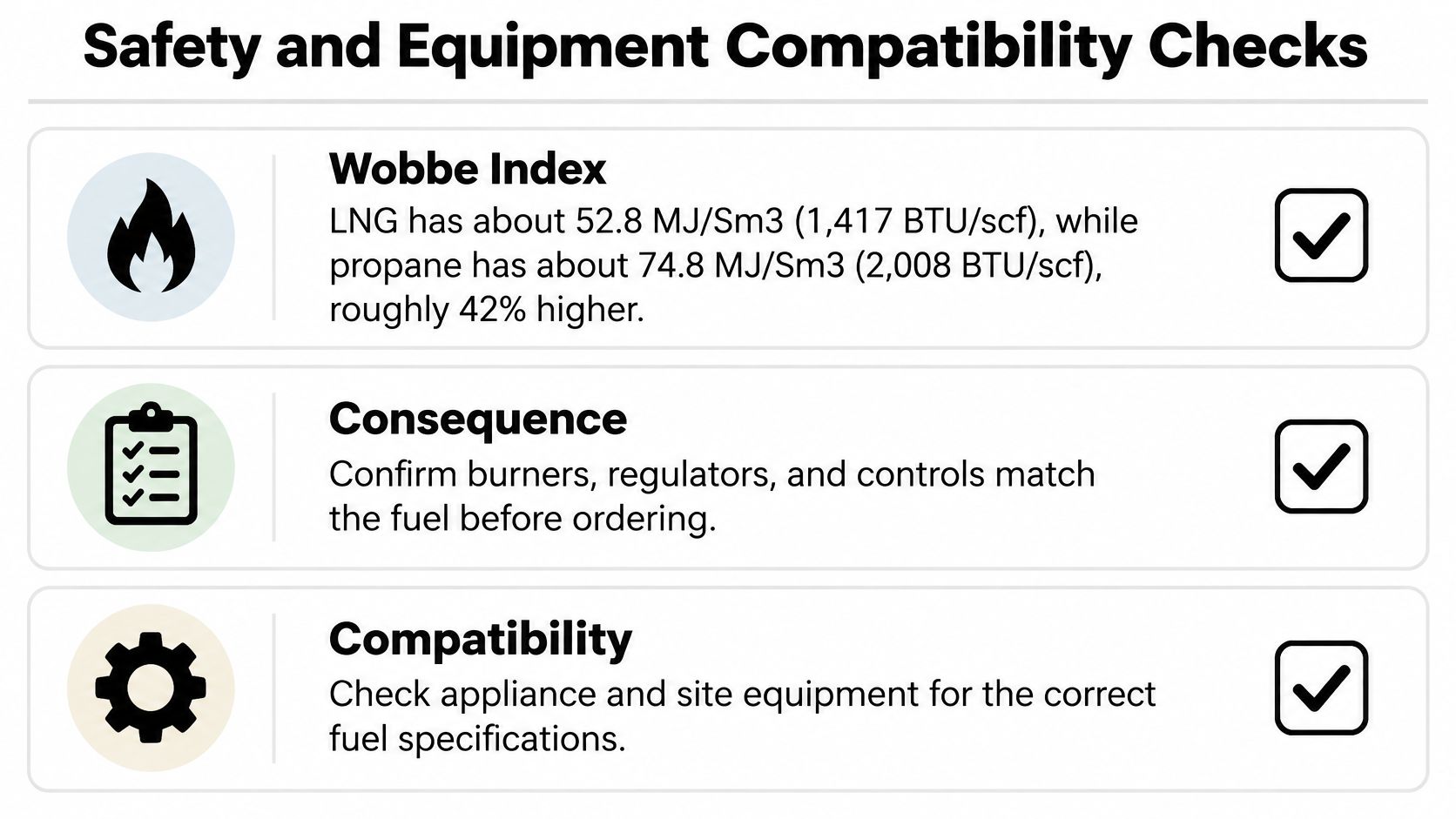
Verify these items before commissioning
Use this checklist with the supplier, equipment contractor, or commissioning team:
- Appliance certification: Confirm each burner or appliance is approved for the fuel being delivered.
- Regulator capacity: Check that regulators can maintain the required flow and outlet pressure at peak demand.
- Orifice sizing: Verify that burner openings match the specified fuel and appliance configuration.
- Manifold pressure: Confirm the required pressure at the equipment, not only at the tank or vaporizer.
- Combustion controls: Check that controls and commissioning settings suit the fuel specifications.
- Delivered-gas properties: Obtain the certified heating value and Wobbe range for the specific LNG supply.
Inspect existing equipment before changing its fuel system. Furnace diagnostics can identify problems with a furnace, burner, or heating system, but an equipment inspection does not establish fuel compatibility. The fuel review must still cover certification, pressure, and combustion settings.
LNG is stored near −260°F, so handling it requires cryogenic precautions. Contact with the liquid or cold equipment can cause severe cold injury. Review transfer procedures and control access to transfer points and vent areas before delivery and commissioning.
Choosing the Fuel and Confirming the Order
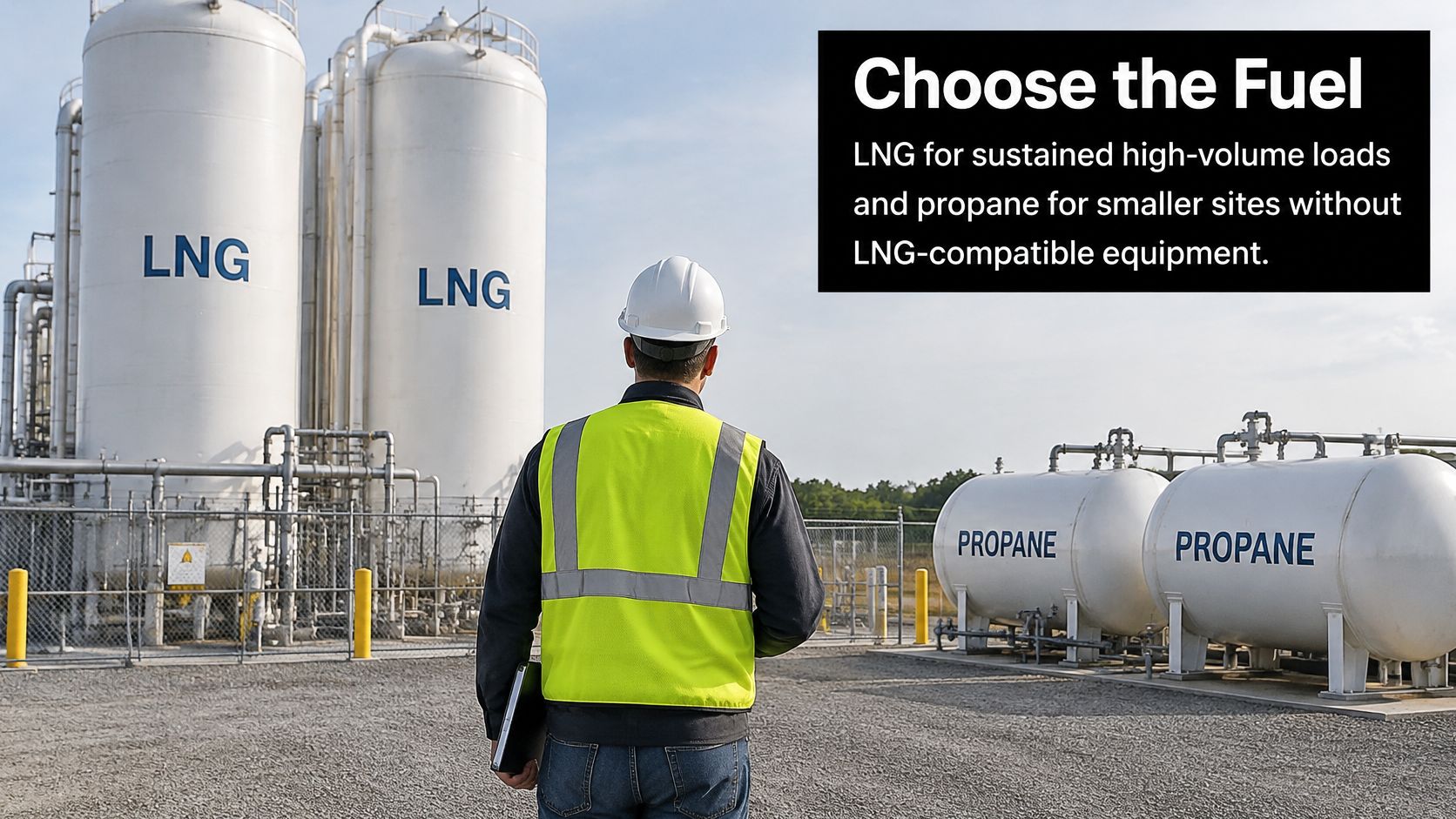
LNG suits sustained, high-volume natural-gas loads when the site can justify insulated cryogenic equipment. Propane is often the simpler fit for smaller loads, remote locations, or sites without LNG-compatible vaporizers. A supplier's ability to deliver fuel matters, but so do the site's peak flow, run duration, access, and equipment.
| Site situation | Better fit | Reason |
|---|---|---|
| Temporary heat for a building waiting on a permanent line | LNG when gas throughput is high | Pipeline-scale demand can justify cryogenic supply |
| Small heating or freeze-protection load | Propane | Pressurized storage and simpler equipment |
| Generator commissioning or model-home gas | Either, matched to peak flow | Size the unit to the appliance capacity |
| Industrial boilers or process heat | LNG | Suited to large, sustained gas volume |
| Remote site with no pipeline and a short run | Propane | No cryogenic delivery system is needed |
| Gas supplement during a main-line outage | LNG | Vaporized LNG can feed the downstream pipeline section |
Neither fuel is the right answer where pipeline service already reaches the site and can meet the required load. Temporary fuel makes sense when it bridges a service delay, supports a remote location, or keeps operations running through an interruption. LNG can also supplement gas shortages during periods of high consumption or when pipeline flow is disrupted.
Confirm the order in sequence
Before committing to a delivery or rental, work through these checks:
- Record peak load and run time. Write down the combined appliance demand in Btu per hour and how long the equipment is expected to operate. A short commissioning run and a continuous industrial process call for different supply plans.
- Check distance and access. Note the fuel source's distance from the site, delivery-vehicle access, and any constraints on container placement.
- Normalize the quotes. Convert each offer to delivered cost per Btu using the cost calculation above, including delivery and equipment charges.
- Confirm fuel properties in writing. Obtain the delivered gas's certified heating value and Wobbe range, then confirm appliance compatibility with the contractor.
- Size to flow, not tank volume. Match the mobile unit to the equipment's gas capacity and flow rate. Blue Gas Express sizes mobile gas units to the capacity and flow speed of the equipment being supplied.
- Set the replenishment and interruption plan. Agree on replacement timing and what the site will do if a delivery or supply route is interrupted.
For temporary natural-gas service, Blue Gas Express rents mobile supply for buildings and pipelines while customers wait for a permanent gas line or where pipeline service isn't available. Choose LNG when peak load and run duration justify cryogenic equipment; otherwise, choose propane, then verify the decision against the actual site conditions.
For a temporary natural-gas supply, Blue Gas Express provides mobile gas units and LNG systems that can support buildings, equipment, or pipeline work while permanent service is delayed or interrupted. Share your peak hourly demand, expected run time, and site access details with Blue Gas Express to discuss a system sized to the project.