

Residential natural gas line installation typically costs US$500 to US$2,000, with an average of US$800 for a 25-foot line to a furnace. A site survey sets the final price, because route, trenching, and meter location can move your job well above or below that average.
That installed price is only half the budget question. If gas isn't available when you need to commission equipment, heat a building, or pass a final inspection, waiting can cost more than the pipe. I'd budget both numbers from the start, the connection itself and the daily cost if that connection slips.
Typical Natural Gas Line Installation Cost Ranges
A useful early budget starts with a range, not a single figure. For 2025, Fixr's residential gas-line estimate puts installation at US$500 to US$2,000, with an average of US$800 for a 25-foot line to a furnace.
Scope explains the spread. A short branch from accessible existing piping may fall near the lower end. A new service from the street main can involve excavation, a riser, a meter set, and surface repair, pushing costs higher.
Three Benchmarks and What Each One Tells You
| Benchmark | What it covers | Figure |
|---|---|---|
| Fixr 2025 residential estimate | Typical residential gas line installation | US$500 to US$2,000 (average US$800 for a 25-foot line to a furnace) |
| ENSTAR (Alaska) 2025 proposed service-line fee | Basic installation fee for piping under two inches, per service line | US$1,082, up from US$985 |
These figures describe different scopes. The Fixr range is a residential planning reference. ENSTAR's proposed fee applies to a defined utility service-line installation, not necessarily to private trenching, interior piping, or restoration.
ENSTAR's 2025 filing notice from the Regulatory Commission of Alaska proposed raising its basic service-line installation fee for piping under two inches from US$985 to US$1,082 per service line. Use it as a market-specific reference, not as a forecast of your full project cost.
How to Budget Before You Have a Site Quote
Match the planning range to the work. An accessible appliance run is different from a buried service or a utility extension.
- Short interior run: Use the average as a starting point when existing piping is accessible.
- New buried service: Allow for costs above the basic installation range if excavation and restoration are needed.
- Utility extension required: Treat published estimates as provisional until the utility prices the route.
If you're hiring for house-side work, gas piping services for homeowners can help clarify what a contractor's scope may include. Compare that work separately from utility charges so neither is omitted from the budget.
A site survey sets the final number. Until the route, meter position, and surface work are priced, treat any estimate as a planning range.
What Makes Up the Installation Invoice
A useful quote separates the work into costs you can check. A residential installation may include service-line construction, meter and connection fees, internal piping, pressure testing, permits, surface restoration, and temporary gas if the permanent connection is delayed. Treat each as a separate line item so you can see what the price covers and compare bids on the same basis.
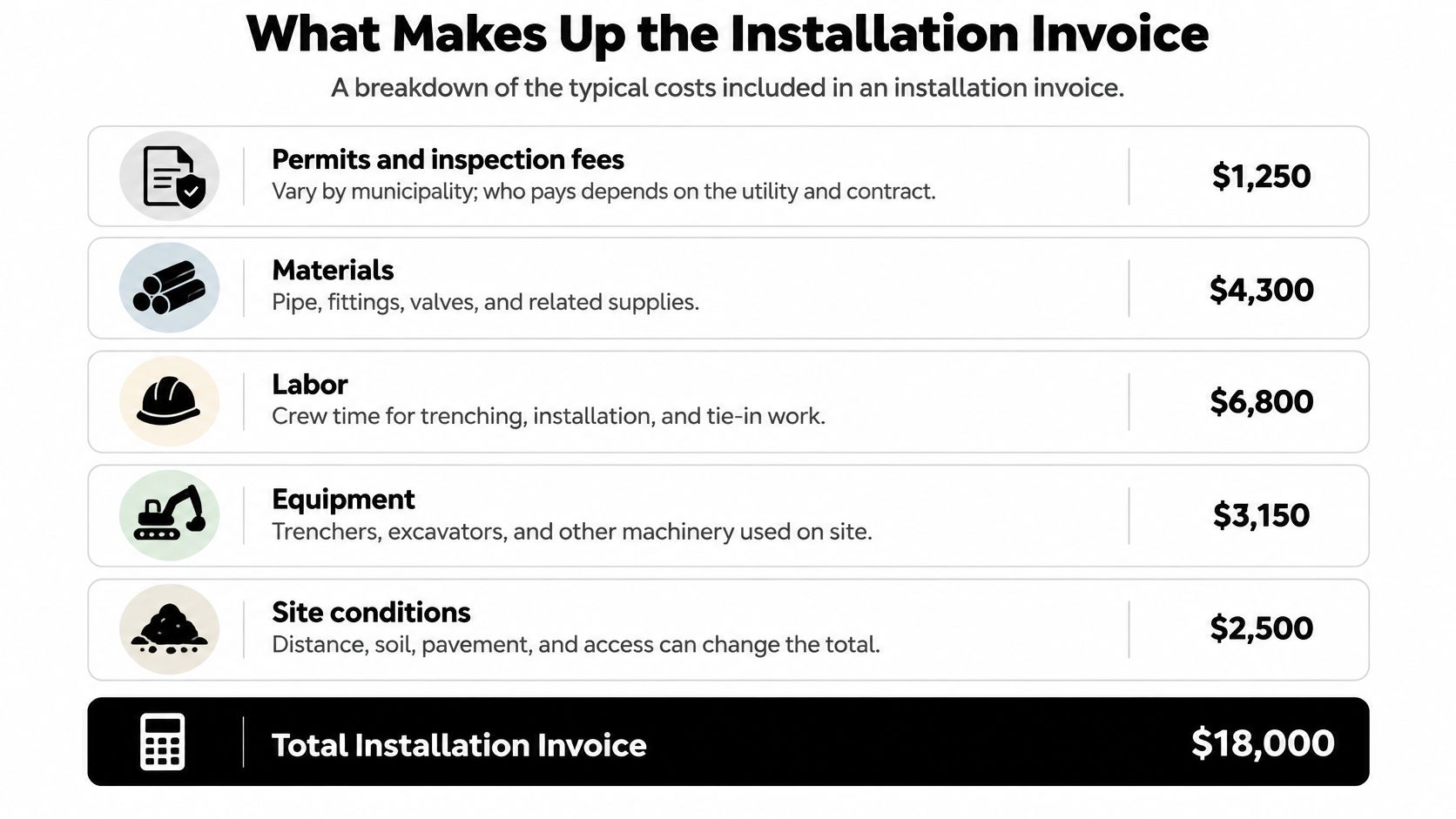
The Seven Lines to Check
Permits and inspection fees vary by municipality, and responsibility depends on the utility and contract. Ask who pulls the permit, schedules inspections, and pays for a reinspection if the first visit fails. A failed pressure test can add both a fee and a day to the schedule.
Materials include steel or plastic pipe, fittings, valves, tracer wire for buried plastic pipe, and the riser where the line exits the ground. Ask for the pipe size and material, not just the footage. The pipe must be sized for the building's gas demand; an undersized line can require costly correction.
Labor covers pipe joining, pressure testing, trenching support, and coordination for the meter set. A quote should state how many site visits it includes. Crew time, supervision, and return trips can outweigh the pipe cost, so understanding labor and overhead cost modeling helps clarify what a labor allowance covers.
Where the Surprises Usually Hide
Excavation and restoration can vary sharply with the surface and trench conditions. Saw-cutting asphalt, breaking concrete, shoring a trench, hauling spoils, backfilling, and repaving all add work beyond laying pipe in open soil. Ask whether the price includes finished restoration or only a temporary patch.
- Meter and regulator: Confirm who supplies and sets the meter, and whether the connection fee is separate.
- Service lateral: Confirm the measured distance from the main to the building and how that work is priced.
- Internal piping: Confirm which appliance runs, shutoff valves, and final connections are included.
- Pressure testing: Confirm the test is included and who pays to correct a failed test.
A short interior branch and a subdivision-scale distribution extension require different scopes. Make sure the quote identifies which work belongs to the utility and which belongs to the contractor.
For commercial and multi-unit projects, include temporary gas during a delay in the schedule budget. Compare its rental and service cost with idle crews, postponed occupancy, or delayed generator commissioning. Blue Gas Express provides temporary natural gas while customers wait for a permanent line or where pipeline service is unavailable. A temporary supply can be the lower-cost route when it protects an occupancy or commissioning date, but the site requirements and duration determine the final comparison.
The pipe itself may be a smaller part of the surprise than excavation, restoration, or a return visit.
Ask each bidder to price the same scope and identify exclusions. That makes it easier to compare the total invoice, not just the headline figure.
How Route, Scale and Region Shift the Price
The same service-line length can produce very different bills. Utilities may bundle some standard residential connection work, while charging separately for longer runs, engineering, or meter connection. Check the utility's current tariff and the quote's scope before comparing per-foot prices. A bundled starting section and separately billed additional work can make two similar-looking rates add up differently.
What Makes Cost Rise Faster Than Footage
Extra pipe adds material and labor. Site obstacles can change the price much faster.
- Road and driveway crossings: Boring or open-cutting, traffic control, and repaving.
- Slab and pavement removal: Cutting and disposal, followed by surface restoration.
- Difficult soil: Rock, groundwater, or unstable trench walls that slow work and require different equipment.
- Utility conflicts: Rerouting around existing water, sewer, electric, or fiber lines.
- Restoration standards: Municipal or environmental requirements that call for more than a basic patch.
A route survey and utility design review can turn assumptions about crossings and conflicts into defined scope before a per-foot allowance is set.
Scale Changes the Engineering, Not Just the Footage
A single-family home, a multi-unit building, and an industrial plant can require different delivery pressures, peak-hour capacities, regulators, and meter configurations. The quote should state its assumed load and pressure, especially on a commercial project.
Large pipeline projects illustrate how differently costs behave at scale. For U.S. land pipeline projects completed in the 12 months ending June 2024, the Oil and Gas Journal pipeline cost report estimated construction at approximately $7.8 million per mile, down from a record $10.7 million per mile estimated in 2023. The report put materials at about $934,979 per mile, labor at $3.45 million, miscellaneous expenses at $3.0 million, and rights-of-way and damages at $391,002. Completed projects ran roughly $800,000 per mile above estimates, a reminder that large projects need contingency for costs that a basic per-mile figure cannot capture.
Region and season affect smaller service lines too. ATCO Gas's 2025 regulated schedule lists residential-scale service-line charges of $743 to $1,327 for lines up to 15 meters, plus $36 to $77 per additional meter, depending on region and season. Larger-diameter lines cost up to $1,784 before other charges. Compare quotes for the same utility, season, route, and scope. A site survey sets the final price.
How Delays Turn Into Real Costs
A cheap connection that arrives late isn't cheap. The usual delay sources are mundane: utility scheduling queues, permit review, weather that closes trenching windows, failed pressure tests, and inspection gaps between trades.
Walk a ten-day slip through a real schedule. The mechanical crew can't commission furnaces or a generator, finish work stalls, rented heaters stay on site, and the certificate of occupancy moves with them.
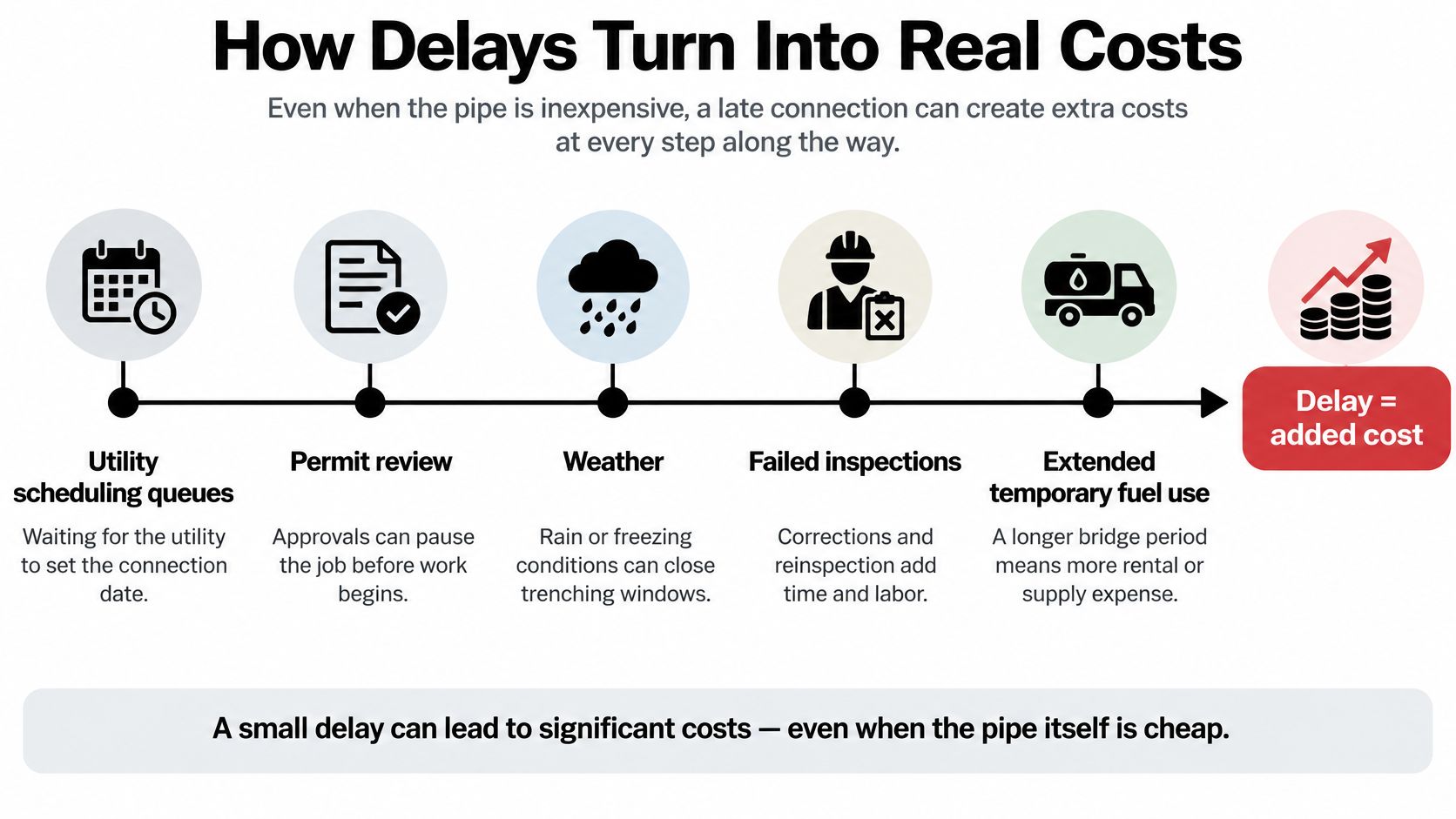
Large projects confirm that schedule risk dwarfs material savings. A 2025 report on TC Energy's Eastern Panhandle Expansion said estimated costs rose from about $25 million to $45.6 million after drilling complications, legal disputes, and construction delays. Your building won't carry those numbers, but the mechanism is identical.
Price the Wait Before It Happens
| Cost item | Example | How to estimate |
|---|---|---|
| Idle crews and subcontractors | Framing or finish crew waiting on gas-dependent work | Daily crew cost multiplied by days waiting |
| Occupancy or inspection delay | Certificate of occupancy held until gas is commissioned | Daily carrying cost of the building or unit |
| Equipment rental extension | Generator or heater rented longer than planned | Daily rental rate multiplied by extra days |
| Freeze protection | Pipes or equipment exposed during cold weather | Protection cost plus the exposure if protection fails |
| Remobilization | Crew returns after work was stopped | One trip charge plus setup time |
Builders coordinating multiple trades will recognize this as a sequencing problem as much as a utility problem, which is the core of scaling homebuilding operations through project management. We routinely solve natural gas line install delays and maintenance-related outages during residential, commercial, and industrial construction, and the worksheet above is how I'd decide whether bridging the gap pays. Homeowners face a shorter list, usually temporary heat, a delayed move-in, or extended rent, but the math works the same way.
Temporary Gas Options Compared
Temporary supply isn't one product. You match the equipment to the load, the space on site, and how long the permanent line will take.
| Option | Best for | Setup | Size |
|---|---|---|---|
| Natural Gas Box | Small buildings and commissioning equipment with low gas use | Rolls off a flatbed and is secured to the ground, operational within minutes | Smallest storage, lowest rental cost |
| Mobile gas unit | Larger buildings, subdivisions and model homes | Trailer rolls to the site and connects to the building gas connection | Usually 16 ft long and 8 ft wide |
| LNG supply | Industrial users replacing propane, diesel or fuel oil | Supplier-delivered tank connected to the site system | Sized to the facility load; confirm with supplier |
| Semi truckload supply | Large volume needs | Bulk delivery arranged with the supplier | Largest option; sized to volume |
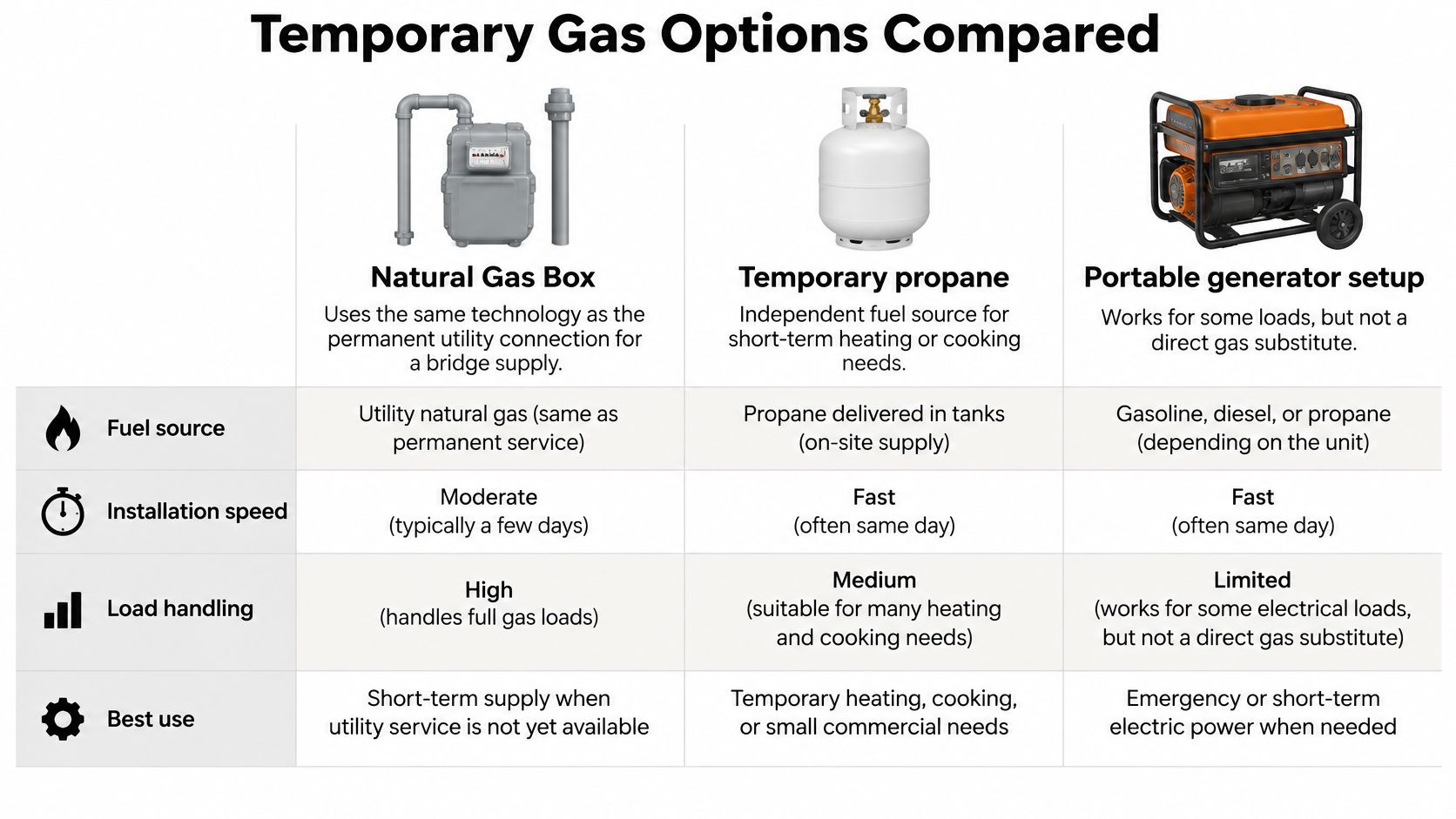
Sizing the Bridge to the Load
A Natural Gas Box uses the same technology as a mobile gas unit but carries a lower rental cost because its storage is smaller. That suits small buildings and commissioning equipment that uses little gas, such as starting up a furnace, water heater, or generator for inspection. A box is fully operational within minutes of being connected to the building, so it fits tight inspection windows.
A mobile gas unit handles larger and longer demands. The trailer is usually about 16 feet long and 8 feet wide, so it occupies roughly one parking space, connects to the building's gas connection, and gets refilled or swapped on site as supply runs down. Builders use this size for model homes, multi-unit buildings, and subdivisions where several appliances need to run before permanent service arrives.
We rent mobile natural gas for buildings and pipelines while customers wait for a permanent gas line or build in areas not served by gas pipelines. Our equipment ranges from small boxes and 16-foot trailers to semi truck loads, so you size the rental to the load instead of paying for capacity you won't burn.
Fuel and Fit Considerations
The gas delivered is pipeline-quality gas from the utility, so appliances, regulators, and commissioning procedures behave the same as they will on permanent service. That matters during startup testing, because you're validating the actual system rather than a workaround.
LNG serves a different case. Industrial users switching from propane, diesel, or fuel oil can run on liquefied natural gas delivered to site storage, which supports larger continuous loads over longer periods.
- Choose the box when the load is small and the priority is a fast, low-rental commissioning window.
- Choose the trailer unit when multiple buildings or sustained heating loads need supply for weeks.
- Choose LNG when an industrial process needs volume that compressed storage can't economically hold.
Temporary supply usually costs more per day than permanent service. It's justified when a missed date costs more than the rental, not as a cheaper substitute for the utility line.
Run that comparison with complete candor. If your occupancy date has slack and no crew is waiting, waiting is often the right call. If a slip triggers idle labor, lost rent, or freeze exposure, the bridge is usually the smaller number.
How to Compare Connection Quotes Step by Step
Quotes only become comparable when every bidder prices the same route, the same scope lines, and the same schedule assumptions. Follow this order and don't skip the survey.
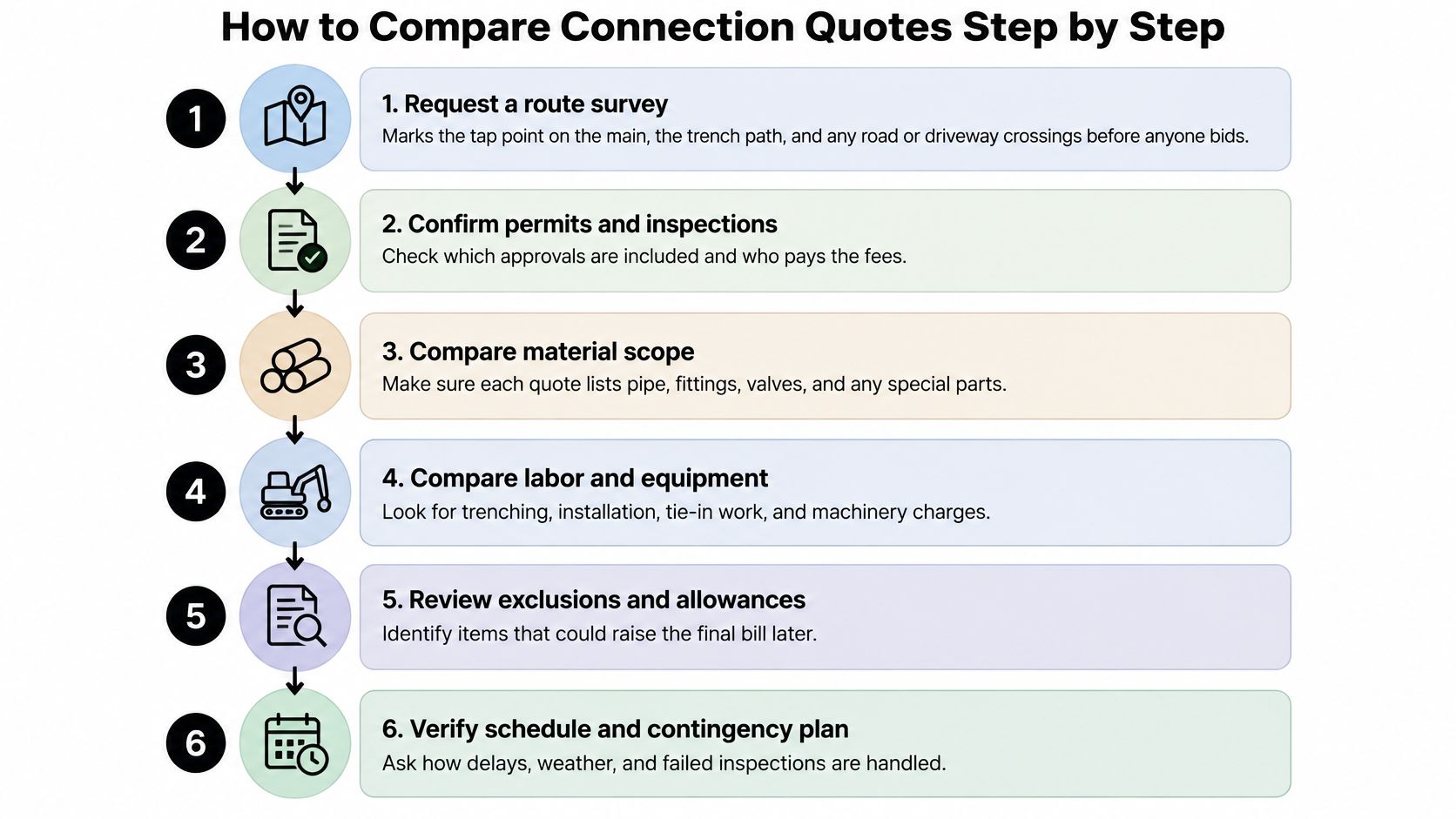
- Request a route survey that marks the tap point on the main, the trench path, and every road or driveway crossing, because every later figure depends on that route.
- Require the same invoice breakdown from each bidder, line by line, so gaps in scope show up immediately.
- Confirm restoration in writing, since whether pavement and landscaping are included or billed as extras is where quotes diverge most.
- Get the utility's earliest connection date in writing, plus what happens to your project cost if that date slips.
- Add the cost of waiting to each option using identical schedule assumptions, so a cheaper quote with a later date isn't mistaken for the better deal.
- Check the stated delivery pressure and meter size in every quote, because mismatched assumptions mean mismatched prices.
- Compare totals last, then ask how contingency is held and how field changes get priced before work proceeds.
A complete quote has every component priced, a stated connection date, and a named route-length assumption. If any of those three is missing, you don't have a quote yet. You have an opening number.
Confirm Your Connection Path Before Work Starts
A delayed utility connection can cost more than the temporary supply that keeps a project on schedule. Compare the cost of waiting with the cost of a bridge supply when a late connection threatens occupancy, commissioning, freeze protection, or crew continuity.
Start with the utility. Confirm the expected connection date and ask whether it can recommend an approved temporary-gas provider. Blue Gas Express partners with gas utilities, including Dominion Energy and Piedmont Natural Gas, to provide temporary natural gas while a utility completes its line installation and to coordinate the transition to permanent service.
Have three details ready: the building type and expected gas load, including peak demand from the largest appliances; the deadline tied to occupancy, commissioning, or a contract; and the route survey showing the tap point, trench path, and crossings. These let the utility assess the connection and help determine whether temporary supply is worth pricing.
If the permanent connection date puts occupancy, generator commissioning, or freeze protection at risk, Blue Gas Express offers temporary mobile natural gas equipment, from a Natural Gas Box for smaller loads to trailer and truckload units. Contact Blue Gas Express to size a bridge supply against your cost of waiting and keep your schedule intact.