

A composite jumbo CNG trailer can deliver roughly 530 to 720 MCF per load, according to the Midstream Calculator engineering capacity guide. That's a useful headline, but it isn't a runtime guarantee. The quantity that matters is how much gas the trailer can deliver at your equipment's required pressure, within the flow and temperature limits of the unloading system.
For a construction heater, generator, or industrial process, CNG trailer capacity is therefore a scheduling input, not just a storage specification. Start with deliverable gas, calculate operating hours, and leave enough reserve to complete the next swap without interrupting service.
CNG Trailer Capacity by Trailer Class
Deliverable MCF is the figure to plan around. In the table, MCF means one thousand standard cubic feet, gallons measure internal tube water volume, and psig means gauge pressure above atmosphere.
Typical capacity by CNG trailer class
| Trailer class | Water capacity | Deliverable gas per load |
|---|---|---|
| Small six-tube trailer | 4,000-5,000 gal | 140-180 MCF |
| Standard eight- to ten-tube trailer | 6,500-8,000 gal | 230-290 MCF |
| Large 12- to 16-tube trailer | 9,000-12,000 gal | 320-430 MCF |
| Composite jumbo trailer | 15,000-20,000 gal | 530-720 MCF |
These are typical engineering estimates, not guarantees for a particular trailer. The engineering guide cited above associates these classes with an approximate operating band of 2,400 to 3,600 psig, with 3,000 to 3,600 psig widely used for transport.
The columns describe different things. Water capacity tells you the internal geometric volume of the pressure vessels, while deliverable gas estimates the quantity available to the customer after allowing for unloading pressure conditions.
Read the range as a screening tool
Use the class ranges to identify equipment worth evaluating, not to approve a delivery schedule. A trailer near the upper end of a water-volume range doesn't automatically deliver the upper end of the gas range, because fill conditions and the required unloading endpoint also matter.
For example, a site that needs a relatively high inlet pressure may leave more gas in the tubes than a lower-pressure application. The same physical trailer can therefore support different delivery quantities on different projects.
Keep these quantities separate when reviewing an equipment schedule:
- Vessel size: Internal water volume establishes the storage geometry.
- Loaded gas: Gross standard cubic feet describe the gas aboard after filling.
- Delivered gas: Usable standard cubic feet describe what the unloading system can supply under the agreed conditions.
Planning rule: Select a trailer class using its deliverable range, then replace that screening estimate with a pressure-specific delivery commitment before scheduling operations.
Find the class that appears suitable for your project and carry its deliverable range into the runtime calculation. Don't choose the largest number in the row unless the proposed equipment and delivery conditions support it.
Units of Measure Behind Every Capacity Figure
A capacity quote needs a consistent measurement basis before you can compare it with another quote. SCF describes gas quantity at reference conditions, not the physical space occupied by compressed gas inside the tubes.
Capacity units and what each one measures
| Unit | What it measures | Where you will see it |
|---|---|---|
| Gallons (water capacity) | Internal water volume of the tubes | Trailer spec sheets |
| SCF (standard cubic feet) | Gas quantity at reference conditions | Quotes and supply agreements |
| psig | Gauge pressure above atmosphere | Tube and fill ratings |
| bar | Pressure expressed in a metric unit | Imported and engineering specs |
| Reference state (commonly 60°F and 14.7 psia) | Conditions the SCF volume is measured at | Stated beside every SCF figure |
The New York State virtual-pipeline CNG tube-trailer guidance identifies reference conditions such as 60°F and 14.7 psia as necessary for interpreting standard-volume capacity. Psia means absolute pressure, which includes atmospheric pressure, unlike gauge pressure.
MCF means one thousand SCF. Keep that distinction visible in spreadsheets so an hourly demand expressed in SCF isn't divided directly into a trailer quantity expressed in MCF.
Normalize the quote before comparing capacity
Say a trailer's gas inventory is quoted using one standard reference temperature, while a competing quote uses another. The reported SCF totals can differ even when the underlying gas quantity is unchanged. A larger printed SCF number doesn't establish that more fuel will reach the site.
Pressure units need similar care. Record the unit beside every pressure entry, and distinguish the tube's rated pressure from its actual fill pressure and the customer's minimum acceptable inlet pressure.
The final distinction is contractual rather than dimensional: nameplate capacity isn't a deliverable-gas commitment. A specification may describe storage under its stated conditions without promising that the complete quantity can pass through the receiving equipment.
Before comparing quotes, confirm:
- Common reference conditions: Both gas-volume figures use the same temperature and absolute pressure.
- Separate quantities: Gross loaded SCF and guaranteed deliverable SCF appear independently.
- Specified delivery conditions: The usable quantity applies at your required pressure and flow.
A quote that omits these details may still describe the trailer accurately. It does not, however, provide enough information to calculate dependable site coverage.
Typical Trailer Configurations and Cylinder Types
Trailer length doesn't establish gas capacity. A chassis carries a bank of pressure vessels, but the vessels' internal volume, construction, pressure rating, and authorized arrangement determine what that assembly can carry.
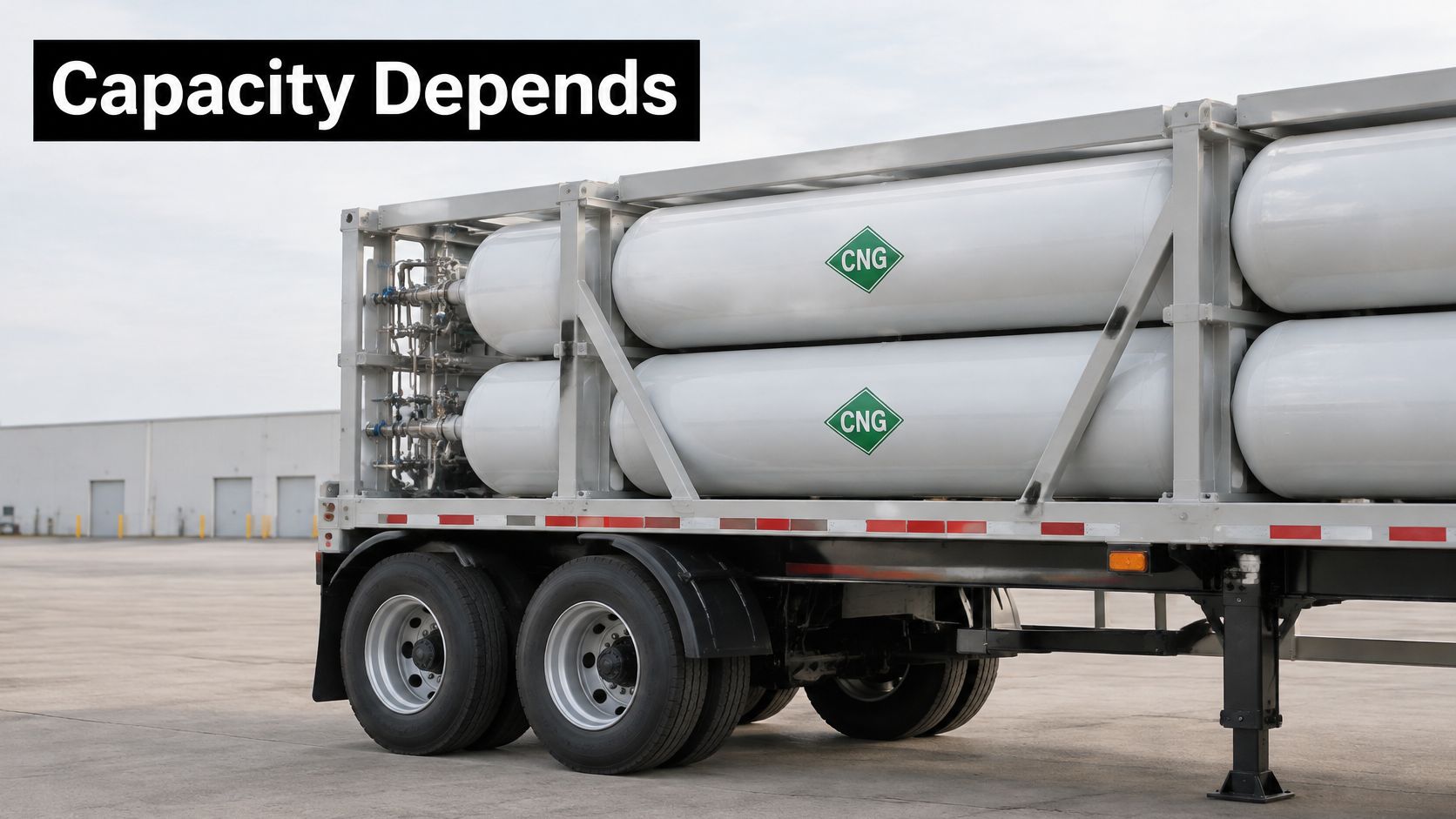
A permitted configuration described in the New York State guidance uses three to six volume bottles, approximately 30 inches in outside diameter and 33 to 40 feet long, rated at 867 psig for that particular permit configuration. Those dimensions aren't a general high-pressure CNG specification. They demonstrate why appearance alone is an unreliable basis for purchasing.
Steel and composite systems solve different constraints
Conventional steel tubes and Type 4 composite cylinders must be evaluated as complete trailer systems. The Luxfer G-Stor Go specification sheet lists individual Type 4 cylinder capacities of roughly 2,375 to 9,365 cubic feet, with listed cylinder weights of about 115 to 399 pounds, depending on design.
Lower cylinder mass can create room within a transport weight allowance for additional gas or a different vessel arrangement. It doesn't prove that the assembled trailer delivers more gas.
The chassis, axle limits, tube layout, fittings, safety equipment, and authorized transport configuration can become the limiting factors. A cylinder-level advantage matters only if the completed vehicle can use it on the intended route and at the intended site.
The useful purchasing question is therefore not whether composite cylinders are lighter. Ask whether the proposed configuration provides more deliverable SCF per permitted trip, with the required flow performance and unloading arrangement.
Read the complete assembly specification
Review these entries together rather than approving the cylinder sheet in isolation:
- Tube count and water volume: Establish the installed vessel bank.
- Rated pressure: Confirm the rating for the actual cylinder and assembly.
- Cylinder type: Identify the construction supplied, not merely an optional design.
- Permitted gross weight: Check the loaded configuration against route constraints.
- Safety and stability equipment: Identify the systems required by the applicable authorization.
- Unloading equipment: Confirm that regulators and connections suit the site duty.
A lighter assembly may improve transport flexibility without changing usable delivery. A higher-capacity assembly may reduce trips but require more staging space. Neither outcome is better by default until the project's limiting constraint is identified.
What Pressure, Temperature and Residual Gas Take Away
Treating gross stored gas as available delivery overstates site coverage. The trailer must retain gas when its pressure falls below the unloading system's usable endpoint, and the transfer equipment must maintain acceptable pressure and flow throughout the delivery.
PHMSA's portable gas-supply-system material provides regulatory context for these systems. A capacity assessment must distinguish storage from the quantity the complete supply arrangement can deliver.
| Factor | What it changes | What the planner should specify |
|---|---|---|
| Destination pressure | Gas available before the pressure endpoint | Required delivery and minimum inlet pressure |
| Residual gas | Inventory remaining after unloading | Assumed end-of-delivery condition |
| Expansion cooling | Temperature and sustainable throughput | Required continuous flow |
| Compressibility | Calculated gas inventory | Real-gas calculation basis |
| Regulators and ambient conditions | Delivery performance over time | Equipment limits and temperature range |
Pressure sets the unloading endpoint
As destination pressure rises, less gas can leave the tubes through a pressure-driven unloading arrangement. The supply system needs sufficient upstream pressure to overcome its operating requirements, so the endpoint isn't necessarily identical to the equipment's nominal inlet setting.
Residual gas is remaining inventory, not automatically lost gas. It may stay aboard for the next fill cycle, but it isn't available to extend the current site's runtime under the specified conditions.
Expansion introduces another constraint. Joule–Thomson cooling can lower gas temperature during pressure reduction, affecting regulator operation and the flow the system can sustain.
Inventory and throughput require separate checks
Real-gas behavior matters when converting vessel volume and pressure into gas quantity. The engineering capacity guide's commonly estimated high-pressure compressibility factor of 0.82 to 0.88 underscores why a simple ideal-gas estimate shouldn't be treated as guaranteed delivery.
Use a consistent real-gas method for the loaded and residual states rather than applying an unexplained correction to the final answer. Gas composition and temperature assumptions belong in that calculation.
Regulators also limit performance. A trailer can contain enough total gas for the job while the unloading train can't supply the required instantaneous demand.
The largest trailer isn't necessarily the best supply system. Select the arrangement that can reach the site, connect safely, and sustain the required duty.
Payload restrictions, turning space, unloading access, and the available connection arrangement can outweigh a storage advantage. Quote capacity as a range with explicit assumptions, including temperature conditions, minimum residual pressure, and required flow, rather than as an isolated headline number.
How to Convert Capacity into Runtime on Site
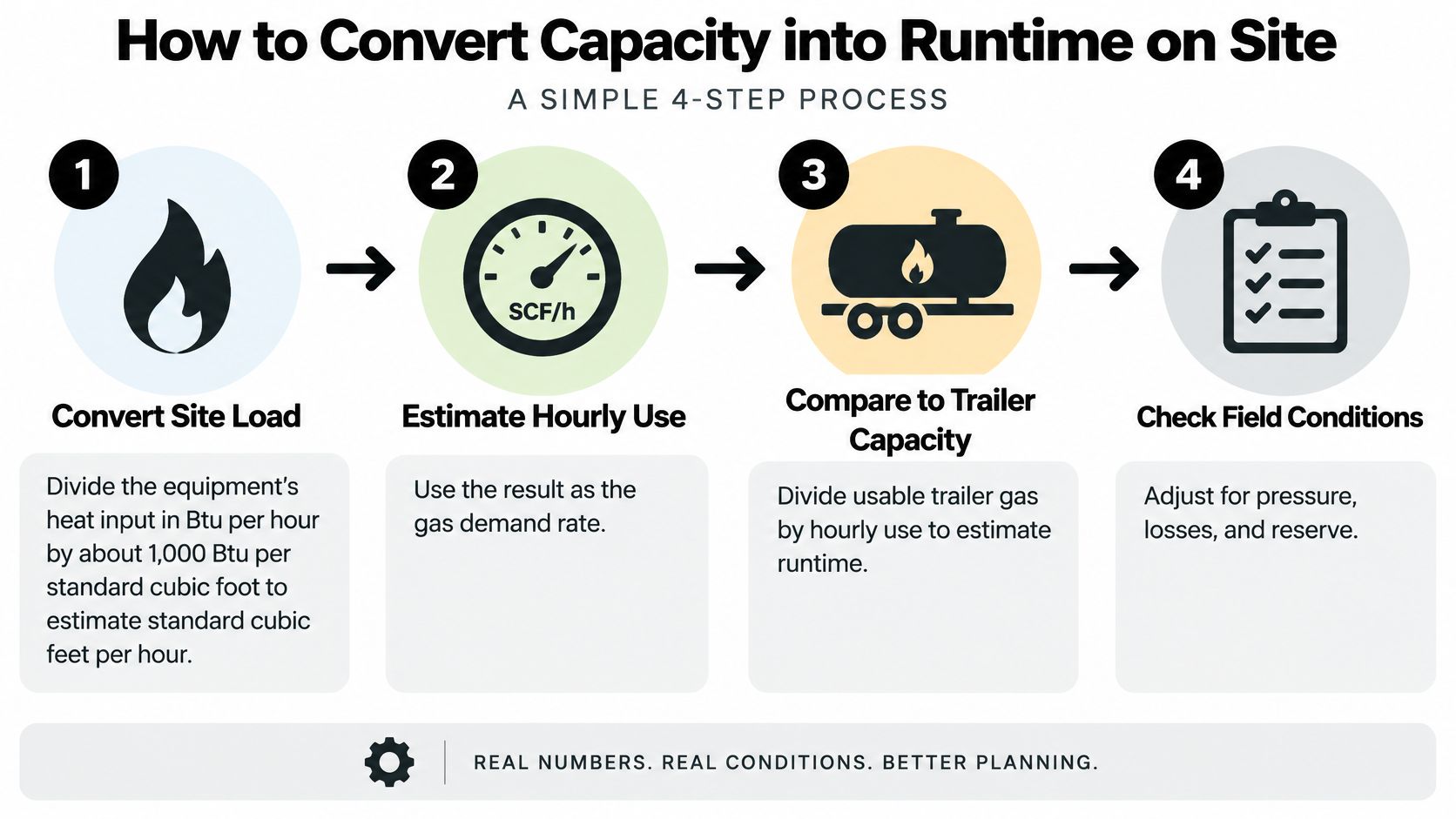
Runtime connects the gas quantity to the work schedule. Use deliverable SCF, not water gallons or gross loaded gas, and keep the demand rate on the same reference basis.
Calculate the operating window
Convert the site load into SCFH. Use the equipment's fuel-input rating in standard cubic feet per hour where available. For a preliminary worked estimate, divide heat input in Btu per hour by an assumed 1,000 Btu per SCF, then replace that assumption with the supplied gas's heating value.
Select the deliverable gas quantity. Use the proposed trailer's usable SCF at the required delivery pressure. A class range is suitable for screening, but the operating schedule needs a unit-specific figure.
Set aside a scheduling reserve. For this hypothetical calculation, use a 10% to 20% reserve to leave time for replenishment. That's an example planning allowance, not a universal operating requirement.
Divide available gas by hourly demand. Planned runtime equals deliverable SCF multiplied by the fraction remaining after reserve, divided by SCFH. The table shows the arithmetic before that scheduling deduction.
Gross runtime from one trailer at three site loads
| Site load (SCF per hour) | Hours from 230 MCF trailer | Hours from 290 MCF trailer |
|---|---|---|
| 2,000 | 115 | 145 |
| 5,000 | 46 | 58 |
| 10,000 | 23 | 29 |
These are hypothetical steady-load calculations using the standard-class delivery quantities, not measured trailer performance. Here, gross runtime means runtime before scheduling reserve, not runtime calculated from gross stored gas.
- Compare runtime with the achievable replenishment interval. Include dispatch, travel, site access, and connection time when deciding whether the window is sufficient. If planned runtime is shorter than the swap cycle, select a larger usable inventory or add a supply unit.
Apply reserve without double-counting losses
In the worked example, 230 MCF at 2,000 SCFH provides 115 hours before reserve. Retaining the example reserve produces approximately 92 to 103 hours of planned runtime, depending on the allowance selected.
Don't subtract residual gas again if the quoted deliverable figure already accounts for it. Physical delivery deductions and scheduling reserve serve different purposes: one defines available inventory, while the other protects the replenishment plan.
Steady demand is also an assumption. For cycling heaters or changing generator loads, calculate consumption across the operating schedule and separately verify peak flow. If demand rises above the assumed rate without a compensating reduction elsewhere, the trailer will reach the dispatch threshold sooner.
Refueling Frequency and Swap-Out Planning
Schedule replacement before the usable supply window closes. The reserve must remain available during dispatch and changeover, rather than becoming extra production time that the site routinely consumes.
Consider a hypothetical generator project using a 24-hour swap cycle and a 15% scheduling reserve. The capacity check must cover the generator's expected consumption through that cycle while retaining the chosen reserve. If the operating schedule changes, the dispatch threshold needs to change with it.
Dispatch against remaining operating time
A pressure reading alone doesn't tell the dispatcher exactly how long the site can continue operating. The useful estimate combines remaining inventory with the current demand and expected operating schedule.
Our remote monitoring estimates when a trailer will run out, allowing another hot-swapping unit to be dispatched before that point. The site still needs a clear response plan for unexpected demand, access delays, or a changed production schedule.
Dispatch trigger: Act when remaining coverage approaches replenishment lead time plus the agreed contingency, not when the trailer is nearly empty.
Some projects use connected supply units so a replacement can be brought into service while another leaves for refilling. A gas manifold allows a second unit to connect while the main unit is taken to a CNG station, supporting continuity during replenishment.
Confirm that the swap can happen physically
The schedule must allow the vehicle to reach the connection point. A staging area occupied by construction materials or a delivery truck can undermine an otherwise adequate fuel plan.
Check the unloading and reconnection window against site working hours, traffic restrictions, and the availability of authorized personnel. Continuous-supply arrangements also need an agreed operating procedure, not just space for another trailer.
Before starting service, settle these responsibilities:
- Swap interval: Identify the planned replacement window and dispatch lead time.
- Reserve: Define the inventory or remaining-runtime trigger.
- Backup unit: Establish what covers delayed replenishment.
- Staging area: Keep access and connection space available.
- Notification owner: Name who receives alerts and who authorizes action.
The practical measure of a good replenishment plan is whether the next unit can be connected while useful reserve remains, not whether the previous trailer was emptied as completely as possible.
Matching Trailer Size to Your Project
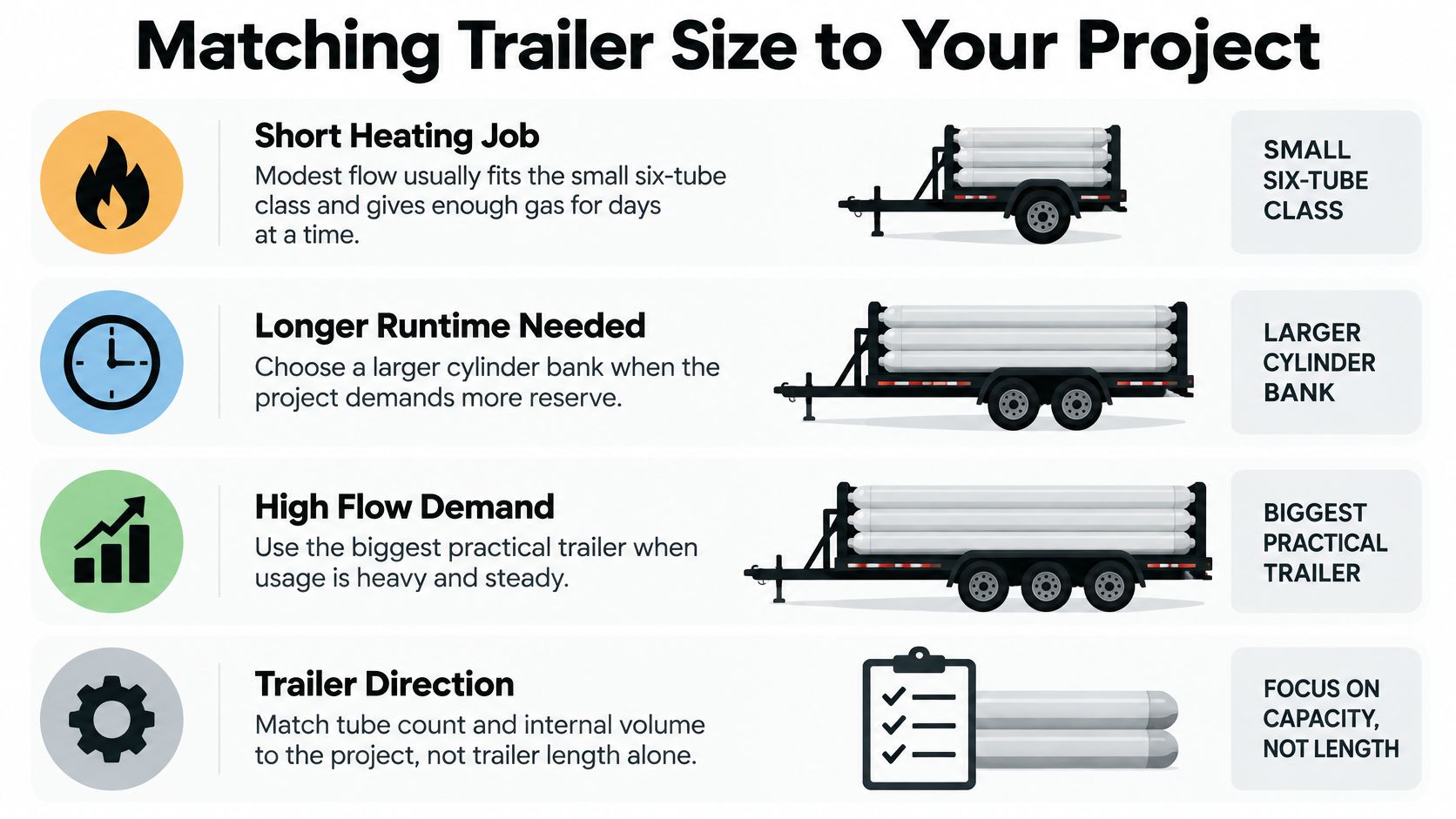
| Project situation | Trailer direction | Reason |
|---|---|---|
| Short heating job with modest flow | Small six-tube class | Enough deliverable gas for days at low load |
| Long generator run with steady demand | Standard eight- to ten-tube class | Fewer swaps across the project |
| Tight site with narrow access or weight limits | Smaller class or several trailers | Keeps each unit within road and parking limits |
| High delivery pressure required | Plan on lower deliverable SCF | Pressure rise cuts usable gas |
| Very high flow with few changeovers | 12- to 16-tube or composite class | More gas per visit if route and unloading allow |
| Uncertain demand | Standard class with a swap plan | Easier to scale up once load is measured |
These are screening directions, not automatic selections. In particular, a heating job gets days of coverage only when its calculated consumption supports that duration.
Match the operating pattern
For short heating work, avoid buying storage solely to maximize time between visits. A smaller class can be appropriate when modest demand leaves a workable replenishment window, especially where site space is valuable.
A long generator run places more emphasis on predictable coverage. The standard class is a useful starting point when its usable inventory reduces changeovers without creating access or staging problems.
A tight site may favor smaller units even if that requires more deliveries. Several trailers are only a sensible alternative when the site has room to stage them and an approved connection arrangement.
Resolve the binding constraint
For high-pressure delivery, evaluate the pressure-specific usable quantity before choosing a class. Buying greater nominal storage without checking the unloading endpoint can leave the same runtime shortfall in a larger package.
For heavy, steady consumption, a large tube bank or composite trailer can reduce delivery frequency. However, more stored gas doesn't replace a peak-flow check, and the route must accommodate the completed loaded assembly.
When demand is uncertain, treat a standard-class proposal as a provisional operating choice rather than a permanent commitment. Record actual consumption during representative operation, then adjust capacity and replenishment together.
The trade-off is between inventory at the site and the logistics required to maintain it. The appropriate trailer isn't necessarily the one that minimizes visits or occupies the least space. It's the one whose usable inventory, delivery performance, and replacement schedule fit the project simultaneously.
Confirm Your Capacity Before You Order
Gather the operating inputs before requesting a quote. Use equipment fuel-input information rather than useful heat output, and record both normal demand and the highest flow the supply system must handle.
Prepare the site requirements
- Measured or rated site load in SCFH. If converting from heat input, use the gas heating value on a consistent basis.
- Target runtime in hours. Include the actual operating schedule.
- Delivery pressure and minimum inlet pressure. Identify the equipment's acceptable operating limits.
- Ambient temperature range. State the conditions expected during service.
- Route, parking, and unloading limits. Include turning access and staging restrictions.
- Reserve percentage and swap interval. Make the replenishment assumptions explicit.
We match mobile-unit size to the gas capacity and flow speed of the equipment being supplied. Our Sales team can prepare a custom quote when you're ready to discuss those requirements.
Check the delivery commitment
The quote should distinguish gross SCF from guaranteed deliverable SCF, state the standard-volume reference conditions, and identify the permitted payload for the intended route. It should also make clear which pressure and flow conditions support the deliverable quantity.
If the quoted pressure or reference state differs from your calculation basis, have the figures restated before comparing alternatives. Don't compensate with an unexplained spreadsheet adjustment.
Make the final decision on one test: does the guaranteed deliverable gas cover the required operating window while preserving the agreed reserve? Once it does, request the quote for that trailer class and replenishment arrangement.
Blue Gas Express offers mobile natural gas supply sized to the equipment's gas-volume and flow requirements. Visit Blue Gas Express to discuss your site load, delivery pressure, target runtime, and swap schedule with our Sales team and request a custom quote.