

A pipeline connection can be late even when the site, equipment, and crew are ready. A construction team may need gas for commissioning, a utility may face an outage during maintenance, or a property owner may need temporary supply before a permanent service is available. In each case, the problem isn't just finding a dispenser. The project needs a complete system that can receive, compress, store, regulate, meter, and safely deliver gas where it's required.
A compressed natural gas pump is therefore better understood as a pressure-management system than as a familiar liquid-fuel pump. The right setup depends on demand, pressure, duty cycle, site access, electrical service, permitting, and how long the temporary supply must remain available.
Introduction to CNG Pump Fundamentals
A crew arrives at a construction site expecting to start gas equipment. The building is ready for commissioning, but the utility connection is still delayed. Waiting may affect inspections, occupancy work, generator testing, or the wider construction schedule. A mobile CNG system can bridge that gap, but only if the equipment matches the site's pressure, flow, storage, and safety requirements.
That distinction matters because CNG access has always depended on infrastructure continuity. An Argonne National Laboratory assessment reported 1,671 public and private CNG stations in 2018, while federal recovery funding supported the addition of 143 CNG stations. The figures describe a network, not a guarantee that gas will be available at a particular site, during a particular outage, or at the pressure needed by a specific appliance.
A station count can also hide the difference between a public vehicle station, a private fleet depot, a slow-fill arrangement, and a mobile daughter station. For a construction firm, utility, industrial facility, or commercial property owner, the practical question is more specific:
Can this project receive the required gas, at the required pressure and flow, for the full operating period?
That question leads to a better choice between permanent infrastructure and temporary mobile supply.
Understanding How CNG Fueling Works
CNG fueling works more like moving water uphill through several pumping stages than filling a tank with liquid. A liquid pump transfers fuel that already exists in a relatively accessible form. A CNG system must first take gas at a lower pressure, compress it, manage the heat created by compression, store it, and then deliver it through a controlled dispenser.
The pressure path
The process usually follows this sequence:
- Gas enters the system. The supply connection provides gas to the compressor at its available inlet pressure.
- The compressor raises pressure in stages. Reciprocating or diaphragm equipment compresses the gas progressively rather than forcing the entire pressure increase through one step.
- The gas heats during compression. Temperature rises as the gas is compressed, so the system must account for thermal behavior before and during filling.
- High-pressure storage buffers delivery. Cascade storage banks hold gas at different pressure levels, helping the dispenser supply a vehicle or appliance without relying only on instantaneous compressor output.
- The dispenser meters and controls the fill. Valves, pressure sensors, temperature sensors, and automatic shutoff logic manage the final transfer.
Vehicle and storage cylinders commonly operate around 3,000 to 3,600 psi, or 20.7 to 24.8 MPa, according to NFPA revision material for compressed natural gas systems. Those values aren't just targets printed on a gauge. They define the operating envelope for cylinders, piping, hoses, fittings, valves, and connectors.
Why temperature compensation matters
Suppose a dispenser fills a cylinder to a fixed pressure while the gas is hot. After the gas cools, the pressure can fall and leave the vehicle underfilled. If the system ignores temperature during a hot fill, it can also create an unsafe pressure condition.
Temperature-compensated fill logic adjusts the stopping point so the system delivers a usable fill without exceeding the equipment's limits. Automatic shutoff then stops the flow when the programmed pressure and temperature conditions are met, or when an emergency signal interrupts the process.
A conventional pump answers, “How much liquid passed through the meter?” A CNG dispenser must also answer, “At what pressure, temperature, and flow did the gas reach the receiving cylinder?”
Exploring Key Components of a CNG Pump
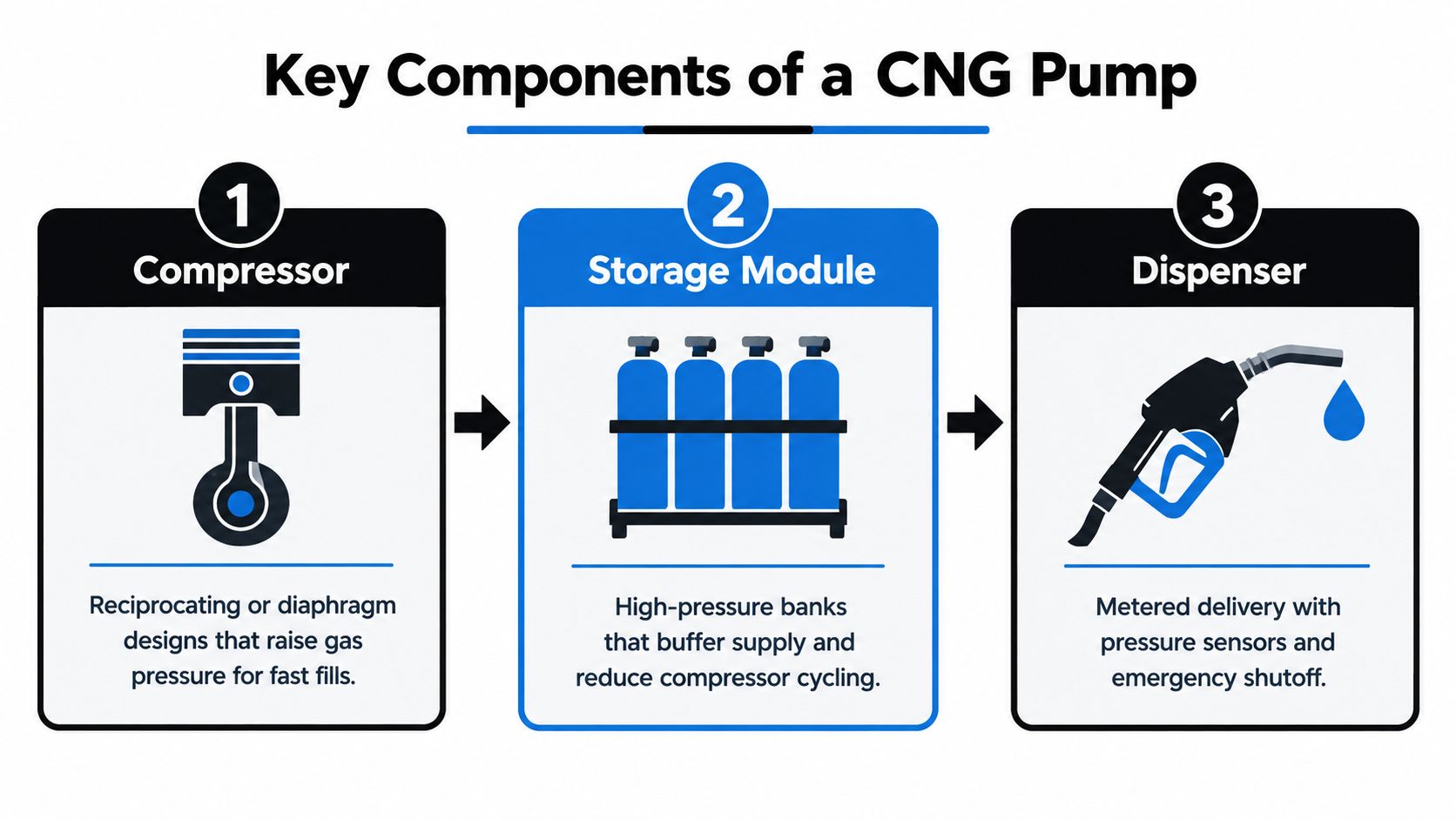
A reliable CNG arrangement has three connected layers: the compressor, the storage module, and the dispenser. Treating these as separate products can lead to compatibility problems. Treating them as one integrated system makes it easier to review the pressure path and identify the point most likely to limit performance.
Compressor
The compressor raises incoming gas to the pressure needed for storage or dispensing. Reciprocating compressors use piston movement, while diaphragm designs separate the gas from the mechanical drive through a flexible membrane. Both approaches require careful control of discharge temperature, lubrication or separation requirements, vibration, and staged pressure rise.
A multi-stage compressor reduces the burden on each stage. Interstage cooling and pressure relief help control heat and prevent one section from operating beyond its allowable service pressure. The relief devices must protect each compression stage, its cylinders, and its associated piping.
For equipment selection, don't look only at horsepower. Ask for the compressor's inlet pressure range, discharge pressure, gas flow, duty cycle, cooling arrangement, and response to changing demand. A compressor can have sufficient headline capacity and still struggle if the regulator, hose, storage bank, or electrical supply becomes the bottleneck.
Storage module
The storage module acts like a reservoir between compression and consumption. Cascade banks hold gas at different pressure levels, allowing the system to transfer gas efficiently as the receiving cylinder pressure changes. Storage also reduces compressor cycling and gives the dispenser a buffer during demand peaks.
The project team should verify the storage vessel ratings, relief devices, isolation valves, mounting arrangement, inspection records, and connection type. A mobile daughter station adds another consideration. The storage module may arrive as a transportable unit, but the receiving site still needs a controlled connection, suitable separation, secure placement, and a documented operating procedure.
Material selection matters wherever weight, strength, transport, and pressure containment influence the equipment design. A technical resource on high strength weight material specs can help project teams understand how material properties affect component choices, although the equipment manufacturer and applicable codes must determine final suitability.
Dispenser
The dispenser controls the last part of the pressure path. It typically includes a regulator, meter, hose, pressure and temperature sensors, fill connector, emergency shutoff, and automatic stop function. Each component must be rated for the complete operating envelope, not merely the expected delivery pressure.
NFPA material specifies that overpressure protection must not be set above 125% of the fueling nozzle's service pressure, and the supply container must not be exposed to more than 1.25 times its service pressure. Pressure-specific connectors are essential. Adapters that defeat connector compatibility aren't an acceptable shortcut.
Comparing Stationary and Mobile Pump Options
A permanent station suits a stable site with predictable, recurring demand. A mobile unit suits a project where the gas requirement is temporary, the permanent connection is delayed, or the site may need to relocate the supply. Neither option is automatically better. The correct choice follows the schedule and the load.
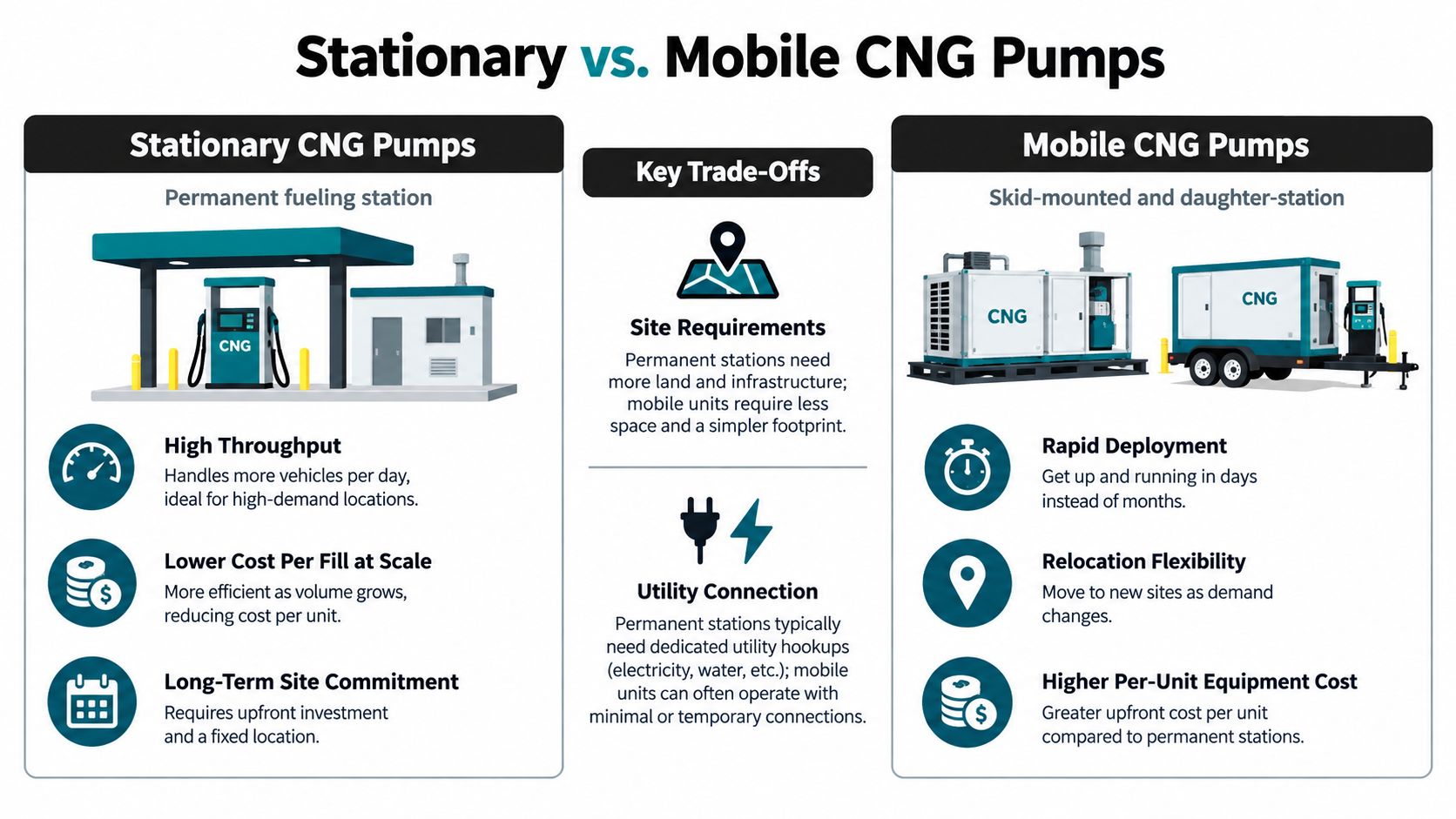
| Requirement | Stationary setup | Mobile or daughter station |
|---|---|---|
| Project duration | Appropriate for continuing fleet, commercial, or industrial use | Appropriate for outages, construction phases, and delayed connections |
| Site commitment | Requires a dedicated footprint and long-term utility planning | Uses a prepared temporary area and can be relocated |
| Supply arrangement | Often connects to a permanent gas and electrical service | Receives gas through mobile storage and may need planned refills |
| Fill profile | Can support fast-fill or slow-fill operation when properly designed | Can support temporary demand when sized for the duty cycle |
| Main risk | Long development, permitting, and construction dependency | Refill logistics, available space, and temporary connection control |
The ISO 16923 standard for CNG stations distinguishes slow-fill and fast-fill stations, fixed and mobile daughter stations, and public and private access. Those categories matter because an overnight fleet depot has a different operating pattern from a generator commissioning site or a temporary construction supply.
Choose a stationary system when the site has a dependable long-term load, adequate utilities, and enough time for design and approvals. Choose mobile storage when the priority is continuity during a defined gap, especially if a permanent connection is already planned.
Managing Flow Rates and System Compatibility
Pump sizing starts with the end user, not the compressor nameplate. A vehicle, engine, generator, or downstream appliance creates a demand profile. The system must maintain usable pressure while meeting that demand, including periods when several users draw gas at the same time.
A government-hosted CNG equipment manual documents pressure reduction from as much as 3,600 psi at the inlet to approximately 125 psi for engine use, with a nominal gas-flow range of 0 to 110 lb/h. Those figures show why the regulator is not a minor accessory. It must reduce pressure while maintaining the outlet conditions required by the engine or appliance.
Review the complete pressure path
Before selecting equipment, document:
- Peak demand: Identify the highest expected flow and whether multiple users operate simultaneously.
- Sustained demand: Determine how long the system must maintain delivery without allowing storage pressure to fall below the user's requirement.
- Regulator capacity: Confirm that the regulator can pass the required flow at the available inlet pressure and temperature.
- Hose and fitting losses: Account for pressure drop through the hose, valves, connectors, and pipework.
- Storage recovery: Check how quickly the compressor can restore the cascade banks after a high-demand event.
- Thermal behavior: Confirm that temperature compensation remains active during repeated fills and changing ambient conditions.
A system may appear adequate during a short test but fail during continuous consumption. For example, a dispenser can deliver the initial high-pressure gas from storage, then lose usable pressure when the storage bank equalizes or the compressor can't recover quickly enough.
Connector compatibility deserves equal attention. The hose, nozzle, receiving connection, pressure class, seals, and shutoff logic must work together. Don't use an adapter to force an incompatible connection. Confirm every component's rating and approval before gas is introduced.
Meeting Safety and Regulatory Requirements
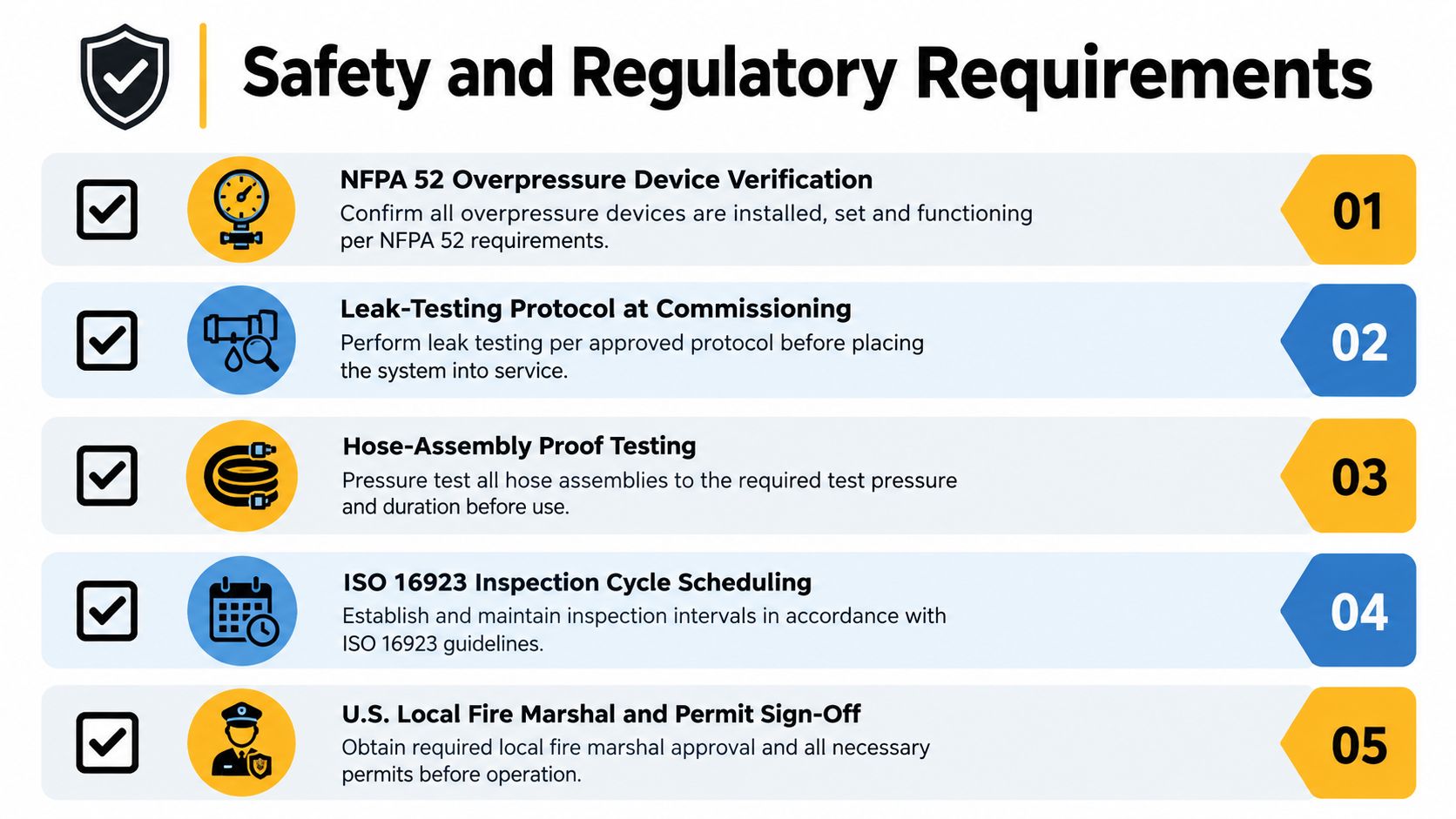
Safety documentation should follow the gas path from supply to end use. A project manager doesn't need to memorize every code provision, but the commissioning package should show that the responsible engineers and technicians verified the applicable requirements.
Commissioning checklist
- Pressure protection: Verify relief-device settings against the service pressure of the nozzle, vessels, cylinders, stages, and piping. Confirm that automatic fill-stop logic responds to pressure and temperature sensors.
- Leak testing: Test piping and hose assemblies at the applicable maximum operating pressure before commissioning. Record the test method, pressure, duration, conditions, and results.
- Hose proof testing: NFPA revision material identifies OEM testing of hose assemblies at at least twice maximum allowable working pressure. Use the manufacturer's records and confirm that the installed hose matches the documented assembly.
- Operational checks: Record stage pressures, discharge temperature, regulator outlet pressure, flow, emergency shutoff response, valve positions, and alarm behavior.
- Permit and inspection records: Coordinate with the authority having jurisdiction, the fire marshal, the utility, and the equipment supplier before operation.
The late-2025 infrastructure report cited 1,385 U.S. CNG stations, but only 53% were publicly accessible and 46% supported Class 8 trucks. The infrastructure report illustrates why station availability isn't the same as project continuity. A nearby station may not serve the right equipment, have sufficient throughput, or remain available during maintenance.
Cathodic protection belongs to the pipeline system, not the dispenser itself. Under U.S. federal rules, buried or submerged natural-gas pipelines installed after July 31, 1971, generally require both protective coating and cathodic protection. The PHMSA interpretation of 49 CFR Part 192 explains that the cathodic-protection system must be placed into operation within one year after construction is completed, subject to regulatory exceptions.
Operators verify protection by measuring pipe-to-electrolyte potential against applicable Appendix D criteria, as described in federal pipeline inspection guidance. The system must be tested at least once during each calendar year, with no interval longer than 15 months, according to PHMSA guidance on cathodic-protection testing. Rectifiers require checks six times per year, with no more than 2.5 months between checks, and operators must retain maps and inspection records for the life of the pipeline, as stated in PHMSA's cathodic-protection factsheet.
Deployment Scenarios and Real World Use Cases
The best CNG arrangement becomes clearer when the project is described as an operating situation rather than a piece of equipment.
Construction startup
A builder has completed the mechanical installation, but the permanent gas line isn't ready. The project team first identifies the appliances, inlet pressure, expected flow, operating hours, equipment location, access route, and required service period.
The mobile supplier and site team then agree on the storage position, separation distances, vehicle access, emergency shutdown location, electrical requirements, and refill schedule. Before gas enters the system, technicians verify hose and fitting ratings, perform leak testing, confirm regulator settings, and document the emergency response procedure.
The lesson is simple: temporary gas should be planned as part of commissioning, not treated as an emergency connection made at the last minute.
Generator commissioning
A generator may need gas for startup tests before permanent utility service is energized. A skid-mounted system can provide a controlled source, but the generator's fuel train determines the required outlet pressure and flow.
The commissioning record should include the generator manufacturer's fuel requirements, regulator capacity, pressure at the inlet during startup, flow during loaded operation, automatic shutoff behavior, and restart response. The team should also confirm how the mobile unit will be refilled without interrupting a critical test sequence.
A short initial run isn't enough. Test the system under the operating conditions that matter, including sustained load and any planned transfer or restart sequence.
Freeze prevention
A winter outage can threaten heating equipment, process systems, or vulnerable water infrastructure. A daughter station may keep gas available while utility crews repair or replace the permanent connection.
The operator should define minimum storage pressure, inspection frequency, refill responsibility, alarm escalation, and the point at which the temporary supply will be removed. Site personnel need clear instructions for emergency isolation and safe access during adverse weather.
For each scenario, the project file should contain:
- Site plan: Show equipment placement, access, connections, shutdown points, and exclusion areas.
- Demand schedule: Identify peak use, operating hours, and refill requirements.
- Test package: Include pressure, leak, functional, and emergency-shutdown results.
- Responsibility matrix: Name the supplier, site operator, utility contact, and emergency coordinator.
- Exit plan: Define how the temporary system will be isolated, disconnected, removed, or extended.
Conclusion and Best Practice Takeaways
A compressed natural gas pump isn't a single universal machine. It's a coordinated system of compression, storage, regulation, metering, sensing, pressure relief, and controlled dispensing. The correct setup depends on whether the project needs permanent throughput, temporary continuity, vehicle fueling, generator operation, construction commissioning, or protection during a utility outage.
Use this decision checklist before approving equipment:
- Define the load: Identify the end use, peak flow, pressure, duty cycle, and simultaneous demand.
- Choose the format: Compare a permanent station with a mobile or daughter-station arrangement based on project duration and site readiness.
- Verify compatibility: Match cylinders, compressors, storage modules, dispensers, regulators, hoses, fittings, connectors, and electrical systems.
- Prove performance: Test pressure, temperature, flow, leak tightness, automatic shutoff, and emergency isolation.
- Document compliance: Keep permits, inspection records, test certificates, operating procedures, refill plans, and commissioning data together.
A well-planned temporary system can protect a construction schedule while the permanent gas connection catches up. A well-designed permanent station can support predictable demand, but only when the upstream supply, utilities, controls, and maintenance plan are equally dependable.
Blue Gas Express provides temporary mobile CNG and LNG delivery for construction, commercial, residential, industrial, and utility applications, including delayed gas connections, generator commissioning, occupancy work, and freeze prevention. Visit Blue Gas Express to discuss the pressure, flow, site, and deployment requirements for your project.