

At 4 p.m., a transit manager is watching buses return to the depot with low-fuel warnings while a utility crew works nearby. The fueling plan looked solid on paper. The operational question is less comfortable: can the fleet still leave on schedule if the compressor trips, the gas connection is delayed, or emergency fueling becomes necessary?
That's the compressed natural gas bus decision that matters. The bus matters, but the compressor, dispenser, depot layout, gas supply, maintenance program, and contingency plan often determine whether the fleet performs well. CNG has a substantial transit history and can reduce petroleum use, yet it also creates infrastructure dependencies that diesel operators can't ignore.
Why Fleet Managers Are Rethinking Compressed Natural Gas Buses
Compressed natural gas became a significant alternative-fuel technology in U.S. public transit during the 1990s and 2000s. Natural-gas transit buses grew from 2.8% of the U.S. bus fleet in 1996 to 18.6% in 2011, representing more than a sixfold expansion in market share over 15 years, according to the American Public Transportation Association's clean-technology endnotes.
That history matters because it disproves the idea that CNG buses are merely experimental vehicles. Transit agencies adopted them at scale to diversify fuel supply, reduce petroleum dependence, and address local air-quality goals. The decision, however, has never been only about buying a different bus.
A fleet manager has to weigh route performance, depot construction, fueling availability, technician training, cylinder inspections, utility coordination, and emergency response. A vehicle that produces favorable emissions results can still create unacceptable availability risk if the depot has no practical backup when its fueling equipment stops working.
Operational rule: Treat a CNG conversion as a fuel-system and facility project, not a vehicle replacement project.
The same discipline used in broader fleet efficiency in 2025 planning applies here. Managers need a complete operating picture, from fuel delivery and preventive maintenance to failure response and route assignment. CNG may fit a large, centralized fleet with predictable overnight parking. It may be a poor choice for a small operation with scattered routes and no resilient fueling option.
The useful question is straightforward: what does CNG improve, and what new failure points does it introduce? The answer depends on the buses, but it depends just as much on the depot around them.
How a Compressed Natural Gas Bus Works
A CNG bus stores natural gas at roughly 3,600 psi, or 25 MPa, in reinforced cylinders rather than a conventional diesel tank. The cylinders may be made from steel, aluminum, or carbon composite and must comply with Federal Motor Vehicle Safety Standard 304, according to the U.S. Department of Energy's CNG safety material. From the cylinders, gas passes through pressure-regulation and fuel-delivery equipment before reaching an engine built for natural-gas operation.
That storage pressure drives the main engineering and operating differences. It affects vehicle packaging, cylinder inspections, fueling procedures, parking arrangements, and emergency response. The bus therefore depends on more than an engine and a fuel tank. Its high-pressure storage, valves, regulators, and depot connections must work together every day.
Why the storage system changes depot design
A damaged or overheated cylinder can release gas rapidly. CNG facilities therefore need combustible-gas detection, mechanical ventilation, emergency controls, and trained personnel. Those requirements determine where buses can park, how indoor maintenance bays are configured, and how technicians respond when an alarm sounds.
The compliance workload continues after delivery. Fuel containers require visual inspection at least every 36 months or 36,000 miles, whichever comes first, under the cited DOE guidance. Fleet budgets must account for that recurring inspection work, along with technician training and related vehicle downtime.
Maintenance procedures also change. Technicians need clear steps for isolating high-pressure fuel systems, finding leaks, controlling ignition sources, and releasing buses back into service after inspection. Much of the vehicle may be familiar to a diesel technician, but the fuel system and depot interfaces require a separate safety discipline. Plan the compressor, dispenser, and gas supply with the same care as the bus itself, because those systems can determine fleet availability when fueling fails.
Emissions, Fuel Cost, and Real-World Performance
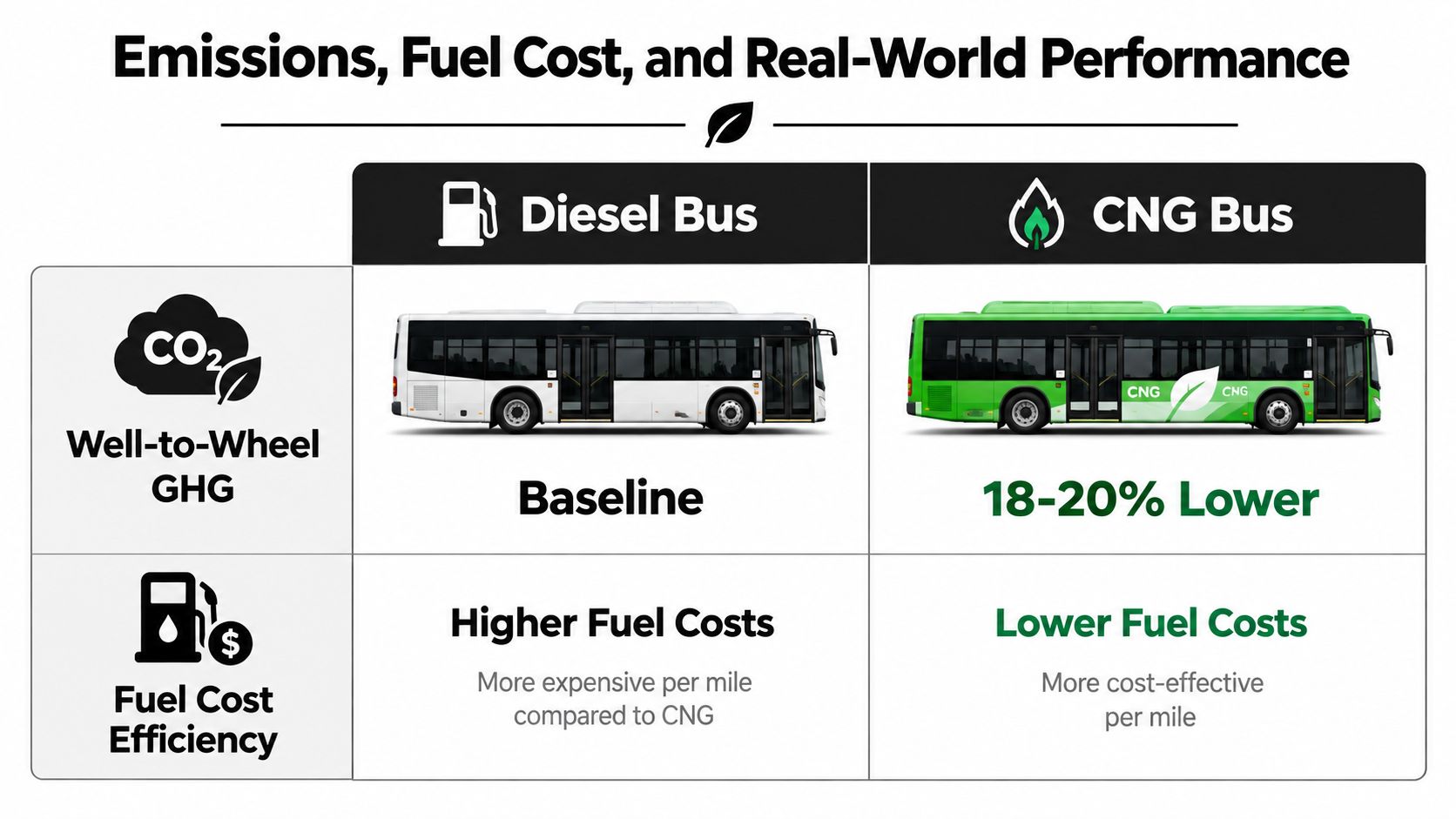
A CNG bus can lower greenhouse-gas emissions, but route conditions and depot operations determine whether the benefit holds in service. A U.S. Department of Energy case study found well-to-wheel greenhouse-gas emissions approximately 18% to 20% below conventional diesel for heavy-duty vehicles operated on CNG. Measured non-methane hydrocarbons, nitrogen oxides, and particulate matter were broadly comparable between the tested CNG and diesel engines, according to the DOE natural-gas bus service case study.
The practical conclusion is specific. CNG offers a credible lifecycle greenhouse-gas advantage, yet it does not guarantee a major reduction in every local pollutant. Engine calibration, operating conditions, and upstream gas assumptions affect the outcome, so agencies should base environmental claims on their own duty cycles rather than on fuel type alone.
Madrid testing shows why route modeling matters. CNG-bus NOx emission rates were about 60% lower than diesel at higher vehicle-specific power, while fuel consumption and CO2 increased 6% to 55% as grade and congestion worsened, according to the same DOE case study. A hilly, congested route needs a different emissions and fuel-cost model from a level route with steady speeds.
Fuel economics also depend on the equipment that delivers the gas. A low fuel price does not protect the operating budget if compressor capacity, dispenser availability, or the depot gas connection limits daily throughput. A fueling outage can force emergency arrangements, disrupt pull-out schedules, and erase expected savings through service delays and replacement fuel. Evaluate the compressor, dispenser, gas supply, and contingency plan alongside the bus purchase.
| Route or operating condition | CNG implication | Advisor's view |
|---|---|---|
| Predictable, centralized routes | Easier to plan fueling and maintenance | Stronger fit |
| Hilly or heavily congested service | Consumption and CO2 can rise | Model the duty cycle first |
| High local air-quality priority | Potential NOx and particulate advantages depend on testing conditions | Validate route-specific assumptions |
| Small fleet without resilient fueling | Compressor or dispenser downtime affects availability | Weak fit |
| High-utilization fleet with technical support | Scale can justify dedicated infrastructure | Consider a controlled deployment |
CNG is a sound option when the fleet can support its full operating system. Compare fuel and emissions under actual routes, then test whether the depot can keep buses fueled when the primary equipment or gas supply is unavailable.
Converting an Existing Bus Versus Buying New
The conversion question should start with the vehicle, but it must end at the depot. An older bus with limited remaining service life may not justify a new fuel system, while a newer platform with a supportive warranty and compatible duty cycle could be a candidate. The choice narrows quickly when managers apply four filters: vehicle age, warranty status, depot readiness, and route demands.
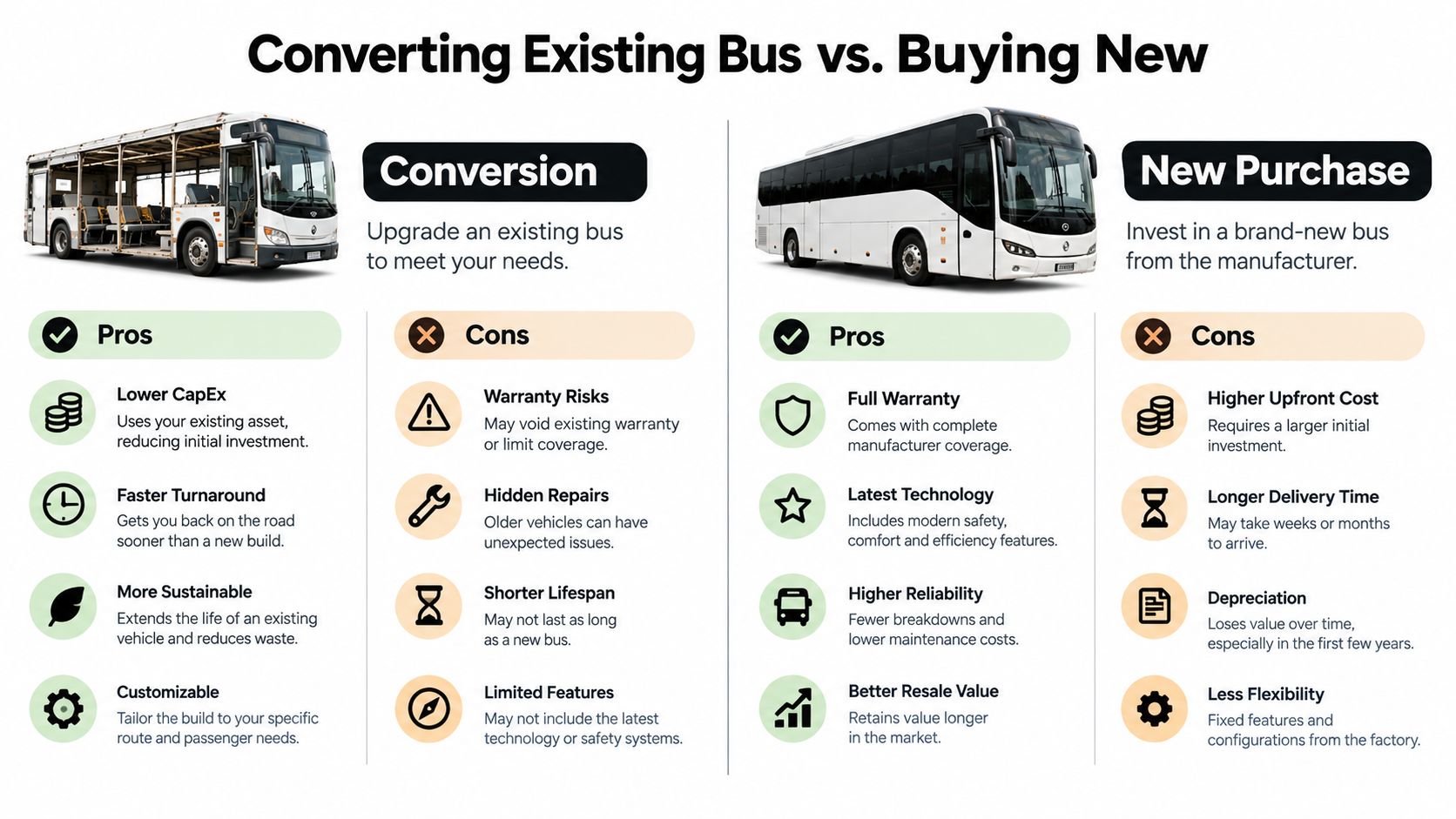
The capital gap is material. One industry analysis estimated that CNG buses averaged about $70,000 more than equivalent diesel buses, while fueling infrastructure could cost at least $25,800 per bus, according to the diesel-versus-CNG analysis. Those figures should be treated as planning references, not universal bids, because site conditions and procurement specifications vary.
Four filters for the purchase decision
Vehicle age comes first. Retrofitting an older bus can concentrate capital in a platform that already has body, suspension, transmission, or electrical wear. A younger bus may offer more usable life, but the conversion still needs engineering validation and a clear responsibility for system integration.
Warranty status is decisive. Factory-built CNG buses usually give an agency a cleaner path for warranty administration, parts coverage, and system accountability. A conversion can work, but the operator must identify who owns failures involving the engine, fuel controls, cylinders, pressure regulation, and integration work.
Depot readiness can end the discussion before procurement. If the facility can't support ventilation, gas detection, emergency shutoffs, inspection access, and compliant fueling equipment, the bus choice is premature.
Duty cycle separates a viable project from an expensive experiment. High-utilization routes can support dedicated infrastructure more readily than occasional service. A private shuttle operator may consider a CNG-blend or dual-fuel conversion when an existing gasoline operation and sustainability positioning matter, but that operator still needs reliable fueling and technical support.
A useful planning rule is simple: convert only when the vehicle has substantial remaining life, the warranty and engineering responsibilities are explicit, and the depot is already close to CNG readiness. Choose factory-built CNG buses for demanding transit routes where availability and support outweigh conversion savings.
Operators also need competent support for the rest of the fleet. A maintenance partner that handles specialized work, including Walking Floor trailer repair options, can help keep non-CNG assets from competing with the new fuel program for workshop capacity.
Fueling Infrastructure and Daily Depot Logistics
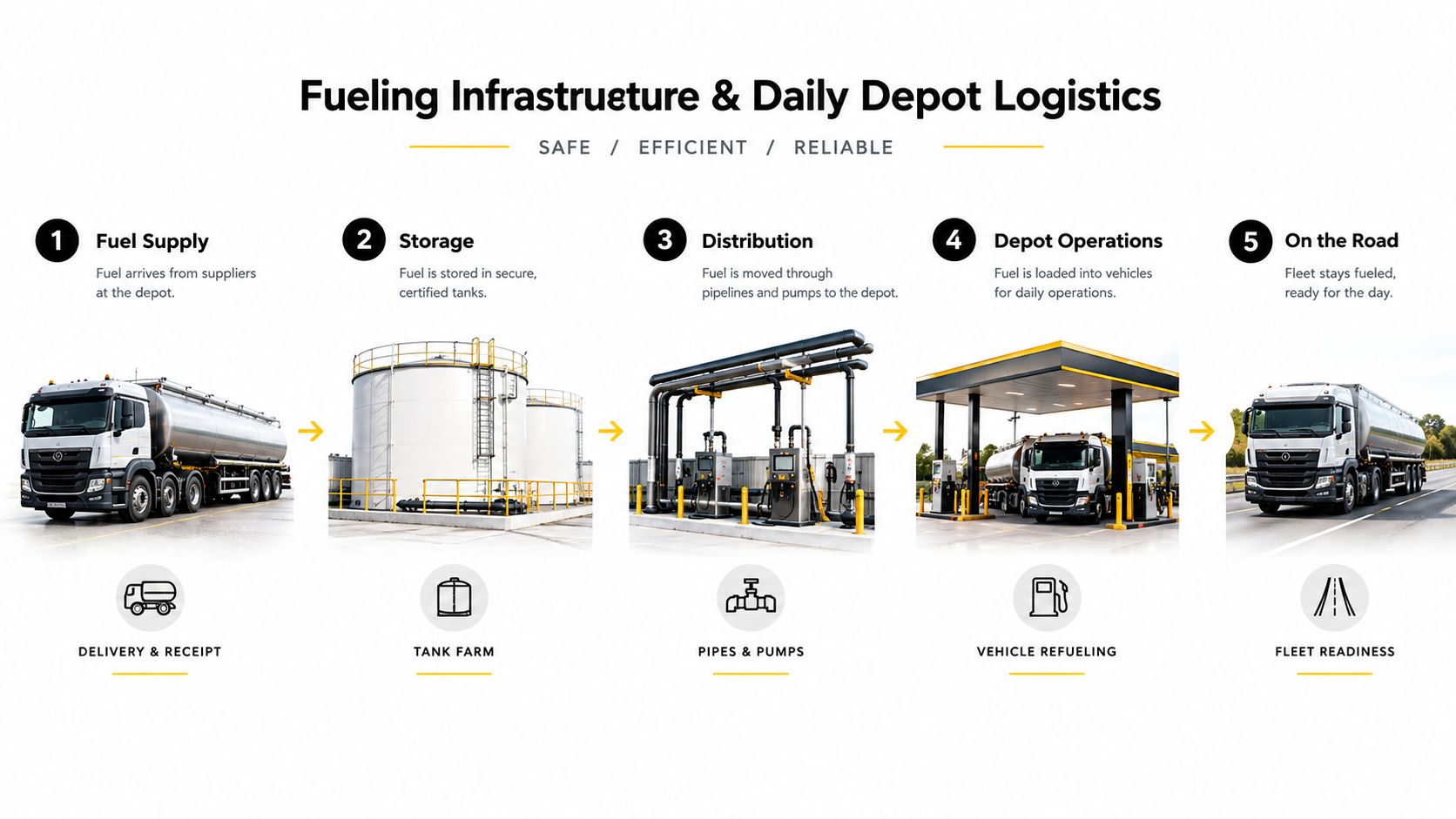
A CNG depot succeeds or fails before the driver connects the nozzle. Utility gas enters the site, the compressor raises pressure, treatment equipment controls gas quality, and the station sends fuel to buses according to the pull-out schedule. A weak compressor, undersized electrical service, or unavailable dispenser can leave vehicles parked even when the buses are ready.
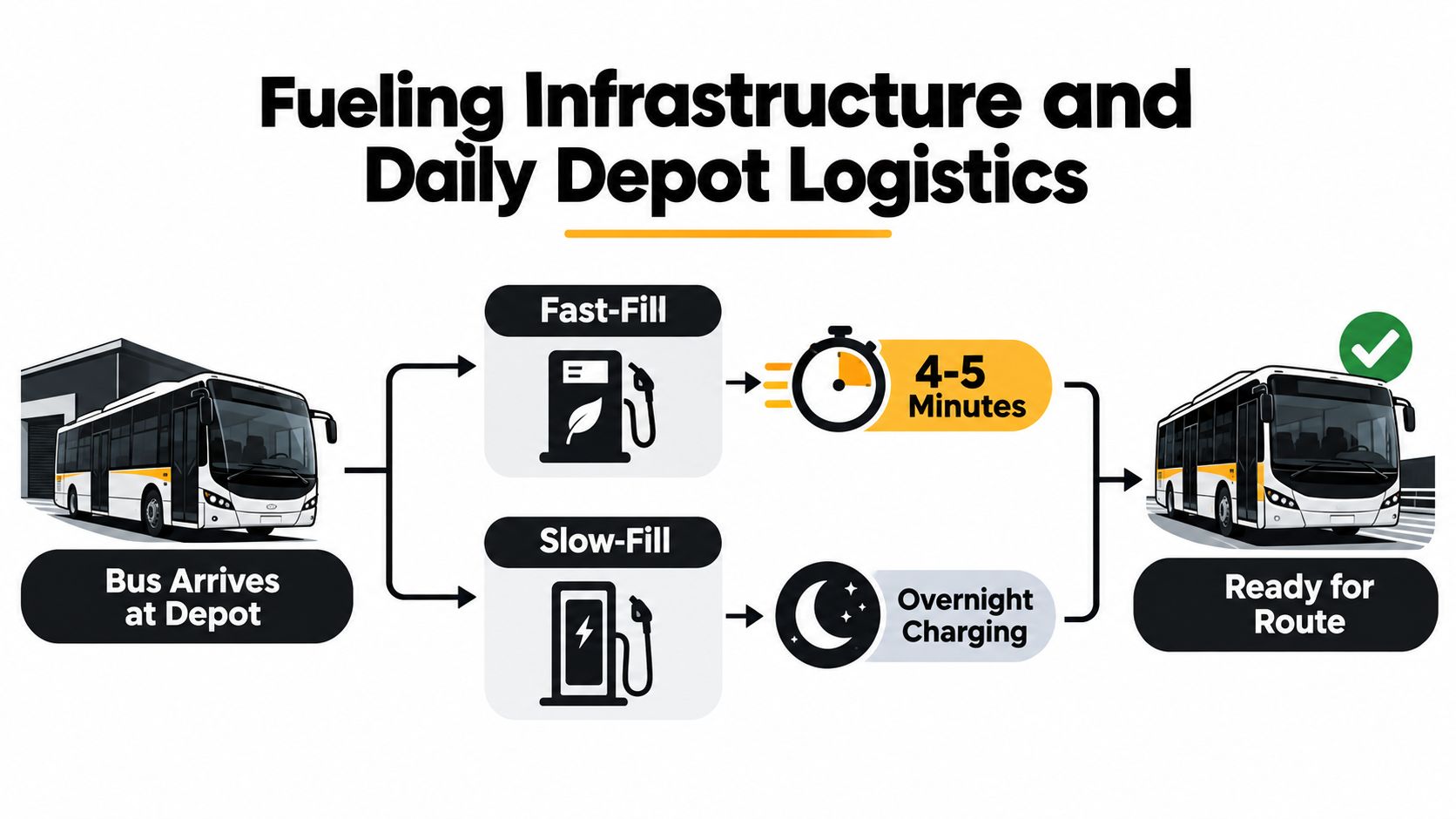
A fast-fill station stores compressed gas and dispenses it quickly, allowing one bus to refuel in roughly 4 to 5 minutes, according to DOE alternative-fuel station guidance. This arrangement suits fleets that return in waves or require rapid turnarounds. Specify enough compressor capacity, storage, electrical service, and dispenser redundancy to handle peak demand. Otherwise, a single equipment fault can delay an entire departure cycle.
Slow-fill systems fuel buses during an extended parking period, commonly overnight. They reduce pressure on rapid dispensing, but they make fueling capacity dependent on parking patterns, connector availability, and dwell time. Confirm that every bus can stay connected long enough to reach its required fuel level.
Equipment that sits between the utility and the bus
A station design must account for hidden equipment and the consequences of its failure.
- Compressor: Raises incoming gas to vehicle-fueling pressure. Poor maintenance or missing spare parts can remove buses from service.
- Priority panel: Directs gas among storage banks and dispensers. Incorrect settings can create slow fills or queues during peak fueling.
- Gas dryer: Removes moisture from the gas stream. Wet gas can freeze regulator valves in winter and contribute to dispenser faults.
- Odorizer: Maintains the recognizable odor associated with pipeline gas. A fault can make gas leaks harder to detect by smell.
- Emergency shutoff valves: Isolate fuel flow during an alarm, impact, fire, or maintenance event. Inaccessible or untested valves can delay a safe shutdown.
- Detection and ventilation: Monitor and control areas where combustible gas could accumulate. Failed sensors or fans can stop indoor work and prevent station operation.
- Inspection area: Provides a controlled location for cylinder checks and records. Poor access can delay inspections and keep buses out of service.
The dispenser is what drivers handle, but the compressor, controls, and gas supply usually determine whether the depot keeps its schedule. Require failure-mode plans, maintenance access, alarm-response procedures, tested shutoffs, and clear authority for returning equipment to service.
What Happens When the Gas Supply Is the Problem
The most serious CNG availability failure often starts outside the bus. A compressor can trip, a dispenser can become unavailable, a utility crew can interrupt service, or a permanent gas connection can fall behind the depot construction schedule. Severe weather can expose every weakness at once, especially when the operator has no alternate fueling site or mobile supply agreement.
That's why the contingency plan must be written before commissioning. It should identify how many buses can operate without normal depot fueling, which routes receive priority, who contacts the gas utility, who controls site access, and how maintenance staff verify that temporary equipment is safe to use.
Assign responsibility before an outage
The transit agency or fleet owner owns service priorities, route substitutions, communications, and the decision to activate emergency fueling. It should also maintain current fuel demand assumptions and identify buses that can be reassigned without compromising service.
The gas utility owns information about upstream supply, planned interruptions, connection timing, pressure conditions, and restoration estimates. The agency needs a named utility contact, not just a general service number.
The construction contractor and station integrator should manage equipment commissioning, punch-list items, alarms, ventilation tests, emergency shutoff verification, and documentation required for occupancy or operational approval.
The emergency supplier provides temporary or mobile natural-gas delivery when the permanent station or pipeline connection can't support operations. Mobile CNG or LNG units can serve as a bridging layer during construction delays, maintenance outages, or other interruptions, but the site must still establish safe connection, traffic, grounding, inspection, and operating procedures.
Pipeline work adds a separate compliance concern. Under 49 CFR Part 192, pipelines installed after July 31, 1971 must generally have suitable external coating and cathodic protection, with required CP placed in operation within one year after construction is completed, according to the Electronic Code of Federal Regulations pipeline requirements. Construction, replacement, and service interruptions can expose buried metallic assets to corrosion risk, so the project team should assign inspection and protection responsibilities rather than treating the pipeline as a finished background utility.
Contingency standard: If the fleet can't explain how buses will fuel during compressor failure or a delayed gas connection, the project isn't operationally ready.
A solid plan connects temporary gas delivery to generator commissioning, occupancy-permit milestones, utility cutover, and emergency exercises. The goal isn't to eliminate every failure. It's to prevent one station problem from becoming a missed service day.
What Real Fleets Have Learned
Sacramento Regional Transit began operating CNG buses in 1993 and eventually converted its entire 182-bus fleet, according to the APTA transit clean-technology reference. That decision shows what agency-wide commitment can achieve. A partial transition leaves an operator supporting two fueling cultures, training paths, parts inventories, and maintenance procedures.
Los Angeles County Metropolitan Transportation Authority began receiving natural-gas buses in 1995 and had more than 2,000 CNG buses by 2011. Los Angeles also became the first major U.S. transit agency to remove diesel buses entirely from its fleet in 2011, according to the same APTA reference.
Those milestones do not make CNG the right answer for every operator. They show that large-scale results depend on procurement, depot investment, technician capability, fueling policy, and daily operating practices moving together.
Evidence from a multi-agency survey
The National Renewable Energy Laboratory examined 10 transit agencies operating a combined 4,071 CNG buses across 24 maintenance garages. Individual agency fleets ranged from 15 to 2,509 buses, while CNG purchases represented approximately 20% to 25% of U.S. transit-bus sales over the preceding 10 to 15 years, according to the NREL transit bus evaluation.
The evaluation also estimated that transit CNG use reduced petroleum consumption by more than 200 million gallons per year. That result reflects sustained fleet operation across agencies, not a short pilot.
The reliability lesson requires disciplined interpretation. Some fleets reported lower mean distance between failures for CNG buses than diesel buses, while differences in reporting narrowed the apparent gap after adjustment. Fleet managers should therefore judge performance through consistent maintenance records, technician training, parts availability, and station uptime, rather than fuel type alone.
Depot equipment deserves the same attention as the buses. Compressor maintenance, dispenser performance, gas supply, emergency fueling procedures, and backup arrangements determine whether vehicles can leave on schedule. A well-specified bus cannot compensate for a station that cannot deliver fuel, so agencies should assign clear ownership for equipment inspections, response times, and contingency fueling before expanding the fleet.
Deciding Whether Compressed Natural Gas Buses Fit Your Operation
CNG is a strong option for operators with centralized depots, repeatable duty cycles, high vehicle utilization, and the capital to build resilient fueling infrastructure. It is a weak option for a small or dispersed fleet that can't amortize station costs, lacks technical support, or has no practical response to a compressor or utility outage.
Use a disciplined evaluation sequence:
- Model the routes. Test grades, congestion, dwell time, seasonal conditions, daily mileage, and fueling windows. Don't rely on a single laboratory emissions or consumption assumption.
- Survey the depot. Confirm space, ventilation, gas detection, emergency access, electrical service, cylinder inspection arrangements, and safe bus parking.
- Coordinate with the utility. Establish connection timing, pressure expectations, outage contacts, construction responsibilities, and restoration procedures.
- Identify contingency suppliers. Decide how temporary or mobile CNG or LNG delivery would connect to the operating plan during construction delays or service interruptions.
- Pilot before scaling. Use a controlled deployment to validate fueling flow, technician readiness, route performance, parts demand, and reporting quality.
Quick Decision Matrix for Choosing Compressed Natural Gas Buses
| Decision Factor | Strong Fit for CNG Buses | Weak Fit for CNG Buses |
|---|---|---|
| Duty cycle | High-utilization routes with predictable return-to-depot patterns | Short, scattered, or irregular routes |
| Depot | Space and approvals support high-pressure equipment, ventilation, and detection | Facility cannot safely accommodate CNG systems |
| Fuel supply | Reliable utility connection with a defined backup plan | Single point of failure with no emergency fueling |
| Capital plan | Agency can fund buses, station equipment, training, and inspections | Budget covers vehicles but not infrastructure |
| Maintenance | Technicians and parts support are available | No trained personnel or specialized service path |
| Risk tolerance | Management accepts infrastructure dependency and plans for it | Service reliability leaves no room for fueling disruption |
Don't choose CNG because the fuel sounds cleaner or because another agency adopted it. Choose it when the route model, depot, gas supply, maintenance program, and contingency plan all support dependable service. Battery-electric buses may win where charging infrastructure and route schedules align better. Diesel may still win where simplicity, dispersed fueling, or limited capital outweighs CNG's emissions and petroleum-displacement benefits.
Blue Gas Express helps operators and project teams maintain natural-gas availability with temporary CNG and LNG delivery when permanent lines are delayed, under maintenance, or not yet ready for commissioning. Visit Blue Gas Express to discuss a practical mobile-fueling contingency for your depot or construction schedule.