

3,600 psi is the standard fill pressure for U.S. CNG systems at 70°F, and tanks are designed to withstand pressure up to 4,500 psi. On a construction site, however, the gauge won't always read 3,600 psi because gas pressure changes with temperature.
A generator operator may see a full reading after a delivery, leave the site overnight, and return to a noticeably lower gauge value. The first reaction is often to suspect a leak or a failed regulator. In practice, temperature, fill conditions, equipment ratings, and pressure measurement methods usually explain the change.
Mobile CNG systems require more discipline than merely watching one gauge. A temporary unit may travel through changing ambient conditions, receive a hot fill, supply equipment through portable regulators, and serve a site where the receiving cylinders or hoses have different pressure ratings. Safe operation depends on treating compressed natural gas pressure as a controlled operating condition, not as a number that remains fixed.
Understanding Temperature Effects on CNG Pressure Readings
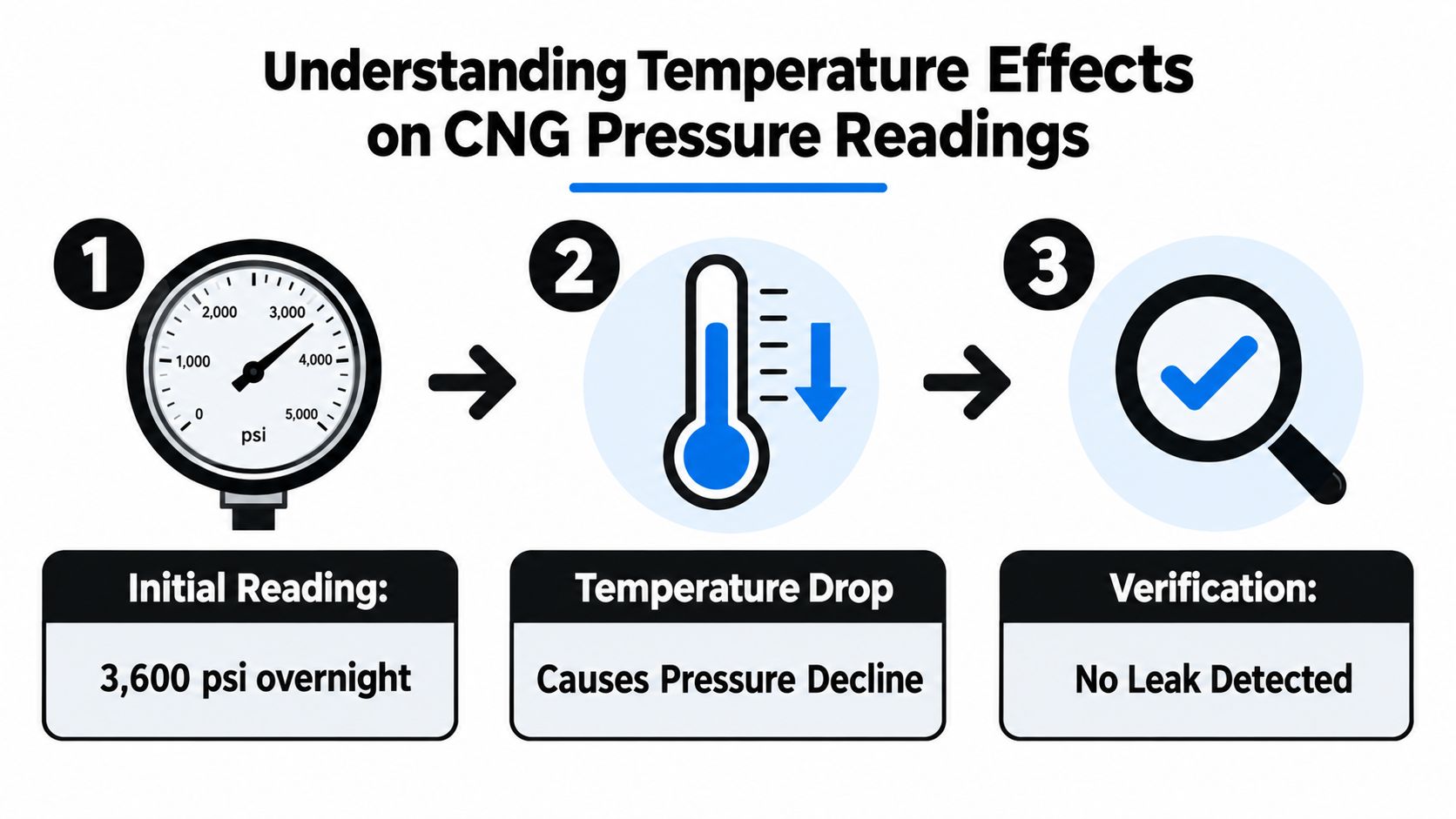
A site manager arrives after a cool night and sees the generator supply gauge has fallen from 3,600 psi to 3,200 psi. The delivery was completed correctly, the equipment is still operating, and no odor or audible release is present. The lower reading may be normal temperature behavior rather than evidence of a leak.
The U.S. Department of Energy explains that standard CNG fill pressures use 70°F as the reference condition, and pressure changes by roughly 100 psi for every 10°F above or below that reference temperature. A cylinder filled while the gas is warm can display a higher pressure initially. As the gas cools, the gauge reading settles downward even though the quantity of gas hasn't fallen proportionally. See the Department of Energy's explanation of CNG filling pressures and temperature effects.
Settled pressure versus dispensing pressure
The pressure shown during filling isn't always the settled pressure. Compression heats the gas, and the dispenser must account for that temperature rise. After transfer stops, the gas cools and the reading may decline.
A lower reading deserves investigation when it appears with other evidence, such as a continuing unexplained decline under stable temperatures, a hissing sound, visible damage, abnormal regulator behavior, or a gas detection alarm. Operators should compare pressure with temperature, delivery records, flow behavior, and equipment condition instead of treating a single gauge reading as proof of a leak.
Practical rule: Record ambient temperature, gas temperature when available, starting pressure, ending pressure, and delivered volume. Pressure alone is not a leak test.
CNG Service Pressure Classes and Standards
CNG pressure has never been represented by one universal number across every system. Equipment has been built around recognized service-pressure classes, and the correct class depends on the cylinder, vehicle or module, dispenser, regulator, and applicable installation standard.
The CSA/ANSI NGV 3.1 classification identifies three major categories for CNG vehicle fuel-system components:
| Service class | Approximate pressure |
|---|---|
| P24 | 2,400 psi |
| P30 | 3,000 psi |
| P36 | 3,600 psi |
These categories reflect the coexistence of older and newer configurations. P30 systems remain in use, including in overseas markets, while P36 at 3,600 psi is the principal U.S. benchmark for modern CNG fueling. The classification matters on a temporary site because a mobile unit must be matched to the receiving equipment's marked service pressure, not to the pressure the operator expects from a different installation. The CSA/ANSI NGV 3.1 standard overview provides the relevant service-pressure framework.
For vehicle-fueling applications, ISO 16923 defines a nominal service pressure of 20.0 MPa gauge, or 200 bar, at 15°C. Temperature-compensated filling may permit a maximum pressure of approximately 26.0 MPa, or 260 bar, when the station and vehicle system meet the required design and control conditions. Those figures aren't a license to fill every mobile module to the same level. They establish why the reference temperature, gauge basis, and equipment certification must appear in the commissioning record.
A construction contractor may also need a broader compliance workflow covering site fire equipment and related documentation. A compliance guide for QLD businesses can help teams organize that separate responsibility, but it doesn't replace the CNG pressure documentation required for the gas system.
Pre-Delivery Pressure Verification Checklist
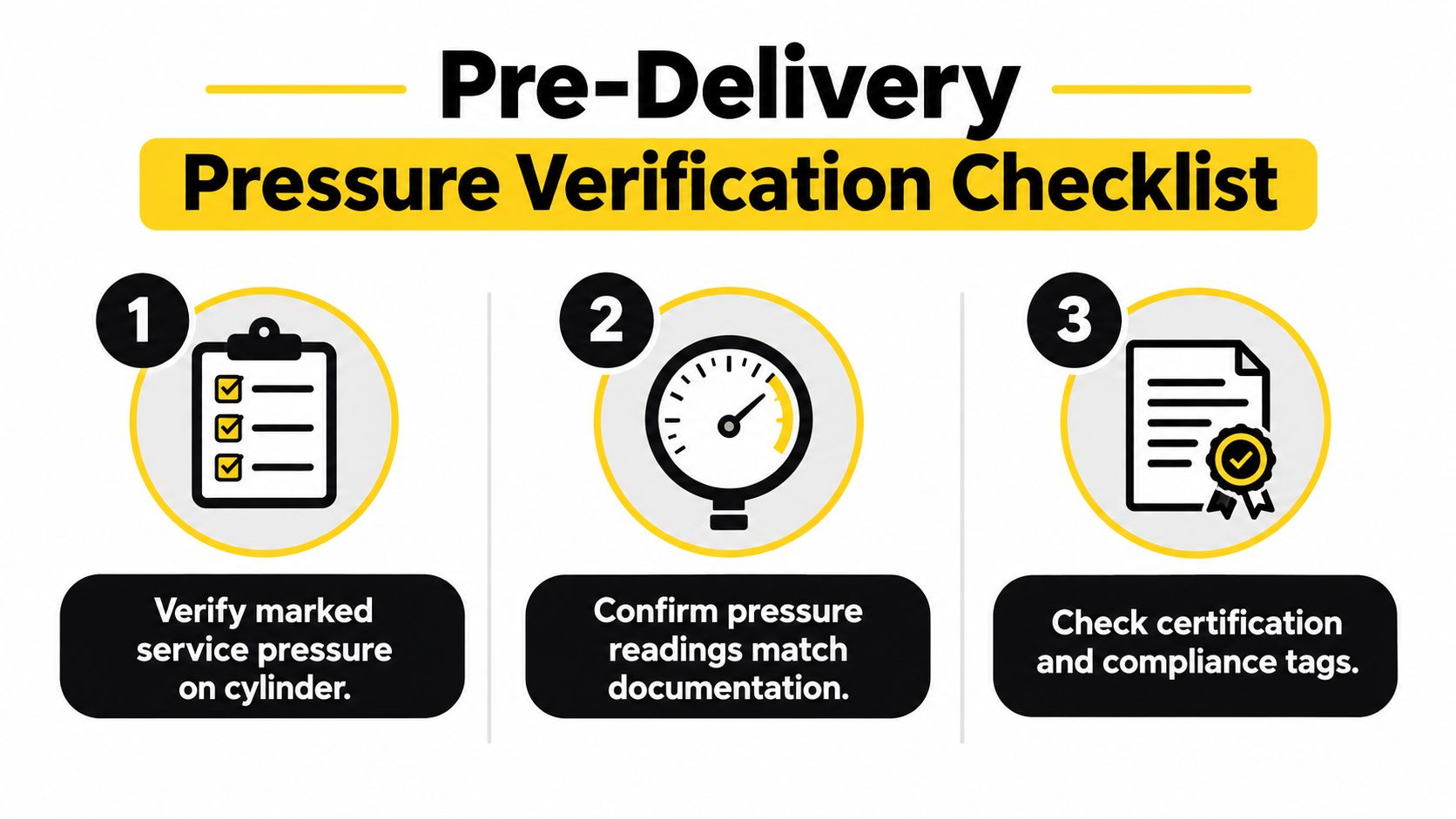
Before accepting a mobile CNG delivery, the site manager should verify the complete pressure path from the storage module to the receiving equipment. The aim isn't to collect paperwork for its own sake. Each check prevents an incorrect assumption about what the receiving cylinder, regulator, hose, or gauge can safely handle.
Verify the receiving cylinder's marked service pressure. Read the permanent marking or approved equipment record. Don't infer the rating from a previous delivery or from the pressure displayed on the trailer.
Confirm the reference conditions. Record gas temperature and ambient conditions so the pressure reading can be interpreted correctly. A gauge value without temperature context is incomplete.
Check pressure-transmitter status. Confirm calibration identification, inspection status, and the condition of the transmitter or gauge used to control transfer. A stable wrong reading is more dangerous than an obvious fluctuation.
Verify the maximum, not just the normal condition
ISO 16923 principles are useful beyond vehicle fueling. For temporary construction and industrial service, specify whether each pressure is gauge or absolute, state the reference temperature, and verify the station's maximum allowable operating pressure.
The regulator, hose, valve, fitting, receiving cylinder, and connected appliance must all be rated for the maximum operating condition, not merely the pressure normally seen during a delivery. Keep the signed verification record with the delivery paperwork so the next operator doesn't have to reconstruct the equipment limits from memory.
Pressure Relief and Gauge Requirements for Mobile Systems
A temporary CNG installation still needs the same engineering discipline as a permanent pressure system. Portable equipment often creates more opportunities for mismatch because storage modules, regulators, hoses, and receiving appliances may arrive from different suppliers.
NFPA 52-based practice requires pressure gauges to read at least 1.20 times the station MAWP, while shutoff valves must have a rated pressure no lower than the system or piping MAWP. Fuel-supply containers must not be exposed to more than 1.25 times their service pressure. A vehicle container is filled only to the quantity that produces service pressure at a uniform reference temperature of 70°F. These requirements are addressed in the NFPA 52 pressure-control provisions.
| Component | Minimum requirement |
|---|---|
| Pressure gauge | Read at least 1.20 times station MAWP |
| Shutoff valve | Rated no lower than system or piping MAWP |
| Fuel-supply container | Must not exceed 1.25 times service pressure |
| Hose assembly | Tested at no less than twice its MAWP before use |
| Relief-device discharge | Routed outdoors and away from hazards, including the specified 10 ft separation where applicable |
Why gauge selection matters
A gauge that tops out too close to normal operating pressure gives the operator little usable resolution and can hide an overpressure condition. A gauge with an appropriate range makes abnormal behavior easier to identify, while a calibrated transmitter supports automatic shutdown and temperature compensation.
Hose testing is equally important. A hose can look intact and still have an unsuitable pressure rating, damaged fittings, or a test record that no longer applies to the assembly. Relief-device discharge must be routed outdoors away from buildings, openings, property lines, public ways, and egress paths. The equipment layout should make that routing obvious before gas is introduced.
Mobile CNG Delivery Versus Permanent Pipeline Infrastructure
Permanent pipeline infrastructure generally operates within a designed network of fixed piping, known equipment, established regulators, and monitoring points. A temporary mobile system has a different risk profile. The storage module moves, the site may experience rapid weather changes, and the pressure-reduction equipment must be installed and verified at each deployment.
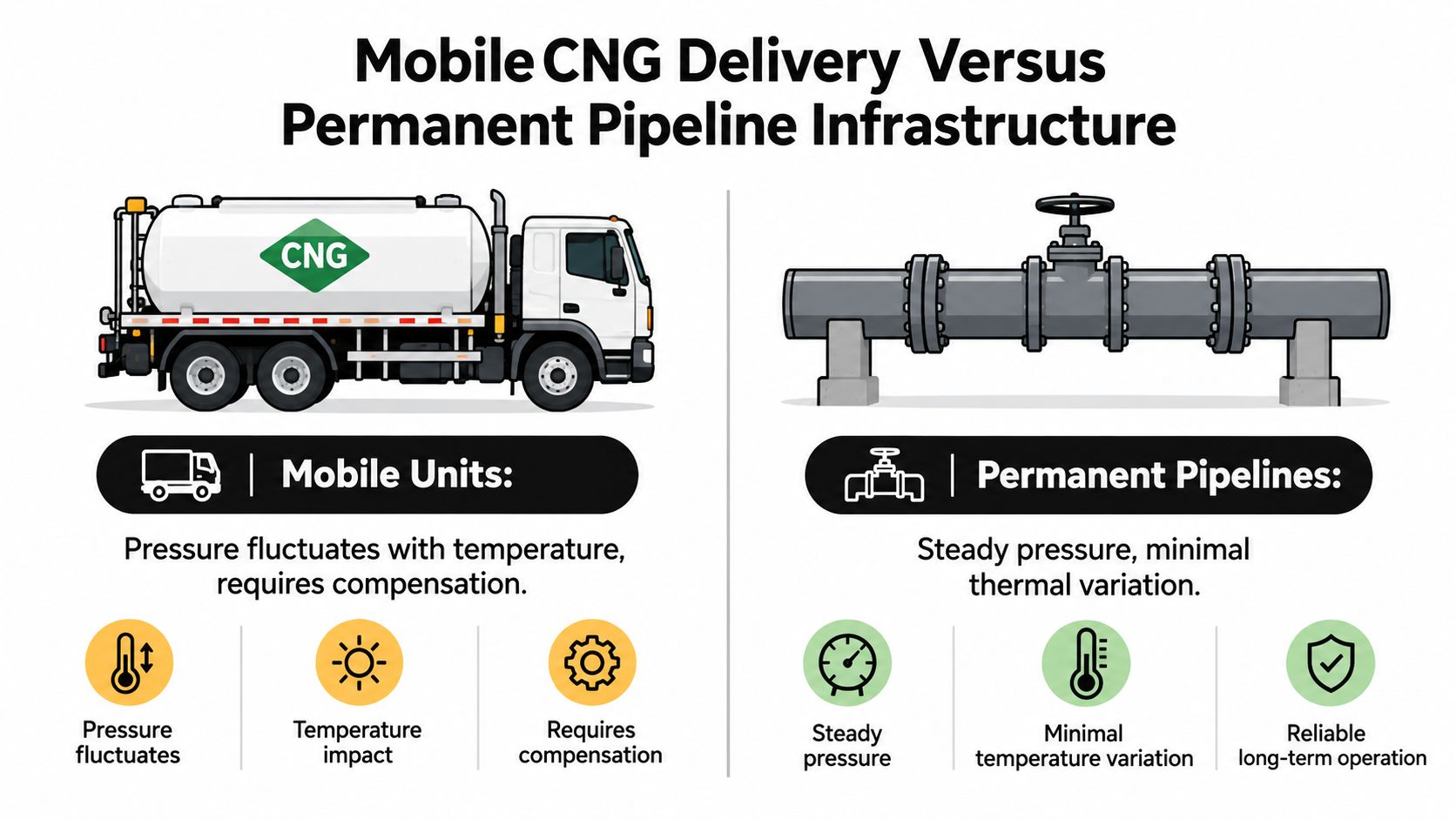
On a permanent installation, operators can rely on fixed test points, established set points, and a consistent equipment arrangement. A construction site may place the unit in direct sun during the day, expose it to cooler air overnight, and connect it to a generator whose demand changes as other loads start or stop.
| Mobile delivery unit | Permanent pipeline |
|---|---|
| Pressure conditions can change during transport and site storage | Equipment remains in a fixed network |
| Portable regulators and hoses must be verified at deployment | Regulators and piping are part of an established installation |
| Temperature effects may appear quickly | Thermal conditions are often more predictable |
| Operators must confirm the receiving system each time | The receiving configuration is usually known |
The practical difference is verification frequency. Mobile operators should recheck connections, readings, regulator behavior, and environmental conditions whenever the configuration changes, rather than assuming yesterday's readings describe today's installation.
CNG Tank Design Margins and Safety Factors
CNG tanks are designed with a margin above their normal operating pressure. U.S. Department of Energy guidance states that CNG tanks can withstand up to 125% of operating pressure. A 3,600 psi tank therefore corresponds to a technical pressure level of 4,500 psi, while a 3,000 psi tank corresponds to 3,750 psi. The EIA explanation of compressed natural gas provides the cited pressure and design-margin information.
That margin accommodates operating realities such as gas heating during a rapid fill and pressure increase when a cylinder warms after transfer. It doesn't change the service pressure, authorize an operator to exceed the marked rating, or replace relief devices and automatic controls.
Use the margin correctly
A brief reading above the settled standard can be understandable when temperature is changing, but it should never be dismissed automatically. The operator still needs to compare the reading with the cylinder marking, MAWP, relief-device settings, gauge range, and temperature conditions.
The practical error is to treat design strength as operating permission. A tank's ability to tolerate a pressure level during testing or an abnormal condition isn't the same as an approved fill target. Normal operation remains controlled by the marked service pressure and the engineered pressure-control system.
Integrated Safety Framework for Temporary CNG Operations
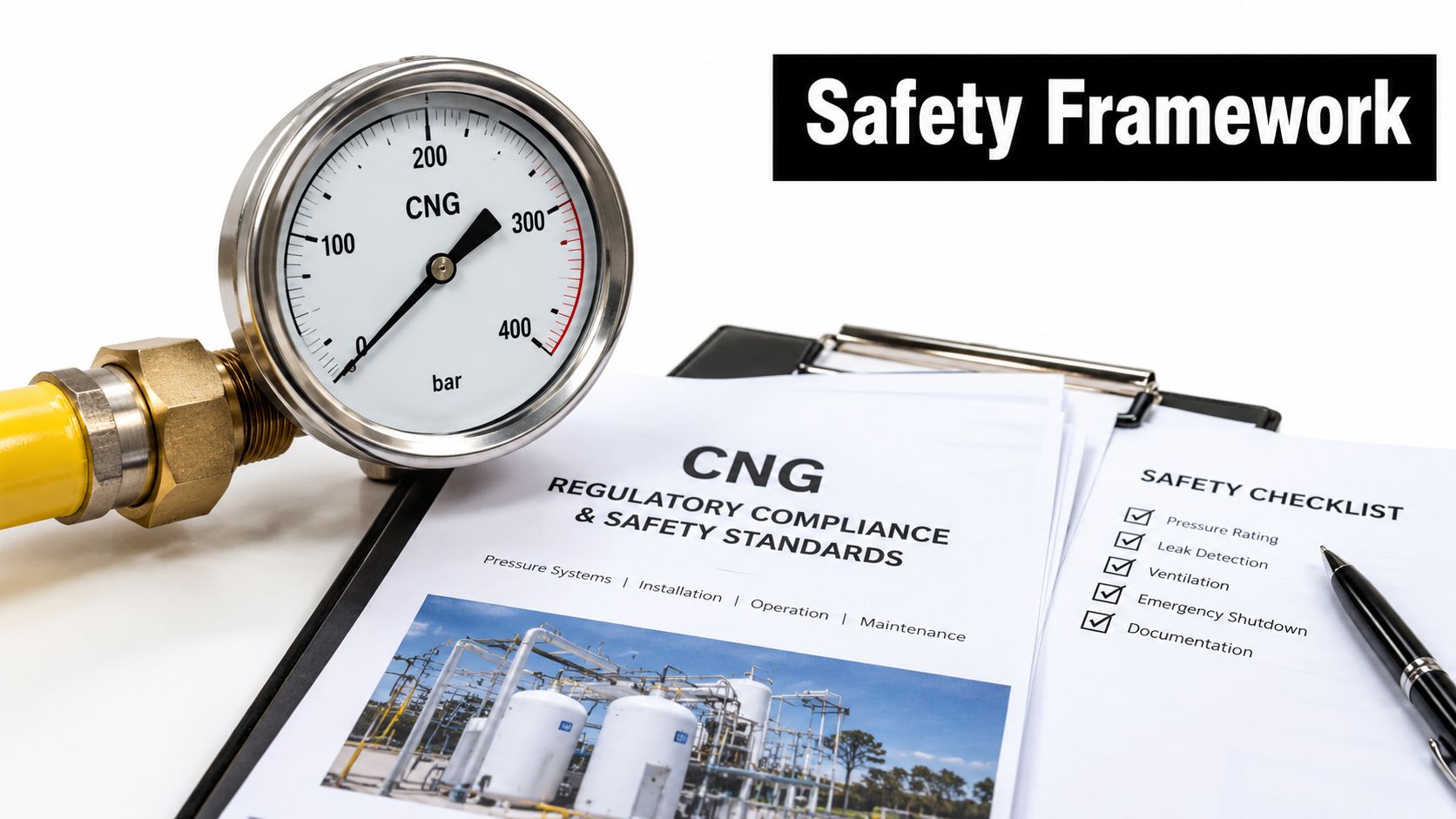
Safe temporary CNG service comes from connecting several controls into one field process. Temperature compensation explains the reading. Pressure classes identify the intended equipment range. Gauges, regulators, valves, hoses, and relief devices keep the system inside its allowable envelope.
Before gas introduction, the commissioning record should identify:
- Cylinder service pressure: Record the marked rating for every receiving cylinder or module.
- Maximum allowable working pressure: Document the applicable MAWP for the station, piping, and connected equipment.
- Relief-device settings: Confirm the devices are installed, accessible, correctly routed, and suitable for the system.
- Gauge range and calibration: Match each gauge to the required reading range and verify its inspection status.
- Hose test status: Check that the assembly has the required test evidence and remains suitable for service.
- Discharge routing: Confirm that relief discharge is directed outdoors and away from buildings, openings, property lines, public ways, and egress routes.
Treat the system as a chain
The weakest component determines the practical operating boundary. A correctly rated cylinder doesn't make an under-rated hose acceptable, and a well-calibrated gauge doesn't compensate for an incorrectly set regulator.
Blue Gas Express provides mobile CNG delivery using high-pressure tube trailers and pressure-regulating equipment that reduces gas pressure to the level required by connected equipment. Its temporary service can support construction, industrial, generator, occupancy, and freeze-prevention needs, but the receiving site's verification and commissioning records still govern whether the connection is ready for gas.
Quick-Reference Pressure Decision Matrix
Field operators need answers that can be used while a delivery is being prepared or a generator is running. The matrix below provides a practical starting point, but the equipment marking, approved procedure, and applicable code control when they impose a stricter requirement.
| Question | Guidance |
|---|---|
| Is a lower reading after a cool night automatically a leak? | No. Compare pressure with temperature, delivery records, flow behavior, alarms, and physical evidence. |
| What should be checked before transfer? | Confirm the receiving cylinder's service pressure, the temperature reference, transmitter status, station MAWP, and the ratings of regulators, hoses, valves, and fittings. |
| Should operators fill to a fixed gauge number in every condition? | No. Use temperature-compensated control and the receiving system's marked service pressure. |
| What indicates a genuine concern? | A continuing unexplained decline under stable conditions, abnormal regulator behavior, a hissing sound, visible damage, or a gas alarm. |
| Is pressure enough to plan the next delivery? | No. Use standardized mass, energy content, or corrected volume where available. |
| What should be recorded after delivery? | Starting and ending readings, temperatures, delivered quantity, equipment identification, alarms, and any corrective action. |
The matrix works best when printed as part of the site's operating pack. Operators should still stop the transfer when readings exceed the approved boundary or when the pressure-control system behaves unexpectedly.
Why Pressure Alone Is an Unreliable Fuel Metric
A gauge measures pressure, not fuel quantity. That distinction becomes important when a mobile CNG module moves from a warm delivery environment to a cool construction site, or when a cylinder is filled quickly and then allowed to settle.
Two containers can hold comparable usable gas while showing different pressure readings because their temperatures differ. A cold-weather reading may look low without indicating that the same proportion of fuel has disappeared. Conversely, a warm reading may look reassuringly high even though it isn't a reliable measure of the energy available after the gas cools.
Pressure is a condition of the gas at a particular temperature. It isn't a direct inventory measurement.
Plan deliveries around usable quantity
For project scheduling, standardized mass, energy content, or corrected volume is more reliable than a simple “full” or “low” gauge label. This approach prevents a site manager from requesting a premature delivery because a cold cylinder displays less pressure, and it reduces the risk of assuming that a warm gauge reading represents more usable fuel than it does.
The operating record should pair the pressure reading with temperature and delivered quantity. If the supplier's metering system provides a corrected quantity, use that value for consumption planning while retaining pressure as a safety and equipment-control measurement.
Essential Takeaways for CNG Pressure Management
A mobile CNG system is ready for service only when its pressure reading, equipment ratings, instruments, and site controls agree. A gauge that looks acceptable cannot compensate for an incorrect regulator setting, an overdue hose test, or a relief outlet aimed toward a work area.
Site-manager commissioning workflow
Before delivery, record each cylinder's marked service pressure, the station or piping MAWP, gauge range, transmitter calibration status, regulator settings, and shutdown setpoints. Keep those records with the delivery paperwork so operators can compare field readings with the approved configuration.
At arrival, document ambient and gas temperature, delivery pressure, corrected quantity if available, and the time of measurement. Repeat the check after rapid filling, transport, direct sun exposure, or overnight cooling. This creates a usable baseline for distinguishing temperature-related changes from a developing leak or regulator problem.
Inspect the complete pressure path before connecting temporary equipment. Confirm hose test status, valve and fitting ratings, connection condition, relief-device installation, and discharge routing. Relief outlets should terminate outdoors, away from buildings, openings, property lines, public ways, and egress paths.
Use standardized mass, energy content, or corrected volume to schedule deliveries. Keep pressure in the record for equipment control and safety review, not as the sole measure of remaining fuel.
Escalate any reading that conflicts with the equipment record, temperature conditions, or operating behavior. Stop transfer when a relief device, automatic shutdown, gauge, regulator, or connection does not perform as specified. Do not reset a protective device until the cause has been identified and the system has been assessed by qualified personnel.
Blue Gas Express provides temporary CNG delivery, mobile high-pressure tube trailers, pressure regulation, and monitoring support for construction and industrial sites awaiting permanent service. Visit Blue Gas Express to discuss a temporary setup matched to equipment ratings, delivery conditions, and the project schedule.