

A fuel outage rarely arrives as a clean, measurable event. The utility gives you a repair estimate, the generator supplier gives you a runtime figure, and the delivery company asks where the truck can unload. Then the outage stretches, access roads tighten, and the fuel plan you approved on paper starts failing in the field.
The right question isn't “Which fuel has the lowest price?” It's which supply method can keep the required equipment operating throughout the logistics window. Mobile CNG, mobile LNG, diesel deliveries, and temporary pipeline connections each solve a different problem. Each also breaks down under pressure when the outage duration, load profile, or site constraints don't match the option.
When a Job Site Loses Fuel Access
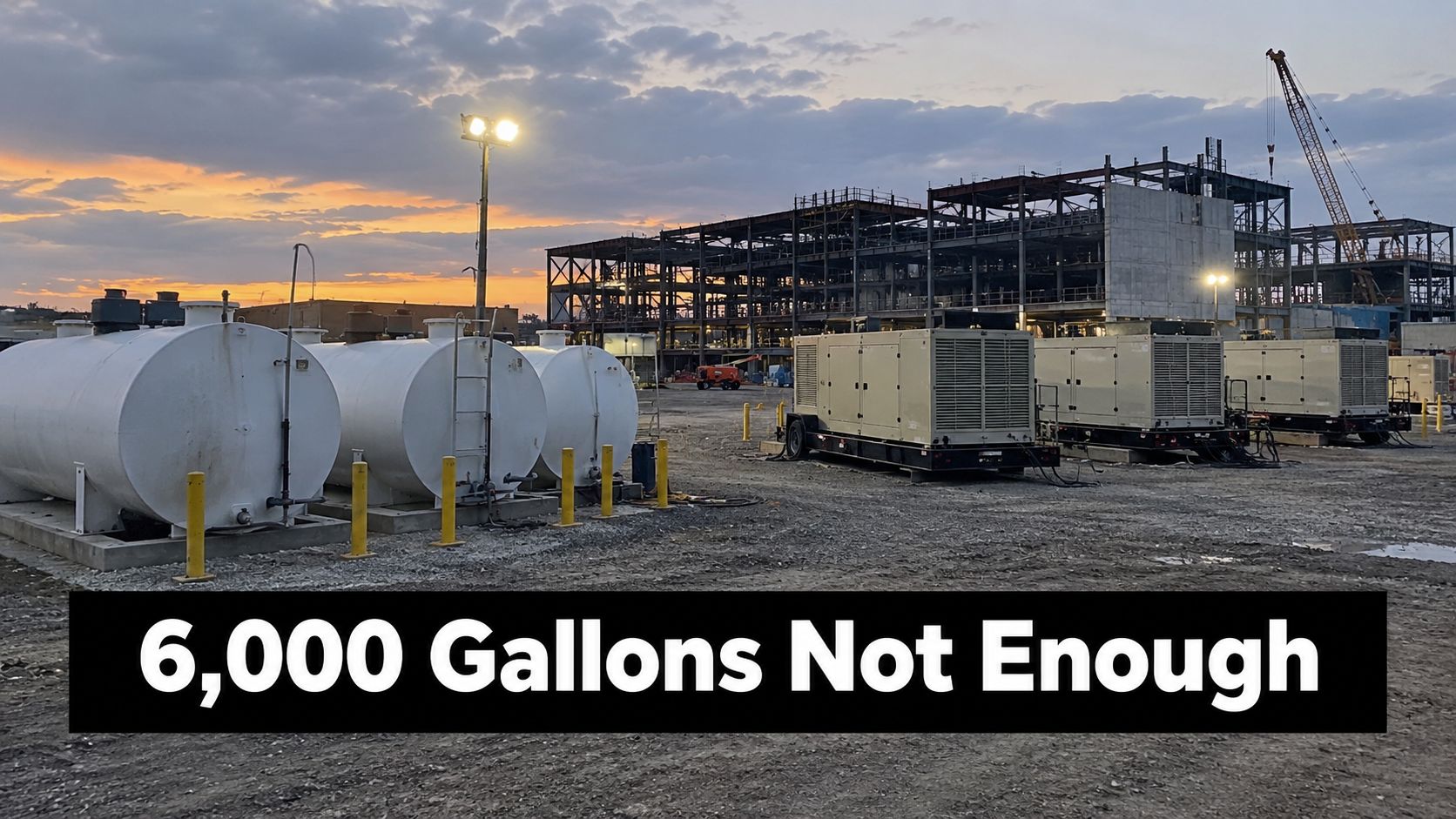
Consider a Midwestern data center construction site after a pipeline repair shuts off gas service. The project manager has specified standby fuel and arranged for deliveries, but the site is consuming fuel for prime power and space heating at a rate the original plan never modeled. A delivery volume that looked generous during commissioning now disappears quickly, while the utility's repair estimate keeps moving.
The manager has four practical lanes. A mobile CNG system may arrive quickly and fit a constrained laydown area. Mobile LNG can place more usable fuel near the site with fewer replenishment movements. Diesel top-offs work well when generators, tanks, and delivery access already exist. A temporary pipeline tie-in may be the right answer for sustained industrial demand, but it won't help if permitting and right-of-way work haven't started.
A municipal water treatment plant presents a different problem. By the third day of generator operation, the priority is no longer getting fuel on site. Operators must manage delivery continuity, tank condition, fuel quality, security, and the possibility that road access will deteriorate before the utility restores service.
A remote compressor station may have more time to plan but less flexibility once the response starts. If the tap crew is four days away, waiting for a permanent connection can leave the station exposed. The temporary option must cover the gap, tolerate remote-site logistics, and support the station's actual load rather than its nameplate capacity.
Field rule: The outage clock starts when fuel access fails, not when the first quote arrives.
These scenarios have different urgency levels. Construction sites often need fast deployment and flexible swaps. Municipal facilities need dependable multi-day continuity and controlled replenishment. Industrial users need stable flow, compatible pressure, and a path that can support sustained demand. Treating them all as storage problems produces the wrong answer.
What Emergency Fuel Supply Actually Covers
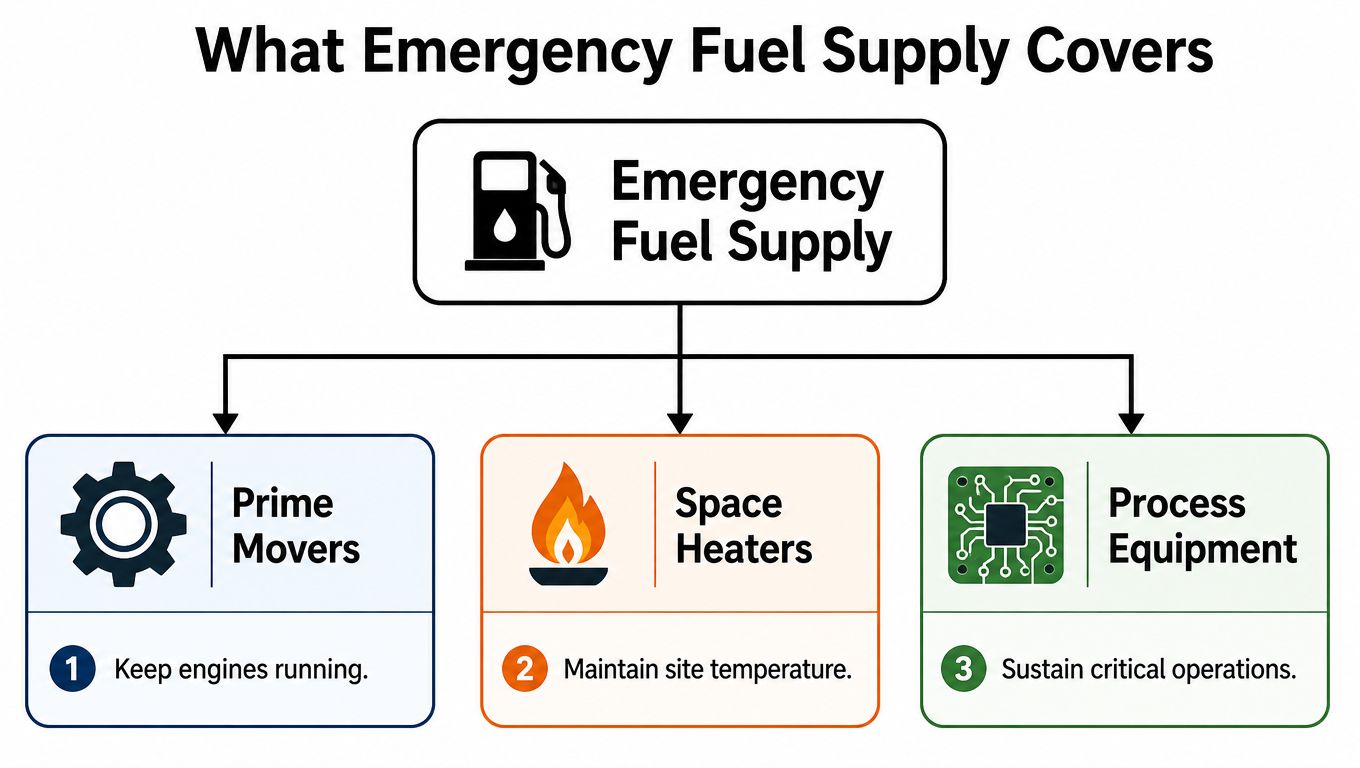
An emergency fuel supply is a short-duration, site-level delivery of gaseous or liquid fuel used to keep prime movers, heaters, or process equipment running when permanent supply is interrupted or unavailable. The term describes an operating response, not a national reserve, a long-term procurement contract, or a permanent bulk-storage installation.
That distinction matters. The U.S. Strategic Petroleum Reserve was authorized in 1975 after the 1973 to 1974 Arab oil embargo, received its first oil delivery on July 21, 1977, and was designed to protect the economy from future supply cutoffs. Its storage capacity was set at 713.5 million barrels, and its inventory reached 726.6 million barrels on December 27, 2009, before later drawdowns reduced holdings to about 372 million barrels as of August 1, 2024, according to the U.S. Department of Energy's Strategic Petroleum Reserve fact sheet. That is strategic national infrastructure, not a site delivery plan.
At the operational level, the category includes:
- Mobile CNG tube trailers, connected through approved pressure-regulation and delivery equipment.
- Mobile LNG ISO tanks, paired with vaporization equipment sized for the connected load.
- Diesel top-off deliveries, including deliveries to existing generator and equipment tanks.
- Temporary above-ground pipeline bypasses, installed to bridge an interrupted or delayed permanent connection.
It doesn't include a permanent utility build-out, speculative propane standby with no confirmed equipment compatibility, or a grid-scale battery system. Those may have roles in a broader resilience plan, but they aren't emergency fuel delivery methods.
Duty cycle determines the supply class
Use three operating categories:
- Ride-through, where the system covers a short interruption, controlled shutdown, commissioning activity, or site egress period.
- Multi-day outage, where deliveries, swaps, inspections, and fuel quality management become part of daily operations.
- Seasonal displacement, where temporary supply supports a site for an extended period while a permanent line, plant, or infrastructure project is delayed.
National reserves demonstrate the value of a buffer, but they don't remove the last-mile problem. Official planning for the SPR has commonly used roughly 90 days of import protection, while a 2020 Congressional Research Service summary described U.S. emergency petroleum stocks as equivalent to about 274 days of the previous year's net imports and commercial stocks as another 423 days, or roughly 697 days combined. The Department of Energy overview of SPR use and emergency releases also records four emergency releases and a coordinated drawdown of 33.75 million barrels after the 1990 Iraq invasion of Kuwait. Those figures describe strategic shock absorption, not how quickly a truck can reach your gate.
Comparing Mobile CNG, Mobile LNG, Diesel, and Temporary Pipelines
The four options should be judged against the outage clock, not against a generic fuel preference. Deployment speed, delivery density, site access, and duty cycle matter more than a brochure's storage rating.
Emergency Fuel Supply Options at a Glance
| Option | Deployment Speed | Energy Density | Scalability | Best Use Case |
|---|---|---|---|---|
| Mobile CNG | Fast for natural-gas loads when access and connection points are ready | Moderate per trailer, with a compact equipment footprint | Add trailers or swap units as demand rises | Construction, commissioning, and short to medium outages |
| Mobile LNG | Fast once the site is prepared, with high fuel density per delivery | High, with cryogenic storage and vaporization requirements | Stack tanks and vaporization capacity for larger loads | Municipal or industrial sites with high demand and limited resupply access |
| Diesel top-offs | Very fast where tanks, vents, and truck access already exist | High for generator and equipment duty | Add delivery frequency, tanks, or both | Backup generators and short-window interruptions |
| Temporary pipeline | Slowest because engineering, permits, testing, and tie-in work come first | Continuous flow rather than truck-limited storage | Strong for sustained industrial demand | Long outages and process loads near a usable gas connection |
Mobile CNG wins on speed and footprint for natural-gas equipment, but it becomes difficult when trailer swaps are frequent, site access is narrow, or demand is high and continuous. It suits a construction project that needs to keep heaters, temporary power, or commissioning equipment running without installing a permanent service.
Mobile LNG wins on delivery density when the site consumes substantial gas or resupply routes are unreliable. It requires a cryogenic tank, vaporizer, pressure control, trained operators, and room for safe separation. LNG isn't the casual choice for a tight urban site with no space for equipment and no clear delivery route.
Diesel is the honest answer when the facility already owns compatible generators, tanks, vents, and transfer equipment. It avoids a gas conversion, but it concentrates risk in truck access, fuel quality, tank capacity, and generator burn rate. Diesel also becomes a poor fit when the facility needs continuous thermal or process gas rather than electricity.
Temporary pipelines are the long-duration tool. They can support continuous industrial demand without repeated truck movements, but they need engineering, permits, right-of-way access, pressure testing, tie-in work, and a credible restoration plan. Starting this lane after the outage begins is usually a scheduling failure.
Cold weather changes the ranking. Diesel can remain practical for generator duty if tanks and equipment are maintained, while CNG and LNG systems require careful attention to pressure regulation, vaporization, freeze protection, and operating procedures. The choice should follow the load and site conditions, not an assumption that one fuel behaves the same in every season.
Decision test: If the option can't cover the full resupply cycle, it isn't sized for the outage.
Cost Drivers Most Comparisons Miss
Emergency fuel quotes often compare the commodity and the daily equipment rate while hiding the operational bill. That approach favors the option with the cleanest first page, not the lowest delivered cost.
Mobile gas units carry mobilization and demobilization charges, mileage-based delivery fees, connection labor, operator requirements, and possible after-hours dispatch premiums. A low daily CNG rate can exceed a higher LNG quote when cylinder capacity forces frequent swaps. The quote must show the complete delivery cycle, including how long a trailer can support the actual connected load and how quickly the supplier can replace it.
Diesel looks simple because the invoice shows gallons. The actual cost includes generator efficiency at the expected load, tank rental or inspection requirements, delivery frequency, spill controls, fuel polishing, and the risk of running below or above the generator's efficient operating range. Cummins guidance describes typical emergency reserves as often sized for 2 hours for building egress or 8 hours for most outages, and gives a 22 kW standby diesel set at about 50% load consuming roughly 0.8 to 1.2 gallons per hour, which translates to about 41 to 62 hours on a 50-gallon tank. Those figures appear in the Cummins application manual, but your own equipment's measured burn rate controls the decision.
Hidden Cost Drivers by Emergency Fuel Option
| Cost Driver | Mobile CNG | Mobile LNG | Diesel | Temp Pipeline |
|---|---|---|---|---|
| Mobilization | Trailer, regulator, hose, and crew movement | Tank, vaporizer, and cryogenic equipment movement | Truck and tank access | Engineering and construction mobilization |
| Replenishment | Swap frequency can dominate cost | Fewer deliveries, but each delivery needs compatible access | Frequent top-offs during high burn | Lower delivery frequency after commissioning |
| Commodity exposure | Gas price and delivered transport | LNG price, liquefaction, and transport | Diesel price and emergency delivery premiums | Gas commodity contract and construction cost |
| Idle time | Unit remains committed during delays | Tank and vaporizer remain committed | Trucks wait at the site or return later | Demurrage when crews wait for permits or right-of-way |
| Compliance cost | Gas detection, spacing, and trained handling | Cryogenic controls, vaporization, spacing, and trained handling | Venting, tank, transfer, and spill controls | Permits, pressure tests, inspections, and restoration |
Temporary pipelines introduce a different penalty. A crew waiting for a permit, access approval, inspection, or right-of-way can generate demurrage before any gas flows. That cost may still be justified for a long outage, but it makes the option irrational for a short interruption.
Tank and generator rules can also make diesel more expensive than expected. NFPA 110 guidance commonly interpreted for Level 1 emergency power systems calls for a minimum 96-hour onsite fuel supply, with tank sizing at 133% of the fuel required at full rated load. In the cited example, a 3,000 kW generator consuming 200 gallons per hour requires 25,536 gallons onsite under those criteria, as described by Curtis Power Solutions' NFPA 110 guidance. The lesson is straightforward. A nameplate rating doesn't size the emergency fuel system. The load profile does.
Deployment, Safety, and Runtime Sizing
Start with the equipment, not the fuel vendor. List every prime mover, heater, and process load that must remain online. Convert the connected demand into a common energy basis, such as MMBtu per hour for gas equipment or gallons per hour for liquid-fueled equipment, then model startup spikes, cold-weather demand, minimum operating pressure, and the time between deliveries.
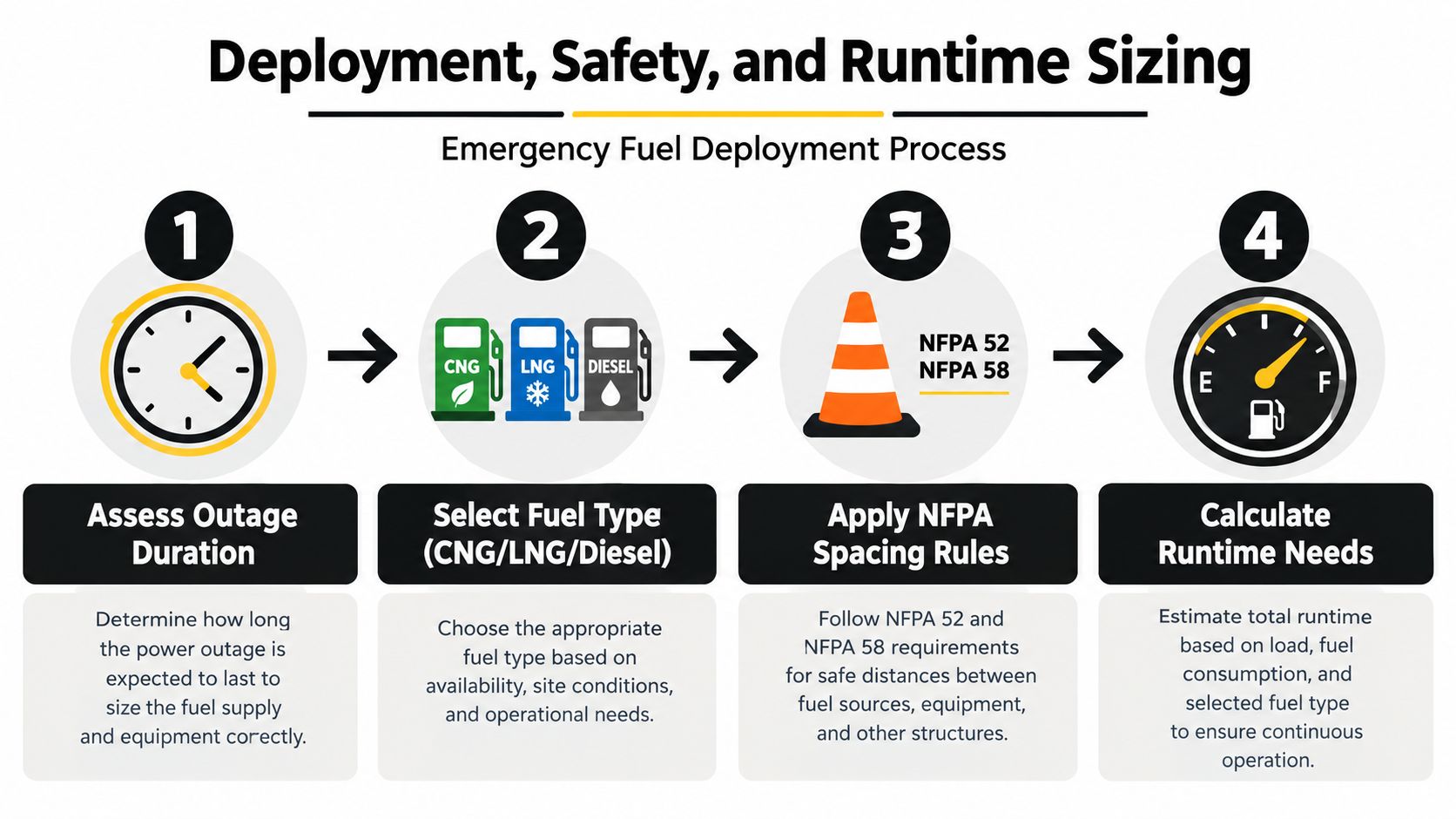
The sizing process should follow a fixed sequence:
- Assess the outage duration. Use the utility's repair estimate as a planning input, not a guarantee. Add the time required to schedule the next delivery or swap.
- Calculate actual duty-cycle demand. Separate continuous thermal loads from intermittent motors, heaters, compressors, and generator loads. A generator operating at partial load won't consume fuel at its full-rated-load rate.
- Add operating margin. Account for cold starts, weather, demand surges, equipment derating, and access delays. Don't use a nominal tank capacity as a runtime promise.
- Match equipment to the site. Confirm connection pressure, hose routing, ventilation, clearances, unloading space, emergency isolation, and operator qualifications before dispatch.
Site controls determine whether fuel can flow
Mobile CNG tube trailers require an approved layout, pressure regulation, protected hoses, gas detection where applicable, ignition-source control, and spacing consistent with the relevant NFPA 52 requirements and the authority having jurisdiction. LNG adds cryogenic exposure, vaporization capacity, pressure management, and a controlled unloading procedure. The vaporizer must handle the maximum simultaneous draw, not just the average demand.
Diesel sites need safe truck access, compatible fill points, tank setbacks, spill controls, ventilation, and transfer procedures. If a generator room or tank enclosure can't manage exhaust and fuel vapors, more diesel won't correct the site constraint.
A temporary pipeline tie-in needs the most disciplined commissioning sequence. Confirm the design pressure and materials, complete the required installation inspections, pressure-test the line, verify isolation and relief arrangements, inspect the connection, and obtain approval before introducing gas. A rushed tie-in is not a faster solution. It moves the outage risk into the commissioning phase.
Federal pipeline rules require each pipeline under cathodic protection to be tested at least once in each calendar year, with intervals no longer than 15 months. For separately protected short sections of mains or transmission lines no longer than 100 feet, sampling may be used, with at least 10% surveyed each year so the system is covered in 10 years, according to 49 CFR 192.465. PHMSA also says rectifiers should be checked six times per year, with no more than 2.5 months between checks, as described in its cathodic protection factsheet. These are ongoing integrity obligations, not substitutes for a temporary tie-in commissioning plan.
Matching the Right Option to Your Use Case
Construction sites usually need flexibility before they need maximum density. Equipment loads change as trades arrive, heaters cycle with weather, and laydown space disappears under materials. Mobile CNG is often the cleanest fit for a fast swap-and-go operation where a natural-gas connection is delayed or temporarily unavailable. It breaks down when the site needs high continuous flow, frequent trailer changes overwhelm access, or the available area can't support safe equipment placement.
Municipal facilities have less tolerance for delivery failure. A water plant, wastewater site, or public utility may need generators and process equipment operating through a repair that lasts far longer than the original estimate. Mobile LNG is often better for high-volume demand where the site can support cryogenic equipment and wants fewer resupply movements. The tradeoff is greater equipment complexity and a stricter operating envelope.
Industrial facilities should start with the process load. A plant with a steady thermal demand, existing pipeline proximity, and a long outage window can justify a temporary pipeline tie-in. The longer lead time becomes acceptable because continuous flow and reduced truck dependence matter more than rapid first deployment. If the site is remote or the connection route is uncertain, mobile LNG can serve as the bridge while the permanent work proceeds.
Diesel belongs in the short-window and generator-only tier. It makes sense where compatible tanks and generators already exist, the site has reliable truck access, and gas infrastructure would take longer to mobilize than the outage is expected to last. It becomes a weak choice for continuous process heat, constrained urban deliveries, or prolonged operation with inadequate storage.
Best Emergency Fuel Option by Customer Profile
| Customer Profile | Recommended Option | Outage Window Fit | Key Tradeoff |
|---|---|---|---|
| Construction | Mobile CNG | Ride-through to multi-day work | Fast deployment, but trailer swaps can limit continuity |
| Municipal | Mobile LNG | Multi-day to extended outages | Dense supply, but cryogenic equipment needs space and trained handling |
| Industrial | Temporary pipeline | Long-duration or seasonal displacement | Continuous flow, but permits and commissioning delay deployment |
| Generator-focused site | Diesel | Short interruption or existing-fuel backup | Familiar equipment, but delivery and runtime depend on tank capacity |
European reserve distribution shows why location matters as much as headline volume. EU countries held about 39 million metric tons of emergency gasoil and diesel in May 2025, while Germany and France together accounted for roughly 35% of those reserves, according to reporting on the distribution of Europe's emergency diesel stocks. A regional reserve can look adequate while a specific hospital, construction site, or industrial facility still waits for finished fuel to reach its gate.
Choose the option whose mobilization, runtime, replenishment, and demobilization windows fit inside the outage clock. The lowest headline rate is irrelevant if the equipment arrives late or needs more deliveries than the site can receive.
Choosing the Right Emergency Fuel Supply for 2026
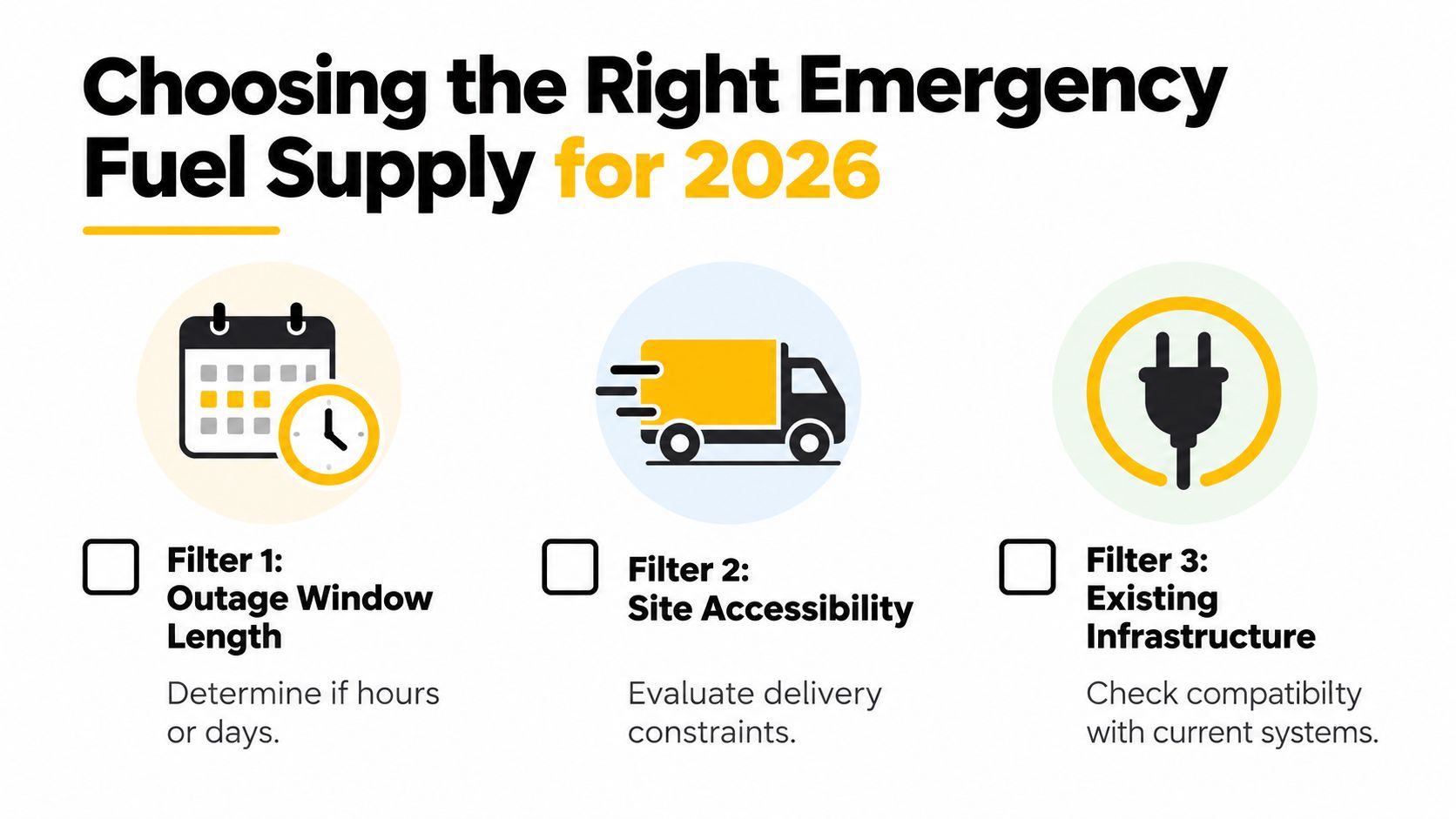
Use three filters before asking for a price. They eliminate bad options faster than a spreadsheet.
First, define the outage window. An interruption measured in hours points toward existing diesel capacity or a rapidly deployable mobile gas unit. An outage measured in days requires a delivery and swap plan. An outage measured in weeks can justify LNG or a temporary pipeline, especially if the permanent repair schedule is uncertain.
Second, quantify the load profile. Intermittent construction equipment and space heating may favor mobile CNG. A steady municipal or industrial demand can favor LNG or a pipeline connection. Generator-only demand may favor diesel when the tanks and transfer points are already compliant.
Third, inspect the site. Measure gate width, turning radius, unloading position, hose route, ventilation, ignition-source separation, drainage, security, and available laydown area. A fuel that works technically may still fail operationally if the delivery truck can't reach the connection point or the equipment can't be isolated safely.
Apply the cost test after the site test
Once unsuitable options are removed, compare the full delivered cost. Include mobilization, demobilization, fuel commodity exposure, delivery mileage, unit swaps, after-hours dispatch, permits, inspections, crew standby, demurrage, tank rental, and the cost of a failed delivery window.
The EIA notes that industrial facilities, large buildings, institutional facilities, hospitals, and electric utilities commonly rely on diesel generators for backup and emergency power, but generator ownership alone doesn't guarantee continued fueling during a widespread disruption. Its overview of diesel fuel use in backup and emergency power reinforces the operational point. Resilience depends on the pumps, terminals, roads, trucks, and coordination that keep deliveries moving.
For procurement teams, a government RFP database can help identify public-sector fuel, emergency response, and infrastructure opportunities early, before an outage turns procurement into a rush order.
Use this checklist within the first hour:
- Confirm the outage duration: Record the utility estimate, the worst credible extension, and the required first-delivery time.
- Quantify daily energy demand: Document MMBtu, gallons, pressure, connected equipment, startup demand, and expected duty cycle.
- Verify site access dimensions: Check gates, turning space, unloading position, hose routes, clearances, ventilation, and security.
- Request comparable quotes: Obtain two quotes from mobile gas providers and one from a temporary pipeline specialist, using the same load and runtime assumptions.
- Document the decision: Record why the selected option fits the outage, site, safety controls, delivery schedule, and compliance requirements.
Call for mobile CNG when fast natural-gas deployment and compact equipment matter most. Choose LNG when demand is high, resupply access is difficult, and the site can safely support cryogenic equipment. Choose diesel when existing generators and tanks can carry a short outage without creating a delivery bottleneck. Choose a temporary pipeline tie-in when continuous industrial demand and a long outage make truck-based supply indefensible.
Blue Gas Express provides temporary mobile CNG and LNG delivery for commercial and industrial sites facing delayed gas-line installation, maintenance outages, generator commissioning, or freeze-prevention needs. Review your outage window and site requirements, then contact Blue Gas Express to discuss a mobile natural-gas supply plan.