

A CNG tube trailer is a road-mobile storage unit built from several high-pressure cylinders mounted permanently together on one trailer, carrying natural gas compressed to as much as 4,000 psig. It does the work a pipeline would do, for a site that doesn't have one yet.
The houses are finished. Sod is down, the driveways are poured, and the utility's main is still two months from being tied in, but the certificate of occupancy needs working gas appliances before the final walkthrough. Or a plant is mid-shutdown, the boiler that keeps process lines warm is offline, and the replacement supply has to arrive on a truck.
Both cases hit the same question. Can a trailer of compressed gas stand in for the pipe, and for how long, at what volume, and under whose rules?
Yes, inside limits you can work out before you order anything. Treat the trailer as a pipeline substitute on wheels, and it earns its place when the distance is short, the daily volume fits what one truck carries, and the site meets the handling requirements.
What a CNG Tube Trailer Is and Why It Exists
Start with a rack of scuba tanks bolted to a flatbed. Each tank holds gas at high pressure, a manifold ties them together so they fill and empty as one, and a single valve block controls the set. Scale that up to steel cylinders the length of a trailer and you have the machine.
The virtual pipeline training material from the U.S. Department of Homeland Security describes the design as two or more steel cylinders mounted together, with a rear valve box and visible plumbing that links the cylinders in a cascade-like system. Three parts are worth naming, because you'll inspect all three.
- The cylinder bank. Single-piece pressure vessels, permanently mounted, never swapped out individually.
- The rear valve box. Where filling, isolation and discharge happen, and where the relief devices sit.
- The manifold plumbing. The pipework tying the cylinders into one pressure system.
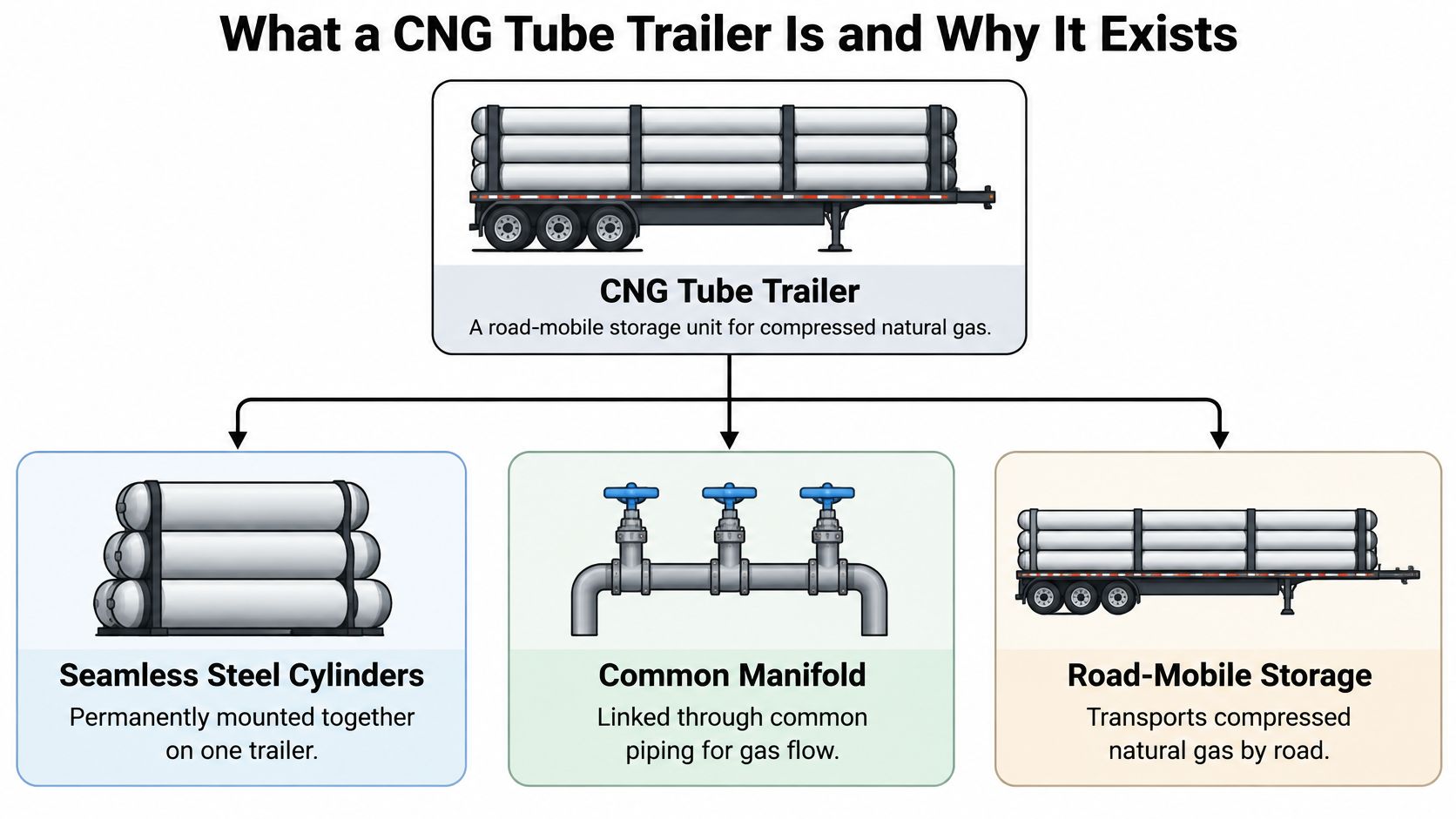
The manifold is why the unit behaves like a small gas system rather than a bottle. Gas enters through the common loading valves at a compression point, travels at high pressure while the truck drives, and leaves through the same valve set at the customer's site. Pressures inside those cylinders run far above what a building's gas train sees, which is why a regulator always sits between the trailer and the meter.
The reason the machine exists is blunt. Gas reaches sites that have no operating pipeline, are waiting for permanent infrastructure, or have lost supply during maintenance work.
The test that matters: if the site can take a permanent connection this quarter, take it. A trailer covers the gap between demand and pipe.
The value isn't the trailer. It's moving a large quantity of compressed gas from a compression point to an off-pipeline customer on one standardized platform. Hold onto that framing, because a tube trailer is a pipeline substitute on wheels, and its ceiling is how much gas one truck can legally and physically carry.
Pressure and Safety Numbers to Know
Four figures cover most of the pressure conversations, and the gaps between them explain why a delivery involves a regulator rather than a hose run straight from the trailer into the building.
| Setting | Pressure or ratio | What it tells you |
|---|---|---|
| Pipeline interconnection | 50 to 1,000 psig | Set by the connection point; the trailer must be regulated down to this range |
| CNG loading for US virtual-pipeline trailers | Up to 4,000 psig | Gas is compressed to this level before it is loaded and trucked |
| FMVSS 304 burst minimum, non-welded Type 1 container | 2.25 times service pressure | Minimum margin between working pressure and burst |
| FMVSS 304 burst minimum, welded Type 1 container | 3.5 times service pressure | Higher required margin for welded construction |
Read the top two rows together. A pipeline interconnection can sit anywhere from 50 to 1,000 psig, while a trailer may be filled to as much as 4,000 psig. No building gas train is built for the higher number, so the regulator between trailer and meter does the translating, and the site's working pressure sets the target.
The bottom two rows come from Federal Motor Vehicle Safety Standard 304, which sets the floor for the vessel itself. A Type 1 CNG container must show a burst pressure of at least 2.25 times service pressure when non-welded, and 3.5 times when welded. In plain words, multiply the number stamped on the cylinder and you get the pressure it has to survive without failing. The margin is wide because a cylinder sees pressure and temperature swings through filling, transport and withdrawal.
Pressure isn't free, either. The U.S. Department of Energy's tube trailer program page records that the TITAN V Magnum configuration was first deployed in compressed-natural-gas service in 2013, and that earlier steel trailers typically carried about 380 kilograms of hydrogen-equivalent gas where composite-vessel trailers reached approximately 560 to 900 kilograms. More pressure raises delivered capacity, but vessel strength, road weight, safety rules and permitted operating limits decide how much of that capacity reaches your site.
One check sits outside the pressure chart. Placarding. On the road the trailer is a hazmat shipment, and the diamond on the back tells a responder what's inside before anyone opens a valve. The Patriot CDL hazmat placard guide walks through the classes and when each applies, which is worth twenty minutes if you're the person signing the shipping paper.
How a Tube Trailer Delivers Gas to a Site
A delivery day has a fixed order, and every step exists for a reason. Skip one and the problem shows up at the meter.
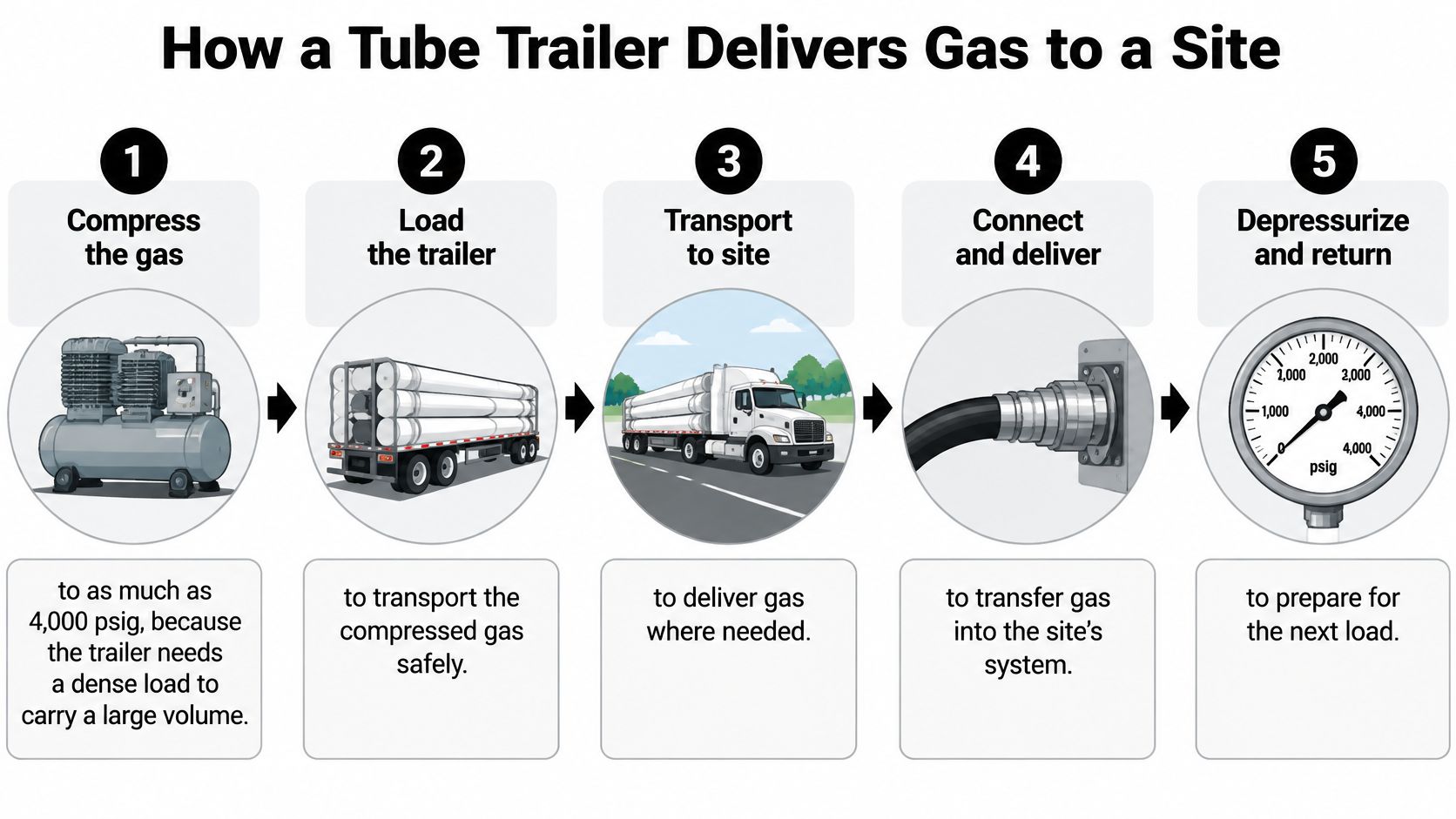
- Compress the gas. At the compression point, gas is packed to the trailer's rated fill pressure, because a dense load is the only way one truck carries a useful volume. A half-filled trailer just means more trips.
- Fill through the common loading valves. One valve set controls the whole bank, so loading is a single controlled operation rather than a cylinder-by-cylinder task nobody wants to repeat.
- Set the unit on level, load-bearing ground. Brakes on, wheels chocked, turning clearance kept open. A tall, heavy cylinder package can shift, and a slope or a soft shoulder changes what the trailer is standing on.
- Connect the rear valve box through a regulator and hose. Keep the run short and out of vehicle paths. Short runs lose less pressure and give a truck far less chance to catch the hose.
- Discharge at the flow rate the site needs. The regulator brings cylinder pressure down to the working pressure of the customer's equipment, so the regulator, not the trailer, decides what the building sees.
- Watch pressure as the bank drains. Book the replacement before the cylinders empty. A refill is a round trip, and a gap in supply stops the job.
Practical rule: the regulator protects the customer's system, not the trailer. Size it for the building's inlet, then confirm every hose and fitting on the trailer side is rated for full cylinder pressure.
A connection is behaving when the meter holds steady pressure through a draw test and no joint, hose end or fitting shows a leak. Anything that creeps, hisses or frosts needs attention before the truck leaves.
Where Tube Trailers Fit in Temporary Gas Service
A builder finishes a row of homes and the utility's line won't be tied in for months, but the occupancy permit depends on gas appliances working. That's the shape of nearly every tube trailer job: gas is needed now, the pipe arrives later.
Five cases that keep coming up
Line extension running late. A trailer keeps framing crews, drywall and painters on schedule while the gas main is behind. The gain is a permit date that doesn't move.
Occupancy and commissioning. Contractors run rooftop units, generators and temporary ambient heat before handover, so the punch list closes while the site is still staffed. The gain is an earlier handover.
Model homes and sales centers. Builders light fireplaces, hot tubs, heated pools, gas ranges and backup generators so buyers see them working on a tour. That demonstration is hard to match with a rendering.
Freeze protection. During a cold snap, gas heat protects equipment, pipes and finishes that would otherwise be drained or damaged. The gain is avoiding a repair bill and a schedule slip at the same time.
Industrial maintenance outages. A plant keeps process heat and boilers running while the permanent supply is serviced, so the outage stays on its planned duration instead of stretching.
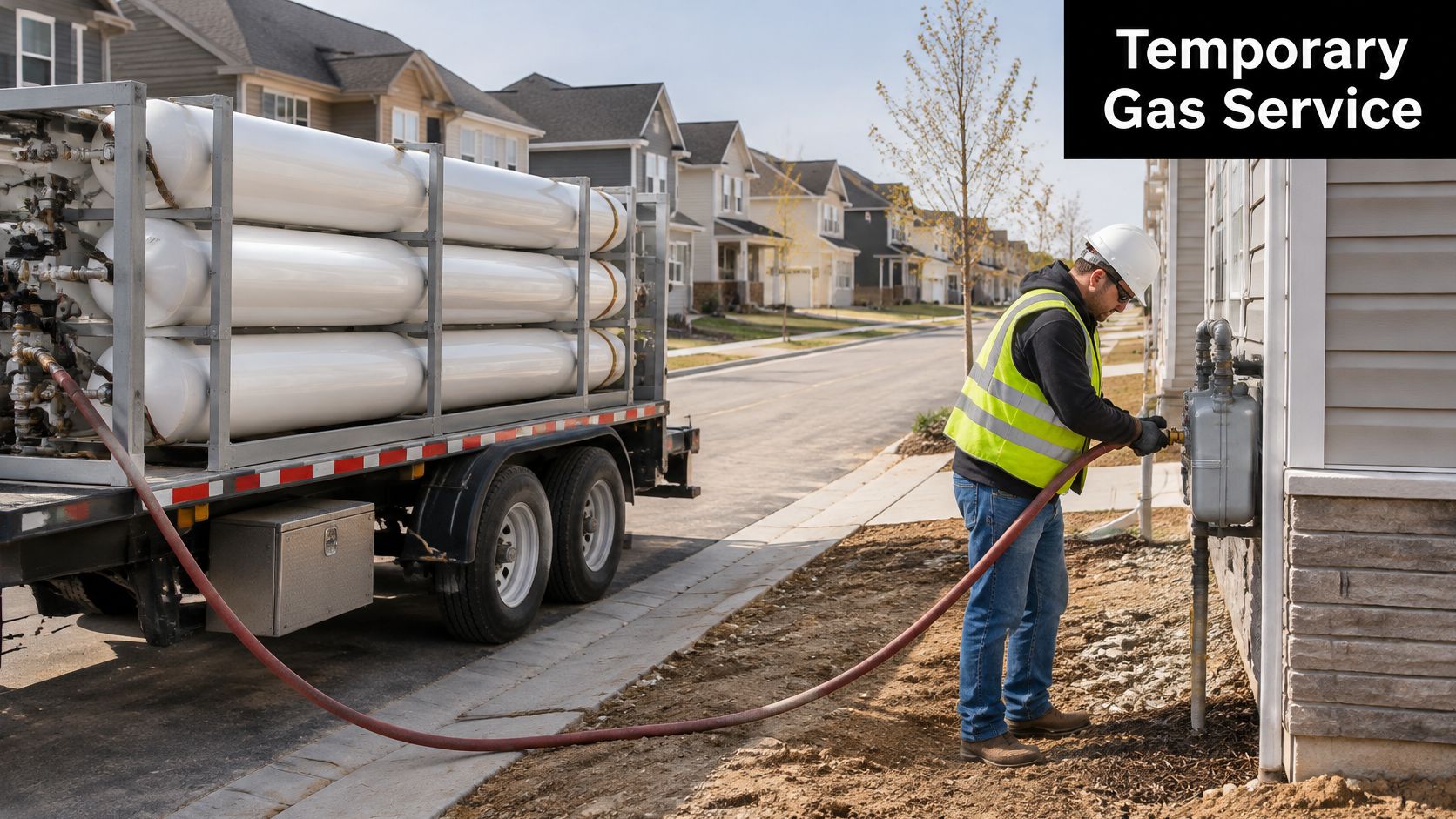
On arrival the unit is unremarkable: a trailer, a hose, a regulator and a meter connection. What changes between jobs is the volume and the number of trailer movements, and those two numbers decide whether a trailer beats a pipeline, LNG, or waiting.
CNG Trailers vs Pipelines and LNG by Distance
Distance is the variable most CNG explainers skip. Capacity and pressure get plenty of attention, deployment speed gets a mention, and then the question of how far gas can travel before another option wins goes unanswered.
| Distance band | CNG tube trailer result | Comparison with pipeline or LNG trailer |
|---|---|---|
| Up to about 250 miles | Lowest carbon intensity, 3.2 gCO2e/MJ static | Lower than the other options in this band in the study |
| About 250 to 650 miles | Delivery adds 1.56 gCO2e/MJ per 100 miles and exceeds pipeline intensity | Pipeline transport has lower carbon intensity |
| Beyond 650 miles | Exceeds LNG-trailer intensity | LNG-trailer transport has lower carbon intensity |
| All distances | Delivered cost and outage risk not reported in the study | Judge them separately; carbon intensity is not a cost or reliability measure |
A comparative lifecycle assessment of transport options for renewable natural gas puts numbers on the tradeoff. CNG tube trailers had the lowest carbon intensity for transport distances up to about 250 miles, at 3.2 gCO2e/MJ, because they carry almost no static emissions. Delivery adds 1.56 gCO2e/MJ per 100 miles, and the limited payload means more trips for the same gas.
How the bands shift the decision
Under 250 miles, the trailer is hard to beat on carbon, and it's usually the fastest option to stand up. Between about 250 and 650 miles, CNG transport exceeded pipeline carbon intensity in that study. Past 650 miles it exceeded LNG-trailer intensity.
Treat those thresholds as study-specific rather than universal. Change the payload, the truck's efficiency or the alternative being compared and the crossover point moves. They're useful as a way of thinking about distance, not as a rule you can quote to a regulator.
The wider decision rests on five criteria: route length, required daily gas volume, number of trailer movements per week, the customer's load profile through the day, and whether a temporary pipeline connection is even practical. A site taking steady low volume for six months is a different problem from one taking a heavy two-week burst.
Carbon intensity answers one question: how much each megajoule of delivered gas costs the climate. It says nothing about the invoice, the dispatch time, or what happens when the truck is late.
Weigh route length and daily volume first. If either pushes you past the band where a trailer makes sense, deployment speed stops mattering.
Safety Margins and Stability on the Road
A trailer doesn't sit at one pressure. It gets filled cold, driven warm and drawn down hard, so the engineering margin between service pressure and failure has to absorb all of that.
Federal container rules spell out the margin. Beyond the burst ratios, Federal Motor Vehicle Safety Standard 304 requires a container either to vent completely through a pressure-relief device or to remain intact without bursting during a specified fire exposure. That's the design intent behind the relief hardware on the valve box: controlled release, never rupture.
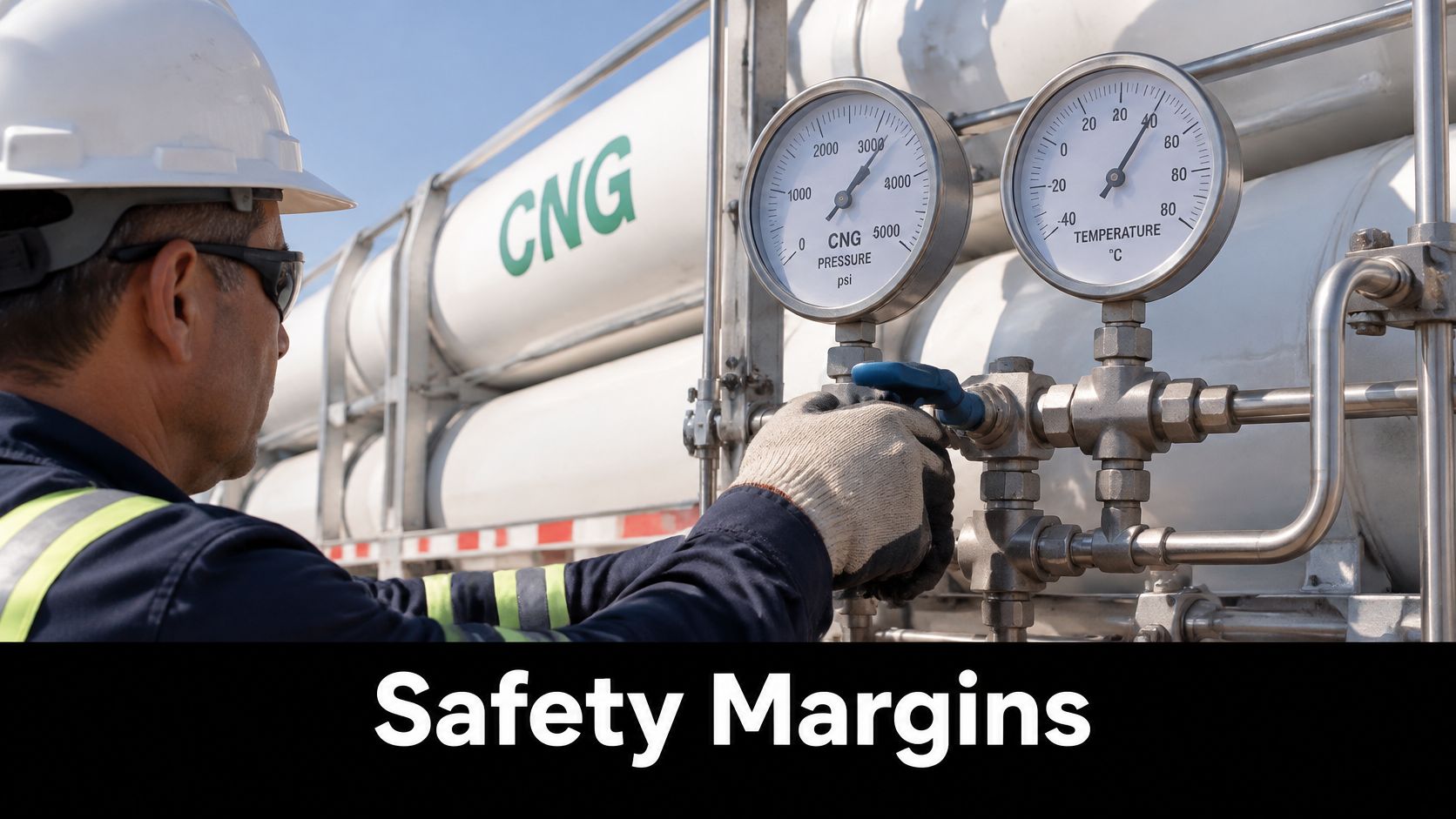
Before any connection, verify the items below rather than comparing nominal gas capacity:
- Cylinder design type and marked service pressure on the vessel itself, not on a spec sheet.
- Relief-device certification and the date it was last verified.
- Inspection status and hydrostatic test history for this specific unit.
- Downstream equipment ratings, including every regulator, hose and fitting between the valve box and the meter.
Route relief discharge away from people, ignition sources, air intakes and occupied areas. A relief valve doing its job in the wrong direction is its own incident.
Stability is the other half. A high-mounted, heavy cylinder package raises rollover and sway risk, and U.S. Pipeline and Hazardous Materials Safety Administration special permits for CNG tube-trailer modules require electronic roll-stability or sway-stability control on covered chassis. One permit identifies a static rollover threshold of 0.375, which tells you the trailer's lateral behavior has to be managed rather than treated as ordinary freight. Select level, load-bearing ground, keep turning clearance, stop unauthorized movement during unloading, and keep hose runs away from excavation and soft shoulders.
Before dispatch: confirm the permit, the chassis and the cylinder-module mounting all match the approved configuration. Swapping a tractor or rearranging equipment can invalidate the authorization that lets the unit travel.
Confirm Permits and Site Setup Before You Order
Requirements vary by jurisdiction, and the useful question isn't "is CNG safe" but "who verifies what, before gas flows". Ontario's regulator states that, as of February 3, 2025, each transport truck carrying a bulk compressed-gas container requires a licence and inspection, plus approval of the pressure-reduction system before operation. Other rules in the same family call for a hard compacted operating surface extending at least one meter around the unit, immobilization with brakes and wheel chocks before filling or dispensing, and piping designed for the full pressure, temperature and loading range with a safety factor of at least four.
Build the pre-delivery checklist in layers so nobody assumes someone else handled it.
- Federal: transport regulations, special-permit conditions, hydrostatic and weld-test records for the specific model and serial number.
- State or provincial: vehicle licensing, inspection, and pressure-reduction approval where required.
- Municipal and fire code: setback, permits, emergency plan, and fire department awareness.
- Site owner: pad condition, access route, grounding, chocking, and who holds the keys.
Site access belongs on that list. The truck needs a clear route in, a gate that opens without a twenty-minute phone call, and a pad nobody else parks on. If the property already uses commercial gate access control, add the delivery vehicle and the technician to the access list before the first load, not after.
A mobile unit usually arrives as a 16 ft by 8 ft trailer that takes one parking space, and remote monitoring estimates when it will run out so a replacement can be dispatched before it does. Our sales team can quote once you describe the load, the gas flow and the timeline.
Blue Gas Express rents mobile natural gas units to buildings and pipelines waiting on a permanent connection, and to sites where no gas line runs at all. We match the unit to your equipment's gas capacity and flow rate, deliver it on a trailer that fits a single parking space, and monitor the supply so a refill or replacement arrives before you run dry. Bring us the load, the flow and the date you need gas, and visit Blue Gas Express to get the quote started.