

A generator can be ready to start and still be unacceptable for commissioning. Local permit guidance can require gas-piping inspection before electrical signoff, so an available machine and a working fuel connection aren't enough. The practical requirements for generators cover the whole installation: the load, fuel supply, electrical tie-in, emissions configuration, site safety and permission to operate.
Generator Requirements at a Glance
| Requirement Area | What to Verify | Governing Reference |
|---|---|---|
| Performance and runtime | Kilowatt rating, required run duration and transfer timing | NFPA 110 and the applicable building code |
| Fuel supply | Fuel type, certified fuel specification, inlet pressure and regulator capacity | EPA stationary engine rules and manufacturer specifications |
| Installation | Clearances, exhaust discharge location, grounding and bonding, transfer-switch rating | NFPA 37 and the local electrical code |
| Permits | Electrical, fuel-gas, fire and air-quality approvals | Building official, fire marshal and air regulator |
| Operation and safety | No direct building connection without approved transfer equipment, no indoor use, GFCI protection and shutdown before refueling | OSHA portable generator guidance |
| Operating hours | Annual hours by permitted category, tracked in a log | EPA emergency and stationary engine rules |
Work down these areas in order. Performance and runtime come first because the generator's intended job determines what the rest of the installation must support. A unit that carries selected emergency loads needs a different design review from one supplying construction equipment throughout a utility-service delay.
Fuel selection comes next, before anyone finalizes the delivery arrangement or piping route. A natural-gas generator's nameplate doesn't establish whether a temporary supply can maintain the required pressure during motor starting. Likewise, an available parking space doesn't establish acceptable exhaust placement or access for fuel deliveries.
Use one approval record
Keep the load schedule, generator submittal, fuel-system drawing, site plan and permit status together. Name the person responsible for each open item and identify the inspection or test that closes it. That prevents an electrical contractor from planning energization around a fuel system that hasn't received approval.
- Separate documentation from verification. A regulator datasheet establishes its rating; a pressure measurement under load demonstrates how the installed system performs.
- Identify hold points. Mark which approvals must be complete before connection, testing and release for normal service.
- Control changes. Moving the generator or adding a connected load should trigger a review of affected drawings and approvals.
Practical rule: Approve the installation as a system, not as a collection of delivered components.
One missing requirement can block commissioning even when the generator itself is ready. Resolve those dependencies before arranging electricians, inspectors, fuel deliveries and load testing for the same day.
Why Requirements Depend on What the Generator Does
A generator is judged by its job, not just its enclosure or fuel type. Start by distinguishing emergency and standby service, temporary project power, and operation intended to reduce demand or support the grid. These descriptions help define the project, but they don't replace the legal operating category.
The Cummins overview of NFPA 110 describes requirements for emergency and standby power systems supplying an alternate source when normal electrical service fails, including performance, installation, testing and maintenance. Its building-and-facility scope makes selection a design decision involving transfer equipment, fuel systems, controls and connected loads, not merely generator capacity.
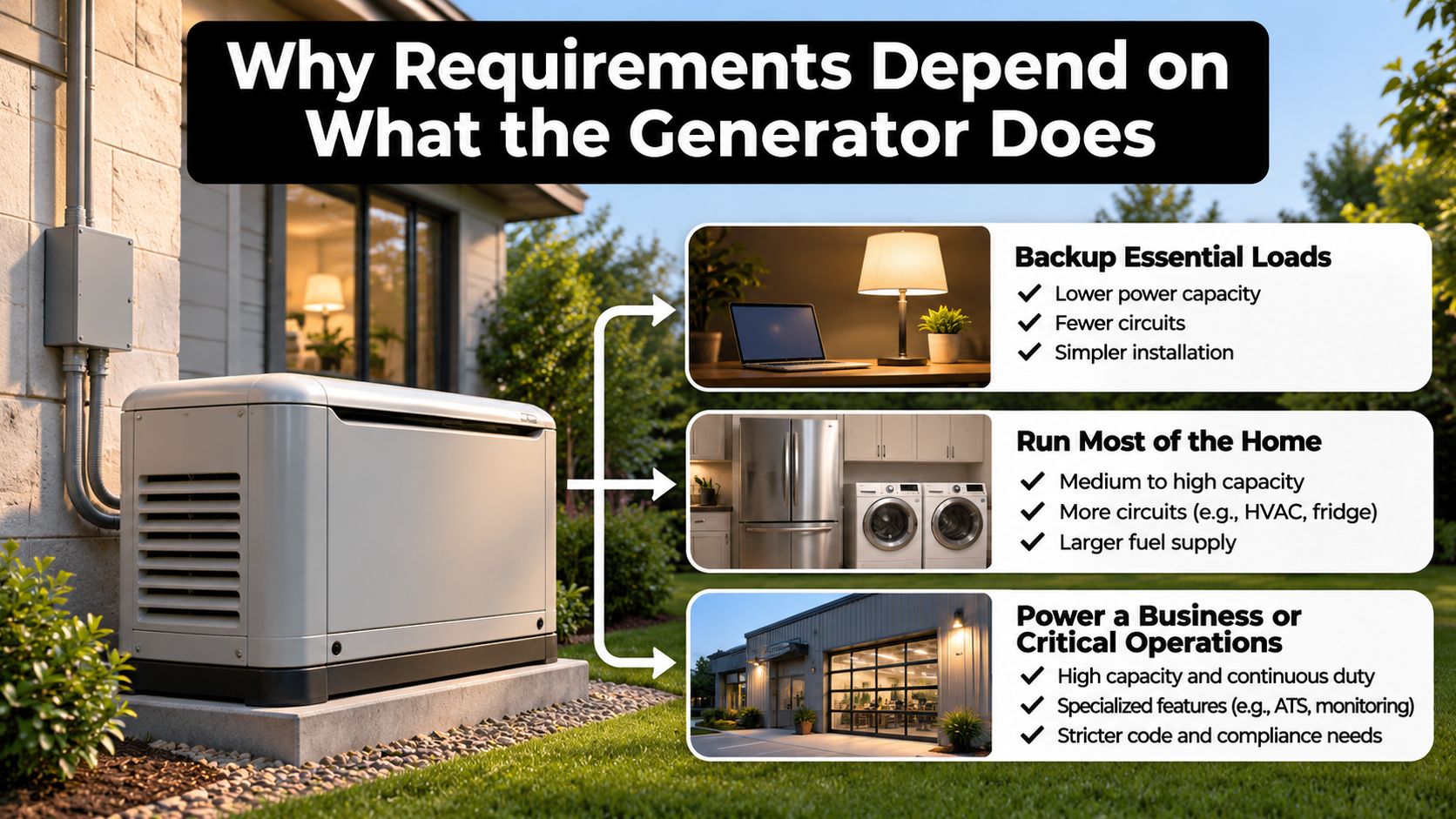
Define the duty before selecting equipment
An emergency or standby unit must respond to the loss of normal service according to the facility's governing requirements. A temporary generator might instead bridge an unfinished utility connection, maintain heating during construction or support a planned shutdown. Peak shaving and grid support introduce another question: whether the proposed operation is allowed under the engine's emissions classification.
Minimum runtime isn't a universal fuel-storage number. The applicable code, authority having jurisdiction and project design establish the operating duration. Don't copy a tank size or delivery schedule from another project without confirming the underlying requirement.
Say a contractor needs a generator to keep building heating operating during a utility delay. That project needs a fuel-replenishment plan matched to sustained use and site access. A hospital standby installation needs a design matched to its required emergency loads and governing facility requirements, even if both projects happen to use similar generator sets.
Before accepting a rental proposal or equipment substitution, answer these questions:
- What triggers operation? Loss of normal service, a construction schedule, a test command or a commercial dispatch signal?
- How long must it run? Identify required continuity and the approved replenishment arrangement.
- Who dispatches it? The facility, a contractor, the utility or another grid operator?
Record the answers in the design basis. Otherwise, the owner, fuel supplier and permitting team may each be planning for a different operating duty.
Fuel Supply Requirements for Natural Gas Generators
A temporary fuel system can prevent an otherwise suitable generator from carrying its load. The engine must have the appropriate emissions certification, and the delivered gas must stay within the manufacturer's fuel-quality and pressure envelope. Having gas available at the site doesn't prove either condition.
Under the EPA stationary engine compliance requirements, purchasing an appropriately certified engine is a primary compliance path for applicable stationary spark-ignition engines, which must be operated according to manufacturer instructions; the natural-gas certification fuel is pipeline-quality gas containing at least 70% methane by volume or a gross calorific value of 950–1,100 Btu per standard cubic foot. EPA also identifies nitrogen oxides, carbon monoxide and volatile organic compounds as regulated pollutants for these engines.
Confirm the fuel envelope
| Parameter | Requirement | Source |
|---|---|---|
| Natural gas composition | Meet the EPA certification-fuel definition stated above and the engine's approved fuel specification | EPA stationary spark-ignition engine rules |
| Engine certification | Certified for the relevant emissions category and operated per manufacturer instructions | EPA stationary engine compliance requirements |
| Transient gas demand | Regulators, vaporizers, hoses and relief devices sized for motor starting and step loads | Manufacturer specification and project design |
| Inlet pressure and regulator capacity | Within the manufacturer's stated operating range at full electrical load | Manufacturer specification |
A fuel mismatch can produce poor combustion, unstable output, increased emissions and nuisance shutdowns. It can also put operation outside the conditions supporting the engine's certification. Don't treat a generator that starts successfully at no load as proof that the fuel system is adequate.
Motor starting and sudden load additions require particular attention. Those events can briefly increase gas demand above steady-state consumption, so a regulator selected only from average consumption may be inadequate. With CNG or LNG, evaluate pressure reduction and vaporization capacity alongside the downstream piping and connection equipment.
Verify before mobilization
Collect the generator model, horsepower, certification documentation, allowable fuel specification, inlet-pressure range and full-load gas demand. Then have the fuel-system designer check regulator capacity and the complete supply path against both sustained demand and anticipated load steps.
- Specify the measurement point. Confirm pressure at the generator inlet, not merely at the upstream supply.
- Check the limiting component. Include hoses, valves, regulators and vaporizers in the capacity review.
- Define acceptance conditions. Agree on the load sequence and allowable pressure range before testing begins.
Fuel approval also belongs in the permitting schedule, rather than being deferred until the generator arrives.
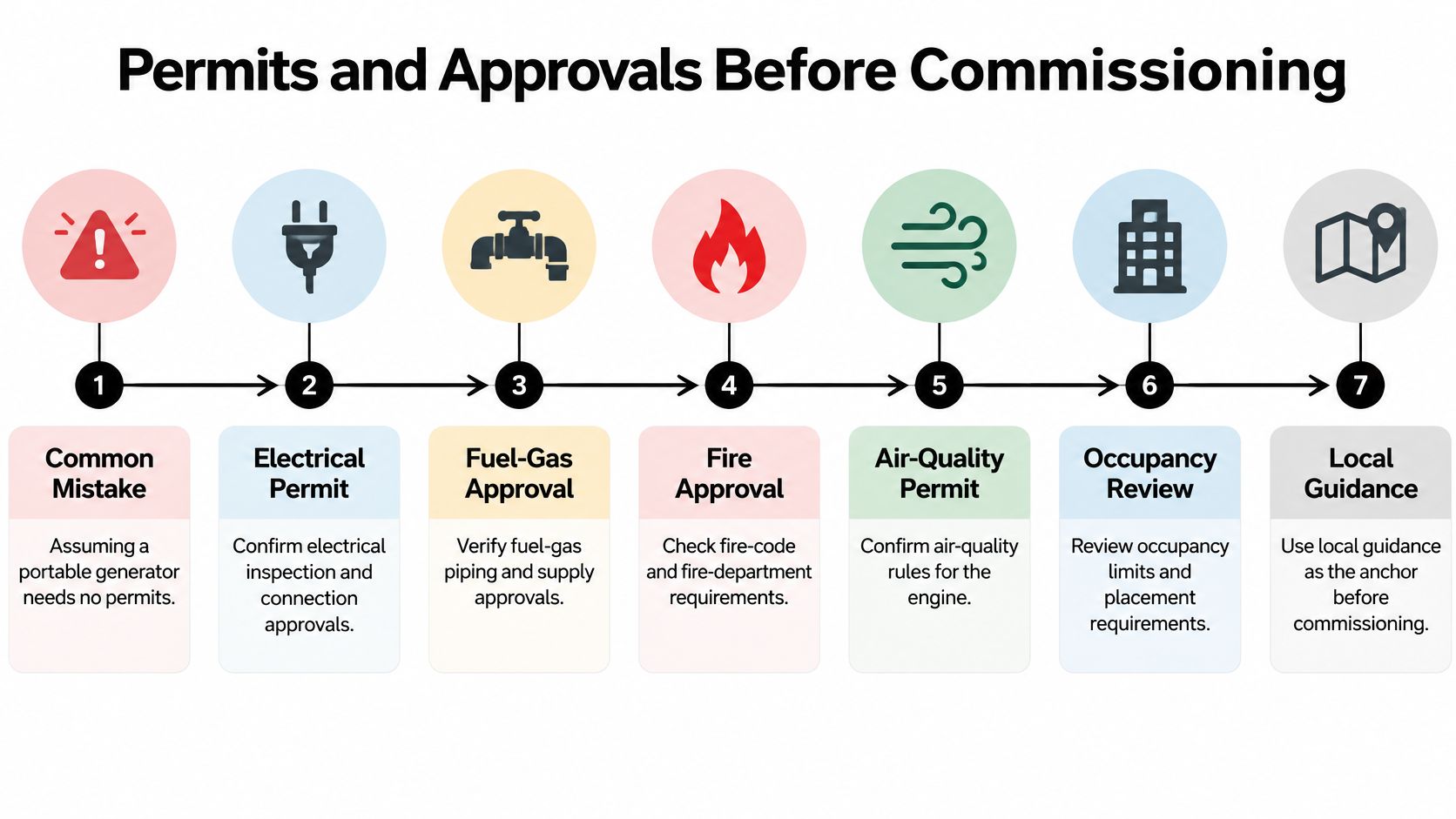
Permits and Approvals Before Commissioning
Portable doesn't mean permit-free. A trailer-mounted generator can still require electrical, fuel-gas, fire, air-quality and occupancy review. Mobility describes the equipment, not its exemption from local approval.
For example, Verona's generator requirements checklist addresses NEC Article 702, connected-load calculations, transfer-switch or interlock documentation and gas-piping inspection before electrical inspection. Treat local guidance as the starting point, then ask the reviewing authorities which requirements apply to the proposed temporary arrangement.
Establish the approval timeline
Use this sequence to assign responsibility, not as a universal rule about when every agency accepts an application. Begin air-permit and utility discussions during design, even where their final confirmations occur later.
| Step | Authority | What it reviews |
|---|---|---|
| 1 | Owner's engineer | Connected-load calculation and drawings |
| 2 | Fuel-gas authority and fire marshal | Gas and fire safety review |
| 3 | Building official | Installation permit for generator, tank, piping and associated equipment |
| 4 | Gas piping inspector | Gas-piping inspection before electrical inspection |
| 5 | Electrical inspector | Applicable standby-code compliance and transfer-switch or interlock documentation, signed off after gas inspection where locally required |
| 6 | Air regulator | Emissions category and any air-district permit |
| 7 | Utility | Coordination of the gas connection |
When the permanent natural-gas line is unavailable, temporary CNG or LNG supply approvals remain separate from the generator's electrical permit. Confirm the applicable tank, fuel-gas and installation approvals before commissioning. An electrical release alone doesn't authorize temporary storage or gas distribution equipment.
Give reviewers the fuel type, proposed location, expected duration, operating pressure, building separation and emissions category. Identify any piping crossing a property boundary or public right-of-way. Those facts can change who must review the project and which drawings are needed.
For a general explanation of why adding an electrical circuit involves permit review, On Time Home Services on permits offers useful context. Generator-specific acceptance must still come from the authorities reviewing the actual installation.
Don't schedule commissioning from the equipment delivery date. Schedule it from the last required approval and inspection.
The installation review should connect those approvals to a single physical layout.
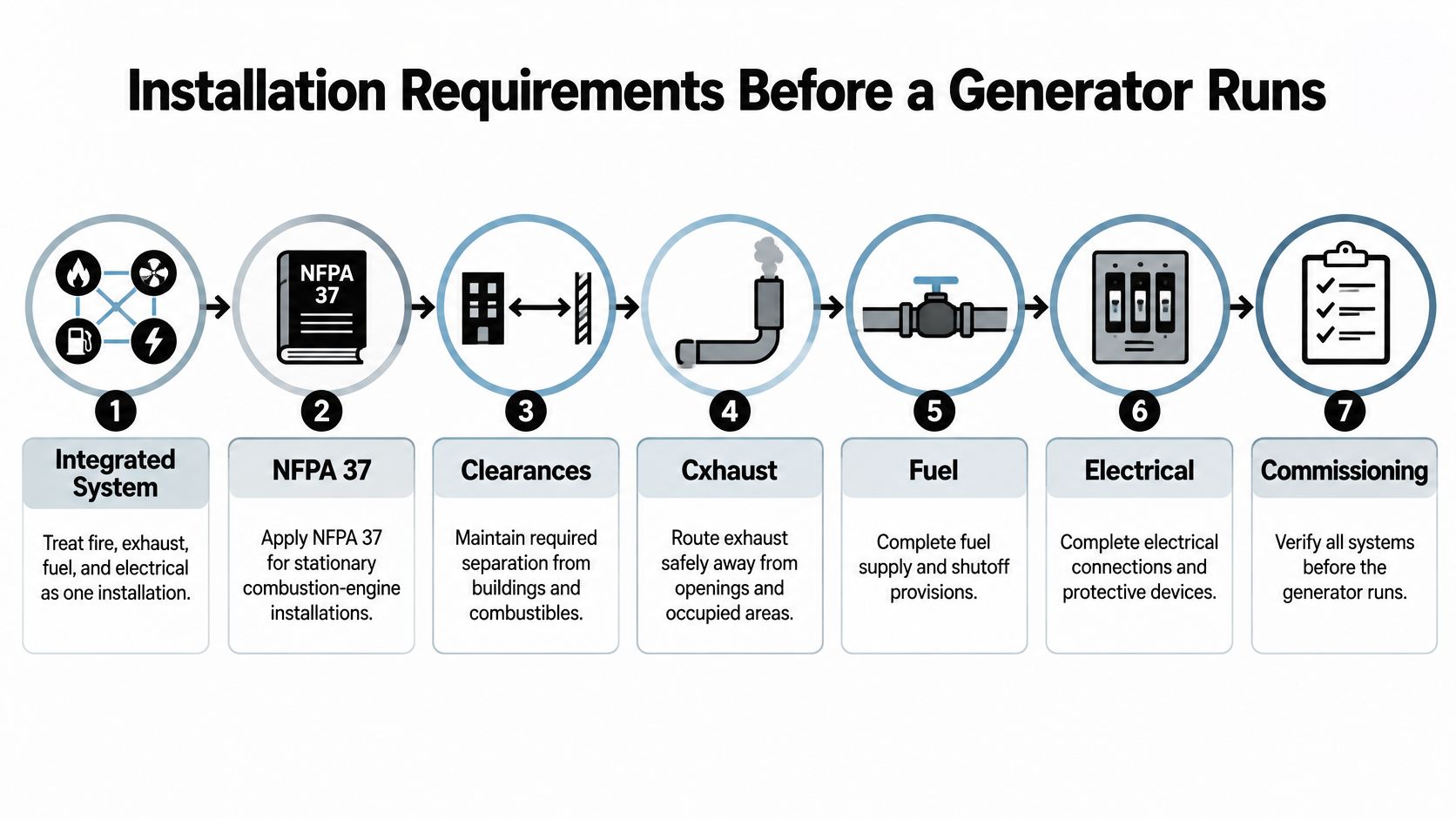
Installation Requirements Before a Generator Runs
Installing a generator means completing a fire, exhaust, fuel and electrical system, not parking a unit beside a building. NFPA 37 addresses stationary combustion-engine installations for emergency, standby and peak-power applications, including fuel supplies, exhaust, controls, instrumentation and fire-protection features.
The setup sequence should move from the site layout to physical installation and then to functional testing. Resolve location and routing before crews cut pipe or terminate cables.
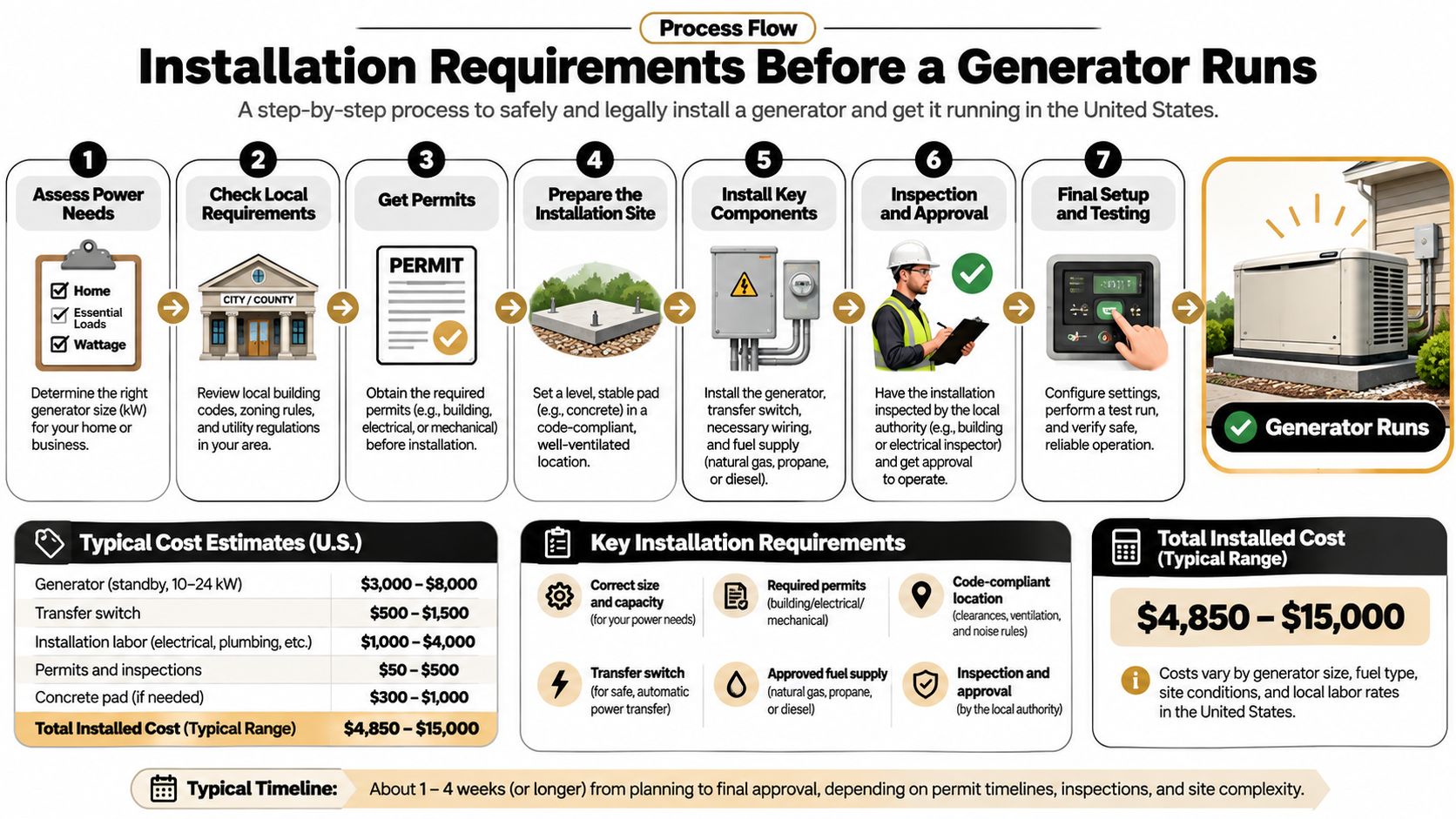
Build from an approved site plan
Establish the footprint and access. Show adjacent buildings, prevailing wind, ignition sources, public routes and emergency responder access. Preserve space for inspection, maintenance and fuel service without obstructing exits or emergency controls.
Document grounding, bonding and transfer equipment. Have a qualified electrician establish the connection method and verify equipment ratings against the design. Don't assume a grounding arrangement from another rental installation is suitable for this generator and transfer configuration.
Position the exhaust safely. Discharge exhaust away from doors, windows and ventilation intakes. Never use portable generators indoors or in enclosed spaces such as garages, basements or crawl spaces, where carbon monoxide can accumulate.
Maintain combustion-air and cooling-air paths. Check the manufacturer's required clearances and account for walls, temporary fencing and stored materials. A layout that looks open during delivery can become obstructed once the construction site fills around it.
Complete and protect the fuel connections. Verify compatible pressure ratings, supports and routing, then complete the required leak testing. Protect the equipment from vehicle impact and unauthorized access, and keep emergency stop controls accessible.
Test the interfaces under load
Verify electrical operation before releasing connected loads. Check phase arrangement and voltage, then functionally test the transfer equipment and alarms using an agreed procedure. Confirm that the intended loads transfer correctly and that the installation prevents unintended connection to utility conductors.
Prove fuel and exhaust performance during commissioning. Record gas pressure at the generator inlet through the planned load sequence, including significant load changes. Inspect the exhaust arrangement and establish a carbon-monoxide monitoring plan wherever workers or occupants could be exposed.
A successful engine start is only an initial check. The meaningful test is whether the installed system transfers power, accepts the intended load and stays within its approved operating conditions.
Commissioning hold point: Don't release the installation while an unexplained alarm, gas-pressure excursion or failed transfer function remains open.
Keep measured results with the commissioning record. Include the load condition, instrument location and acceptance criterion so another engineer can understand what was demonstrated. A note saying that the generator ran provides little help when the owner later needs to confirm readiness.
If the site arrangement changes after testing, assess the affected interfaces before restarting. Moving a barrier may alter cooling airflow; rerouting a hose may change its protection; relocating the generator may change exhaust exposure. Acceptance belongs to the tested installation, not to the engine's serial number.
Electrical Safety and Operating Hour Limits
An installed generator isn't permission to run whenever the site finds it convenient. Operators must follow both electrical-safety procedures and the engine's permitted operating category. A change from outage response to routine demand reduction can change the compliance question even when no hardware changes.
OSHA's portable-generator guidance calls for manufacturer-supplied cords where appropriate, undamaged heavy-duty grounded three-prong extension cords, GFCI use according to manufacturer instructions and shutdown before refueling. It also warns against connecting a generator to building wiring without properly installed transfer equipment because backfeed can expose utility workers to electrocution.
Keep the operating log by category
Don't adopt a generic annual-hour allowance from another engine or permit. Confirm the rule applicable to the actual engine, its certification and its intended use. The OSHA safety guidance isn't an authority for an EPA operating-hour allowance.
Keep separate records for emergency operation, maintenance, testing and any authorized non-emergency dispatch. Record start and stop meter readings, the reason for operation, who authorized it and any supporting instruction. A total-hour meter alone won't explain why the engine ran.
The EPA's May 2025 clarification on local grid reliability describes circumstances in which certain stationary emergency engines may operate for up to 50 hours per year for local reliability: dispatch must come from the balancing authority or transmission/distribution operator, prevent a local outage or overload, follow recognized reliability protocols and supply only the facility or local grid.
That's a narrow operating pathway, not general permission for peak shaving or financially motivated dispatch. Review any proposed financial arrangement before enrollment rather than assuming an emergency classification covers it.
Use this decision path before each run:
- Actual outage. Record the service interruption and the emergency operating period.
- Maintenance or testing. Confirm the activity fits the applicable category and remaining allowance.
- Reliability dispatch. Obtain the operator's instruction and retain the supporting records.
- Commercial demand reduction. Have the air regulator confirm the proposed use before proceeding.
Coordinate grid-support operation with the utility before it starts. Fuel planning must match the authorized duty, not merely the customer's preferred runtime.
Confirm Your Requirements Before You Order a Unit
Finish the pre-order review in a single document that the owner, contractor, engineer and fuel team can all use. Unresolved assumptions should appear as open items with a responsible person, not disappear into email exchanges.
Write the load. Identify the required kilowatt capacity, connected equipment and operating duration. Include the expected starting sequence so the electrical and fuel designs address the same duty.
Describe the site. Record building use, proposed location, separation from occupied areas, public access and emergency responder access. Attach a marked-up site plan rather than relying on a verbal description.
Confirm the fuel plan. State fuel type, full-load gas consumption, inlet-pressure range and the proposed regulator and piping capacity. Identify who will verify pressure and leak-test results before release.
Confirm the approvals. List applicable permits, inspection dependencies and the authority responsible for each signoff. Flag property-line and public-right-of-way crossings before the routing is finalized.
Set the operating category. Distinguish the project's temporary duration from the engine's legal emissions category. Document permitted uses, applicable hour allowances and who maintains the operating log.
Make the schedule conditional on approval
Check each answer against the matching requirement area rather than rebuilding the checklist from memory. Keep the approved revisions together so the delivery team and commissioning engineer receive the same information.
Equipment availability and authorization to operate are different milestones. Confirm the operating category and fuel plan with the local authority having jurisdiction before committing to a delivery or commissioning date. Permit sequencing, inspection availability and operating restrictions can change the schedule even when the generator is immediately available.
We can deploy mobile gas units within a few hours of a customer's request, with connection equipment, gas flow testing and leak testing available on a service contract basis. Visit Blue Gas Express to discuss your generator's gas demand, inlet pressure, site conditions and approval schedule with our Sales team and request a custom quote for a mobile unit.