

The call usually arrives with a deadline attached. A general contractor has an occupancy inspection on the calendar, the gas utility has pushed main energization back another month, and the building's boilers, water heaters and kitchen equipment are sitting there with nothing to burn. Someone mentions that a trailer can bridge the gap, and the first question is always the same: how many gallons does it hold?
That number matters. It just isn't the number that decides whether the project stays on schedule. An LNG trailer is a time-limited supply system: the fuel is only useful while it stays cold and liquid, while pressure stays inside the vessel's limits, and while the site is approved to receive it. A large trailer that shows up on Wednesday with an unapproved installation is worth less than a smaller one that arrives approved and unloads cleanly.
Get the capacity, the boil-off, and the paperwork right, and the trailer does its job effectively. Get one of them wrong, and you own a very expensive parked vehicle.
What an LNG Trailer Is and Why It Matters
The building is finished and the punch list is short. What's missing is the gas main: the utility crew is still working a street away, and the boilers, the domestic hot water and the kitchen equipment all need fuel before the first tenant walks in. A trailer parked on the pad solves the problem, because an LNG trailer carries natural gas in liquid form, chilled to cryogenic temperature until it condenses, then held in an insulated vessel mounted on a road chassis.
Think of a thermos. A good one keeps coffee hot for hours because the vacuum between its walls blocks heat from getting in. A trailer works the same way in reverse: it keeps a cryogenic liquid cold by slowing the heat that leaks inward. The better the insulation, the longer the cargo stays liquid, which is why insulation, not just tank size, sets how far and how long a trailer can deliver.
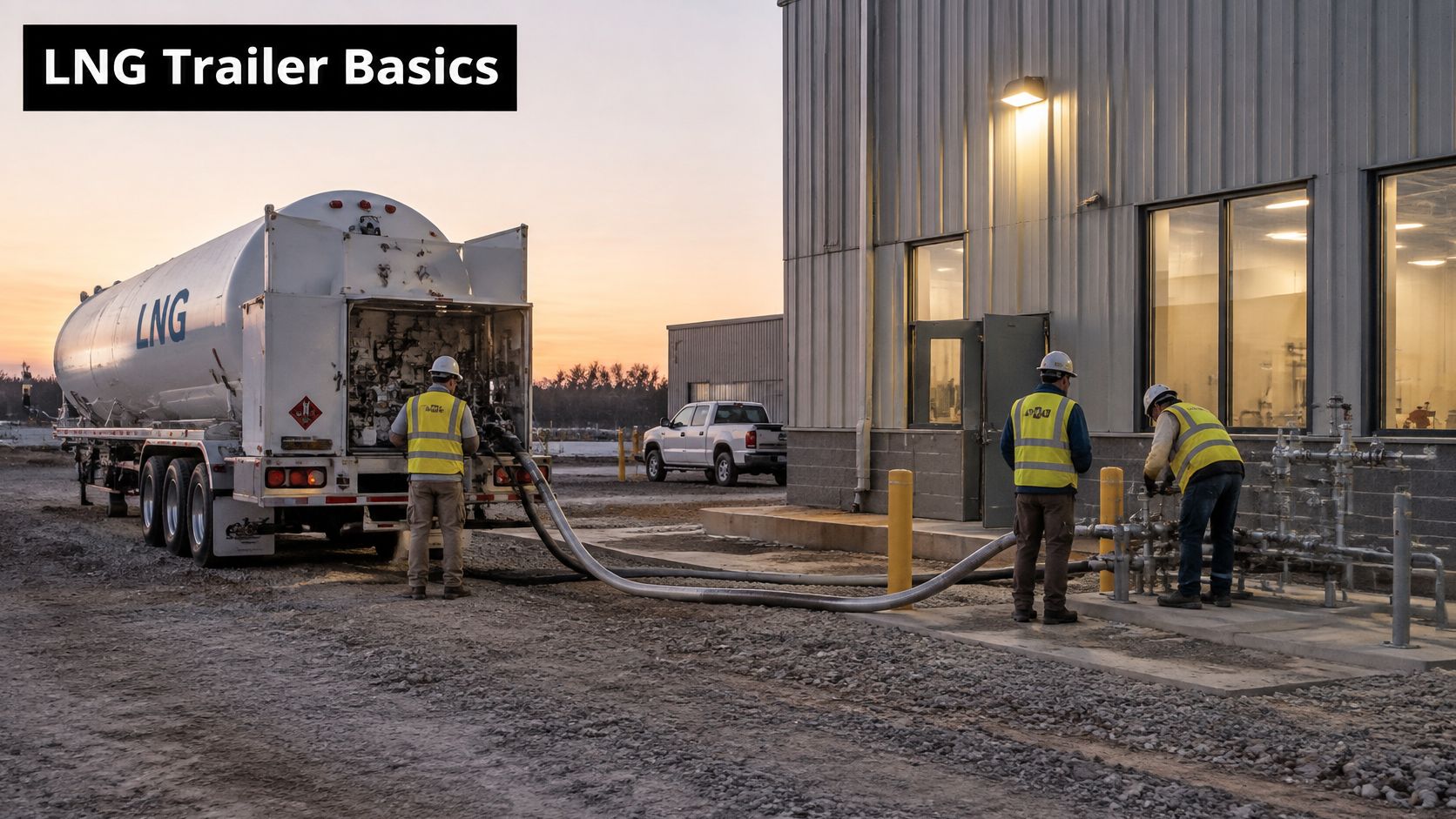
Trailers turn up in three situations:
- Temporary supply while a pipeline goes in. The permanent main is months out, but the building needs gas to pass inspection and open.
- Coverage during a maintenance outage. A live line comes down for planned work, and the buildings on it still need heat and hot water.
- Supply where no pipeline reaches. Remote industrial sites, plants outside a distribution network, and equipment that will never have a main connection.
This isn't a new idea. By the late 1970s, the U.S. Government Accountability Office documented approximately 75 LNG trucks in operation in the United States, each with an estimated capacity of about 40 cubic meters, equivalent to roughly 10,600 U.S. gallons. That same report noted that the Department of Transportation had no dedicated inspection program for liquefied energy-gas trucks at the time, which is a reminder that the specialized oversight around this equipment had to be built deliberately, and that it varies by jurisdiction today.
What decides whether the trailer arrives useful is a chain of linked details: which class fits the pad, what the insulation and pressure limits allow, how the transfer is run, and what the local authority accepts. Capacity sits at the start of that list, not the end.
LNG Trailer Types and Capacities Compared
Match a trailer class to the job before you book it. Capacity and footprint move together, so the trailer that covers your gas demand may not fit your pad.
| Trailer class | Gross capacity | LNG held | Length | Width |
|---|---|---|---|---|
| Historical U.S. LNG truck benchmark | about 10,600 gal (40 m³) | about 10,600 gal when full | about 42 ft, matching the 11,000-gallon class | about 8 ft outer diameter |
| Typical 11,000-gallon tanker | 11,000 gal | 11,000 gal gross, less after boil-off | about 42 ft | about 8 ft outer diameter |
| Large commercial trailer | 12,700 to 16,300 gal | 39,276 to 50,400 lb at 70 psig | 48 to 53 ft | about 8 ft 6 in |
What the size numbers mean on site
A representative 11,000-gallon tanker runs about 42 feet long, with an inner tank roughly 7 feet 4 inches across and an outer diameter near 8 feet, according to a PHMSA docket attachment. LNG is a low-density cargo carried in a wide vessel, so the center of gravity sits higher than on a petroleum tanker of similar length. That geometry raises rollover susceptibility in some driving conditions, which is a routing question as much as an equipment question.
Step up to larger commercial designs and the numbers grow with the envelope: 12,700 to 16,300 gallons gross capacity, roughly 39,276 to 50,400 pounds of LNG at 70 psig, and an overall length of 48 to 53 feet at about 8 feet 6 inches wide. A 53-foot trailer on a tight commercial lot behaves very differently from a 42-foot one.
Fit before you book: pull the site plan and walk the route. Turning radius, overhead clearance, pavement loading, parking orientation, emergency access and unloading-hose reach all decide whether the trailer can actually serve the connection, and all of them are cheaper to check now than to discover at 6 a.m. on delivery day.
The cargo adds a second constraint. LNG sits at about -260°F, so lines, hoses and valves need insulation, the area around the connection needs controlled access, and anyone working the transfer needs cryogenic personal protective equipment and procedures that keep liquid, vapor and cold surfaces away from skin.
How to pick a class by burn rate
Start with the connected equipment's daily burn, multiply by the number of days between deliveries, and you have the volume you need. Compare that against usable capacity, not the number painted on the side of the tank. Then run the fit check above before the booking is confirmed, because the smallest trailer that meets the demand is often the one that works best on a crowded site.
Components That Keep LNG Cold and Liquid
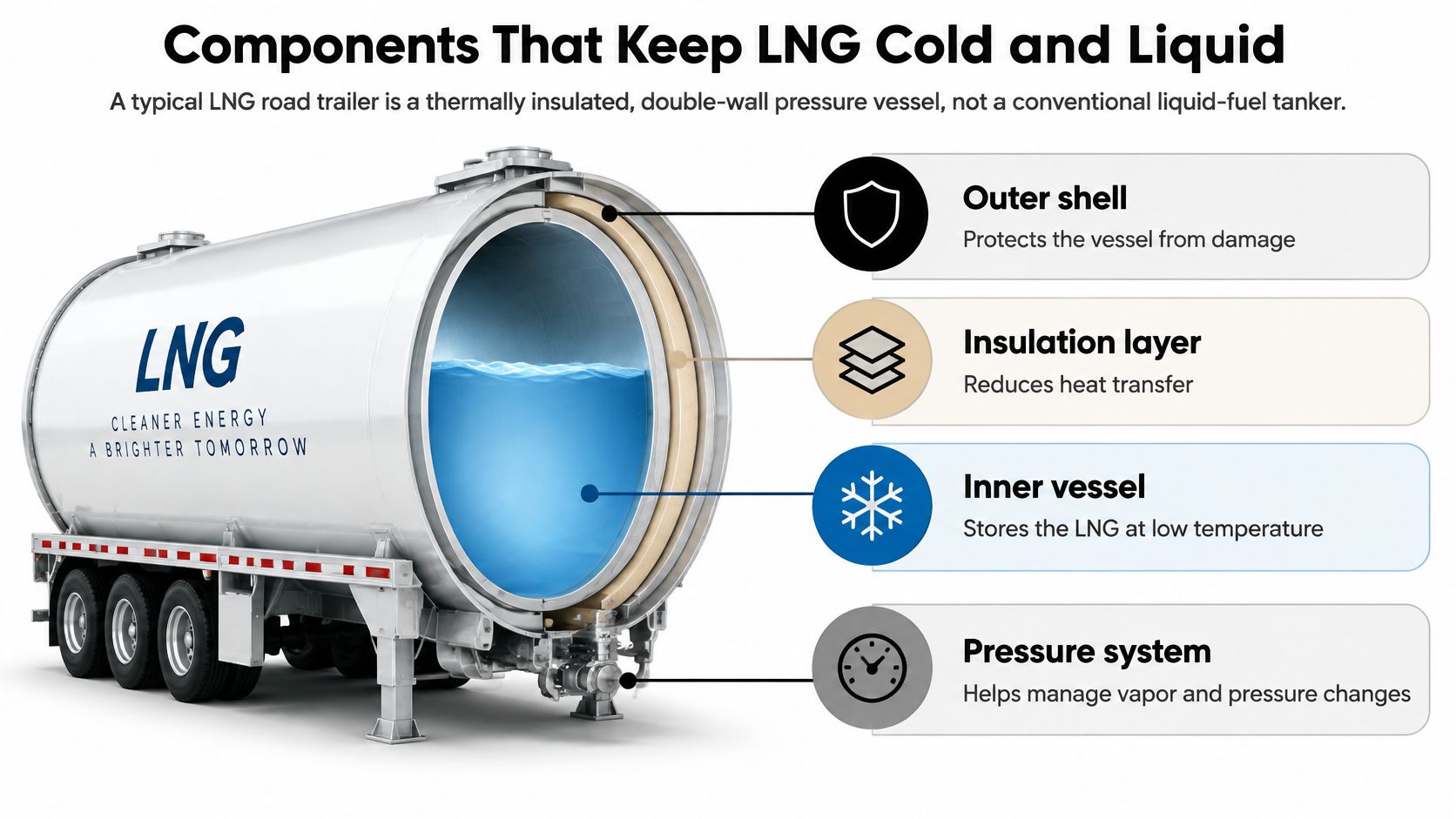
A typical LNG road trailer is a thermally insulated, double-wall pressure vessel, not a conventional liquid-fuel tanker, as the U.S. Department of Energy's LNG transportation overview describes it. That distinction explains almost everything you see when you walk up to one.
From the outside in
The outer shell is carbon steel or stainless steel, and its job is structural: it holds the insulation envelope together and protects it from impact, weather and handling damage. It is not the pressure boundary.
The annular space between the two vessels is evacuated, and it may also contain perlite or multilayer insulation. Pulling the air out removes the gas that would otherwise carry heat across the gap, and the added insulation blocks radiant heat. Together they cut conductive and convective heat transfer to a rate that lets LNG stay liquid through a transport cycle.
The inner vessel is commonly stainless steel or aluminum, chosen for how it behaves at cryogenic temperature. This is the pressure boundary and the part that holds the liquid.
What you'll see at the trailer
- Transfer piping and hoses, sized for the vaporization rate at the site rather than for the tank.
- Pressure controls and relief devices, which protect the vessel as heat leaks in and vapor forms.
- Level and pressure gauges, the two readings that tell an operator how much is left and how hard the vessel is working.
The vaporizer and regulators that turn LNG back into usable gas usually sit at the site, not on the trailer. U.S.-built trailers typically follow 49 CFR Parts 173.318 and 178.338, which is why the specification package, the relief device settings and the inspection records all trace back to a defined standard rather than to a supplier's preference. The shell, the fittings and the gauges are the same points a pre-deployment review checks, and seeing them described in the spec sheet is a good sign the paperwork is real.
How to Load, Unload and Manage Boil-Off
Unloading looks simple from a distance. It's a sequence of small checks, and skipping one is how a routine delivery turns into an incident or a lost afternoon.
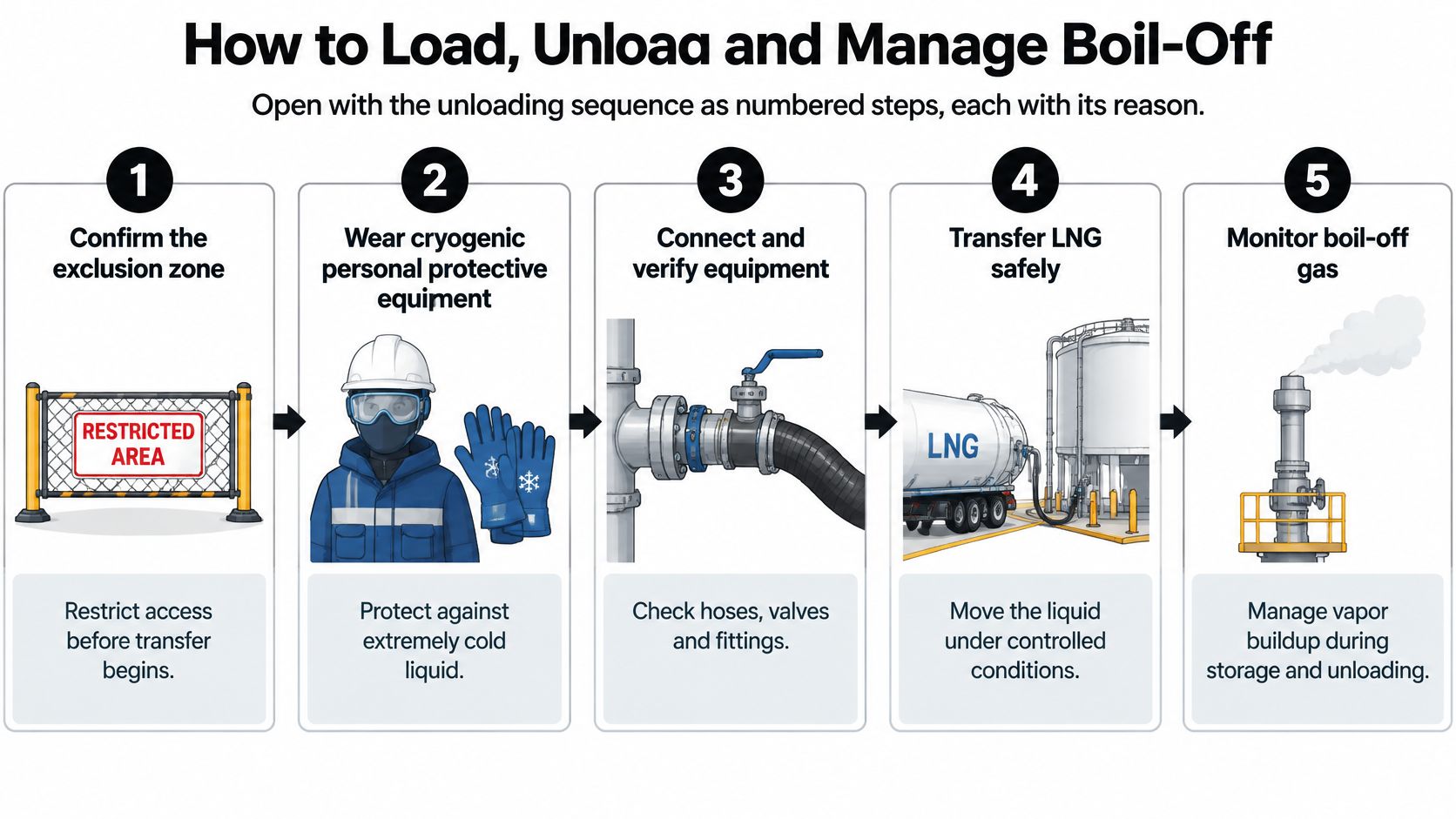
- Confirm the exclusion zone, PPE and access control. The liquid is cold enough to cause severe burns, so the area gets cleared and controlled before a hose comes off the truck.
- Position and chock the trailer on the approved pad. A vehicle that shifts mid-transfer pulls on the hose, and that's the failure nobody wants.
- Connect the transfer hose and leak-check every fitting before any flow starts. A joint that weeps at ambient temperature can behave differently once cryogenic liquid reaches it.
- Cool the transfer line first. Opening liquid flow into a warm line shocks the metal and the seals, so the line gets cooled in a controlled step.
- Transfer while watching pressure at both ends, the trailer and the vaporizer. Pressure tells you how the transfer is going, not just how full the tank is.
- Close, drain and secure the hose once the volume is in. Residual liquid trapped in a line has to go somewhere safe.
- Record the delivered volume and the residual pressure. That record is what makes the next delivery predictable instead of guessed.
Why an idle trailer loses usable gas
No insulation is perfect. Heat leaks through the vacuum and the shell, boils a little of the liquid into vapor, and the vapor raises pressure inside the vessel. A trailer parked for a week comes back with a higher pressure reading and less liquid than it left with, so capacity on the invoice isn't the same as gas you can burn.
Manage it with the schedule. Keep delivery intervals inside the transport window, use the vent and pressure controls as designed instead of bleeding vapor early, and put unloading time in the dispatch window rather than after it.
The Energy Department's LNG transportation overview sets out the working envelope, and each value has a dispatch consequence:
| Parameter | Typical value | What it means for dispatch |
|---|---|---|
| Transit cycle | about 7 to 10 days | Plan delivery intervals inside this window |
| Operating pressure | normally below 70 psig | Keep pressure management in the unloading plan |
| Design pressure | often below 100 psig | Do not treat the vessel as a pressure reserve |
| Structural burst calculation | approaching 280 psig | Confirms the safety margin, not a working limit |
Plan the trailer's return trip at the same time you plan its arrival. The unit that sits on site waiting for a pickup slot is losing volume the whole time.
Real Use Cases From Construction Delays to Remote Sites
A four-story mixed-use building is complete except for gas service. The utility's main is held up by a road permit, the boiler and the rooftop units need fuel for commissioning, and the certificate of occupancy depends on both. That's the classic trailer job: it arrives, connects to the building's gas connection, and holds the project on schedule until the main is live.
How the connection works is the same in every case. The trailer's liquid goes through the site's vaporizer and regulators, then into the building's gas piping or a pipeline injection point. Where the load can't tolerate a pause, a manifold lets a second unit connect while the first is taken away for refilling, so flow continues through the swap instead of stopping for it.
Three more cases look different but follow the same logic:
- Generator commissioning. The trailer fuels a testing window, then the site moves to permanent supply once the equipment is signed off.
- A planned outage on an existing line. Buildings stay heated while the utility works, and nobody drains the systems or rents electric heat.
- Sites with no pipeline at all. Steam plants, boiler fuel, asphalt melting, lumber drying and water treatment equipment can run on delivered LNG indefinitely, not just as a stopgap.
Sizing the trailer to the load
Add up the daily burn of everything connected, multiply by the days between deliveries, then subtract your margin. Boil-off during transit and unloading time both eat into the number on the tank, and a remote site with a four-day haul loses more than a customer 40 minutes from the depot. If the result lands between two trailer classes, the smaller one with more frequent deliveries usually beats the larger one running half empty.
The project timeline that keeps a trailer useful
- Order when the permanent connection date slips, not after the building is ready.
- Confirm the site plan and permit path before the booking, because approval is the long pole.
- Schedule the first delivery ahead of equipment testing, so the fuel is there when the commissioning crew is.
- Agree the handover date with the utility or facility owner in writing.
- Release the trailer once the final delivery is recorded and the permanent supply is proven.
Skip step two and the rest of the list doesn't matter. A trailer is only useful when its schedule matches the project's timeline, and the schedule is set as much by approvals as by the truck.
Safety Rules and Approvals Before a Trailer Arrives
Fast delivery and fast approval are two different things, and treating them as one is the most common mistake on a temporary gas job. A trailer can be on site within hours. The installation can still be waiting on a fire marshal, and until that sign-off lands, the building isn't occupied and the equipment isn't commissioned.
In the United States, PHMSA identifies the Natural Gas Pipeline Safety Act as the authority for regulating LNG transportation and storage, while NFPA 59A is the foundational consensus standard for LNG production, storage and handling, as summarized in the federal pipeline safety regulations. Compliance depends on the transport mode, the jurisdiction and the site configuration, so it never resolves to a single supplier checkbox.
The pre-deployment checklist
- Trailer specification (supplier). Vessel ratings, relief device settings and current inspection documentation.
- Approved transfer equipment (supplier and carrier). Hoses, fittings and vaporizer rated for cryogenic service and compatible with the site.
- Exclusion zones (facility owner and general contractor). A defined area around the trailer and transfer point, marked and enforced.
- Grounding and bonding (carrier, verified by the site). Static control before any transfer begins.
- Vehicle positioning and emergency shutdown locations (carrier and facility owner). Agreed placement, agreed shutdown points, both known to the people on shift.
- Operator qualifications (carrier). Trained personnel for the transfer, not whoever is closest.
- Authority having jurisdiction sign-off (facility owner, with the fire marshal and utility). The acceptance that opens occupancy.
The delay nobody schedules: a trailer can arrive on a Tuesday and still hold up an occupancy inspection the following week, because nobody submitted the temporary installation for review.
Site basics that don't wait for paperwork
Cryogenic burn protection, controlled access around the trailer and clear emergency routes for both vehicles and crews are day-one items, not items to finalize after the equipment lands. The same discipline that governs general workplace safety guidance from Evright Industrial applies here: define the hazard, control the access, brief the people who will be on site, and keep records you can show an inspector.
Approval is a shared responsibility. The supplier owns the vessel and the transfer equipment. The carrier owns the people and the vehicle. The facility owner and general contractor own the site layout and the access control. The utility and the fire marshal own the acceptance. Assign each item to a name before mobilization, and the trailer stops being a scheduling risk.
Decide Whether a Trailer Fits Your Project
A trailer wins when the gas gets burned. It loses when the fuel sits in the tank while the clock runs. That single ratio, volume used against volume lost to time, distance and idling, settles most of these decisions before the budget conversation starts.
- Delivered fuel volume. What the site consumes, not what the tank holds.
- Route distance. Longer hauls burn transit days, and every transit day is a day closer to pressure buildup.
- Trailer utilization. A unit that comes back empty is efficient. A unit that returns with half its cargo is an expensive tanker rental.
- Boil-off and venting controls. Equipment and procedures that keep vapor from being lost needlessly.
- End-use efficiency. A condensing boiler and an open burner get very different results from the same delivered gallon.
- Verified upstream methane intensity. The number that decides whether the environmental case holds.
Say a building has a three-week heating outage, the depot is 90 minutes away, and the trailer gets used down to a low residual every time. That's a strong case for LNG over diesel or a shutdown. Now say the site is six hours out, deliveries come weekly, and the trailer sits at partial load between them. The fuel that boils off and the return trips can erase the advantage.
The environmental comparison needs the same care. A 2025 S&P Global LNG impact study identifies supply-chain methane emissions as the key driver of variation between fuel pathways and reports wide methane-intensity ranges across producing regions; it also cites International Energy Agency figures of 3.5 million tonnes of methane emissions across the global LNG supply chain in 2024, about 10% of methane emissions from global natural gas operations. Temporary LNG can cut local particulate pollution compared with diesel while still carrying a methane-accounting obligation. The two claims live on different ledgers.
What to gather before you ask for a quote
Write down the daily burn of the connected equipment, the site distance from the nearest supply point, the clearances at the pad, who holds permitting authority, and the outage or project dates. Those five answers turn a vague request into a sized unit. Our sales team can prepare a custom quote for a mobile unit, and the more of that detail you bring, the faster the numbers come back.
Blue Gas Express delivers mobile natural gas units from 16-foot trailer configurations up to tractor-trailer LNG loads of 8,000 to 10,000 gallons, with service across North Carolina, South Carolina, Tennessee and Virginia and delivery available anywhere in the US. If a permanent gas line is running behind your construction schedule, or a maintenance outage is about to leave a building without heat, we can size a unit to your equipment's burn rate and put fuel on site while the permanent connection catches up. Visit Blue Gas Express with your dates, site layout and connected load, and we'll work out what the project needs.