

A gas-line installation slips behind schedule. The generator is ready, crews are mobilized, and the building needs temporary service before it can receive its occupancy permit. A diesel backup may be available, but it can introduce noise, emissions, fuel-handling work, and a different set of site constraints. A CNG delivery truck can provide another route: bring compressed natural gas to the project, connect it to approved equipment, and keep critical work moving while permanent infrastructure catches up.
What a CNG Delivery Truck Is and When It Matters
A CNG delivery truck is more than a natural-gas-powered fleet vehicle. In temporary operations, it's a mobile compressed natural gas supply unit that transports fuel to a construction site, industrial facility, utility job, event, or other location without waiting for a permanent gas connection. The truck or trailer forms part of a virtual pipeline, carrying gas from an available supply point to equipment that needs it on site.
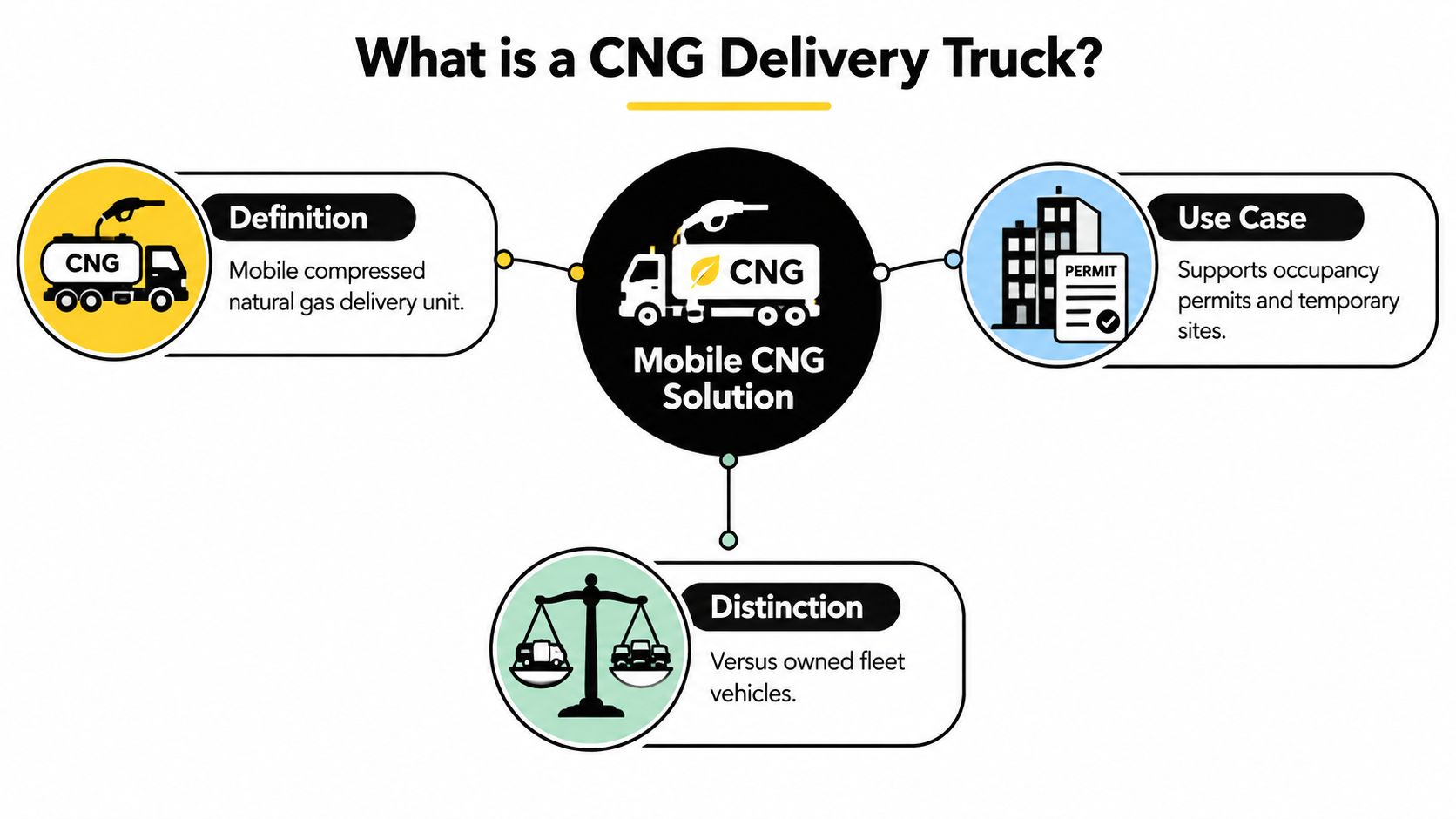
That distinction matters for project managers. An owned CNG fleet depends on vehicle availability and refueling access. A mobile supply service addresses a different problem, such as a delayed utility connection, a planned maintenance outage, generator commissioning, or temporary freeze prevention. The provider delivers the gas and the associated equipment arrangement, while the site team focuses on safe access, connection, consumption, and scheduling.
The fuel's history also shows why commercial routes and predictable operations matter. CNG vehicle use began in Italy in 1935, where national policy supported energy self-sufficiency. Between 1945 and 1960, CNG reached approximately 10% of Italy's vehicle-fuel market, then lost share during the 1960s as gasoline became cheaper and more available, according to the U.S. EPA historical review. U.S. heavy-duty adoption during the 1970s remained sporadic, but early conversions included dump trucks, pickup trucks, and school buses. Those applications had concentrated routes and repeatable operating needs, the same conditions that make temporary commercial gas delivery easier to plan than general consumer adoption.
Operational principle: Mobile CNG is most useful when the cost of waiting for permanent gas service exceeds the cost and coordination effort of temporary delivery.
How CNG Storage, Compression, and Dispensing Work
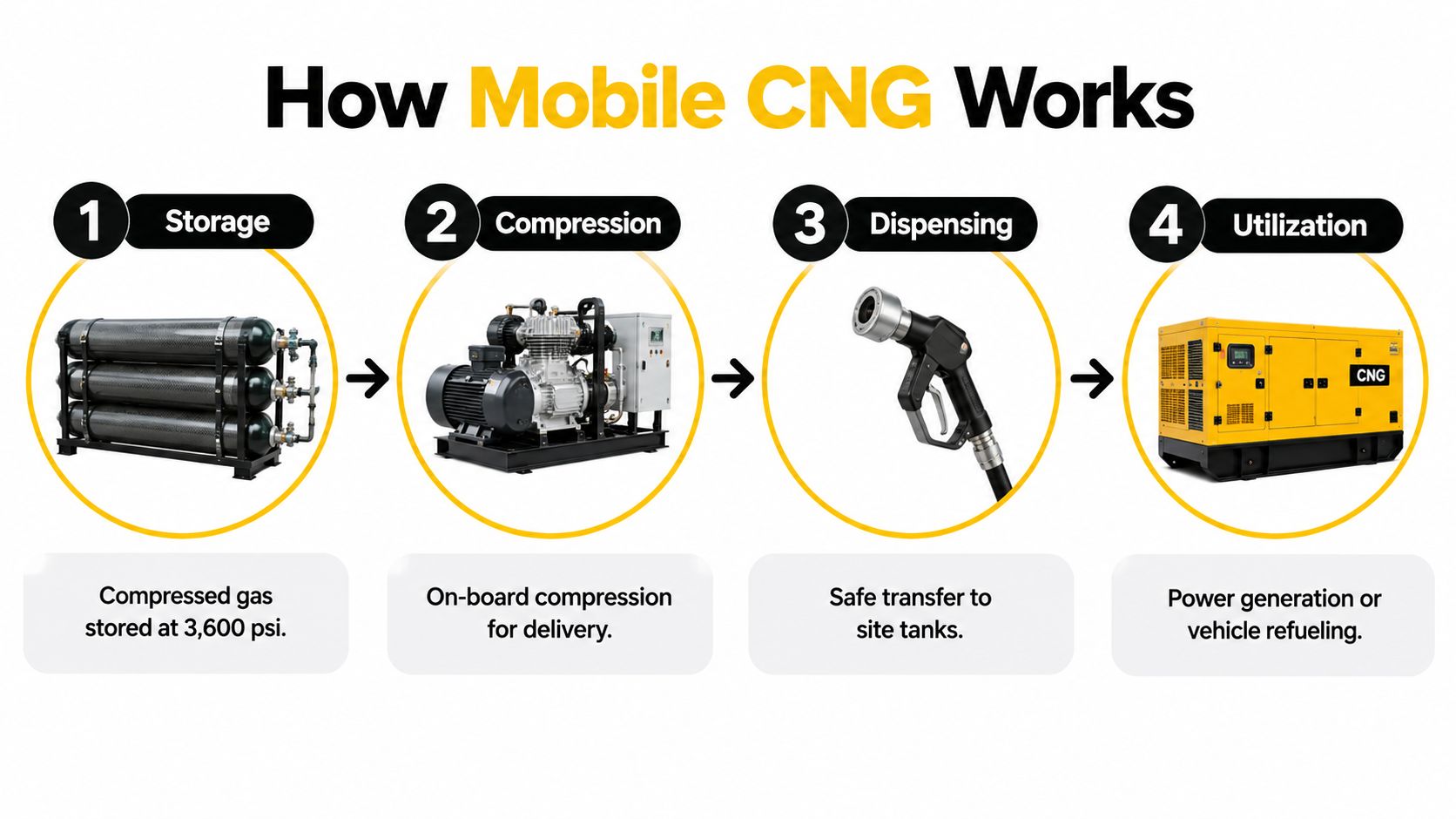
At a temporary job site, mobile CNG works like a fuel pipeline that arrives by truck. Gas moves through four linked stages, and each one affects delivery timing, equipment selection, and the amount of usable fuel available.
- Storage: High-pressure cylinders hold compressed natural gas on the vehicle or trailer. In the United States, vehicle CNG is commonly stored at approximately 3,600 psi, or 24.8 MPa. Multiple cylinders are often mounted behind the cab, where their weight and size also affect payload.
- Pressure management: A regulator reduces cylinder pressure to the level required by the engine or connected equipment. It does not make more fuel. Instead, it controls the pressure as gas leaves storage, much like a valve turns a high-pressure supply into a usable flow.
- Dispensing: Hoses, couplings, valves, and approved transfer equipment move gas from the mobile unit to site storage, a generator, or a vehicle. The receiving system must match the delivery pressure, connection type, and operating arrangement.
- Utilization: Gas then enters an engine, generator, boiler, or other approved equipment. Consumption depends on load, operating hours, ambient conditions, and equipment efficiency.
Plan by usable gas, not cylinder size
Cylinder water volume can mislead a dispatcher. Evaluate capacity in standard cubic feet or diesel-gallon equivalent, because temperature, fill pressure, and compression conditions change the gas available for use. Cylinder mass also reduces payload, so the largest physical tank arrangement may not suit a particular route or work site.
A government example shows why route planning needs real operating assumptions. A CNG vehicle with a 4,500-standard-cubic-foot tank at 3,000 psi achieved an estimated range of about 100 miles, according to the Alternative Fuels Data Center explanation of natural-gas Class 8 trucks. Treat that figure as an example, not a guaranteed result. Route length, return-to-base distance, idling, payload, weather, and seasonal conditions all change actual performance.
Set a minimum end-of-shift reserve before dispatching a truck or mobile unit. Confirm that the fueling equipment can provide the required pressure without excessive filling time. Schedule cylinder inspections as part of the operating calendar. Common U.S. guidance calls for inspection at least every 36 months, with cylinders meeting applicable vehicle-cylinder standards, as outlined in PHMSA cylinder requalification guidance. These checks belong in the same maintenance system as hose, valve, and vehicle inspections.
CNG Delivery Truck Safety and Fuel-Quality Requirements
A temporary CNG site combines stored energy, high pressure, moving vehicles, hoses, and changing work conditions. Safety planning therefore has to control both the pressure system and the path gas could take if a component releases it.
Commercial systems use shutoff valves to isolate individual containers and the engine. Pressure-relief devices connect directly to cylinder interiors, while venting directs released gas away from enclosed compartments where a combustible mixture could accumulate. CNG can be stored at pressures up to approximately 3,600 psi, and methane's flammability range in air is roughly 4% to 14% by volume, according to technical guidance on CNG vehicle safety. Preventing gas accumulation is as important as preventing ignition.
Fuel quality affects uptime as well as safety. Excessive water can freeze or form hydrates during pressure reduction. Sulfur and other contaminants can damage or poison exhaust after-treatment systems. Technical guidance recommends a natural-gas dew point at least 10°F, or about 6°C, below the coldest expected winter ambient temperature, which gives suppliers and fleet managers a practical specification for variable climates.
Treat the loading area as a controlled zone
Before transfer begins, the site lead should verify the following:
- Inspect equipment: Check hoses, couplings, valves, and visible fittings for damage or contamination.
- Confirm emergency controls: Make sure grounding and emergency shutdown procedures are understood by the driver and site crew.
- Control ignition sources: Keep generators, heaters, smoking areas, and other ignition sources separated from the transfer area.
- Protect vent paths: Ensure pressure-relief vents aren't blocked by materials, temporary structures, mud, or equipment.
- Correct site labeling: Review placards and transport markings before the unit arrives. A practical reference on how to fix rear placard mistakes can help teams identify common errors.
Temporary construction sites deserve extra attention because layouts change quickly. A generator may move, a trench may close an access route, or an enclosure may be added after the initial safety review. Recheck the transfer area whenever the site configuration changes.
Conventional Natural Gas vs Renewable Natural Gas Trade-offs
The phrase “cleaner fuel” hides several separate questions. A CNG delivery truck's results depend on the engine's nitrogen oxide certification, vehicle age, methane emissions, fuel source, duty cycle, and the accounting boundary used for lifecycle analysis.
California's EMFAC2025 analysis updated methane emissions using measurements from 50 natural-gas heavy-duty vehicles across four vocational categories. The update increased modeled methane emissions for 2025 by 20%, largely because of blow-by emissions from older engines, according to the EMFAC2025 natural-gas heavy-duty vehicle analysis. The same analysis distinguishes CNG engines certified at 0.2 g/bhp-hr NOx from newer technology certified at 0.02 g/bhp-hr NOx, with delivery-truck observations associated with both categories.
| Factor | Conventional Natural Gas | Renewable Natural Gas |
|---|---|---|
| Fuel origin | Extracted natural gas supplied through conventional gas channels | Gas produced from renewable feedstocks, depending on the specific project |
| Tailpipe question | Engine certification and vehicle condition still determine NOx and methane performance | The truck's engine behavior remains relevant, even when the fuel has a different origin |
| Lifecycle picture | Depends on production, processing, transmission, leakage, and accounting boundaries | Can materially change lifecycle results, but benefits depend on feedstock and accounting boundaries |
| Procurement priority | Confirm fuel composition, supplier controls, and local air-quality requirements | Confirm feedstock, certificates, carbon accounting, and supply continuity |
| Best comparison method | Compare measured or modeled NOx and methane for the actual duty cycle | Compare the same emissions categories while documenting the renewable claim |
The right buyer question isn't whether CNG is cleaner. Ask which engine certification the truck carries, how old the equipment is, whether it idles frequently, what fuel is supplied, and what local rules require. Separate modeled emissions from measured on-road performance before approving a fleet or temporary supply strategy.
Operational Cost and Downtime Considerations for Mobile CNG
Fuel price rarely determines the full cost of a CNG delivery operation. A truck can consume attractively priced gas and still become expensive if its driver waits at a congested station, travels out of route for refueling, or loses payload because of cylinder weight.
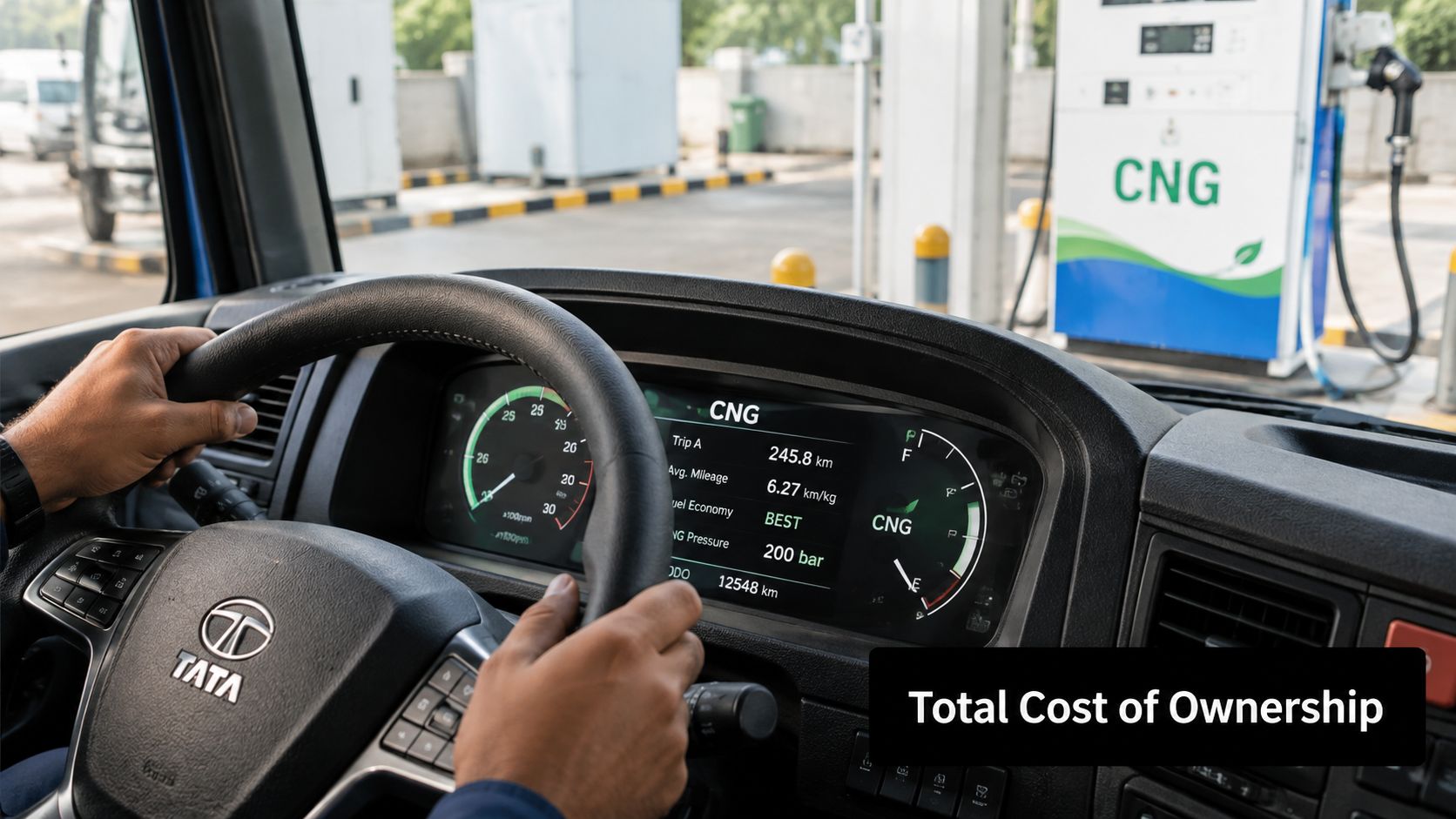
The U.S. Department of Energy and NREL total-cost-of-ownership framework includes refueling dwell time, driver costs, lost payload capacity, maintenance, insurance, tires, permits, and tolls, not only purchase price and fuel, as documented in the federal total-cost-of-ownership review. For construction and utility managers, this means a temporary site should be evaluated as a schedule problem as well as a fuel problem.
Build a route-level operating model
Use the actual work pattern rather than a brochure range:
- Daily miles: Include travel between the depot, job site, service calls, and return location.
- Fuel capacity: Record usable standard cubic feet or diesel-gallon equivalent, not only cylinder dimensions.
- Payload impact: Account for the mass of cylinders and any mobile dispensing equipment.
- Station access: Measure distance, compatibility, operating hours, and expected queue time.
- Productivity value: Assign a financial value to an hour of lost truck and driver availability.
- Backup arrangements: Identify another fueling point, a reserve unit, or a temporary delivery option.
A recent registration trend reinforces the need for a vocational analysis. In 2025, medium- and heavy-duty natural-gas vehicle registrations reportedly fell 15% year over year, while straight-truck registrations rose 27%, according to the cited federal review. The pattern suggests that adoption is concentrating in particular truck applications rather than spreading evenly across every segment.
For a temporary project, compare the cost of mobile delivery with the cost of a route deviation, a delayed commissioning window, an idle crew, or an unavailable generator. The cheapest gas supply isn't the cheapest operating decision if it interrupts the workday.
Temporary CNG Supply for Construction, Utilities, and Generators
A construction manager may have walls, electrical equipment, and mechanical systems ready, but no permanent gas service. A utility may need to maintain service during a planned outage. A facilities team may need fuel for generator commissioning before the final connection is approved. In each case, mobile CNG can act as a bridge between the current site condition and the permanent operating model.
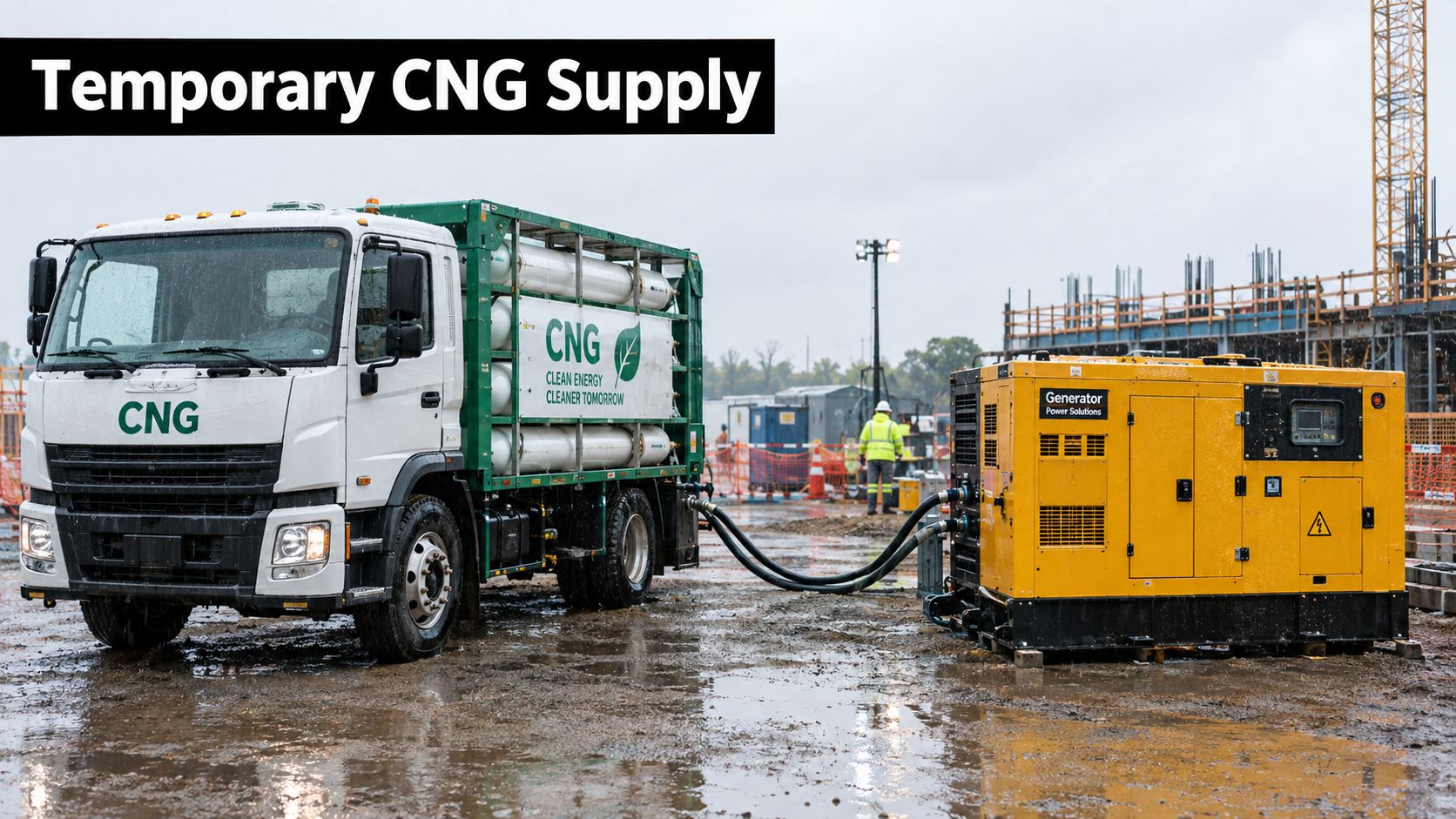
Blue Gas Express provides temporary CNG and LNG delivery across North Carolina, South Carolina, Tennessee, and Virginia, using mobile gas units for customers facing natural-gas-line delays or maintenance outages. Its service model supports needs such as occupancy permits, generator commissioning, and freeze prevention, with deployment planned around the site's equipment, access, and fuel demand.
Match the supply method to the project
For a building awaiting occupancy approval, the team should confirm the temporary equipment arrangement with the relevant authorities, identify the generator or appliance connection requirements, and schedule delivery around inspections. For a utility outage, the priority may be continuity of service, safe access, and a defined changeover procedure. For freeze prevention, the plan must account for weather exposure, monitoring, reserve fuel, and rapid response if consumption rises.
Temporary CNG isn't a substitute for every permanent installation. It makes the most sense when the need is time-sensitive, the site can accommodate a controlled delivery area, and permanent infrastructure is delayed, unavailable, or temporarily offline. Teams evaluating generator resilience can also review commercial backup power systems to compare broader equipment and continuity considerations.
Before ordering, provide the supplier with the site address, equipment type, expected load, access restrictions, delivery window, connection details, and emergency contact. That information lets the provider assess whether a mobile unit can serve the job safely and without creating an avoidable schedule conflict.
CNG Delivery Truck Deployment Checklist and Next Steps
A CNG truck should be planned as part of the job, not treated as a fuel drop. Before mobilization, the fleet manager, contractor, utility representative, equipment operator, and supplier should assign responsibility for ordering, connection, monitoring, emergency shutdown, and demobilization.
Use the first planning call to confirm:
- Define the job: Identify whether the need involves occupancy, generator commissioning, outage support, freeze prevention, or vehicle fueling.
- Document demand: Estimate operating hours, load, daily consumption, delivery frequency, and the reserve required at shift end.
- Verify equipment: Confirm cylinder standards, inspection status, pressure requirements, hose and coupling compatibility, and receiving-equipment approval.
- Prepare the site: Mark the delivery route, establish a controlled high-pressure zone, protect vents, separate ignition sources, and preserve emergency access.
- Check fuel quality: Specify gas-quality and dew-point requirements for the coldest expected conditions.
- Plan downtime: Record delivery windows, station alternatives, queue risks, backup fuel, and the productivity cost of an interrupted hour.
- Assign authority: Name the person who can stop transfer, request emergency support, approve layout changes, and release the unit after service.
High-pressure equipment requires scheduled inspection and documented records, not informal visual checks. Common U.S. guidance calls for CNG cylinder inspection at least every 36 months, as described in the Alternative Fuels Data Center truck guidance. Retain delivery records, inspection documents, fueling logs, and incident reports so the next shift can understand the equipment's operating history.
Request a site review before mobilization. Give the provider the schedule, equipment details, access limits, connection information, and emergency contacts. Then compare mobile CNG with delay costs, route disruption, and temporary fuel alternatives.
Blue Gas Express provides mobile CNG and LNG units for temporary service, maintenance outages, generator commissioning, occupancy support, and freeze prevention across North Carolina, South Carolina, Tennessee, and Virginia. Visit Blue Gas Express to discuss site requirements, delivery timing, equipment connection, and a temporary gas plan.