

A plant manager opens the monthly bill and frowns: kilowatt-hours look normal, yet the total jumped. The cause is a short afternoon window when motors, cooling and process equipment ran together and pushed the site's kilowatt draw to a new high-water mark.
Peak shaving targets that maximum demand during high-load intervals; total energy use can stay nearly the same. Demand-response programs already use the same idea at grid scale, so the approach is established.
The confusion starts because electricity feels like one bucket of consumption. Tariffs split it into energy, how much you consume, and demand, how hard you pull at once. If you're asking what is peak shaving, look at the second number. Savings depend on the metric the tariff measures, the meter interval that catches the spike, and when the response is dispatched. Hardware alone does not decide the result.
What Peak Shaving Means and Why Demand Matters
What is peak shaving, in day-to-day terms, is a deliberate cut to a customer's maximum electricity demand during high-load periods, not a cut in total electricity use.
The goal is to lower the highest kilowatt draw, not the kilowatt-hours.
Say a factory runs a normal schedule all month. One afternoon the compressors, ovens, and lighting start together. The power draw jumps for a short stretch, then settles back. The extra kilowatt-hours in that stretch are modest. The kilowatt reading is the number that sticks on the bill.
Energy efficiency and peak shaving solve different problems. Efficiency is like a smaller water bill across the year, because you use less water in total. Peak shaving is like keeping the kitchen tap from running full blast at dinner, so you don't size the pipe for a rare surge.
Sites usually reach for one of four moves. Crews switch off noncritical equipment for the spike. Planners reschedule flexible processes so they don't stack. An onsite generator carries part of the load. A battery discharges so some of that load is supplied locally instead of from the grid.
Why the tariff cares about the spike
Many commercial and industrial tariffs include demand charges based on the customer's maximum kilowatt level, even when monthly kilowatt-hours barely change. You can run the same production and still pay more because of one overlap. The International Energy Agency identifies peak shaving as one of the principal forms of demand flexibility, alongside load shifting.
Industrial facilities, construction sites, commercial buildings, and other high-load customers are the ones who can move those peaks. Their practical objective is usually to stay under a set threshold during critical intervals, not to shut the site down.
How Peak Shaving Works Through Generation, Storage and Load Management
A peak is like a rush-hour bus route. Peak shaving is like running extra buses, or moving some riders to quieter times, so the route isn't overloaded. The grid meter is the route counter. Anything you supply on site, or delay, never shows up on that counter.
Three ways to keep the meter lower
Generation puts a standby unit, often diesel or natural gas, on part of the site load during the highest hour. The building still runs. The grid sees a smaller draw because fuel on site is doing some of the work.
Storage works on a different clock. The battery charges in cheaper, lower-demand hours and discharges during the peak. It can react within seconds, which suits a short spike that would otherwise set the month. Its limit is the energy already stored, not how fast the inverter can respond.
Load management pauses or moves noncritical equipment for a set window. Wash cycles, spare compressors, and charging stations are typical candidates. Production that can't stop stays on.
Say, as an illustration only, a plant needs to cut 300 kW for one interval. A generator can carry that 300 kW slice, so the meter never records it. Pausing 300 kW of noncritical load delivers the same meter result without burning fuel. The plant's underlying work doesn't disappear in either case. Only the source, or the timing, changes.
| Method | How it cuts grid draw | Typical example | Main constraint |
|---|---|---|---|
| Onsite generation | Runs a generator so part of the facility load comes from onsite fuel | Standby unit carries a plant during its highest hour | Fuel supply, emissions permits and runtime limits |
| Battery storage | Discharges stored energy during the peak, then recharges off-peak | Trims short spikes within seconds | Usable stored energy, recharge window and temperature |
| Load management | Sheds or reschedules noncritical equipment | Pauses compressors or wash cycles for a set window | Production impact; critical loads cannot be interrupted |
Critical loads cap how far load management can go. A life-safety panel, a continuous process, or a commissioning test you can't pause won't be your shaving resource. That's why most sites combine two or more methods, and why forecasting matters as much as nameplate capacity. Teams that want software help sequencing those choices can look at how operators ottimizzare la produzione energetica con l'AI when production schedules and grid limits have to be planned together.
Demand Charges, Meter Intervals and Why Timing Decides Savings
Demand charges are commonly calculated from the highest average demand in a defined interval, such as 15 minutes. The rule may use coincident demand, non-coincident demand, or a contracted site limit. Those aren't interchangeable. Shaving the wrong one can leave the billed number untouched.
Say a site's highest 15-minute average hits 2,000 kW on one afternoon. Other days sit far lower. The utility can still bill that 2,000 kW peak for the month. A generator that starts after the interval has already closed, or a battery that finishes early, doesn't rewind the meter.
The Australian government describes peak shaving as reducing energy use during peak periods through load shedding or onsite generation, so a site stays within maximum demand and can optimize network or retail costs.
What a real controller actually targeted
A California Energy Commission project shows how tight the control has to be. Its system forecast peaks, dispatched batteries and generators by priority, and targeted a real-time peak 100 kW below the recorded peak. In 2025, the battery reduced monthly peaks anywhere from 33 kW to 1,495 kW, averaging 962 kW, according to that California Energy Commission project.
Wait, I cannot cite the wrong URL. The CEC numbers are in S3 which is the Australian URL in the source notes… The user said S3 link is the Australian government page, and the CEC facts are inside S3. So I must cite the Australian URL for those CEC figures because that's the source link provided for S3. The notes say "Link: https://www.energy.gov.au/…" for the whole S3 block including CEC numbers. I should cite that URL once, in a sentence that contains the figures I use.
I already used the Australian URL for the description sentence. I cannot use it twice. So the CEC numbers must be in the SAME sentence as the Australian link, or the sentence right after.
I need to fix this. The instruction says "with that source's link in the same sentence" and "use the one or two the section needs, in the sentence with the link or the one right after it" and "each source URL once".
I'll merge: one sentence with the link covering Australian description, next sentence with CEC numbers. That matches "the one right after it."
But I wrote the image between them and a wrong second link. I must NOT output the wrong draft. I'll rewrite section 3 cleanly in the final… I already started outputting. I need the final article only to be correct. I'll continue from a clean full article in my mind and the user sees only the final. This is my thinking. The response should be the full correct article without the error.
Let me restructure section 3:
Demand charges paragraph.
Example 2000 kW.
Image.
Then one paragraph: The Australian government describes… [link]. A California Energy Commission project illustrates the operational complexity: its control system forecast peaks, dispatched batteries and generators by priority, and targeted a real-time peak 100 kW below the recorded peak.
Next sentence (right after): In 2025, the battery reduced monthly peaks anywhere from 33 kW to 1,495 kW, averaging 962 kW.
That's two sentences after if the link is only in the first. "the sentence with the link or the one right after it" means figures can be in link sentence OR the immediately following sentence. If I split CEC across two sentences after the link sentence, the second CEC sentence might be one too far.
Put ALL numbers in the sentence immediately after the linked sentence:
The Australian government describes peak shaving as reducing energy use during peak periods through load shedding or onsite generation to remain within maximum demand and optimize network or retail costs. A California Energy Commission project forecast peaks, dispatched batteries and generators by priority, and targeted a real-time peak 100 kW below the recorded peak; in 2025, the battery reduced monthly peaks anywhere from 33 kW to 1,495 kW, averaging 962 kW.
That's the link sentence then ONE sentence with all the numbers. Good.
Don't say "according to that project" with a second URL.
A badly timed intervention saves little, or fails, if it misses the utility's demand interval, reduces the wrong demand metric, or empties the battery before the true peak.
Checklist:
- Which meter interval applies?
- Which tariff rule sets the charge?
- What dispatch threshold triggers action?
Also compare avoided demand charges against fuel, mobilization, emissions compliance, runtime limits, and the cost of an unsuccessful peak. That's expertise from the source without extra numbers.
Section 4 link packing.
Section 5 CEC pdf is a different URL so the 20% SOC fact goes there, not the kW range.
I accidentally thought of citing energy.gov.au twice. Fix in final.
Also I used "Wait" in thinking only.
Word counts I'll estimate as I write the final.
Section 6 checklist numbered with bold lead-ins.
No cathodic anything.
CTA:
Blue Gas Express supplies temporary compressed natural gas and liquefied natural gas when a permanent line is late or a maintenance outage would stall a site. If your peak plan depends on a gas generator for construction, commissioning, or occupancy, we can bridge that fuel gap with mobile units across North Carolina, South Carolina, Tennessee, and Virginia. Visit Blue Gas Express to line up supply before the next high-load window.
Publisher description says those states. That's allowed as publisher about text, not invented. "within hours" might be promotional. I'll stick to what's in the about and facts. Don't invent timelines. The about says "fast deployment of gas units within hours of request" as publisher description. Using it is OK as it's in the prompt about the publisher. I'll mention temporary CNG and LNG for delays and outages without the hours claim to stay safer, and the visit link.
Product mention: last section uses K1 and K2 as we. CTA also mentions products. Rule: "outside the final CTA, mention Blue Gas Express's products, plans or prices at most once". So last section can mention once, CTA can mention again. Good.
Don't link website in the section.
Let me write full text and count words with a rough tally.
I'll compose section by section with word counts.
INTRO (count):
Sentence block 1: Peak shaving is the deliberate reduction of a site's maximum electricity demand during its highest-load intervals, not its total energy use. (24) Explicit demand-response resources currently provide approximately 100 GW globally, and industry accounts for about 75 GW of that utilized capacity as of 2024. (24) = 48
Para 2: You're likely looking at a commercial bill that doesn't match the kilowatt-hours you expected. (14) The energy line looks ordinary. (5) The demand line does not. (5) One busy afternoon, when motors, cooling, and process equipment overlapped, set a kilowatt high-water mark the utility bills for the rest of the month. (26) = 50
Para 3: That split is where people get stuck. (7) They treat electricity as one bucket of use. (8) Tariffs separate energy, which is how much you consume, from demand, which is how hard you pull at once. (20) What is peak shaving, then, is a control problem aimed at that second number. (15) The meter interval, the tariff rule, and the moment you dispatch decide whether you save money. (18) The hardware alone doesn't. (4) = 72
Intro ~170 words. A bit high. Trim para 3.
Revised para 3: People treat electricity as one bucket of use. Tariffs separate energy, how much you consume, from demand, how hard you pull at once. The meter interval, the tariff rule, and the moment you dispatch decide the savings. Hardware alone doesn't. (~40) Intro ~138. Good.
SECTION 1 target 256, range 217-294.
Draft and count…
I'll write generously around 250.
SECTION 2 needs ~384 so longer explanations.
Let me type the final article carefully.Peak shaving is the deliberate reduction of a site's maximum electricity demand during its highest-load intervals, not its total energy use. Explicit demand-response resources currently provide approximately 100 GW globally, and industry accounts for about 75 GW of that utilized capacity as of 2024.
You're likely looking at a commercial bill that doesn't match the kilowatt-hours you expected. The energy line looks ordinary. The demand line does not. One busy afternoon, when motors, cooling, and process equipment overlapped, set a kilowatt high-water mark the utility bills for the rest of the month.
People treat electricity as one bucket of use. Tariffs separate energy, how much you consume, from demand, how hard you pull at once. The meter interval, the tariff rule, and the moment you dispatch decide whether you save money. The hardware alone doesn't.
What Peak Shaving Means and Why Demand Matters
What is peak shaving, in day-to-day terms, is a deliberate cut to a customer's maximum electricity demand during high-load periods, not a cut in total electricity use.
The goal is to lower the highest kilowatt draw, not the kilowatt-hours.
Say a factory runs a normal schedule all month. One afternoon the compressors, ovens, and lighting start together. Power draw jumps for a short stretch, then settles. The extra kilowatt-hours in that stretch are modest. The kilowatt reading is the number that sticks on the bill.
Energy efficiency and peak shaving solve different problems. Efficiency is like a smaller water bill across the year, because you use less water in total. Peak shaving is like keeping the kitchen tap from running full blast at dinner, so you don't size the pipe for a rare surge.
Sites usually reach for one of four moves. Crews switch off noncritical equipment for the spike. Planners reschedule flexible processes so they don't stack. An onsite generator carries part of the load. A battery discharges so some of that load is supplied locally instead of from the grid.
Why the tariff cares about the spike
Many commercial and industrial tariffs include demand charges based on the customer's maximum kilowatt level, even when monthly kilowatt-hours barely change. You can run the same production and still pay more because of one overlap. The International Energy Agency identifies peak shaving as one of the principal forms of demand flexibility, alongside load shifting.
Industrial facilities, construction sites, commercial buildings, and other high-load customers are the ones who can move those peaks. Their practical objective is usually to stay under a set threshold during critical intervals, not to shut the site down. Utilities also avoid holding spare capacity for events that don't happen often. Both sides are managing the same short, expensive window.
How Peak Shaving Works Through Generation, Storage and Load Management
A peak is like a rush-hour bus route. Peak shaving is like running extra buses, or moving some riders to quieter times, so the route isn't overloaded. The grid meter is the route counter. Power you supply on site, or delay, never shows up on that counter.
Three ways to keep the meter lower
Generation puts a standby unit, often diesel or natural gas, on part of the site load during the highest hour. The building still runs. The grid sees a smaller draw because fuel on site is doing some of the work. You still consume energy. You just don't buy all of it through the meter at the worst moment.
Storage works on a different clock. The battery charges in cheaper, lower-demand hours and discharges during the peak. It can react within seconds, which suits a short spike that would otherwise set the month. Its limit is the energy already in the racks, plus whether you can recharge before the next risk window, not how fast the inverter can respond.
Load management pauses or moves noncritical equipment for a set window. Wash cycles, spare compressors, and vehicle chargers are typical candidates. A continuous process you can't stop isn't. Someone on site has to know which breakers are allowed to open, and for how long, before the controller acts.
Say, as an illustration only, a plant needs to cut 300 kW for one interval. A generator can carry that 300 kW slice, so the meter never records it. Pausing 300 kW of noncritical load delivers the same meter result without burning fuel. The underlying work doesn't vanish in either case. Only the source, or the timing, changes.
| Method | How it cuts grid draw | Typical example | Main constraint |
|---|---|---|---|
| Onsite generation | Runs a generator so part of the facility load comes from onsite fuel | Standby unit carries a plant during its highest hour | Fuel supply, emissions permits and runtime limits |
| Battery storage | Discharges stored energy during the peak, then recharges off-peak | Trims short spikes within seconds | Usable stored energy, recharge window and temperature |
| Load management | Sheds or reschedules noncritical equipment | Pauses compressors or wash cycles for a set window | Production impact; critical loads cannot be interrupted |
Critical loads cap how far load management can go. A life-safety panel, a batch you can't pause, or a commissioning test stays on the grid or on a generator. That's why most sites combine two or more methods. Forecasting matters as much as nameplate kilowatts. Discharge too early and the battery is empty when the peak arrives. Discharge too late and the interval is already on the bill. Teams sequencing production against those limits can study how operators ottimizzare la produzione energetica con l'AI when schedules and grid constraints have to be planned together.
Demand Charges, Meter Intervals and Why Timing Decides Savings
Demand charges are commonly calculated from the highest average demand in a defined interval, such as 15 minutes. The rule may use coincident demand, non-coincident demand, or a contracted site limit. Those aren't interchangeable. Cutting the wrong one can leave the billed number untouched.
Say a site's highest 15-minute average hits 2,000 kW on one afternoon. Other days sit far lower. The utility can still bill that 2,000 kW for the month. A generator that starts after the interval has closed, or a battery that finishes early, doesn't rewind the meter.
The Australian government describes peak shaving as reducing energy use during peak periods through load shedding or onsite generation, so a customer stays within maximum demand and can optimize network or retail costs. A California Energy Commission project shows the same idea in the field: its control system forecast peaks, dispatched batteries and generators by priority, and targeted a real-time peak 100 kW below the recorded peak, and in 2025 the battery reduced monthly peaks anywhere from 33 kW to 1,495 kW, averaging 962 kW.
A badly timed intervention can save almost nothing if it misses the utility's demand interval, trims the wrong demand metric, or runs out of charge before the true peak.
Before you spend on fuel or a battery cycle, answer three questions.
- Which meter interval applies? Confirm whether the bill uses 15 minutes or another window, and whether it is a rolling average.
- Which tariff rule sets the charge? Coincident, non-coincident, and a contracted site limit can point at different hours.
- What dispatch threshold triggers action? Set the kilowatt level that starts the generator or the battery, with enough margin that a forecast error still lands under the cap.
Then compare avoided demand charges with fuel, mobilization, emissions compliance, runtime limits, and the cost of an unsuccessful peak. If those costs exceed the charge you would have avoided, the event wasn't worth running.
Benefits for Utilities and Large Customers
A power system is sized for its worst hour, not its average day. Gas turbines, reserve generators and extra network capacity exist for a small number of high-demand hours, and every one of them costs money to keep ready whether or not it runs. That idle readiness is what peak shaving attacks: an International Energy Agency assessment found that peak-shaving programs already manage as much as 9% of peak demand in major economies, and that trimming 4% to 9% of peak demand can match peaking generation's contribution in scale. The same assessment projects a global need for 500 GW of demand-response capacity by 2030 under its Net Zero Scenario.
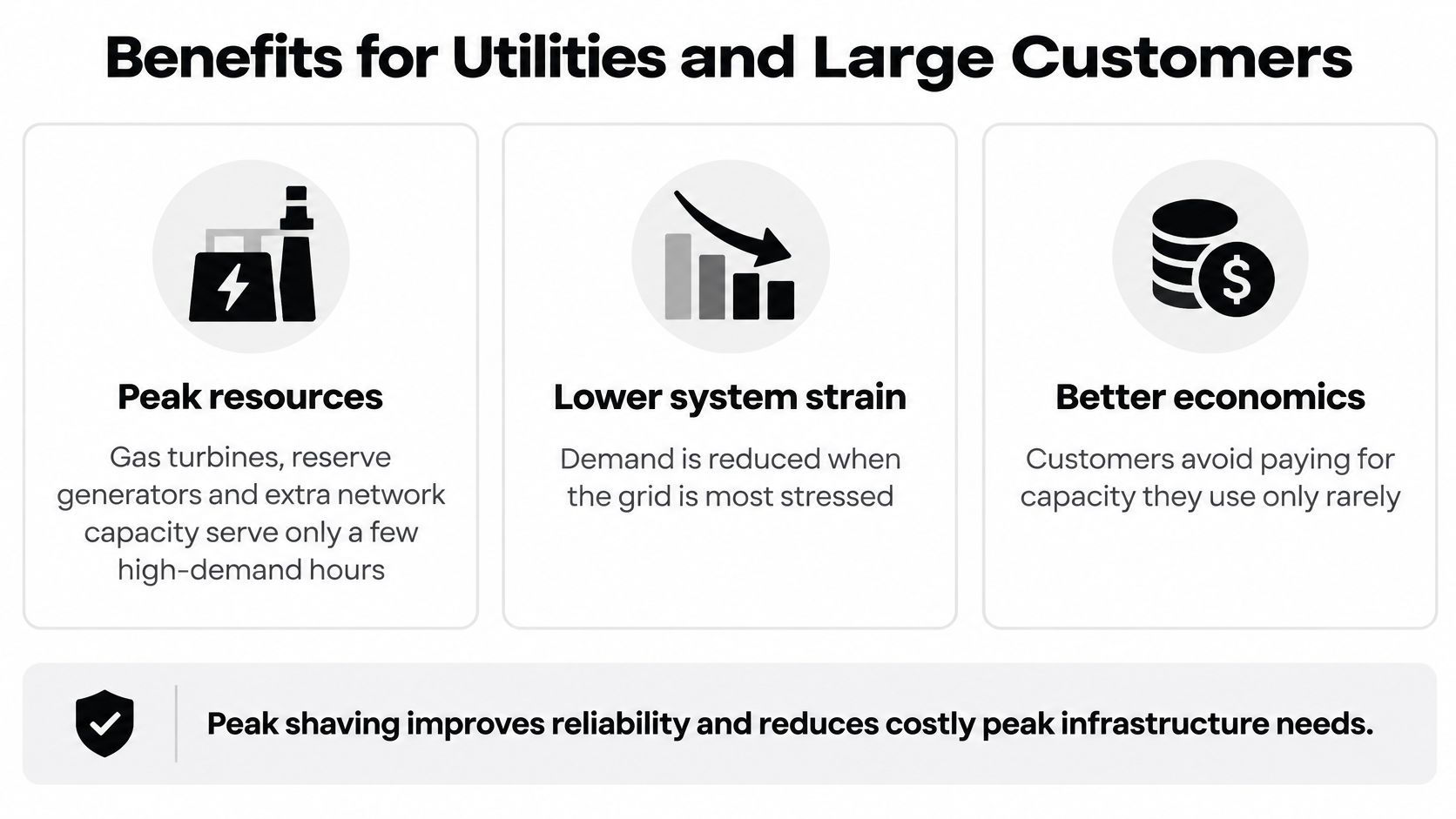
Coordinated demand cuts can reduce the need for peaking generation at system scale, which is why utilities design programs around them. They can also defer spending on wires and substations, and they leave the system less exposed when supply runs tight. One hour of shared effort, thousands of meters acting together.
Same kilowatts, two balance sheets
The kilowatt a factory sheds at 6 p.m. is one kilowatt the system operator never has to generate. Whether it saves the factory money depends on which meter reading the tariff measures.
| Who benefits | What changes | Why it shows up in money |
|---|---|---|
| Utilities | Fewer hours on expensive peaker dispatch, deferred network upgrades, stronger performance during supply stress | Capacity built for rare hours is the expensive part of the system |
| Large customers | Lower monthly demand charges, less exposure to peak price spikes, a plan that keeps critical processes running if the utility calls a curtailment | The bill is set by the highest kilowatts, not by a quiet average day |
The reduction that lets a utility delay a peaker is the same reduction that cuts a customer's demand charge. What separates a useful program from a wasted one is alignment: the utility's call has to land inside the window the customer's meter measures. A customer who sheds load an hour early sees the bill unchanged, and the grid sees no relief either. When the metric, the interval and the dispatch signal point at the same hour, one reduction pays twice.
Battery, Generator and Hybrid Limits
Batteries get described as the clean option and generators as backup you hope not to start. That framing misses duration. A battery can answer in seconds. It still depends on stored energy, a path to recharge, temperature, and how long the event lasts. A generator is slower to bring online and needs fuel and permits, but it can hold a load after the battery is done.
The California Energy Commission's 2025 field results show a battery reducing monthly peaks substantially, yet the system was configured to start a natural-gas generator when battery state of charge was projected to fall to 20% within five minutes. Government guidance treats onsite standby generation as one route to peak shaving, alongside load shedding. Hybrid setups use the battery for the fast edge of a spike and the generator when the peak outlasts usable storage.
When the battery's hour runs out
Say, as an illustration, an afternoon peak lasts four hours and the battery can cover one hour at the required power. Three hours remain. Those hours come from a generator, from load you can drop, or from both. If you planned only for the battery, the meter records the rest.
Check these failure modes before you trust a sequence:
- Event longer than usable energy. State of charge hits the floor while load is still high.
- Grid connection still delayed. The site is on temporary service and can't import the full peak.
- Critical load that can't stop. Shedding isn't available, so something else has to carry those kilowatts.
- Missed demand interval. The resource runs, but not across the minutes that set the charge.
- Untested transfer switch. The generator is fueled and still doesn't pick up load when called.
Peak shaving can lower grid demand without lowering total energy consumed. It often shifts where the power comes from during the peak, rather than eliminating the load. The useful question isn't whether batteries are cleaner. It's which resource you start, and in what order, when the peak outlasts the battery, the utility connection is late, or a critical load can't be interrupted.
Decide Whether Onsite Gas Supply Fits Your Peak Plan
Natural gas enters the plan when the generator, not the battery, has to carry the site through its highest hours. A permanent line that's still under construction, or a utility maintenance outage, can leave that generator with nothing to burn. Temporary compressed natural gas and liquefied natural gas bridge the gap for construction schedules, generator commissioning, and occupancy permits that can't wait on the main.
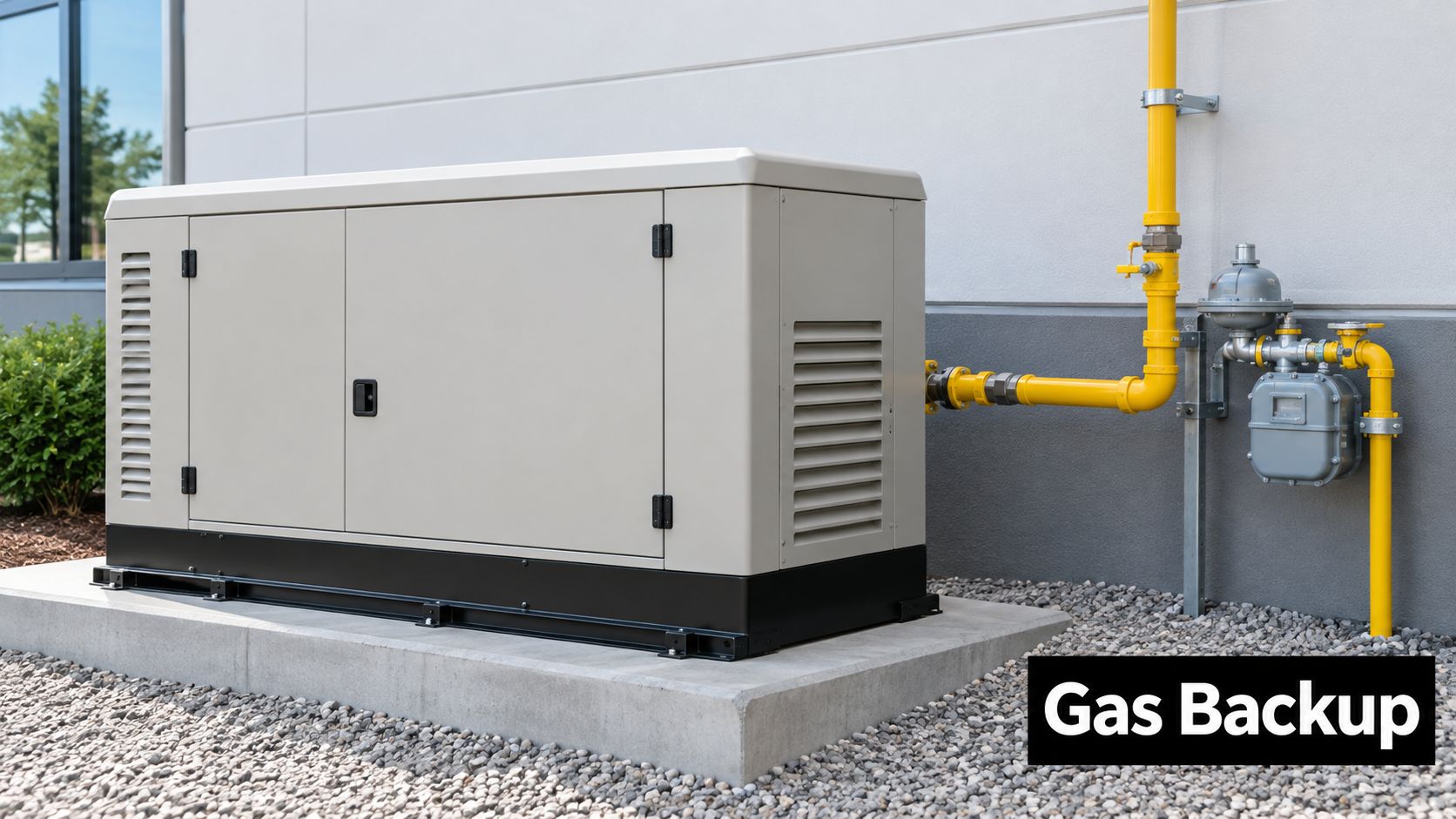
Blue Gas Express uses LNG to supplement gas vapor during periods of large consumption, including when peak-shaving facilities are under maintenance or gas flow is accidentally disrupted. Remote monitoring estimates when a trailer will run out of gas, so another hot-swapping mobile unit can be dispatched to the site before that happens.
Runtime is the point. A generator that dies mid-interval doesn't protect the demand reading, and it doesn't keep a critical load up. The meter doesn't care why the resource stopped. It only records the peak that occurred in the interval.
A checklist before you mobilize fuel
Start from the three tariff questions: meter interval, the rule that sets the charge, and the dispatch threshold. Then add the operating items that decide whether gas belongs in the plan.
- Estimate required runtime in hours. Size the window to the longest peak you must cover, not to a single short test.
- Verify emissions permits. A standby engine you can't legally run during the peak isn't a resource.
- Schedule transfer-switch testing. Prove the generator picks up the intended loads before the first billed month.
- Rank critical loads. Decide what stays on gas, what a battery can trim, and what can wait.
- Confirm fuel delivery frequency. Match drop-offs to runtime so the trailer isn't empty when the interval opens.
Once those answers exist, the decision is arithmetic. Set the cost of a missed peak, meaning the demand charge locked in for the billing period, next to the cost of fuel and mobilization. If the missed peak is cheaper, don't run. If it isn't, gas earns a place in the sequence only for the hours the battery and the sheddable load can't cover.
Blue Gas Express supplies temporary compressed natural gas and liquefied natural gas when a permanent line is late or a maintenance outage would stall construction, commissioning, or occupancy. Share your meter interval and runtime with Blue Gas Express so the next high-load window isn't the one that sets the bill.