

Most people spot a natural gas outage through their senses. A rotten-egg smell or a hissing sound means you leave, get to a safe distance, and call the utility's emergency line or 911 from outside. If the appliances just stopped and there's no odor, that's a different situation. Confirm the interruption with the utility before you start poking at equipment.
What to Do First During a Natural Gas Outage
Before anything else, I ask three questions. Is this a safety problem, a utility-side outage, or an internal equipment fault? How long will restoration take, and what does the building lose if gas stays off?
The usual losses are fairly predictable:
- Heat and hot water
- Process load and production
- Generator commissioning
- Freeze protection for pipes
On a job site, that often looks like a cold building, a boiler that won't fire, or a missed inspection window.
A short blip under one hour is usually just a wait. Once the outage runs past the one-hour mark, though, it's worth arranging temporary supply so the work doesn't stall.
Match the Situation to a First Action
| Situation | First action | Who owns it |
|---|---|---|
| Gas odor or hissing | Leave, then call from outside | Utility emergency line or 911 |
| Several appliances down, no odor | Confirm the outage first | Utility desk |
| One appliance only | Check that unit | Building or contractor |
Run this safety check before you go looking for a cause:
- Don't flip switches or relight pilots if you smell gas.
- Don't go back inside to hunt for the source.
- Call from outside and follow the utility's instructions.
Report first, investigate second. Poking at valves can delay the safety check crews need before gas comes back on.
This infographic walks through the same path, from danger signs to the one-hour rule.
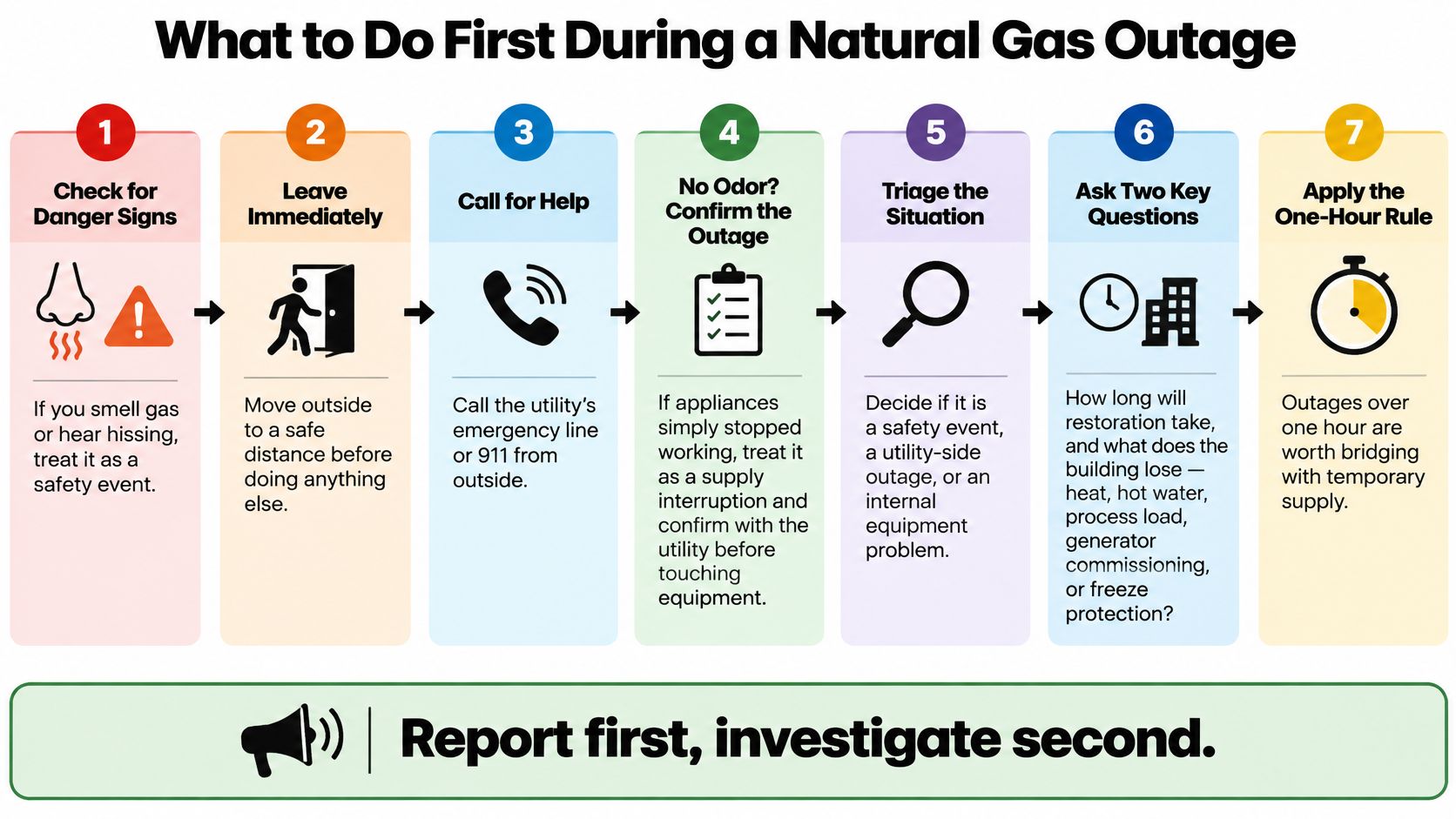
Smell or hissing means leave and call. No odor means confirm the outage, name an owner, and decide whether the site can safely wait.
Before you call anyone about a natural gas outage, rule out problems on your own property. It sounds obvious, but it saves a lot of time.
Start with the account. A recent move-in, a transfer, or an unpaid balance can pause service without any warning. Check whose name is on the account and whether its status is active.
Check the Inside Causes First
Next, look for a manual valve that someone may have closed after recent work. A tripped appliance or a problem limited to one unit in a multi-tenant building can also look exactly like an outage.
Here's a quick way to tell the difference. If only one unit is affected, the problem is probably internal. If the neighboring units are dark too, you're likely dealing with a supply problem.
Check Outage Maps and Alerts
Once you've ruled out your own building, look at the wider picture. Open the provider's outage map and status alerts, then search by the exact service address rather than the general neighborhood, since block boundaries can be surprisingly specific.
Call the Right Number
Use the customer or emergency number printed on your bill. Have the account number and service address in front of you. Agents will verify both before they share anything, and fumbling for them mid-call only adds minutes.
Before you hang up, get answers to three questions:
- An incident reference number for the outage
- The affected area and whether your block is included
- An estimated restoration window, even if it's only a range
Write down the incident number first. It's the fastest way to get updates.
Job Sites Without a Meter
New construction addresses often don't show up in outage systems at all, because no meter has been set yet. Don't assume the map is wrong. Ask the utility directly whether a service order exists for the site, and if it does, get the order number.
Who Needs to Know
Once you have the facts, bring in the people who depend on the gas. That usually means the general contractor, the mechanical subcontractor, the inspector handling occupancy or generator commissioning, and the property manager.
If outage calls are piling up and your team can't keep up, HVAC answering support can help route urgent service requests to the right people. For a look at how that workflow runs in practice, see how Mercateer books HVAC jobs.
Details Worth Logging
Keep a simple written record. Note these details:
- The time the gas was lost
- The utility contact's name
- The ticket number
- Any callback time they promised
A log like this pays off later, especially if you need to dispute a delay or document losses for an insurance claim.
What an Estimate Really Promises
An estimated restoration time reflects the utility's current plan. It isn't a guarantee. Storms, crew availability, and inspections during widespread events can all push it back, sometimes by hours. Treat the window as a planning tool, and build in a buffer for your crews and your schedule.
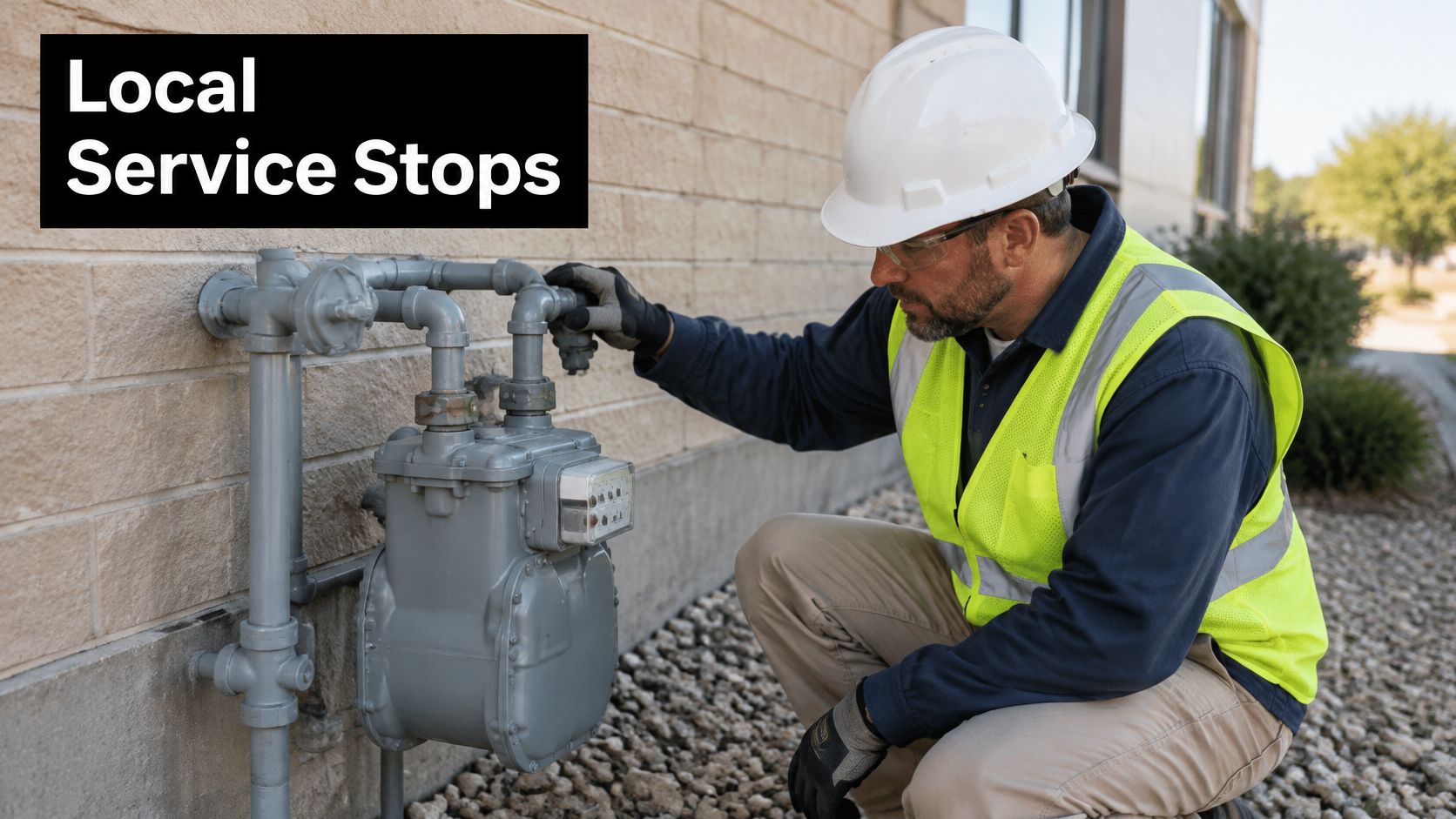
National supply figures are reassuring on paper, but they won't do much for your building. Your site runs on one service line, and that line can fail for reasons that have nothing to do with the national picture.
Why Big Numbers Can Hide Local Problems
Take January 21 and 22, 2025. Domestic demand hit a record 150 billion cubic feet per day, and freeze-offs and unplanned production outages pulled supply in the other direction.
Dry-gas production had climbed by at least 14.5 billion cubic feet per day over the five winters before that. Still, the cold froze wells and gathering lines anyway.
More supply on average lowers risk across the system. It doesn't make any single pipe immune to a hard freeze.
Four Local Causes Behind a Service Interruption
Most local outages come down to one of a handful of places:
- Customer side: a closed valve, a faulty appliance, or an account problem.
- Distribution incidents: damage or failure inside the local network.
- Planned maintenance: scheduled work the utility announces ahead of time.
- Excavation damage: a crew hitting a line during digging or construction.
- Upstream constraints: supply limits that reach your area from farther away.
Each one looks different on the ground. A customer-side problem usually means one dead appliance, while a distribution or upstream issue can darken an entire block.
What Builders and Facility Managers Actually Feel
On a job site, the impact shows up fast. Without gas, commissioning can slip, occupancy approvals can stall, and any process that depends on steady heat can grind to a halt.
Generators can run out of fuel, and exposed pipes can freeze. These costs often hit well before gas comes back to the meter.
Why Utilities Investigate Before Restoring Service
Pipeline incidents fall under their own safety category in 49 CFR Part 191. The rule covers transmission, gathering, storage, distribution, and LNG operators.
That's why utilities report and investigate first, and restore service second.
For a broader look at heating fuels, see Bender's Oil Service homeowner advice in Oil vs Gas Heat: An Eastern Connecticut Homeowner's Guide.
A temporary supply hooks into the building's existing piping, just downstream of the meter set. Boilers, appliances, and process equipment keep running while the utility finishes its repair or installs a new line.
That connection is what makes the difference. You don't have to wait for the permanent meter before heat, hot water, or a production load comes back online.
On a typical job, crews run the temporary hose into the piping past the meter. The utility can then keep working on its side, and the cooking line, boilers, and heating loop don't sit cold for the length of the repair.
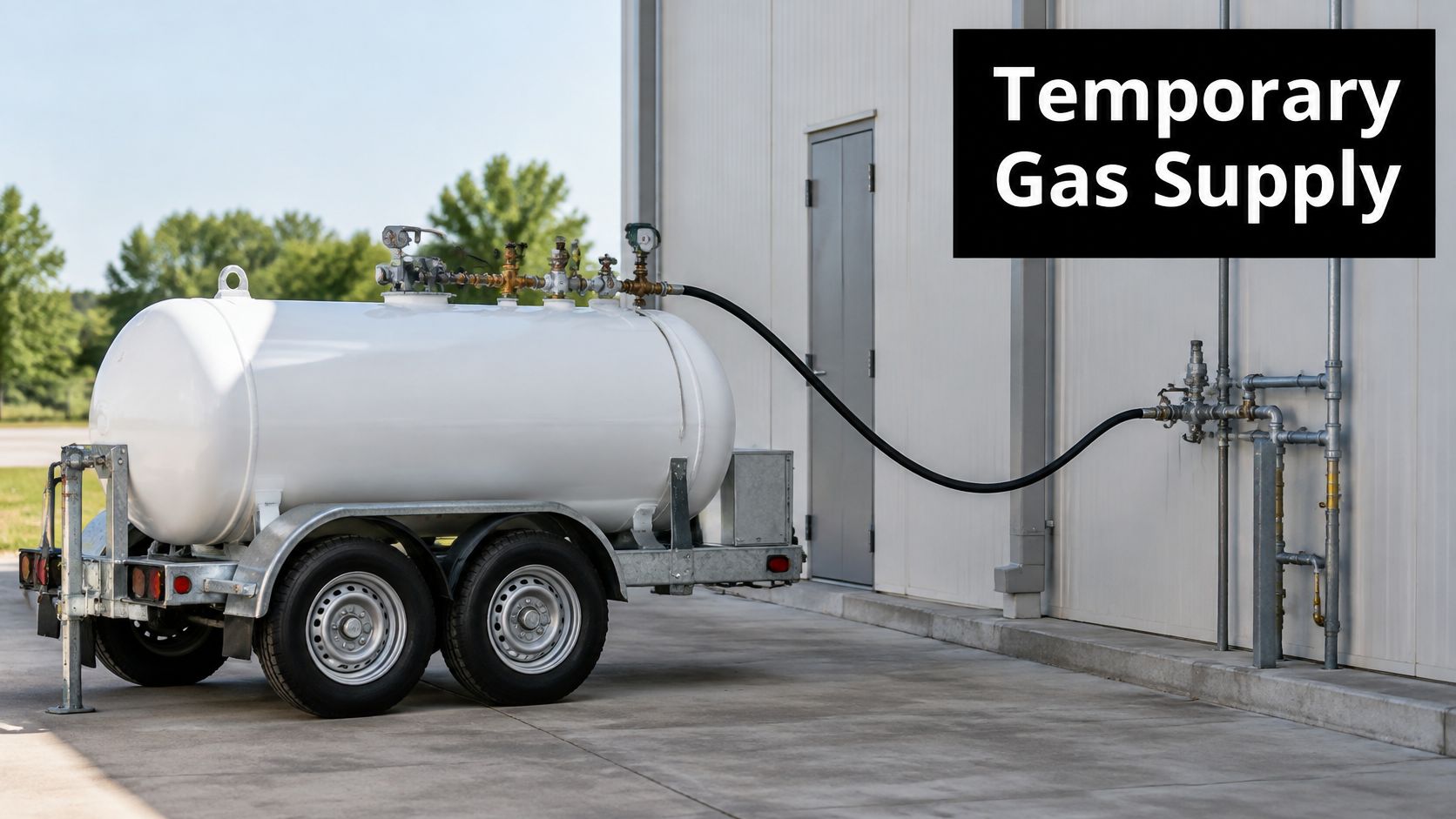
Match the Unit to the Connected Load
Blue Gas Express equipment ranges from small Natural Gas Boxes and 16-foot trailers up to semi-truck loads. Sizing depends on connected load, not square footage. A compact office and a process plant of similar footprint can need very different volumes, so don't guess from the building's size.
Most questions about the Natural Gas Box come up again and again:
- It runs within minutes of connection.
- A 110V drop-cord charges the backup batteries and powers the telecom device used for remote monitoring.
- It works well as a quick backup when a natural gas outage near me lasts more than an hour.
LNG fills a different role. It supplements vapor during high consumption, covers peak-shaving facility maintenance, and steps in when flow gets accidentally interrupted. Mobile supply also serves sites with no pipeline service at all, such as construction phases that come before a line exists.
Which Setup Fits the Outage
| Outage scenario | Equipment that fits |
|---|---|
| Disruption longer than an hour | Natural Gas Box |
| Medium commercial or job-site load | 16-foot trailer |
| Large industrial or utility load | Semi-truck load |
| High consumption or peak-shaving maintenance | LNG |
| No pipeline at the address | Mobile unit sized to connected load |
Waiting for restoration leaves the building cold and the schedule stalled. Running through the outage keeps appliances and process equipment on gas until the permanent line is ready.
Blue Gas Express mobile natural gas hooks these systems into commercial, industrial, or residential lines and stays on site until the utility's permanent pipeline is back in service.
The best lessons usually come from jobs that didn't go to plan. Here are four situations where temporary supply kept the work going.
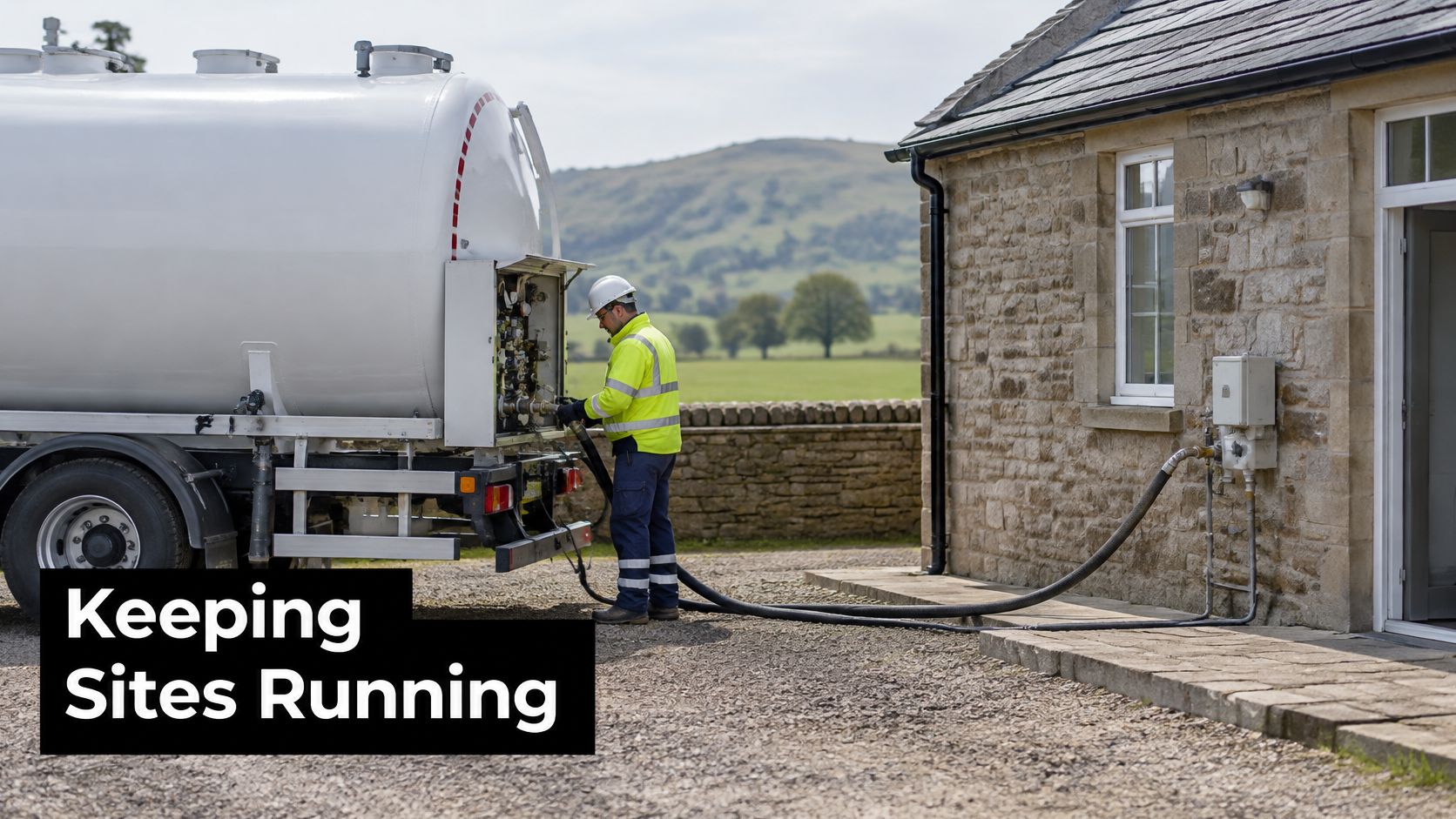
Farm Tap During Old Pipeline Replacement
The problem started with an aging line that needed replacing. Once the crew scheduled the swap, the farm tap would be cut off.
- The trouble: The old line had to come out of service for the replacement.
- Why it mattered: Rural customers would go without gas for the entire length of the work, which can stretch longer than anyone wants to plan for.
- How it was set up: A mobile unit was sized to the farm's connected load, not to a rough guess.
- Back to normal: Service moved to the new line once the swap was done.
Municipality During New Pipeline Construction
A town lost its supply while new mains went in. Nobody likes hearing that news in the middle of winter.
- The trouble: Existing service had to be taken down so construction could proceed.
- Why it mattered: Homes and businesses would have had no heat or hot water for the full build.
- How it was set up: Mobile units connected to the town's existing distribution piping.
- Back to normal: The crews handed off to the permanent system during a planned window.
Digging Accident on an Active Site
An excavator cut through a line, and the job stopped within minutes. Accidents like this happen more often than most people admit.
- Why it mattered: Heating, process loads, and crew schedules all sat idle at once.
- How it was set up: A compact mobile unit kept the site's essential appliances running.
- Back to normal: Repairs finished, and the handoff happened without a second shutdown.
Emergency Dispatch Center
Continuity planning goes well beyond keeping people warm. A dispatch center that loses gas faces the same risks as any other critical facility, and the stakes are higher.
- The trouble: Gas supply was interrupted.
- Why it mattered: Emergency response couldn't pause while the utility worked on the problem.
- How it was set up: Mobile supply was matched to the center's load.
- Back to normal: Service returned through the permanent connection after restoration.
Good coordination made each handoff work. Utilities such as Dominion Energy and Piedmont Natural Gas worked alongside the provider so planners knew exactly when the switch would happen. Because the provider builds its own units and runs its own fleet, deployment can move quickly when it's needed.
If you want more background on how outages get bridged, the Greenbiz energy resilience discussion roundup is worth a look.
A handoff planned in advance turns a switch into a transition, not a second shutdown.
A natural gas outage usually boils down to one goal: get temporary gas to the site, then switch back without shutting everything down a second time.
Before you request a mobile unit, gather these details:
- Service address and site access notes
- Connected load and a list of appliances
- Expected duration of the outage
- Space and vehicle access for a box, trailer, or larger equipment
- A nearby 110V outlet for the drop cord
Timing Your Request
Don't wait for the schedule to slip. Once the utility confirms the outage will last longer than one hour, it's time to call for temporary supply.
Mention any hard deadlines at the start of the conversation. Occupancy inspections, generator commissioning, and a forecast overnight freeze all change how quickly a crew needs to arrive, and providers plan around them better when they know early.
Getting the Site Ready
Clear a workable area, identify a protected spot for the piping connection, and name one person on site who handles delivery and keeps an eye on the unit.
Most delays come from two problems. The first is temporary supply getting in the way of permanent restoration. The second is nobody on site being authorized to approve the connection, which can stall everything while someone tracks down a decision-maker.
It also helps to share the utility incident ticket number early. When the delivery team and the restoration crew work from the same reference, their timelines stay aligned.
Switching Back to Utility Gas
Start by confirming the restoration window and identifying who has the authority to approve the cutover. Keep the temporary unit running until the utility's permanent line has been formally accepted. Only then move your loads back to utility gas and schedule the removal.
A utility ETA is an estimate, not a guarantee. Build your handoff around a confirmed window instead.
Mistakes That Cost Time and Money
- Treating the utility's ETA as a firm commitment
- Letting the project sit idle while you wait
- Ordering gas without knowing the load, access requirements, or who to contact
- Removing temporary gas before the permanent line is ready
Blue Gas Express can keep your site running on mobile gas until the handoff is fully complete.
How Long Can a Natural Gas Outage Last
Some outages are over almost as soon as they start. If crews only need to reset a valve or confirm that the system is safe, service may return in under an hour. Larger problems take longer. A main break, planned maintenance, or a failed pressure control station can keep gas off for days, and crews often inspect equipment carefully before they turn flow back on.
That uncertainty is why the one-hour mark matters. Once an outage passes that point, it's usually worth arranging temporary supply rather than waiting and watching heating, hot water, or production sit idle.
Can Temporary Gas Serve a Building with No Pipeline Service
Yes. Mobile gas units can serve addresses that have never had pipeline service, including remote properties and construction sites that haven't reached the permanent connection stage yet.
The unit is sized to the connected load, meaning the equipment that will actually run. It's then tied into the building's existing piping so appliances and process equipment can operate normally.
What Happens to the Temporary Unit When Utility Gas Returns
The switchover needs planning. The provider works with the utility, confirms that the permanent line has been accepted, moves loads back to utility gas, and then removes the temporary unit.
Planning the handoff this way avoids a second shutdown and keeps crews from repeating work on the site.
Which States Does Blue Gas Express Serve
Blue Gas Express serves North Carolina, South Carolina, Tennessee, and Virginia. Residential, commercial, industrial, and utility customers are all covered.
If restoration is likely to run past one hour, start the temporary gas conversation early.
Most people searching for a natural gas outage near me need one practical answer: who to call. Contact Blue Gas Express with the service address, connected load, expected outage duration, and any site access notes. That information lets the team size the right unit and schedule delivery.
Blue Gas Express provides mobile natural gas in the Carolinas, Tennessee, and Virginia. Visit Blue Gas Express to request temporary supply.