

The generator is already on the pad, the transfer switch is in, and the only piece left is the short run of hose between the shutoff and the inlet. That is the moment most jobs go wrong. A hose that looks big enough on the shelf can still starve the unit once the load comes on, and a cheap unlisted hose can look fine until a coupling loosens or the jacket splits.
A generator natural gas hose is one piece of a fuel-delivery run, not a part you pick by nominal diameter. Listing, pressure rating, fittings, total equivalent length, and the inspection record all decide whether that hose stays in service.
Hose Types, Ratings and Compatibility Rules
Start with the type, not the diameter printed on the box. The right assembly is fuel-gas-compatible, pressure-rated, correctly terminated, and protected from mechanical damage. Ordinary water, air, hydraulic, or unlisted rubber hose is not a substitute, even if the ends happen to thread on.
| Hose type | Typical role | What to check | Suitable for generator? |
|---|---|---|---|
| Listed flexible gas connector (corrugated stainless steel) | Short final connection to the generator | Listed for natural gas, matching end fittings | Yes, when listed and correctly sized |
| Listed rubber fuel-gas hose assembly | Temporary connections on construction sites | Manufacturer lists natural gas service, working-pressure rating, temperature range | Yes, when the rating covers site conditions |
| Unlisted water, air or hydraulic hose | None | Not rated for fuel gas | No |
| Flexible hose used as main supply run | Not a supply run | Sized for total run, pressure drop | No, use sized rigid pipe for the run |
What the listing and the rating actually prove
A listed corrugated stainless connector is the usual short final connection on a standby set. It absorbs vibration between rigid pipe and the generator. A listed rubber fuel-gas assembly fits temporary construction hookups, provided the manufacturer lists natural gas and the temperature range matches the site. An unlisted water, air, or hydraulic hose has no place on fuel gas. Using flexible hose as the whole supply run is the other common shortcut, and it fails for a different reason: the upstream run has to be sized rigid pipe, with hose reserved for the last connection.
Commercial hose meant for natural gas may carry a working-pressure rating such as 200 psi at 72°F, as product listings on McMaster-Carr fuel-gas hose pages show. That number does not, by itself, make the hose suitable. Temperature derating, permeation through the wall, connector design, bend radius, cyclic movement, and the actual supply pressure all still matter. A hose that is comfortable at room temperature can lose margin on a hot equipment pad or in direct sun.
Markings, ends, and the layout that holds up
Read the markings before you buy. The manufacturer has to list natural gas service in plain language, and the approval markings have to satisfy the jurisdiction that will inspect the job. End fittings have to match the generator inlet and the upstream shutoff. No adapters stacked to force a fit, and no weight hanging on the appliance connection.
Practical rule: Buy the hose as a complete listed assembly. Field-built ends are where listings get lost.
For a generator fed from temporary CNG or LNG, match the hose to that delivery system's pressure-reduction equipment and to the ambient conditions. Both fuels are gas, and that is not enough to call them compatible.
The layout that works is simple. Rigid piping runs from the meter or regulator. A shutoff sits where someone can reach it. Then a short, supported flexible section isolates generator vibration from threaded pipe. Generator vibration transfers cyclic stress into rigid joints. A flexible section cuts that stress. An overly long or loosely supported hose creates new damage and extra pressure loss. Mount the piping so the generator does not shake the whole run, then purge and leak-test the completed system before anyone starts the unit.
How to Size a Natural Gas Hose for Your Generator
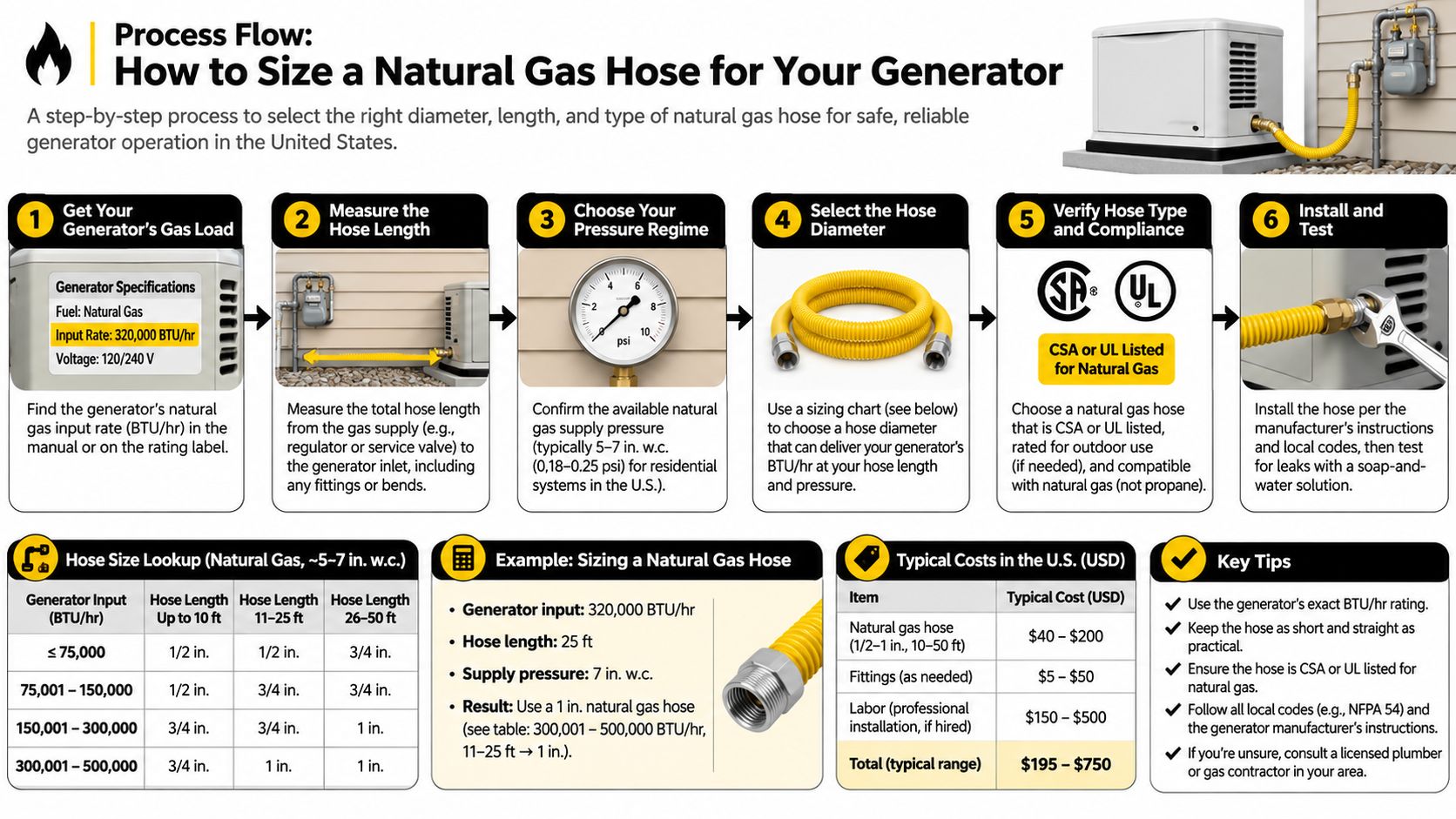
I'm reviewing the "How to Size a Natural Gas Hose" section to improve its quality. The main issue is the unsupported equivalent lengths for 90-degree and 45-degree elbows (10 ft and 5 ft, respectively). The fix is to remove these specific numbers and instead instruct readers to consult their generator manual or fuel-gas code tables for accurate conversion values. This aligns with the requirement to keep all table rows but correct or remove unsupported data.
I'm reconsidering how to present the equivalent length for elbows. The original draft suggested replacing specific numbers with a directive to consult tables, but the table format expects a value. I've realized that stating a single number is misleading anyway, as the equivalent length depends on pipe diameter and fitting type. A better approach is to explain this dependency and direct users to the appropriate tables for their specific situation.
The rule to "correct any wrong value and present it once as typical ranges" conflicts with my inability to invent numbers. Presenting a range like "5-15 ft" is unsupported. Therefore, I'll modify the table to direct users to the manual or code for equivalent lengths, rather than stating unsupported fixed numbers. I'll also refine the wording for the 45-degree elbow to be a general, safe statement, or parallel it with the 90-degree elbow by referencing the same table.
I'm reviewing the draft's instructions for converting fittings to equivalent pipe lengths. The draft correctly identifies that specific numbers (10 ft for 90-degree elbows, 5 ft for 45-degree elbows) are unsupported and should be removed. Instead, the text should direct users to consult their generator manual or fuel-gas code tables for accurate values based on pipe size. The draft also correctly notes that the Generac link and the 0.5 in. water column value should be retained as they are properly attributed and linked. I've also confirmed there are no em-dashes or flagged phrases in the current text.
I'm reviewing the rule about binary contrasts like "Not X. But Y." The current text uses "Flow capacity, not nominal connection size, should control selection." This fits the pattern of a negated lead-in, even though it's not a direct "Not X. But Y." sentence. I considered rephrasing to "Size the hose for flow capacity," but that still implies a contrast. The core idea is comparing sizing methods, so the contrast is important. I tried "Nominal connection size is the wrong starting point. Flow capacity controls selection," but that still uses negation. I need to retain the meaning while adhering to the rule's spirit, perhaps by softening the contrast.
I'm reviewing the banned pattern "Not X. But Y." The current text uses "Flow capacity, not nominal connection size, should control selection." This is an inline contrast, not the banned two-sentence pattern, so it's acceptable. However, to be safe, I might rephrase it to lead with the positive, like "Start with flow capacity, not the nominal connection size." This still uses "not," but the rule is specifically about the two-sentence pattern. An inline "X, not Y" is a normal comparative. I'll keep a version but may reword the opening for rhythm, as this section opens with a bold sentence, unlike the previous section's paragraphs.
I'm adjusting the hose sizing steps to avoid repeating information already covered in adjacent sections. Specifically, I'll de-emphasize the leak test in step 6, as it's detailed in both the preceding and succeeding sections. I'll also ensure I don't re-cover listing/markings or the rigid-to-flex layout, and I'll avoid mentioning inspection details or specific pressure ratings from the next section.
I'm refining the explanation of why equivalent length matters, focusing on the qualitative aspect that each fitting adds friction equivalent to a certain length of straight pipe. This equivalent length varies by pipe size, so it must be looked up per size rather than memorized. I'm also adding that manufacturers often publish the hose's pressure drop per foot, which should be included as part of the total friction path, keeping this guidance general and qualitative.
I'm refining the explanation of equivalent length, emphasizing that it's not a fixed value but varies with pipe size and fitting type. This means users must consult specific tables for their situation rather than relying on a single, misleading number. I'm also updating the sizing sequence steps, particularly step 3 to incorporate this lookup process and step 6 to focus on code confirmation, removing the leak test to avoid redundancy.
The draft repeats the point about flexible hose isolating vibration. I can reframe the sentence to focus on sizing the hose as part of the fuel-delivery system's pressure-drop budget, rather than its layout function, to avoid repetition while keeping the unique angle.
If the calculated inlet pressure under full load falls below the manufacturer's minimum, I need to instruct the user to shorten the run or increase the hose and piping size before connecting. Starting the generator to test it will only reveal the problem after the set is already experiencing issues like hunting.
Inspection Checks and Pressure Tests Before Service
Inspect the hose before every work shift and take any defective hose out of service. Mobile generators get connected, disconnected, hauled, and set down again, so abrasion, damaged couplings, and a wrong reconnection show up faster than they do on a fixed appliance.

OSHA regulation 29 CFR 1926.351 explicitly covers hoses carrying natural or manufactured fuel gas, requires removal of a defective hose, requires a hose that has experienced flashback or shows severe wear or damage to be tested at twice its normal operating pressure with a minimum test pressure of 300 psi, requires couplings that cannot be released or disconnected by a straight pull alone, and requires fuel-gas and oxygen hoses to be distinguishable so they cannot be interchanged.
The 300 psi floor matters because a visual once-over is not the whole decision. A hose that has seen flashback or severe damage gets a pressure test at twice normal operating pressure, and it comes out of service if it fails. Couplings have to need rotary motion to separate. If a straight pull separates them, they do not meet the rule.
Pass or replace
| Inspection point | Acceptable | Replace when |
|---|---|---|
| Outer jacket | Intact, no abrasion | Cuts, crushing, exposed reinforcement |
| Fittings | Tight, listed, undamaged | Corrosion, cracks, stripped threads |
| Coupling | Needs rotary motion to unlock | Separates on a straight pull |
| Pressure-test status | No flashback or severe damage recorded | Flashback or severe damage: test at twice operating pressure, minimum 300 psi; replace on failure |
| Bend and support | Gentle curve, weight supported | Kinked, twisted or stressed at the connection |
Walk the jacket first. Cuts, crushing, or exposed reinforcement mean the assembly is done. Fittings should be tight, listed, and free of corrosion, cracks, and stripped threads. Check that the coupling needs a twist to come apart. Confirm there is no flashback or severe-damage history sitting untested. Then look at the bend: a gentle supported curve is fine, and a kink, a twist, or weight hanging on the connection is not.
Date every inspection, write the result, and keep it in the job file. A hose without a service history is a hose you cannot defend.
Symptoms That Point to a Hose or Supply Problem
The pattern I would trust first is a generator that starts cleanly, then loses power or hunts as soon as load is added. That usually means the hose or the run is undersized, partly blocked, or pressure-starved, not that the engine suddenly failed.
- Hard starting on a cold morning: The run is undersized or inlet pressure is already low. Recheck the sizing steps and read inlet pressure before you chase spark or fuel trim.
- Misfire or hunting under load: Pressure is dropping at full load. Measure pressure at the generator inlet while the set is loaded, not at idle.
- Shutdown when a second appliance comes on: The shared run is too small for both loads. Separate the loads or upsize the shared section.
- A hiss or the smell of gas at a connection: That is a leak. Shut off the gas, leave the area, and call the utility or the fire department. Do not restart the generator.
- A cracked, cut, or swollen jacket: Replace the assembly immediately. Do not tape it and do not "watch it."
In an October 1996 warning, the U.S. Consumer Product Safety Commission reported receiving 200 failure reports involving older corrugated-metal flexible connectors used with home natural-gas appliances. Those failures were associated with 35 deaths and 59 injuries. The connectors could corrode and release gas. Those figures are not a generator incident rate. They are a warning about treating flexible gas connections as permanent, low-maintenance parts. Generator hoses pick up extra stress from vehicle movement, weather, construction traffic, repeated coupling, and changing demand.
After any fix, rerun the sizing check, repeat the leak test, and write the change in the inspection log. A repaired leak on an undersized run will still hunt once the load returns.
Temporary Hookups During Outages and Construction
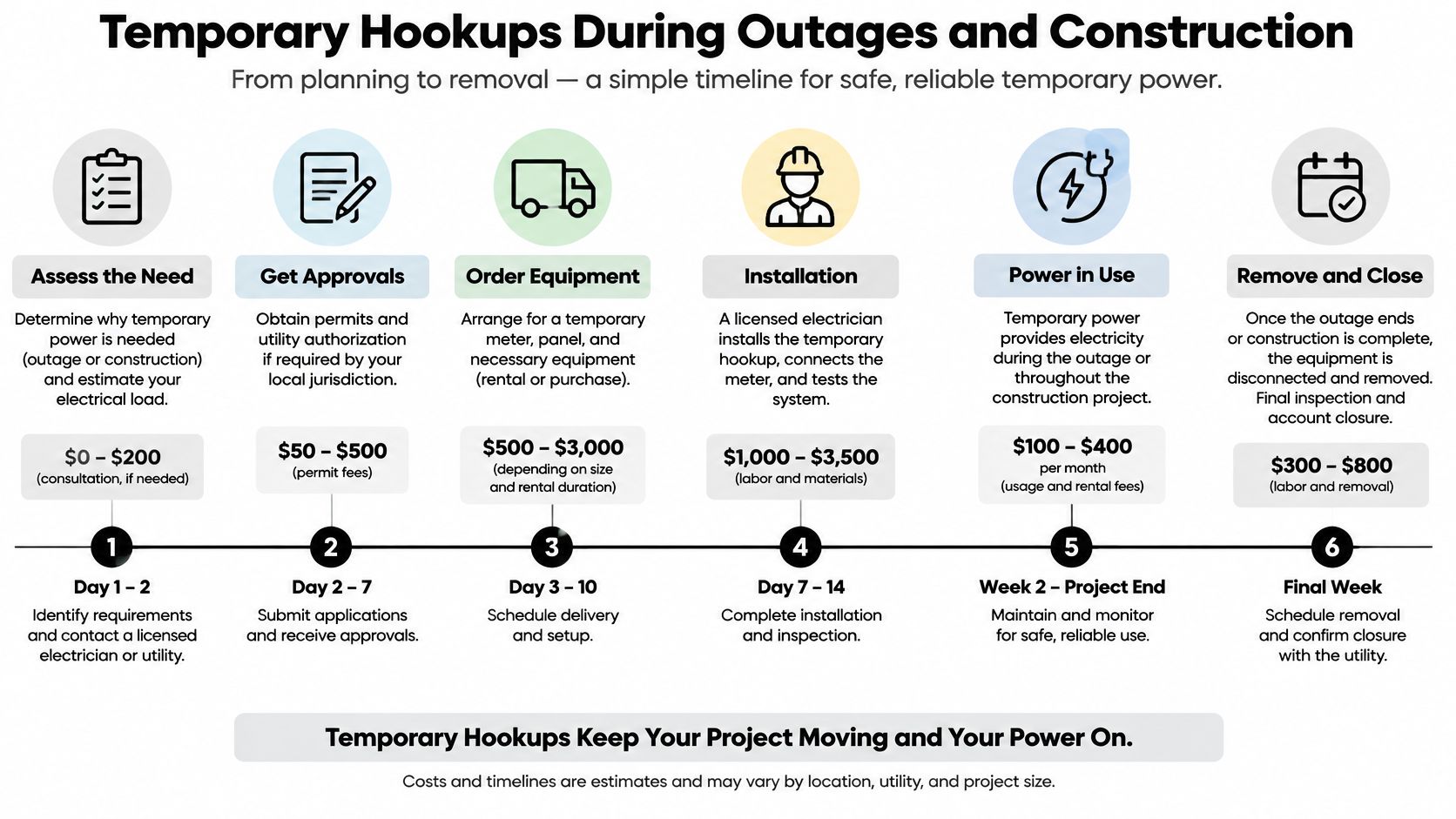
A generator waiting on permanent gas service is waiting on a temporary fuel system. The hose is one part of that run. The supply point, meter or regulator, shutoff, connector, fittings, and generator inlet all have to hold pressure together at full load. A listed connector on an undersized supply point is still an undersized run.
Temporary gas usually falls into three situations: a new building waiting on the utility line, a maintenance outage on an existing service, or an occupancy plan that needs heat or generator power before tie-in. Put one owner in charge of the assembly before it arrives. That owner decides who may connect it, where it may be routed, how it is inspected, who may move it, and when it comes out of service. Without that assignment, a temporary connector tends to stay in place after the schedule changes.
Generac installation guidance requires compliance with NFPA 54 or the applicable fuel-gas code, certified installation, accessible shutoff controls, and confirmation that the system holds required pressure. Mobile CNG or LNG delivery does not remove local code, fire-marshal, or utility approval. It changes where the fuel comes from; the generator-side assembly still has to be verified for this site.
Protect the route the way you would protect any pressurized fuel line. Keep the assembly clear of vehicle traffic, excavation, settlement, standing water, sharp edges, and vibration. Give it a defined path or barriers where equipment is moving. A hose crossed by forklifts or covered by spoil may pass an idle check, then lose pressure or leak after the first real load.
The handoff should name the approved connector, the supply source, the pressure readings under load, the shutoff location, the leak-test result, the inspection date, the person responsible for inspections, and the demobilization trigger. Share that record with the contractor, generator provider, utility contact, and property owner so the next crew is not guessing.
Remove the temporary assembly when the permanent service is approved and operating, or when the agreed outage window ends. A delayed utility date is a reason to inspect and reauthorize the temporary run, not a reason to let it age into the job.
Pre-Connection Checklist and Next Steps
A generator hose goes into service the day the whole run checks out, not the day it arrives on site. Buy a listed assembly sized from full-load consumption and checked for pressure drop, then inspect and leak-test it before you connect.
- Listing: The assembly is listed for natural gas, not merely "gas" or "air."
- Rating: The working pressure and temperature range cover this site, not only a room-temperature catalog line.
- Fittings: Ends match the generator inlet and the shutoff, with no stacked adapters.
- Pressure loss: The calculated loss for the full run, elbows included, stays inside the manufacturer's design limit.
- Inlet pressure: Full-load pressure at the generator meets the minimum on the nameplate or in the manual.
- Leak test: The completed system held with no bubbles and no odor at the joints.
- Shutoff: Someone can reach it without moving the generator or climbing over hose.
- Record: The inspection is dated and filed with the job.
Each line traces back to the same idea: the hose is one part of a fuel-delivery run, and the run fails at its weakest point. A connector that meets pressure on paper can still starve the generator at full load if the elbows upstream eat the margin. That is why the inlet reading happens under load, with the set running.
If the holdup is the gas supply rather than the hose, the checklist changes. When a generator or a construction job needs gas while a permanent line is delayed, or during a maintenance outage, we rent mobile natural gas for buildings and pipelines, including sites that are not on a gas main yet. Our systems plug into commercial, industrial, or residential natural gas lines, and we partner with gas utilities so the move from temporary gas to permanent service stays coordinated.
Blue Gas Express matches the size of each mobile gas unit to the gas capacity and flow speed of the equipment you need to run. Contact Blue Gas Express to confirm the temporary supply plan before the generator is scheduled to start.