

A straightforward residential natural gas hookup near an existing gas line is commonly quoted at $500–$2,000, first-time hookups can reach $3,500, and larger or more difficult projects cost more. That spread is a planning range, not a price you can hand to accounting.
You are looking at a site with an occupancy date already on the calendar and a utility window that does not match it. The meter is still a mark on the plan. Someone asks what the natural gas hookup cost will be, and the useful answer is two numbers: the one-time connection stack, and the money the project loses if the permanent line is late. I would price both before you freeze the schedule.
The utility sets the tariff, the footage allowance, and whether the extension even gets a fixed price. You control the route, the load you declare, who digs, and whether a missed inspection day is acceptable. Split the bill into charges the tariff sets and charges the builder can still change.
Line-by-Line Natural Gas Hookup Cost Breakdown
A straightforward residential hookup beside an existing gas main is commonly quoted at $500–$2,000. A first-time hookup can reach $3,500. A longer extension, a street crossing, or a commercial load costs more than either figure. The invoice is a stack of separate charges, not a single installation fee.
| Line item | What it covers | Reference cost | Usually paid by |
|---|---|---|---|
| Utility connection charge | Meter, regulator, service connection, inspection and turn-on | Set by utility tariff | Customer |
| Service line trenching | Excavation, pipe laying and backfill | $15–$25 per linear foot (broad estimate) | Customer or contractor |
| Engineering and inspection | Utility review and inspection of extension work | Per-foot charge in utility policy | Developer or customer |
| Permits and plan review | Fees due before work or inspection scheduling | No published reference figure; confirm on the quote | Contractor or customer |
| Road or pavement restoration | Repair after crossing streets, driveways or sidewalks | No published reference figure; confirm on the quote | Contractor or customer |
| Security deposit | Refundable hold against line-extension risk | Set by the utility and often refundable | Customer |
| First-time hookup, typical total | Combined one-time costs on a new service | $500–$2,000 near existing line; up to $3,500 first-time | Customer |
How to read the stack
The connection charge is the tariff piece. It typically covers the meter, regulator, service tie-in, inspection, and turn-on. You do not negotiate that line the way you negotiate a trench unit price.
Trenching is where broad consumer estimates put underground installation at roughly $15–$25 per linear foot. That figure is excavation, pipe, and backfill, not pavement, permits, or the meter set. The customer or the site contractor usually pays it, depending on who holds the dig contract.
Engineering and inspection sit on top of the dig. Some utilities bill them per foot of developer-installed extension. Permits and plan review have no published reference figure here, and some utilities will not schedule construction or inspection until those fees are paid. Restoration is the same: no published benchmark, and any street, driveway, or sidewalk crossing can dwarf the pipe itself. A security deposit is a hold against extension risk, often refundable, and it is not part of the construction cost. Crew labor for trenching, piping, and the final connection is usually inside the contractor line, not a separate utility fee.
Practical rule: Use the table to compare quotes line by line. Do not treat any row as your final price.
Footage, pipe diameter, and site conditions move every number below the connection charge. Ask each bidder to map their quote onto these rows so a low total is not just a missing restoration line.
Factors That Move Your Hookup Bill
Distance to the main moves the natural gas hookup cost more than any other site variable. The number that matters is the shortest compliant route from the utility main or the property line to the meter. Every foot past the utility's allowance is footage you pay for. Measure that route on the plan before you request a price, including offsets around structures and required cover.
| Factor | How it changes cost | What to measure |
|---|---|---|
| Distance to the main | Each foot beyond the utility allowance adds cost | Shortest compliant route from main or property line to the meter |
| Customer class | Commercial and industrial customers may not get the residential allowance | Building type and load classification |
| Pipe size | Pipe 2 inches or larger can trigger a feasibility review instead of a fixed price | Required pipe diameter for the connected load |
| Ground conditions | Rock, saturated soil and dense existing utilities add trenching time | Site survey of soil and buried lines |
| Surface crossings | Roads, driveways and sidewalks add cutting and restoration | Number and length of crossings |
| Gas use | Gas that is not the main heating fuel can shift costs to the customer | Appliance list and intended gas use |
Class, pipe, and the ground
Customer class is the next swing. A house and a small commercial building can sit the same distance from the main and still get different bills, because commercial and industrial customers often do not receive the residential service-extension allowance. Classify the building and the connected load before you ask.
Pipe size changes the pricing method, not just the material. Pipe 2 inches or larger can move the job from a posted unit price into a feasibility review. Size the pipe to the load, including a backup generator if one is on the drawings.
Ground and surface conditions add time rather than tariff math. Rock, wet soil, and a crowded utility corridor slow the crew. Each road, driveway, or sidewalk adds cutting and a restoration patch. Count crossings in feet, not as a yes or no.
Gas use can shift cost back to the customer when gas is not the main heating fuel. List every appliance and say whether gas is primary heat. If you are also pricing a rural shell, it helps to compare barndominium construction expenses so the gas extension is not the only site number in the budget.
Distance past the allowance, loss of a residential allowance, and a feasibility review on larger pipe usually produce the biggest price swing. Measuring those three before the first quote avoids a second pricing round after the utility rejects the route.
How Utility Tariffs Set Your Share
The customer share is usually a contribution in aid of construction (CIAC), not a national install price. The utility prices the main extension, service line, meter, regulator and construction, then subtracts the tariff allowance and the revenue it expects the new account to produce. The invoice is the leftover gap, so two buildings with the same footage can land on different totals.
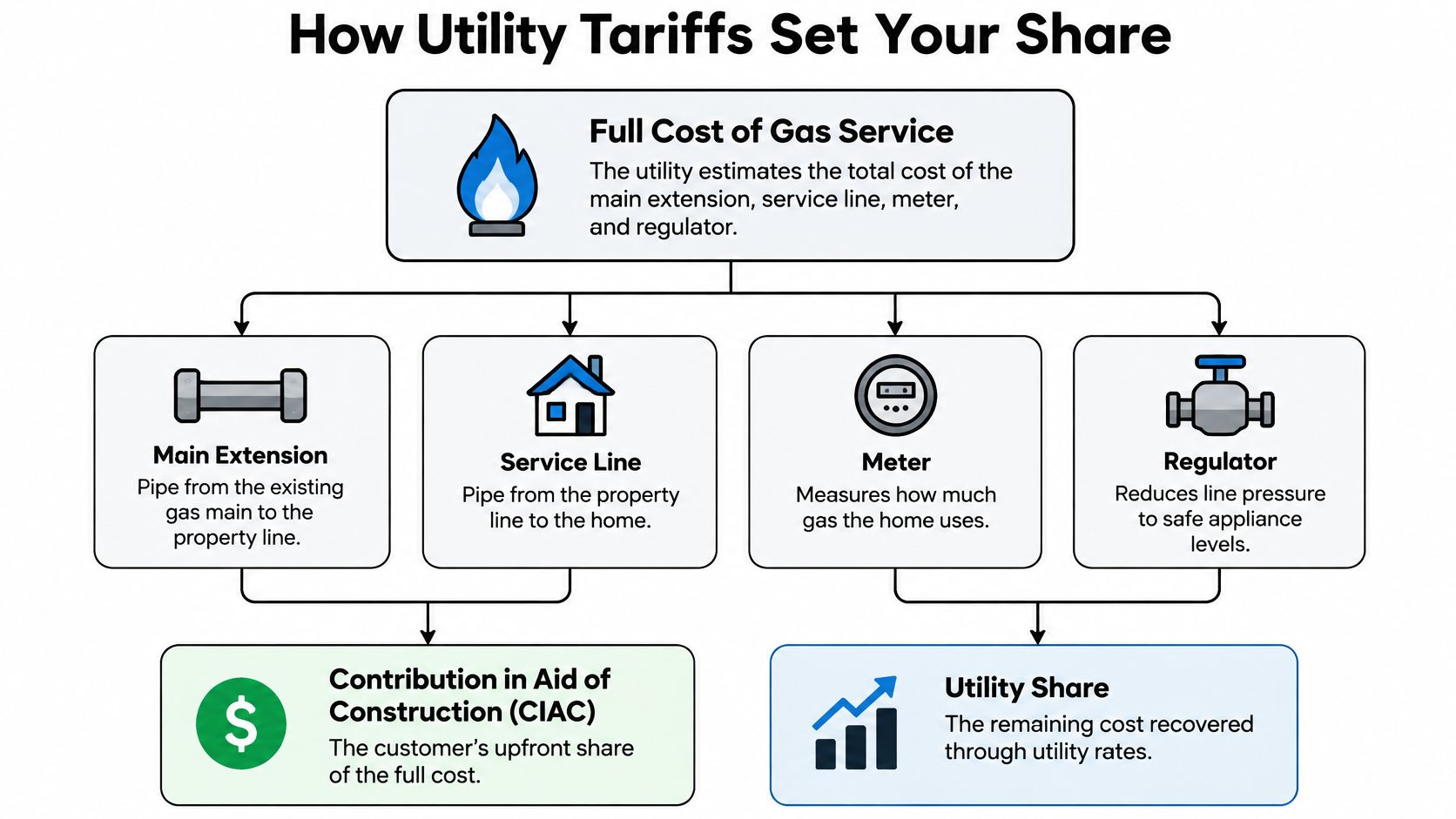
National Grid's New York regulatory filing states that residential and non-residential applicants may receive allowances for up to 100 feet of certain main and service facilities, with extra cost assigned when the project exceeds that allowance or fails the revenue test. That is the core tariff decision: the utility is not asking whether the job is expensive, it is asking how much of that cost the tariff shifts to the applicant.
Regional allowances side by side
A Minnesota utility tariff gives a residential customer in an existing service area 75 feet of service line without CIAC, and footage beyond that may be charged at an incremental rate capped at $7 per foot. That tariff also states that commercial and industrial customers do not receive the residential allowance. A base-minimum tariff works differently: the meter, regulator, service connection, inspection and turn-on sit under one minimum charge, and customer participation starts when the service runs beyond the included footage or gas is not the primary space-heating fuel.
| Market | Included at base charge | Customer pays beyond that | Takeaway |
|---|---|---|---|
| Minnesota, residential in existing service area | 75 feet of service line without CIAC | Incremental rate capped at $7 per foot beyond 75 feet | Commercial and industrial customers do not get this allowance |
| Base-minimum tariff | Meter, regulator, service connection, inspection and turn-on under one minimum charge | Customer cost participation when the service runs beyond the included footage or gas is not the primary heating fuel | The minimum is a floor, not a total |
| New York, National Grid filing | Allowances for up to 100 feet of certain main and service facilities | Costs above the allowance, or when the project fails the revenue-based test | Expected future gas revenue can change the bill |
| Formula-based tariffs | Extension cost reduced by the filed margin allowance and credits | Remaining balance, sometimes with a refundable deposit or security requirement | No flat regional price; get the formula in writing |
Residential benchmarks do not transfer to commercial construction or industrial commissioning. The same 90 feet can be inside one allowance and entirely on the customer in another class.
A 120-foot residential example
Say the shortest compliant residential service is 120 feet under a Minnesota-style rule. The allowance covers 75 feet, so 45 feet sit outside it. At the $7 cap, the incremental service-line charge is no more than $315. That is only the footage adder. It does not include a failed revenue test, pavement, or a main that does not yet exist.
I ask for a written feasibility estimate that lists refundable deposits, CIAC, inspection, meter work, permits, and restoration as separate lines.
Frontage, roadway restoration, trench conditions, load size, and whether a main already exists can change the contribution by more than the advertised connection fee. Pull your own utility's current tariff before you compare a New York allowance with a Minnesota one. If the permanent line will miss occupancy, generator commissioning, or freeze protection, set the incremental CIAC next to the schedule risk and keep the permanent plan in place.
When a Late Permanent Line Costs More Than the Hookup
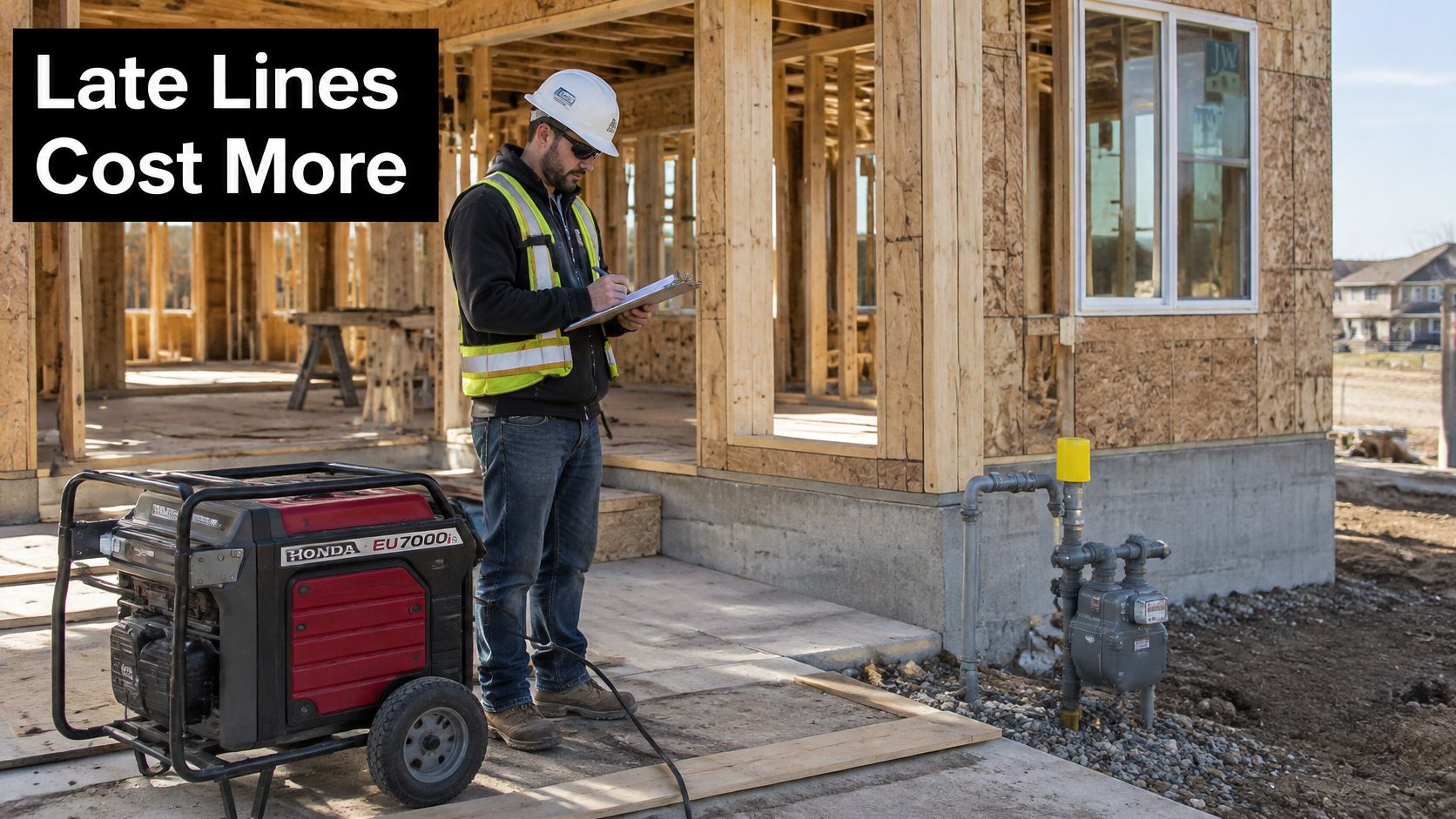
Say the occupancy inspection is booked, the generator is on site, and the utility's install date is six weeks out. The hookup invoice is the smallest number on that page. The expensive part is the days the building cannot use gas.
Palo Alto's gas service connection materials describe connection work that can require permits, plan review, inspections, excavation, and restoration, with fees sometimes due before construction or inspection is scheduled. The commonly quoted residential range of $500–$2,000 applies mainly to straightforward properties near an existing line, while broader estimates put first-time hookups as high as $3,500. Those articles rarely price what happens if the line is not ready for the building, the generator, freeze protection, or the occupancy deadline.
Costs that sit outside the invoice
A household can often wait. A construction site or a facility accrues cost every day.
- Idle crews: Trades standing by for a gas inspection or a startup.
- Rescheduled inspections: Another mobilization after a failed or missed visit.
- Delayed rent or sales: Units that cannot be turned over.
- Late commissioning: A generator or boiler started weeks after the plan.
- Freeze exposure: Wet systems with no heat on a cold night.
- Remobilization and standby: Crews sent home and brought back.
The delay test
Multiply the expected daily delay cost by the expected days of delay. Compare that total with an interim energy plan priced line by line: delivery, site access, safety controls, fuel consumption, equipment rental, and demobilization. If the interim total is lower, temporary supply protects the date while the permanent connection continues.
A six-week delay that idles crews at an illustrative $2,000 a day is about 42 days and about $84,000 of exposure. That is a scenario, not a tariff, and it still sits far above a single hookup invoice.
Blue Gas Express rents mobile natural gas for buildings and pipelines while customers wait for a permanent line, including during install delays and maintenance outages on residential, commercial, and industrial work. Run the test against a real interim quote. The cheapest permanent hookup is not always the cheapest project outcome when the schedule has a dollar value.
Three Project Examples and What Drives Each Bill
These are illustrations, not quotes. Each one uses a different driver so you can see which line grows.
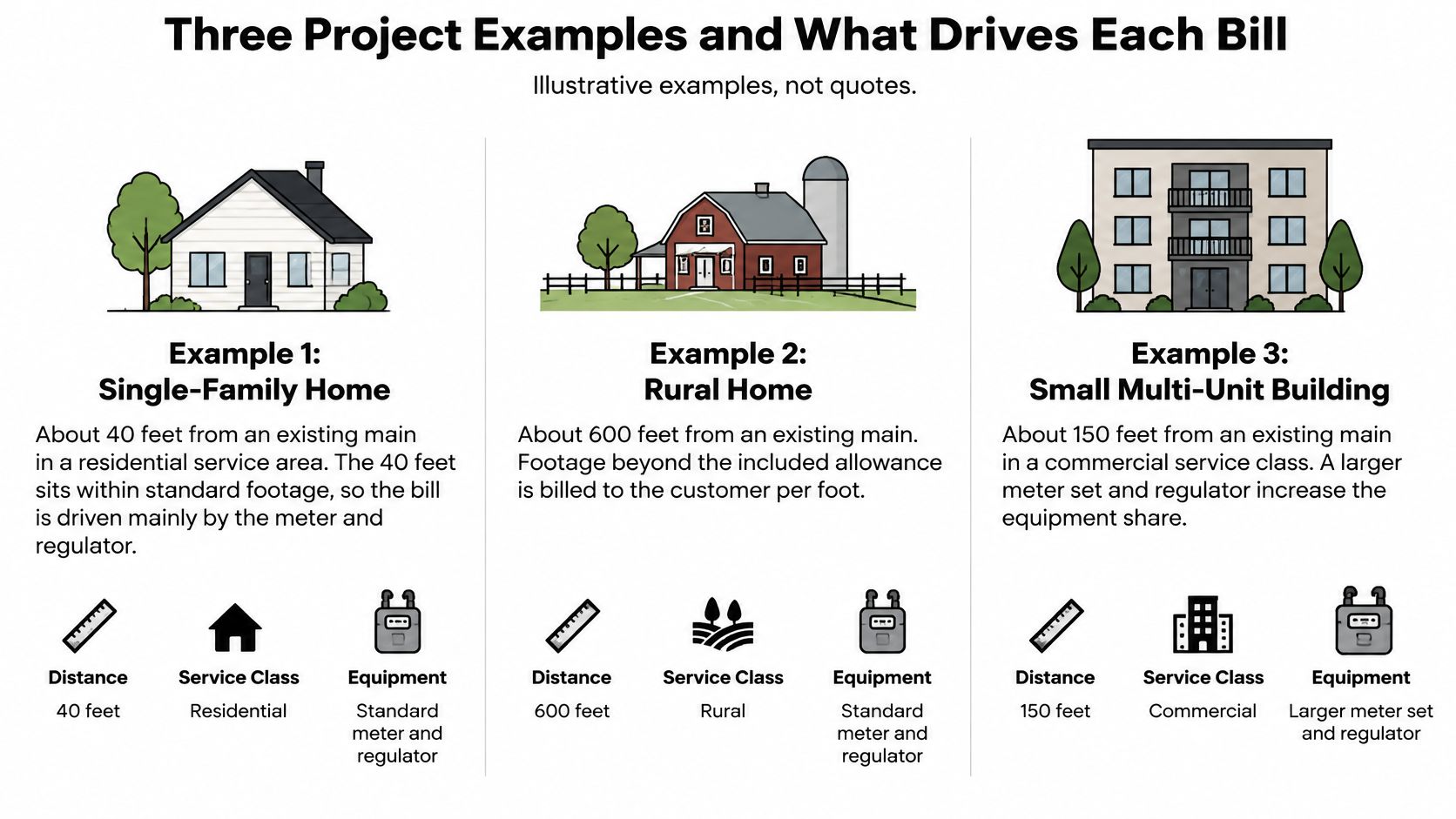
A single-family home sits about 40 feet from an existing main in a residential service area. Those 40 feet fall inside a 75-foot residential allowance of the Minnesota type, so footage beyond the allowance is zero. The bill stays toward the low end of the typical range, and the customer mainly covers the connection charge for the meter, regulator, tie-in, inspection, and turn-on.
A 30-lot subdivision needs a 500-foot developer-installed extension. Utility extension policies commonly carry a per-foot engineering and inspection charge for developer-installed gas work, billed across the full length before trenching, materials, restoration, meters, or permits enter the total. Read the gas line on its own, because the same policy often prices other developer-installed utility work at a different per-foot rate. Once an extension reaches the size or revenue threshold written into the tariff, it moves to a feasibility analysis instead of a fixed per-foot price. At that point the per-foot charge is the floor, not the extension cost.
A commercial building with a backup generator does not get the residential allowance. The bill follows CIAC, the connected load, and whether the extension passes a feasibility test. Footage past whatever allowance the commercial tariff grants is usually the line that grows fastest, especially once the generator load pushes pipe size up.
Where the bill actually grows
The home's bill is driven by the connection charge. The subdivision's bill is driven by extension footage and engineering review. The commercial building's bill is driven by CIAC and feasibility.
Published household gas prices reflect commodity and delivery, not the one-time cost of joining the network, so a quoted price per unit tells you nothing about the hookup. Recurring consumption sits outside all three examples. Budget it separately from connection, extension, and construction costs, or the operating forecast will look cheaper than the true project cash requirement.
Request a Written Hookup Estimate Before You Schedule
The first document to request is the utility's written feasibility decision for this site, with the route length and the allowance applied. A verbal "you're close to the main" is not a budget.
- Feasibility in writing. Ask for the route length, the allowance, and a clear pass or fail on the revenue test.
- CIAC and any deposit. Ask for both itemized, and ask whether the deposit is refundable and when it comes back.
- Who installs and who pays. Split utility crews from your contractor so trench, pipe, and restoration are not priced twice or missed.
- Inspection, meter, regulator, and permits. Confirm each charge and the date it must be paid. A fee due before scheduling can move the install more than the fee amount.
- Dates against your milestones. Put the utility install date next to occupancy, inspection, and commissioning. The gap in days is the delay you will test.
- One-time versus recurring. Strip commodity and monthly charges out of every quote so you compare connection scope only.
If the property already has damaged or aging piping, a trade such as Big Bear gas pipe repairs is the call to make before you assume the utility will reuse the old service. Reuse is a site fact, not a hope.
If the permanent date misses
I would not wait on a missed milestone with equipment that needs gas. Price interim supply against the delay cost, and keep the permanent connection moving at the same time. We partner with gas utilities, including Dominion Energy and Piedmont Natural Gas, so end users can take temporary natural gas while the utility finishes the line. Express Gas Boxes give those utilities assurance that gas will be on the agreed hookup date, which is often what an occupancy or commissioning schedule actually needs.
A quote you cannot split into CIAC, deposit, inspection, meter, permits, and restoration is not ready to compare.
Once those lines match and the install date is next to your milestone, you can decide whether the permanent hookup stands alone or needs a bridge.
Blue Gas Express rents mobile natural gas for buildings and pipelines when a permanent line is late or the site is not on a gas main yet. If your occupancy, generator, or freeze-protection date will arrive before the utility tie-in, price a temporary supply against that delay and keep the permanent hookup on track. Visit Blue Gas Express to talk through the site, the load, and the dates.