

The generator starts, the commissioning crew is booked, and the building's permanent gas connection still isn't ready. You need to prove the unit can carry its intended load without discovering halfway through the test that the temporary gas supply can't keep up.
Load bank testing applies controlled electrical demand so you can check the generator under working conditions. For a natural gas unit, a useful test proves more than electrical output: the engine, gas supply, controls, and connected distribution must work together at the site's actual duty.
Matching the Load Bank to Your Generator Duty
Start with the load the generator must serve, not the load bank that's easiest to rent. Real power in kW describes useful electrical output; apparent power in kVA includes the current associated with reactive demand. Matching only kW can leave alternator and voltage-regulator performance insufficiently tested.
In a commissioning case published by Consulting-Specifying Engineer, generators rated at 0.8 power factor supported a full resistive step only once in seven attempts, while factory testing at their rated power factor didn't reproduce the problem. The resistive test's voltage drop interrupted the load-bank controller, illustrating why a different test configuration isn't automatically an equivalent test.
Load bank types and what each one proves
| Load type | Power factor | What it proves | Limitation |
|---|---|---|---|
| Resistive (unity power factor) | 1.0 | Real kW capacity and engine heat | Does not test voltage regulation at lagging power factor |
| Reactive (inductive) | Used with real load to achieve 0.8 lagging | Voltage regulation and kVA capability | Usually needs a dedicated reactive bank |
| Combined resistive and reactive | 0.8 lagging test setting | Realistic mix of kW and kVAR | More complex setup and higher rental cost |
| Site loads (motors, drives) | Measured from the operating equipment | Transient response and motor starting | Hard to simulate with a standard load bank |
A purely inductive bank doesn't independently reproduce a loaded engine's duty. Its reactive contribution must be coordinated with real load to establish the intended overall power factor.
Calculate the target before choosing equipment
Use kVA = kW ÷ power factor and kW = kVA × power factor. Apply those relationships to the nameplate and planned site demand, then check both against the generator's permitted operating envelope.
Don't treat connected equipment ratings as a complete load study. Identify coincident running loads, motor-starting demand, and the order in which equipment reconnects. Apply the manufacturer's altitude and ambient-temperature derating curves, since natural gas engine output can fall below its reference-condition rating.
A steady resistive test doesn't establish motor-starting capability, variable-frequency-drive compatibility, or utility-to-generator transfer performance. Those require an appropriate dynamic profile, site-load test, or coordinated transfer test.
Acceptance rule: Write voltage and frequency limits, recovery requirements, plateau durations, temperature limits, and protective-trip rules on the test sheet before anyone applies load.
Specify the measurement location too. A result at the generator terminals doesn't establish identical performance at the main distribution board.
Safety Checks Before the Load Bank Connects
Check the natural gas supply first. Confirm the engine's required inlet-pressure range and full-load gas consumption from its technical documentation. There's no universal pressure setting that makes every natural gas generator safe or capable of rated output.
Inspect the regulator, isolation valves, hose or pipe rating, and supply-line sizing. Calculate pressure loss at the required flow, including other equipment drawing from the same supply. Leak-test accessible joints with an approved gas-leak solution, following the equipment's commissioning procedure.
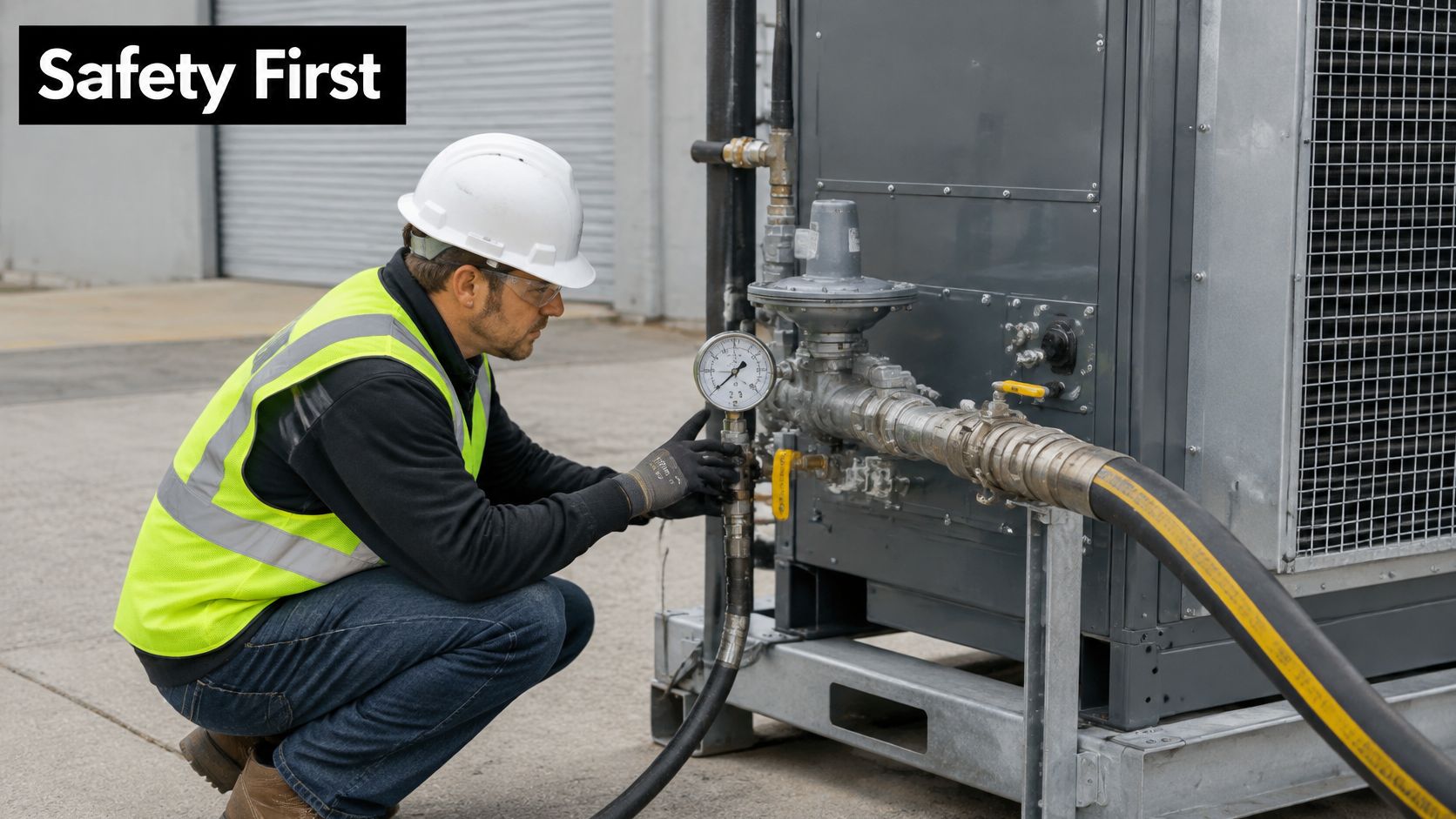
Supply capacity must cover the whole test, not merely startup. For temporary fuel, confirm usable inventory, sustained delivery capability, regulator capacity, and any vaporization limits. A satisfactory static pressure reading doesn't establish full-flow performance.
Control exhaust, electrical, and personnel hazards
Position temporary generators outdoors with exhaust directed away from windows, doors, air intakes, and occupied work areas. Follow the approved installation clearances, and place suitable carbon monoxide monitors where personnel could be exposed. Permanent indoor installations need their designed ventilation and exhaust systems operating.
Qualified electrical personnel should isolate the connection point, apply lockout/tagout, and verify absence of voltage before connecting cables. Size conductors for the intended current and installation conditions, verify grounding and bonding, and confirm breaker protection. Establish the transfer-switch position and isolation arrangement so the test cannot backfeed the utility.
Keep the load bank's hot discharge away from generator cooling-air intakes. Open enclosure ventilation paths, maintain clear access, and keep an appropriate fire extinguisher and spill-control materials available for oil or coolant leaks.
Assign a controls operator and a separate observer with reliable radio contact. Exclude other personnel from electrical, exhaust, and hot-surface zones.
The supervisor should sign a go/no-go checklist confirming:
- Fuel readiness: Leak checks complete, pressure limits documented, and sustained flow available.
- Electrical isolation: Connections, protective devices, grounding, and transfer position verified.
- Safe operating area: Ventilation, barriers, emergency access, and communications established.
- Stop authority: Everyone knows who can halt the test and how to initiate a safe shutdown.
An unresolved fuel leak, isolation concern, or exhaust hazard means no-go.
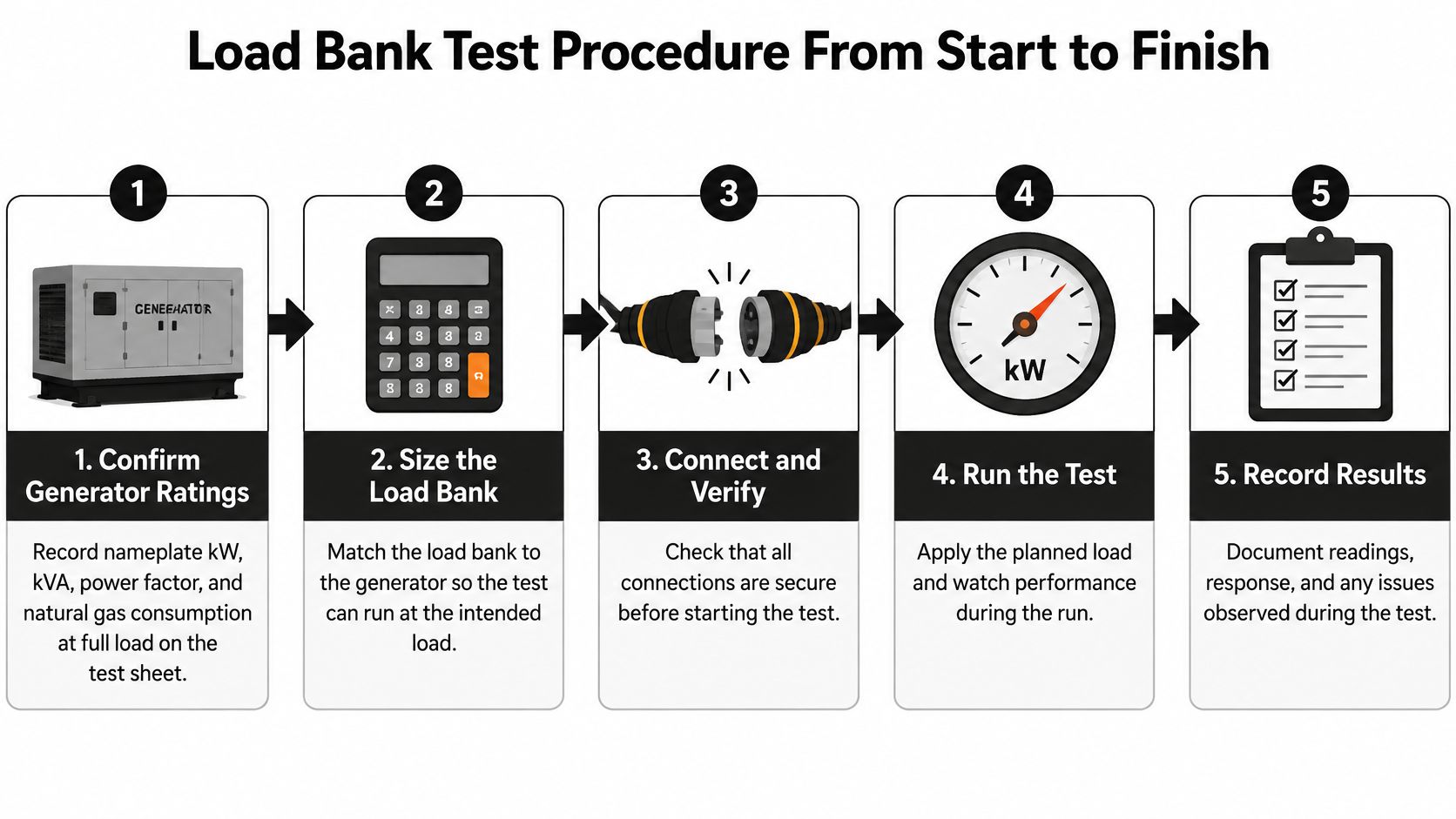
Load Bank Test Procedure From Start to Finish
- Record the generator ratings. Enter nameplate kW, kVA, power factor, voltage, and the manufacturer's full-load natural gas consumption on the test sheet.
- Select a load bank with capacity above the intended test demand at the required voltage and power factor. Check its actual available increments, cooling requirements, and ambient rating.
- Complete and sign the safety checklist. Verify connections while isolated, then release lockout/tagout under the approved energization procedure.
- Start the generator on natural gas. Let coolant and oil temperatures reach the manufacturer's specified operating condition before loading.
- Measure running gas inlet pressure at the designated test point. Confirm it remains inside the engine's permitted range.
- Apply the approved load profile. Hold each plateau for its specified duration, recording steady-state readings and load-step response.
- Log electrical, engine, and fuel readings throughout each hold. Record alarms and unusual behavior when they occur, not from memory afterward.
- Remove load in stages and complete the manufacturer's cooldown sequence. Open and isolate the test connection, disconnect safely, and restore automatic-transfer controls.
- Compare the record with the agreed acceptance limits. Separate completed, acceptable plateaus from interrupted or failed ones.
Published profiles are benchmarks, not interchangeable rules
A government procurement specification specifies 35% for 30 minutes, 60% for 30 minutes, and 85% for 60 minutes. That's a defined acceptance profile for that procurement, not permission to apply it to every generator.
Published load bank plateau benchmarks
| Benchmark | Plateau 1 | Plateau 2 | Plateau 3 | Load time |
|---|---|---|---|---|
| Government procurement benchmark for critical power | 35% for 30 min | 60% for 30 min | 85% for 60 min | About 2 hours |
| Healthcare follow-up after a failed monthly test | 25% for 30 min | 50% for 30 min | 75% for 60 min | About 2 hours |
| Annual full-load exercise, common data-center practice | 70%-100% of rated output | Not separately specified | Not separately specified | 1-2 hours |
| Monthly exercise minimum under NFPA 110-related diesel guidance | At least 30% of nameplate kW for 30 min, or the applicable exhaust-temperature criterion | Not separately specified | Not separately specified | 30 minutes minimum |
The healthcare and monthly profiles are summarized in ASCO guidance; Cummins describes the annual practice. These published frameworks largely concern diesel standby equipment. Confirm the applicable code edition, project specification, and natural gas engine manufacturer's requirements before adopting a row.
For crews handing records between dispatch, technicians, and commissioning managers, SIX ERP's explanation of how ERP connects field service operations offers useful context for keeping work orders and test evidence together. The essential requirement is simpler than the software choice: the approved profile, recorded results, and corrective actions must remain attached to the same job.
Reading Results During and After Each Step
One stable reading isn't a pass. Coolant temperature, frequency, and fuel pressure can look acceptable immediately after a step, then deteriorate as the equipment warms. Record both the initial response and the direction of change throughout the hold.
Use a calibrated power analyzer for electrical measurements and an appropriately ranged pressure instrument at the approved gas test point. Synchronize timestamps so a pressure dip can be compared with a frequency excursion rather than treated as an unrelated event.
Parameters to record and their warning signs
| Parameter | When to record | Warning sign |
|---|---|---|
| Voltage per phase | Each plateau and after settling | Dip or drift beyond approved tolerance, or controller trip |
| Frequency | Each plateau, including step response | Sustained drift or slow recovery after a step |
| Current per leg | Each plateau | Imbalance beyond the manufacturer's allowance |
| Oil pressure | Every 10 minutes as a working log interval, unless the approved plan requires more | Downward trend approaching or crossing operating limits |
| Coolant and exhaust temperature | Every 10 minutes as a working log interval, plus continuous alarm monitoring | Continued rise without acceptable stabilization |
| Natural gas supply pressure | Before load and at each plateau | Falling pressure as load rises |
| Power factor and kW | Each plateau | Actual demand fails to match the approved target |
Read related measurements together
Uneven leg currents can indicate a loose termination, failed load-bank element, or incorrect connection. Check the load arrangement before blaming the alternator. Oil pressure normally changes as oil warms, so interpret its trend against the engine's operating limits rather than treating every reduction as a fault.
A falling gas pressure that coincides with increasing load points toward supply restriction or regulator capacity. Stable pressure with falling engine speed shifts attention toward engine capacity, fuel metering, ignition, or governor response. Neither pattern alone establishes the final diagnosis.
Thermal imaging can help locate unusually hot terminations when an authorized inspection can be performed safely. The practical thermal camera tips from DigiDevice are useful for understanding image interpretation, but thermal imaging doesn't replace electrical measurements or justify opening energized equipment without an approved procedure.
A passing result needs a complete timed record, not a photograph of the meter at its best moment.
Write the verdict explicitly: every required plateau completed, readings within agreed limits, temperatures within the permitted envelope, and trends flat or settling acceptably at each step's end. Record an interrupted test as incomplete or failed under the agreed rules, with the corrective action and retest scope identified.
Common Load Bank Problems and How to Fix Them
The costly mistake is accepting a light-load exercise as evidence of full-duty capability. ASCO's load-bank best-practice guidance describes monthly non-mission-critical diesel exercises at 30%-50% for 30 minutes and healthcare follow-up testing at 25%, 50%, and 75%. Those profiles serve particular maintenance purposes; neither automatically proves a different site's maximum operating duty.
The other trap is treating a resistive-bank result as universal approval. If the required duty includes lagging reactive demand, investigate voltage behavior under that condition before signing off the installation.
Load bank symptoms, likely causes and fixes
| Symptom | Likely cause | Fix |
|---|---|---|
| Voltage collapses and controller trips at a plateau | Test-load mismatch on a generator rated for lagging power factor, or a control or excitation fault | Investigate the event; add coordinated reactive loading or use a combined bank where required, then retest |
| Engine loses speed at high load | Undersized gas line or regulator when inlet pressure also falls | Verify sizing, regulator setpoint, and flow capacity; repair before retesting |
| Black smoke and fouling after light running | Diesel wet stacking, or another combustion fault | Diagnose first; use manufacturer-approved loaded operation where appropriate |
| Frequency drifts after warm-up | Governor or thermal instability | Stay within stop limits and have manufacturer-qualified personnel investigate controls |
| Test passes at light load but fails higher up | Earlier loading never challenged the limiting component | Correct the fault and repeat the approved full profile |
| Temperatures keep rising late in the run | Insufficient stabilization, cooling restriction, or heat recirculation | Monitor through cooldown and inspect cooling and airflow before retesting |
Separate a better test from an equipment repair
Adding the correct load characteristic may resolve a test-design problem. It won't repair a weak excitation system, restricted gas supply, or defective governor. Don't keep changing the profile until the machine produces a favorable result.
Wet stacking is principally a diesel concern, involving incomplete combustion and fuel deposits during light operation. Don't transfer that diagnosis automatically to a natural gas engine with smoke, fouling, or unstable combustion. Follow the engine manufacturer's diagnostic and loaded-operation instructions.
A temperature still climbing near the end of a plateau isn't a reason to run indefinitely. Stop at the agreed limit, inspect radiator airflow and hot-air recirculation, and check the cooling system. Likewise, a gas-line upgrade or governor adjustment requires qualified repair and a controlled retest, not an improvised field adjustment while the unit struggles.
Set Your Test Interval and Document Every Run
Use routine exercising to confirm readiness and periodic loaded testing to establish performance under sustained demand. A Cummins technical publication summarizes covered diesel-generator exercising as monthly for at least 30 minutes and describes annual full-load exercises commonly lasting 1-2 hours at approximately 70%-100% of rated output. Those are diesel-oriented reference points, not a universal natural gas maintenance schedule.
For a gas engine, confirm the manufacturer's exercise interval, loading instructions, and operating-temperature requirements. A short idle run doesn't substitute for a specified capacity test.
Schedule around changes, not just the calendar
- Retest after failure or major work: Include significant gas-supply, engine, control, or electrical modifications.
- Review new demand: Reassess the test when equipment is added or the operating sequence changes.
- Prepare for critical service: Resolve outstanding defects before a critical event, and check testing-hour restrictions in the engine's emissions permit.
Keep the date, ambient conditions, connection point, load steps, gas pressure, plateau results, alarms, and technician's name together. Tutorial AI's guide on how to write effective SOPs can help turn that recordkeeping into a repeatable crew procedure.
When permanent service is delayed, our mobile gas units can supply new buildings and construction sites for early commissioning of rooftop units, generators, and ambient heating. They can be deployed within a few hours of a customer's request, and our Sales team can provide a custom quote when you're prepared to discuss your needs.
Book the next test date and confirm the gas plan for that day, including required inlet pressure, sustained full-load flow, and enough supply for the complete run.
Blue Gas Express provides temporary mobile natural gas supply for generator commissioning when permanent service isn't available. Visit Blue Gas Express to discuss your generator's full-load consumption, inlet-pressure requirements, site access, and planned test duration with our Sales team.