

A generator can be mechanically complete while the project remains weeks away from having usable natural gas. The genset is set, the electrical terminations are ready, the load bank is booked, and then the utility connection slips. Waiting for the permanent tap can hold up testing, occupancy, construction milestones, and the owner's operating plan.
A mobile CNG or LNG supply can keep generator commissioning moving, but temporary fuel changes the job. The trailer becomes part of the fuel system, delivery timing becomes an operating constraint, and pressure and vaporization must be proven before the engine cranks. The following sequence is built around those field conditions, with the checks that prevent a temporary hookup from becoming a source of rework.
What generator commissioning looks like with a temporary gas supply
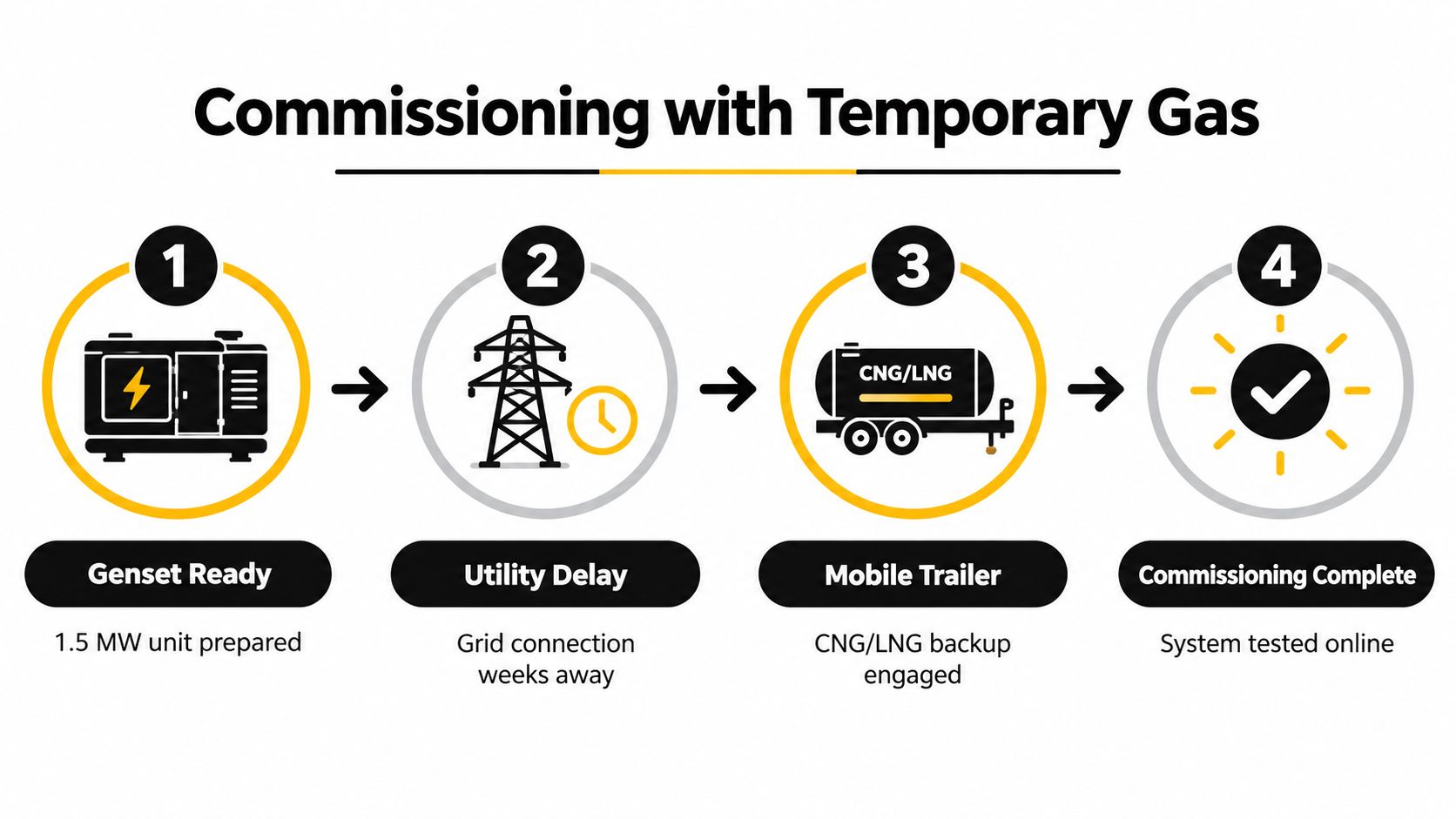
A common situation is a 1.5 MW gas genset sitting ready on an industrial site while the utility tap remains weeks away. The permanent gas line has been designed, but the meter, trench, regulator station, or utility inspection isn't complete. Rather than leave the unit untested, the commissioning crew spots a mobile CNG or LNG trailer, connects a temporary fuel package, and treats that package as a system that must be qualified.
That approach isn't the same as connecting an already-proven permanent line. A permanent-gas commissioning plan usually starts with an established source, known pressure conditions, and a utility-owned delivery point. A temporary plan has to validate the source itself, including trailer placement, hose routing, regulator capacity, vaporization performance, delivery pressure, and the ability to sustain flow as the generator load increases.
BPA's generation commissioning process begins roughly 180 days before initial synchronization, which illustrates that commissioning is often a managed project milestone rather than a same-day startup activity. The UK renewable-registry framework also treats commissioning as complete only when relevant tests and procedures are finished and the generating station is capable of commercial operation. ERCOT's workflow requires notice before a resource is commissioned, reinforcing the importance of controlled synchronization, testing, and readiness. These practices are summarized in BPA's generation commissioning process documentation.
The temporary supply becomes a test subject
The crew needs to qualify the temporary gas path before treating the genset as ready. That means confirming the trailer can deliver the required fuel, the vaporizer can keep up with demand, and the regulator arrangement can maintain the engine's required inlet pressure during a load change.
Fuel delivery windows also matter. A trailer that supports a no-load start may not support a full-load acceptance test if its vaporization rate is marginal or if the supply pressure falls as the vessel cools. The fuel vendor, commissioning lead, site supervisor, and generator technician should agree on the start window, expected test sequence, monitoring responsibilities, and replenishment plan before the first valve opens.
A useful way to plan the work is to divide it into four gates:
- Equipment ready: The genset, controls, electrical connections, exhaust, cooling, and safety systems are installed and inspected.
- Temporary fuel qualified: The trailer, hoses, regulators, vents, valves, and vaporization equipment pass their checks.
- Generator proven under load: The unit demonstrates stable operation through the planned load sequence.
- Records accepted: Test data, drawings, settings, open items, and ownership responsibilities are signed over.
For project teams comparing temporary power options more broadly, the principles used in sizing home backup power systems also apply at a basic level. The connected load, starting behavior, fuel availability, and operating conditions all matter more than the generator's nameplate alone.
Pre-commissioning checks before a single valve opens
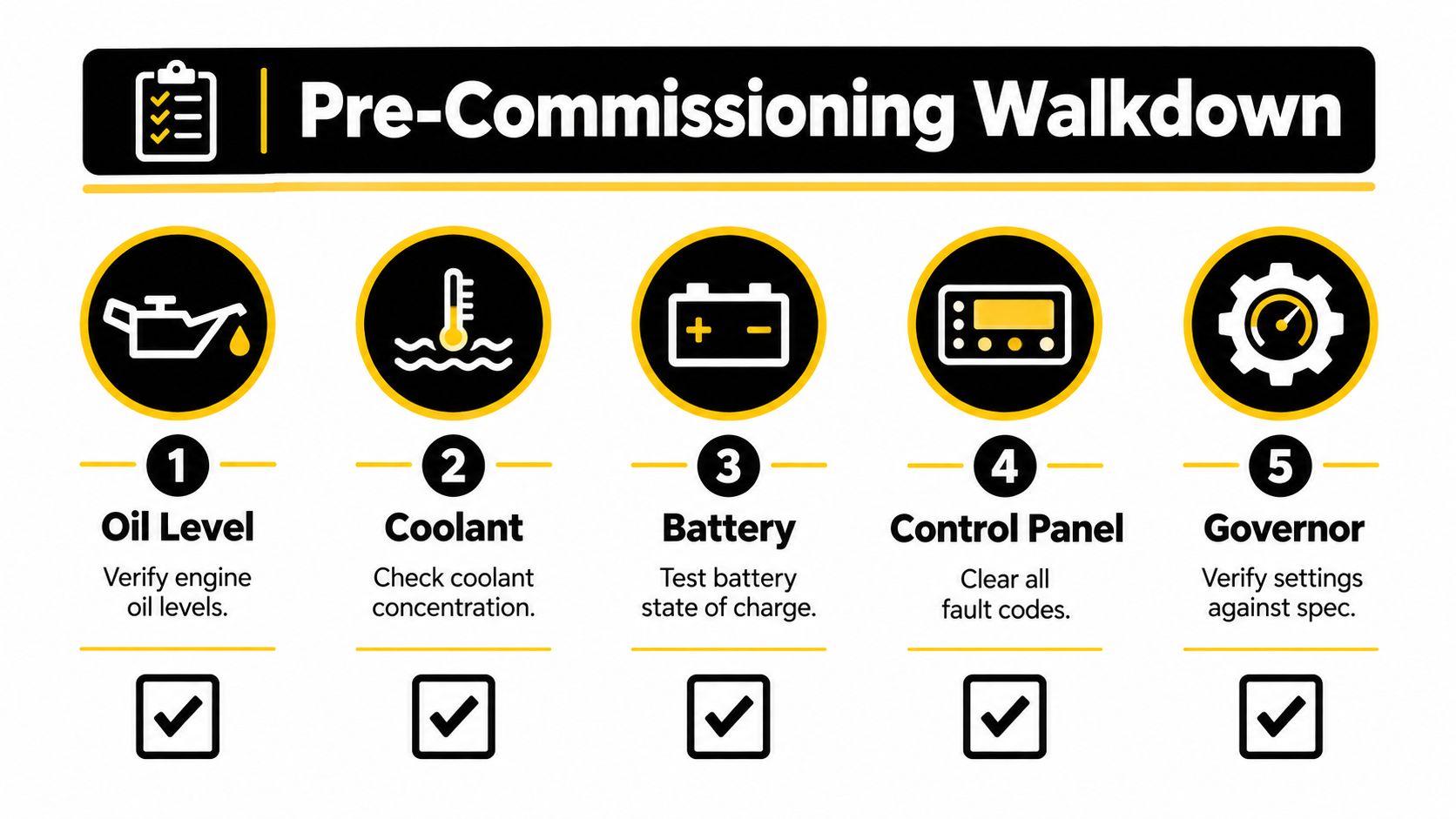
The first walkdown should start at the genset, not the trailer. Confirm the engine oil is at the approved level, coolant is filled and correctly prepared, the battery has adequate state of charge, and the controller shows no active faults. Verify governor settings, voltage settings, frequency settings, and protection parameters against the approved site specification and the engine manufacturer's requirements.
Check the physical installation before looking for a control-panel explanation. Inspect the air intake, exhaust, flexible connections, enclosure access, cooling path, grounding, cable terminations, and service clearances. A forgotten shipping plug, damaged fitting, or loose connection can turn a first start into an engine or equipment failure. The commissioning guidance for industrial generator systems specifically identifies wrong wiring, shipping plugs, and mis-torqued fuel fittings as preventable first-start risks. The same guidance also recommends factory acceptance testing, pre-commissioning checks, site acceptance testing, and load-bank testing as connected stages rather than isolated activities.
Fuel-side checks crews often miss
Temporary fuel equipment introduces failure points that aren't present in the same form on a permanent utility connection. Walk the fuel path in order:
- Trailer position: Set the CNG or LNG trailer on a suitable level surface, with separation and access consistent with the site plan and vendor requirements.
- Combustion air clearance: Keep the trailer, vaporizer, exhaust, and hose arrangement clear of generator combustion-air intakes.
- Hose selection: Confirm the hose rating, coupling type, gasket condition, length, bend radius, and protection from vehicles or site traffic.
- Regulator sizing: Match the regulator and secondary regulator to the engine fuel pressure requirement and the expected full-load flow.
- Vaporization capacity: Confirm that the LNG vaporizer can maintain gas production as demand rises, without unacceptable pressure or temperature loss.
- Monitoring position: Put a qualified person at the pressure-monitoring point for the first start and the load sequence.
The fuel vendor should know when the engine will start and when the load bank will be applied. A trailer that arrives without enough usable capacity, the correct connection hardware, or a confirmed replenishment window can delay a test even when every generator check is complete.
Documentation is part of the walkdown
Review the approved P&IDs, redlines, equipment submittals, gas-train documentation, hose certificates, regulator data, and commissioning procedure before opening a valve. Confirm that the temporary arrangement is represented clearly enough for the technician who will operate it and the person who will inspect it later.
The punch list needs a clear gate for items that prevent energization. Don't bury an open gas-train issue among cosmetic construction items. Mark who owns each unresolved item, what evidence will close it, and whether the genset can safely proceed without that item.
Practical rule: If the crew can't point to the approved pressure, flow, vent, and shutdown requirements, the fuel system isn't ready for first start.
Hooking up mobile natural gas to the genset
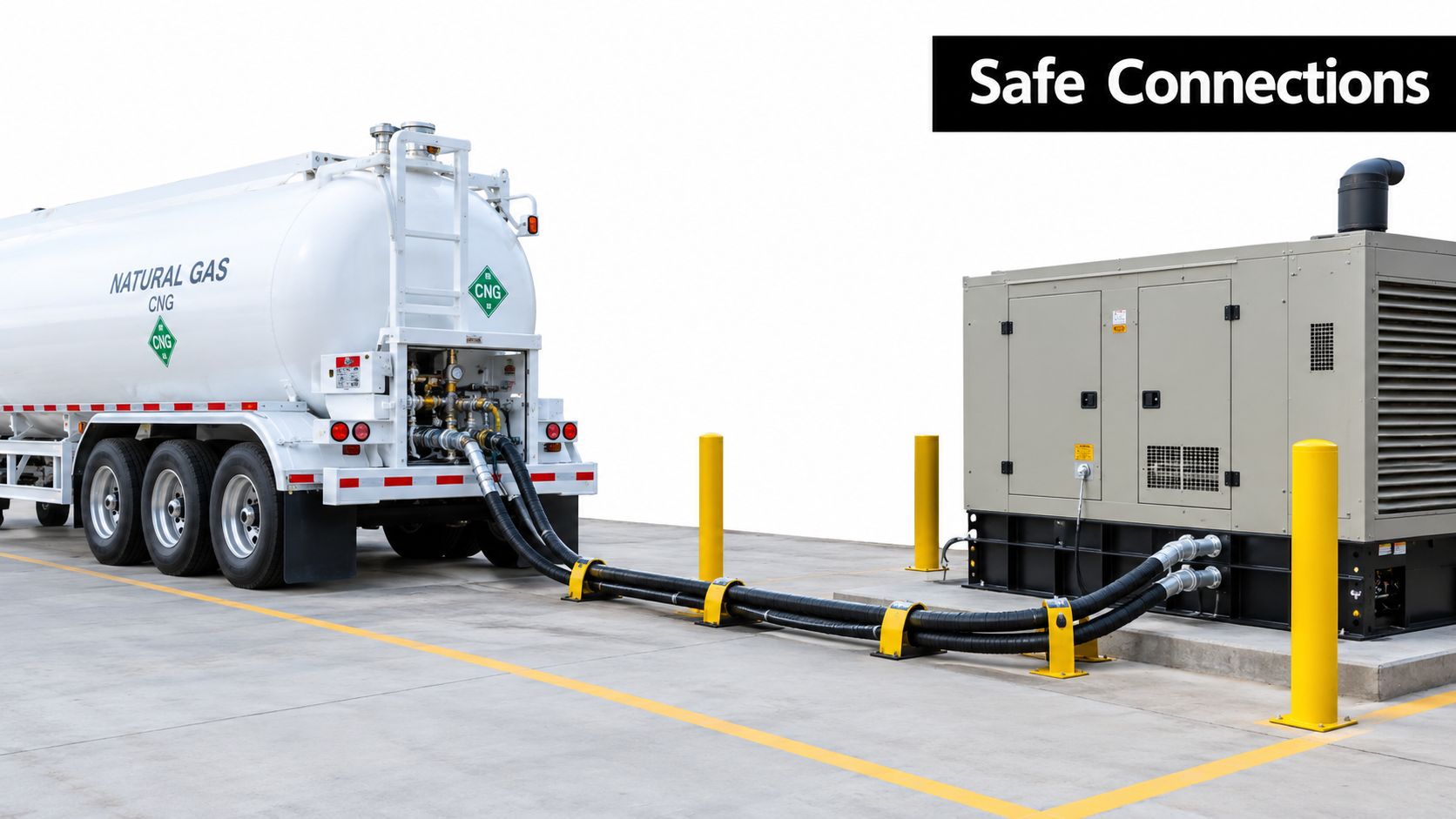
At a representative industrial site, the hookup starts with trailer placement. The trailer is spotted on a level pad where the operator can access valves and gauges, while the hose run stays as short as practical and remains protected from vehicle traffic, sharp edges, standing water, and construction activity. The crew confirms that the arrangement doesn't obstruct the generator's combustion-air intake or emergency access.
Before making the connection, the operator verifies the trailer pressure and confirms the relevant isolation valves are closed. The manual vent is operated according to the approved procedure to establish that the isolated section is in the expected condition. The team then inspects the high-pressure hose, checks the coupling faces, installs a fresh gasket, and tightens the connection to the coupling manufacturer's specification.
Regulators must match the engine
The regulator station is where a temporary supply becomes usable engine fuel. The primary regulator reduces trailer pressure into the range handled by the downstream equipment. A secondary regulator then establishes the delivery pressure required at the engine fuel rail or gas-train inlet.
The exact setting comes from the engine manufacturer's data and the approved fuel-system design. Don't select a setting because it worked on another genset. Two units with similar electrical ratings can have different fuel-train requirements, and a regulator that looks physically adequate may still lack the capacity to respond to a rapid load change.
Vent lines deserve the same attention as pressure lines. Confirm that regulator and relief vents terminate in an approved outdoor location, remain unobstructed, and don't discharge into the generator enclosure or near an air intake. Check the direction of flow on every regulator and filter, then label each isolation valve so the operating sequence is obvious.
Leak checks come before startup
Once the connections are complete, the crew performs a leak check at every joint, valve, coupling, regulator, and transition. A soap solution can help identify a visible leak during initial verification, but the commissioning procedure should also use a calibrated gas detector where required by the site plan, vendor procedure, or safety program. A pressurized hold test then confirms that the isolated fuel path maintains pressure for the specified period without unacceptable decay.
Photograph the regulator faces and record the settings before the system is energized. Photograph the hose routing, valve positions, trailer identification, and vent termination as well. These records save time when a later operator asks whether a valve was intentionally closed or when the temporary package must be reassembled after a fuel delivery.
The crew should also confirm emergency isolation before the gas train goes live. Everyone involved needs to know which valve stops the trailer, which valve isolates the generator, where the emergency shutoff is located, and who has authority to stop the test.
Pressure and flow testing the fuel path
Pressure testing answers one question, while flow testing answers another. Line pressure is the pressure arriving at the regulator station from the mobile supply. Regulated inlet pressure is the pressure available at the engine gas-train inlet after the regulator arrangement has reduced and controlled the source. A trailer can show acceptable pressure at rest while the engine inlet collapses when demand rises, so the two points must be checked independently.
Start with a static test of the new hose, fittings, valves, and regulator connections. Use the approved test medium and procedure, isolate equipment that isn't rated for the test condition, and hold the system at 1.5 times operating pressure for the manufacturer-specified duration where that criterion applies. A calibrated gauge should show whether pressure decays during the hold. Any unexplained decay stops the sequence until the crew finds and corrects the cause.
Build the acceptance record before testing
The flow test must be based on the genset's calculated full-load fuel consumption, expressed in SCFH, with the project's required margin. The commissioning lead should record the calculated demand, the measured flow, the source pressure, the regulated inlet pressure, the gauge identification, the time, and the trailer or vaporizer operating condition.
The table below is intentionally tied to approved project values rather than invented universal gas pressures. Engine fuel requirements vary by manufacturer, model, fuel composition, regulator arrangement, and site design. The lead should enter the values from the approved submittal and record a clear pass or fail.
Fuel path test thresholds for typical gas-fired gensets
| Genset kW | Static test pressure (psig) | Max allowable decay in 30 min (psig) | Full-load fuel flow (SCFH) | Regulated inlet pressure (in. w.c.) |
|---|---|---|---|---|
| Site-rated unit | Approved test pressure | Manufacturer and project limit | Calculated full-load demand | Engine manufacturer's required value |
| 1.5 MW unit | Approved test pressure | Manufacturer and project limit | Calculated full-load demand | Engine manufacturer's required value |
The numbers that can be standardized belong to the generator acceptance sequence, not to every gas connection. Industry checklists commonly use load steps at 25%, 50%, 75%, and 100% rated load, with typical acceptance targets of about ±5% voltage and ±0.5 Hz frequency, as described in industrial generator testing and commissioning guidance. Those figures don't replace the fuel-system values approved for the particular engine.
Find the pressure collapse before full load
Temporary installations commonly fail at the transition from no load to load. An undersized regulator may hold pressure while the engine is idling, then fall behind when the fuel valve opens. A hose can have an adequate nominal rating but still create a restriction through excessive length, a sharp bend, a damaged liner, or an unsuitable coupling.
Run the flow test under the conditions that matter. Watch the trailer pressure, regulator outlet, and engine inlet together as demand changes. If regulated pressure drops outside the manufacturer's permitted range, stop the test and investigate the regulator capacity, vaporizer performance, hose arrangement, filter condition, and valve position before applying more load.
Safety verification and load acceptance
A temporary-gas commissioning job needs one integrated safety check for the fuel package and the generator. Start at the trailer pad and work toward the engine enclosure. Confirm gas detection coverage, emergency-shutoff access, valve lineup, relief orientation, regulator vents, hose protection, fire protection, and the condition of the surrounding work area.
Inside the enclosure, verify that the gas detector is calibrated and positioned according to the approved design. Confirm that ventilation is available, ignition sources are controlled, warning signs are visible, and no one is working on exposed electrical or mechanical components during the gas test. The operator should be able to isolate the fuel supply without entering an unsafe area.
Make the first start a controlled event
Before cranking, the lead reviews the valve lineup aloud and assigns specific people to the trailer pressure, engine controls, gas detection, and emergency stop positions. The engine starts at no load, then the crew watches oil pressure, coolant behavior, voltage, frequency, exhaust, vibration, and fuel pressure as the system stabilizes.
The gas-side acceptance criterion is simple to state: the engine must receive stable fuel pressure without an unsafe leak indication or unacceptable sag. The electrical side must meet the manufacturer's tolerance band, while frequency should remain stable within 0.5 Hz where that is the project acceptance target. If the gas pressure falls as the engine accepts load, don't compensate by changing governor or fuel-train settings without an approved engineering basis. Correct the supply problem first.
Bring the load bank through 25%, 50%, 75%, and 100% of nameplate in the approved sequence. At each step, record load, voltage, frequency, fuel pressure, coolant condition, oil pressure, alarms, and gas-detection status. A full-output load-bank benchmark used in engineering guidance is 100% output for at least 120 minutes, paired with a 1,000 V DC megger test of generator windings, the generator circuit breaker, ATS power circuits, and interconnecting wiring. The University of Michigan engineering design guidance for generator acceptance testing describes that benchmark and emphasizes the importance of pre-commissioning verification.
Don't skip the last safety checks
Time pressure often causes crews to rely on a quick soap check and a brief run. That doesn't prove the system can sustain a full-load test without operator intervention. Use a calibrated sniffer where required, verify emergency shutdown response, and confirm the temporary supply has enough operating capability for the entire planned test.
Facilities also need a wider outage-readiness plan around temporary equipment. Teams responsible for protecting property during system outages may need coordinated fire-watch or site-monitoring procedures while construction systems remain in transition. That work doesn't replace gas testing or generator acceptance, but it can close a separate risk during the period before permanent service is available.
Documentation and handoff to operations
The generator isn't commissioned when it starts. It's commissioned when the owner can prove what was tested, understand the temporary arrangement, and operate the system without relying on the installing crew's memory.
The record set should include the as-built fuel-line diagram, regulator and hose specifications, trailer identification, vent locations, valve labels, and any field changes. Add the pressure and flow results with timestamps, calibrated-gauge details, test conditions, and the names of the people who witnessed the work.
Leave a record another technician can use
The load-acceptance report should capture the controller readings at each load step, including voltage, frequency, load, fuel pressure, coolant condition, oil pressure, alarms, and shutdown behavior. Include the engine settings used during the test, the approved fuel pressure range, regulator settings, and any temporary limits imposed by the vendor or manufacturer.
A practical handoff package contains:
- Fuel-system drawings: Show the trailer, hose route, regulators, vents, isolation valves, and connection to the genset.
- Test records: Include static pressure, pressure-hold, flow, leak-detection, megger, protection, and load-bank results.
- Controller data: Export or print the relevant alarms, set points, event history, and load readings.
- Operating instructions: Explain startup, shutdown, emergency isolation, pressure monitoring, and trailer changeover.
- Open-item list: Assign every remaining item to a named owner with a target completion date.
The handoff conversation should answer practical questions. Who owns the trailer and gas inventory? Who calls for replenishment? What pressure reading requires a shutdown? Which alarms are active because the supply is temporary? Who can alter regulator settings? What should operations monitor during the first 72 hours?
Transfer responsibility clearly
Operations should walk the fuel path with the commissioning lead and physically identify every isolation point. The team should review the first-run readings, expected pressure behavior, alarm meanings, and the limits that require an immediate stop. If the utility connection remains incomplete, the permanent-gas tie-in should be treated as a future change that requires its own inspection, leak test, purge, pressure verification, and operating handoff.
A clean closeout protects more than the current project schedule. It protects the next technician who opens a valve, the operator who responds to a low-pressure alarm, and the owner who needs to demonstrate that the generator was accepted on evidence rather than assumption.
Blue Gas Express provides mobile CNG and LNG delivery for temporary onsite gas needs, including generator commissioning when utility line installation is delayed. If your project needs a temporary supply coordinated with pressure verification, leak testing, controlled startup, and load acceptance, visit Blue Gas Express to discuss the site requirements and deployment plan.