

A burst pipe claim can pass $20,000 on average, based on State Farm's report of more than $181 million paid for nearly 9,000 frozen pipe claims in 2022. On a live job, that money is only part of the loss. Water ruins finished work, a building can't open, and the crew spends days drying, repairing and retesting instead of commissioning. That's why freeze protection is a schedule and continuity decision, not just a roll of insulation. The right method depends on two practical questions. How long can your site run without its own gas heat, and who's checking the coldest points overnight?
Forecast Triggers for Gas Lines and Meters
Frozen pipes damage homes and offices every year and can stop occupancy or a construction schedule, with FEMA cited as estimating approximately 250,000 homes and offices suffer damage from frozen pipes each year.
| Forecast low | Risk level | Action |
|---|---|---|
| Above 40°F | Low risk for most lines | Routine checks; confirm vents and meter covers are clear |
| 40°F (4°C) | Minimum for water-filled fire and process systems | Verify heat trace and insulation; place sensors at the coldest spots |
| 32°F (0°C) | Standing water in exposed lines can freeze | Energize heat trace; drain dead legs on water branches |
| 20°F | Southern plumbing and buildings often unprepared | Activate temporary heat plan; check meters and enclosures every shift |
| Below 20°F, sustained | Exposed piping in unheated spaces can freeze quickly | Full protection: temporary heat, continuous monitoring, staffed rounds |
Read the Forecast From the Pipe Out
Don't plan from the weather app's low alone. That number describes air at a reporting station, not metal on an exposed meter set. Wind strips heat from fittings. An unheated garage, crawl space or exterior wall can sit well below the forecast low for hours after the air outside starts warming.
Walk the route and find your coldest exposed point before the season turns. Put a sensor there, not in a comfortable mechanical room that'll report safe temperatures all night. If your sensor location is wrong, every trigger in the table fires late.
The 40°F line matters because it's your preparation trigger, not your emergency trigger. By the time standing water can freeze at 32°F, you should already know which circuits energize, which dead legs drain, and who owns the overnight round. At 20°F, you're no longer testing a plan. You're running it.
Practical rule: If a forecast shows a low under a trigger, act the day before, not the night of.
Crews lose more pipe to late starts than to bad materials. Insulation ordered during a cold snap, a heater nobody has test fired, and a sensor still in its box all fail the same way. They weren't ready when the temperature crossed the line.
Where Gas Lines and Meters Freeze First
The first failure is rarely the main line. On most jobs, it starts on a short, exposed piece the crew walked past every day. Follow the supply from its entry point and note every place a run leaves a heated space. That transition is where your risk concentrates.
Walk the Supply in Order
Check these spots first, in the order you'd encounter them:
- Short exposed runs: Piping to a water heater or appliance in unheated crawl spaces and attics, plus runs through garages and exterior walls.
- Meter and regulator sets: Exposed sets take wind directly, and metal bodies shed heat fast.
- The regulator vent: Condensate or ice can block the opening, so confirm it's clear and drains properly.
- Branch lines to temporary equipment: These get installed fast, insulated last, and forgotten when the layout changes.
Mark every fitting outside a heated space. Elbows, tees and valves have more exposed surface and more mass transitions than straight pipe, and they lose heat faster. A straight run wrapped neatly means nothing if the elbow at the end sits bare.
The New Build Problem
A building that isn't yet connected to permanent heat or gas has no internal heat source working for it. Lines that were perfectly safe in October freeze in January because nothing inside the envelope pushes back against the cold. Incomplete walls, open penetrations and doors that don't seal yet make it worse.
Winter Storm Uri in February 2021 showed how fast this spreads in places that don't build for prolonged cold. Southern buildings and plumbing were less adapted, and exposed plumbing froze and burst when temperatures fell below approximately 20°F. Northern crews aren't immune either. They just get more practice.
A freeze usually starts where the pipe was unprotected, not where the building feels coldest. Find the bare fitting before the weather does.
Choosing Insulation, Heat Trace or Temporary Heat
Match the method to your power situation and to how long the site can run without its own gas heat. Each option below works inside its limits and fails predictably outside them.
| Method | Best for | Depends on | Where it fails |
|---|---|---|---|
| Insulation only | Short exposures in mild cold | Intact, dry jacket | No heat source; trapped moisture; missing jacket |
| Insulation plus heat trace | Permanent exposed runs | Power, working thermostat, sensor on pipe | Power outage; damaged or overlapped cable |
| Heated enclosure | Meter sets, regulators, valve clusters | Enclosure heater and power | Enclosure leaks; heater failure |
| Temporary gas heat | Delayed permanent service or outage | Temporary gas supply and monitoring | Unit runs out of gas if not refilled on time |
| Drain or bleed low points | Water branches and dead legs only | Manual or automatic drain | Does not protect live supply lines |
Run the Timeline Test First
Count the days until permanent gas heat is ready. Then count the days until the next forecast low at or below your trigger. If the first number is bigger, you have a gap, and you need a method that covers the whole gap.
Short gap, reliable power, mild exposure? Insulation with heat trace is usually the efficient answer. Long gap, no permanent service, finished interiors going in? Plan temporary heat instead of asking insulation to do a heater's job. Insulation slows heat loss. It doesn't replace a single degree.
Our mobile gas units have actively heated, computer-controlled gas flow systems, and smart heating turns on and off automatically to prevent equipment from freezing. Gas boxes provide a quick backup for gas utility service disruptions that last more than an hour. That kind of backup covers occupancy permits, generator commissioning, freeze prevention and general heat while permanent service catches up.
A unit that runs out of gas is as useless as a dead heater. Monitoring isn't an accessory on temporary heat. It's the protection.
Five Decisions Before You Order Anything
- List critical equipment: Boilers, heaters, generators and fire protection risers that must stay above freezing.
- Set each trigger: Use the forecast table above and assign an owner to each level.
- Confirm run time and refills: We estimate when a trailer will run out through remote monitoring, so another hot-swapping unit can be dispatched before that happens.
- Confirm placement: Gas boxes stay in the same location for the entire project, and a mobile unit refills them periodically, so pick a spot that won't block later work.
- Schedule a test run: Fire the equipment before the forecast drops, while a failure is still just an inconvenience.
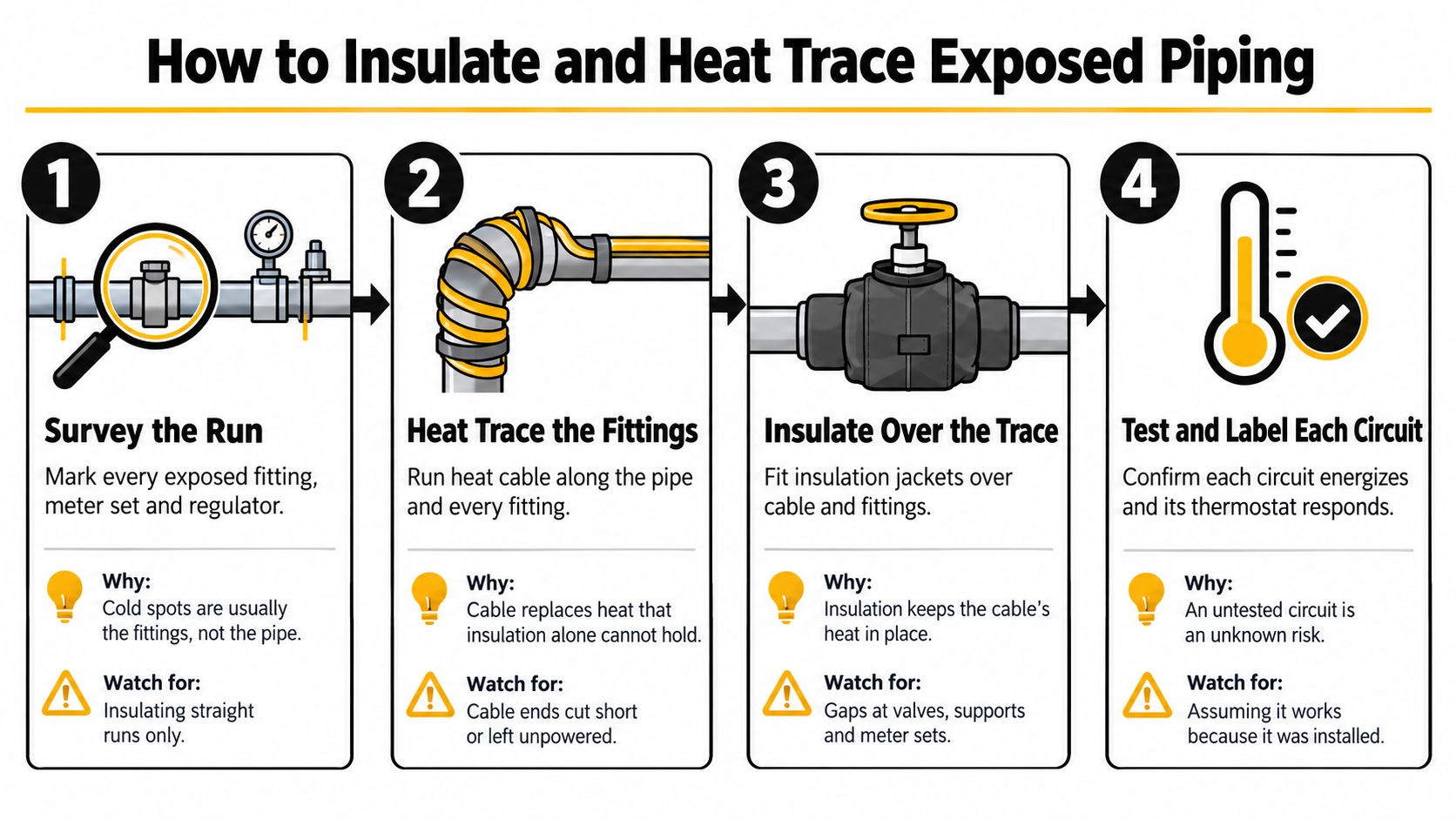
How to Insulate and Heat Trace Exposed Piping
Good installs fail on small details, not big concepts. Work through these steps in order, and don't skip the verification at the end. An untested circuit isn't freeze protection. It's a guess wrapped in a jacket.
The Numbered Procedure
Survey the run: Mark every exposed fitting, meter set and regulator before you buy material. The cold spots are usually the fittings, not the straight pipe. The common slip is insulating the easy straight runs and leaving valves and elbows bare.
Leak test and dry the line: Confirm the piping is leak-tested and dry before wrapping. Moisture trapped under insulation freezes, and wet insulation loses much of its value. Wrapping a damp line locks the problem inside the jacket.
Choose the right insulation: Pick insulation rated for outdoor or unheated use with a weather-resistant jacket, typically 1 inch or thicker on small exposed lines. Check fitting sizes before ordering. Covers that don't fit valves get left in the gang box.
Run heat trace along the bottom: Install self-regulating heat trace cable along the bottom of the pipe, not the top, and route it only where the manufacturer allows. Overlapping or crossing cable can overheat. Heat rises around the pipe from the bottom position, which is why placement matters.
Put the sensor on the pipe: Attach the thermostat sensor to the pipe itself so it reads metal temperature. A sensor reading nearby air can stay warm while the pipe drops toward freezing. This single mistake defeats otherwise sound installs.
Protect the circuit and seal the jacket: Install ground-fault protection on the heat trace circuit. Seal jacket joints with approved tape so water can't wick in at seams. Label each circuit at the panel so a night-shift electrician can find it fast.
Energize and recheck: Turn the system on, confirm the thermostat setting, and check cable temperature after 24 hours. A circuit that never energizes looks identical to a working one from the outside. Only the recheck tells you which one you have.
The Mistake That Beats Most Installs
Here's the failure that repeats every winter. The crew wraps the pipe neatly, the cable goes in correctly, and then somebody mounts the sensor where it's convenient instead of where it's cold. The sensor reads warm air, the cable never switches on, and the line freezes during the first real cold night.
Watch for: If your thermostat never calls for heat during a test cold night, suspect sensor placement before you suspect the cable.
Test under conditions that resemble an actual freeze. A system verified on a mild afternoon hasn't proven anything yet. Confirm it responds when the pipe itself gets cold, then write down which breaker feeds it and tape that note where the on-call person will find it.
Protecting Water Systems and Fire Sprinklers
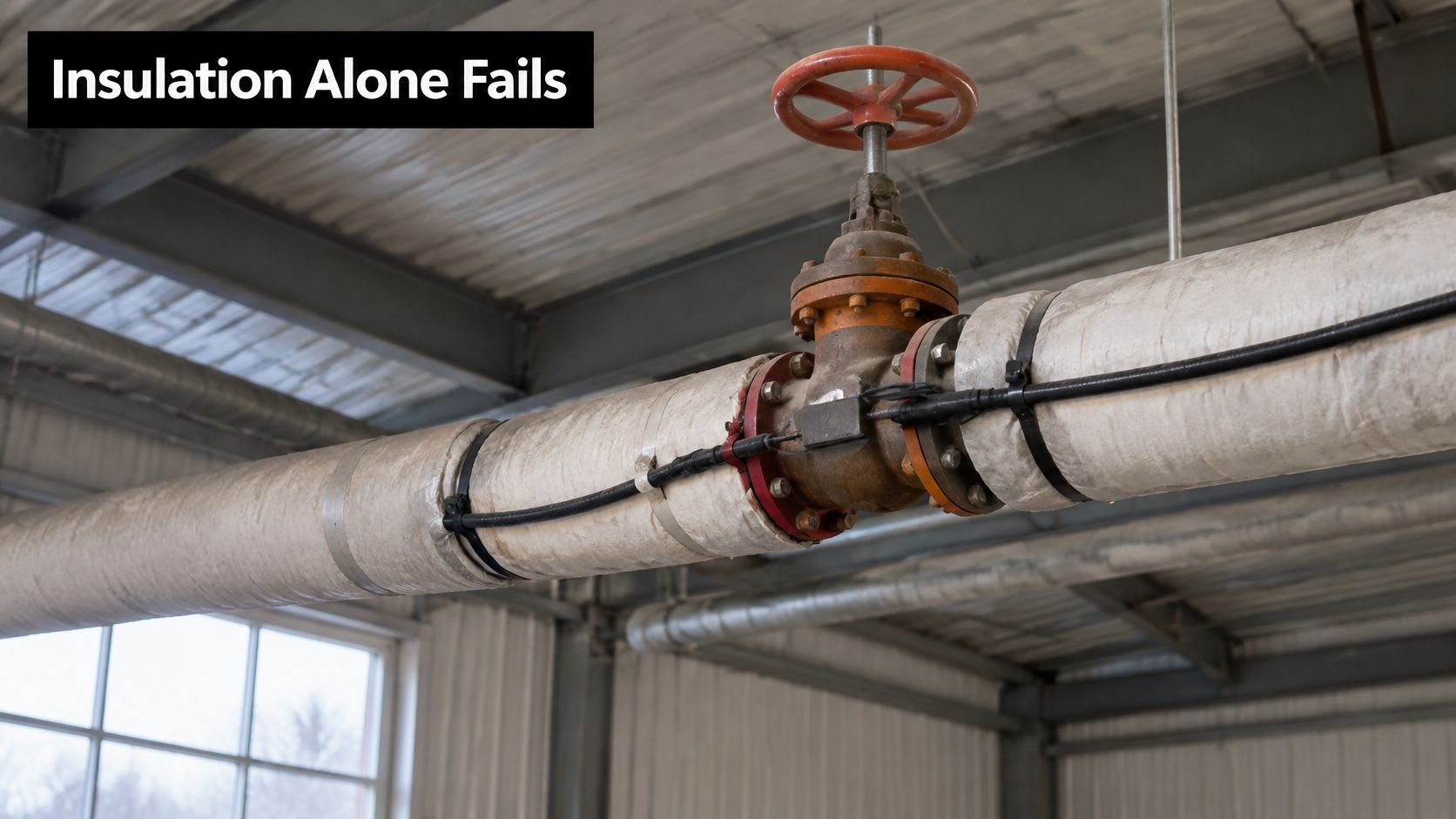
The misconception that does the most damage is simple. Insulation without a heat source protects nothing for long. It delays freezing by hours, maybe. Then the pipe reaches ambient temperature anyway, and standing water does what standing water does.
Hold the Temperature or Remove the Water
FM guidance on maintaining susceptible areas at a minimum of 40°F (4°C) gives you the control target for water-filled fire protection and process systems. Where you can't hold that temperature, drain or circulate non-fire-protection water systems. Convert a wet-pipe fire system to an approved dry-pipe arrangement when necessary.
Exterior risers and valves need an insulated, heated enclosure with temperature monitoring connected to a continuously attended location. An alarm that reports to nobody isn't monitoring. It's decoration.
Keep automatic sprinklers operational through cold weather, and keep up weekly inspections, including weekends. The weekend gap is where construction sites get hurt. A riser room that's fine on Friday afternoon can freeze by Sunday if a temporary heater trips and no one's scheduled to look.
Pitfalls That Keep Repeating
- Trapped water: Isolated branches and dead legs hold water long after the main system drains.
- Warm-spot sensors: A sensor in a representative heated area misses the cold pocket at the exterior wall.
- Disabled alarms: Crews silence alarms during construction and forget to restore them, so freezing goes undetected.
Temporary construction conditions make all three worse. Open doors, incomplete envelopes and uncommissioned heaters create localized freeze pockets even when average building temperature looks safe. Use the mapping and heat trace procedure above, then run the checks below. The heat source and the alarms matter more than the wrap.
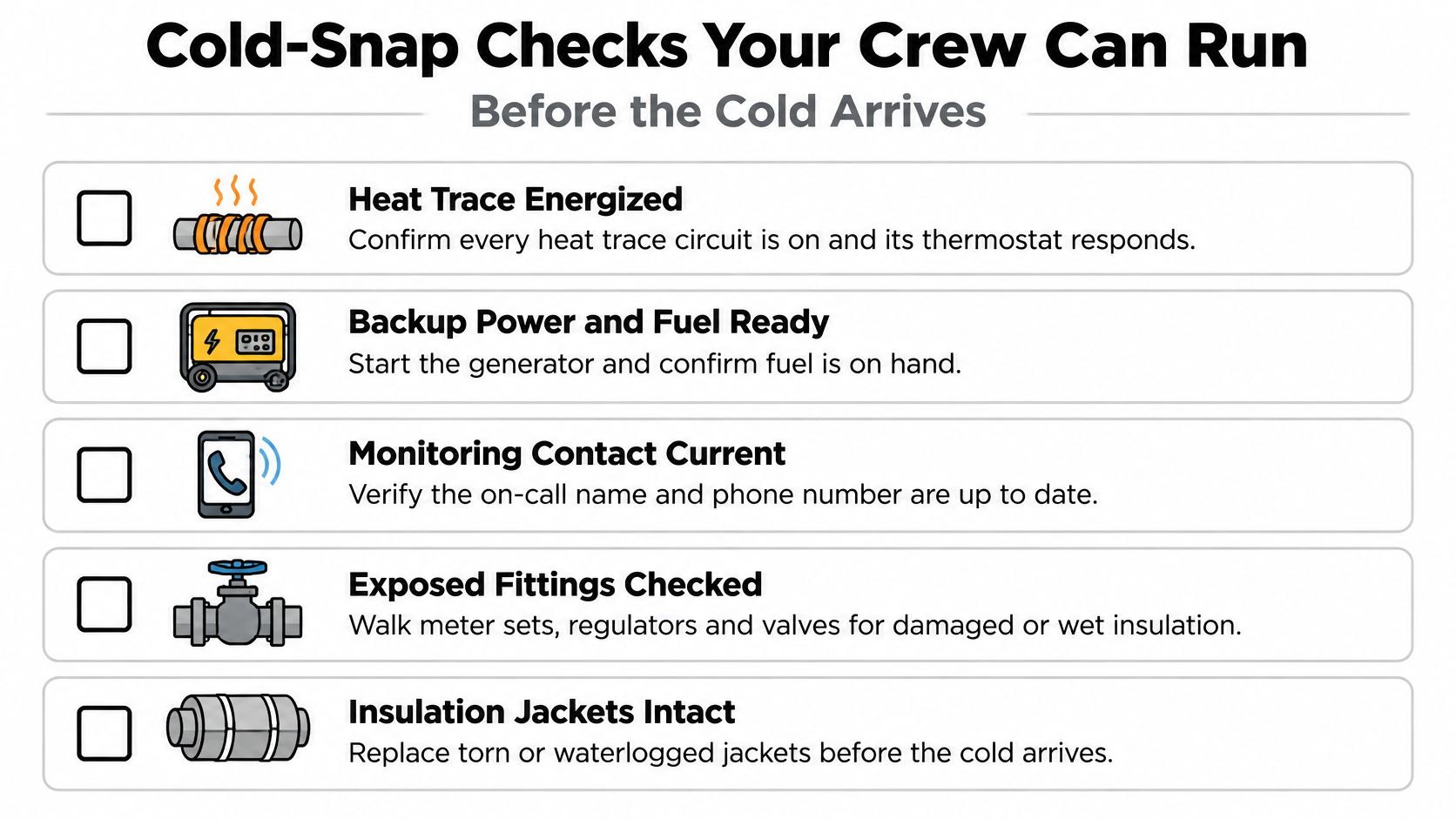
Cold-Snap Checks Your Crew Can Run
A written plan fails the first night nobody owns a round. Freeze protection is a staffing decision as much as a materials one: the right check depends on how long your site can run without gas heat and who is actually awake to notice when it stops. Turn the plan into a printable routine with named owners, fixed round times and written readings. Memory doesn't survive a three-night cold snap.
Before the Cold Arrives
- Heat trace energized: Confirm every circuit is on and its thermostat responds.
- Backup power and fuel ready: Start the generator and verify fuel on hand. On units that run on back-up batteries, confirm the generator cycles on to charge them and shuts off when they're full.
- Monitoring contact current: Check the on-call name and phone number, and confirm who responds to an alarm.
- Exposed fittings checked: Walk meter sets, regulators and valves looking for damaged or wet insulation.
- Jackets intact: Replace torn or waterlogged insulation now, not during the event.
During the Event
Run rounds at fixed times, including overnight and weekends. Record the reading at each meter set, enclosure and temporary unit. If you're running on temporary gas, check remaining supply against the monitored run-out estimate so a refill unit reaches the site before the current one empties. Log every alarm with the time it was acknowledged and the action taken.
Set escalation rules in advance. Decide who calls the gas provider, who can shut down a branch, and who approves restarting a line after a thaw. Decisions made at 2 a.m. should follow a list written at 2 p.m.
After the Thaw
Never thaw a frozen gas line with an open flame or by heating the pipe directly. Call the gas provider, isolate the affected branch, and let the line thaw slowly with heat applied to the enclosure or surrounding space. Before restoring pressure, leak test and inspect fittings and joints, because a split pipe may not show until gas or water returns.
A missed round is the most common way a freeze goes unnoticed. Staff the rounds like you staff the work itself.
When permanent gas service is delayed or an outage threatens your heat, Blue Gas Express supplies temporary natural gas through mobile units and gas boxes, with LNG available where the job calls for it. Talk with us before the next forecast low crosses your trigger, and we'll size the setup to your load so freeze prevention doesn't become freeze repair.