

You're standing on a finished slab, the inspector's date is on the calendar, and the one thing you don't have is gas. That's the gap a temporary supply is meant to close, but only if pressure, placement, and approvals line up before a trailer rolls onto your site. Understanding how a CNG delivery service works as a short term bridge, not a permanent replacement, helps you judge whether it'll keep your schedule or create a new problem.
When a Job Site Needs Gas Before the Line
The building's framed, the mechanicals are roughed in, and the drywall crew is waiting on heat. The permanent natural gas connection, though, is still weeks out because the utility crew is backed up, a permit is sitting in review, or an existing line is down for maintenance. Nothing else on the job is broken. You're ready before the pipe is.
That gap costs more than patience. A residential builder can't get occupancy approval if heat and hot water can't be tested. A commercial owner can't commission kitchen equipment, rooftop units, or a backup generator without fuel to run them under load. An industrial plant that loses gas during a planned outage may have to idle a process line it just spent days bringing up to temperature.
Who Feels the Delay First
- Residential builders: You're blocked from final inspections and closings even though the houses themselves are complete.
- Commercial owners: You can't hand over space to tenants if heating, cooking, or standby power hasn't been proven.
- Industrial facilities: You risk unplanned downtime when a maintenance window runs longer than expected.
- Gas utilities: You're trying to keep a customer on gas while your own line work catches up, and a long wait pushes that customer toward another fuel.
Each of those situations raises the same set of questions, in the same order. What does a mobile supply bring to the site. How does high pressure gas on a trailer become fuel your equipment can safely burn. Who has to approve the setup before gas flows. When does trucking gas in protect your schedule, and when does it just trade a pipeline delay for a refill problem. And finally, which kinds of Southeast projects fit this model well enough to justify a call.
A temporary gas setup only saves time if the site can legally receive it, safely use it, and reliably refill it.
This guide stays with temporary compressed and liquefied natural gas delivery for construction, commissioning, and outage support. It doesn't wander into unrelated pipeline maintenance specialties that have nothing to do with getting your building heated, tested, or occupied. By the end, you should be able to look at your load, your site, and your timeline and make a practical call about fit before you ever phone a supplier.
What a CNG Delivery Service Actually Supplies
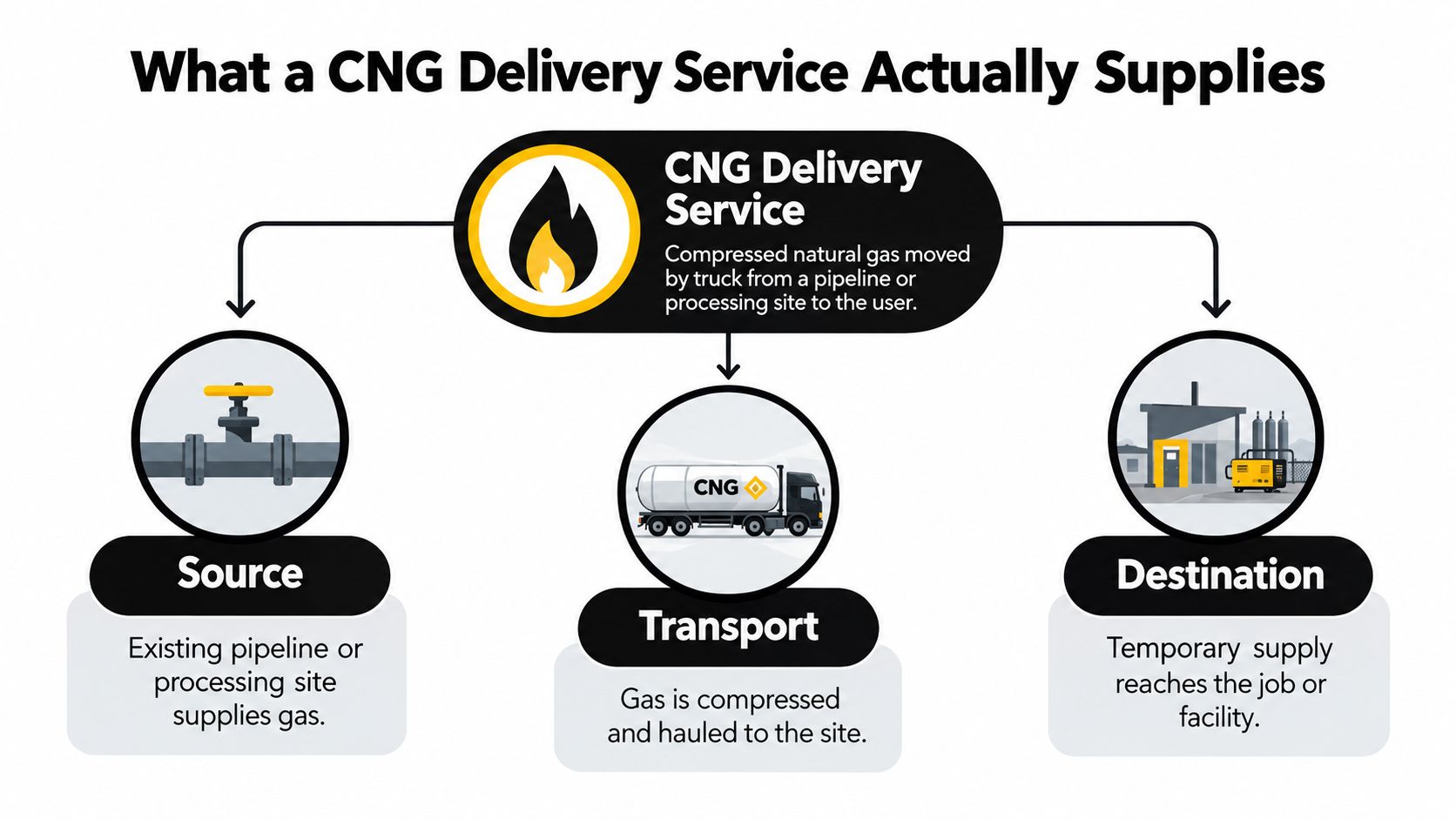
A CNG delivery service moves compressed natural gas by truck from an existing pipeline or gas processing site to a customer who can't yet use a fixed distribution line. The industry often calls this a virtual pipeline, because the truck route temporarily does the job a buried pipe would normally do. Gas is compressed, loaded onto a trailer, hauled to your site, and fed into your equipment through an on site connection until permanent service arrives or an outage ends.
A Bridge With an End Date
Vermont offers a clear picture of how this is supposed to work. Middlebury College, a nearby dairy, and a hard cider company received CNG through a virtual pipeline from 2015 until 2018, when Vermont Gas completed a conventional pipeline connection. The trucked supply wasn't the long term answer. It kept those customers running for the years the permanent line took to arrive, then it went away.
That pattern shows up across the customer types already using the model, including rural towns, remote factories, universities, hospitals, and farms. What they share isn't size or industry. It's a need for gas during a window when geography, permitting, construction, or an outage makes the fixed system unavailable. On a building project, that timing often overlaps with finishing trades sequencing their work, the same way a superintendent might explore decorative concrete options while flatwork is still being scheduled around other crews. Temporary gas fits into that sequence as one more coordinated step, not as a standalone fix.
Established, but Deliberately Small
By 2016, nine virtual pipeline companies operated across the country, from Texas to Maine, which tells you the practice was established rather than experimental. At the same time, virtual pipelines were estimated at far less than 1% of total U.S. natural gas consumption, based on U.S. Energy Information Administration analysis cited in that same reporting.
That boundary matters when you're buying. Mobile gas supports construction schedules, facility commissioning, heating, and business continuity during a specific constraint. It doesn't replace the national pipeline network, and it isn't priced or planned as if it does. If you treat it as a permanent utility, you'll be disappointed. If you treat it as a bridge with a defined start, a defined load, and a defined end, you're using it the way it was built to be used.
How Mobile CNG Reaches Usable Pressure
Here's where new buyers get confused. A trailer can sit on your lot full of gas and your equipment still won't run. That's because pressure management is the central constraint in any CNG delivery service, and three pressures have to stay safe and compatible at the same time: the pressure in storage, the pressure during transfer, and the pressure your appliance or generator can accept at its inlet.
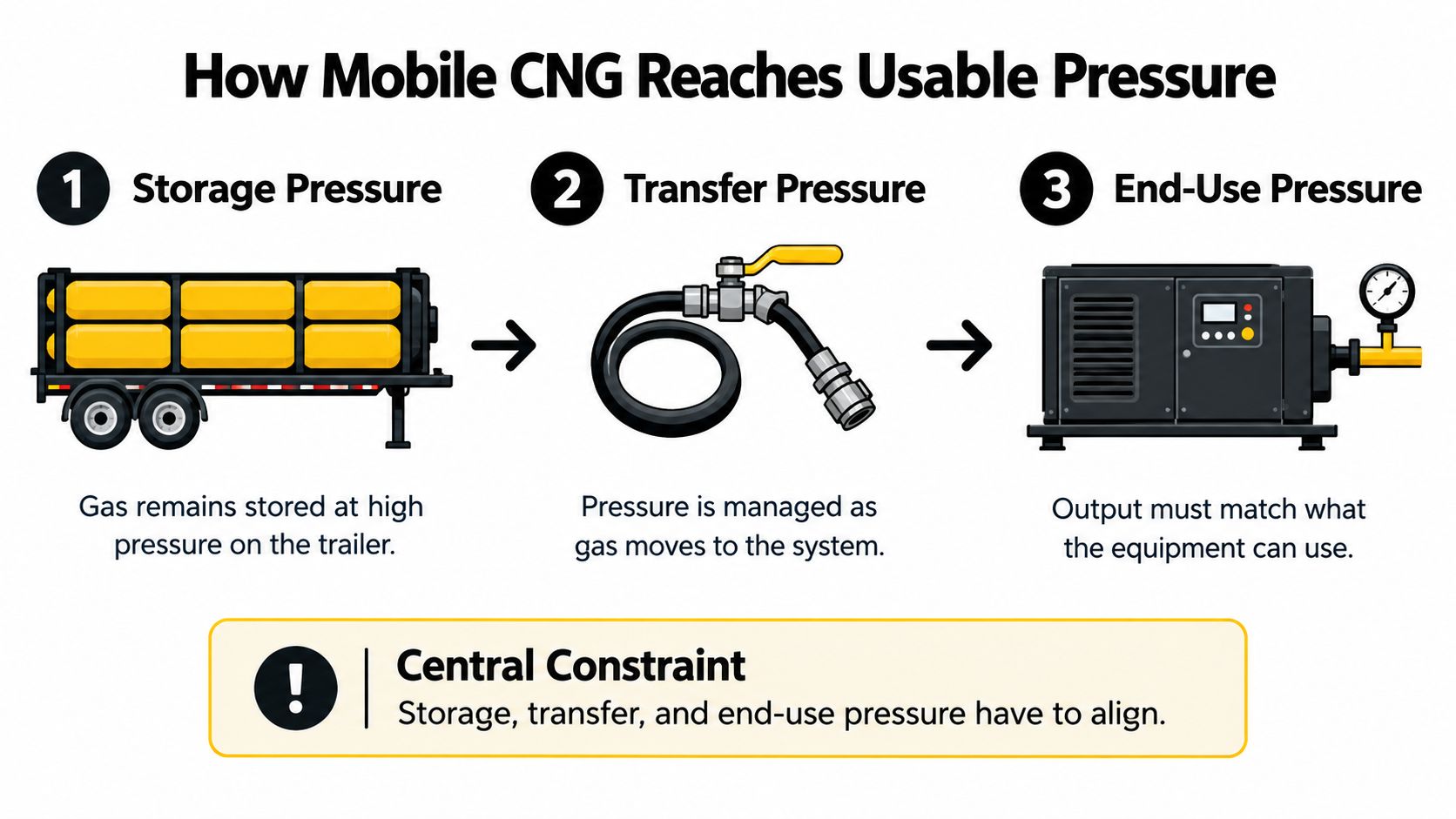
Gas stays on the trailer at high pressure so a useful amount fits in a transportable space. Your heater, boiler, oven, or generator expects something far lower and steadier. A pressure reduction train normally sits between the two and converts high pressure CNG into a stable, equipment compatible supply. If that conversion isn't sized and set correctly, inventory on the trailer is just inventory. It isn't usable fuel.
How a Full Trailer Still Fails You
- Regulators freeze: Rapid pressure drop chills components, and a frozen regulator can restrict or stop flow during the cold weather demand you ordered gas for.
- Filters plug: Debris or moisture caught upstream starves the equipment downstream even though storage pressure looks fine.
- Pressure sags at peak demand: Generator starts and morning heating peaks pull hard, and an undersized setup can't hold minimum delivery pressure through the surge.
- The connection can't pass the flow: Hose length, hose diameter, and fittings all limit how much gas reaches the load per hour.
A credible dispatch plan accounts for those failure modes before mobilization. The supplier should work from your expected load in standard cubic feet per hour, your minimum delivery pressure, ambient temperature, regulator capacity, hose length and diameter, and a reserve margin for startup demand. If a quote doesn't ask for those inputs, it isn't really a delivery plan yet.
Field rule: Don't ask how much gas is on the trailer. Ask whether the setup can deliver your peak flow at your required pressure on your coldest expected morning.
Placement follows the same safety logic. NFPA 52 based guidance requires pressure relief devices on storage and compression systems to discharge CNG outside buildings, with one cited jurisdiction requiring the discharge point to be at least 10 feet from buildings, ventilation openings, property lines, public ways, and egress paths. Your crew also needs accessible emergency shutdowns and continuous checks of storage and discharge pressures while the system runs. Those aren't paperwork extras. They're what make rapid deployment credible when a generator starts, a heating peak hits, or commissioning puts the full load on at once.
Which Approvals a Temporary Gas Site Needs
Pressure can be perfect and the setup can still sit idle if nobody with authority has approved its placement. Who's legally responsible for a temporary CNG site depends on several variables at once: the gas classification, the transport route, how gas is stored and dispensed on site, the fire code jurisdiction, and whether the customer is a construction site, an occupied building, a generator installation, or an industrial facility. There's no single generic checklist that answers all of that.
Start with the federal distinction, because it's the one most often misread. FMCSA classifies CNG as a Division 2.1 hazardous material and notes that CNG does not fall within the specific methane category requiring a federal Hazardous Materials Safety Permit under the cited rule. Some buyers hear that and assume permitting is handled. It isn't.
No federal safety permit does not mean no permitting burden. Site level approvals can still decide whether gas is delivered at all.
Temporary CNG Site Approval Path
| Project stage | Who is involved | What must be confirmed |
|---|---|---|
| Utility coordination | Gas utility, site owner | Whether temporary supply interferes with planned line work or permanent connection timing |
| Fire marshal review | Local fire official, authority having jurisdiction | Placement, separation distances, discharge location, and fire protection on site |
| Building and electrical permits | Local permitting office, contractor | Whether connected equipment, generators, or temporary heat trigger additional permits |
| Transport documentation | Carrier, driver | Hazardous material paperwork and required communication at pickup and delivery |
| Emergency contacts | Site operator, supplier | Who gets called, and who can isolate the system, at any hour it runs |
| Demobilization | Supplier, site owner | How gas is removed and the site is restored when permanent service starts |
First time builders often meet this layered process on the building side first, which is why permit planning for first-time home builders is useful background for understanding how local approvals stack. Temporary gas adds its own layer on top of that, because traffic patterns, crane operations, and neighboring occupancy all affect where a trailer can sit.
FMCSA also references required communication between drivers and carriers at pickup and delivery locations. That detail matters because accountability isn't just about owning a trailer. It's about documented handoffs every time gas moves. For a builder chasing an occupancy permit or a utility managing a line delay, an approval path scoped too narrowly can erase every day the fast deployment was supposed to save.
Choosing CNG Over Diesel LNG or a Rush Line
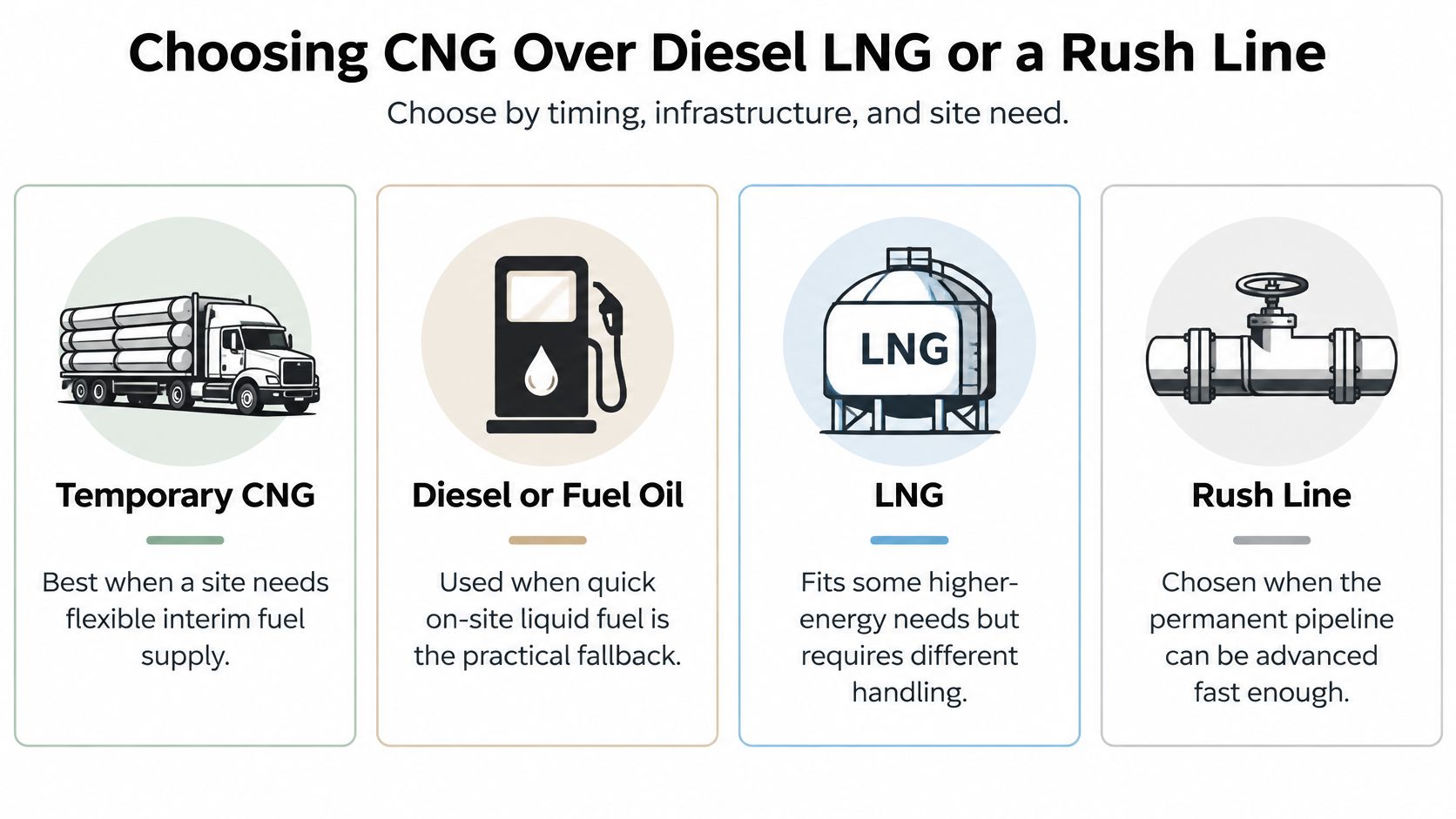
Temporary CNG is one of four realistic responses when permanent gas isn't there. You can truck in CNG, fall back on diesel or fuel oil, bring in LNG, or push hard to accelerate the permanent line. The right choice isn't the cheapest fuel per unit. It's the option that actually protects continuity for your specific load and duration.
The Conditions That Decide It
- Expected demand and duration: A short commissioning window and a full winter of temporary heat are different logistics problems.
- Delivery frequency and on site storage: Together they set your autonomy, meaning how long you can run between refills.
- Truck access and weather exposure: A site a trailer can't reach in bad weather has a fragile plan no matter what the contract says.
- Consequence of a missed refill: Losing temporary heat overnight is inconvenient. Losing freeze protection or a generator test window can be a safety or schedule failure.
Diesel or fuel oil often wins on simple familiarity, since liquid fuel storage and handling are well understood on most job sites. LNG fits some higher energy needs but requires different handling because it's stored as a cryogenic liquid rather than a compressed gas. A rush line is the cleanest ending when the utility can genuinely advance construction, but you don't control that schedule, and hoping isn't a continuity plan.
Geography also shapes how sturdy a CNG plan really is. One 2025 market estimate reports more than 39,000 CNG refueling stations across 85 countries, while other research estimates more than 27,500 stations, with roughly 61% in Asia-Pacific and about 8% in North America. Those differing totals warn you not to treat any headline count as a promise of local availability, since estimates vary by what counts as a station. A plan can be technically feasible and still fragile if nearby supply, site access, or refill windows are thin.
In the Southeast, Blue Gas Express operates as a mobile CNG and LNG provider across North Carolina, South Carolina, Tennessee, and Virginia, using scalable units when line installation or maintenance leaves a customer without gas. It works with utilities and with residential, commercial, and industrial sites on needs such as occupancy, generator commissioning, and freeze prevention, and states it can deploy within hours of a request. Treat that speed as conditional, not automatic. It still depends on the pressure sizing and approval path being right for your site.
Where Temporary Gas Keeps Projects Open
The same delivery model shows up in very different weeks on very different sites. What changes is the constraint each customer is trying to survive.
A residential or commercial builder usually needs gas for a milestone. Temporary heat keeps interior finishes curing on schedule, and a working gas supply lets inspectors verify furnaces, water heaters, and fireplaces so occupancy can move forward. The constraint there is a date. Miss it, and closings, tenant move ins, and punch list work all slide together.
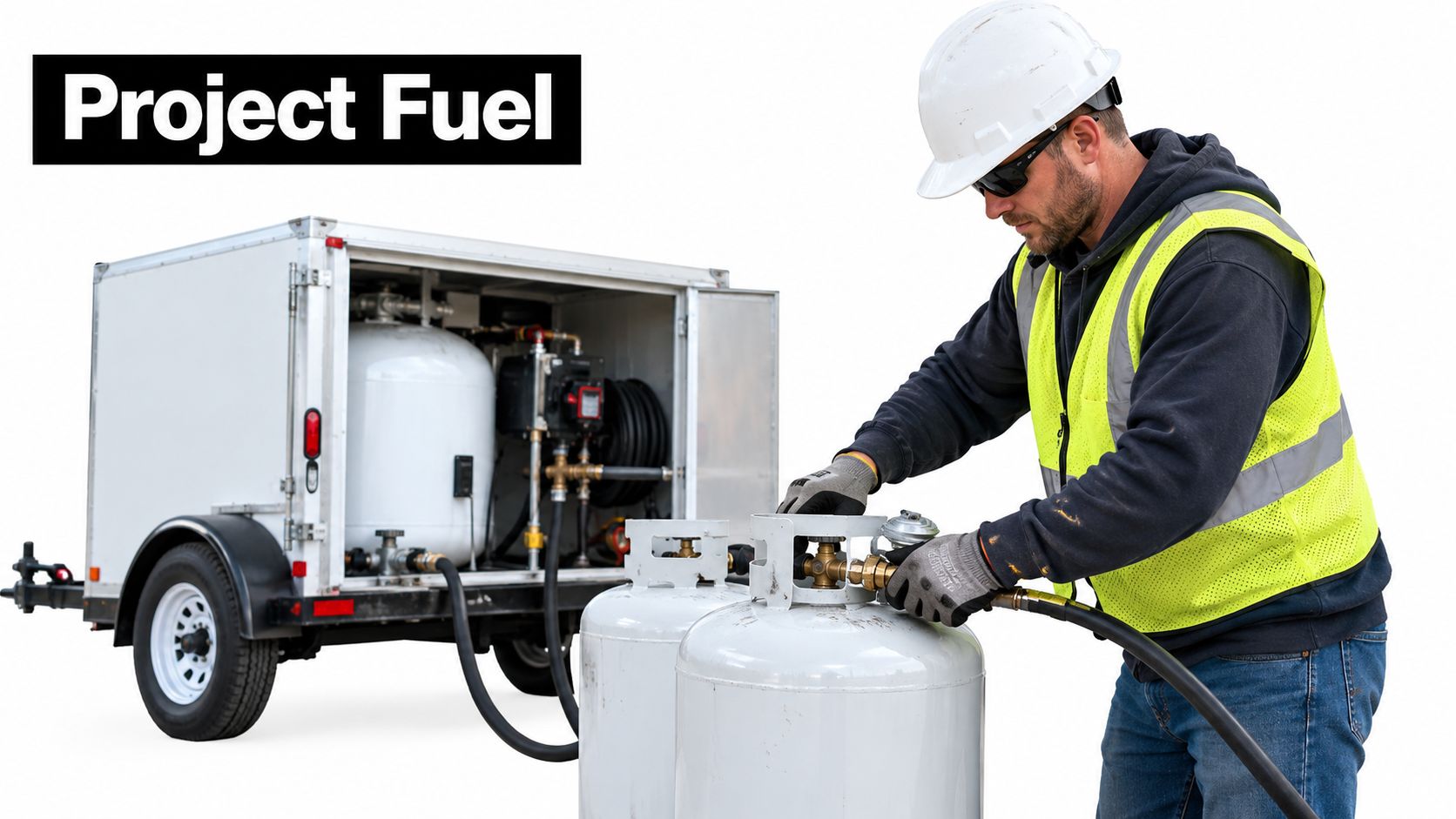
An industrial facility is usually protecting a process or a backup system. Keeping process heat or standby equipment online during a planned outage avoids a cold restart and the quality problems that come with it. Generator commissioning belongs in this group too, and it ties directly into electrical decisions the facility has already made. If your team is still sorting out how backup power connects, a generator interlock vs transfer switch comparison can help clarify that side before fuel arrives for load testing.
A utility uses the model differently again. When line installation or maintenance would otherwise leave customers without service, a mobile supply bridges the gap so those customers stay on gas instead of switching fuels during the wait. The constraint there is retention as much as heat.
Organized Logistics, Not an Emergency Favor
This isn't an occasional practice. In 2019, virtual pipelines moved more than 225 million gasoline-gallon equivalents of CNG and nearly 180 million of LNG, about 405 million combined, equated to roughly 99,000 truckloads, with an attributed average annual reduction of 3.6 million metric tons of carbon-dioxide equivalent from displacing diesel, fuel oil, propane, and grid electricity. Read those figures as industry reported, not as a government census, but they still establish the scale. Mobile gas in the Carolinas, Tennessee, and Virginia supports the same practical loads, temporary heat, generator commissioning, and freeze prevention, where a missed delivery can affect safety, a commissioning date, or an occupancy approval.
What to Arrange Before You Call for Gas
Treat the mobile unit as what it is, a regulated high pressure gas system, not a fuel trailer you park and forget. That mindset turns your first call into a productive one, because you'll already know what has to be true before gas is introduced.
Pre Mobilization Checklist
- Listed or approved components: Confirm pressure relief devices, gauges, regulators, valves, hoses and connections, gas detection, alarms, and fire protection equipment are listed or approved for this use.
- Ratings and compatibility: Verify pressure ratings and regulator compatibility against your actual equipment, not a generic load estimate.
- Shutdown and hose condition: Test emergency shutdown function and inspect hoses before they're pressurized.
- Grounding and bonding: Confirm both are in place where required for the setup.
- Authority having jurisdiction requirements: Get the local expectations confirmed before mobilization, not after the trailer arrives.
Two cited control points give that checklist teeth. NFPA material indicates piping and components should use a minimum safety factor of 3, and gas detection systems, where installed, should alarm at one-fifth of the lower flammable limit. Those aren't abstract code trivia. They're the margins that keep a hose failure, regulator problem, or small leak from escalating.
Day to day habits matter just as much once gas is flowing. Establish a controlled exclusion zone around the equipment, keep compression, storage, and dispensing equipment outdoors where required, and document pressure readings at compression discharge, storage, and dispenser discharge points. Make sure the people on site are trained to detect leaks and isolate the system without waiting for someone to drive over.
With that groundwork done, the decision gets simple. Match your load, your duration, your site access, and your approval path, then contact a mobile provider that serves your site. For projects in North Carolina, South Carolina, Tennessee, and Virginia, Blue Gas Express is the named option for requesting temporary CNG or LNG while permanent service is unfinished or interrupted.
If your project in North Carolina, South Carolina, Tennessee, or Virginia is ready before its permanent gas line is, Blue Gas Express can supply temporary mobile CNG or LNG to keep heat, commissioning, and occupancy work on schedule. Bring your expected load, duration, and site access details, and visit Blue Gas Express to start the request.