

Picture this: you have a personal, portable gas station that comes to you, right where you need it. That's the simple idea behind CNG home fill and, more broadly, onsite natural gas solutions. It’s a game-changer for construction sites, commercial buildings, and industrial projects that need energy independence, especially when the utility company is dragging its feet.
Bringing the Gas Station to You with Onsite CNG
When your project's timeline depends on a steady energy supply, waiting months for the utility to install a permanent gas line can bring everything to a grinding halt. This is where onsite compressed natural gas (CNG) steps in, delivering fuel directly to your location. It’s much bigger than just a homeowner filling up their car; it's a flexible, on-demand energy source for all kinds of commercial needs.
Think of it as a "virtual pipeline" on wheels. Instead of being stuck waiting on underground infrastructure, a mobile unit shows up and provides a constant flow of natural gas. This simple switch helps keep projects on schedule and on budget by completely sidestepping the usual delays that come with utility hookups.
Powering Progress Beyond the Pipeline
The uses for onsite CNG are surprisingly diverse and solve some really frustrating business problems. For example, a construction crew can use it to run temporary heating systems. This means they can pour concrete and keep working through the winter, avoiding weeks of costly downtime.
It’s also critical for getting new buildings up and running. Before a commercial space can open its doors, all the essential systems have to be tested and signed off on. This includes things like:
- Generator Commissioning: You absolutely have to prove the backup power systems work before anyone can move in.
- HVAC System Testing: Firing up the heaters and air conditioners is a mandatory step for passing inspections.
- Securing Occupancy Permits: Most cities won't grant a Certificate of Occupancy until they see that all gas-powered equipment is fully operational.
None of these milestones can happen without a gas supply. Mobile CNG delivers the fuel needed to check these boxes, get the final permits, and open for business without delay.
This shift toward flexible energy isn't just a niche idea; it's a massive market trend. The global compressed natural gas market is on track to hit USD 344.6 billion by 2030, a huge part of which is driven by small-scale and temporary solutions filling in these infrastructure gaps. You can discover more insights about this expanding market on Grand View Research.
In the end, whether it's for a small CNG home fill setup or a massive commercial site, the goal is the same. It's about taking control of your energy supply, keeping things running smoothly, and turning what could be a logistical nightmare into a simple, efficient solution.
Understanding Your Onsite CNG Fueling Options
When you need natural gas on-site, it's easy to think of a permanent utility line as the only solution. But the reality is you have a whole range of options, from small appliances for your personal vehicle to powerful, mobile systems that can power an entire building.
Choosing the right approach all comes down to what you're trying to accomplish. Are you simply refueling a car overnight? Or do you need a temporary, high-volume gas supply for a massive construction project? Let's walk through the four main ways to get CNG on-site, starting with the most basic and building up to the most flexible.
This quick decision tree can help you see where to start.
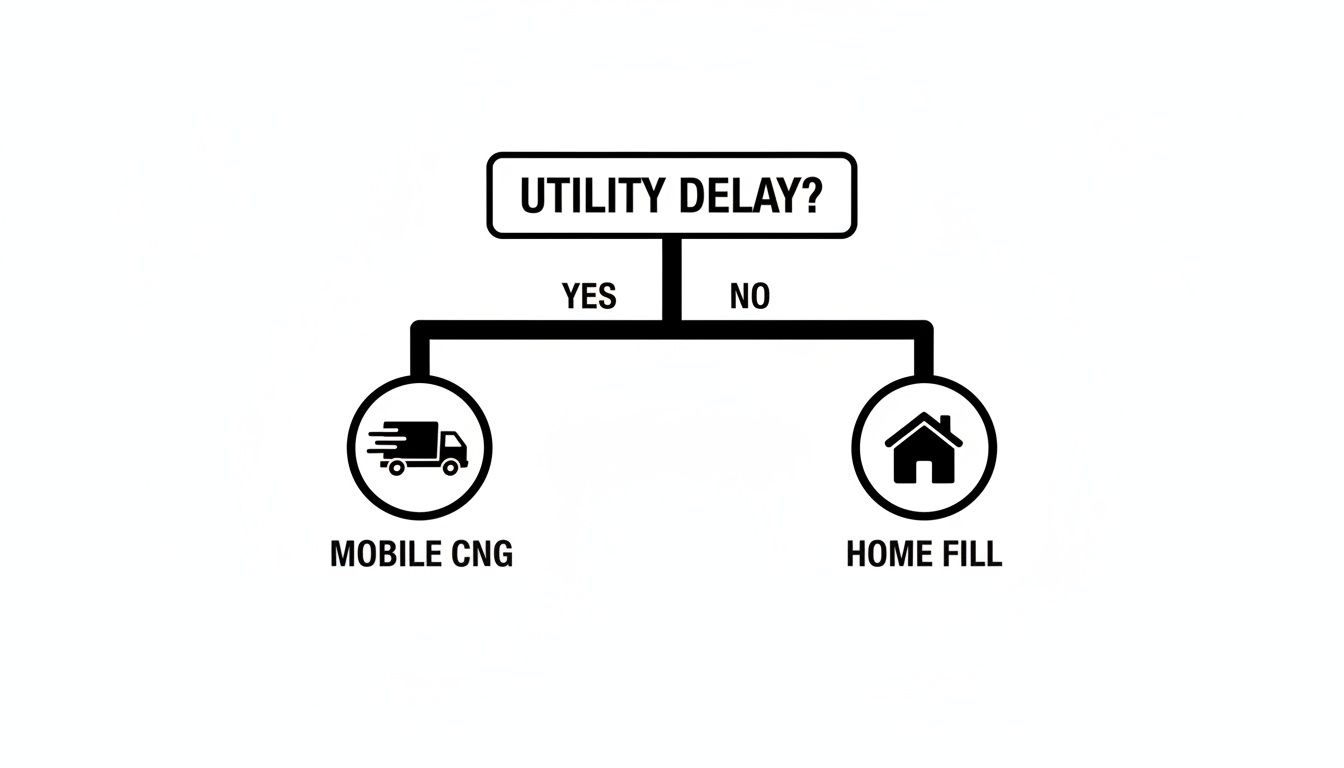
As you can see, the first big question is why you need gas. If a utility delay is holding you up, a mobile solution is your immediate answer. For routine, long-term use, a permanent setup like a home fill station is the way to go.
Permanent Home Refueling Appliances
This is the classic cng home fill station. It’s a small appliance, usually mounted on a garage wall, that taps directly into your home's existing low-pressure natural gas line. It works like a mini-compressor, slowly pressurizing gas and feeding it into your vehicle's tank.
This setup is fantastic for individuals or families with one or two CNG vehicles. You get unbeatable convenience and cheap fuel right at home. But it’s slow—a full tank can take 8-12 hours—so it's strictly for personal, overnight refueling.
Time-Fill Systems for Small Fleets
Step up from a home unit and you get a time-fill system. Think of it as a heavy-duty version of the home appliance, built to refuel a small fleet of vehicles at the same time. It’s a permanent installation you’d see at a small business where delivery vans or service trucks park at a central depot overnight.
- How it Works: Multiple vehicles hook up to individual fueling posts and fill up slowly over several hours.
- Best Use Case: Perfect for small-to-medium fleets that have predictable schedules and long, overnight parking times.
- Limitation: This system can't provide a quick top-off during the day. That lack of speed makes it a poor fit for fleets running multiple shifts or needing fast turnarounds.
Fast-Fill Stations for Commercial Use
A fast-fill station is the closest thing you'll find to a traditional gas station in the CNG world. These are major, permanent installations that store pre-compressed gas in a large "cascade" of high-pressure tanks. When a vehicle pulls in, that stored gas is dispensed rapidly, filling the tank in minutes.
A fast-fill station can refuel a vehicle in just 3-5 minutes, about the same time it takes to pump gasoline. That speed is essential for high-traffic fleets, public refueling stations, and any operation where vehicle downtime is a major cost.
Of course, all that speed and power comes at a price. Fast-fill stations demand a huge capital investment, a lot of physical space, and navigating complex permits. They are built for large-scale, long-term commercial or public fueling—not for temporary or residential needs.
Mobile CNG Delivery: The Virtual Pipeline
This brings us to the most agile and adaptable solution of all: mobile CNG delivery. With this method, you don't need any permanent infrastructure on your property. Instead, natural gas is compressed at a central facility, loaded onto specialized trailers, and trucked directly to your location. It’s literally a "virtual pipeline" on wheels.
This approach is the ultimate problem-solver for temporary or urgent needs, like:
- Powering generators while waiting for the utility company to finish a pipeline.
- Providing temporary heat for a large construction site.
- Keeping the lights on during planned pipeline maintenance or an outage.
Comparing Onsite CNG Fueling Methods
This table provides a side-by-side comparison of the four main types of onsite CNG fueling to help you quickly assess the best option for your needs.
| Fueling Method | Best For | Refueling Speed | Typical Capacity | Infrastructure Need |
|---|---|---|---|---|
| Permanent Home Appliance | 1-2 personal CNG vehicles, overnight refueling. | Very Slow (8-12 hrs) | Small (single vehicle) | Permanent; taps into home gas line |
| Time-Fill System | Small, centralized fleets with predictable overnight downtime. | Slow (6-10 hrs) | Small to Medium Fleet | Permanent; requires dedicated commercial site |
| Fast-Fill Station | High-traffic commercial fleets, public stations, rapid turnarounds. | Fast (3-5 mins) | Large Fleet | Permanent; significant investment & footprint |
| Mobile CNG Delivery | Temporary needs, utility delays, remote sites, emergency power. | Instant (On-demand) | Scalable (from generators to buildings) | None; completely self-contained trailer |
In short, mobile delivery completely separates your energy supply from the readiness of permanent utility lines, giving you incredible flexibility.
This agility is why the CNG market is projected to grow at an 11.7% CAGR, with mobile solutions playing a huge role in closing these exact infrastructure gaps. You can read the full research on the growing CNG market to learn more. Companies like Blue Gas Express are built on this model, delivering gas precisely when and where it's needed most.
How Mobile CNG Delivery Keeps Projects Moving
Picture this all-too-common scene: your multi-million dollar construction project grinds to a halt. The culprit? The permanent gas line isn't installed yet. This isn't just a small hiccup; it's a budget-crushing delay that can push your entire timeline back by weeks, sometimes even months. This exact problem is where mobile CNG delivery steps in and saves the day for project managers and developers.
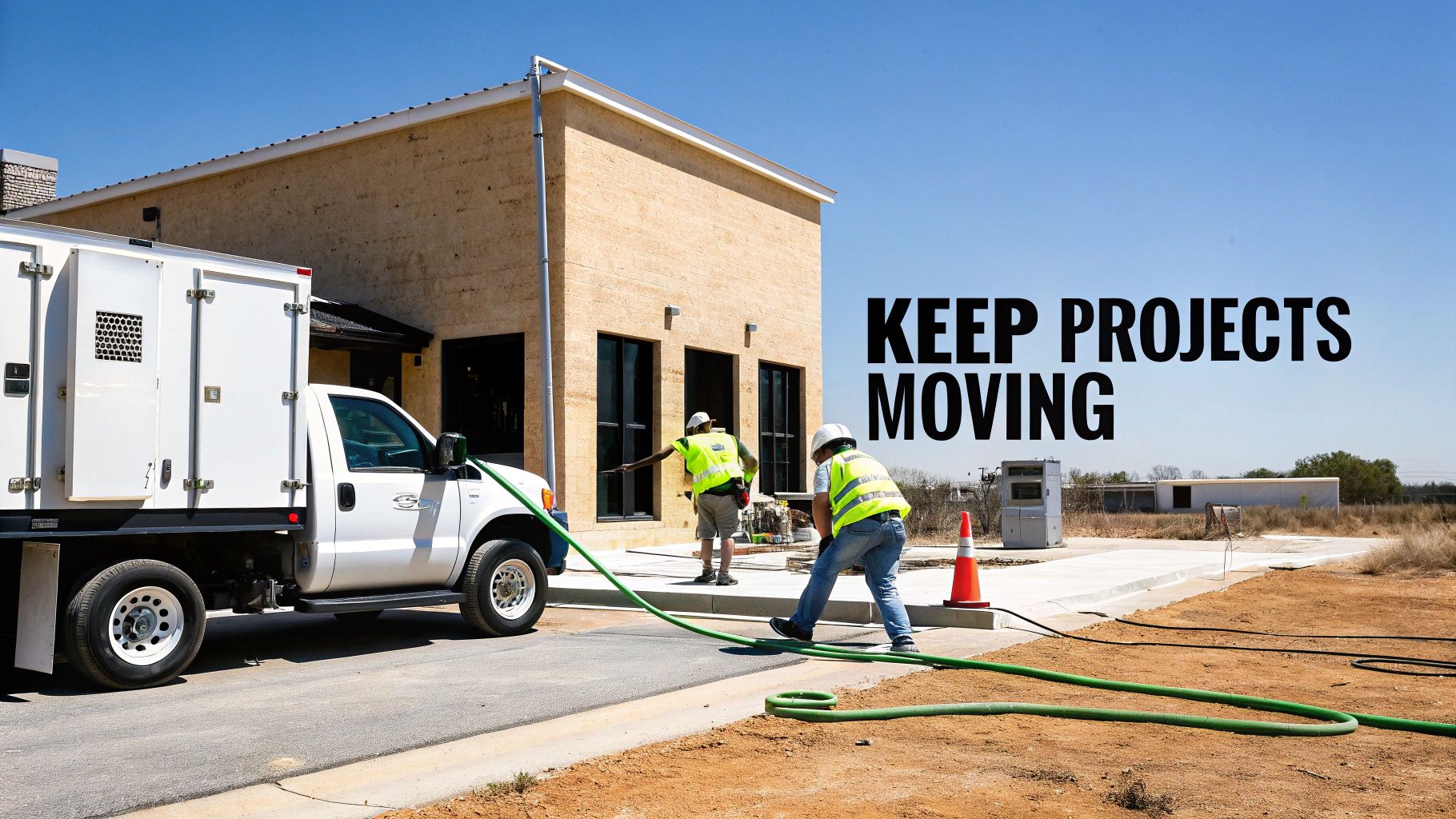
Unlike a permanent cng home fill station that needs fixed infrastructure, a mobile solution is completely self-contained. The best way to think of it is as a "virtual pipeline" on wheels. We bring specialized trailers filled with compressed natural gas right to your job site, ready to connect to your equipment. The whole setup process can take just a few hours—not months—transforming a potential standstill into a simple logistical step.
Turning Delays into Deadlines Met
The most immediate benefit here is simple: you keep the project moving forward. When you decouple your schedule from the local utility company's timeline, you take back control. This has a direct and measurable impact on your bottom line and your ability to deliver on time.
For instance, a project manager can confidently schedule critical tasks that need a gas supply, like running temporary heaters for concrete curing, knowing that fuel will be there when they need it. This prevents the costly domino effect where one stalled task holds up a dozen others.
The business outcomes are clear:
- Meeting Project Milestones: Keep everything from system testing to temporary heating right on its original schedule.
- Avoiding Penalty Clauses: Many construction contracts have steep financial penalties for missing deadlines. Mobile CNG is your insurance policy against them.
- Improving Cash Flow: Finishing a project on time lets you get paid and move on to the next one, keeping your business and crews productive.
Securing Your Certificate of Occupancy Sooner
One of the biggest hurdles at the end of any building project is getting the Certificate of Occupancy (CO). Without it, a building can't be legally occupied, sold, or opened for business. Inspectors have a long checklist, and a huge chunk of it requires a live, functional gas supply.
A mobile CNG service is the perfect workaround. It gives you the fuel needed to prove all your systems work, which is essential for passing inspection. This includes commissioning backup generators, firing up HVAC systems, and testing commercial kitchen appliances—all things that can't wait for the utility meter.
This means you can get your CO weeks or months earlier. For a developer, that translates directly into revenue by letting tenants move in and start paying rent. For a business, it means opening your doors to customers without a frustrating and expensive delay.
Proactive Planning and Emergency Response
Mobile CNG delivery isn't just for planned construction needs; it's also a powerful tool for outage mitigation and emergency preparedness. If the utility plans a shutdown for pipeline maintenance, it doesn't have to mean shutting down your facility. A mobile unit can be scheduled to provide a seamless temporary gas supply, ensuring zero operational downtime.
Likewise, during an unexpected outage, a provider like Blue Gas Express can often deploy a unit within 24-48 hours. This rapid response is absolutely critical for places like hospitals, data centers, or manufacturers where losing power and heat simply isn't an option. By having a plan in place, you turn a potential crisis into a manageable event, protecting both your assets and your reputation.
Where Mobile CNG Delivery Really Shines
The concept of mobile natural gas is one thing, but its real value comes to life on the ground, where project deadlines are tight and every hour of downtime hits the bottom line. Think of it as a utility pipeline on wheels—a temporary gas supply that arrives exactly when you need it. It’s the saving grace for a construction crew facing a winter freeze, the key to getting a new building its occupancy permit, and a crucial lifeline when the local utility has an unexpected outage.
Let's walk through a few common scenarios where mobile CNG solves very real, very expensive problems.
Keeping Construction Sites Productive
The Problem: You’re managing a commercial construction project, and winter is setting in fast. The problem? The permanent gas line from the utility is still weeks, maybe months, from being connected. Without heat, you can't pour concrete, cure drywall, or even keep your crew working safely. The entire project is on the verge of a costly shutdown.
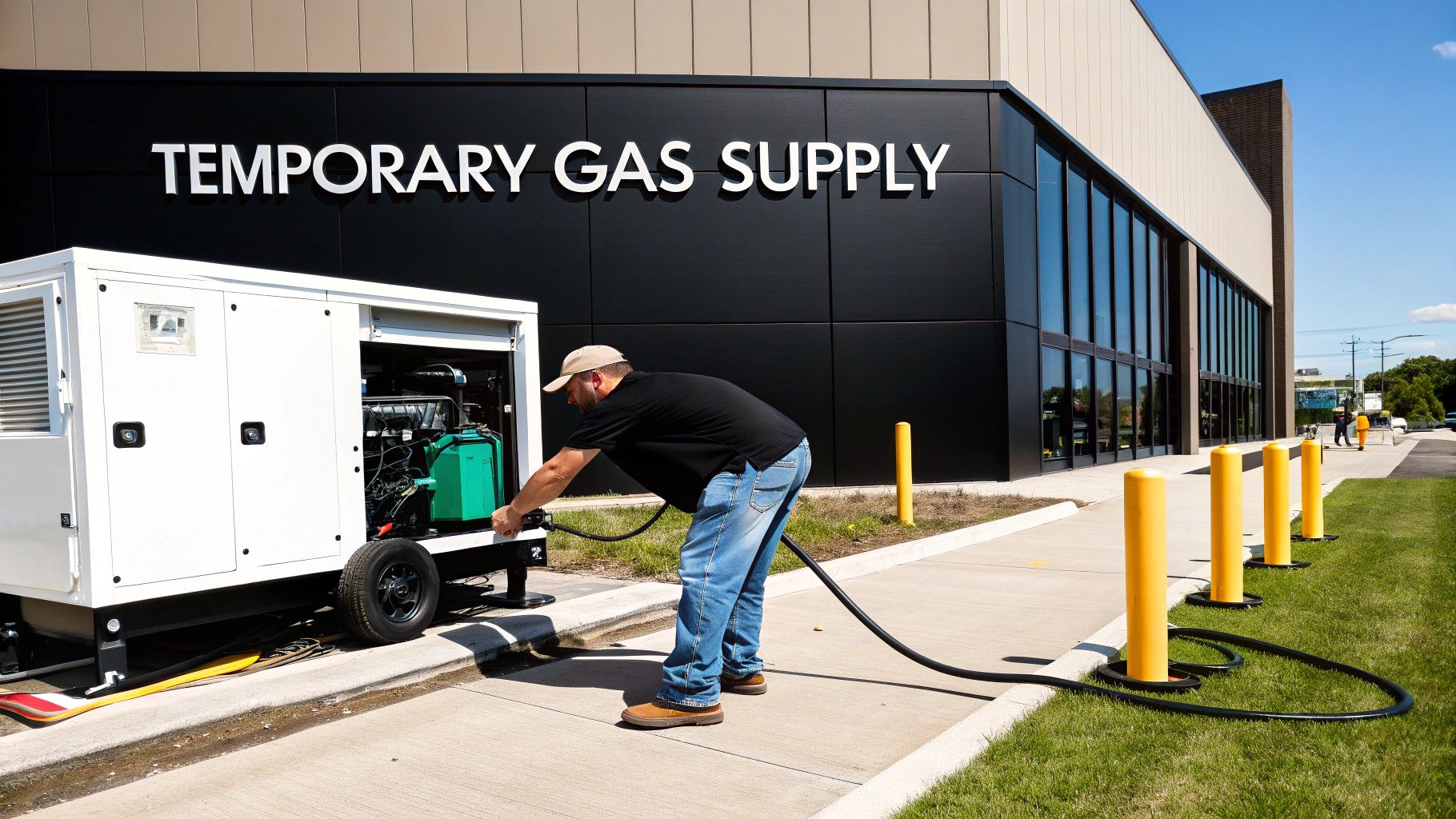
The Solution: This is a classic case for mobile CNG. A portable unit is brought right to the job site and hooked up to powerful temporary heaters, providing a steady, reliable source of warmth. Suddenly, that multi-week shutdown is off the table. Crews can keep working productively, materials cure properly, and the project stays on schedule.
This is hands-down one of the most common and effective uses for temporary natural gas. It’s also often a more efficient choice than propane, since CNG typically provides a better BTU rating—meaning you get more heating power for your dollar.
Commissioning Critical Systems for Occupancy
The Problem: A brand-new commercial building is finished, but it can’t legally open its doors without a Certificate of Occupancy. A huge part of that process involves proving to inspectors that all the essential systems—like the backup generator and HVAC—are fully functional. But the utility is dragging its feet on the final meter installation, leaving you with no way to power anything up.
The Solution: Mobile CNG delivery provides an instant, on-demand gas supply. Technicians can connect a virtual pipeline directly to the building's main gas intake. This allows you to:
- Commission the Backup Generator: Run the generator through its full test cycle to prove it’s ready for an emergency.
- Test HVAC Systems: Fire up the heating and cooling systems to get them balanced and working correctly.
- Verify Appliance Functionality: Test all the commercial kitchen equipment, water heaters, and other gas-powered systems.
By bringing in the fuel needed for these critical tests, mobile CNG can help you pass final inspections and secure that Certificate of Occupancy weeks or even months ahead of the utility’s schedule. That means tenants can move in sooner, and the building starts generating revenue instead of sitting empty.
Ensuring Continuity During Utility Outages
The Problem: Imagine a hospital getting a notice from the gas company: a planned pipeline maintenance project is going to shut down their natural gas supply for 48 hours. An outage like that would cripple their heating, sterilization equipment, and kitchens, creating a serious risk to patient care. Shutting down is simply not an option.
The Solution: A service like Blue Gas Express works with the facility’s team to schedule the delivery of a mobile CNG unit before the planned outage. The unit is connected to the hospital's gas infrastructure, creating a seamless, uninterrupted bridge.
When the utility shuts off the main line, the mobile unit automatically takes over. The hospital continues to operate with zero downtime. This proactive planning turns a potential crisis into a complete non-event. The same logic applies to unexpected outages—a rapid deployment can restore heat and power within hours, providing vital business continuity for anyone from manufacturers to data centers who can't afford to go dark.
Navigating Costs, Safety, and Permitting
Any time you're looking to bring in an energy solution—whether it's a permanent CNG home fill station or a temporary mobile unit—three big questions always come up. What’s it going to cost? Is it safe? And what kind of permits and red tape are involved? Getting clear answers is the only way to make a solid decision for your project.
The money part is usually the most straightforward comparison. A permanent fast-fill station is a massive capital investment. You're talking major construction costs, expensive equipment, and a long-term commitment to a physical site. Mobile CNG, on the other hand, works more like a utility bill. You pay for the service as an operational expense, which lets you sidestep the huge upfront cost and long-term ownership headaches. This makes it a no-brainer for temporary projects where sinking a ton of capital just doesn’t add up.
But of course, the conversation always turns to safety and regulations—and for good reason. When you're dealing with natural gas, these are the most important factors.
A Professional Approach to Safety Protocols
Safety isn't just a box to check; it’s a detailed, systematic process handled by people who know what they're doing. While natural gas is lighter than air and vents quickly, its flammability means you have to follow safety codes to the letter. A professional provider like Blue Gas Express takes care of every single detail, ensuring everything is buttoned up and compliant.
This involves a few key layers of protection:
- Site Assessment: Before a single piece of equipment shows up, our experts conduct a full site evaluation. We figure out the safest spot for the mobile unit, looking at everything from ventilation and ignition sources to emergency access routes.
- Code Compliance: Every hose, regulator, and monitoring system we use meets or exceeds the strict standards set by organizations like the National Fire Protection Association (NFPA).
- Professional Handling: Certified technicians manage the entire operation, from the first hookup to the final disconnect. They're trained in emergency response and are on hand to monitor the system for the entire duration of the service.
Because CNG is flammable, using the right components is non-negotiable. Learning about explosion-proof equipment gives you a good sense of the heavy-duty engineering that keeps these systems safe.
Demystifying the Permitting Process
Diving into the world of permits can feel like a nightmare, but it doesn't have to be. For a temporary mobile CNG setup, the process is a world away from the complexities of a permanent installation. Your service provider should handle the entire regulatory lift for you, acting as your guide and advocate.
A huge part of our service is coordinating directly with local authorities—especially the local fire marshal. We prepare and submit all the required paperwork, from site plans to safety protocols, to make sure the project gets the official green light before we even think about turning on the gas.
This partnership is essential. The fire marshal's job is to protect public safety, so they need to know that every possible precaution is in place. By managing these communications, a mobile CNG provider takes a huge administrative weight off your shoulders. You get to focus on your project, knowing your energy supply is not only dependable but also fully approved and compliant with every local safety rule. It turns a daunting process into just another handled detail.
How to Arrange Your Mobile CNG Service
Getting a temporary natural gas supply set up for your project might seem like a huge headache, but it’s actually a surprisingly straightforward process. When you work with a team like Blue Gas Express, we take care of the heavy lifting. Our whole goal is to get you the gas you need with clear communication and a fast turnaround so you can stay focused on your job.
It all starts with a simple phone call. We need to understand your project and exactly what you need to get it done. This isn't just about dropping off a trailer; it's about making sure you have the right fuel, at the right pressure, for the right amount of time.
Step 1: Initial Consultation and Needs Analysis
That first conversation is all about building an energy profile for your site. We’ll walk through the key details of your operation to figure out precisely what kind of support you need.
We’ll ask a few core questions:
- Required Gas Volume: How much gas do you need, and at what rate? Are we talking hourly or daily consumption?
- Pressure Requirements: What PSI does your equipment need? Generators, boilers, and heaters all have specific pressure demands to run safely and efficiently.
- Duration of Service: How long will you need us? A couple of days for a quick test, or several weeks for a major project?
Getting these details right from the start means we can tailor a solution that fits your operational needs perfectly, with no guesswork involved.
Step 2: Site Assessment and Logistics Planning
Once we know what you need, we need to figure out the where and how. A trained technician will come out to your location for a full site assessment. They’ll survey the area to find the safest and most practical spot for the mobile CNG trailer. Safety is always number one, so we look at everything from truck access to the distance to your connection point.
This on-the-ground planning is critical. It’s where we map out every logistical detail—from the truck’s entry route to how we’ll run the hoses—to guarantee a smooth, hiccup-free setup on delivery day.
Step 3: Proposal and Agreement
After the site visit, we’ll put together a detailed, easy-to-understand proposal. This document lays out the entire scope of service: the equipment we’ll provide, the service timeline, and a transparent cost breakdown. No hidden fees, no surprises.
Step 4: Rapid Deployment and Connection
With the proposal approved, our team gets to work. We’ll schedule the delivery and deployment of the CNG unit to fit seamlessly into your project timeline. Our certified technicians handle the full installation, making a safe and secure connection to your system. They won't leave until everything is running exactly as it should be, getting you powered up and back on track without missing a beat.
Answering Your Onsite CNG Questions
Even after you've got a handle on the basics, a few practical questions always pop up when you're thinking about bringing CNG to a site. It's one thing to understand the concept, but another to picture the logistics. Let's tackle some of the most common things people ask.
One of the first concerns is always about the physical impact on a busy worksite. Just how much room does one of these units take up?
How Much Space Does a Mobile CNG Unit Need?
You'll be surprised how little space it requires. A typical mobile CNG trailer needs a footprint roughly the size of a standard tractor-trailer parking spot—about 15 by 60 feet.
Since the whole system is self-contained on the trailer, we can usually tuck it away in a staging area or an unused part of a parking lot. It stays out of your way and doesn't disrupt the day-to-day flow of your operation.
What’s the Real Difference Between CNG and LNG?
This is a great question, especially when you're looking for temporary gas. While both are natural gas, the way they're stored and delivered makes all the difference for onsite use.
- CNG (Compressed Natural Gas): Think of this as natural gas stored under high pressure, but still in its gaseous state. The equipment is simpler, deployment is faster, and it's much more straightforward for temporary hookups.
- LNG (Liquefied Natural Gas): This is natural gas that’s been chilled to cryogenic temperatures (around -260°F) until it becomes a liquid. It's denser, meaning you can store more energy in the same space, but it requires special equipment on site to warm it back into a gas before use.
For most temporary jobs—like commissioning generators or keeping a construction site heated—CNG is the clear winner. Its simplicity and speed are exactly what you need when you can't afford delays.
The Bottom Line: While LNG has its place, CNG is the more agile and practical choice for temporary projects. It delivers the gas you need without the added complexity and setup time of cryogenic systems.
How Fast Can We Get a Mobile CNG Unit Onsite?
This is where mobile CNG really shines. When you're in a pinch—say, a surprise utility outage or a cold snap that threatens to derail your project—we can often have a mobile CNG unit on your site and running within 24 to 48 hours.
That kind of rapid response is what turns a potential crisis into a minor hiccup. Instead of facing weeks of costly downtime waiting for a permanent fix, you're back up and running almost immediately. It’s a world away from the months it can take to get a permanent solution like a cng home fill station approved and built.
Ready to secure a reliable, temporary gas supply for your project without the wait? The team at Blue Gas Express is ready to help. Contact us today to discuss your project's specific needs and get a customized solution.