

A rented boiler is no longer a small-plant backup. The global boiler-renting service market was valued at $4.8 billion in 2025, according to Dataintelo. That money is spent because a dead boiler, or one that has not shown up, stops production, occupancy, and heat on the same day. I treat boiler rental as a continuity plan: the steam or hot water the site needs, a fuel path that fires, permits in the operator's name, and enough redundancy that one failed unit does not idle the plant.
What Boiler Rental Is and When It Makes Sense
Boiler rental is temporary steam or hot-water capacity, delivered as a trailer-mounted or skid-mounted package. It ties into the site's fuel, water, power, and distribution, runs for an agreed term, and then comes off the header. You are buying operating time, not a permanent asset.
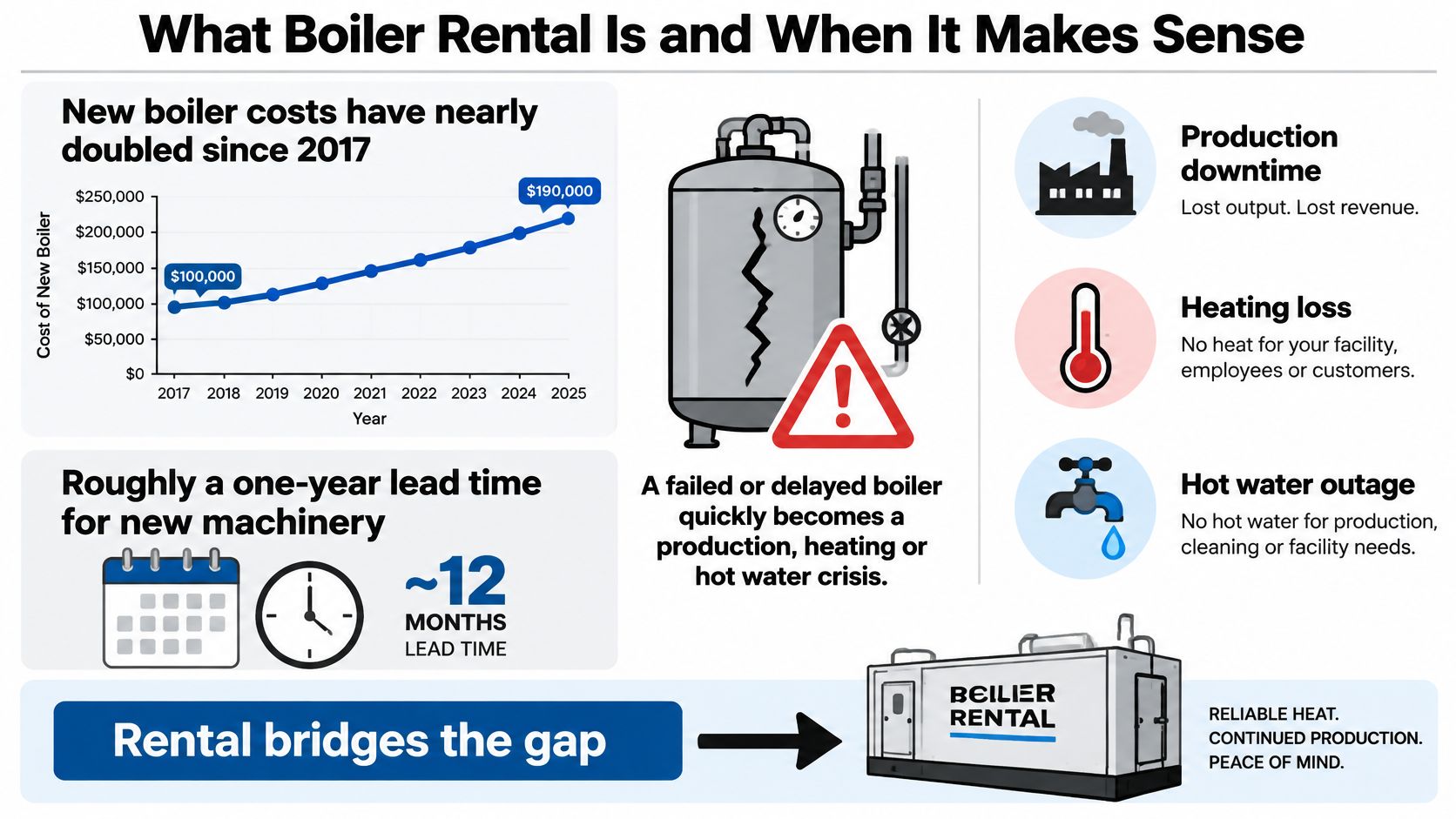
A food plant loses its fire-tube in January. The replacement quote sits well above older equipment prices, and the factory slot is far enough out that a purchase order will not save the season. Production, space heat, and process hot water stop together.
The rental only pays if it is one operating package. Match the unit to the load you will run, put the permits in the operator's name, and decide whether a second unit has to stand by. Fuel belongs in that same plan: gas already at the meter, or a temporary supply that arrives with the trailer. I would not book the boiler until those four items have owners. A unit that shows up without a steam path, a permit, spare capacity, or fuel is downtime with a rental invoice attached.
Two reasons plants call
Unplanned needs hit without warning. A tube failure, a utility outage, or storm damage takes the primary boiler offline with nothing on the spare header.
Planned needs are quieter and just as common. An inspection outage, a capacity add, commissioning of a new line, or a plant that is late to the job all need steam before the permanent unit is ready. Higher equipment cost, thin rental fleets, and long parts lead times push buyers to rent instead of waiting on a purchase order.
Renting wins when you skip the capital buy, get capacity on a rental schedule rather than a new-boiler build cycle, and match the unit to a temporary load instead of a plant sized for a once-a-year peak.
Where Temporary Boilers Keep Operations Running
A hospital or process plant loses its primary boiler in a winter cold snap. A trailer-mounted rental is on site and firing within days, wards stay warm, and the line keeps running. That is the emergency case, and it is still the one people remember.
The same package covers a planned outage. Size the rental to normal load, take the permanent boiler off the header for an inspection, retube, or burner overhaul, and put it back without a shutdown. Duration follows the overhaul scope, so lock it in the quote before the truck is booked.
Construction, peaks, and late plants
On a building that is not dried in, temporary heat supports concrete curing and interior work. Hot water helps the project reach certificates of occupancy, so finished floors can open while other areas are still under construction. Rooftop units, generators, and ambient heat can be commissioned before the permanent plant is online.
Seasonal peaks are different. Winter heat or a process campaign sits above installed capacity for weeks or months. Modular units sit beside the existing plant and come off when the peak passes.
The last case is a building or process line waiting on a permanent gas main or a boiler house that slipped. Trailer boilers, sometimes with LNG vaporization, carry the load for months. Those vaporization sites have served railcar manufacturing, forging, industrial boilers, asphalt melting, lumber drying, steam plants, incinerators, water treatment, and other industrial and municipal loads.
Single trailer-mounted packages grew from a highway-legal 20,000 pounds of steam per hour in 1967 to roughly 150,000 pounds per hour, about 650% above that first rating, as ACHR News traces through the later jumps to 52,000, 60,000, about 70,000, then high-pressure units. That ceiling is why a rental can stand in for a real industrial header.
| Application | Typical trigger | Typical duration | Typical equipment scale |
|---|---|---|---|
| Emergency replacement | Sudden failure of the primary boiler | Weeks to a few months | Single trailer-mounted unit sized to site load |
| Planned maintenance outage | Annual inspection, retube or burner overhaul | One to six weeks, set by overhaul scope in the quote | Unit matched to normal steam load |
| Construction heat and commissioning | Permanent plant not yet online | Weeks to a season | Box or trailer units, scalable as the building grows |
| Seasonal peak support | Heating or process demand above installed capacity | Weeks to months | Modular units added alongside existing plant |
| Delayed gas line or plant construction | Permanent fuel or boiler supply behind schedule | Months | Trailer units or LNG-supported supply |
Sizing a Rental Boiler to the Real Load
A horsepower figure on a quote sheet still leaves the load unstated. One federal requirement paired an 800-horsepower fire-tube with a historical peak of 120,000 pounds per hour at 95 psi and a 9-ppm NOx target, accepting 30 ppm only as a temporary unit, while another asked for up to 150,000 pounds per hour at 250 psig, continuous 24/7 duty, with coverage within 48 hours of task-order issuance, as set out in that VA boiler solicitation file. Pressure, emissions, and response time sat in the same sentence as flow. That is a continuity spec, not a catalog line.
Output, not nameplate
Write the spec as net steam or hot-water output. Nameplate input counts fuel in, not pounds delivered at the header. State pounds per hour at the operating pressure, or hot-water flow with supply and return temperatures.
Start from the combined peak of existing loads plus anything you are about to connect. Apply diversity so you do not add every coil as if it fires at once. Then add auxiliary equipment and the steam or hot water lost in the distribution lines. Planners typically add expansion headroom on top of that diversified peak, so a later connection does not force a second mobilization. I put that headroom on top of auxiliaries and line loss, not in place of them.
Diversity is a load decision, not a discount you apply after the quote. If two process users never peak together, stacking both peaks buys idle capacity and extra cycling. If they do peak together, and a long run loses heat, header pressure falls even when the nameplate looked generous.
Undersizing drops pressure when every user calls together. Heavy oversizing increases cycling and hurts combustion efficiency at low fire.
One unit, several units, or a fuel workaround
One large trailer is the simplest hookup and the clearest single point of failure. Modular units cost more to pipe. They also let you phase capacity and keep a spare online if one package trips. A CNG or LNG supply decouples the burner from a meter or main that cannot yet carry the load. Size that fuel package to the same net output, or the boiler you rented correctly still sits cold.
Practical rule: The cheapest unit that matches the pounds per hour is the risky one if it has no spare and cannot meet the site NOx limit.
Before you sign, confirm feedwater, blowdown, condensate return, electrical service, fuel, and exhaust. A missing utility is a second mobilization. Permit status for the temporary stack and the fuel tie-in belongs in that same check. A unit that fits the load and fails the permit still idles the plant.
| Specification item | What to confirm | Why it matters |
|---|---|---|
| Net output | Required steam in lb/hr at operating pressure, or hot-water flow with supply and return temperatures | Nameplate input overstates what the site actually receives |
| Operating pressure and temperature | Settings matched to the distribution system and safety valves | Mismatches throttle performance or trip limits |
| Peak versus average load | Simultaneous peak demand with diversity factors applied | Undersizing drops pressure when everything calls at once |
| Future expansion | Expansion headroom added on top of the diversified peak | Avoids a second mobilization when the load grows |
| Site connections | Feedwater, blowdown, condensate return, electrical, fuel and exhaust routing | A missing utility delays startup and adds cost |
| Redundancy | Single large unit versus modular units with backup | One failed unit should not idle the plant |
How a Temporary Boiler Rental Works from Call to Return
Walk the job as seven steps, and schedule them against the permanent plant's outage calendar. A rental improvised after the failure is how you lose a week.
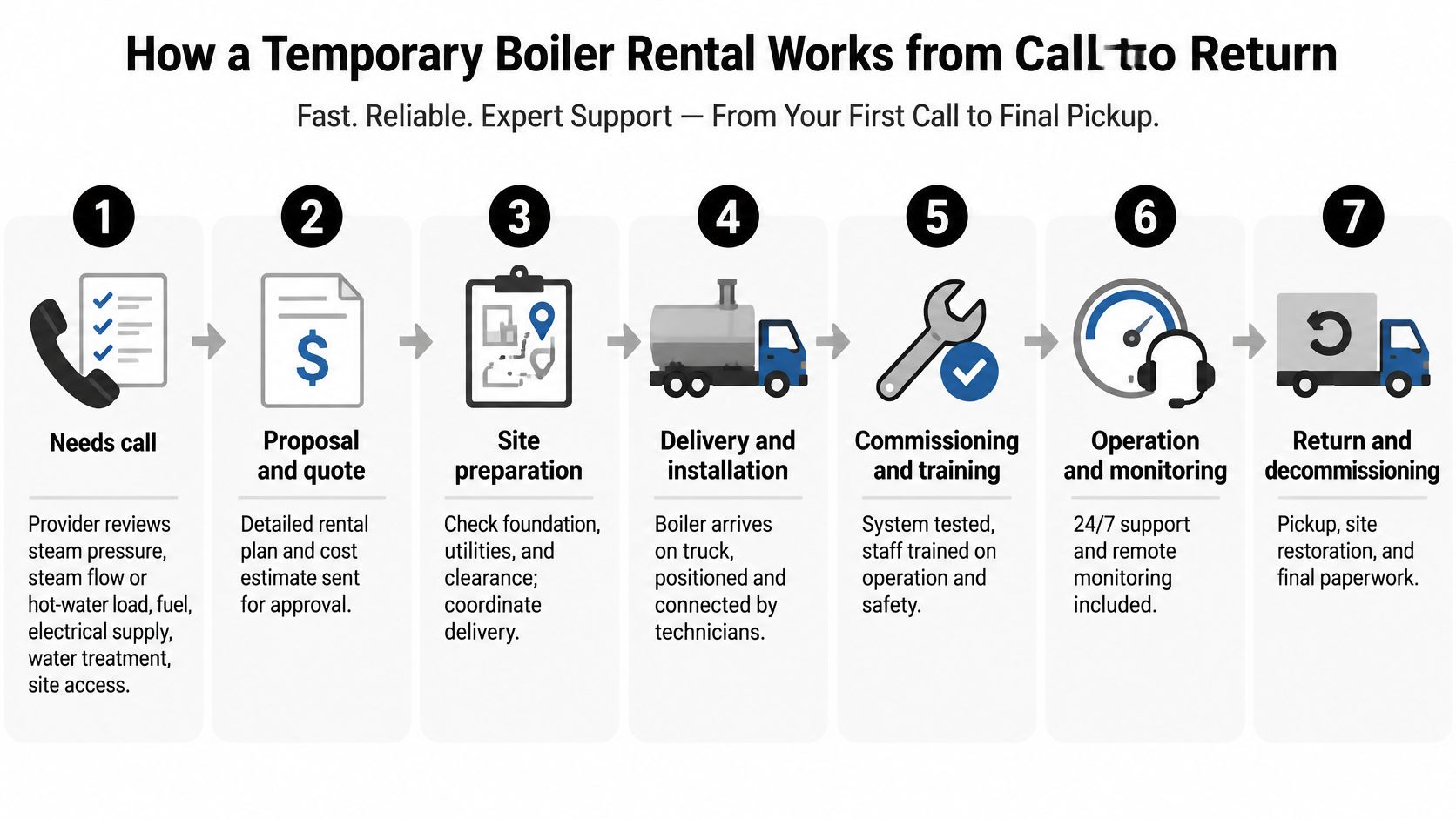
- Needs call. Open with net output, operating pressure, and peak load already written down. The provider then checks fuel, electrical supply, water treatment, site access, and the date steam has to be up. A vague horsepower request produces a vague quote.
- Equipment selection and quote. A trailer or skid is matched to that load, with term, rate, and what is included. Reject a quote that states input BTU and skips operating pressure.
- Site preparation. You need a pad or staging area, a clear roll-in path, and tie-ins for gas, water, power, condensate, and exhaust. Permit status is part of this step, not a footnote after the unit arrives.
- Mobilization and connection. The package rolls in and ties to the building. On the fuel side, mobile gas units can be on site within a few hours of the request, which matters when the boiler is ready and the main is not.
- Commissioning and acceptance. Burner tuning, combustion readings, safety valves, and controls are checked before anyone signs the handover. Do not accept a unit that has only been lit at low fire.
- Operation and monitoring. The rental carries the load with remote telemetry where fitted, scheduled fuel, and routine water tests. Scale and low-water trips are how a good rental becomes downtime.
- Demobilization. Disconnect, restore the pad, and return the permanent boiler to the header only after it has passed its own checks. One provider contact should own the job from the first call through pickup, so scope does not split between a hauler, a millwright, and a fuel vendor who have never spoken.
Rental Considerations That Prevent Expensive Surprises
A rental may move the equipment off your balance sheet. It does not automatically move operating or environmental liability with it. Air permits sit with the party that runs the boiler and generates the emissions, not with whoever owns the trailer.
A U.S. Department of Veterans Affairs boiler solicitation states that air permits are the responsibility of the entity operating or generating the emissions, and the same buy required ASME construction, NFPA codes, VA specifications, the NEC, and local codes, as posted on SAM.gov. Electrical service, fuel piping, exhaust, controls, and where the trailer sits can each need a separate approval. Miss one, and the package is on the pad with no legal way to fire.
Who files, and for how long
Settle the paperwork before the trailer rolls. Ask who applies for the air permit, whether the facility permit already covers a temporary unit, whether the install is exempt from a boiler or building permit, and who pays if the burner cannot fire because an approval was missed.
Inspection and approval rules are not the same from one jurisdiction to the next. Some want a rented boiler inspected and approved for temporary installation before it is placed in service. Others use a different inspector, a shorter approval life, or an exemption you still have to document. A certificate that looks current where the trailer was built does not clear the plant where it will run. I would not mobilize until the local authority has said what it will accept and how long that approval lasts.
Combustion you can defend
Natural gas averages about 1,020 Btu per standard cubic foot, commonly 950 to 1,050 Btu/scf, and poorly tuned or off-design firing cuts efficiency and raises carbon monoxide, with NOx, CO2, methane, nitrous oxide, VOCs, sulfur dioxide, and particulate matter also listed for gas combustion in EPA AP-42. Confirm heating value and fuel pressure when the burner is set, and file the local NOx and CO limits with combustion readings across the firing range you need, plus stack and ventilation checks. Those records are what you hand an inspector if the rental is carrying production steam.
Money questions that show up later
Price the rental rate against the actual duration, then add mobilization and demobilization, fuel, water treatment, operator coverage, and standby if the outage slips. Name spare capacity in that same scope: a second package, or paid standby, is often cheaper than a cold header if the first unit trips or the outage runs long. Put in writing who pays for a unit that sits cold because a permit was missed. Equipment that cannot run is still a business interruption, which is why a machinery policy such as ABS Insurance Brokers machinery cover belongs in the same conversation as the rental quote, not after the first claim.
How Temporary Natural Gas Supply Supports a Rental Boiler
A boiler with no gas is a parked trailer. New construction, a delayed main, utility maintenance, and peak-day curtailment can all leave a rented burner unfired. Pick the fuel route before you pick the paint color on the boiler.
| Supply option | Best for | Capacity flexibility | Deployment |
|---|---|---|---|
| Existing meter or regulator | Sites with adequate utility gas service and meter capacity | Limited by the meter and service line | Immediate connection |
| Mobile CNG units | Construction sites, occupancy heat, commissioning and outage backup | Scales from one box to several trailers as load grows | Within hours of request |
| LNG vaporization plant | Large industrial steam loads without pipeline access | High continuous capacity, engineered to the site | Days, engineered and commissioned on site |
What each route actually does
An existing meter is the right answer when service pressure and meter capacity already cover the rental's full fire. Do not assume they do. A temporary boiler often needs more gas than the building used during construction.
Mobile CNG units plug into a standard residential, commercial, or industrial meter or regulator. They roll up, tie to the building gas connection, and scale from one box to several trailers, then to semi-truck loads, as the load grows. When several mobile units are too small, a turn-key LNG vaporization plant carries large continuous steam and process loads with no pipeline.
Keeping the flame through a cold week
Remote monitoring estimates when a trailer will run out, so a replacement unit can be dispatched before the header goes soft. That hot swap is the difference between a planned exchange and a cold startup at midnight.
Units connect to regular 110-volt power so heaters, remote monitors, and sensors stay alive. Computer-controlled flow turns heating on and off to keep equipment from freezing. Gas-flow testing and leak testing are available on a service contract, and they should be on the commissioning list, not left to the first operator who smells gas.
Requesting a Custom Boiler Rental Quote
A useful quote starts with the operating limits, not just the boiler's rated output. Give the supplier enough detail to size equipment, coordinate fuel, and identify approval or site constraints before scheduling the outage.
Prepare these six items:
- Load. Peak and average steam demand in lb/hr, or hot-water flow, plus operating pressure or supply and return temperatures.
- Dates. Expected start and return dates, and the outage window for the permanent boiler.
- Fuel. Existing meter capacity or the temporary gas supply under consideration, such as CNG or LNG.
- Site. Access, staging area, and connection points for gas, water, power, condensate, and exhaust.
- Permits. Permit status and the legal name of the entity holding the air permit.
- Redundancy. Whether the plan calls for one large unit, modular units, or a spare.
Blue Gas Express can provide a custom quote for mobile natural gas equipment based on these requirements. Its temporary equipment ranges from small boxes and 16-foot trailers to semi-truck loads. The right gas capacity depends on the boiler's demand and site conditions, so include those details when discussing a quote.
Blue Gas Express supplies temporary CNG and LNG for customers waiting on a permanent gas line or dealing with a utility outage. It serves North Carolina, South Carolina, Tennessee, and Virginia, with mobile gas units for building and pipeline needs. Ask for a custom quote with this packet so the temporary gas supply can be priced and scheduled to match your boiler's load. Contact Blue Gas Express to discuss the requirements.