

A crew is finishing a shell building in late November. The gas utility says the permanent service line is eight weeks out. The mechanical inspector arrives Friday, and the generator commissioning date doesn't move. Nobody in that meeting is asking whether gas is needed. They're asking how to get gas onto that slab without a pipeline, what it takes to move it, and who signs off on the arrangement.
Bulk fuel delivery answers that question more often than most project teams expect, and it covers far more than a diesel tank behind a fence. The same distribution system moves gasoline, fuel oil, LNG and CNG into terminals, tanks and temporary units. What changes between them is load size, hazard classification, permitting, and the emissions math that decides whether the temporary route is defensible.
The path below follows the fuel rather than the sales pitch. First how fuel physically reaches a site, then which delivery method fits a given demand pattern, then the hazard checks, permits and trade-offs that decide whether a plan survives contact with a fire marshal.
Bulk Fuel Delivery Options at a Glance
Choosing a delivery option works like choosing a freight class. The fuel itself stays the same, but the vehicle, the paperwork and the permits all change with the load. Six routes cover almost every way bulk fuel reaches a customer.
| Delivery option | Typical load | Fuel form | Best fit |
|---|---|---|---|
| Tanker truck to fixed tank | Bulk loads above 119 gallons | Diesel, gasoline, fuel oil | Ongoing supply to on-site storage |
| Rail tank car | Large volume per car | Refined petroleum products | Long-distance bulk movement to terminals |
| Pipeline | Continuous high volume | Natural gas, refined products | Long-distance, high-volume transfers |
| Large LNG tanker load | 8,000 to 10,000 gallons | LNG | Refilling on-site LNG storage for continuous flow |
| Mobile CNG or LNG unit | Sized to site flow rate | CNG or LNG | Temporary supply until permanent service starts |
| Small non-bulk container | Under 119 gallons | Diesel, propane | Limited-use sites with low demand |
Load size sets the rules, not just the invoice. A container or tank holding more than 119 gallons is treated as bulk under PHMSA guidance on bulk packaging and vehicle fuel tanks, and diesel in a bulk package can require placards while non-bulk diesel may qualify for different treatment under specified conditions. Placards, shipping papers and driver credentials all follow that classification. So before you compare price per gallon, ask what container the fuel arrives in. Bulk is a regulatory label, not a truck size.
Three rows get confused with each other in conversation, so separate them early:
- Large LNG tanker loads keep on-site storage full. A tractor-trailer load of 8,000 to 10,000 gallons lands at a site that already has storage and vaporization in place, refilling a fixed asset rather than feeding equipment directly.
- Mobile CNG or LNG units are sized to the flow rate of the equipment they feed. The sizing question is how much gas the burners draw at peak, which is a different engineering problem from how many gallons fit on the trailer.
- Small non-bulk containers stay under the 119 gallon line and fit limited-use sites where a full delivery would sit long enough to degrade.
The typical load column gives ranges rather than single figures on purpose. Tank size, site flow rate and local rules reshape every job, and no supplier can quote a firm number without your daily burn and peak draw.
Read the table in two passes. Find the fuel form you are buying first, then the volume band you fall into. The intersection gives you your delivery option and your load class, and both follow you into the hazard checks and permitting decisions that come later.
How Bulk Fuel Reaches a Site
A gallon of fuel almost never travels from refinery to jobsite in one vehicle. It moves in legs, and each leg answers a different question: how much volume has to move, and how close to the equipment it has to land.
Most supply plans succeed or fail at the handoff between those legs.
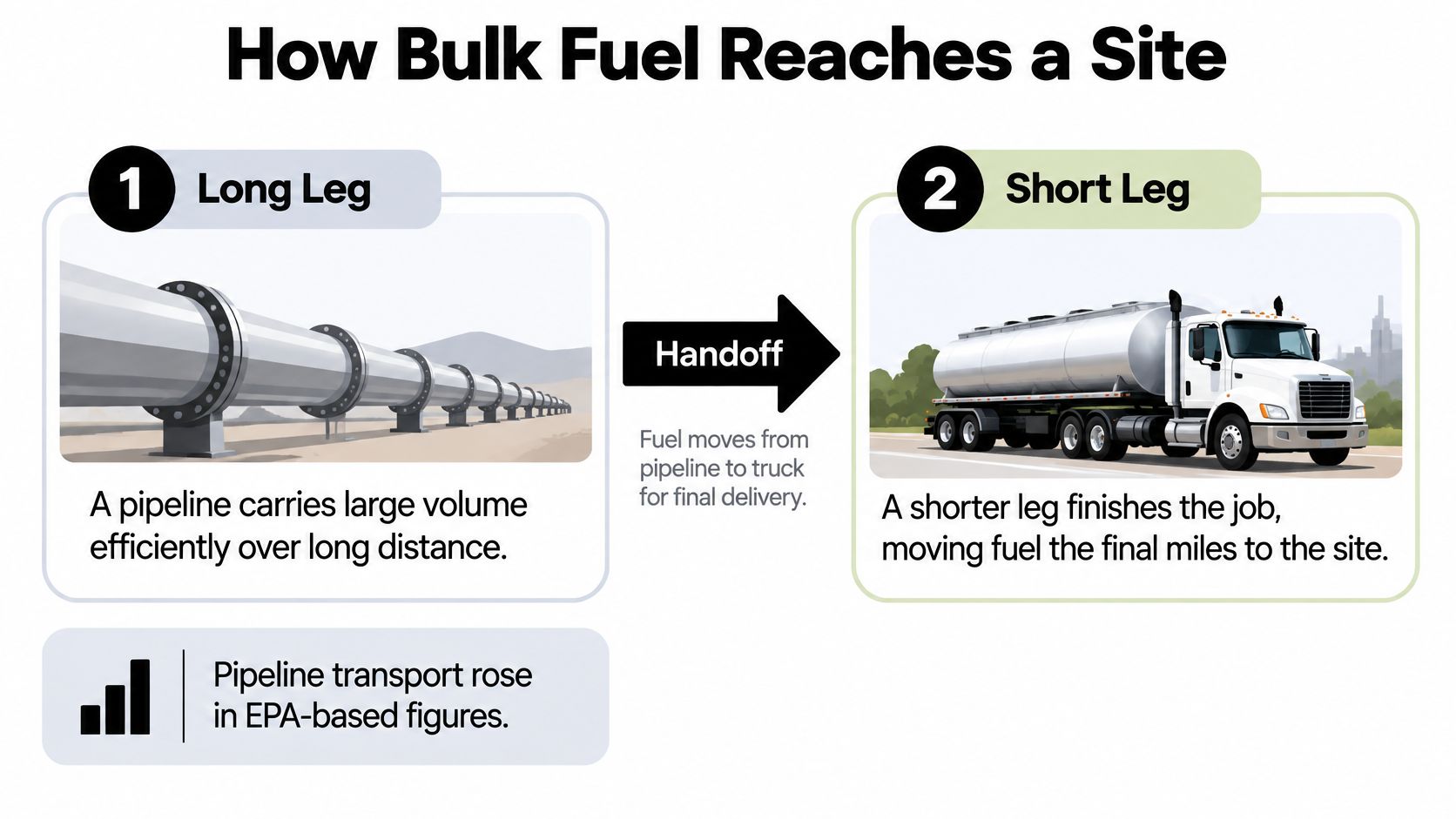
The Long Leg Carries Volume
The pipeline leg works like a river: continuous flow, no driver, no delivery window, no tank to schedule. Pipeline transport of refined product steadily gained share through the final decades of the twentieth century while tanker and barge movements gave up ground, and that division of labor has held since. Pipelines generally remain the more efficient option for long-distance, high-volume transfers into terminals, which is why your site effectively buys from a terminal rather than a refinery.
The Short Leg Carries Reach
Trucks hold a small share of total ton-miles yet carry the dominant share of the final mile, because terminals rarely sit next to the sites they supply. The volume passing through that leg is enormous: U.S. highway fuel consumption totaled 171,812,062 thousand gallons in 2024, according to the Federal Highway Administration.
The paperwork changes with the vehicle as well. A truckload travels under its own shipping documents. A stationary LNG installation answers to a different set entirely: an emergency plan for the site and coordination with the local fire marshal.
LNG repeats the same delivery shape at a different scale. Gas is liquefied at a central plant, moved in large tankers by sea or road, stored, then regasified or delivered for end use. A mobile CNG or LNG unit sits on that final leg, between centralized supply and a site still waiting for permanent pipeline service. Because it stands in for infrastructure that has not arrived, treat it as a temporary leg of the chain with a planned end, the same way you would treat any other stopgap in a delivery schedule.
Test your own plan: name the leg your site sits on, then name what happens to your operation if that leg stops for a week. If the answer is that you stop too, that is the leg to design around.
Matching Delivery Method to Site Demand
Four questions decide the method before price enters the room.
- Daily burn: how much fuel the site consumes on an average day, in gallons or in cubic feet of gas.
- Duration: how long the need lasts, and whether that's weeks or quarters.
- Permanent service date: whether a line is coming, and the date the utility has committed to.
- Site access: whether the site can take a full tractor-trailer, including turning room and a safe transfer point.
Answer those four and the method usually picks itself.
Two Sites, Two Answers
A commercial property waiting three months for a gas line and needing continuous heat through the winter doesn't need a bigger tank. It needs supply that starts this week and runs until the line arrives, tied into the building piping and right-sized to the boiler load. Speed dominates that decision.
An industrial plant with steady, high-volume demand and liquid fuel tanks already on site is the opposite case. Deliveries into existing tanks keep the plant running, and the containment, transfer procedures and trained staff are already there. Reliability dominates, and the permanent line, when it comes, is an upgrade rather than a rescue.
Peak flow rate matters as much as total volume. A mobile gas unit is sized to the speed at which equipment draws gas, so a building with one large boiler and a hard startup needs a different unit than its monthly total suggests.
Sizing rule: give every supplier two numbers, peak flow and total volume, then ask which of the two their proposed unit is limited by. You'll learn quickly whether the quote was built or copied.
Truck transportation prices fell 5.2% from 2022 to 2023, the largest year-over-year decrease on record since records began in 2004, according to the Bureau of Transportation Statistics. Cheaper haulage doesn't make the unit itself cheaper, which is why quotes should separate delivery charges from unit rates. Compare the transport line across suppliers before you compare totals.
Before requesting pricing, write down four numbers: daily fuel use, peak flow, expected duration and the projected date permanent service arrives. Those four turn a vague request into a quote you can compare.
Hazard Checks Before Any Bulk Load Moves
Bulk classification starts with the substance, not with the word on the order form. "Diesel" and "fuel" aren't classifications.
Under U.S. hazardous-materials rules, the shipper identifies the material, assigns its hazard class and packing group, then applies the requirements in the Hazardous Materials Table. Those entries drive packaging, markings, shipping papers, placarding, emergency response information and training. PHMSA's guide to using the Hazardous Materials Regulations sets out that sequence, and the order matters, because change the product and every downstream requirement can change with it.
The checklist below is the short version of that sequence.
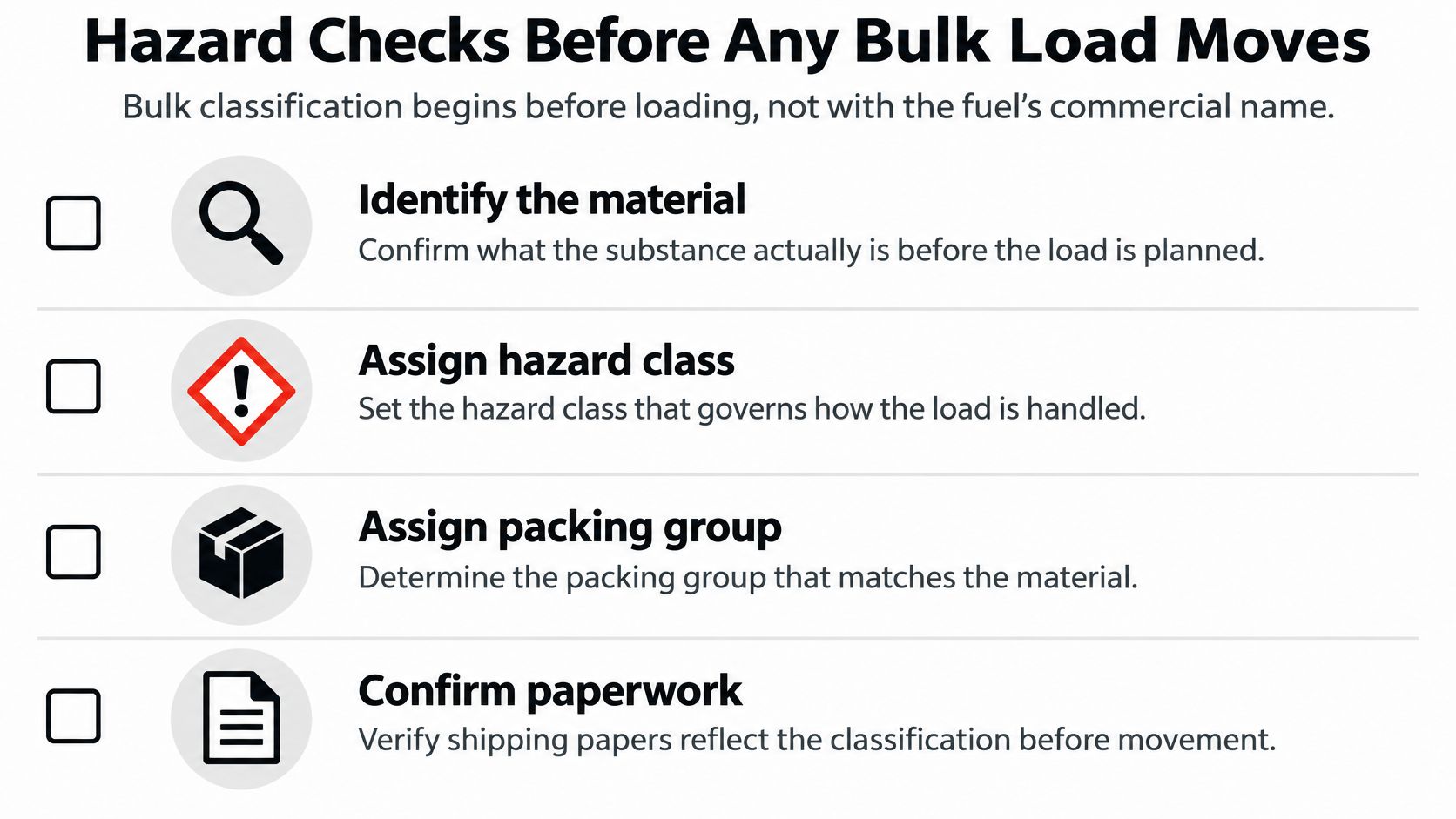
Why Flash Point Decides the Placard
Gasoline generally carries the lower flash point, so bulk diesel and gasoline can require different identification numbers and different placards. A cargo tank holding several petroleum distillates is marked with the identification number of the liquid with the lowest flash point in the load. That one rule explains why a tanker that hauled diesel yesterday may be papered differently today.
Gasoline's identification number, UN 1203, is the one often recognized on a tanker. If you want the plain-language version of what that number controls, from the placard to the shipping paper to the markings on the tank itself, what code 1203 means for tankers walks through each piece.
Before dispatch, the delivery plan should document:
- Product composition and flash point, confirmed from the actual product rather than a generic fuel designation.
- Physical state, since a liquid and a compressed gas carry different packaging and handling requirements.
- UN or NA identification number, matched to what is loading.
- Container specification, including whether the tank is a specification cargo tank.
- Transfer procedure, covering bonding, hose routing and who stands where during the transfer.
- Emergency controls, including shutdown points, spill response and the person who answers at 2 a.m.
- Driver credentials, including the hazardous-materials endorsement the load requires.
A mobile unit that switches service between diesel, gasoline, CNG and LNG changes all of it, because packaging, labeling, driver qualification and response requirements move with the material. And a tank that dispenses fuel to a customer is engineered and regulated as a cargo tank, not as an exempt vehicle fuel tank, no matter how familiar it looks on the back of a truck.
PHMSA places responsibility for determining flash point, package compliance and completion of all applicable requirements on the offeror, before shipment. That's the supplier's job, and it's the first thing to confirm in writing.
Mobile Natural Gas When Pipeline Service Is Unavailable
A residential development is ready for occupancy in October. The utility's permanent main is months away. The inspector needs working gas at the range and the water heater before an occupancy permit can be issued, and the backup generator needs commissioning before the first homeowner moves in.
Connecting a temporary supply to site equipment is a mechanical job with a permit attached.
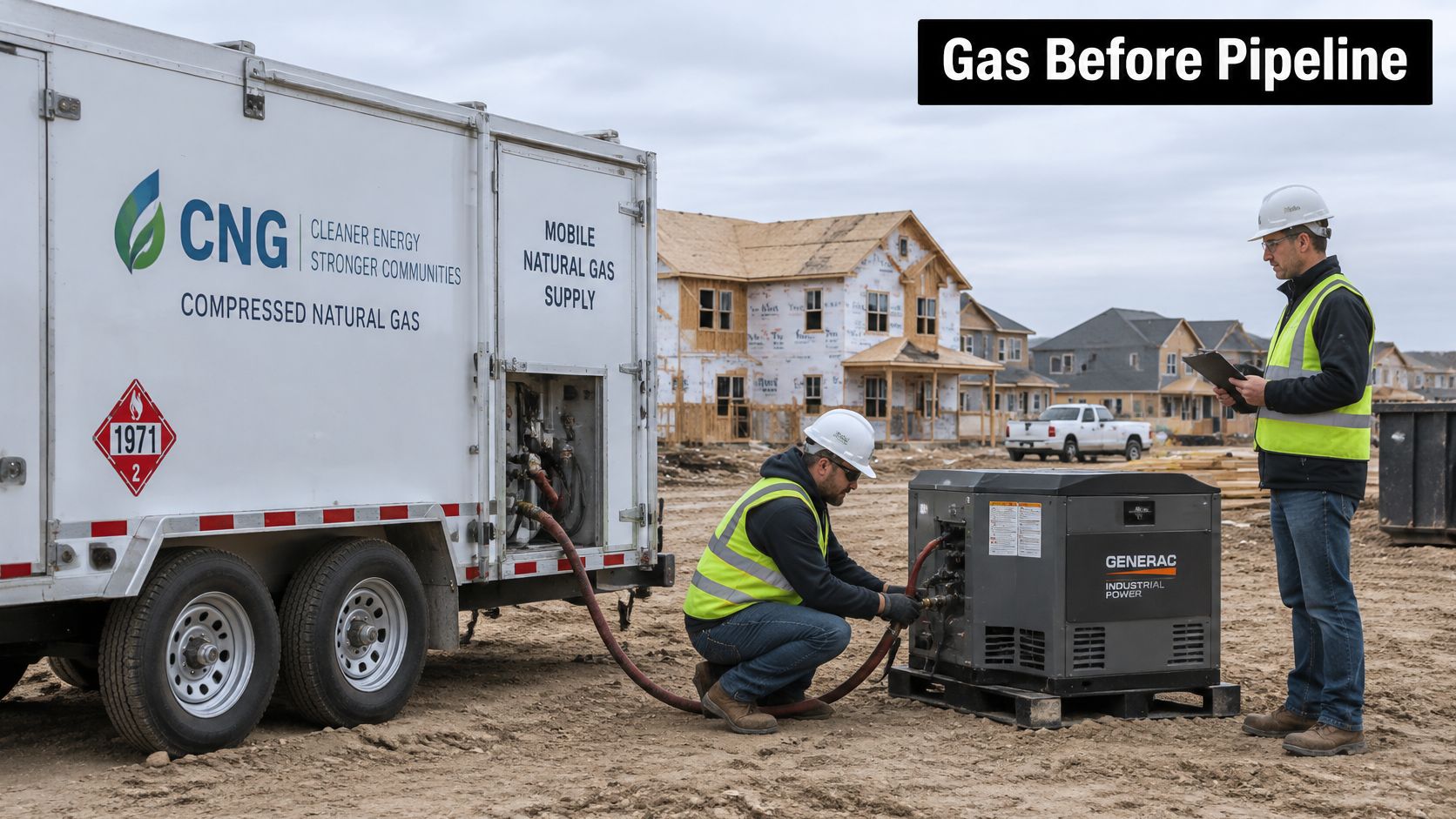
A mobile unit closes that gap by connecting to the building piping or a temporary line and feeding gas while the permanent connection is completed. Five needs come up again and again:
- Occupancy inspections that require working gas appliances.
- Generator commissioning before handover.
- Freeze prevention during winter construction.
- General heat for a building still under construction.
- Temporary supply to gas appliances, including the fireplaces and outdoor kitchens in a model home.
Utility-side cases follow the same logic: gas during old pipeline replacement, supply to a municipality while a new line is built, and response to disruptions caused by digging accidents. LNG also supplements gas vapor during periods of high consumption, or when peak-shaving facilities are down for maintenance.
The flexibility behind that supply is the same flexibility running through global gas markets. The International Energy Agency's global gas security review reported that more than 50 million tonnes per annum of new liquefaction capacity came online in 2018, roughly 72 billion cubic metres per year of production capability, and that global LNG trade then grew by 10% to about 420 billion cubic metres per year. Contracts allowing cargoes to be redirected accounted for 40% of total LNG delivered in 2018. A temporary unit draws on that same system, which is why it can be resupplied on short notice rather than rationed.
The boundary is the calendar. Mobile supply is a bridge, so the handover date belongs in the contract at signing, not in a phone call three weeks before the line lands. Write down what happens if the permanent connection slips: who pays for the extra month, whether the unit stays, and who tells the inspector.
Emissions Trade-offs Versus Waiting or Diesel
Natural gas is not an emissions claim by itself. A short mobile deployment can be the lower-impact choice for a site, and it can be the higher one, depending on how the gas gets there and what happens to it en route.
The IEA's Global Methane Tracker estimates global energy-related methane emissions are about 80% higher than countries report to the UN. It also notes that gas may lose its climate advantage over coal when methane emissions are very high, or when a 20-year warming timeframe is used instead of a longer one. Both conditions show up in temporary work: a unit that vents during changeover, or a delivery route that runs long, moves the answer.
The useful comparison is option by option, not fuel by fuel.
| Alternative | What drives its footprint | What to measure |
|---|---|---|
| Wait for pipeline connection | Schedule delay and idle equipment | Delay length and standby hours |
| Diesel or fuel oil delivery | Combustion emissions and truck trips | Delivered volume and truck miles |
| Temporary CNG or LNG unit | Methane leakage, boil-off, regasification and truck miles | Boil-off rate, leakage, truck miles and backup duration |
| Extended outage on existing supply | Lost productivity and continued fuel use | Idle crew hours and fuel burned while the site is down |
Six site-level values make the comparison concrete: delivered fuel volume, truck miles for every delivery, expected boil-off or leakage, backup duration, equipment efficiency, and the construction delay the temporary supply avoids. Collect them before anyone writes "cleaner fuel" into a permit application.
Here's the arithmetic with round numbers. Suppose a site needs 30 days of supply, delivered in three truck trips of 120 miles round trip each, plus whatever boil-off the proposed unit reports over the month. Compare that against 30 days of diesel generator run time at the site's measured consumption, then weigh both against the 60 days of construction delay the temporary supply avoids. On most projects the avoided delay is the largest number in the comparison, and it's the one nobody puts in the spreadsheet.
Accounting rule: regasification energy and any gas vented during transfer belong in the same column as the truck miles. A footprint that leaves them out isn't a comparison, it's a preference.
Ask a prospective supplier four things: how they account for methane on the proposed unit, the length and number of delivery routes per month, the expected boil-off rate for that unit and how the site handles it, and whether regasification happens on site and what that adds. Whoever signs the emissions section of a permit should be able to defend the choice with those numbers rather than a general statement about natural gas.
Confirm Permits and Delivery Plan Before You Order
Rapid deployment doesn't remove compliance work. It moves that work earlier, and it spreads it across more people than a project schedule usually assumes.
In the United States, PHMSA's LNG regulatory documents note that LNG facilities may be regulated by multiple agencies, including FERC, the Coast Guard, PHMSA and state utility regulators. PHMSA rules address siting, design, construction, operations, personnel qualification, fire protection and security, while marine transfer areas fall under separate Coast Guard rules.
A temporary gas unit works like a construction elevator: permitted for a defined period, inspected on a schedule, and removed once the permanent system carries the load. That framing matters because every regulator involved wants the same two things, evidence the site will run safely while the unit is there and a date it leaves. Which agency signs off varies by county, so the fire marshal's office is the right first call.
Who Owns Which Piece
The fuel supplier handles transport, transfer and the safety of the load. On an LNG site that typically includes the mandatory Emergency Management Plan, the personnel and technology that operate and monitor the equipment, and direct contact with fire marshals and other regulatory bodies. The property owner, general contractor, utility and authority having jurisdiction handle the site itself, the access route and local approvals. Most delays come from one side assuming the other already did its part.
Confirm these before mobilization:
- Setbacks from buildings, property lines and ignition sources.
- Truck access, including turning radius and a firm surface for the delivery vehicle.
- Grounding and transfer procedures, written down rather than described over the phone.
- Emergency shutdown locations and who is authorized to operate them.
- Fire protection, matched to what the fire marshal requires rather than what's convenient.
- Trained personnel on site during transfer and at startup.
- Inspection records for the unit, its hoses and its relief devices.
- Local permits, including any the supplier doesn't hold on your behalf.
This Week, Not Next Month
Gather four numbers before you call anyone: daily fuel use, peak flow, expected duration and the utility's target connection date. Add the permit list from the fire marshal's office to the same conversation. Bring those numbers when you request a custom quote, because a sales team builds the mobile unit spec around them rather than quoting a generic trailer. Confirm the unit can tie into your existing line, then put a date on the switch from temporary to utility gas, confirmed by both sides. A temporary supply with no end date turns into a permanent expense.
The deliverable is one dated document you can send to the supplier and the permitting office, with a name against every line.
Blue Gas Express rents mobile natural gas units for buildings and pipelines, delivered by truck to sites waiting on a permanent gas line or sitting where no pipeline reaches. Units range from small boxes and 16ft trailers to semi-truck loads, sized to the gas capacity and flow speed of the equipment you are fueling, and they connect to commercial, industrial or residential gas lines of any size. The company coordinates with gas utilities so the handover to permanent service doesn't add a second delay. Bring your daily fuel use, peak flow and target connection date to Blue Gas Express, and the sales team can build the quote around them.