

The generator is on order, the pad is on the concrete schedule, and the electrician has reserved a crew. Then the gas utility asks for the engine's full-load fuel demand, and nobody has it. The electrical selection came from the panel nameplate, while the gas-service request assumed an average operating load.
That's how a nearly finished project ends up waiting for a meter upgrade, a revised regulator, or a permanent main. A successful natural gas generator installation needs a coordinated path from permits to loaded operation, not just an equipment delivery date.
Generator Size and Fuel Demand Before You Order
Size, fuel demand, and equipment cost by duty
| Duty | Typical output | Fuel basis | Inlet pressure to confirm | Equipment cost |
|---|---|---|---|---|
| Essential home circuits | 10–22 kW planning class | Data-plate BTU/h at 100% load | Often 3.5–7.0 in. WC; confirm on the plate | About $200–$400 per kW, 2025 benchmark |
| Whole-building standby | 24–48 kW planning class | Data-plate BTU/h at full load plus other appliances firing together | Model-specific; verify at generator inlet | Same benchmark; obtain a project quote |
| Light commercial | 50–150 kW planning class | Full-load flow with pipe length and regulator loss included | Model-specific; confirm at inlet under load | Same benchmark; separate site work |
| Prime or long industrial run | Engineered output matched to operating duty | Stated duty cycle, fast start versus long hours | Utility or temporary supply matched to heat input | Obtain equipment and interconnection pricing separately |
Treat the output bands as preliminary planning categories, not a substitute for an electrical load calculation. For the cost reference, Dataintelo's natural gas generator market report gives approximately $200–$400 per kilowatt installed in 2025. Its broad market wording isn't a complete project estimate, so require separate prices for the pad, transfer equipment, piping, permits, wiring, and commissioning rather than assuming they're included.
Specify electrical duty and fuel demand separately
Start with the circuits the owner needs during an outage. Record running demand, motor-starting requirements, voltage, phase, and the loads that can be shed. A panel's ampere rating tells you its capacity, not what the generator must carry.
For longer industrial operation, state the intended duty explicitly. Equipment selected for occasional fast starts isn't automatically the best choice for extended operation. Compare the operating rating, efficiency, maintenance requirements, and fuel consumption at the expected load.
Say a small commercial building needs its refrigeration, controls, lighting, and selected HVAC equipment supported. The electrical designer should establish the starting sequence before purchasing the set, while the mechanical designer adds the generator's full-load heat input to the appliances that may fire simultaneously. Those are related calculations, but they aren't interchangeable.
Size the complete gas path
Use the generator's data-plate full-load BTU/h, not its average expected consumption. Confirm the exact inlet-pressure limits in the selected model's documentation rather than carrying a familiar residential pressure range into an unrelated commercial installation.
Calculate piping pressure drop for the actual route before selecting the downstream regulator. Include developed length, fittings, valves, the sediment-trap arrangement, and the regulator's capacity at the available supply pressure. Long runs and simultaneous appliance demand can make an apparently adequate service unsuitable.
Bid rule: Put duty, required kW, full-load BTU/h, and allowable inlet pressure on the equipment schedule before calling the utility.
Give bidders the same assumptions. Otherwise, the cheapest proposal may omit the meter alteration, load management, or fuel-system work needed to make the generator usable.
Temporary Gas When the Utility Line Is Late
The building can be ready for commissioning while the permanent main is still unfinished. Select the interim fuel arrangement before reserving the load bank and test crew, and make sure the chosen supply supports the planned operating duty.
Fuel arrangements for a natural gas generator
| Arrangement | Use it when | Limit to design for |
|---|---|---|
| Firm utility gas | Normal standby or prime service with a completed main | Pressure loss if upstream compression or regulation loses power |
| Interruptible utility gas | Cost matters and the set can stop when called | Curtailment during peak demand or cold weather |
| Dual-fuel with stored backup | The site is on a constrained or outage-prone segment | Stored-fuel maintenance and switchover testing |
| Mobile CNG or LNG bridge | Permanent line is late, under repair, or not yet built | Vaporizer capacity, shutoff, restraints, and refill continuity |
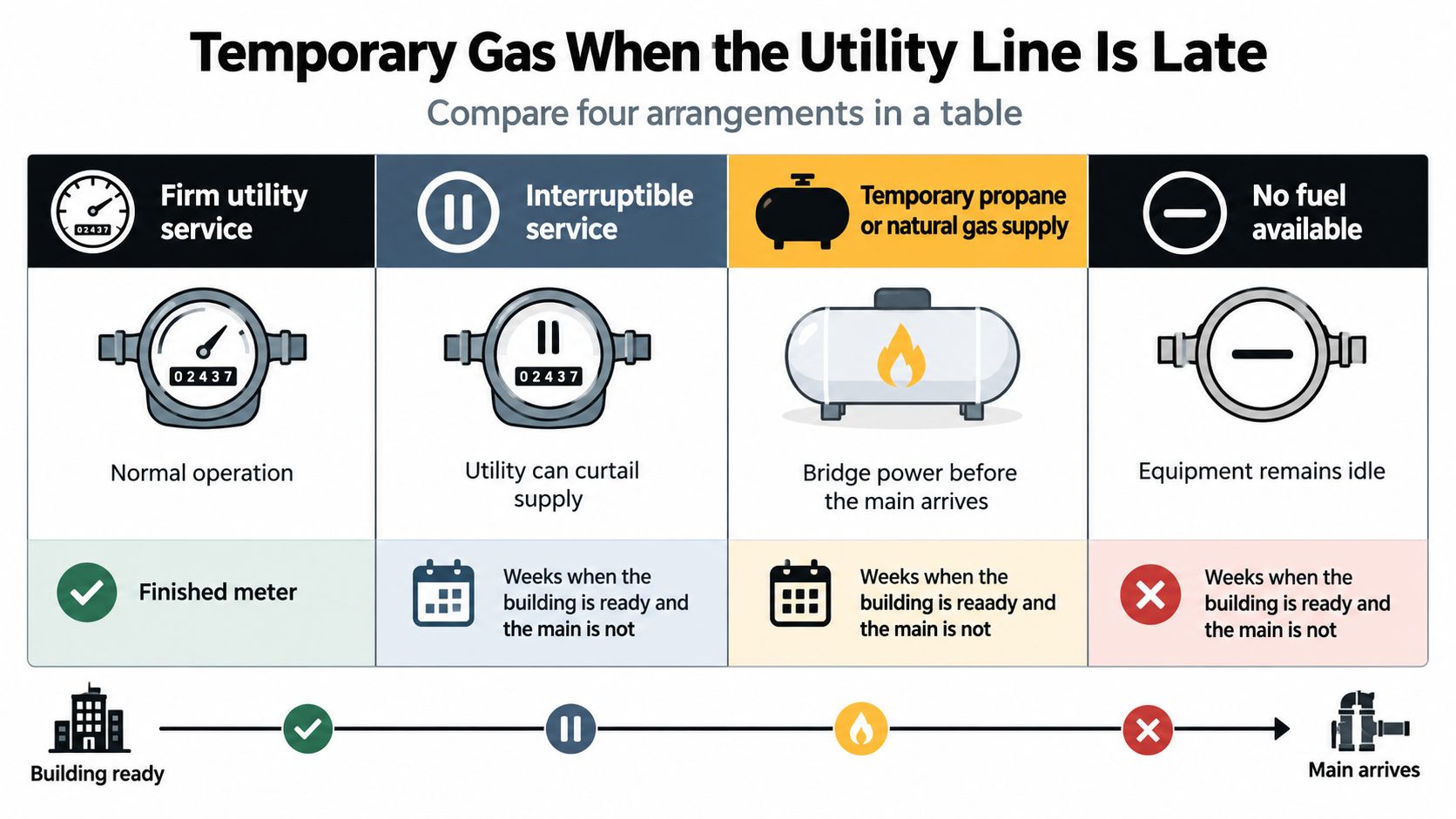
A National Laboratory comparison of backup-generator fuel choices found natural-gas generators less likely than diesel generators to fail during an outage under its assumptions, but the difference was small in most regions and depended on fuel-security assumptions. That's a reason to examine the delivery chain, not declare either fuel universally superior.
Design the bridge as an operating system
Ask whether the site is on a constrained main and whether upstream equipment can maintain pressure through a power interruption. Decide which loads can be shed and establish a black-start sequence that doesn't bring every large motor online together. Firm service terms deserve review, but they don't replace physical contingency planning.
For projects requiring coordinated mechanical, electrical, and plumbing design, HireArchitects' guide to choosing an MEP engineering team can help define who owns the fuel interface, electrical sequencing, and commissioning responsibilities.
Before a temporary supply arrives, document:
- Delivery conditions: Required pressure and flow at the connection.
- Conditioning capacity: CNG regulation or LNG vaporization adequate for the planned load.
- Site protection: Hose restraints, protected routing, and a marked emergency shutoff.
- Continuity: Refill access, changeover arrangements, and responsibility for monitoring consumption.
We rent mobile natural gas for buildings and pipelines while customers await permanent service or work in areas without pipelines. Our construction work routinely addresses line-installation delays and maintenance outages; a gas manifold allows another mobile unit to connect while the main unit goes to a CNG station for refilling.
For LNG sites, we prepare the Emergency Management Plans and coordinate operations with fire marshals and other regulatory bodies. Match the bridge duration to the utility's promised in-service date, with an agreed extension decision if that date changes.
How to Install the Generator in Order
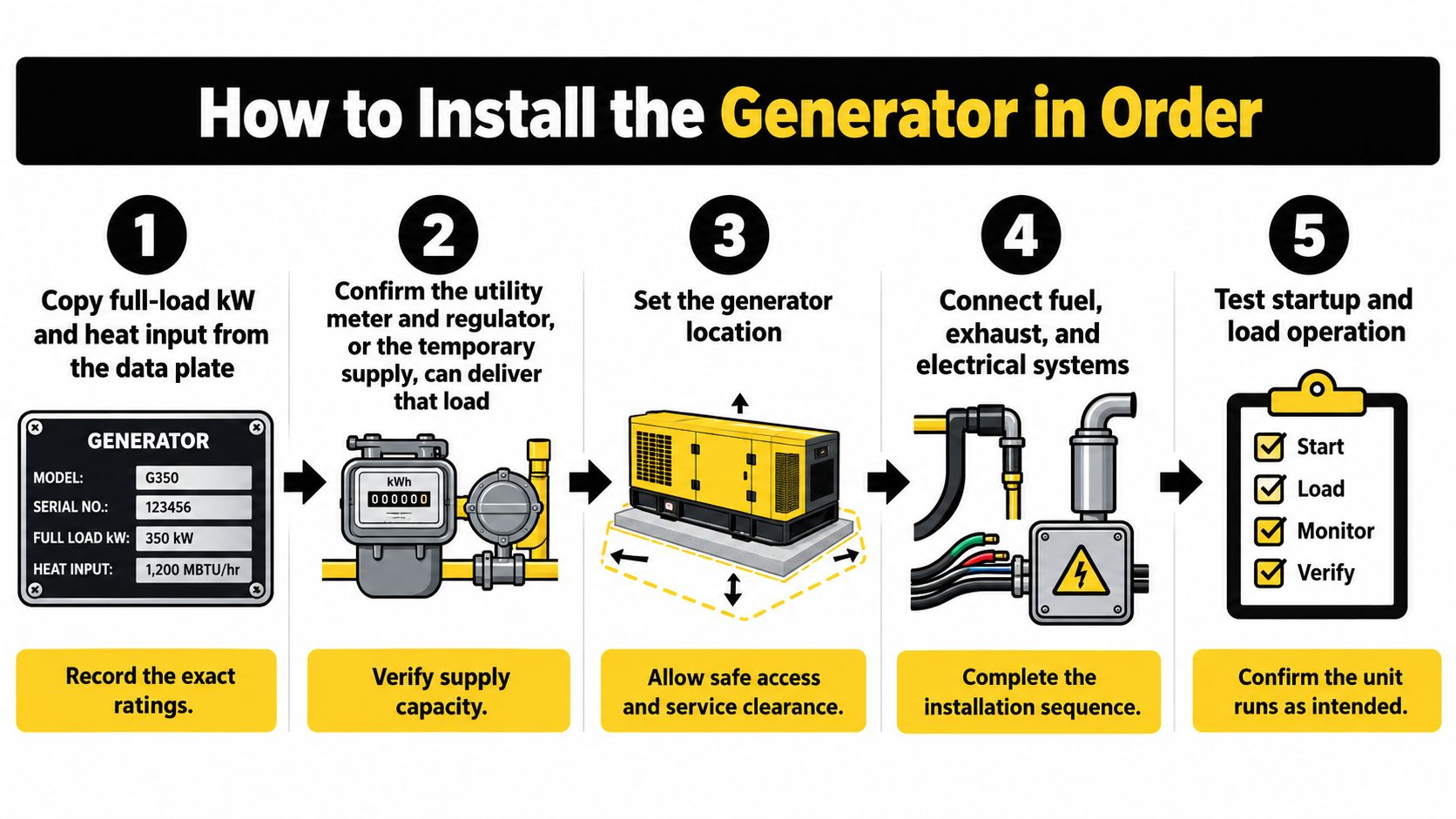
Give the superintendent an installation sequence with named hold points. Licensed and qualified trades should perform the work, with the utility, equipment manufacturer, and authority having jurisdiction involved where their approvals are needed.
The Generac installation manual illustrates why model-specific fuel requirements matter: its specified inlet range is 3.5–7.0 inches water column, not a universal pressure allowance for every natural-gas generator. Keep the selected unit's manual with the field drawings.
Establish the ratings and physical installation
Copy the full-load electrical rating and heat input from the data plate, so the crew doesn't build from a sales brochure covering several models. Record the model, serial number, voltage, phase, fuel, and intended duty with the approved submittal.
Confirm that the utility meter and regulator, or temporary supply, can deliver the required heat input at the specified pressure, preventing a service restriction from starving the engine. Obtain confirmation for the actual connection, not merely confirmation that gas exists on the property.
Approve the location before placing the pad, preventing an expensive relocation after someone identifies a nearby opening or combustible structure. Mark service access, equipment-removal access, underground utilities, enclosure airflow, and the exhaust path on the site layout.
Design and install the piping, sediment trap, and regulators for full-load flow, preventing excessive pressure loss through a route that was sized by connection diameter alone. Check regulator orientation, accessibility, and manufacturer requirements before concealing or backfilling work.
Connect, test, and release
Install grounding, bonding, transfer equipment, exhaust components, and controls with a labeled emergency stop, preventing unsafe fault conditions and confusion during an emergency. The electrician must resolve neutral switching and bonding for the actual system arrangement, not copy another project's detail.
Pressure-test new piping using the approved procedure, then check accessible joints at operating pressure, preventing an undetected leak from becoming an operational hazard. Isolate components that can't withstand the piping test pressure, use approved leak-detection solution, and complete the prescribed purge before startup.
Measure fuel pressure at the generator inlet during cranking and rated-load operation, preventing acceptance based on a misleading engine-off reading. Use a suitable manometer, record the lowest observed pressure, and include other gas appliances in the test configuration where simultaneous operation is intended.
Finish electrical verification and obtain the required authority approvals before normal operation, preventing premature energization. Follow the approved commissioning sequence for controlled testing, and don't treat permission to conduct a test as unrestricted permission to operate.
For temporary fuel connections, add the delivery-pressure setting, vaporization or regulation capacity, hose-restraint check, emergency-shutoff location, and refueling arrangements to the installation record. Confirm who can stop the test and who controls the fuel supply.
Keep a one-page installation log with each numbered item, completion date, responsible person's initials, measured values, and unresolved exceptions.
Attach supporting test sheets rather than replacing measurements with checkmarks. A signed statement that pressure was checked is much less useful than the actual reading and the operating condition under which it was taken.
Exhaust Clearances and Outdoor Venting
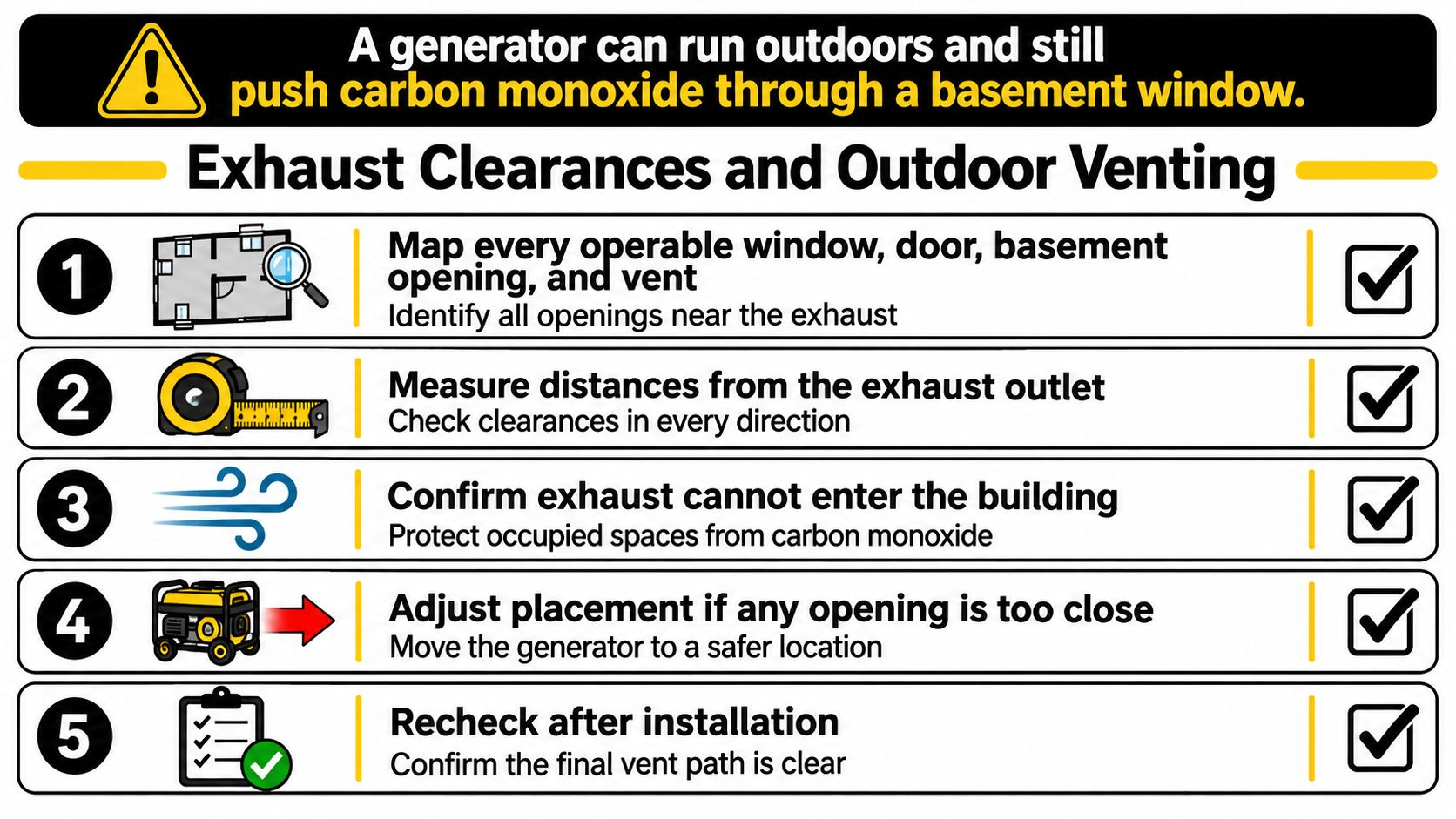
A generator can run outdoors and still push carbon monoxide through a basement window. Successful engine operation says nothing about whether the exhaust is reaching occupied space.
Clearance review must follow the adopted code, manufacturer instructions, and the authority's interpretation. The NFPA 37 materials identify a 5-foot (1.5 m) minimum outdoor separation from building openings and combustible-wall structures unless a code-recognized fire-resistance or engineering-based exception applies.
Walk the actual exhaust route
Map every opening. Include operable windows, doors, basement openings, vents, outdoor-air intakes, and mechanical exhaust openings. Note prevailing wind, nearby walls, and recessed areas where exhaust could collect.
Verify the applicable separation. Measure the installed equipment arrangement against the approved layout and manufacturer's reference points. Don't assume a fire-rated wall exception also permits an otherwise prohibited nearby opening.
Direct exhaust away from the building and combustion-air intakes. Consider neighboring structures and work areas, not just the wall behind the generator. Don't add improvised exhaust extensions that the manufacturer hasn't approved.
Protect enclosure airflow. Check cooling-air entrances and discharge paths with the enclosure assembled. Remove shrubs, fencing, stored materials, and temporary barriers that restrict the intended airflow or cause hot air to recirculate.
Check vents and neighboring equipment
Terminate regulator vents and relief discharge safely outdoors. Keep discharge away from occupied areas, ignition sources, intakes, and building openings. Support and route vent piping so moisture accumulation, backpressure, or backflow won't impair regulator operation.
Review other fuel-burning equipment. Arrange combustion, cooling, and ventilation air so generator exhaust can't be drawn into a boiler or another appliance. A generator location can satisfy a simple distance check and still create a poor airflow arrangement.
Install and test carbon-monoxide alarms where required. Verify the applicable occupancy and code requirements, and identify who maintains the devices after handover. Alarms supplement safe placement; they don't make an unsuitable location acceptable.
A temporary plywood wall can change exhaust movement after the approved plot plan has been issued. Recheck placement whenever site crews add screening, scaffolding, fencing, or material storage near the set.
Field check: Inspect the completed surroundings, not just the drawing that authorized the pad.
During commissioning, evaluate indoor CO and enclosure airflow under load. If readings or temperatures indicate a problem, stop the test and correct the cause before repeating it.
Controls Testing and Inspection Records
A start button isn't an acceptance test. A no-load exercise doesn't establish that the generator can accept the building, maintain electrical output, transfer correctly, or keep operating when fuel and cooling demand increase.
An inspector needs evidence that the installed system meets its approved design and applicable requirements. The commissioning team needs enough measurements to distinguish a fuel problem from a control, wiring, or load-sequencing problem.
Build the acceptance packet
Keep the equipment identification and test conditions on the same record as the results. Include the model, serial number, fuel source, instrument identification, personnel, and configuration of the loads used.
- Fuel measurements: Static inlet pressure, minimum pressure during starting, and pressure at rated load.
- Electrical safety: Insulation-test results where appropriate, grounding and bonding verification, and phase rotation.
- Loaded output: Voltage, frequency, current, and the actual load applied.
- Transfer performance: Measured timing and successful operation in both transfer directions.
- Protective functions: Alarm, shutdown, emergency-stop, and remote-signal responses.
- Environmental checks: Indoor CO observations, cooling performance, and exhaust conditions during the loaded run.
Use a load bank or verified site load that demonstrates the required performance. Record what was tested rather than describing a partial building load as full-load acceptance.
Diagnose the failure before closing the punch list
Commissioning failures and the test that catches them
| What you see | Test that catches it | Correction to record |
|---|---|---|
| Pressure fine at rest, sags on start | Inlet pressure during crank and rated load | Correct pipe or regulator capacity; revise approved starting-load sequence |
| Engine runs, indoor CO rises | Loaded run with indoor CO readings | Correct exhaust placement and restore required opening clearances |
| Transfer switch clicks, loads stay dark | Phase rotation, voltage, and frequency at source and load terminals | Correct wiring or control faults and verify both transfer directions |
| Empty run passes, loaded run trips | Load bank or verified site load | Correct the identified fuel, cooling, protection, or sequencing issue |
| Emergency stop or alarms do nothing | Alarm and emergency-stop functional test | Repair the circuit and repeat the functional test before final inspection |
Don't record “adjusted regulator” as a complete correction. Record the approved setting, resulting inlet pressure under the relevant condition, and successful retest. Likewise, a transfer-switch click doesn't prove that its contacts delivered acceptable power to the intended loads.
The installing contractor should sign the completed installation and commissioning records. Obtain the authority having jurisdiction's required inspection approval and retain it with the operating documentation; the contractor's signature doesn't substitute for that approval.
Keep unresolved items visible, with a responsible person and a retest requirement. The set stays locked out of automatic operation until the required acceptance and approval lines are complete.
Permit and Fuel Lock Before Mobilizing
A generator can be installed and still be barred from operating. Before mobilization, line up the permit conditions, the fuel supply, and the specific tests needed to authorize the intended use.
Federal rules may apply to stationary backup engines, while state and local agencies issue many air permits. For multi-engine backup systems, permit scope often covers nitrogen oxides, carbon monoxide, particulate matter, and other regulated pollutants, depending on engine count and operating case. Confirm requirements with the agencies responsible for the site.
Resolve the operating case first
Use this decision order before committing to a start date:
Establish engine size and count. Give the permitting specialist the equipment schedule, manufacturer emissions information, and site arrangement. Assess the installation as a whole, including the proposed engines and their combined operating case.
Define emergency-only versus prime use. State expected operating hours and whether the owner plans testing, maintenance runs, construction power, peak management, or other non-emergency operation. A generator's marketing description does not determine its legal operating classification.
Identify the issuing agencies. Confirm whether an air construction permit or other preconstruction authorization is needed before installation. Coordinate building, electrical, mechanical, fire, and fuel-system approvals; one approval does not necessarily cover the others.
Prepare emissions estimates and any required modeling. Base them on the proposed engine configuration and operating case. If permit conditions rely on emissions controls, include installation, commissioning, and ongoing compliance requirements in the work scope.
Check property-line noise. Review the enclosure, exhaust treatment, nearby receptors, and operating schedule. A “quiet” enclosure does not establish compliance at the site boundary.
Allow for public-notice requirements. Ask the permitting team which review steps could affect the construction or operating date. Include those steps in the owner's schedule, not just equipment lead time.
Date the fuel connection. Confirm when permanent or temporary gas will be available, who accepts the connection, and which approval permits the planned test or operating period.
Separate construction permission from operating permission
A construction permit does not automatically authorize operation. Read the authorization conditions and identify what must be completed before startup, during testing, and before routine use. Temporary operation may need separate review, even when the permanent installation has an established permit path.
Coordinate building-system approvals as well. HomeProBadge's guide to when HVAC work needs a permit can help identify parallel mechanical work; the local authority must confirm what the project requires.
Temporary gas can supply rooftop units, generators, and ambient heating while permanent service is delayed, supporting commissioning when the work is authorized. It does not waive air, fire, building, or electrical requirements.
Blue Gas Express provides temporary natural gas for generator commissioning, delayed utility connections, and construction-related gas outages. Where site power is unavailable, its natural-gas-powered generator runs when backup batteries need charging and shuts off automatically once they are charged. Include that auxiliary operation in site coordination.
Make Monday's release decision explicit
Before releasing delivery, put the superintendent, electrical contractor, mechanical designer, utility contact, and permitting lead on the same schedule.
- Confirm equipment: Approved duty, kW, full-load BTU/h, and model documentation.
- Confirm fuel: Permanent or temporary delivery pressure, capacity, connection date, and continuity arrangements.
- Confirm authorization: Air and building approvals that match emergency or prime operation.
- Confirm acceptance: Test procedure, inspection appointment, responsible signatories, and open hold points.
Do not ship the generator until fuel capacity and the permit path both have dated commitments. Natural gas may emit less of some pollutants than diesel, but air-permit review can still affect the schedule. Make release a documented go or no-go decision, not an assumption that approvals will arrive in time.
Blue Gas Express provides temporary natural gas for generator commissioning, delayed utility connections, and construction-related gas outages. Before scheduling a test crew, discuss the generator's full-load fuel demand, required delivery pressure, commissioning date, and expected bridge duration.