

The U.S. had 186 LNG facilities in service in 2025, according to PHMSA's LNG facilities inventory. That figure reframes an LNG storage tank as more than a container: it's part of a supply system with siting, operating, inspection, and emergency-response responsibilities. A temporary installation can carry those responsibilities too.
Liquefied natural gas, or LNG, stores natural gas as a refrigerated liquid. For a construction manager or industrial buyer, the important question isn't just how much a tank holds. It's whether the complete installation can deliver the required gas flow, fit the site, meet applicable approvals, and remain safe through changing demand.
LNG Storage Tank Types and Containment Designs
The tank type follows from where it sits and how much liquid it must hold. Containment means the number of barriers that hold the liquid if the inner tank leaks. However, the outer barrier's ability to retain liquid doesn't automatically mean it can retain vapor.
A single-containment tank relies on its inner tank for liquid storage, with a surrounding dike or earth bund providing spill impoundment. Double containment adds an outer liquid-retaining container. In a full-containment system, the engineered outer structure retains both liquid and vapor following an inner-container leak.
Membrane tanks use a thin stainless steel liquid barrier supported through insulation by a concrete structure. Pressure vessels belong to a different design family: horizontal bullet vessels and transportable tanks store LNG under a pressure-vessel design basis rather than functioning as large, low-pressure terminal tanks.
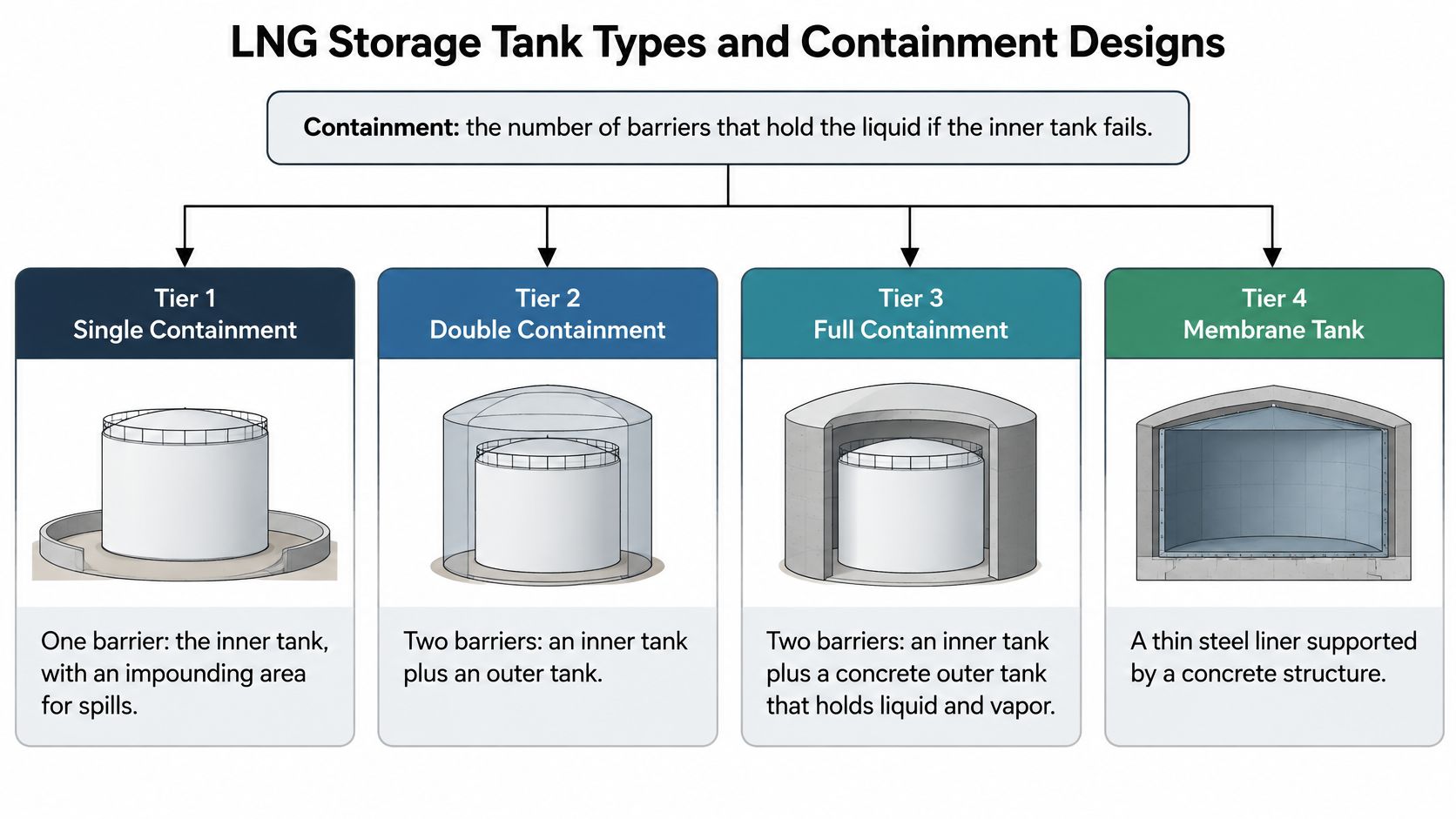
LNG storage tank types by containment design
The capacities below are selection guides, not definitions of a containment category. The engineered design establishes the actual capacity.
| Tank type | Containment and structure | Typical capacity | Typical use |
|---|---|---|---|
| Single containment | Inner 9% nickel steel tank; dike or earth bund as outer barrier | Project-sized stationary storage | Terminals where a dike meets impoundment rules |
| Double containment | Inner 9% nickel steel tank; outer steel liquid barrier, with carbon steel suitability requiring verification | Project-sized terminal storage | Import terminals needing an outer liquid barrier |
| Full containment | Inner 9% nickel steel tank; gas-tight prestressed concrete outer wall and roof | Large terminal storage | Large modern base-load terminals |
| Membrane | Thin stainless steel membrane on insulation panels inside a concrete outer tank | Large terminal storage | Large onshore terminals |
| Pressure bullet vessel | Horizontal, vacuum-insulated pressure vessel, often skid-mounted | 40–200 m³ per vessel as a preliminary selection band | Small-scale supply and industrial vaporization |
| Mobile trailer or ISO tank | Vacuum-insulated tank on a road trailer or standardized ISO frame | About 30–40 m³ as a preliminary selection band | Temporary supply and short-term deployments |
For example, the single-containment row describes a site where the external impoundment is a major part of the layout. The pressure-bullet row describes equipment that may arrive on a skid, but still needs engineered supports, transfer connections, and an approved spill-management arrangement.
Don't treat an ordinary carbon steel outer shell as a qualified cryogenic liquid barrier. A double-containment specification must establish the outer container's material suitability and performance during a leak.
Where the tank-system standard applies
API 625 generally covers low-pressure, aboveground, vertical cylindrical tank systems of 800 m³ and larger, storing products that are gaseous at ambient conditions and require refrigeration below 5 °C (40 °F) to remain liquid. That temperature describes the standard's scope, not LNG's storage temperature.
The standard treats containment, insulation, accessories, quality assurance, and commissioning as an integrated system. Its geometry provisions include nominal 300 mm (12 in.) freeboard above design liquid level and a maximum 6 m (20 ft) annular spacing between primary and secondary liquid containers.
For terminal-scale stationary service, evaluate field-erected double or full containment. For small, relocatable, or skid-mounted supply, evaluate pressure vessels. Some bullet designs avoid bottom penetrations, so review the fill and withdrawal arrangement before selecting the tank, without assuming that a particular piping arrangement eliminates permitting or impoundment obligations.
LNG Tank Capacity Bands From Mobile Units to Terminals
A useful preliminary conversion is about 600 cubic metres of natural gas for each cubic metre of liquid LNG. At the beginning of 2016, CEDIGAZ recorded 429 tanks serving 118 import terminals, with an estimated 55.3 million m³ of liquid storage, equivalent to approximately 33.2 billion m³ of natural gas after regasification.
That relationship explains why LNG works as a supply buffer. It also creates a common purchasing error: confusing the liquid volume inside the tank with the much larger gas volume delivered after vaporization.
LNG tank capacity bands with gas-equivalent volume
Use these bands to organize a specification, not as a market census or an automatic code assignment. Gas equivalents are rounded calculations using the preliminary conversion above; the supplier must identify the reference conditions for a contractual gas-volume figure.
| Capacity band (liquid) | Typical equipment | Design reference |
|---|---|---|
| About 30–40 m³ | Road trailer or ISO-frame vacuum tank; approximately 18,000–24,000 m³ gas equivalent | Transport and vehicle-scale requirements, plus temporary-installation rules |
| About 40–200 m³ | Skid-mounted or bullet pressure vessel; approximately 24,000–120,000 m³ gas equivalent | Applicable pressure-vessel code and project specification |
| 200–800 m³ | Small vessel or small field-erected tank; approximately 120,000–480,000 m³ gas equivalent | Project specification; verify the boundary of API applicability |
| 800–20,000 m³ | Field-erected tank within a dike; approximately 480,000–12 million m³ gas equivalent | API tank-system requirements and applicable LNG facility standard |
| 20,000–180,000 m³ | Terminal single- or double-containment tank; approximately 12–108 million m³ gas equivalent | API tank-system requirements, facility standard, and federal rules where applicable |
| Above 180,000 m³ | Full-containment or membrane terminal tank; above approximately 108 million m³ gas equivalent | Applicable tank-system standard plus site-specific design basis |
A hypothetical 40 m³ trailer contains about 24,000 m³ of gas equivalent before operating allowances. That isn't necessarily the quantity available to the customer, and it doesn't establish the delivery rate.
The vaporizer, which converts liquid into gas, and the downstream pressure-control equipment must also meet peak demand. A tank can contain enough energy for the job while its associated equipment cannot supply the required instantaneous flow.
Gross volume isn't working inventory
Nominal capacity is the stated tank size. Working capacity is the inventory available within approved operating limits. A heel is liquid retained to support the operating condition, often including keeping the vessel cold.
Freeboard, maximum filling limits, minimum operating level, and unusable residual inventory all affect the quantity available for consumption. Don't subtract an assumed allowance without checking the tank's level-volume chart and operating procedure.
Buying rule: Ask for liquid capacity, usable gas inventory, and maximum gas flow as separate entries. They answer different questions.
For the final specification, confirm whether every capacity is liquid volume or gas equivalent, and gross or working capacity. Require the gas reference temperature and pressure, especially when comparing quotations from different suppliers.
Materials for Cryogenic LNG Tank Shells and Roofs
LNG is stored at approximately −162 °C near atmospheric pressure. At that temperature, material selection is about fracture resistance before it's about purchase price or weight.
A metal that performs well in ordinary outdoor service may become brittle in cryogenic service. The designer must qualify each component for its minimum design metal temperature, the lowest temperature used to establish its material suitability.
Inner tanks and liquid-contact components
Large field-erected inner tanks commonly use 9% nickel steel because the specified material and heat treatment can provide the required cryogenic toughness. The material designation alone isn't sufficient: plate condition, thickness, welding, and inspection must match the approved design.
Austenitic stainless steel is used for membrane barriers and smaller cryogenic vessels. It supports thin-wall construction, but the designer still has to address weld quality, thermal contraction, and how loads reach the supporting structure.
Aluminium alloys can suit lightweight vessels. Their weld design and fabrication controls need particular attention, and the selected alloy must be qualified for the actual service.
| Tank component | Material approach | Main verification |
|---|---|---|
| Primary liquid container | Cryogenic-qualified nickel steel or stainless steel | Toughness, weld qualification, and minimum design temperature |
| Membrane barrier | Thin austenitic stainless steel | Support details, joints, and contraction accommodation |
| Lightweight vessel | Qualified aluminium alloy | Alloy selection and welded-joint performance |
| Normally warm outer shell | Carbon steel where suitable | Exposure during normal operation and credible leakage |
| Full-containment outer structure | Engineered prestressed concrete system | Liquid retention, vapor tightness, and thermal protection |
Outer structures, roofs, and foundations
Carbon steel isn't a substitute for cryogenic-qualified inner-tank material. It can be appropriate for normally warm outer shells and structural components, but a leak may expose those parts to temperatures outside their design basis.
A roof specification must distinguish between an outer weather roof, a suspended insulation deck, and a pressure-retaining roof. These parts don't have interchangeable functions or material requirements.
Prestressed concrete provides the structural outer container in many full-containment systems. Vapor tightness depends on the complete engineered arrangement, including liners, joints, penetrations, and roof details, not concrete alone.
Foundation insulation must support the loaded tank without crushing while limiting heat flow. The designer also needs to consider contraction, settlement, and a credible cold-liquid leak onto the base or impounding structure.
Request mill certificates, impact-test results at the specified minimum temperature, and welding procedure records. Have the responsible engineer confirm where impact testing is required for the selected material and code, rather than imposing an unsuitable test on every component.
Insulation Systems and Boil-Off Rates
Heat entering an LNG storage tank causes some liquid to evaporate. Operators call that vapor boil-off gas. A boil-off rate expressed as a percentage per day is meaningful only when the specification defines the inventory basis, test conditions, and treatment of pressure changes.
Boil-off isn't automatically gas lost to the atmosphere. The system may consume, recover, or otherwise manage it within its approved operating arrangement.
Insulation by location and function
Perlite fill occupies the annular space in many large field-erected tanks. It limits heat conduction when dry, but settling can create poorly insulated areas, and moisture ingress can impair performance.
Cellular glass serves in load-bearing bottom insulation. Check compressive capacity, joint sealing, installation quality, and the thermal design, not just the insulation's quoted conductivity.
Polyurethane foam appears in panel systems and some smaller tank arrangements. Review moisture resistance, compatibility with adjacent materials, and the specified fire performance.
Multilayer vacuum insulation combines reflective layers with an evacuated space in mobile and bullet vessels. It can provide very low heat leak, but loss of vacuum can sharply increase heat input.
Insulation systems and typical boil-off ranges
A universal typical range isn't reliable enough for procurement. The design data sheet must give the guaranteed or calculated rate for the particular tank and operating conditions.
| Insulation system | Where used | Behaviour | Limit to check |
|---|---|---|---|
| Perlite fill | Annular space of large field-erected tanks | Low conductivity when dry | Settling and moisture ingress |
| Cellular glass | Tank bottom and load-bearing base layers | Carries compressive load | Sealing and cost |
| Polyurethane foam | Membrane tanks and some smaller tanks | Sprayed or panel form | Moisture sensitivity and fire rating |
| Multilayer vacuum | Mobile and bullet pressure vessels | Very low heat leak when vacuum is maintained | Vacuum loss raises boil-off |
| Large tank boil-off | Terminal full containment | Obtain the tank-specific reference rate | Fill level and ambient temperature |
| Small vacuum vessel boil-off | Mobile and skid units | Obtain the specified evaporation rate and holding-time basis | Vacuum condition and relief operation |
For a hypothetical calculation, assume a tank contains 40 m³ and has an evaporation rate of 0.4% of that inventory per day. The calculated evaporation is 0.16 m³ of liquid per day, or approximately 96 m³ of gas equivalent using the preliminary conversion. These are illustrative inputs, not a typical-rate claim.
Fill level changes liquid inventory, exposed internal surfaces, and pressure behavior. Ambient temperature, insulation condition, transfer activity, and gas withdrawal also matter, so don't assume a fuller vessel always has the same daily percentage loss.
An evaporation calculation estimates heat-related vapor generation. It doesn't replace the supplier's pressure-holding-time calculation.
Compare usable inventory with daily consumption and the delivery schedule. If pressure or apparent boil-off rises unexpectedly, investigate insulation condition, vacuum performance, instrumentation, and pressure-control behavior rather than diagnosing a relief-valve fault from the trend alone.
Safety Features and Containment Sizing Rules
Impoundment sizing starts with the applicable regulatory case, not an assumed percentage of the tank's nameplate volume. Under the 2018 edition of 49 CFR Part 193, an impounding system serving a single tank generally requires 110% of maximum liquid capacity; for multiple tanks, it requires 100% of all tanks or 110% of the largest tank, whichever is greater, subject to the stated surge-related provision.
Where the dike accounts for catastrophic-failure surge, the cited rule permits the specified reduction to 100%. A project engineer must verify the current applicable text, exceptions, and approval basis before using that allowance.
For a hypothetical installation with two tanks of 100 m³ maximum liquid capacity each, the combined-capacity test gives 200 m³, while the largest-tank test gives 110 m³. The larger result controls: 200 m³ of effective impoundment capacity, before accounting for displaced volume and other applicable design allowances.
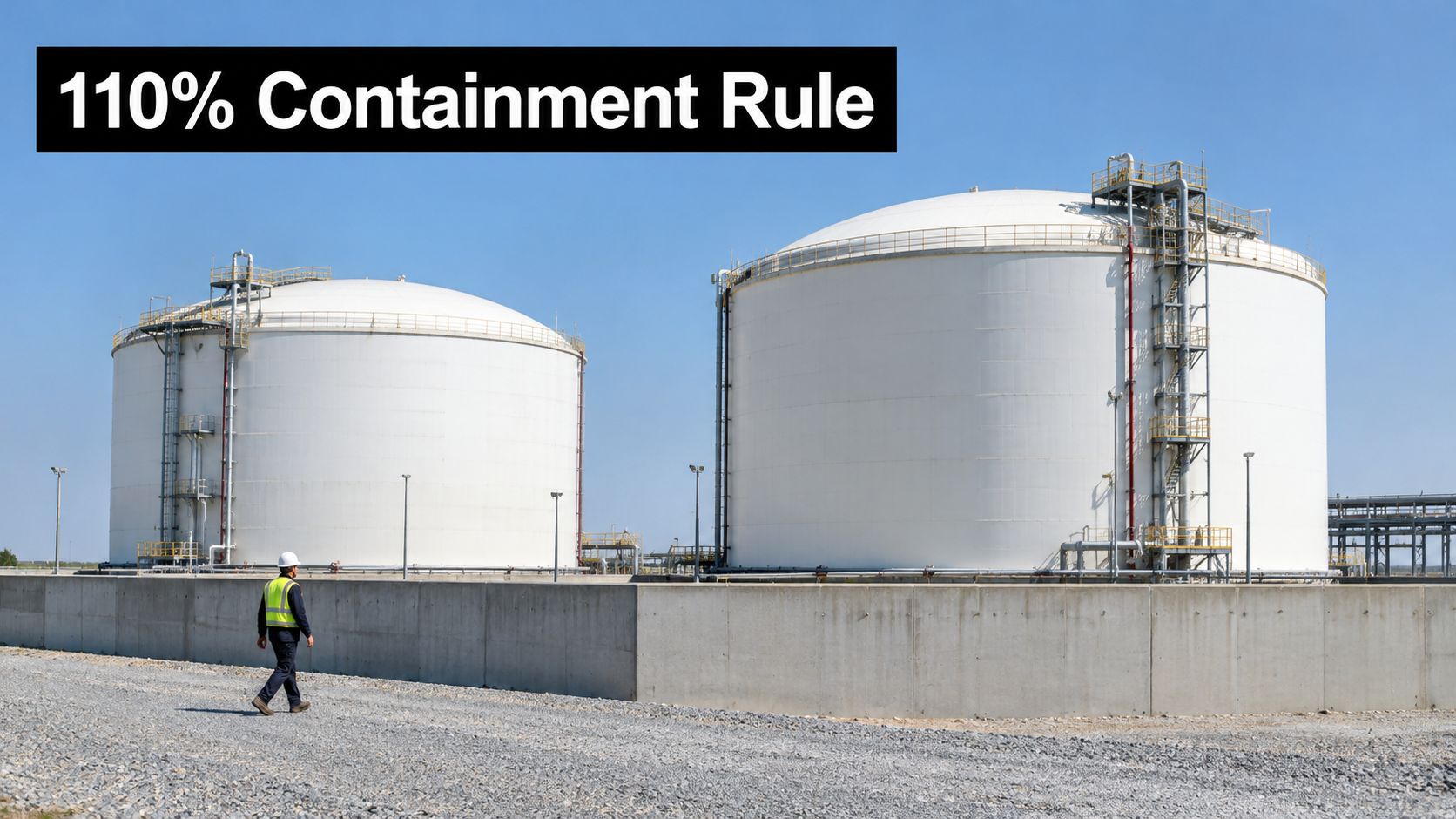
Verify geometry and structural loads
Freeboard and annular spacing belong in the tank-system geometry review. They affect the difference between physical shell volume and approved storage level, as well as the space needed for insulation and inspection.
Don't confuse tank freeboard with spare capacity in an external impoundment. They protect against different conditions and must be checked independently.
For covered facilities, the federal provisions reference NFPA 59A for field-fabricated tank seismic design and API 620 seismic requirements for other LNG storage tanks. The engineer must select the applicable reference for the actual equipment, rather than assigning a code solely from its appearance.
Check safeguards before first fill
Follow the interfaces from the structure to the process controls:
- Supports and anchorage: Confirm bearing conditions, attachment details, settlement assumptions, and the approved seismic and wind basis.
- Pressure limits: Record maximum allowable working pressure, or MAWP, and maximum allowable vacuum. Both overpressure and external-pressure loading can damage a vessel.
- Relief and vent systems: Verify sizing, discharge routing, isolation arrangements, and access for maintenance. Relief devices aren't normal inventory-management controls.
- Overfill protection: Confirm independent protection where required, together with a defined transfer shutdown response.
- Level and pressure alarms: Establish setpoints, instrument checks, operator actions, and communication with the delivery operator.
The impounding structure must also withstand the applicable wind, pressure differential, impact, and wind-borne-object loads. Its effective capacity must remain available, so drainage arrangements and stored materials need control.
After a major weather or ground event, inspect tank and foundation movement, supports, piping strain, and evidence of inner-container leakage before authorizing return to service. A tank that looks upright may still have damaged connections or shifted supports.
Permits, Notices and Approvals by Installation Case
There's no single LNG tank approval. The route depends on federal coverage, state requirements, the local fire authority, and the installation's purpose. A trailer-mounted tank can still become part of a regulated facility, so the word portable describes the hardware, never the permit burden.
The specification itself steers the paperwork. Tank capacity and containment type feed directly into impoundment volume, the exclusion distances drawn on the site plan, and the scope of the fire-response evaluation. A larger inventory or a longer operating period can push a project from a simple notice into full facility permitting.
Approvals and notices by installation case
| Installation case | Typical approval or notice | Reference basis |
|---|---|---|
| Portable LNG covered by federal LNG rules | Report to the state pipeline-safety agency at least two weeks before installation | PHMSA LNG FAQ |
| State that requires an LNG-facility permit | Permit before construction or operation, including fire-response evaluation | Applicable state LNG rules |
| Stationary tank at a regulated facility | Siting, design, operations, and personnel-training compliance | Federal LNG rules and applicable facility standard |
| Vehicle fueling or on-vehicle LNG fuel | Vehicular gaseous-fuel-system requirements | Applicable vehicle-fuel standard |
| Local jurisdiction without a state permit | Determine local fire-code permit, site-plan, and responder-coordination requirements | Adopted local fire code |
The Pipeline and Hazardous Materials Safety Administration (PHMSA) states in its LNG plant requirements FAQ that covered portable LNG facilities must be reported to the state pipeline-safety agency at least two weeks before installation. Coverage depends partly on the supply and consumption arrangement, so identify who supplies the LNG, who owns and operates the installation, and who uses the gas.
A notice is not a permit, and filing one does not by itself authorize construction or operation. Track each approval separately, including any conditions that must be satisfied before delivery.
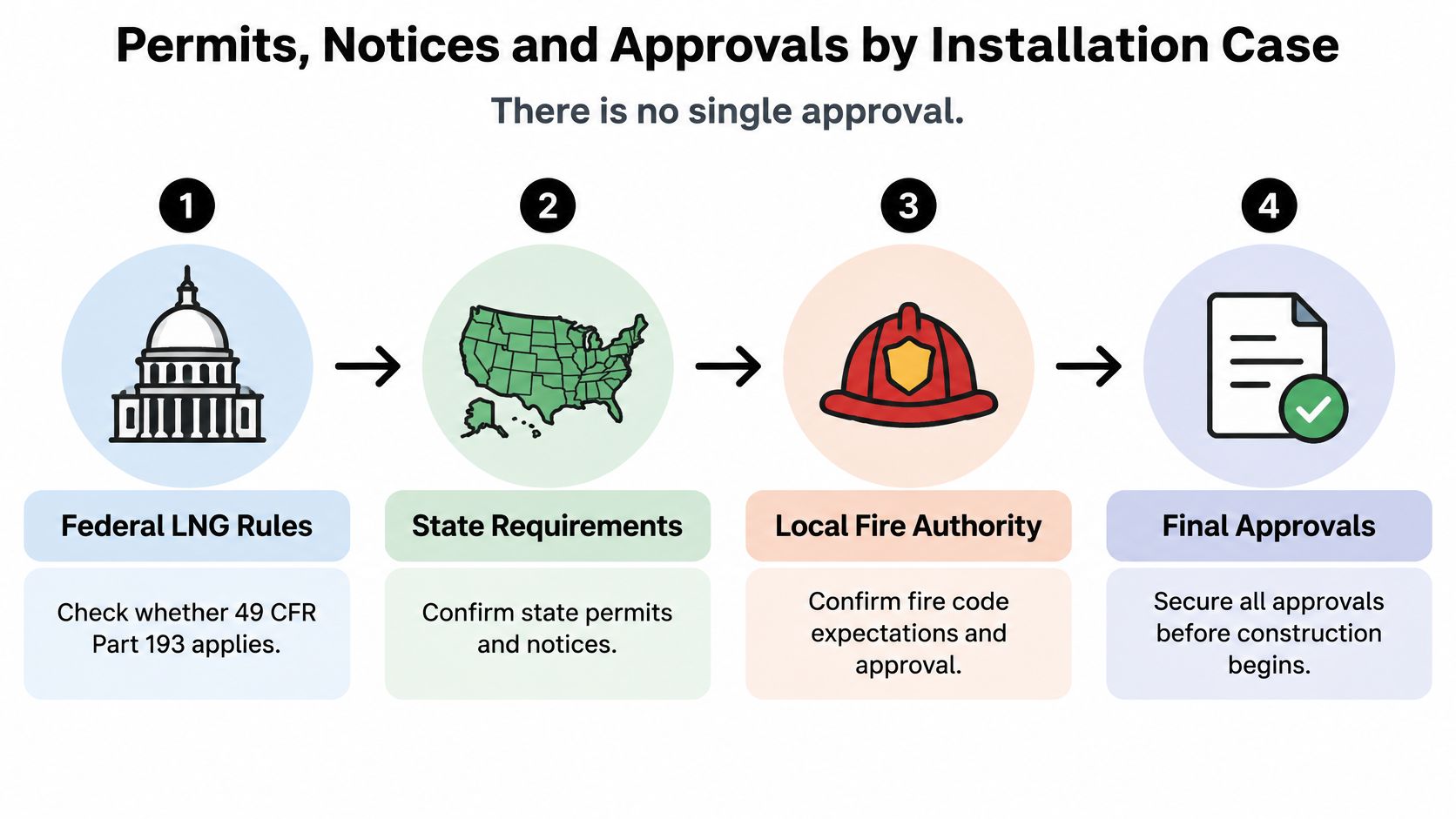
Establish the approval sequence
Resolve federal applicability. Give the responsible authority a clear description of the supply chain, end user, equipment, and proposed operating period. Obtain a documented applicability decision rather than relying on the word portable.
Check state requirements before site work. Some states require an LNG-facility permit before construction or operation, often with emergency-readiness documentation. Confirm the process in the project's own state, because one state's permit structure rarely transfers to another.
Coordinate with the fire department. Agree on the fire-response evaluation, emergency-response plan, access arrangements, and responder training. Identify isolation points and who has authority to shut down the system.
Submit a usable site plan. Show property boundaries, nearby occupancies, vehicle routes, exclusion distances (the required setbacks between the tank and occupied areas), spill containment, transfer connections, and emergency access. Include the basis for impoundment sizing.
Close out commissioning documentation. Record inspections, instrument checks, approved procedures, operator handover, and outstanding conditions before first fill.
Three frameworks recur across these cases. NFPA 52, from the National Fire Protection Association, addresses vehicular gaseous-fuel systems. NFPA 59A addresses LNG facilities. 49 CFR Part 193, the LNG facilities regulation in the Code of Federal Regulations, applies within its federal jurisdictional scope, so it is not a universal rule for every LNG container.
Code editions, exclusions, state adoption, and local amendments all need confirmation for the specific project. Mobility shortens equipment installation. It does not shorten approvals.
Temporary vs Permanent Tanks in Operation
Duration decides emphasis, and the word "temporary" changes less than buyers expect. A trailer-mounted vessel on a site for three months still operates as a small LNG facility: it needs defined operating limits, containment where the rules require it, and a named operator who can act on an alarm. What duration shifts is where the engineering effort goes. A temporary tank puts weight on transport condition, site supports, post-move inspection, and delivery continuity. A permanent tank needs engineered foundations and a maintenance strategy measured in years. Both need a defined operating envelope and a responsible operator.
Temporary and permanent LNG tanks compared
| Factor | Temporary installation | Permanent installation |
|---|---|---|
| Typical duration | Weeks to months as a planning description | Years to decades as a planning description |
| Footprint | Trailer or skid scale, relocated with the job | Engineered site with containment and impoundment |
| Foundation | Stabilized pads or anchors designed for site loads | Engineered foundation addressing settlement and seismic loads |
| Regulatory path | Notices and permits; facility rules may still apply | Full applicable siting, design, and facility permitting |
| Inspection | Pre-service, post-move, and post-event checks | Periodic inspection program and movement monitoring |
| Operating focus | Inventory turnover, deliveries, and outage length | Sustained operation and planned maintenance |
| Main cost driver | Rental, mobilization, and delivery frequency | Capital construction and long-term maintenance |
The IFC's LNG environmental, health, and safety guidance supports periodic integrity inspections, maintenance of valves and other components, overfill protection, secondary containment, spill-risk assessment, and fire-response planning. Treat those items as parts of one operating system rather than separate documents filed after delivery.
Temporary use doesn't justify lighter inspection. A recently moved vessel can need closer attention to supports, connections, instrument condition, and transport-related damage than a stationary vessel with an established inspection history. Mobility does simplify some logistics. A Blue Gas Express mobile gas unit typically arrives on a 16 ft trailer that is 8 ft wide, occupying about one parking space, and a refill trailer can plug directly into a stationary Natural Gas Box so the storage vessel itself never moves between fills.
Responding to rising pressure
Consider a construction outage where gas demand falls below the planned level. LNG remains in storage, and the customer is no longer consuming gas at the expected rate. Heat continues leaking through the insulation, so tank pressure drifts upward toward the relief set point, the pressure at which the safety valve opens to protect the vessel.
Continue cold operation with monitoring only when the approved pressure-control arrangement can handle the expected heat input and the operator has a clear response margin. Monitoring alone doesn't control pressure, and keeping the vessel cold doesn't eliminate incoming heat.
Reduce inventory or pause deliveries when projected demand won't provide sufficient turnover, an outage extends, or the pressure-management margin becomes inadequate. Any inventory reduction must use an approved transfer or consumption procedure, not improvised venting.
Less visible flaring doesn't automatically mean less risk. The operator must manage pressure, methane releases, and emergency protection together.
Flaring rules belong to the jurisdiction where the installation sits. Some regulators prohibit routine flaring except in emergencies and require advance notice for planned flaring above defined volumes; others set different triggers. Confirm the applicable requirements with the local regulator rather than carrying one region's threshold into another region's permit file.
Make the handover operational
The operating decision should account for tank age, inspection history, pressure trend, ambient conditions, LNG turnover, delivery frequency, vaporizer demand, relief-device condition, and expected outage duration.
Give the site manager, operator, and responders the same current information: inventory, operating limits, alarm actions, isolation locations, emergency contacts, and delivery status. Record who can pause deliveries and who can authorize restart. A one-page sheet posted at the transfer point serves the site better than a phone chain when pressure is climbing.
Choose continued operation only when the approved system can maintain safe limits for the expected demand profile. Otherwise, revise inventory, deliveries, or the operating plan before the margin disappears.
Confirm the Tank Specification Before Delivery
Choose temporary or permanent service from the expected duration, relocation needs, and whether the equipment forms part of a stationary facility. Don't make that choice from rental availability alone. The installation must remain suitable if the project runs longer or demand changes.
Turn the operating requirement into a purchase specification
Fix usable capacity and peak flow. Give the supplier daily consumption, maximum simultaneous demand, the longest expected supply interruption, and the delivery constraints. Include the supplier's boil-off and pressure-holding calculations, and distinguish usable inventory from nominal liquid capacity. A trailer-scale selection still needs a vaporizer sized for the equipment's peak load.
Confirm the design basis and containment type. Identify the tank standard, pressure-vessel requirements where relevant, applicable facility rules, and the adopted code editions. API's large refrigerated-tank scope doesn't mean every vessel above its capacity boundary uses the same construction method. Require the engineer to document the selection.
Approve the impoundment calculation and layout. Use the applicable single- or multiple-tank rule, including the approved treatment of surge and displaced volume. For a shared dike, don't size containment from the largest vessel alone when the combined inventory controls. Confirm truck access and emergency access on the same drawing.
Obtain the technical records. Request material certificates, applicable toughness-test records, weld documentation, insulation performance, MAWP, and allowable vacuum. Include a level-volume chart, relief-device details, and the permitted filling and withdrawal arrangement. Resolve missing records before equipment dispatch.
Start notices and approvals early. Establish federal applicability and enter the required portable-facility notice period into the project schedule. Identify state and local approvals separately, with an owner for each submission. Don't treat an equipment delivery date as permission to install.
Agree the inspection and handover plan. Define pre-service, post-move, and post-event checks, plus the records needed before first fill. Name the operator responsible for monitoring, delivery coordination, alarm response, and shutdown decisions.
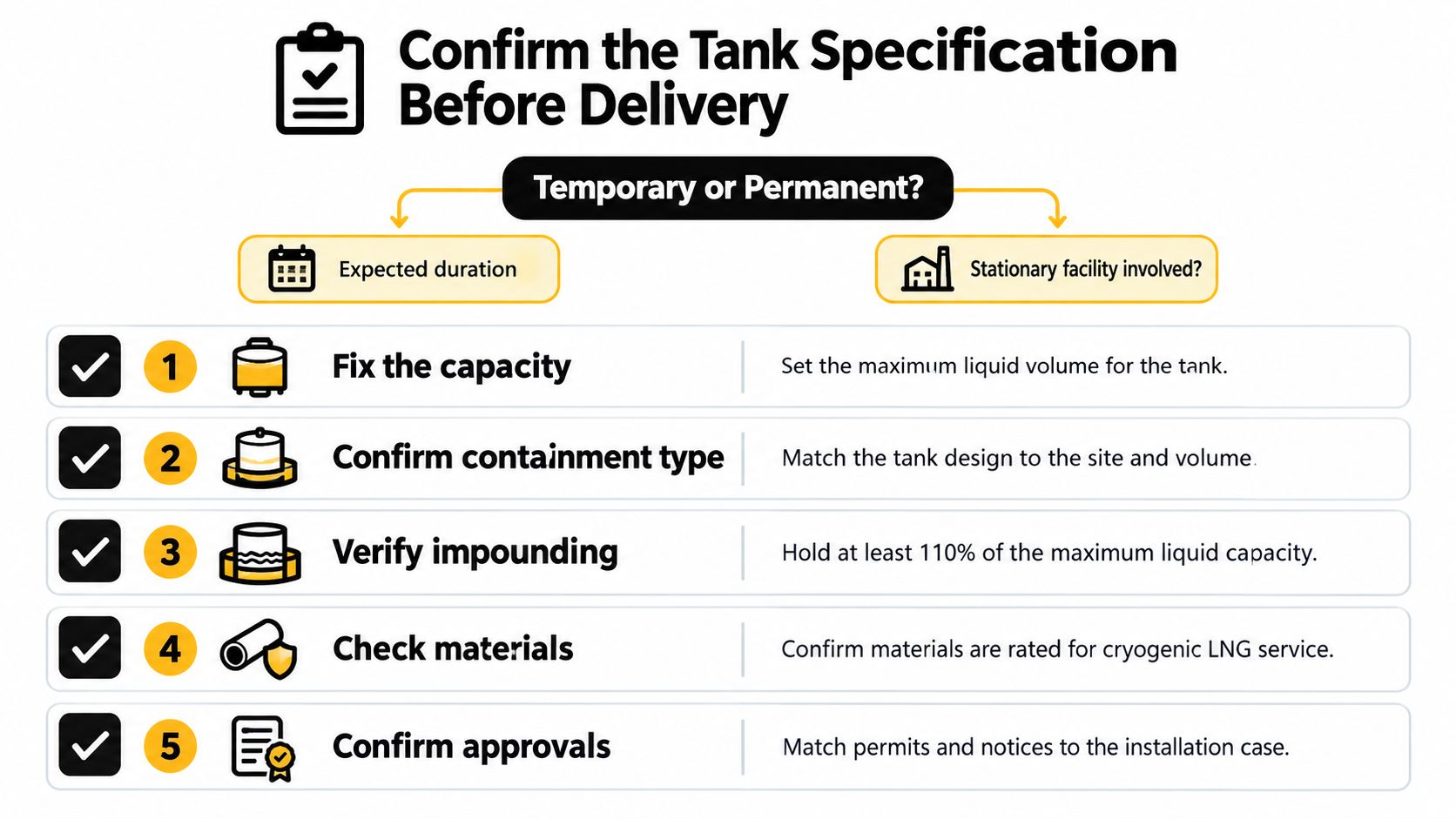
Allow for changing gas demand
At Blue Gas Express, our temporary natural gas equipment ranges from small boxes and 16 ft trailers to semi-truck loads. We can upgrade a customer from one box to several boxes to a mobile unit as demand grows, and gas boxes provide quick backup for utility disruptions lasting more than an hour. These are supply options, not interchangeable LNG tank classifications.
Send the six specification points to the tank supplier with the site plan and demand profile. Request written confirmation of sizing, operating limits, required documentation, and delivery dates before fixing the construction schedule.
Blue Gas Express offers temporary natural gas supply, including LNG containers and the vaporization and pressure-control equipment needed for an on-site system. Visit Blue Gas Express to discuss your gas demand, outage duration, and site constraints so the supply arrangement can be matched to the job.