

A contractor has a site ready for occupancy, but the permanent gas connection is delayed. The generator still has to run, crews still need heat and power, and every day of delay carries a cost. Diesel can arrive quickly in a tank, while mobile CNG may offer cleaner local air and a better fit for a longer commissioning window. The wrong choice can create either unnecessary infrastructure expense or an avoidable schedule failure.
The practical question in compressed natural gas vs diesel isn't which fuel wins in the abstract. It's whether the project has enough duration, throughput, and operating pressure to justify CNG's additional coordination. Diesel usually wins when deployment simplicity matters most. CNG earns its place when a temporary gas supply supports a sustained, high-load operation, helps meet local air-quality requirements, or prevents a costly delay.
A Project Manager Faces a Fuel Decision
The general contractor has already coordinated equipment, inspections, and subcontractors. The building is nearly ready, but the permanent gas line won't be available when the generator must begin testing. A diesel unit could be delivered, fueled, and started with familiar procedures. A mobile CNG package could bridge the gap without waiting for permanent construction, but it requires high-pressure storage, delivery planning, pressure regulation, and a dependable supply schedule.
That decision can't be made from the advertised fuel price alone. The contractor needs to know how much energy the project will consume, how continuously the generator will run, whether the site can accommodate storage, and what the cost of a delayed occupancy date would be. The same analysis applies to a utility crew maintaining service during a pipeline outage, a manufacturer commissioning a new line, or a construction company providing temporary heat during winter.
The right fuel is the one that protects the project's operating requirements at the lowest total delivered cost.
This comparison gives operators a usable way to decide. It separates tailpipe pollution from life-cycle emissions, explains why CNG storage changes the site layout, and shows why diesel's apparent simplicity has value. It also identifies the situations where temporary CNG can justify its mobilization and the situations where diesel is the sensible default.
The answer won't be universal. A remote job with a short runtime and limited access usually favors diesel. A sustained project with high demand, strict local air-quality requirements, or an expensive commissioning delay may favor CNG, provided the supply plan is engineered before equipment arrives.
What CNG and Diesel Actually Are for Vehicle and Stationary Use
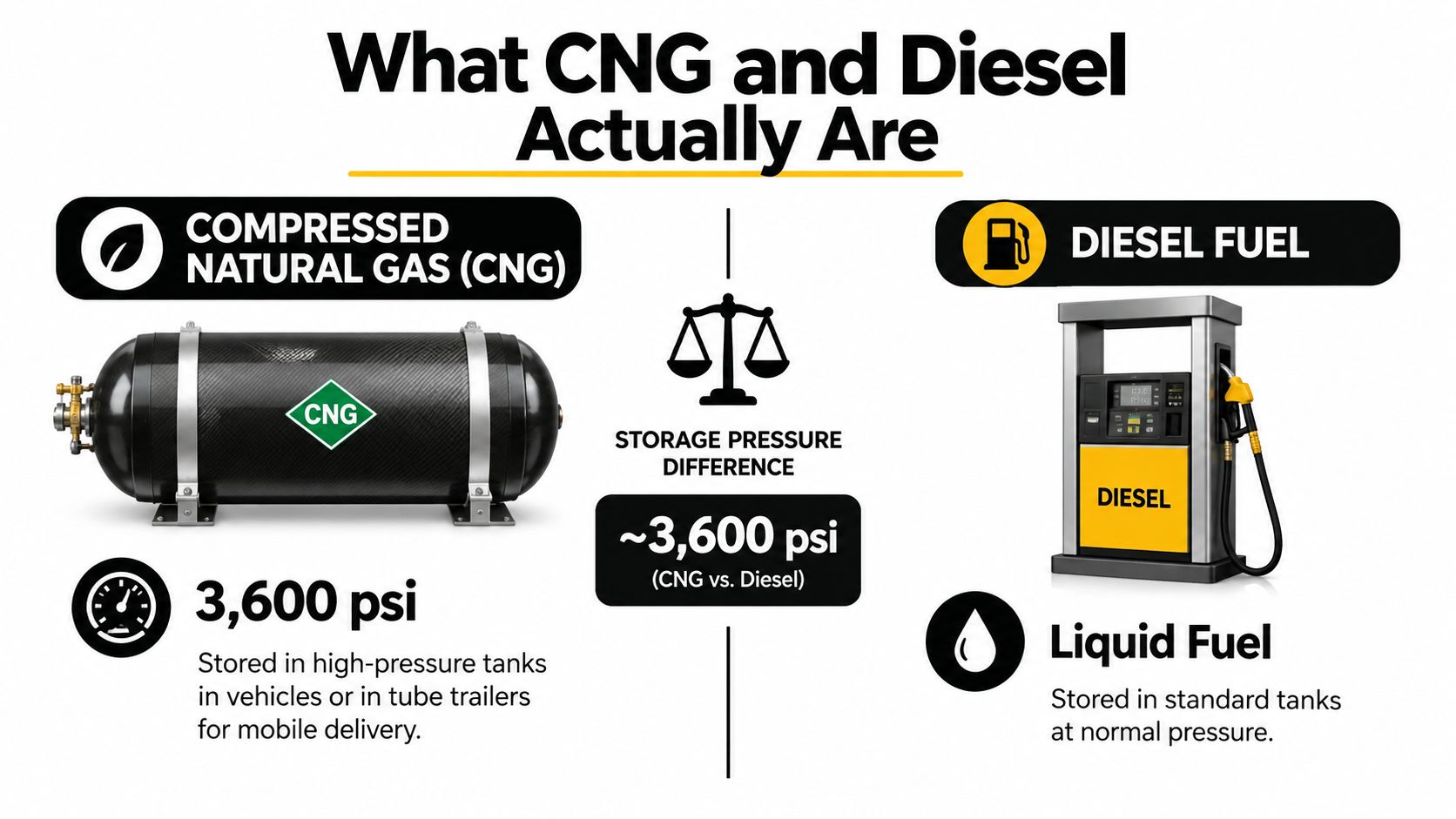
Compressed natural gas is natural gas stored as a high-pressure gas rather than as a liquid. Vehicle cylinders commonly operate around 3,600 psi, while tube trailers can deliver compressed gas to locations without a permanent pipeline. Stationary generator systems use pressure regulation equipment to reduce that stored pressure to the level required by the engine.
Diesel follows a simpler physical model. It is a liquid stored in conventional tanks and transferred with standard pumping equipment. That makes diesel easy to inventory, move, and dispense at many construction and industrial sites. CNG requires more attention to cylinder placement, pressure equipment, connection procedures, and usable reserve.
Use energy-equivalent units
Comparing a physical gallon of diesel with a physical volume of gas produces a misleading result. Operators should compare diesel-gallon equivalents, or DGE, because the unit expresses equivalent energy rather than container volume. According to the U.S. Department of Energy fuel comparison chart, 1 DGE contains the same energy as approximately 6.37 pounds, or 139.30 cubic feet, of CNG. The same source states that diesel has about 13% more energy per gallon than gasoline on its comparison basis.
| Property | Compressed Natural Gas | Diesel |
|---|---|---|
| Physical state | Gas compressed for storage | Liquid fuel |
| Typical vehicle storage | High-pressure cylinders around 3,600 psi | Standard liquid-fuel tanks |
| Mobile delivery | Tube trailers and pressure-regulated equipment | Tanker delivery and pumping |
| Fair energy comparison | DGE or delivered megajoules | DGE or delivered megajoules |
| Main planning issue | Tank footprint, pressure, reserve, and delivery timing | Tank capacity, fuel quality, and delivery timing |
The unit choice affects procurement. Ask suppliers for cost per DGE or cost per delivered megajoule, not merely cost per physical gallon. A low quoted CNG price can lose its advantage if the site needs additional storage, more frequent deliveries, or standby fuel to protect against supply interruption.
Emissions, Pollutant by Pollutant
CNG is not automatically cleaner across every emissions category. Its advantage depends on the pollutant being measured, the engine calibration, the operating conditions, and the methane released before or during use.
The clearest heavy-duty difference is nitrogen oxides. A 2019 U.S. Environmental Protection Agency analysis comparing model-year 2010-and-newer diesel and CNG heavy-duty vehicles found that CNG vehicles had lower NOx emission rates than the diesel cases. That can matter for urban delivery fleets, construction sites near occupied buildings, and facilities operating under local air-quality constraints. The findings are summarized by the U.S. Department of Energy's natural-gas emissions guidance.
The same analysis found that carbon dioxide rates were comparable. It also found that CNG PM2.5, carbon monoxide, and total-hydrocarbon rates could be significantly higher, depending on calibration and operating conditions.

Tailpipe improvement isn't the whole climate story
A generator operator may see a local air-quality benefit from lower NOx while receiving little or no carbon dioxide advantage at the tailpipe. The U.S. Department of Energy describes heavy-duty natural-gas vehicles as capable of small-to-moderate life-cycle greenhouse-gas reductions compared with diesel, but it emphasizes that outcomes depend on relative fuel economy, upstream methane leakage, and methane leakage from the vehicle.
That distinction is important for temporary energy systems. CNG can improve conditions around a site without guaranteeing lower full life-cycle greenhouse-gas emissions. Methane has a higher hydrogen-to-carbon ratio than diesel, which gives natural gas a chemical carbon advantage, but leakage and engine efficiency can offset it.
Make the emissions decision by objective
- For local NOx control, CNG deserves serious consideration, especially where nearby workers, residents, or occupied buildings face air-quality constraints.
- For particulate matter, don't assume CNG automatically wins. Engine configuration and operating conditions matter.
- For carbon dioxide, compare the actual equipment and duty cycle rather than relying on fuel labels.
- For life-cycle climate performance, include methane leakage, fuel economy, and vehicle or generator technology.
The practical conclusion is straightforward. Choose CNG when the local air-quality benefit solves a real permitting or operating problem, not because “natural gas” is a universal synonym for clean. Choose diesel when reliable deployment and heavy-load response matter more than a potential emissions advantage.
Fuel Economy, Energy Density, and Onboard Storage
Natural gas carries more energy by mass than diesel, but that fact doesn't guarantee better fuel economy. A 2023 peer-reviewed review of heavy-goods vehicles reports typical net calorific values of approximately 50 megajoules per kilogram for natural gas and 43 megajoules per kilogram for diesel, about 15% more energy per kilogram for natural gas. The review also notes that lower natural-gas-engine efficiency and methane leakage can offset that chemical advantage. Its findings are available in this review of well-to-wheel life-cycle emissions.
Diesel engines generally convert fuel into useful work more efficiently, while diesel itself stores energy densely as a liquid. CNG therefore needs larger cylinders to provide comparable working range or generator autonomy. Those cylinders consume space that could otherwise hold tools, cargo, batteries, or auxiliary equipment.
Storage changes the operating plan
A CNG installation has to account for:
- Cylinder footprint, including clearance and access requirements.
- Pressure regulation, which must deliver stable fuel conditions to the engine.
- Temperature effects, because gas behavior and usable capacity can vary with ambient conditions.
- Reserve capacity, so the generator doesn't reach a supply limit during a critical operating period.
- Delivery frequency, particularly when a generator runs continuously.
This is why fuel price comparisons often fail. A cheaper energy unit can require more site space, more coordination, or more frequent replenishment. For projects that combine temporary power with modular buildings or specialized infrastructure, a resource such as Pacific Mobile Structures' data center cost guide can help frame the wider facility-planning context, even though fuel selection still requires its own load and delivery model.
The procurement question should be cost per DGE or delivered megajoule, adjusted for storage and delivery. If the CNG price looks attractive but the site needs another trailer, a larger pad, or additional standby fuel, the apparent saving may disappear.
Infrastructure Break-Even, Not Headline Fuel Price
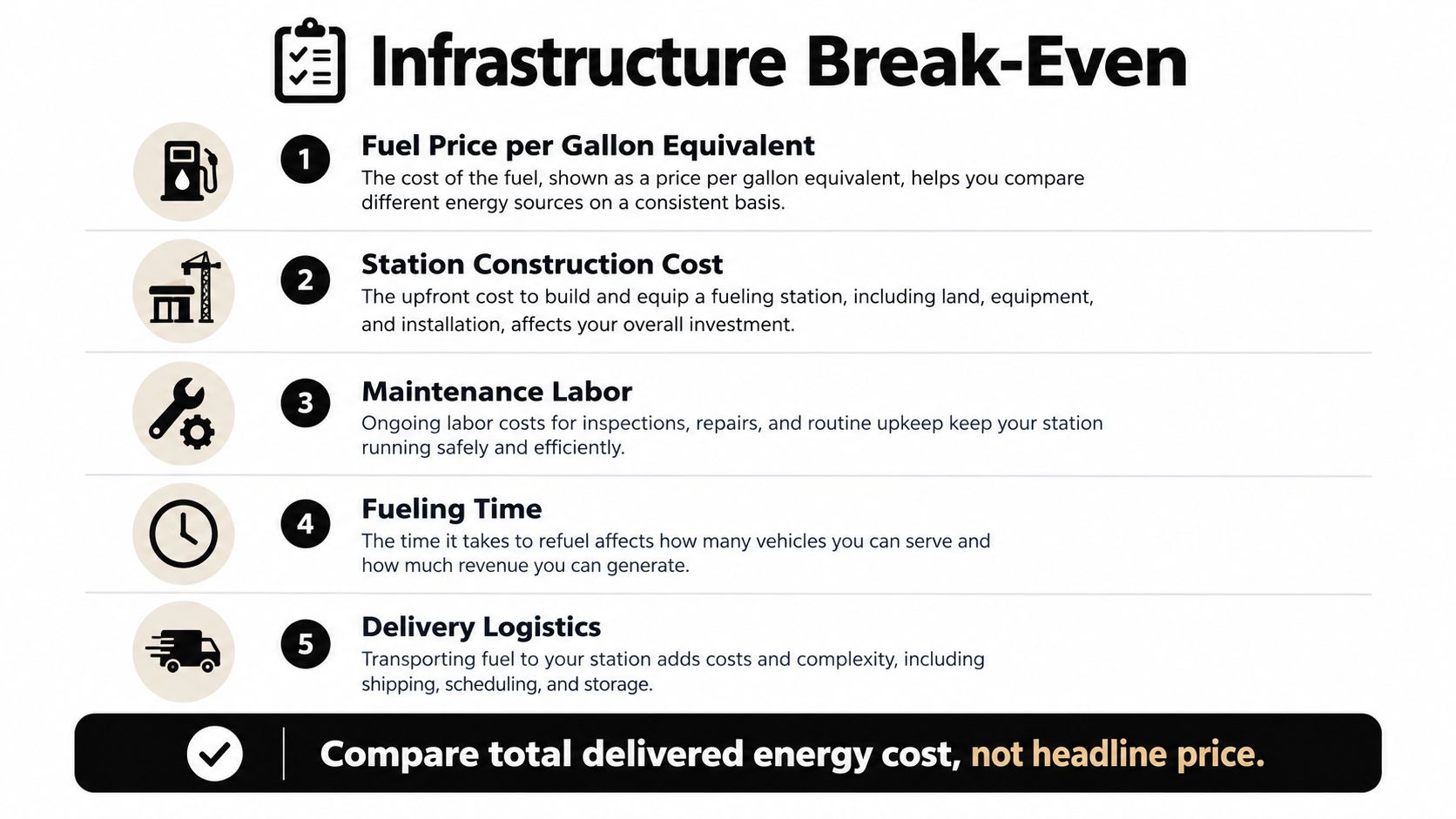
Start from total delivered energy cost over the project's actual duration, then test whether the fuel system can support the work without delaying commissioning or occupancy.
CNG costs can include compression, transport, storage, permitting, connection equipment, standby capacity, operator labor, pressure regulation, and backup fuel. Diesel usually requires less mobilization, but it brings exposure to fuel-price volatility, emissions-control maintenance, local air-quality restrictions, and the financial cost of delays.
The U.S. Department of Energy fleet business-case model uses cost and throughput data from federally supported CNG infrastructure projects. Its method supports a practical rule: evaluate infrastructure alongside fuel consumption. Treating infrastructure as a fixed assumption can hide the point at which CNG starts paying for itself.
Test the project in operating windows
Short, low-load work usually favors diesel. A generator serving a limited commissioning task or a small crew needing temporary power may not run long enough to recover the cost of mobile compression and storage. Diesel has low delivery friction, and operators already know its tanking and replenishment procedures.
Multi-week work warrants a full CNG model. As throughput rises, fixed mobilization costs become a smaller share of delivered energy. Sustained generator demand, temporary gas service during a pipeline repair, or a building awaiting permanent service can justify mobile CNG when supply and delivery access are dependable.
Longer, high-load work can favor CNG when the supply chain is reliable and the project gains from lower local NOx, reduced noise, or protection from permanent-line delays. Storage capacity, delivery access, and backup arrangements still determine the result.
Build a side-by-side worksheet covering:
- Fuel consumed, converted to DGE or delivered megajoules.
- Equipment mobilization and demobilization.
- Compression, storage, regulation, and connection.
- Transport and delivery labor.
- Permitting, site preparation, and standby capacity.
- Diesel maintenance and emissions-control requirements.
- Delay costs if the selected system cannot support commissioning or occupancy.
Infrastructure break-even is a project calculation. It cannot be copied from a fleet average.
A short, low-demand project may never recover mobile CNG's coordination costs. Sustained commissioning can produce the opposite result, particularly when a delayed occupancy date or production start costs more than the temporary energy system. For a construction or industrial operator, project duration decides whether CNG's added infrastructure earns its place.
Performance, Maintenance, and Refueling Logistics
Diesel remains the easier choice for operators who need immediate deployment, compact fuel storage, and strong response to changing loads. Compression ignition gives diesel equipment a familiar operating profile, and liquid fuel can be stored on site with straightforward pumping equipment.
CNG equipment can operate smoothly and requires less noise attention, but it adds a high-pressure fuel system and, in spark-ignited applications, an ignition system that requires its own service attention. Operators should plan for spark-plug and ignition-system inspections, pressure-regulation checks, and delivery coordination rather than treating a CNG package as a diesel generator with a different fuel hose.
Diesel brings a different maintenance profile. Modern units may require careful attention to particulate filters, emissions aftertreatment, fuel quality, and operation under the intended load. A generator that spends too much time at light load can create operational and maintenance problems even if the fuel supply is reliable.
Refueling is part of reliability
Diesel generally offers the simplest replenishment process. A truck can deliver liquid fuel to a tank, and the generator can continue running while the operator follows established fuel-handling procedures. The limitation is that long-duration operation still requires enough tank capacity, delivery access, and protection against fuel contamination or interruption.
CNG depends on delivery pressure, available storage, connection equipment, and the supplier's ability to maintain the required flow. Mobile delivery can support a site overnight or through a prolonged outage, but the plan needs a reserve strategy. A single missed delivery or pressure problem can affect the entire energy system.
The same discipline applies to ancillary electric equipment. A practical Campus EV maintenance cost guide illustrates why operators should evaluate the full maintenance environment around a project, not only the prime mover. Inspection routines, service access, trained personnel, and downtime planning all affect overall operating cost.
Match the machine to the load
Diesel is usually friendlier when the job has sharp load changes, remote access, or a tight mobilization window. CNG becomes more attractive when the load is steady, the site can support the equipment, and the project lasts long enough for fuel and emissions benefits to matter.
Neither fuel eliminates maintenance. The better choice is the one your team can service, refuel, and monitor without creating a new single point of failure.
Where Each Fuel Earns Its Place
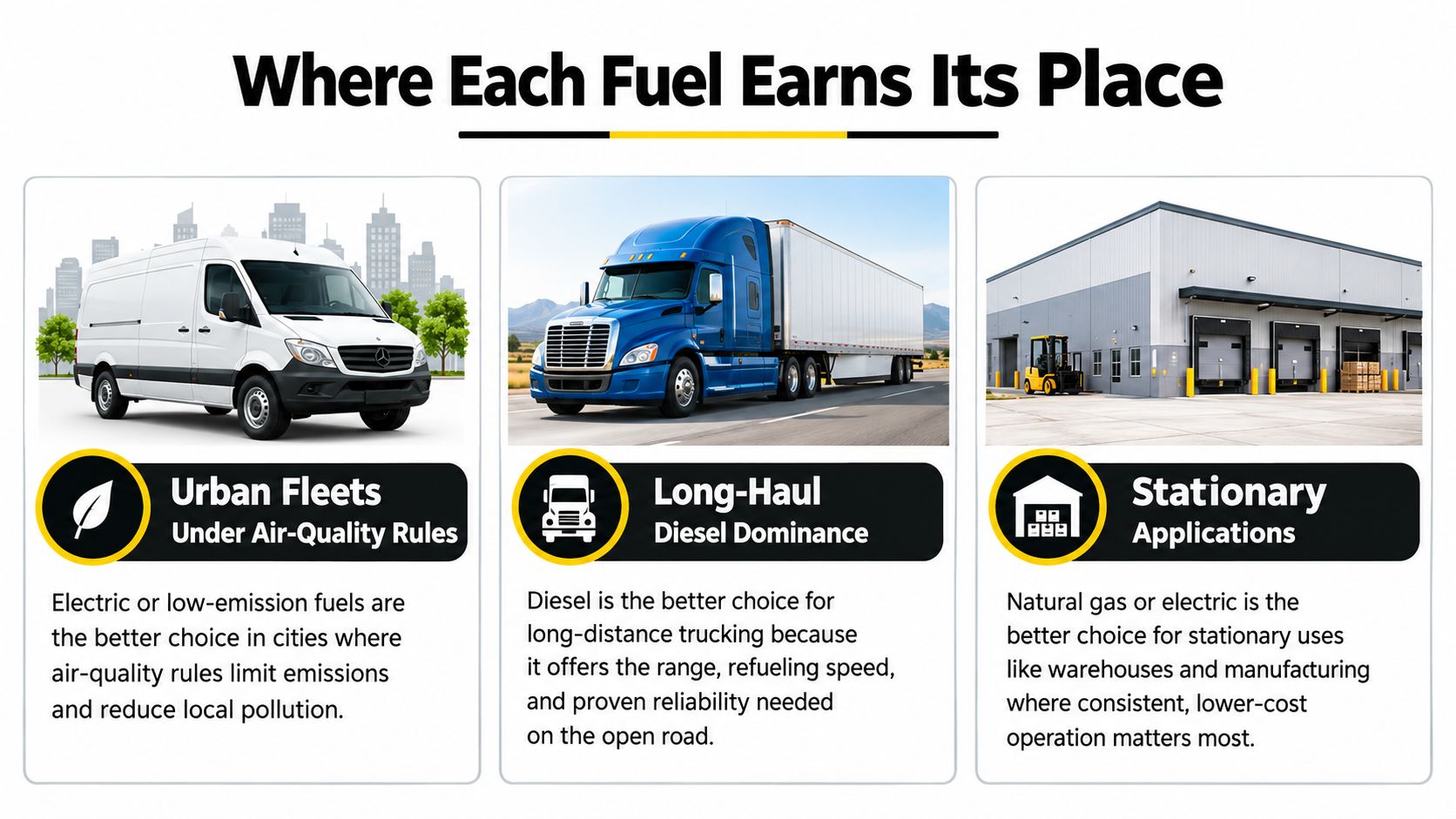
Fuel selection becomes clearer when tied to operating conditions instead of broad environmental claims.
Urban delivery fleets
CNG can make sense for refuse trucks, delivery vehicles, and other fleets that return to a predictable base. Lower NOx rates in the EPA comparison can support local air-quality objectives, while regular return-to-base behavior makes fueling infrastructure easier to use. The fleet still needs to evaluate tank space, route range, vehicle availability, and methane performance.
Long-haul trucking
Diesel remains the stronger default for long-haul work that demands dense onboard energy, long range, broad fueling access, and fast turnaround. CNG can work on defined corridors with dependable fueling, but the storage footprint and infrastructure requirements make it harder to displace diesel across irregular routes.
Construction and temporary power
Temporary CNG earns its place when permanent gas service is delayed but the project has a meaningful operating window. That includes construction sites waiting for occupancy approval, generator commissioning during line installation, and facilities that need a bridge supply while a pipeline is repaired or replaced.
Diesel is better when the project is short, remote, lightly loaded, or unable to accommodate high-pressure storage. It also remains the practical backup when a CNG supply plan has no credible reserve.
Winter freeze prevention and utility outages
Freeze prevention can justify CNG when the protected facility must operate continuously and a pipeline outage would otherwise threaten equipment or occupancy. Industrial facilities and utilities can use mobile gas as a bridge, but they should confirm delivery access, regulation, emergency procedures, and backup fuel before the outage begins.
The pattern is consistent. CNG fits an infrastructure gap with sustained demand. Diesel fits a rapid-response requirement where the operator values autonomy and minimal site complexity.
A Practical Decision Framework
Use four questions before approving either fuel.
- How long will the demand last? A short runtime usually favors diesel. A multi-week window gives CNG more opportunity to recover mobilization and storage costs.
- How large and continuous is the load? High, steady demand supports a stronger CNG business case than intermittent low-load operation.
- What local rules apply? Air-quality, noise, permitting, and occupancy requirements can change the value of lower local NOx or quieter operation.
- What does delay cost? If waiting for permanent gas service postpones occupancy, commissioning, production, or utility restoration, include that cost in the comparison.
Duration and throughput, not headline price, decide whether temporary CNG is worth mobilizing.
My recommendation is direct. Choose diesel for short, remote, or rapidly deployed jobs where deployment friction dominates and the site can manage liquid-fuel storage. Choose CNG for multi-week or high-load temporary energy needs where local emissions, noise, schedule pressure, or a delayed permanent connection reward the additional coordination.
Before equipment arrives, calculate delivered energy cost, confirm storage and delivery capacity, define a backup plan, and price the cost of delay. That four-part check will produce a better answer than comparing CNG and diesel prices on a fuel invoice.
Blue Gas Express provides mobile CNG and LNG delivery for construction sites, industrial facilities, generator commissioning, occupancy requirements, freeze prevention, and temporary utility service across North Carolina, South Carolina, Tennessee, and Virginia. If your project needs dependable natural gas before permanent infrastructure is ready, visit Blue Gas Express to discuss a temporary supply plan.