

Ever finished a major construction project? That feeling of seeing the final nail hammered in is incredible, but you're not quite at the finish line yet. Before anyone can legally step inside to live or work, you need one last, crucial document: the Certificate of Occupancy (CO).
Think of it as the building's official permission slip. It's a formal document issued by your local government or building department that certifies a building is safe, up to code, and ready for humans. Without it, you can't legally "drive" the property—whether that means moving in, renting it out, or selling it.
Your Building’s Green Light
At its heart, a Certificate of Occupancy is the government's final stamp of approval. It’s the official verification that everything from the wiring and plumbing to the structural soundness and fire safety systems has passed a series of tough inspections.
This piece of paper is what transforms a newly built structure into a legally habitable space. For a property owner, it's the key that unlocks the door to generating revenue, finalizing a sale, or simply moving your family in.
A CO is your assurance that a property meets all essential safety and legal requirements, protecting both the owner and its future occupants from unforeseen hazards and legal complications.
The Legal Backbone of Occupancy
To really get what a CO does, you have to start with understanding local building codes. These codes are the rulebook for construction, setting the minimum safety and quality standards for everything built in a community. The CO is simply the proof that you followed that rulebook to the letter.
Its main job is to provide legal evidence that a building is fit for people. This isn't just about red tape; it's a fundamental requirement for anyone looking to legally occupy, use, or sell a property.
To put it simply, the Certificate of Occupancy plays several critical roles. Here's a quick look at its key functions.
Key Functions of a Certificate of Occupancy
| Function | What It Means for You |
|---|---|
| Legal Compliance | Legally permits you to live in, rent out, or operate a business in the building. |
| Safety Verification | Confirms that the property has passed all required safety inspections (e.g., fire, electrical). |
| Financial Necessity | Often required by lenders to close on a mortgage or by insurers to provide coverage. |
| Real Estate Transactions | A valid CO is almost always mandatory to legally sell a property to a new owner. |
Essentially, from a legal and financial standpoint, a building simply isn't complete without this certificate. It’s the final, non-negotiable step in the construction journey.
Key Triggers for Needing a Certificate of Occupancy
It’s a common misconception that a Certificate of Occupancy is only for brand-new buildings fresh off the blueprints. In reality, a CO is required anytime a building's fundamental purpose, structure, or safety profile changes in a significant way.
Think of it as the building's official permission slip from the city. Certain events trigger the need for a new one, and knowing what they are is key to avoiding serious headaches, costly delays, and legal trouble down the line.
New Construction
This one is the most obvious. Every single new home, office tower, or retail shop needs a Certificate of Occupancy before anyone can legally move in or open for business.
The CO is the final stamp of approval from the local building authority, confirming that the structure was built exactly to the approved plans and meets all current building, fire, and safety codes. Until that document is in hand, the structure is just an empty shell—not a usable property.
Major Renovations or Additions
You don't need a new CO for a minor facelift, but you absolutely will for major alterations. If you’re adding a new wing to a hospital, building a second story on an office, or completely reconfiguring the interior layout, a new CO is almost certainly in your future.
Why? Because these kinds of changes can dramatically affect things like the building's structural integrity, emergency exit routes, and electrical and plumbing systems. Everything has to be re-inspected and re-approved to ensure it's still safe. A good rule of thumb is that if the work requires a building permit, it’s probably going to require a new CO when it’s all done.
Change of Use or Occupancy Classification
This is a huge one. When you change what a building is for, you’re also changing its safety and zoning requirements, which means a new Certificate of Occupancy is mandatory. An old warehouse being converted into trendy loft apartments, for example, has an entirely new set of rules to follow for residential safety that simply didn't apply when it was just storing boxes.
Think of it like this: A vehicle designed to haul cargo (a truck) needs different safety features than one built to carry people (a bus). When you change a building's use, you're essentially re-certifying it for its new "passengers."
Failing to get a new CO after a change of use is a serious compliance issue that can lead to fines, shutdown orders, and even voided insurance policies.
Here are a few common examples that trigger a new CO:
- Retail to Restaurant: This brings in new requirements for commercial kitchen fire suppression, ventilation, and different accessibility standards.
- Single-Family Home to Multi-Unit Rental: This change requires new fire separation walls between units, separate utility meters, and updated egress paths.
- Office Space to Medical Clinic: This conversion demands specific plumbing for exam rooms, different HVAC systems for air quality, and stricter accessibility for patients.
Getting Your Certificate of Occupancy: A Step-by-Step Guide
Getting a Certificate of Occupancy can feel like navigating a maze of red tape, but it’s actually a pretty logical process. If you understand the steps, you can create a clear game plan and sidestep the headaches and delays that plague so many projects. Think of it as a series of checkpoints, not one giant hurdle.
Each stage is there for a reason: to confirm your project is safe, structurally sound, and meets all the local rules before anyone sets foot inside. While the fine print can change from town to town, the basic roadmap from application to final approval is almost always the same.
Let's break it down.
1. Submitting the Application and Plans
Your path to a CO starts way before construction wraps up. The first move is to file a detailed application with your local building department. This is more than just a form—it's the complete blueprint for your project.
You’ll need to bundle together everything from architectural and engineering plans to site surveys and proof of all your building permits. Getting this initial package right is crucial. Any missing piece or mistake can stop you in your tracks before you’ve even started.
2. Passing a Series of Critical Inspections
With your application in, the real action begins: the inspections. This is where officials come to your site at different stages to sign off on the work. It’s not a single, final tour; it’s a sequence of targeted checks as you build.
You can almost always count on these key inspections:
- Structural Inspection: This is where they check that the foundation, framing, and key support walls match the plans and meet code. It’s all about the building's bones.
- Plumbing Inspection: An inspector will make sure all your water lines, drains, and vents are installed properly and, most importantly, don't leak.
- Electrical Inspection: Here, every wire, outlet, and circuit breaker gets a close look to ensure the system is safe and up to standard.
- Fire Safety Inspection: A big one. This covers fire alarms, sprinkler systems, emergency exits, and lighting—everything needed to keep people safe.
You have to pass each of these inspections before you can proceed with the next phase of work.
A failed inspection isn't just a minor delay; it can bring that part of your project to a dead stop. The secret to keeping things moving is to anticipate problems and keep the lines of communication with your inspectors wide open.
3. The Final Walk-Through and Approval
Once construction is done and all the mid-project inspections are checked off, it's time for the final boss: the final inspection. A city inspector will do a top-to-bottom walk-through to make sure every last detail lines up with the plans and satisfies every code. They’re confirming that the building is 100% ready for people.
If they spot anything wrong, you'll get a "punch list" of fixes. You have to correct every single item on that list before they'll come back for a re-inspection. Once you get the all-clear, the building department will finally issue your official Certificate of Occupancy. That piece of paper is your legal green light to move in and use the space.
Navigating Inspections and Avoiding Common Roadblocks
The inspection phase is where many projects hit frustrating, and frankly, expensive delays. Think of it as the final exam for your building; passing requires careful preparation, not last-minute cramming. This is where every detail, from the wiring hidden behind the walls to the precise slope of a wheelchair ramp, is scrutinized against strict local codes.
When you get it right, inspections aren't a source of stress but a smooth quality-control checkpoint. It really all comes down to being proactive and keeping the lines of communication wide open.
The Standard Inspection Workflow
The journey from submitting your application to getting that final sign-off involves several key milestones. While specifics vary by location, the general flow is pretty consistent.
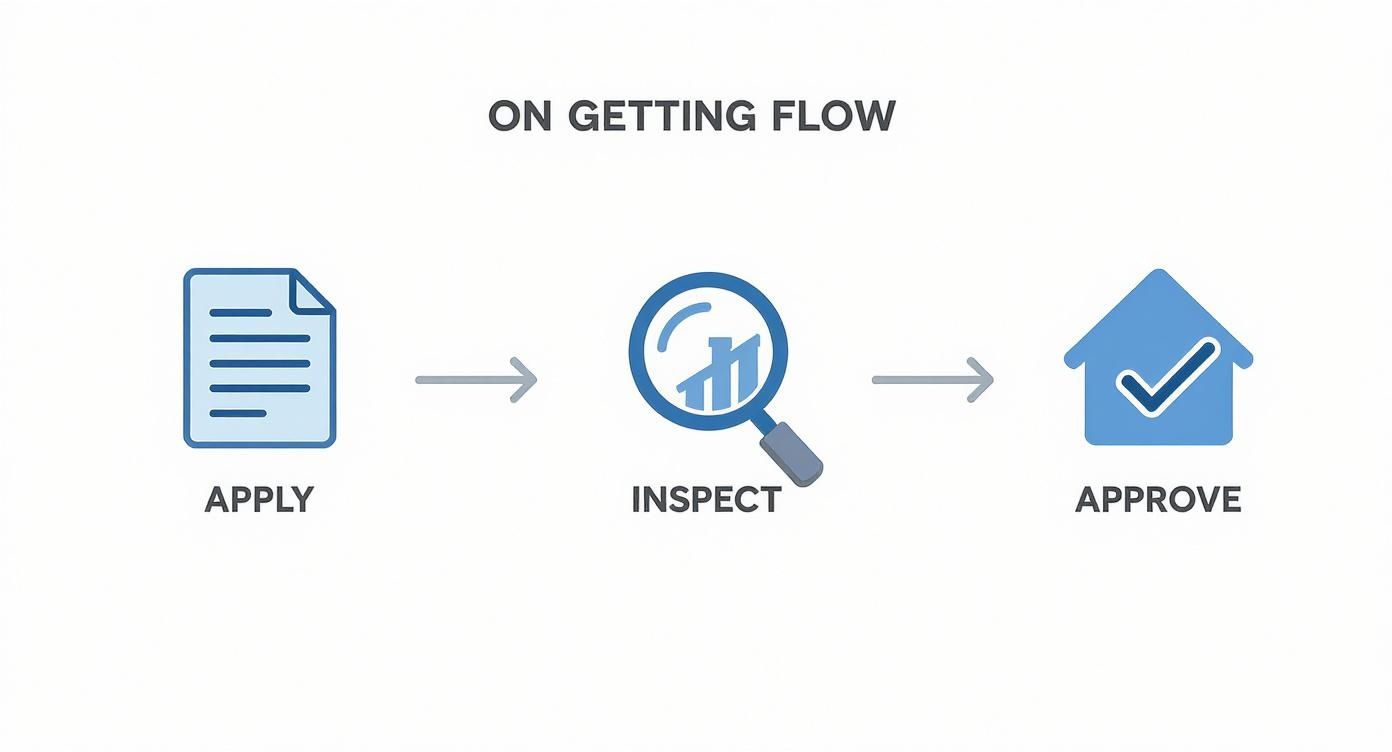
As you can see, inspections form that critical, hands-on bridge between submitting paperwork and receiving final approval. It's often the most intensive part of the entire process.
Red Flags That Inspectors Look For
Inspectors are trained to spot two things: deviations from the approved plans and any code violations that could compromise safety. For instance, staying on top of things like regular plumbing inspections throughout the build can prevent major headaches with water and sewer systems later on.
To help you prepare, here’s a look at some of the most common issues that trip people up during final inspections.
| Inspection Area | Common Failure Point | Prevention Tip |
|---|---|---|
| Electrical | Unsecured wiring, overloaded circuits, or incorrectly grounded outlets. | Have your electrician perform a full system check against the latest National Electrical Code (NEC) standards before the inspector is called. |
| Plumbing | Improperly sloped drain lines, unsecured pipes, or missing backflow preventers. | Do a pressure test on all supply lines and a flow test on all drains well ahead of the final inspection. |
| Structural | Unauthorized changes from approved architectural plans (e.g., moving a wall). | Implement a strict change order process. Ensure any deviation, no matter how small, is documented and approved by the architect and AHJ. |
| Safety/Egress | Blocked emergency exits, incorrect door hardware, or inadequate exit signage. | Walk the egress paths yourself. Do all doors open correctly? Is signage visible and illuminated? Is the path completely clear? |
Remember, these aren't just minor slip-ups; they can bring your entire project to a halt.
A failed inspection isn't just a mark on a report; it's a stop-work order that costs real time and money. Each day of delay can add thousands to a project's budget, making a first-pass approval a huge financial win.
Strategies for a Smooth Inspection Process
The best way to sail through inspections is to design problems out of the project from the start. That means having a deep respect for building codes and maintaining an open dialogue with your entire team—from the general contractor to every last sub.
Here are a few actionable tips that can make all the difference:
- Conduct Pre-Inspection Walk-Throughs: Have your site superintendent or GC perform a meticulous internal review a few days before the official inspector arrives. It's your chance to catch and fix mistakes.
- Maintain Meticulous On-Site Records: Keep all permits, stamped plans, and subcontractor documentation in an organized, accessible binder on-site. When the inspector asks for it, you'll have it ready.
- Establish a Single Point of Contact: Designate one person, usually the superintendent, to be the sole communicator with the inspector. This prevents conflicting information and keeps the conversation clear and professional.
If you treat the inspection process as a collaborative verification of quality—not an adversarial encounter—you’ll find the path to getting your Certificate of Occupancy is a whole lot smoother.
How a CO Impacts Your Project's Bottom Line
A Certificate of Occupancy is more than just a piece of paper; it’s the financial key that unlocks the final, and often largest, payments on a project. For anyone managing the budget—from contractors to owners—grasping how the CO controls the flow of cash is non-negotiable.
Think of it this way: until the city or county issues that certificate, your project isn't officially "done" in the eyes of the law, the bank, or even the contract itself. This has a direct, and sometimes painful, impact on when the last checks get cut.
The Connection Between Your CO and Final Payments
The most immediate financial hit comes from a standard practice in construction contracts called retainage. This is where the property owner holds back a slice of the money owed to the contractor during the project.
This chunk of cash, usually 5% to 10% of the total contract value, serves as a kind of performance bond. It’s leverage to make sure the contractor finishes every last detail and fixes any lingering punch-list items. On a $1 million job, that’s $50,000 to $100,000 sitting on the sidelines.
The Certificate of Occupancy is almost always the contractual trigger that forces the owner to release those retainage funds. No CO, no final payment. It’s often that simple, and it can put a serious squeeze on a contractor's cash flow.
Substantial Completion Is Not Final Completion
Here’s a common point of confusion that can lead to some serious headaches: the difference between two types of "completion." A contractor might issue a Certificate of Substantial Completion, which basically says the building is safe and ready for its intended use.
But that’s an internal document between the owner and the contractor. It is not the government-issued Certificate of Occupancy.
Lenders and owners are waiting for the official stamp of approval from the local building authority. That CO is the ultimate proof that the building is safe and up to code. It's why final loan disbursements and those big retainage payments are tied directly to it. You can dig deeper into how these documents fit into the project closeout process over at Procore's resource library.
This distinction is critical. A contractor might have packed up their tools and moved on, but from a financial and legal standpoint, the job isn't over until the CO is in hand. Any delay in getting that certificate freezes the final payments, strains relationships, and can quickly turn a profitable project into a financial nightmare.
So, What About a Temporary Certificate of Occupancy?
Picture this: your new building is safe and structurally sound, but the landscapers are still waiting on a shipment of trees and the final coat of paint in the lobby isn't quite dry. Does the whole project have to grind to a halt? Not necessarily. This is where a Temporary Certificate of Occupancy (TCO) can save the day.
A TCO is an official, short-term pass from the building department. It confirms that all the critical life-safety systems—we're talking fire alarms, plumbing, electrical, and HVAC—are fully functional and have passed inspection. It gives you the legal green light to occupy the space, even while minor, non-essential work is still wrapping up.
Think of it as a provisional license. It's not the final goal, but it’s a crucial bridge that gets you from "construction site" to "operational building" without waiting for every last detail to be perfect.
When Does a TCO Actually Make Sense?
A TCO isn't a free pass to cut corners; it's a practical tool for specific situations. The core idea is to provide flexibility for owners and tenants to start using a space that is fundamentally safe while the final touches are put in place.
Here are a few classic examples where a TCO comes in handy:
- Phased Occupancy: For a new high-rise, a TCO might let tenants move into the finished lower floors while crews are still working on the penthouses.
- Seasonal Delays: Imagine it's the middle of winter and impossible to pour the final concrete for the patio. A TCO lets you open for business indoors while you wait for warmer weather.
- The Final Punch List: If the only things left are minor cosmetic details that pose no safety risk, a TCO prevents these small items from holding up your entire grand opening.
A Temporary Certificate of Occupancy isn't open-ended. It’s usually valid for a set period, often around 90 days, depending on your local jurisdiction. This puts you on the clock to finish up the remaining work before you have to apply for an extension or risk having it expire.
Got Questions About Your CO? We've Got Answers.
When you're deep in a construction or real estate project, the paperwork can feel overwhelming. Let's cut through the noise and answer a few of the most common questions people have about getting that all-important Certificate of Occupancy.
So, Can I Sell a Place Without a Certificate of Occupancy?
The short answer? Not really. Trying to sell a property without a valid CO is a logistical and legal nightmare.
Think about it from the buyer's perspective. No lender in their right mind will approve a mortgage for a property that hasn't been officially declared safe and up to code. This immediately cuts out almost every potential buyer. On top of that, you're opening yourself up to a world of legal and financial risk by trying to offload a property that isn't technically legal to live in.
What's This Going to Cost Me?
The price tag for a Certificate of Occupancy can be all over the map. It really depends on your city or county, the scale of your project, and how complex the building is. You could be looking at a few hundred dollars or easily several thousand.
What are you actually paying for? The fees usually break down into a few key areas:
- The initial application and processing fees.
- Charges for each specific inspection—plumbing, electrical, fire, and so on.
- Extra fees for re-inspections if the first go-around uncovers problems.
Your best bet is to call your local building department directly. They'll have a clear fee schedule so you know exactly what to expect.
It's easy to get sticker shock from the fees, but remember this: the fines for occupying a building without a valid CO are in a completely different league. We're talking potential fines of thousands of dollars per day, stop-work orders, or even being forced to vacate the building immediately.
What Happens if I Just… Don’t Get One?
Skipping the CO is one of the riskiest gambles you can take on a project. It’s not just a suggestion; it's the law.
If you occupy a building without one, you can expect hefty daily fines, legal action from the local authorities, and potentially an order to clear everyone out on the spot. Even worse, if there's a fire or accident, your insurance company will likely deny your claim, leaving you personally on the hook for everything. It's a critical step you simply can't afford to miss.
When testing and commissioning your building's gas systems is the last hurdle between you and your CO, Blue Gas Express can bridge the gap. We provide temporary natural gas solutions that give you the clean, consistent fuel needed to fire up equipment, pass those final inspections, and get your Certificate of Occupancy signed off without a hitch. Check out how we can help at https://bluegasexpress.com.