

Hot tapping is the go-to method for creating a new branch connection on a live, pressurized pipeline without ever having to shut it down. For any industry where a continuous gas supply is critical, this technique is a lifesaver. It completely sidesteps the need for a costly and disruptive system shutdown, all through a precise, engineered process that puts safety and operational continuity first.
Connecting to Live Pipelines Without Shutdowns
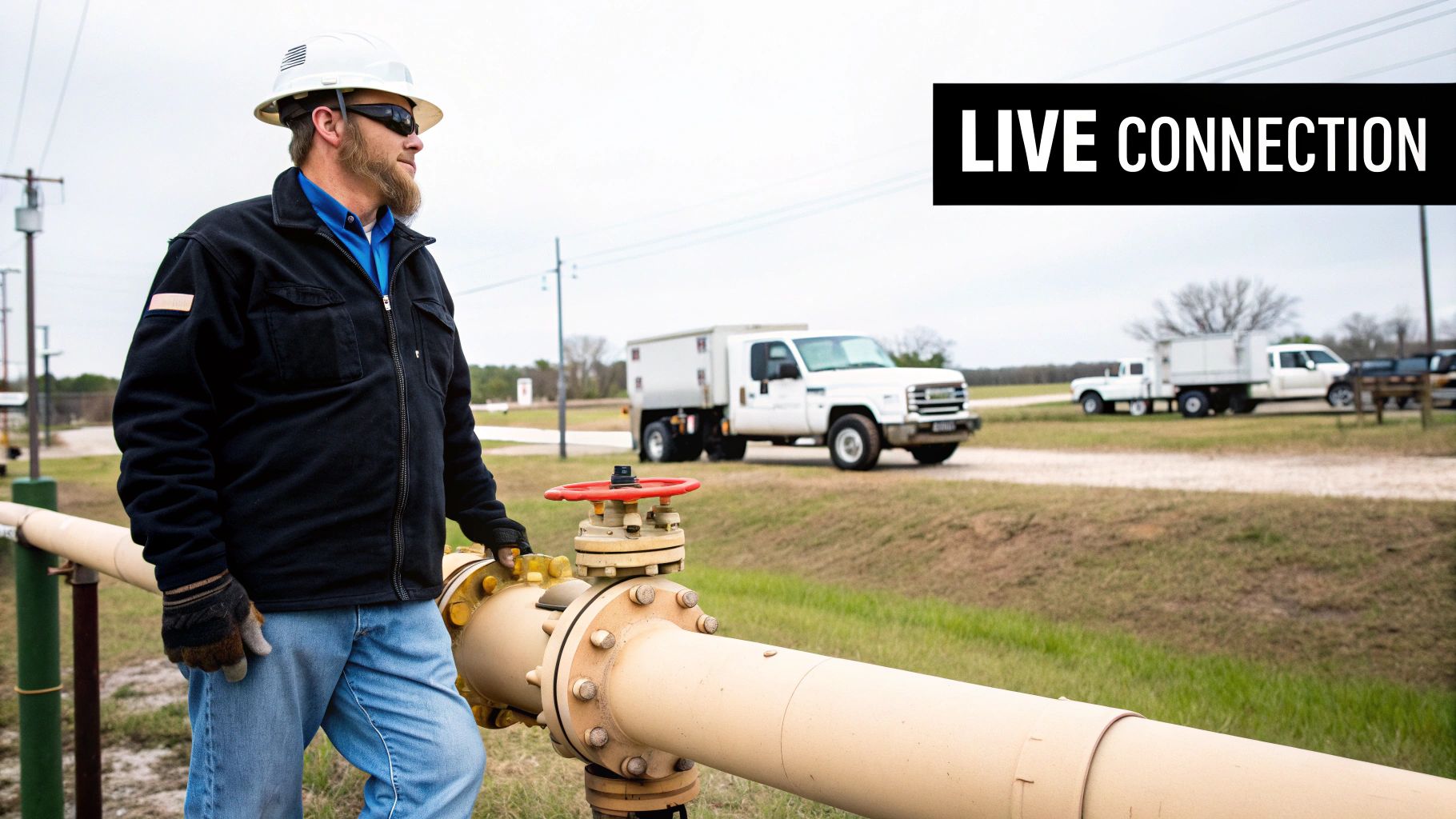
Think about what it takes to add a new connection to a major natural gas pipeline. The old-school approach meant a complete system shutdown. You'd have to vent huge amounts of valuable gas and deal with major downtime for every single customer on that line. Hot tapping completely changes the game.
The technique involves welding a specialized fitting and valve directly onto the active pipe. Once that’s secure, a drilling machine attaches to the valve and cuts into the pipeline, creating the new access point. The best part? This all happens while the product—whether it's natural gas, water, or oil—keeps flowing without a single interruption.
Why Avoid a Shutdown
For big industrial facilities, active construction sites, and utility providers, the advantages are massive. A shutdown isn't just a minor hassle; it’s a direct hit to the bottom line. Hot tapping offers a serious strategic edge.
- No More Downtime: Operations just keep running. That means revenue and productivity are protected.
- Continuous Customer Service: Utilities can expand or repair their grids without cutting off service to homes and businesses.
- Keeps Projects on Schedule: Construction jobs that depend on gas service can move forward without costly delays, helping meet those all-important occupancy permits.
- Better for the Environment: You get to skip the "blow down" process, which avoids venting huge amounts of methane into the atmosphere.
Since the 1950s, hot tapping has grown from a specialized trick to a standard, indispensable procedure. It's fundamentally changed how operators plan for maintenance and expansion. The EPA even points to hot tapping as a key practice for reducing methane emissions, as it prevents the traditional blowdown that can release millions of cubic feet of gas.
For businesses like construction sites that need a continuous gas supply, hot tapping procedures make it possible to tie in temporary CNG or LNG systems while keeping the main network pressurized. This simple capability is often the one thing that keeps a project from falling behind schedule. You can find more expert insights on hot tapping's role from specialists like TEAM, Inc..
Key Takeaway: The real value of hot tapping is its power to modify a live system. It’s more than just a technical job—it's a business continuity tool that saves time, money, and resources while being safer and better for the environment.
Laying the Groundwork for a Flawless Hot Tap
Anyone who’s been in the field long enough knows the truth about hot tapping: 90% of the job is preparation, 10% is execution. The real work happens well before a welder strikes an arc or a tapping machine gets bolted on. This is where you build the foundation for a safe, successful operation, and skipping these steps isn't just a risk—it's asking for trouble.
The whole procedure starts with getting intimately familiar with the pipeline you’re about to modify. You can't work off assumptions. A thorough site assessment is your first order of business, and this isn't a quick walk-around. It’s a hands-on investigation to confirm exactly what you're dealing with.
This initial deep dive means verifying a few critical details:
- Material Identification: Is it carbon steel? Stainless? Something else? The pipe’s material dictates your entire welding procedure and which cutter you’ll need for the machine.
- Wall Thickness Measurement: We get out the ultrasonic testing (UT) equipment to confirm the pipe wall is thick enough. You need enough steel to support the new weld and handle the tapping pressure without a hint of compromise.
- Flow and Pressure Verification: What are the real-time operating conditions? We need exact numbers for the pressure, temperature, and flow rate of the product running through that line. This data is non-negotiable for all our engineering calculations and safety protocols.
Building a Bulletproof Work Plan
Once you have solid data from the site, you can put together a comprehensive work plan. Think of this document as the operational bible for the job. It’s far more than a simple to-do list; it details every single step, assigns clear responsibilities, and sets a realistic timeline from material delivery to the final pressure test.
For instance, if we're tapping a natural gas line for a new commercial development, the work plan must include coordinating with a temporary gas supplier like Blue Gas Express. This ensures their mobile CNG or LNG units are on-site and ready for a seamless tie-in, so the project never loses its gas supply.
A well-structured work plan transforms a complex operation into a sequence of manageable, verifiable tasks. It’s the single most important tool for keeping the project on schedule, within budget, and, most importantly, safe for everyone involved.
Sorting Out Permits and Running the Risk Assessment
With a solid plan, you can move on to securing permits and conducting a formal risk assessment. The permitting process can be a headache, often involving everyone from the local municipality to state environmental agencies. You absolutely have to start this early to keep the project from getting bogged down in red tape.
At the same time, we conduct a Job Safety Analysis (JSA), and this is a non-negotiable part of the process. It’s not just about flagging obvious hazards like welding sparks. We have to think through every possible "what-if." What's our plan if a seal on the tapping machine fails? What’s the emergency response if an atmospheric monitor starts screaming about a gas leak? The JSA must produce specific, actionable ways to handle every risk we can identify.
Before any work begins, this checklist helps ensure every base is covered. It's a systematic way to confirm that no detail, no matter how small, has been overlooked.
Hot Tapping Pre-Job Planning Checklist
| Planning Stage | Key Action Items | Verification Method |
|---|---|---|
| Site Assessment | Confirm pipe material, diameter, and operating pressure. Measure wall thickness. | Review as-built drawings, conduct ultrasonic testing (UT), and check SCADA data. |
| Work Plan Development | Create a step-by-step procedure. Schedule all personnel, equipment, and third-party services. | Formal document review and sign-off by project manager and engineering lead. |
| Permitting | Identify and apply for all required work permits (e.g., hot work, excavation, municipal). | Maintain a permit tracking log and confirm approvals with relevant authorities. |
| Risk Assessment | Conduct a Job Safety Analysis (JSA) to identify hazards and create mitigation plans. | Documented JSA signed by all crew members during the pre-job safety meeting. |
| Stakeholder Coordination | Align on schedule with utility owner, site managers, and temporary gas suppliers. | Documented communication plan and confirmed meeting minutes with all parties. |
Ultimately, a solid plan gets everyone on the same page. From the utility's engineers to our crew on the ground, everyone is working from the same blueprint. That coordinated approach is what turns a high-stakes job into a controlled, predictable, and successful project every time.
The Hot Tapping Procedure in Action
With all the planning, permits, and safety checks out of the way, it’s time to get hands-on. This is where the real work begins—the methodical, high-stakes process of creating a new connection on a live, pressurized pipeline. Every single step builds on the last, and there's no room for error.
The first thing we do on-site is prepare the pipe surface itself. The spot where the new fitting will be welded has to be absolutely perfect. We’re talking completely free of paint, rust, scale, or any coatings. This isn't just a quick wipe-down; it involves grinding down to clean, bare metal to ensure a solid, high-integrity weld.
Right after that, we bring in the Non-Destructive Testing (NDT) crew. They’ll use ultrasonic testing (UT) equipment to scan the exact spot we plan to tap. This is our final green light, confirming the pipe's wall thickness and making sure there are no nasty surprises like hidden corrosion or laminations. You never, ever weld or cut near a known flaw.
This diagram gives a great overview of the critical planning that happens long before we ever touch the pipe.
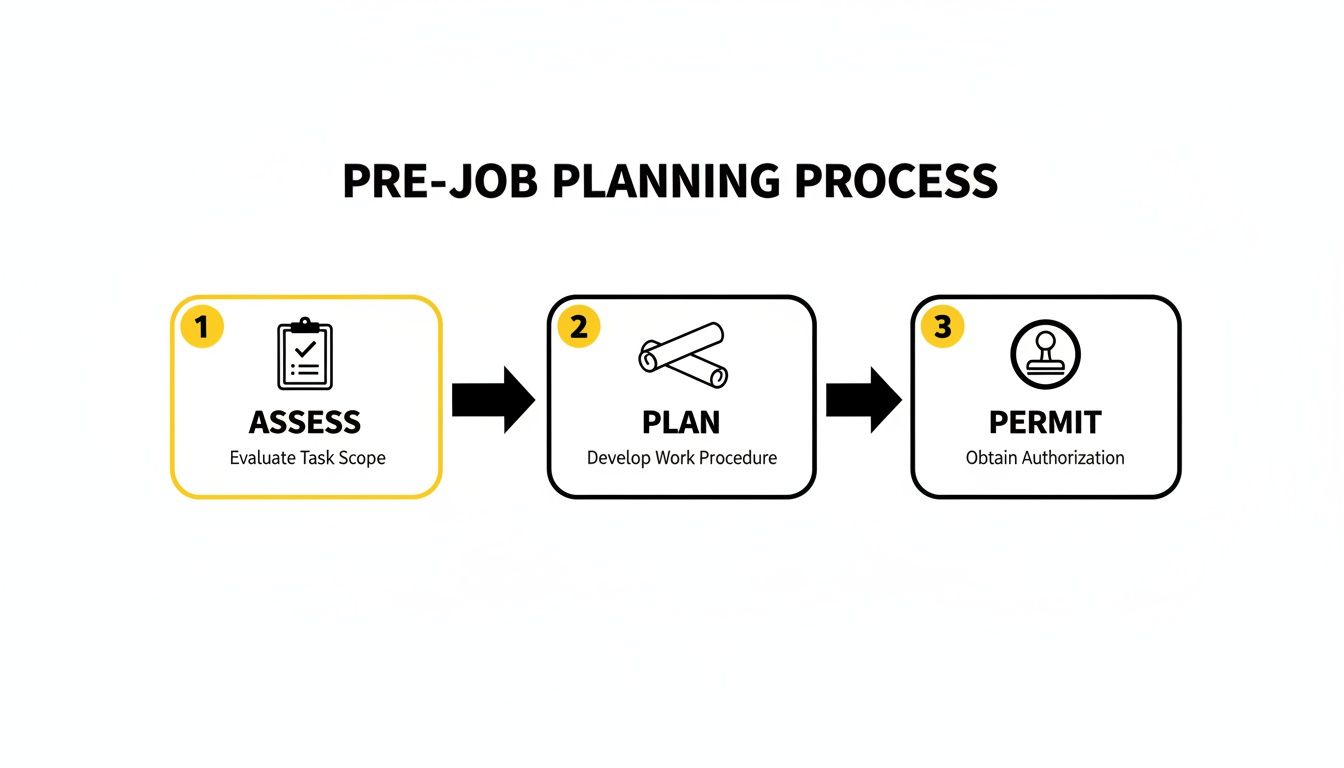
It really drives home that a successful hot tap is built on a solid foundation of assessment, planning, and permitting.
Welding the Fitting and Installing the Valve
Once NDT gives us the all-clear, the hot tapping fitting—usually a split tee or a reinforcing weldolet—is carefully positioned and welded directly onto the live pipeline. Honestly, this is one of the most skill-intensive parts of the whole procedure for hot tapping. The work must be done by a certified pressure welder who is following a very specific, pre-approved procedure tailored to the pipe's material, its thickness, and what's flowing inside.
Welding on a live line means heat management is everything. We have to control the heat input carefully to avoid damaging the pipeline. Often, this involves closely monitoring the flow rate inside the pipe to ensure there's enough product moving to dissipate the heat and prevent any chance of a burn-through.
After the weld is finished and passes inspection (which often includes another round of NDT on the weld itself), we bolt a permanent isolation valve, like a full-bore gate or ball valve, onto the fitting’s flange. This valve becomes the single most important control point for the rest of the job.
Expert Tip: Before we even think about mounting the tapping machine, we pressure test the entire assembly—the fitting and the valve. We'll pressurize the space between the pipe wall and the closed valve gate to confirm that every weld and gasket is 100% leak-free. You have to be certain of your seals before you breach the pipe.
Mounting and Aligning the Tapping Machine
With the valve assembly proven to be secure, it's time for the star of the show: the hot tapping machine. Think of it as a heavy-duty, perfectly sealed drill designed to mount directly onto our new valve. The machine is carefully hoisted and bolted to the valve's outlet flange, creating a completely contained, pressure-tight system.
Getting the alignment right here is non-negotiable. The machine must be perfectly centered and perpendicular to the pipe. If it's even slightly off, the cutter can bind, you could damage the valve seats, or worse, end up with an incomplete cut. That’s a major failure.
The machine itself consists of a few key parts:
- A boring bar that holds the cutter and a pilot drill.
- A motor and gearbox for the power to cut through steel.
- A pressure housing that will contain the pipeline pressure.
- A feed mechanism to precisely advance and retract the cutter.
Executing the Cut and Retrieving the Coupon
Now for the moment of truth. With the machine mounted and aligned, the operator opens the isolation valve. This allows the pipeline pressure to fill the machine's housing. We then carefully bleed any trapped air through a purge valve until only the pipeline product is inside the machine. This is a crucial safety check; it confirms all our seals are holding pressure exactly as they should.
Then, the cutting begins. The operator starts the motor and slowly advances the boring bar. The first part to make contact is the pilot drill, which sits in the center of the main cutter. It drills a small stabilizing hole and is the first to breach the pipe wall.
Once the pilot drill is through, the main cutter blades engage the pipe. The operator has to advance the cutter with a steady, controlled hand, shaving away the pipe material. This takes real experience and a feel for the machine. Go too fast, and you can stall the motor. Too slow, and you'll just dull the blades.
When the cut is finished, a section of the pipe wall—we call it the "coupon"—is completely severed. The cutter is designed with small retaining wires or latches that securely catch the coupon. This is a brilliant and critical feature that prevents that chunk of steel from falling into the pipeline where it could cause blockages or serious damage downstream.
Finally, the operator retracts the boring bar, pulling the cutter and the captured coupon all the way back up through the valve. As soon as it's clear of the valve gate, the operator closes the valve, securely isolating the hot tapping machine from the live pipeline. The pressure inside the machine is then safely bled off, and the equipment can be removed.
What's left is a brand new, fully operational, valved branch connection—all without ever shutting down the line.
On-Site Safety: Turning Plans into Action
Once you're on-site, all the planning and paperwork get put to the test. This is where safety moves from a document to a dynamic, real-time discipline. A hot tap is a live, high-energy operation, and the safety controls you implement on the ground are what separate a smooth project from a potential disaster.
We’re not just talking about hard hats and safety glasses. The real safety net for a hot tap is a series of overlapping, active controls. These aren't just best practices; they're rigid requirements that keep the crew and the asset safe while you're working on a live, pressurized pipeline. Each control is a layer of defense.
Think of it as building a secure bubble around the work area. The goal is to anticipate every potential failure point and have a system in place to stop it before it starts.
Setting Up a Controlled Work Zone
The very first thing we do on location is establish a clearly defined work zone. This is more than just stringing up some caution tape. It’s about creating a hard boundary that keeps unauthorized personnel out. We use physical barriers and prominent signage—like "Hot Work in Progress" and "Flammable Gas Area"—to make the hazards impossible to ignore.
Inside this main perimeter, we almost always establish an inner "hot zone" right around the tap point. Only the essential crew directly involved in the weld and tap are allowed in here. This layered approach cuts down on distractions and ensures every single person inside the boundary knows the risks and has a specific job to do.
A controlled zone is all about eliminating surprises. When you control who comes in and what they do, you drastically cut the chances of an accidental ignition, equipment damage, or someone getting hurt.
For a high-stakes job like a hot tap, a communication lapse can be catastrophic. Understanding the role of essential communication technologies in New Zealand's Oil & Gas Industries highlights just how critical reliable comms are to any modern safety plan. Constant, crystal-clear contact between the tapping machine operator, the fire watch, and the supervisor isn't a luxury—it's essential.
Continuous Gas Monitoring and the Fire Watch
With natural gas, the most significant danger is the one you can't see. That’s why continuous atmospheric monitoring is non-negotiable. We strategically place calibrated gas detectors around the work zone to constantly sniff the air for flammable vapors. These monitors are set to alarm at a fraction of the Lower Explosive Limit (LEL), giving us a crucial early warning long before the air becomes dangerous.
This electronic surveillance goes hand-in-hand with a dedicated fire watch. This person has one job and one job only: watch for any sparks from welding or grinding and be ready to snuff them out instantly. The fire watch is armed with the right type of fire extinguishers and stays put during the entire hot work phase and for a specified cool-down period afterward.
Together, the gas detectors and the human fire watch form a powerful defense against fire and explosion—the biggest risks we face when tapping a live gas line.
Here are a few other critical, on-the-ground rules we live by:
- Buddy System: No one works alone. Ever. Especially not during the weld-out or the actual cut. A second set of eyes is invaluable for spotting a developing hazard or helping in an emergency.
- Certified Gear: Every piece of equipment, from the tapping machine to the valves, must be certified, pressure-tested, and have a solid maintenance record. You have to trust that your gear will perform under intense pressure.
- Emergency Response Plan (ERP): Before a single tool is picked up, the entire crew walks through the site-specific ERP. Everyone knows where the emergency shutdown valves are, the location of muster points, and who to call. A well-rehearsed plan is the key to an orderly response if things go sideways.
Bringing Your New Connection Online
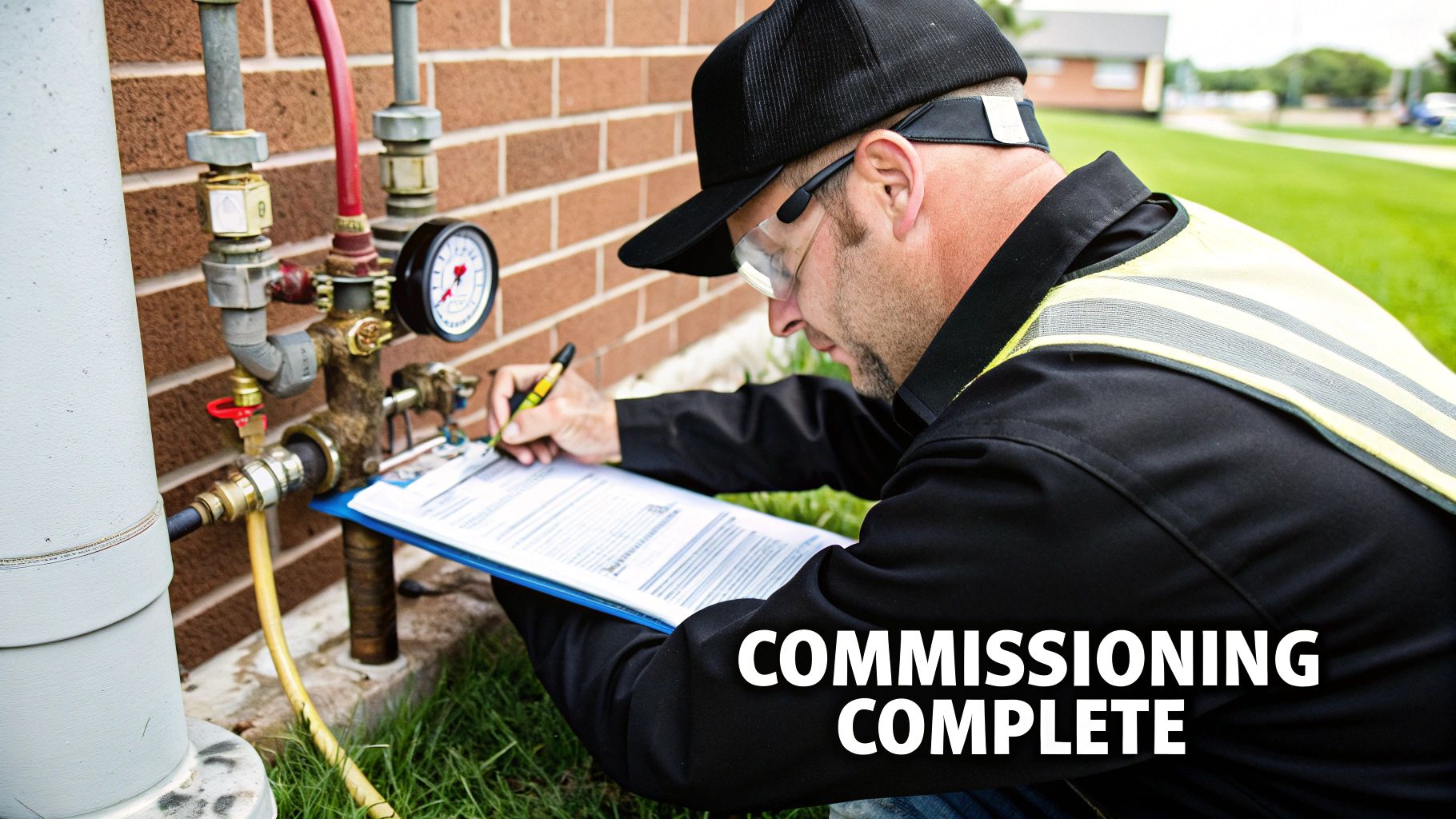
The tapping machine is off and the isolation valve is shut, but don't pack up your tools just yet. The job isn't done until the new connection is commissioned and safely brought to life. This is the moment where all that hardware becomes a functional part of the live gas system, and it demands the same level of care and precision as the cut itself.
The first order of business is prepping the new branch line for service. It’s currently full of air, and mixing air with natural gas is a recipe for a flammable, dangerous situation. To get around this, we start by bleeding and purging the line.
We'll push an inert gas like nitrogen through the new pipework to displace every last bit of oxygen. Once we've verified the oxygen content is safely below the threshold, we can slowly introduce natural gas, which in turn pushes out the nitrogen. It’s a carefully controlled sequence that ensures we’re introducing fuel into a stable, non-combustible environment.
Finalizing the Tie-In Connection
With the new line safely purged and filled with natural gas, you can finally complete the physical tie-in. How this looks in the real world depends entirely on what the project is trying to accomplish.
- Permanent Infrastructure: For a new, permanent extension, this is where you'll make the final flange connection or weld that ties into a new piping network for a building or an industrial process.
- Temporary Supply: If the goal was to hook up a temporary source, this is the point where a provider like Blue Gas Express would connect their mobile CNG or LNG units. This is a common scenario for keeping a facility online during a planned outage or supplying a construction site before its permanent meter is set.
This flexibility is exactly why hot tapping is so valuable—it works for both long-term expansions and immediate, short-term needs without ever shutting down the main line. The demand for this kind of work is huge. A recent analysis valued the hot tapping machine market at around USD 900 million in 2023, and it's projected to climb to nearly USD 1.6 billion by 2032. That growth is being driven by expanding gas networks and the constant need for in-service maintenance and modifications. You can find out more about how these market trends impact modern gas line solutions from Blue Gas Express.
Key Insight: Don't treat commissioning as a simple box to check. It's a critical safety gate. Proper purging and rigorous leak testing are the final checks that guarantee the integrity of the entire operation before you hand that connection over for permanent service.
Verifying Integrity with Leak Testing
The tie-in is complete and the system is pressurized. Now comes the most meticulous part: the final leak test. There is zero tolerance for leaks. Technicians will go over every new weld, flange, and threaded fitting with calibrated electronic gas detectors (or "sniffers") and good old-fashioned soap solution.
This isn't a quick once-over. It’s a slow, methodical inspection of every single potential leak point while the line is under full operating pressure. The new branch is only officially ready for service once every connection is confirmed to be 100% leak-free.
Closing Out with Proper Documentation
The last piece of the puzzle—and one that’s too often rushed—is documentation. A hot tap permanently alters a pipeline system, and the records have to reflect that change. This means updating the as-built drawings to show the new connection's exact location, size, and valve specs. These drawings are the bible for any future work on that line.
And what about that piece of pipe the tapping machine cut out? That’s called the coupon, and it gets labeled and saved. It’s not just a souvenir; it's physical proof of a successful cut. Often, it's sent off for metallurgical analysis, giving engineers valuable data on the pipeline's condition. This final paper trail closes out the project and ensures everything is safe, accounted for, and documented for the life of the system.
The Business Case for Hot Tapping
When you need to modify a pipeline, you're usually staring down two very different paths: a full system shutdown or a hot tap. On the surface, a shutdown seems simple and traditional. But once you dig into the real-world costs, you see it’s a decision that can make or break your project's budget and timeline. The choice isn't just technical; it's fundamentally about money and operational stability.
The financial case for hot tapping is built on one powerful advantage: it completely sidesteps the single biggest expense of any pipeline project—downtime. For a manufacturer, every hour the gas is off means production lines grind to a halt and revenue vanishes. For a utility, it means angry customers and service interruptions. Those indirect costs almost always eclipse the direct price tag of labor and equipment.
Shutdowns vs. Hot Tapping: A Cost Comparison
Pulling off a planned shutdown is a massive logistical headache. You're coordinating customer notifications, scheduling crews to depressurize the line, and then venting—or "blowing down"—huge volumes of sellable natural gas into the atmosphere. Then, you have to do it all in reverse to get the system back online. Every one of those steps bleeds money.
Think about the hidden expenses:
- Lost Product: Venting natural gas is the same as setting cash on fire. You lose a valuable commodity you can never get back.
- Production Halts: A multi-day shutdown can easily cost a large industrial user hundreds of thousands of dollars in lost output.
- Customer Impact: Outages can trigger contractual penalties or, even worse, push your customers to look for more reliable suppliers.
- Labor Inefficiency: Shutdowns are notorious for crew standby time, which inflates your labor bill for work that isn't even happening.
This is where the procedure for hot tapping completely changes the game. Yes, the upfront invoice for a specialized hot tapping service might look higher than what you'd pay for a simple pipe cut. But what you're really buying is operational continuity. Production keeps running, customers stay online, and the entire project gets done in a fraction of the time.
By avoiding a full system shutdown, hot tapping preserves your revenue stream and prevents the enormous waste of venting pipeline gas. It's a direct investment in operational efficiency that pays for itself almost instantly.
The numbers back this up. One U.S. case study looked at a pipeline that needed 15 new connections. The total annual cost for using hot tapping came out to around $80,160. But when you factor in the preserved revenue and avoided gas loss, the financial picture becomes incredibly clear. The analysis showed a net present value (NPV) of $104,665 and a staggering 113% internal rate of return (IRR). The payback period? Just 12 months. You can see the full financial model in this methane mitigation toolkit.
The business case couldn't be more straightforward. Hot tapping isn't just a clever engineering technique; it’s a strategic financial decision that protects your bottom line, keeps your projects moving, and delivers a powerful return on investment.
Answering Your Hot Tapping Questions
Even the most well-laid plans can hit a snag, and when it comes to hot tapping, a lot of questions come up on-site. Getting a handle on the real-world limitations and logistics is what separates a smooth project from a costly one. Here are the answers to some of the most common questions we get from the field.
What Are the Main Limitations?
Hot tapping is a fantastic tool, but it's not a silver bullet. You can't just use it anywhere. For starters, it’s a no-go on pipelines with walls that are too thin or made from materials that are a nightmare to weld, like old cast iron.
It’s also strictly forbidden on lines carrying anything that could become dangerously unstable with heat—think pure oxygen or chlorine. Every single job requires a thorough engineering review; this isn't something you can guess on.
How Long Does a Typical Job Take?
The timeline really depends on the specifics: pipe size, what it’s made of, and the conditions at the site. A simple, small-diameter tap on a standard carbon steel pipe? You might be done in a single shift, say 4-8 hours.
But if you're tackling a large-diameter, high-pressure line, that's a different story. You'll need to plan for several days to cover all the prep work, welding, and the actual tapping procedure itself.
Field Tip: Never, ever perform a hot tap near a known pipeline defect. We're talking about corrosion, cracks, or any delamination. You absolutely must run non-destructive testing to confirm the pipe is sound at the exact spot you plan to tap.
Once the cut is complete, the tapping machine pulls out the piece of pipe it just removed. This "coupon," as we call it, is your physical proof of a clean cut. We always keep it for the client's records, and sometimes it's sent off for metallurgical analysis.
Need a reliable, temporary natural gas supply to keep things moving during your next project? Blue Gas Express delivers mobile CNG and LNG solutions to ensure your operations don't miss a beat during pipeline modifications. Find out more at the Blue Gas Express website.