

Ever had to perform a delicate task without stopping everything around you? That's the essence of a gas line hot tap. It's a specialized procedure that lets technicians tie into a live, pressurized gas main without ever shutting down the flow of gas. This is a critical capability for keeping our energy infrastructure running smoothly during maintenance and expansion.
What Is Gas Line Hot Tapping
A gas line hot tap is a precision-engineered method for drilling into an active pipeline to add a new branch or install equipment. Imagine a plumber needing to add a new faucet to a water line in your house. Instead of shutting off the main valve and draining the pipes, they perform the entire operation while water is still flowing at full pressure. That’s exactly what hot tapping achieves on a much larger, more complex scale for gas lines.
Also known as line tapping, this technique is the linchpin of uninterrupted pipeline operations. Its importance is reflected in the global market for the equipment involved. Valued at about USD 1.2 billion in 2024, the hot tapping machine market is expected to more than double, reaching USD 2.5 billion by 2033. This growth isn't just in oil and gas; it spans water distribution and chemical processing, all industries where downtime is incredibly costly. You can explore more data on the hot tapping machines market to see just how widespread this technology is.
The Purpose of a Hot Tap
At its core, a hot tap is all about avoiding a system shutdown. Taking a major gas pipeline offline isn't like flipping a switch. It can disrupt service for thousands of homes and businesses, cause major revenue loss for utilities, and create a logistical nightmare.
Hot tapping allows crews to perform essential work while keeping the system online and stable. Some of the most common applications include:
- Adding New Service Lines: This is how new residential developments, commercial buildings, or industrial plants get connected to an existing gas main without interrupting service to existing customers.
- Installing Monitoring Equipment: Technicians can place sensors, pressure gauges, or sampling ports directly onto a pipeline to get real-time data on its health and performance.
- System Modifications: It's used to create tie-in points for future pipeline extensions or to reroute sections of a line, all while the main network continues to operate as usual.
How It Differs From Other Methods
The main alternative is what’s known as a "shutdown and purge." This old-school method is a much bigger deal. It involves completely isolating a section of the pipeline, venting all the flammable gas in a controlled "blowdown," doing the work on the now-empty pipe, and then carefully re-pressurizing the whole system.
While a shutdown works, it’s usually the last resort. The costs, customer impact, and complex safety procedures for purging and refilling a major gas line make hot tapping a far more efficient and practical choice in most situations.
The fundamental difference comes down to one thing: is the pipeline live or not? A shutdown requires the line to be completely inert and empty. A gas line hot tap, on the other hand, is designed from the ground up to work under live, pressurized conditions. This is what makes the procedure so valuable, but it's also what makes it so technically demanding, requiring specialized tools and highly trained crews to pull off safely.
The Critical Steps of a Hot Tapping Operation
Think of a gas line hot tap less as a single task and more as a carefully choreographed ballet of engineering and execution. Every move is planned, practiced, and performed with absolute precision. The goal isn't just to get the job done—it's to create a flawless, leak-free connection while keeping the crew safe and the pipeline completely intact.
This visual gives you a great high-level look at why hot tapping is so valuable. It lets crews add new connections to a pipeline that's live and under pressure, meaning no shutdowns and no service interruptions.
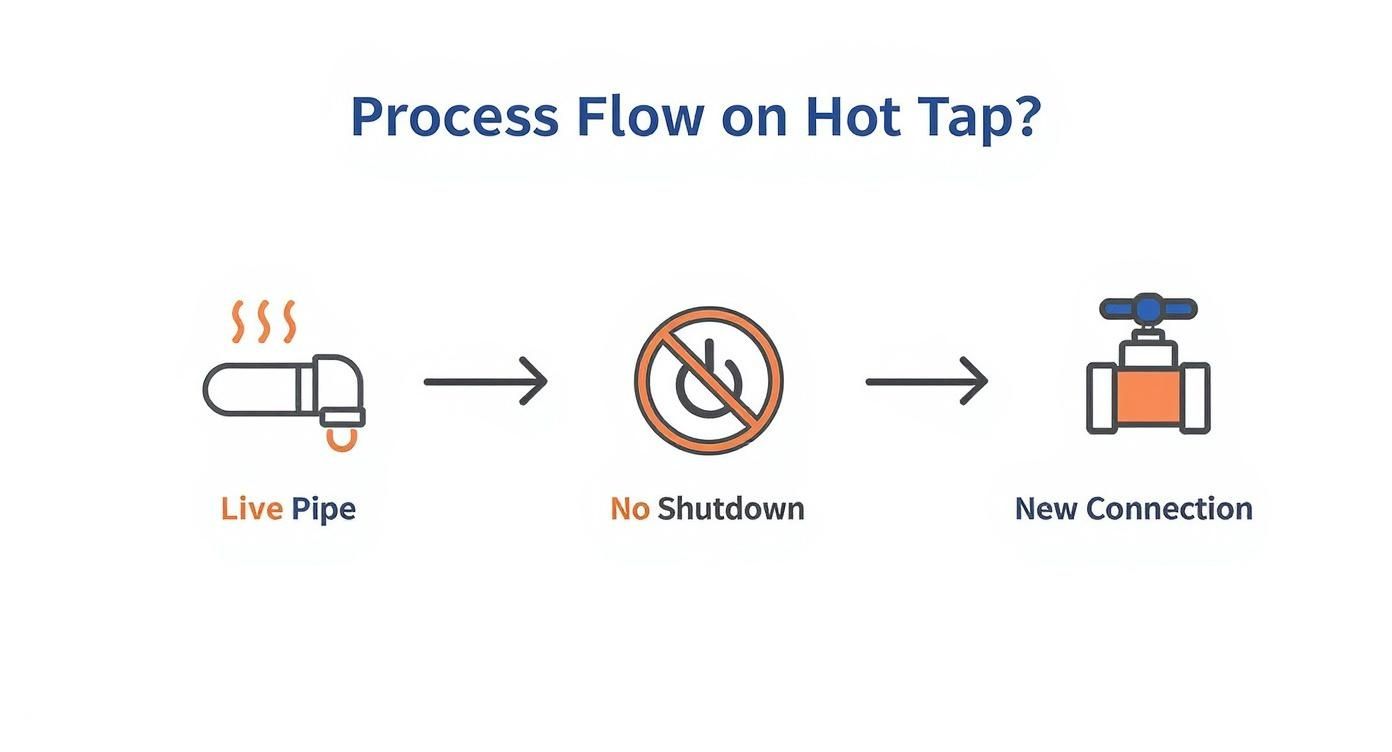
As you can see, the process seamlessly goes from an existing, operating pipe to a new, fully functional branch line—all while the gas keeps flowing.
Phase 1: Pre-Job Engineering and Site Preparation
Long before a single wrench is turned, the most important work is happening behind the scenes. This is the planning stage, and it’s all about doing the homework. Engineers start by digging into the details of the target pipeline: its material, its exact diameter, and its normal operating pressure.
Next comes one of the most vital checks: non-destructive testing (NDT). Using tools like ultrasonic scanners, technicians measure the precise wall thickness of the pipe right where the tap will happen. This isn't optional. It's how we confirm the pipe is strong enough to support the new connection. If they find any signs of corrosion or weaknesses, the job is a no-go until it's resolved.
At the same time, a detailed, site-specific safety plan is drawn up. It identifies every conceivable risk and lays out the exact steps to manage it, forming the safety bedrock for the entire operation.
Phase 2: Fitting Installation and Valve Mounting
Once all the engineering checks out, the hands-on work can finally start. The first piece of hardware is a custom-made hot tap fitting, which is carefully positioned and welded directly onto the live pipe. This fitting serves as the permanent anchor for the new branch connection.
You can't overstate the importance of that weld. It has to be perfect—creating a bond that is just as strong, if not stronger, than the original pipe itself. This weld needs to reliably hold back the full force of the pipeline's pressure for many years to come.
With the fitting in place, a permanent valve (usually a full-port gate or ball valve) is bolted on top. This valve is the gatekeeper, the primary safety barrier that will contain the gas during and after the tap.
Now for a crucial safety gate. The entire setup—the fitting, the valve, and the adapter for the tapping machine—is pressure tested. It's typically filled with an inert gas like nitrogen to a pressure significantly higher than what's inside the pipeline. This test proves that every weld and seal is 100% sound before a single hole is drilled.
Phase 3: The Tapping Machine and the Cut
After a successful pressure test, it's time to bring in the main event: the hot tapping machine. This isn't your average drill. It’s a powerful, high-torque cutting tool housed inside a sealed, pressurized chamber that mounts directly onto the valve.
The operator slowly advances the cutter through the open valve until it touches the pipe wall. The cutting process is deliberate and controlled, never rushed. The machine is engineered to slice through the steel while safely containing the immense pressure and gas inside. As it cuts, it creates a solid, circular piece of the pipe wall called a "coupon."
This is the moment of truth. The pipe wall is officially breached, and the pipeline's pressure is now fully contained by the hot tapping machine and the valve assembly.
Phase 4: Coupon Retrieval and System Restoration
Once the cut is complete, the job's not done. The cutter, along with the newly freed coupon, is retracted back out through the valve. A special pilot bit holds the coupon firmly so it can't fall into the pipeline, where it could travel downstream and cause catastrophic damage to equipment. This step, known as coupon retrieval, is the definitive proof of a clean and successful cut.
With the cutter and coupon safely back on the outside, the operator closes the main valve, sealing off the pipeline's pressure once and for all. The hot tapping machine can then be depressurized and removed from the valve.
Just like that, the new branch connection is ready for tie-in, and the entire operation was completed without ever taking the pipeline out of service.
Essential Equipment for a Successful Hot Tap
A successful gas line hot tap is a masterclass in precision. It’s not just about having the right tools; it’s about having a perfectly integrated system where every single component performs its job flawlessly under extreme pressure. Think of it like a deep-sea dive—the quality of your equipment is the only thing standing between a smooth operation and a disaster.
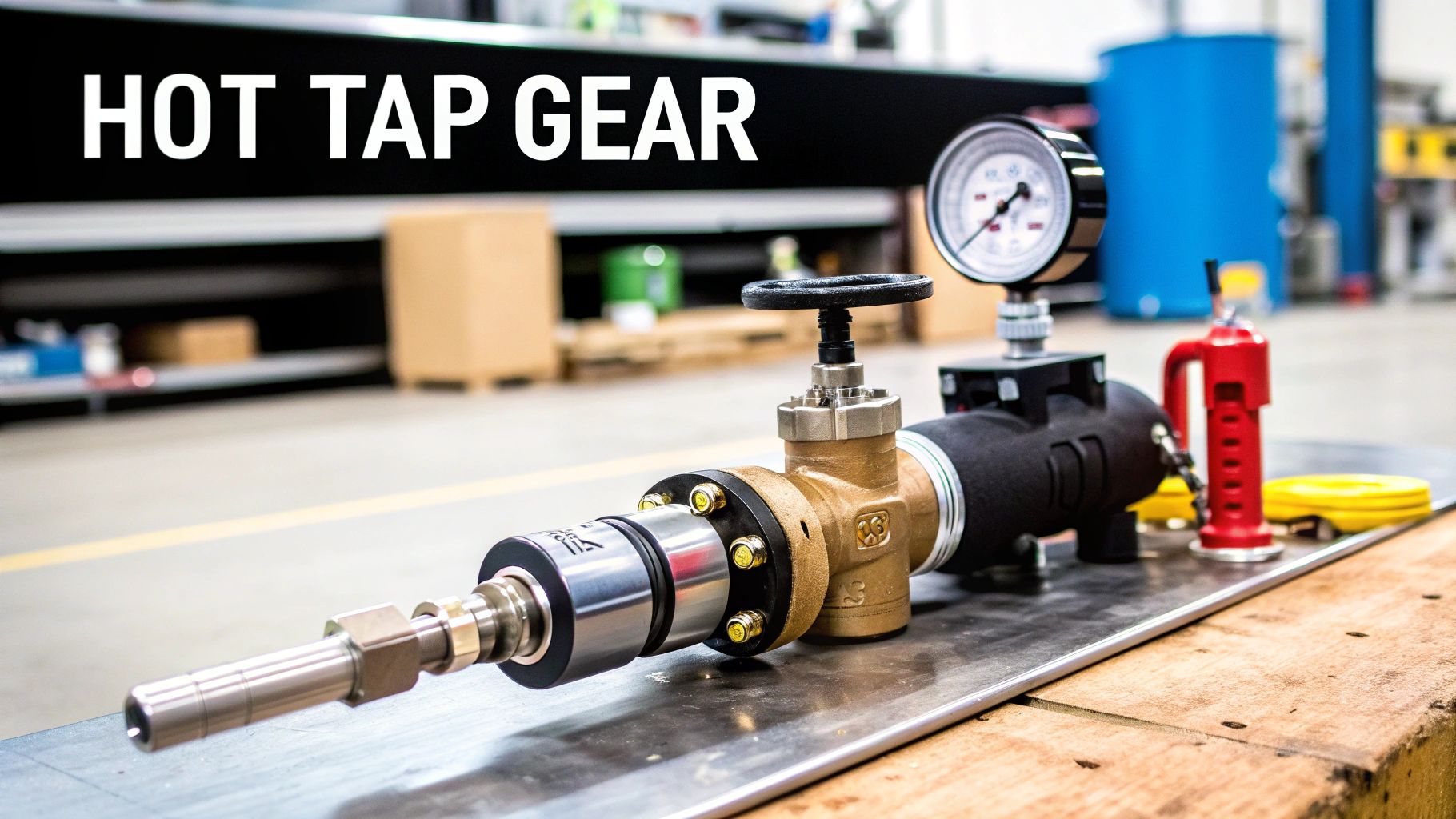
This machinery isn't just a collection of parts; it's a complete system built to execute a high-stakes procedure on a live, unforgiving pipeline. The quality, calibration, and proper handling of this equipment are the absolute bedrock of a safe job. There is simply no room for error.
The Core Mechanical Trio
At the very heart of the operation, you have three core components working together in perfect sync. Each one has to be meticulously matched to the pipe’s specific characteristics—its pressure, diameter, and what it’s carrying—to guarantee a secure, leak-proof connection.
The Hot Tapping Machine: This is the real workhorse. It’s essentially a powerful, high-torque drilling machine sealed inside a pressurized housing that mounts directly onto the valve. Its job is to cut a clean hole through the pipe wall while safely containing every bit of the high-pressure gas.
The Full-Port Valve: This is your primary safety barrier. It's a permanent valve that sits between the pipeline and the tapping machine. The "full-port" design is critical—it means the opening is just as wide as the cutter, letting the tool pass through cleanly. Once the cut is done and the machine is removed, this valve is closed to seal off the new branch.
The Hot Tap Fitting: This is the foundation of the new connection, the piece that will stay on the pipe forever. It’s a custom-fabricated fitting, typically a split-sleeve that bolts around the pipe or a piece that is welded directly onto it. This fitting provides the structural integrity and the flange needed to bolt the valve on.
Vital Ancillary and Safety Tools
Beyond the main hardware, a whole team of supporting tools is needed to monitor and control the process. These are the instruments that give operators the real-time data they need to make sure everything is going according to plan.
A small but absolutely crucial part of this is the coupon retention device. It’s a clever little mechanism on the pilot drill bit designed to catch the circular piece of pipe—the "coupon"—that gets cut out. If that coupon were to fall into the pipeline, it could get swept downstream and cause millions of dollars in damage to compressors, turbines, or other equipment.
Other tools are just as indispensable for keeping the operation safe:
- Pressure Gauges: These are mounted right on the tapping machine to continuously monitor the internal pressure, ensuring it perfectly matches the pipeline pressure before the cutter ever touches the pipe.
- Bleed Valves: A simple but vital tool used to safely vent any trapped pressure from the tapping machine after the main valve is closed. This allows the crew to remove the machine safely.
- Ultrasonic Thickness Gauges: Before any cutting begins, this non-destructive tool is used to measure the pipe wall. It confirms the pipe has enough thickness and structural integrity to handle the stress of the hot tap.
Choosing the Right Tapping Machine
You can't just grab any hot tapping machine off the shelf. The right choice is dictated entirely by the job's demands—the pipeline's pressure, its diameter, and even the material it's made from. The machine must always be rated for pressures significantly higher than the pipe's maximum operating pressure to ensure a robust safety margin.
The choice of machinery is a critical engineering decision. A machine designed for low-pressure water lines would catastrophically fail on a high-pressure natural gas transmission line. Every component, from the seals and gaskets to the cutter material, must be compatible with the product inside the pipe.
Selecting the appropriate machine is crucial for both safety and efficiency. The table below breaks down the common types you'll see in the field and where they fit best.
Comparison of Hot Tapping Machine Types
| Machine Type | Power Source | Typical Pressure Range | Common Applications | Key Advantage |
|---|---|---|---|---|
| Manual/Light-Duty | Hand Crank/Ratchet | Up to 300 PSI | Small-diameter distribution lines, water mains | Portability and simplicity for low-risk jobs. |
| Pneumatic | Compressed Air | 300 – 1480 PSI | Medium-diameter gas and chemical lines | Offers consistent power and is spark-free, ideal for flammable environments. |
| Hydraulic | Hydraulic Power Unit | Over 1480 PSI | Large-diameter transmission pipelines, subsea lines | Delivers immense torque needed for thick-walled, high-pressure pipes. |
As you can see, the power source and pressure rating directly correlate with the application's intensity. Matching the machine to the job isn't just best practice; it's a fundamental requirement for a successful and safe hot tapping project.
Navigating Critical Safety Protocols
When you're dealing with a live, high-pressure gas line, safety isn't just a priority—it's everything. There is absolutely zero room for error. Every single move a technician makes is guided by meticulous safety protocols, born from decades of experience and standardized by groups like the American Petroleum Institute (API) and the American Society of Mechanical Engineers (ASME).
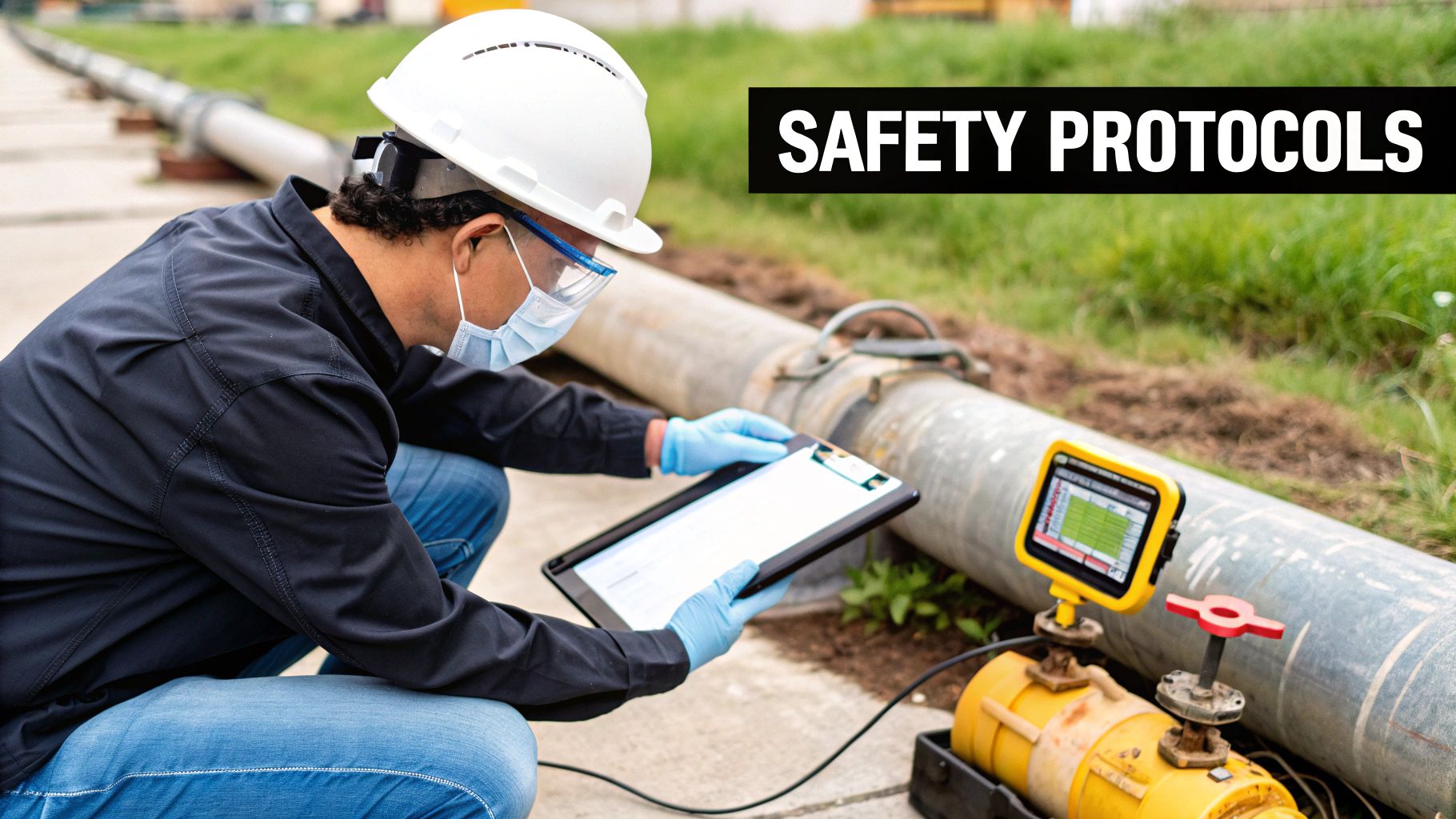
This process starts long before a single tool is unpacked. A successful hot tap is built on a rock-solid foundation of planning and a culture where anyone on the crew can—and will—stop the job if things aren't 100% safe.
The Foundation of a Safe Operation
It all begins with a comprehensive risk assessment. This isn't just ticking boxes on a form. It's a deep dive into every possible hazard, from the pipeline's pressure and flow rate to the weather forecast for the day. This assessment becomes the blueprint for a detailed, step-by-step procedure that anticipates challenges and leaves nothing to chance.
Before the work kicks off, the entire crew huddles up for a pre-job safety meeting, what we often call a "toolbox talk." This is where the plan is walked through, roles are clarified, and emergency drills are mentally rehearsed. Everyone needs to be on the same page, knowing exactly what to do if something goes wrong.
Grounding is another non-negotiable step. Believe it or not, the friction from gas flowing through a pipe can build up a powerful static charge. A single spark is all it takes for disaster. To prevent this, every piece of equipment, from the tapping machine to the welders, must be securely bonded to the pipeline itself.
Essential Pre-Cut Safety Verifications
With the equipment in place, a series of final checks must be completed before the cutter even gets near the pipe. Think of these as the final green lights that confirm the system is secure and ready.
Key safety checks always include:
- Ultrasonic Wall Thickness Verification: A technician uses an ultrasonic testing (UT) device to get a precise measurement of the pipe wall. This tells us if the pipe has the structural muscle to handle the tap and hasn't been weakened by hidden corrosion.
- Pressure Testing the Assembly: Once the new fitting and valve are welded on, the whole setup is sealed off and filled with an inert gas like nitrogen. It's then pressurized to a level significantly higher than what the pipeline normally operates at. This is how we prove every weld and seal is perfect before we breach the pipe.
- Atmospheric Monitoring: Throughout the entire job, sensitive monitors are constantly sniffing the air for any hint of flammable gas. This is our early warning system, capable of detecting a minuscule leak long before it becomes a real problem.
These procedural layers are not suggestions; they are mandatory requirements. Skipping even one of these steps introduces an unacceptable level of risk. The entire philosophy of hot tapping is built on a system of redundant checks and verifications to ensure containment is never compromised.
The Consequences of Protocol Failures
The stakes couldn't be higher, and history provides a stark reminder of what happens when protocols are ignored. A well-known case involved a pipeline explosion in Texas during a hot tap on an active gas line. The aftermath was devastating, and in the legal proceedings that followed, the company was found liable. A jury awarded $173 million in damages, a figure that reflects the immense human and financial cost of getting it wrong. You can discover more about the outcomes of improper pipeline procedures.
This case drives home a fundamental truth: in the world of hot tapping, obsessive planning and a proactive safety culture aren't just best practices—they are the only way to operate.
How Mobile Gas Solutions Make Hot Tapping Seamless
Hot tapping is almost never a standalone job. It’s usually part of a much bigger pipeline maintenance or expansion project where shutting off the gas simply isn’t an option. For every customer downstream—be it a hospital, a factory, or a whole neighborhood—the gas has to keep flowing.
This is where mobile gas solutions come in. They act as a temporary, portable pipeline, delivering compressed natural gas (CNG) or liquefied natural gas (LNG) right to the site. This creates a "virtual pipeline" that bypasses the section being worked on, ensuring the entire operation runs smoothly without anyone losing service.
What is a Mobile Natural Gas Bypass?
Think of it like setting up a detour on a busy highway. When a section of road is closed for construction, you divert traffic onto a temporary route. A mobile gas bypass does the same thing for natural gas, rerouting the flow around the hot tap site so service is never interrupted.
It’s a surprisingly straightforward process. Operators bring mobile CNG or LNG units right to the work zone. From there, high-pressure hoses connect these units to the pipeline, creating a bridge that carries the gas past the point where the new fitting is being installed.
- Site Deployment: A mobile unit, often on a trailer, arrives and is positioned near the pipeline. It’s ready to supply CNG or LNG on a temporary basis, sometimes within just a few hours.
- Connection Setup: Crews use specialized high-pressure hoses and fittings to divert the gas flow from the main line, through the mobile unit, and back into the line downstream of the work.
- Pressure Management: The mobile units have integrated gauges and controls to constantly monitor the gas pressure, making sure it perfectly matches what the pipeline needs.
These units are incredibly versatile and can handle everything from lower-pressure local distribution lines to major high-pressure transmission mains. By providing this external feed, the hot tapping crew can concentrate on the delicate work of drilling and fitting, confident that the gas supply is stable and secure.
When is a Temporary Gas Supply Essential?
This kind of temporary supply is a game-changer in a lot of situations, especially for urban expansion projects, emergency repairs, and commissioning new equipment like generators. For instance, we saw a developer in Charlotte who needed to get occupancy permits for a new building but was facing delays on the new meter sets. A temporary gas supply kept them on schedule.
Another time, a hospital in Raleigh needed to prevent their systems from freezing up during a sudden cold snap while maintenance was happening. Mobile LNG units kept their essential services powered without risking a shutdown.
Other common scenarios include:
- Generator Testing: Ensuring backup power systems have the fuel they need during maintenance cycles.
- Industrial Outages: Keeping factories and manufacturing plants online during planned mainline work.
- Large-Scale Events: Providing a temporary gas source for festivals, major construction sites, or other temporary installations.
This is exactly what Blue Gas Express specializes in. We can get mobile units deployed across North Carolina, South Carolina, Tennessee, and Virginia, often within hours of a call. This rapid response is critical for the tight timelines involved in hot tapping operations.
Mobile supply units are the lifeline during live pipeline work. They are what makes a truly seamless energy delivery possible.
By combining the technical precision of hot tapping with the logistical muscle of on-demand mobile gas, operators can tackle massive pipeline integrity projects with zero disruption to their customers.
- Coordinate Delivery: The key is to schedule the mobile gas unit to arrive just as the hot tap team is ready to start.
- Monitor Pressure: Always use redundant gauges to ensure the flow and pressure remain perfectly consistent.
- Plan Removal: Have a clear plan for safely disconnecting the mobile units once the new branch connection is live and stable.
Following these practices ensures the mobile gas solution and the hot tapping procedure work together perfectly, resulting in safe, efficient, and uninterrupted service.
The Benefits of Integrating a Virtual Pipeline
Bringing a mobile gas bypass into the plan completely eliminates the risk of downtime and helps companies meet their strict service level agreements. It also goes a long way toward preventing customer complaints, since gas pressures remain exactly where they should be.
The numbers speak for themselves. Data from recent projects shows that using mobile gas units can slash potential downtime by up to 95% when compared to a full shutdown and purge of the line.
We had a project with a facility in Asheville that was looking at an eight-hour service interruption for a hot tap tie-in. By bringing in CNG trailers to create a bypass, they avoided that downtime completely.
- Reduced Downtime: Less disruption keeps projects on schedule and budgets in check. It’s as simple as that.
- Flexible Scalability: Whether you're working on a small local line or a massive transmission pipe, there's a mobile unit with the right capacity for the job.
Our clients consistently tell us that integrating a temporary supply leads to smoother operations and far fewer scheduling headaches. It’s the bridge between the technical work on the ground and the logistical challenge of keeping the gas on.
Managing Risks and Ensuring Pipeline Integrity
A successful gas line hot tap is about more than just the cut. It’s about making sure that new connection becomes a strong, seamless part of the pipeline for decades to come. While immediate safety on the job site is paramount, the real endgame is long-term pipeline integrity. This takes a serious commitment to engineering, material science, and rigorous testing to ensure the asset’s life is extended, not cut short.
It all begins with making sure the new components are a perfect metallurgical match for the host pipe. You can’t just weld any old steel fitting onto a pipeline. Engineers have to meticulously match the materials to head off future problems like galvanic corrosion or stress cracking. This compatibility is the bedrock of a permanent, trustworthy connection.
Designing for Long-Term Strength
Once the materials are confirmed to be compatible, the focus shifts to reinforcing the structure. Every hot tap involves cutting a hole in the pipe, which naturally creates a potential weak spot. To compensate, a custom-fabricated fitting is welded on. This fitting isn't just a simple connection point; it's an engineered reinforcement designed to redistribute stress around the new opening.
Engineers run complex calculations to design this fitting, making sure it can handle the pipeline’s maximum operating pressure and any external forces with a hefty safety margin. This reinforcement is what transforms a potential vulnerability into one of the strongest points on the entire pipeline.
A hot tap fitting isn’t just a patch; it's an engineered upgrade. The goal is to make the area around the new connection stronger than the original, untouched pipe, effectively fortifying the system at the point of modification.
Validating the Work with NDT
You can't just trust the math, though. Every critical step has to be physically verified on-site. This is where non-destructive testing (NDT) is absolutely essential. We use various NDT methods before, during, and after the job to confirm the integrity of the work without causing any damage.
- Before the Tap: We start with ultrasonic testing (UT) to check that the existing pipe wall is thick enough and has no hidden defects.
- During Installation: After the fitting is welded on, techniques like magnetic particle or dye penetrant testing are used to check the weld for any tiny surface cracks.
- After the Tap: Finally, radiographic or ultrasonic inspection can be used to get a look inside the weld, ensuring it has penetrated fully and is free of any internal flaws.
This multi-stage validation gives us concrete proof that the connection is sound. Of course, ensuring the long-term integrity of pipelines is an ongoing effort. Beyond the hot tap itself, continuous monitoring and advanced inspection methods, such as those used in drone inspection for critical infrastructure integrity, are vital for catching problems before they become failures.
This intense focus on pipeline safety has paid off massively over the years. Historical data shows that between 1970 and 2001, there were 1060 incidents involving unintentional gas releases on high-pressure steel pipelines. Thanks to better protocols and technologies like those used in modern hot tapping, that rate has plummeted to about 0.20 incidents per year per 1000 km recently. You can read the full research on these pipeline safety improvements to see just how far we've come.
Frequently Asked Questions About Hot Tapping
Even when you understand the mechanics, the idea of cutting into a live gas line naturally raises a few questions. Let's tackle some of the most common ones we hear from project managers, engineers, and facility owners when they're planning pipeline work.
Getting these answers straight helps everyone see why this procedure, when done by the book, is a safe and reliable industry staple.
Is Hot Tapping a Gas Line Truly Safe?
Yes, but with a huge asterisk: it’s only safe when handled by certified professionals who live and breathe industry standards like API RP 2201. Think of it as a surgical procedure for pipelines. The entire process is built on layers of redundant safety checks.
Before anyone even thinks about cutting, there are mandatory engineering assessments, ultrasonic tests to confirm the pipe wall is thick enough, and pressure tests on all the new equipment. Everything is verified before the final cut.
While it's true that working on a live, pressurized gas line sounds risky, these methodical controls are precisely what tames that risk. A well-planned and properly executed hot tap isn't a gamble; it's a routine, highly controlled operation.
What Are the Main Alternatives to Hot Tapping?
The old-school alternative is a complete system shutdown. This means isolating a whole section of the pipeline, purging every last bit of flammable gas in a "blowdown," doing the work, and then going through the painstaking process of re-pressurizing the system.
This approach definitely avoids working on a live line, but it swaps one set of challenges for another. It almost always means major service disruptions for customers downstream and can cost the pipeline operator a fortune in lost revenue. For a critical line that feeds a whole city or an industrial complex, a full shutdown is usually a non-starter.
A system shutdown turns a precision task into a massive logistical headache. The costs, customer impact, and complex safety steps for purging and refilling a major gas line make hot tapping the smarter, more practical choice in most scenarios.
Can Hot Tapping Be Done on Any Pipeline?
Absolutely not. Not every pipe is a candidate for a hot tap, which is why a thorough engineering assessment is the first, non-negotiable step. An expert needs to give the green light before any work begins.
Several red flags can stop a hot tap project in its tracks:
- Insufficient Pipe Wall Thickness: The pipe just isn't strong enough to handle the new connection.
- Material Defects: Things like corrosion, weak spots, or other integrity problems make tapping far too risky.
- Incompatible Materials: Some pipeline materials simply can't be welded on safely.
- Unstable Contents: The product flowing through the pipe has to be stable enough for the operation.
Beyond that, the pipeline's operating pressure and temperature have to be well within the safety limits of the specialized tapping equipment itself.
Planning a pipeline project that can't afford a shutdown? The team at Blue Gas Express provides reliable mobile natural gas solutions to support your hot tapping operations, ensuring seamless energy delivery. Find out how we can support your project.