

A winter peak-day demand gap of 86% separates ordinary seasonal use from the gas that residential and commercial customers may need on the coldest days. That gap isn't just about how much fuel a region has for the season. It's about whether enough gas can reach the right customers at the rate they need it, when temperatures plunge or infrastructure goes offline.
For a utility, the challenge might last through a cold snap. For a builder or plant manager, it could be the time between a delayed gas connection and a scheduled opening, or a maintenance outage and the return of normal service. Peak shaving natural gas is a short-duration reliability strategy, not a plan to build every pipeline for the single highest-use day.
Why Peak Shaving Natural Gas Matters on Peak Days
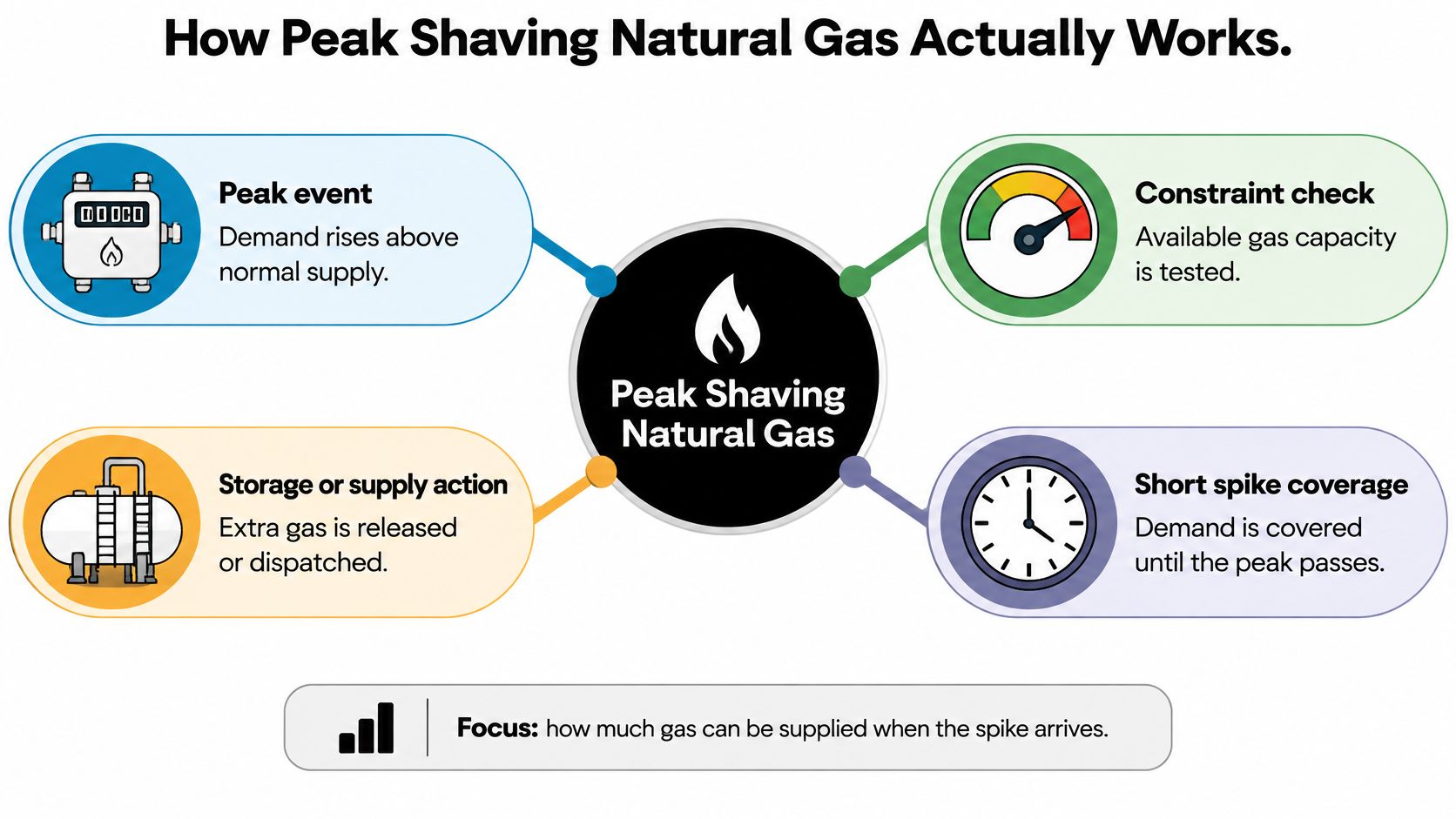
During a cold spell, a local distribution company may see heating demand climb sharply across the neighborhoods it serves. Residential and commercial customers need more fuel at the same time, while the utility still relies on the pipeline deliveries built into its normal supply portfolio. If those deliveries can't meet the spike alone, the utility needs supplemental gas that can be supplied when demand rises.
Across the 2018–2019 through 2024–2025 winter heating seasons, peak-day demand from U.S. residential and commercial customers averaged 67.7 billion cubic feet per day (Bcf/d), compared with seasonal average demand of 36.4 Bcf/d. Peak-day demand was about 86% higher than the average, according to the American Gas Association's analysis of natural gas storage.
A utility therefore plans for a combination: regular pipeline deliveries for normal conditions, with other resources available to cover short-lived peaks. It doesn't follow that the utility should pay year-round for enough pipeline capacity to cover the coldest day. That would mean building the everyday system around an exceptional level of use.
Paying for pipeline capacity sized to the extreme day is usually the wrong default. The planning question is how to cover the spike reliably without carrying that level of capacity all year.
The same problem appears on a smaller scale at a construction site or industrial facility. A builder might be ready for occupancy, but the permanent gas connection is delayed. A plant manager might have equipment ready to commission, but a main is out for maintenance. In either case, the customer can face a short-term gap even though the longer-term supply plan is sound.
Utilities use peak shaving to help serve customers during periods of high demand. A construction, commercial, or industrial customer can use temporary supply for a similar reason: to bridge the time until an interconnection, repair, or permanent capacity is ready. In both cases, reliability depends on covering the spike, not on supplying more gas than the customer needs for the whole season.
How Peak Shaving Natural Gas Actually Works
To judge whether a peak-shaving plan will work, ask how much gas can be delivered during the cold snap or outage, not only how much is available in a region for the season. Three measures matter, and each answers a different question.
Start with total stored fuel. This is the amount of gas held in storage or otherwise available as a supply reserve. It tells a planner whether there's enough fuel in the broader system, but it doesn't say how quickly that fuel can be released.
Then check the withdrawal or send-out rate. This describes how quickly a storage facility or supply source can release gas into the system. A facility may hold substantial fuel but still be unable to send it out fast enough to cover a short, sharp peak.
Finally, check the delivery rate at the site. This is the amount of gas the customer can receive through the relevant pipeline, compression equipment, lateral connection, or temporary setup. Think of a full tank connected to a narrow hose: the tank may hold plenty, but the burners can still run short if the hose can't supply them quickly enough.
The distinction matters during a real event. A New York grid-operator assessment of the 2025–26 winter identified daily gas deliverability, rather than total storage or annual production, as the binding constraint during cold snaps. The assessment said LNG injections east of New York likely eased pipeline constraints. During peak hours, the generation mix included 26% natural gas and 28% oil, according to the New York grid operator's cold-weather operations assessment.
| Metric | Question it answers | What it can still miss |
|---|---|---|
| Total stored fuel | How much gas is held or available? | Whether it can be released quickly enough or reach the customer |
| Maximum withdrawal or send-out rate | How fast can the resource supply gas into the system? | Whether the pipeline route can carry that flow to the site |
| Site delivery rate | How much gas can reach the equipment? | Whether that rate can be sustained for the entire outage or peak |
A region or site can have adequate inventories and still face a reliability problem if pipeline capacity, compression, or a lateral can't match the required hourly flow. That's why a planner needs to ask: What flow rate does the site require? How long must supplemental supply sustain it? What happens if several customers peak at once?
Storage CNG LNG and Demand Response Compared
A winter peak is less like a yearly fuel budget and more like a narrow delivery window. The question is not only how much gas exists somewhere, but how fast it can move, where it can reach, and how long the extra flow must last.
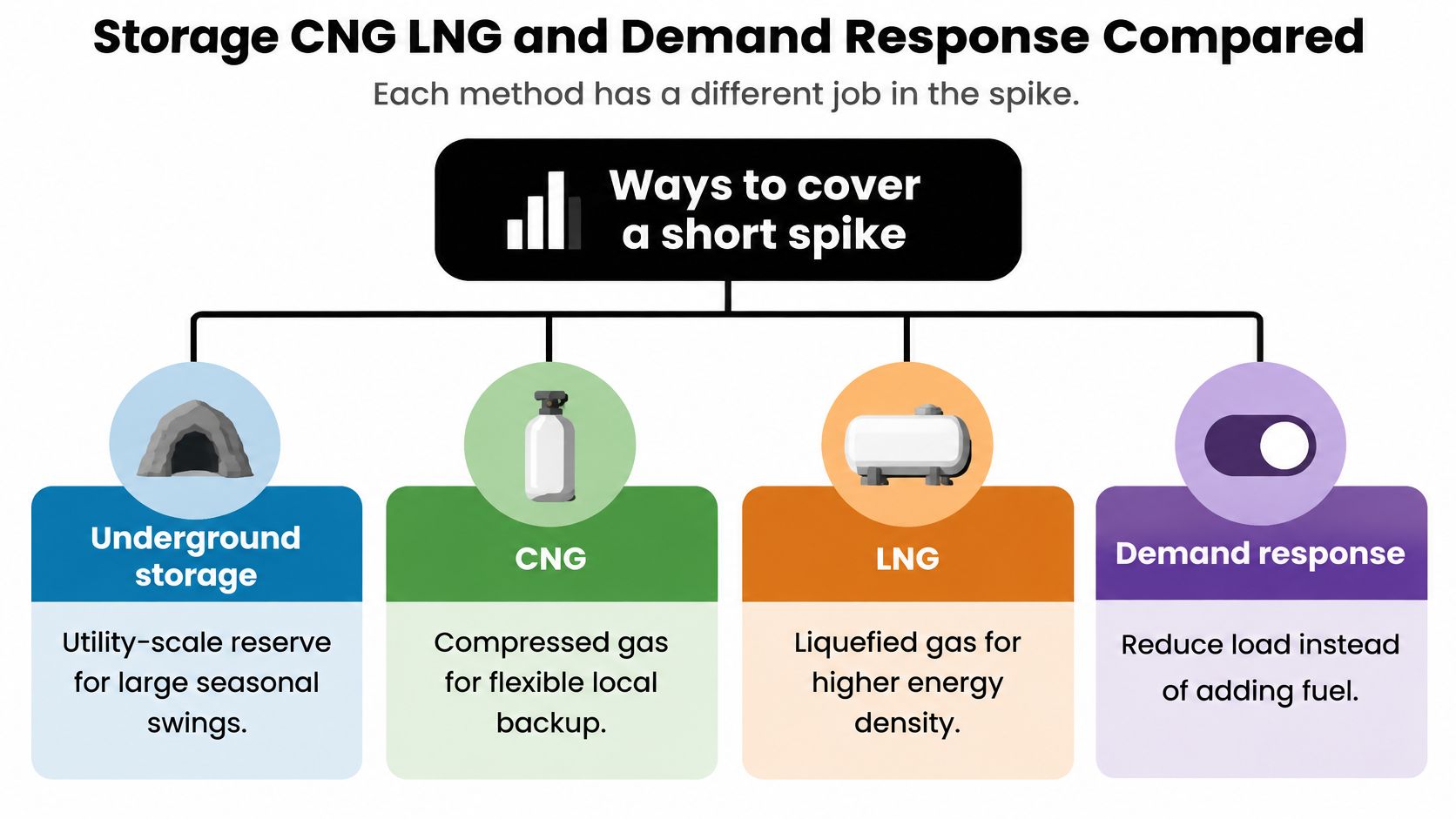
Underground storage is the broad utility tool. Gas is injected mainly from April through October and withdrawn from November through March, so utilities can pair stored fuel with steady pipeline deliveries instead of buying enough pipeline capacity for the coldest hour. In the Lower 48 states, demonstrated peak underground-storage capacity reached 4,203 Bcf in the November 2023 reporting period, up 124 Bcf, or 3%, from the prior year, and equal to about 90% of approximately 4,666 Bcf of working-gas design capacity, according to the U.S. Energy Information Administration's underground storage capacity data.
Regional movement was uneven, which is why the regional pieces should not be read as a neat sum. The Pacific region alone added 124 Bcf of demonstrated peak capability in that same EIA dataset; because the national total also rose by 124 Bcf, increases elsewhere were offset by declines in other regions. For a planner, the national number shows scale. The site question is narrower: can stored gas be withdrawn at the needed rate and reach the constrained point during the hours that matter?
LNG and CNG answer different kinds of delivery gaps. LNG is stored as a liquid and vaporized when needed, so it can support a utility corridor when pipeline send-out falls short or serve a customer with space for suitable facilities. CNG is compressed gas delivered by truck and connected for shorter needs, such as a facility waiting for a new main or an area affected by maintenance.
Demand response changes the load rather than adding supply. A utility may ask participating customers to curtail use, while an industrial site pauses equipment that can safely wait. For readers comparing how households can reduce electricity use during high-demand periods, electricity savings for solar battery households offers related context.
| Resource | Typical role and duration | Typical owner or user | What it addresses |
|---|---|---|---|
| Underground storage | Seasonal reserve used during winter peaks | Gas utilities and storage operators | Large, system-level supply swings |
| LNG | Stored fuel vaporized for a constrained system or site | Utilities or customers with suitable facilities | Supplemental supply when pipeline delivery is tight |
| CNG | Mobile supply for a local, temporary gap | Utilities, builders, commercial or industrial customers | Short-term site-level delivery needs |
| Demand response | Temporary reduction or shift in consumption | Utilities and participating customers | Peak load that can be curtailed rather than supplied |
The practical test is fit. Underground storage covers broad seasonal swings, mobile CNG or LNG can close a site-level gap when a location cannot wait for a line or repair, and demand response works only where enough usage can be reduced safely.
Reliability Gains Costs and Emissions Tradeoffs
Gas peak shaving also affects electric-system reliability. When gas-fired generators need fuel during a period of high electricity demand, a gas supply constraint can become a power-system concern as well as a heating or industrial one.
In 2025, U.S. natural-gas demand averaged 107.6 Bcf/d, up 4.6% year over year. Winter-month gas use for power generation reached a record 34 Bcf/d, which was 10% above the five-year average. During Winter Storm Fern, total demand reached 173 Bcf/d on January 24 and remained above 160 Bcf/d for ten days. Storage supplied up to 36% of daily demand during the storm, according to the Federal Energy Regulatory Commission's State of the Markets report.
For operators, the practical benefit is straightforward: supplemental supply can help generators and heating customers stay online when regular pipeline deliveries can't ramp up enough. For a project team, the competing cost may be an interrupted construction schedule, delayed occupancy, or idle industrial production. The choice isn't only between fuel options. It's between the reliability value of temporary supply and the cost of waiting, alongside the impacts of the alternative.
Those impacts can include combustion emissions from equipment, methane leakage, truck trips to deliver CNG or LNG, and the energy used for liquefaction. Switching to oil or another liquid fuel can also change a site's emissions and permitting profile. Without site-specific measurements, it's not sound to declare one temporary option cleaner or more economical than another.
A reliability benefit is real, but it isn't a complete decision. Compare what the temporary supply enables with the environmental and permitting consequences at that site.
Before calling a deployment a win, decision-makers should document their assumptions about methane intensity, generator efficiency, delivery distance, expected outage duration, and the cost of waiting for the permanent line. Those facts help a utility, builder, or plant manager make a transparent comparison without relying on a generic emissions factor or invented return calculation.
Choosing Mobile Gas for Construction and Industry
A builder may have a building ready for occupancy while the permanent utility connection is still pending. The site may need gas for appliance startup or freeze prevention before the line is ready. In that situation, the planner needs to match the temporary supply to the equipment's required flow and the length of the delay, then check truck access and how quickly the units must arrive.
A utility faces a different version of the same issue. It might need to bridge a main outage or a local capacity pinch so customers can continue receiving service while crews complete work. Here, the utility needs to confirm the flow the affected customers require, whether the temporary connection can serve them, and how long the work is expected to take.
At an industrial or commercial site, the trigger may be generator commissioning or process heat during a temporary supply gap. A manager should check whether CNG or LNG suits the equipment, whether the site can accommodate delivery vehicles, and whether supplemental gas can sustain the necessary load for the full period. A short interruption and an extended delay call for different operating plans.
Blue Gas Express provides mobile CNG and LNG units in North Carolina, South Carolina, Tennessee, and Virginia. Its units are sized to immediate customer loads, and the company says it can deploy within hours of a request for residential, commercial, and industrial needs, including occupancy permits, generator commissioning, and freeze prevention. It also partners with gas utilities when a permanent line is delayed or a main is out.
Mobile supply is a bridge, not a substitute for sound permanent planning. It can help cover a short delay or outage, but it doesn't create a permanent interconnection or replace the utility's need for adequate ongoing capacity. If the expected need extends beyond a temporary gap, or if multiple customers depend on the same constrained connection, the utility and site owner still need to resolve the lasting infrastructure requirement.
Site Flow Rates Permits and Planning Checks
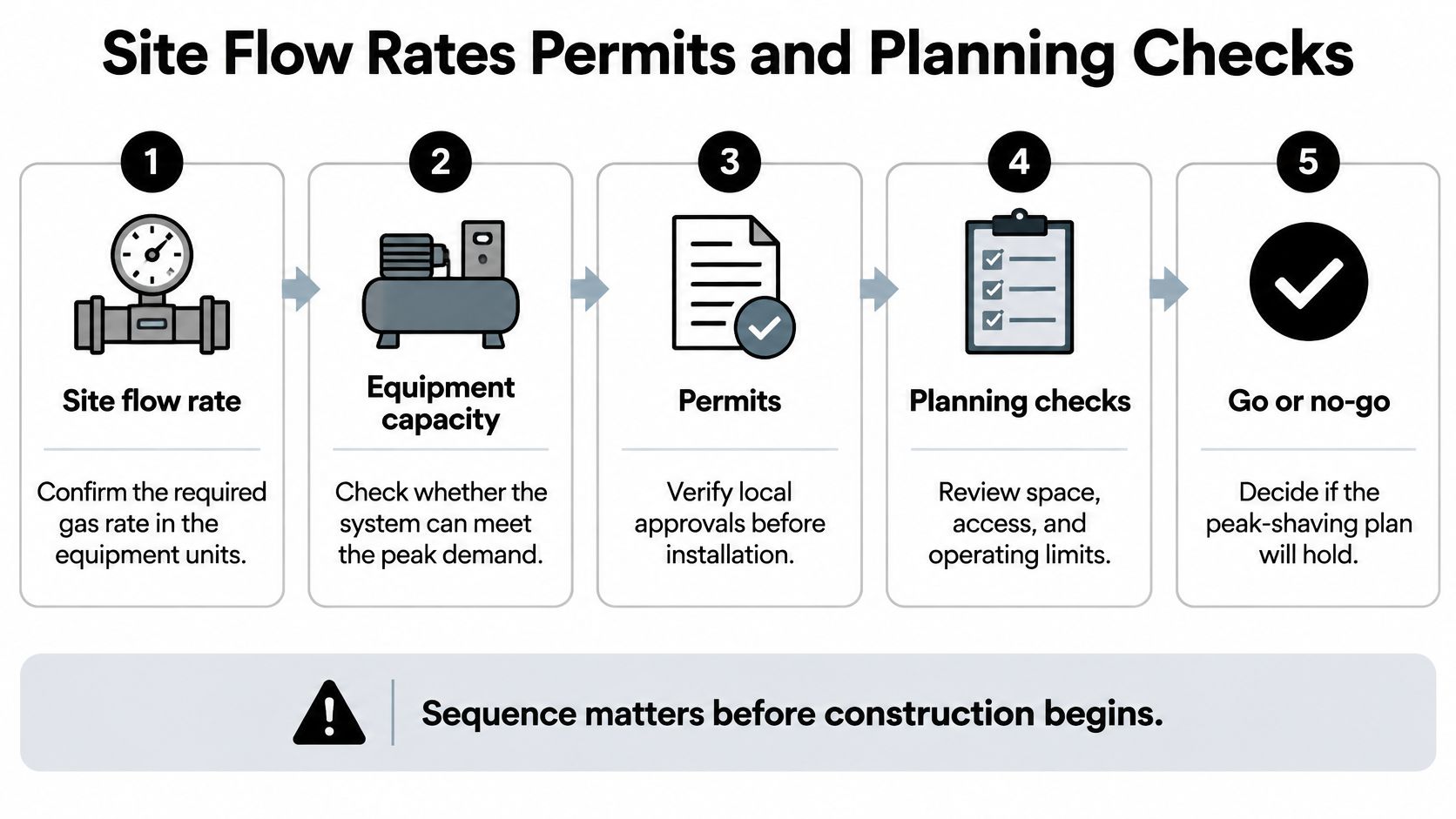
A peak-shaving plan starts with the site flow rate. Record the gas rate required by the equipment in units both the equipment supplier and utility can use. A total fuel estimate alone won't show whether the supply can meet the peak demand at a particular moment.
Next, define the coverage window. Include the expected hours or days of need, plus nights and weekends if the equipment must continue running then. If the outage lasts longer than the planned supply, a setup that initially met the flow requirement may still fail before permanent service returns.
Then check whether demand coincides. Several buildings, generators, or neighboring customers drawing gas at the same time can use up capacity faster than a plan based on one meter suggests. The site owner and utility should agree on what can be supplied during overlapping peaks, not just the individual customer's maximum need.
Temporary CNG or LNG doesn't replace a designed interconnection, adequate permanent capacity, or a utility's ability to send out enough gas. It also doesn't remove the need to check local approvals for temporary equipment. Include space and truck access, and assess the air-quality and climate-reporting implications of combustion, trucking, methane, and liquefaction energy. Document delivery distance and expected duration so the reliability gain can be weighed against those impacts.
Bring this checklist to the utility or mobile supplier:
- Required flow: What rate must the site receive when demand peaks?
- Coverage period: How many hours or days must supply last, including nights and weekends?
- Concurrent demand: Which other buildings, generators, or customers may draw gas at the same time?
- Site readiness: Can trucks reach the site, and can the equipment be installed and operated under applicable approvals?
- Permanent-service plan: What interconnection or capacity work remains, and when is it expected to be ready?
- Impact comparison: What delivery distance, outage duration, methane assumptions, combustion impacts, and liquefaction energy should be included?
What to Do Before the Next Demand Spike
A peak shaving plan lives or dies on three numbers: the flow rate the site must receive, how many hours the supply gap will last, and what an interrupted schedule or lost occupancy costs relative to temporary supply and its emissions. Everything else follows from those figures. A gap measured in hours calls for a different response than one measured in weeks, so write the duration down before pricing anything.
A mobile CNG or LNG bridge fits when the shortfall is temporary: a line installation running behind schedule, a maintenance outage, or a service connection waiting on utility work. Deliverability for those hours is the problem being solved, and naming that problem early saves calls later. Construction firms, industrial plants, commercial property owners, and utilities across North Carolina, South Carolina, Tennessee, and Virginia can time a deployment to the outage or delay, then confirm connection and safety requirements with the gas utility.
When a line delay or maintenance outage is on the calendar, share the required flow and expected coverage window with the supplier before site work begins. Blue Gas Express provides temporary mobile CNG and LNG supply for construction, commercial, industrial, and utility needs, and can confirm whether a mobile setup fits the site and schedule.