

Your building is nearly ready, but the gas main isn't. The boilers need commissioning, the production line needs heat, or the utility needs to repair a pipe without cutting off downstream customers. Waiting for permanent service may mean delaying work that's otherwise ready to proceed.
Liquefied natural gas transportation can bridge that gap, but it involves more than sending a tanker to the gate. The useful way to understand it is as two linked systems: ocean cargoes that supply regional markets, and smaller cryogenic deliveries that bring gas to places a pipeline can't yet serve.
Why Natural Gas Travels as a Liquid
At a coastal liquefaction plant, operators prepare natural gas for shipment. Far inland, a construction site needs that fuel but has no working pipeline connection. Turning the gas into liquid makes transport practical: liquefaction reduces its volume by approximately 600 times relative to gas at standard conditions, as described in the gas-carrier overview.
Think of it as packing the same fuel into a much smaller transport space. Natural gas is mostly methane, and LNG is that gas made portable through cooling, not a different fuel. It's also not compressed natural gas, or CNG, which remains gaseous under pressure.
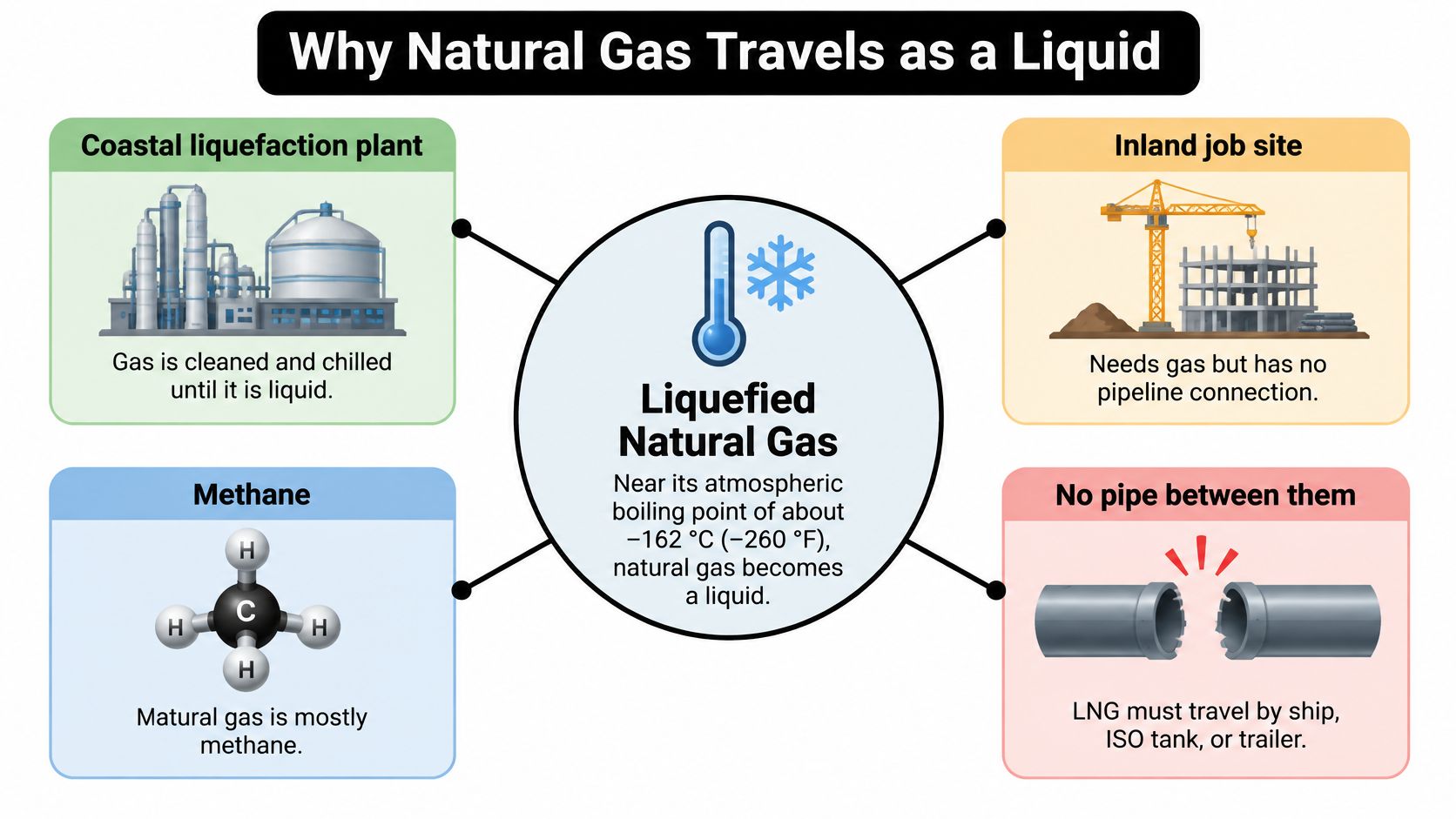
Two transport systems, different jobs
The coastal plant and inland customer don't necessarily share a direct delivery route. Large ocean carriers move LNG between export plants and import terminals; smaller ISO tanks, highway trailers, permitted rail movements, and temporary vaporization equipment handle regional supply.
According to LNG Industry's coverage of GIIGNL's annual report, global LNG trade reached approximately 406 million metric tons in 2024. That international trade supplies markets, while a local delivery operation solves a particular customer's shortage.
The distinction matters when someone says they need LNG transportation. A terminal buying an ocean cargo needs a vessel and berth. A builder waiting for a utility connection needs a road-accessible receiving location, sufficient storage, and equipment that delivers usable gas.
Practical distinction: An ocean cargo supplies a market. A mobile LNG installation supplies a particular connection.
Read fleet figures with their dates
A later snapshot helps show how fleet size and transport activity can move differently. The International Gas Union's World LNG Report 2026 reported 804 active vessels in 2025, up 8.4%, according to PortNews.
The same report recorded 6,870 LNG trade voyages in 2025, down 2.8% from 2024 as larger vessels transported cargoes more efficiently, according to Safety4Sea. More ships therefore doesn't automatically mean more voyages.
For the inland customer, fleet totals are background rather than a delivery specification. The practical questions concern the tank, vapor-management arrangements, applicable transport rules, and unloading appointment. Each must suit a liquid that needs controlled cryogenic handling until operators deliberately warm it back into gas.
How Each Transport Mode Fits the Job
| Mode | What moves | Distance role | Best when |
|---|---|---|---|
| Ocean LNG carrier | Bulk liquid in membrane or spherical cargo tanks | Export plant to import terminal across an ocean | No practical pipeline connection spans the route and the parcel is a full cargo |
| ISO cryogenic container | Smaller liquid parcel in a standardized tank | Ship, rail, or truck without unpacking | The load must change vehicles or stay smaller than a ship cargo |
| Highway LNG trailer | One cryogenic trailer load per trip | Plant or storage site to a regional tank | A site needs gas by road before or instead of a local main |
| Rail tank car | Bulk cryogenic rail tank | Inland corridor with rail access | Track exists, the movement is authorized, and the haul extends beyond a practical truck turn |
| On-site storage and vaporization | Liquid held cold, then warmed to gas | Last step at the customer or pipeline segment | Supply must enter a building, boiler, or pipe at usable pressure |
Choose a row by the supply gap you're filling, not by which vehicle carries the most fuel. The largest transport mode is rarely the best answer to a small, urgent delivery problem.
An ocean carrier moves a bulk parcel between facilities built to receive it. Its cargo isn't a local delivery that can be redirected to a construction entrance. A coastal importer needs compatible terminal infrastructure, an unloading window, and arrangements for distributing the resulting gas.
When the load must change vehicles
An ISO cryogenic container lets operators transfer the tank between compatible vehicles rather than transfer the liquid at every interchange. That distinction matters on a route involving a ship, an inland terminal, and a final road leg.
The container still needs suitable handling equipment and an approved operating plan. Standardized dimensions don't remove cryogenic requirements, and a container's permitted holding conditions must suit the complete journey, including delays.
Rail can serve an established inland corridor where terminals and customers have the necessary access and handling arrangements. Track alone isn't enough. Operators must establish that the proposed equipment and movement are permitted in the relevant jurisdiction before treating rail as an available option.
- Changing vehicles: Consider an ISO tank when keeping the liquid inside the same container simplifies a multimodal route.
- Serving a regional customer: Use road delivery when the receiving tank is accessible by truck and refill scheduling fits the demand.
- Moving along an established corridor: Evaluate rail only alongside authorization, terminal capability, and the final delivery leg.
When the customer needs gas now
A delayed utility tap generally points toward a trailer-plus-vaporizer arrangement, not a marine solution. The trailer brings the liquid to the site; stationary equipment converts it into gas at the pressure the customer can accept.
Say an industrial building is ready to commission its boilers, but the permanent main hasn't been connected. The important constraints are the access road, unloading position, receiving capacity, and peak gas demand. The delivery vehicle must fit those constraints without obstructing construction or emergency access.
A longer inland route may combine modes, such as an ISO container arriving through a port and completing the trip by truck. Each interchange adds handling and scheduling obligations, so the shortest line on a map isn't necessarily the simplest route.
On-site storage and vaporization aren't another fuel type. They're the receiving end of the transport chain. Whatever brings the liquid, operators need compatible containment, transfer equipment, and vapor controls before unloading starts.
Tanks Hoses and Boil-Off Control
Heat enters; vapor forms. Insulation slows that process, but it doesn't eliminate it. The resulting vapor is called boil-off gas, or BOG, and operators must account for both its pressure and its effect on liquid inventory.
The U.S. Department of Energy and NETL lifecycle model describes LNG near its atmospheric boiling point of approximately −162 °C (−260 °F) and provides the storage, voyage, and transfer benchmarks below.
LNG boil-off and transfer benchmarks
| Measure | Benchmark | Operational meaning |
|---|---|---|
| Storage boil-off | 0.02–0.1% of volume | Modeled liquid inventory converted to vapor through heat ingress |
| Laden LNG-carrier voyage | About 0.1% of cargo volume per day | Daily vapor-generation allowance on a loaded sea passage |
| Ship loading and unloading | 10,000–12,000 m³/h | Modeled transfer rate relevant to berth time |
| Modeled boil-off generation | 20,000 kg/h | Vapor requiring fuel use, reliquefaction, or approved pressure control |
These are model benchmarks, not guaranteed performance figures for a customer's tank. In particular, the storage range shouldn't be assigned a daily time basis that the stated benchmark doesn't provide. The ship-transfer figures also shouldn't be used to estimate a highway trailer's unloading time.
Longer journeys allow more time for heat ingress. Insulation condition, starting liquid temperature, cargo composition, and transfer duration also change the amount of liquid available at arrival.
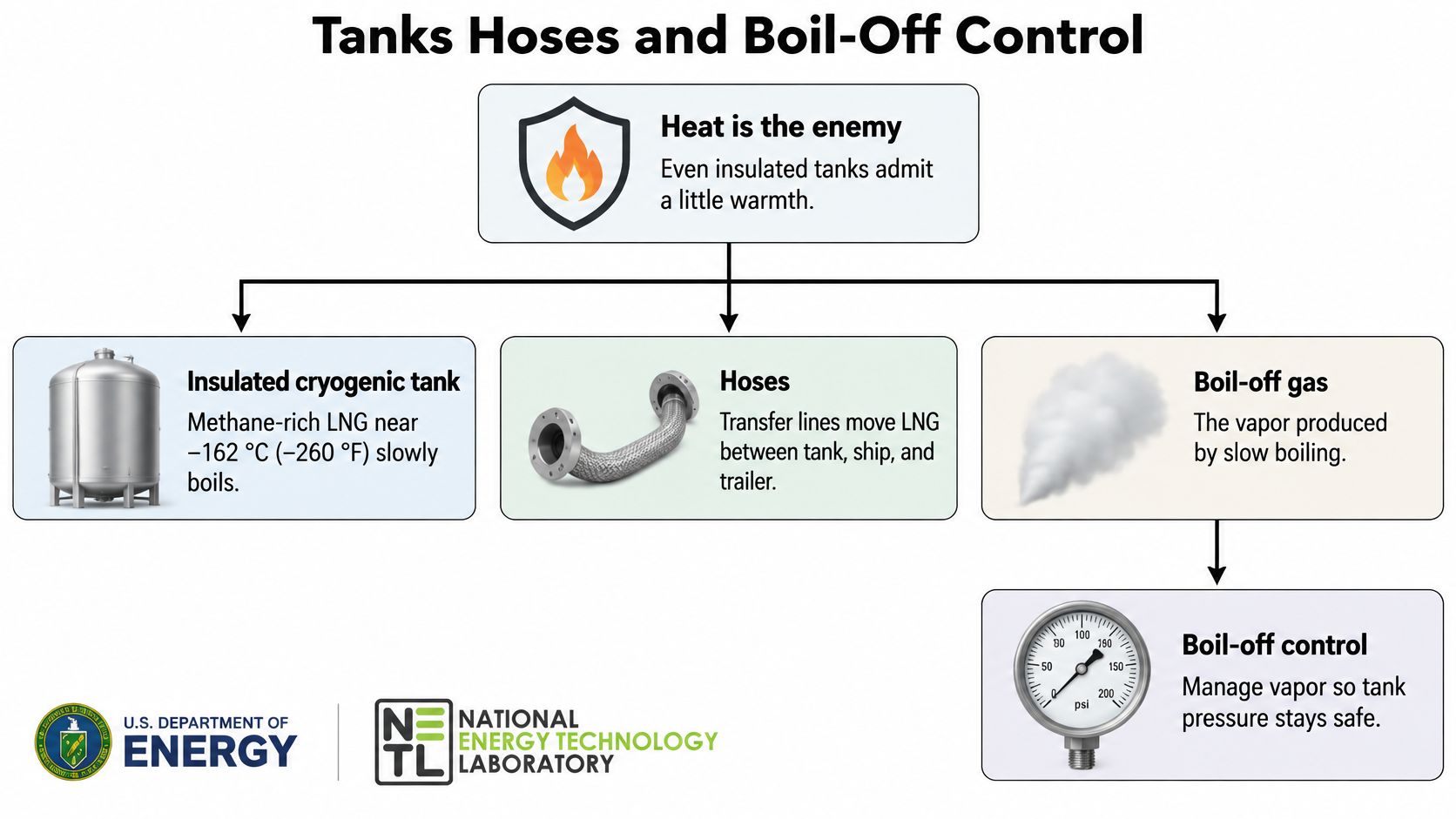
Give the vapor a planned destination
Operators need a defined way to handle vapor rather than treating it as an unexpected byproduct. The principal options are:
- Use it as fuel: Suitable ship systems can consume boil-off gas rather than discharge it.
- Reliquefy it: Appropriate equipment can return vapor to liquid inventory.
- Control pressure through an approved system: The tank and operating procedure must accommodate vapor within their permitted limits.
Uncontrolled venting is not a normal logistics method. A relief device is a safety safeguard, not a substitute for routine vapor management.
The physical equipment works together. Primary containment holds the liquid, insulation limits heat entry, and monitoring shows temperature, volume, and pressure. LNG carriers generally also need an independent secondary barrier to address a failure of primary containment.
At a truck delivery, the receiving tank, hose, valves, vaporizer, and relief equipment must all be suitable for cryogenic service. Ordinary materials can become brittle, and exposed cold surfaces can injure personnel. A short route may reduce cumulative vapor generation, but it doesn't justify improvised fittings or unprotected transfer areas.
Before booking transport, calculate usable delivered inventory, not just the departure load. Include the expected boil-off, transit time, unloading conditions, and any vapor that remains available for controlled use.
Safety Rules for Ships Terminals and Roads
LNG safety arrangements address distinct failures: a cold spill, an accumulating vapor cloud, ignition, and pressure rise as the contents warm. Treating all of them as a generic gas hazard leads to incomplete preparation.
A cold spill requires cryogenic-compatible equipment and protection against personnel contact. A vapor release requires attention to dispersion and ignition sources. Fire protection and pressure protection serve different purposes, so neither replaces the other.
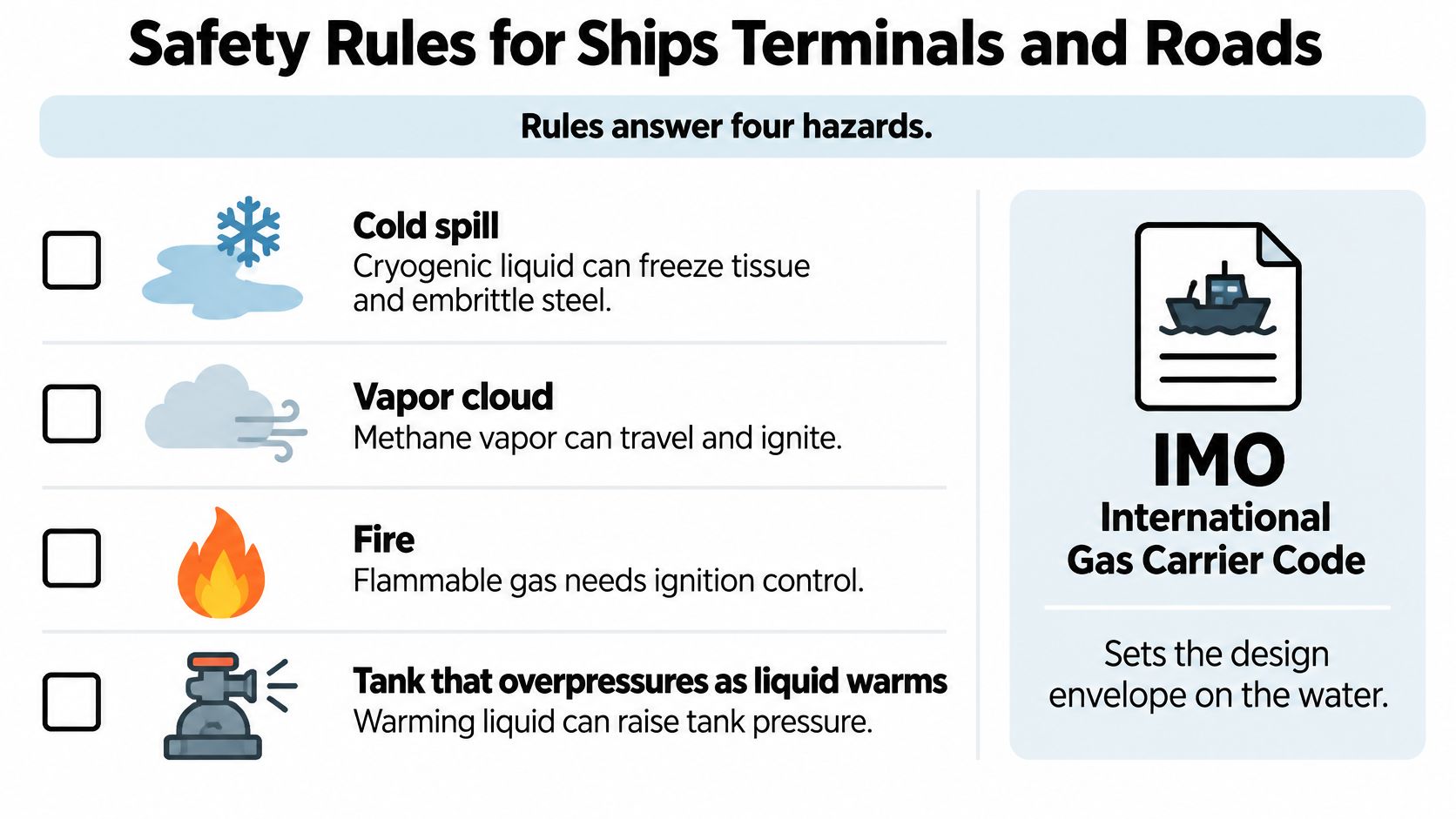
Different authorities cover different interfaces
On the water, the IMO International Gas Carrier Code establishes the design framework for cargo containment, secondary barriers, and cargo monitoring. The ship's cargo system must keep the liquid contained while operators track conditions during loading, travel, and unloading.
In the United States, 49 CFR Part 193, where applicable, and the NFPA 59A provisions incorporated into the regulatory framework address LNG-facility safety. Applicability depends on the facility and operation, so a permanent import terminal and a temporary customer installation shouldn't automatically be treated as identical regulatory cases.
Facility planning addresses siting, spill impoundment, fire protection, and emergency shutdown. The Coast Guard oversees relevant marine-terminal and ship-to-shore transfer requirements. Highway operators separately address hazardous-materials transportation requirements, including shipping documentation, qualified drivers, suitable vehicles, and applicable routing restrictions.
Responsibility also changes at each interface. The carrier operator manages transport, the terminal operator manages the jetty and storage operation, and the customer-site operator manages the vaporization installation and its receiving connection. Written procedures must identify who controls each transfer and who can stop it.
Make the pre-transfer check concrete
Before a pump starts, operators should confirm:
- Compatible connections: Check hose service rating, condition, coupling security, and the receiving equipment's pressure limits.
- Electrical precautions: Verify the grounding or bonding arrangement specified by the approved transfer procedure.
- Controlled surroundings: Establish the exclusion zone and assess wind, vehicle movements, and ignition sources.
- Correct valve positions: Confirm the intended liquid path, vapor arrangements, and available pressure-relief protection.
- Clear shutdown authority: Name the person who can stop the transfer and confirm communications between both ends.
Odorization belongs at the appropriate downstream point when gas enters a system that requires a detectable smell. Operators shouldn't handle liquid cargo as though it were already odorized household gas.
A compliant delivery is a matched transport vehicle, receiving installation, operating procedure, and emergency plan. It isn't simply a tank parked beside a building.
From Liquefaction Plant to Usable Gas
The complete journey has several handoffs. Each operator needs to know what arrives, what the receiving equipment can accept, and what happens if the planned transfer is delayed.
- Clean and liquefy the gas. At the source plant, operators prepare the feed gas and chill it into liquid suitable for cryogenic storage.
- Load the LNG through compatible loading arms or hoses into a ship, ISO tank, or highway trailer. Transfer speed must suit the actual equipment and receiving conditions.
- Monitor the journey. Operators track pressure and temperature while following the cargo's boil-off management plan.
- At the destination, unload into a terminal tank, customer vessel, or temporary storage container with adequate available capacity.
- Produce usable gas. A vaporizer adds heat, and regulators establish the pressure accepted by the boiler, process equipment, or pipeline connection.
- During a utility interruption, an engineered temporary installation can feed an isolated downstream section while crews maintain, repair, or replace the affected main.
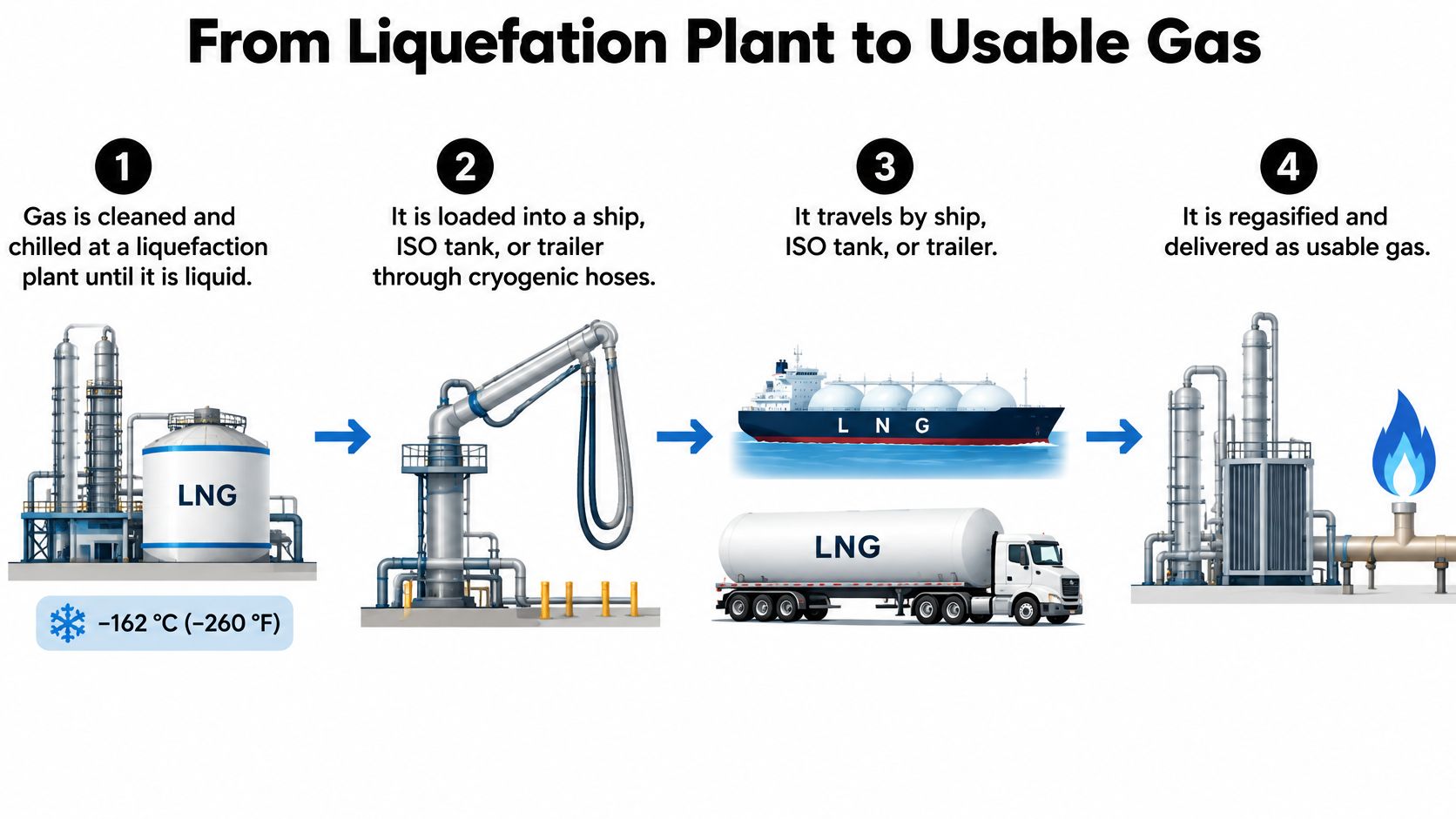
Scheduling matters as much as distance
The scale helps explain why delivery slots matter: the International Energy Agency's LNG supply assessment describes approximately 550 billion cubic meters exported as LNG in 2024, just under 15% of global natural-gas consumption, supported by about 760 operating LNG ships, roughly 250 vessels under construction for projected delivery by 2027, and approximately 7,000 annual round trips; it also estimates 800 petajoules of shipping fuel use in 2024, primarily boil-off gas alongside heavy fuel oil and marine gasoil.
A ship must reach an available berth, not merely reach the right coastline. The terminal must also have room for its cargo and the ability to complete the transfer.
A local buyer faces the same scheduling problem at a smaller scale. A trailer arriving too early may find insufficient receiving capacity. One arriving too late may leave the vaporizer without enough liquid to maintain supply.
Ullage means the available space in a tank. Dispatchers need the permitted receiving capacity, not a rough visual estimate of how full the vessel appears.
Build the delivery plan around usable supply
A practical schedule records:
- Source plant and loading slot: Confirm where the liquid will come from and when loading can occur.
- Transit duration and inventory allowance: Account for the route, likely delays, and expected vapor generation.
- Receiving-tank ullage: Ensure the delivery fits within the approved filling limits.
- Vaporizer output: Specify required gas delivery in dekatherms per hour, with operating conditions clearly stated.
- Permanent-service handoff: Record when utility supply is expected to return and who authorizes the changeover.
The ship network replenishes markets. The trailer schedule and vaporizer capacity determine whether a particular construction project, industrial process, or downstream utility segment keeps receiving gas.
When Cleaner Burning Still Costs the Climate
Better transport efficiency doesn't automatically mean lower total climate impact. An operator can reduce the transport burden per unit while moving more fuel over longer routes.
A 2026 Nature study found that global LNG maritime trade grew about 30% to roughly 402 million tonnes in 2023, while cumulative sailing distance increased 89.9% and transport intensity fell 11.7% per cubic metre transported; the accompanying findings also identify reported real-world methane slip of 6.4% for one widely used low-pressure engine category.
The engine finding isn't a universal leakage rate for LNG ships or truck deliveries. It illustrates why engine technology and operating conditions matter alongside cargo volume and distance.
When do lower stack emissions lose to methane released along the route?
Compare the whole delivery pathway
A useful assessment follows methane through liquefaction, loading, shipping, unloading, regasification, and combustion. Methane slip means methane passing through an engine without being burned; terminal leakage and other releases create additional pathways that a fuel-efficiency figure doesn't capture.
The Nature work identifies terminal methane leakage and alternative delivery pathways as gaps in a complete assessment. That means an efficiency improvement alone can't establish which fuel arrangement is better for a particular customer.
Consider the alternative the site would use. Short-haul LNG replacing diesel or fuel oil at an industrial boiler may present a different comparison from a long marine journey involving substantial methane emissions. Neither scenario supports a universal claim that LNG is cleaner.
Put the offer against the real alternative
- Distance: Request the actual supply route, including the final inland leg, rather than the distance to the nearest terminal.
- Days in transit: Include waiting and holding time, not just driving or sailing time.
- Boil-off destination: Establish whether vapor is consumed, reliquefied, or otherwise managed within an approved system.
- Displaced fuel: Compare against the diesel, fuel oil, CNG, pipeline gas, or electricity the customer would otherwise use.
Pipeline gas already available at the property avoids the extra liquid-delivery steps. Temporary CNG may also deserve consideration for a short supply gap. The defensible choice depends on the actual route, equipment, methane management, and displaced fuel, not a cleaner-burning label.
Decide Whether to Truck LNG or Wait for the Pipe
Wait for the permanent main when the service date is dependable and the delay is tolerable. A small load that can pause without affecting occupancy, commissioning, or production may not justify a temporary installation.
Bring temporary supply into the decision when the main is late, an operating section needs repair, peak consumption exceeds available vapor supply, or the property has no pipeline access. The right scale follows the gas demand and the refill opportunities, not just the size of the site.
Match the installation to the draw
- Modest demand: A trailer refill may cover a limited operating window when storage and consumption align.
- Continuous consumption: Plan repeated deliveries before inventory reaches the operating minimum.
- Large industrial demand: Use a properly sized vaporization installation when smaller mobile arrangements can't support boilers, dryers, or a distribution segment.
Our LNG system at Blue Gas Express combines containers, vaporizers, odorizers where required, regulators, and connecting pipe. We bring LNG from liquefaction plants where we have liquefaction contracts, and tractor-trailer loads of 8,000 to 10,000 gallons refill the on-site containers to maintain continuous gas flow.
That source arrangement belongs in the plan. Don't base a critical commissioning date on unspecified liquid availability or an assumed spot-market pickup.
Prepare the site and the handoff
Before the first transfer, establish the emergency arrangements, operating responsibility, and regulatory coordination. We create the mandatory Emergency Management Plans, bring the personnel and technology to operate and monitor the LNG site, and coordinate with Fire Marshals and other regulatory bodies.
The utility handoff needs equal attention. We coordinate with gas utilities so temporary service and permanent supply don't leave an unintended gap or overlap.
Write down hourly gas demand, the expected temporary-service window, and the receiving connection size. Use those details to establish a refill schedule based on usable delivered inventory, with boil-off already accounted for.
Blue Gas Express provides mobile LNG supply, operating personnel, monitoring, and site planning for projects waiting on a gas main or working through an outage. Visit Blue Gas Express with your hourly gas requirement, expected service dates, and connection details to discuss an installation and refill schedule for your site.