

When your fleet runs on natural gas, searching for "NGV stations near me" is more than a quick Google Maps query—it's a mission-critical part of your daily logistics. The best starting point, and frankly the one I turn to first, is the U.S. Department of Energy's Alternative Fuels Data Center (AFDC) station locator. Think of it as the definitive, no-nonsense guide for finding CNG, LNG, and even RNG fueling options.
Your Best Tools for Finding NGV Stations Now
A simple map search might get you close, but for commercial fleet operations, you need tools built for the job. Specialized platforms understand that things like fueling pressure, payment types, and public access hours are non-negotiable details, not just minor conveniences.
It also helps to have a basic understanding of how these search platforms work. Knowing a bit about the top Google Maps ranking factors, for example, can give you insight into why certain stations pop up first and help you tweak your search for better, more relevant results.
Mastering the AFDC Station Locator
The AFDC locator is the gold standard for a reason. It’s less of a map and more of a powerful, filterable database designed specifically for fleet managers who need precise information.
You can drill down and get exactly what you need by filtering for:
- Fuel Type: Choose between Compressed Natural Gas (CNG), Liquefied Natural Gas (LNG), or Renewable Natural Gas (RNG).
- Access: Is the station public and open 24/7? Or is it a private station you have access to? This filter sorts it out instantly.
- Payment Options: Find stations that accept your specific fleet cards to avoid any headaches for your drivers at the pump.
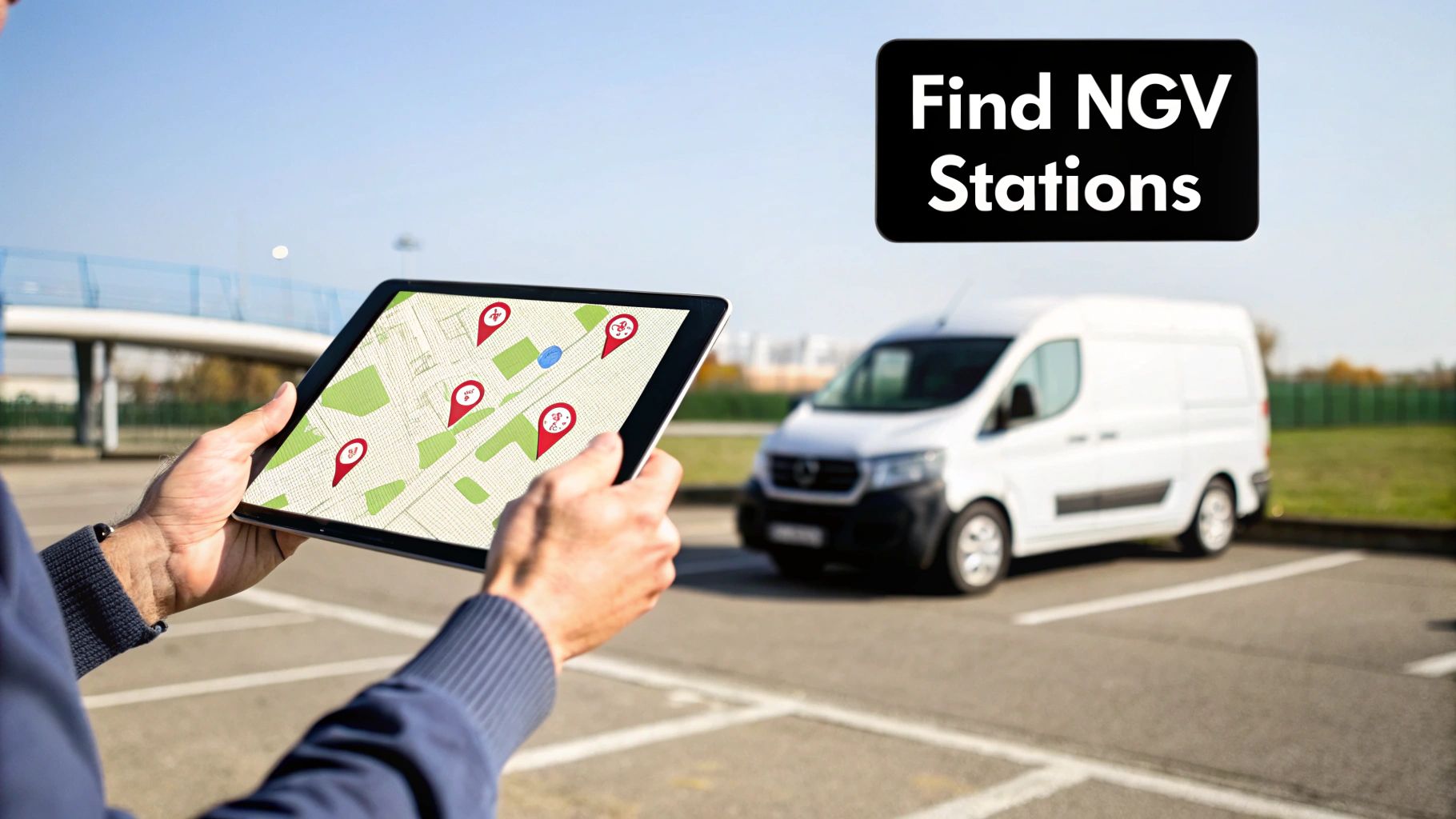
The map interface gives you a fantastic bird's-eye view, making it easy to see station density along a long-haul route or spot potential fueling deserts in new service areas.
The good news is that this infrastructure is growing. Across the United States, there are now 1,385 compressed natural gas (CNG) stations and 81 liquefied natural gas (LNG) stations. What's truly important for fleet operations is that 53 percent of these CNG stations are open to the public, giving your drivers broad access when they need it most.
Top NGV Station Locator Tools
Here's a quick comparison of the most effective tools for finding natural gas fueling stations, highlighting their best features for fleet managers and operators.
| Tool/Resource | Best For | Key Feature |
|---|---|---|
| AFDC Station Locator | Detailed route planning and verifying station capabilities. | The most comprehensive and accurate government-backed data with robust filters. |
| CNGnow App | On-the-road drivers needing real-time updates and pricing. | User-reported data on station status, current fuel prices, and pump availability. |
| LNGnow App | Fleets operating LNG vehicles, especially for long-haul routes. | Specialized focus on LNG stations with real-time operational status updates. |
While the AFDC is your strategic planning tool, mobile apps are your tactical advantage on the ground.
Essential Mobile Apps for Drivers
For drivers in the field, real-time information is everything. That's where mobile apps like CNGnow and LNGnow come into play. These apps provide a live look at station status, current pricing, and even crowd-sourced intel on issues like a broken pump.
Equipping your drivers with the right mobile tools turns them into proactive partners in your fueling strategy. They can make informed decisions on the road, report station issues in real-time, and adapt to unforeseen changes without disrupting the entire logistics chain.
These apps are indispensable for avoiding a costly detour to a station that's unexpectedly closed or out of service. Setting up alerts for new stations opening along your primary routes can also give you a leg up, potentially unlocking more efficient routing options as the network expands.
Evaluating a Station's Fit for Your Commercial Fleet
Finding a potential natural gas station on a map is one thing. Figuring out if it can actually serve your commercial fleet without a major headache is another thing entirely. The last thing you need is a driver showing up to a station they can't access or use, wasting precious time, fuel, and throwing your schedule off track.
Before you ever add a new station to your approved routes, you need to do a little homework. Think of it as pre-qualifying a new partner—you have to make sure they can handle the unique demands of heavy-duty vehicles.
It’s about looking past the pin on the map and digging into the details that make for a smooth, efficient stop.
Confirming Vehicle and Fuel Compatibility
Not every NGV station is built for big rigs. Many are designed for light-duty passenger vehicles and simply don't have the space for a Class 8 truck to maneuver, let alone the right equipment.
Here's what you absolutely must verify first:
- Vehicle Access: Can your semi-truck actually get in and out of the station easily? Pull up the location on a satellite map and look for tight turns, low canopies, or other obvious deal-breakers.
- Fuel Pressure: Most heavy-duty CNG trucks need a 3,600 psi (pounds per square inch) fill to get a full tank. Double-check that the station’s dispensers can deliver this pressure. Anything less means an incomplete fill.
- Connector Type: Does the station have NGV1 or NGV2 nozzles? The smaller NGV1 is for cars and light trucks. Your medium and heavy-duty vehicles almost certainly require the larger NGV2 connector. The wrong nozzle makes the station useless to your driver.
Get any of these wrong, and the station might as well be on another planet. It simply won't work for your fleet.
Assessing Operational Logistics
Once you've sorted out the technical side, it's time to look at the day-to-day operational details. This is what really impacts your driver's time on the road and how smoothly your back-office billing works.
A great fueling station becomes an extension of your own operations. It should be reliable, accessible whenever you need it, and simple for your team to use. Anything less introduces friction and hidden costs into your logistics.
Never send a truck to a new station without a quick phone call or a check on a trusted app to confirm the essentials.
Key Logistical Questions for NGV Stations
| Logistic Factor | Why It Matters | Best Practice |
|---|---|---|
| Operating Hours | Many stations are 24/7, but some aren't. Don't assume. | Always confirm the hours, especially for sites hosted at private businesses or municipal depots. |
| Public vs. Private | Some stations are for private fleets only and won't serve your vehicles. | Use filters for "Public Access" in tools like the AFDC Station Locator to avoid a wasted trip. |
| Payment Methods | Will the station take your fleet fuel cards, like Comdata or WEX? | Confirming payment options ahead of time prevents your driver from being stuck without a way to pay. |
Spending just a few minutes on this upfront check turns a random dot on the map into a vetted, reliable fueling partner. This is how you build an NGV fueling strategy that’s efficient, predictable, and ready for the real world.
Building a Smarter NGV Fueling Strategy
Running an NGV fleet efficiently is about more than just finding the closest pump. It's about building a proactive fueling strategy that's woven directly into your daily logistics. The real goal here is to keep your vehicles on the road and making money, turning what could be a major bottleneck—refueling—into a smooth, predictable part of your day.
Instead of waiting for a low-fuel warning, think ahead. Smart route planning should always account for your vehicle’s tank range, your drivers' hours of service, and where your trusted NGV stations are located. This kind of foresight is what cuts down on "deadhead miles"—those costly, unproductive trips just to find fuel. By mapping out both primary and backup fueling stops along your regular routes, you build a resilient network that won't fall apart because of traffic, a closed station, or some other unexpected headache.
To get this right, you really need data. Implementing a comprehensive fleet fuel management system gives you the real-time information you need on fuel consumption and vehicle location. Those insights are gold for fine-tuning routes and schedules to be as cost-effective as possible.
Primary Networks vs. Provider Flexibility
A big decision you'll face is whether to stick with a single, primary station network or give yourself the flexibility to use multiple providers. Committing to one network can definitely have its perks, like volume discounts and simplified billing, which makes the back-office work a lot easier. But putting all your eggs in one basket is risky—if one of their key stations goes down, you're stuck.
For most fleets, a hybrid approach is the smartest play:
- Establish Your Go-To Stations: Pick a handful of core, high-volume stations that you know are reliable and are right on your most common routes.
- Have a Plan B (and C): Vet and approve several backup stations from different providers to serve as your alternatives.
- Equip Your Drivers: Give your team clear instructions on when to use the primary stations and when it's okay to switch to a backup.
This balanced strategy delivers the best of both worlds: you get the potential for cost savings without sacrificing your operational resilience.
The global natural gas vehicle market is booming, expected to jump from USD 15.02 billion to USD 23.78 billion by 2032. This isn't just a random statistic; it shows how much more the world is relying on NGV infrastructure. It also underscores why a rock-solid fueling plan is no longer a nice-to-have—it's essential. You can dig into more NGV market trends on marketsandata.com.
Finally, never forget about your most important asset—your drivers. They are on the front lines. Proper training on safe and efficient NGV fueling isn't just a compliance issue; it's a core part of your strategy. When drivers understand the equipment, know how to handle minor issues, and are clear on the fueling protocol at different stations, they become invaluable. What was once a simple task becomes a well-oiled part of your entire operation.
What to Do When There Are No NGV Stations Nearby
You’ve planned the route, the fleet is ready to roll, but a search for "NGV stations near me" turns up nothing. It’s a frustratingly common problem, especially for projects in developing areas or industrial parks built just outside the reach of existing natural gas infrastructure.
This is where a carefully planned operation can hit a major snag.
Picture a massive construction site breaking ground miles from the nearest city. The generators, water heaters, and heavy equipment are all designed to run on efficient natural gas, but the permanent pipeline won't be live for months. Suddenly, you're facing expensive downtime and a project timeline that's at serious risk.
Confronting the Infrastructure Gap
This isn't just a problem for remote job sites. What happens when the local gas utility schedules a planned maintenance shutdown? An entire industrial facility can lose its primary energy source for days. In moments like these, a backup plan isn't just nice to have—it's essential for survival.
The hard truth is that while the natural gas vehicle network is growing, that growth isn't happening everywhere at once. The infrastructure is expanding strategically in key markets, with major clusters of CNG and LNG stations in China, Europe, and North America.
But even here, the expansion can be slow, leaving significant service gaps. This is especially true for construction and industrial operations in regions like the Carolinas, Tennessee, and Virginia. You can dig deeper into these NGV infrastructure trends and innovations on archivemarketresearch.com.
When you’re staring down one of these gaps, you need a flexible, on-demand alternative to a permanent fueling station.
Mobile Natural Gas: The Bridge Solution
This is exactly where mobile natural gas delivery comes in. Instead of hauling equipment to a station miles away or switching to more expensive fuels like diesel or propane, you can have a temporary fuel source brought directly to you. It’s a solution that keeps your equipment running without missing a beat.
Think about these real-world scenarios where a mobile setup is the only practical choice:
- Remote Construction Sites: Powering generators and site equipment long before permanent utility lines are active.
- Pipeline Interruptions: Providing an emergency gas supply during unexpected utility maintenance or repairs.
- Peak Demand Support: Supplementing an industrial facility's existing gas supply during high-usage periods.
- Events and Emergency Services: Fueling temporary kitchens, heating, and power for large outdoor events or disaster relief efforts.
In these situations, the question changes from "Where are the NGV stations near me?" to "How quickly can I get a reliable natural gas supply delivered to my site?" Finding the right answer is what keeps your project on schedule and on budget.
Ultimately, a lack of fixed infrastructure doesn't have to bring your operation to a halt. Knowing that mobile solutions exist turns a potential crisis into a manageable logistics problem, ensuring your project keeps moving forward, no matter where it is.
Mobile NGV Fueling: An On-Demand Solution
Let's be honest: for many construction sites, industrial plants, and remote operations, a quick search for "NGV stations near me" is going to come up with nothing. When the nearest permanent station is a hundred miles away or the local one is down for maintenance, your entire project timeline is at risk. This is exactly where on-demand mobile fueling becomes an operational lifeline, not just a nice-to-have.
For businesses operating in North Carolina, South Carolina, Tennessee, and Virginia, this critical gap is often filled by specialized mobile providers like Blue Gas Express. The whole paradigm shifts. Instead of trying to haul your equipment to the fuel, the fuel comes directly to you, completely changing the logistics of working in an area without built-in natural gas infrastructure.
How On-Demand Fueling Works
The process is refreshingly simple and built for speed—the last thing you need is more downtime. It all starts with a phone call to map out what you need: the type of gas (CNG or LNG), the volume you'll require, and your exact location. From there, a team can get a temporary mobile gas unit rolling out to your site.
We're not talking about a week-long lead time. In many scenarios, deployment can happen within hours. This kind of rapid response is a game-changer when you're dealing with an unexpected pipeline outage or a construction project that absolutely must power up equipment to stay on schedule.
This flow chart gives you a clear picture of the journey, from identifying the fueling gap to getting a mobile solution on the ground.
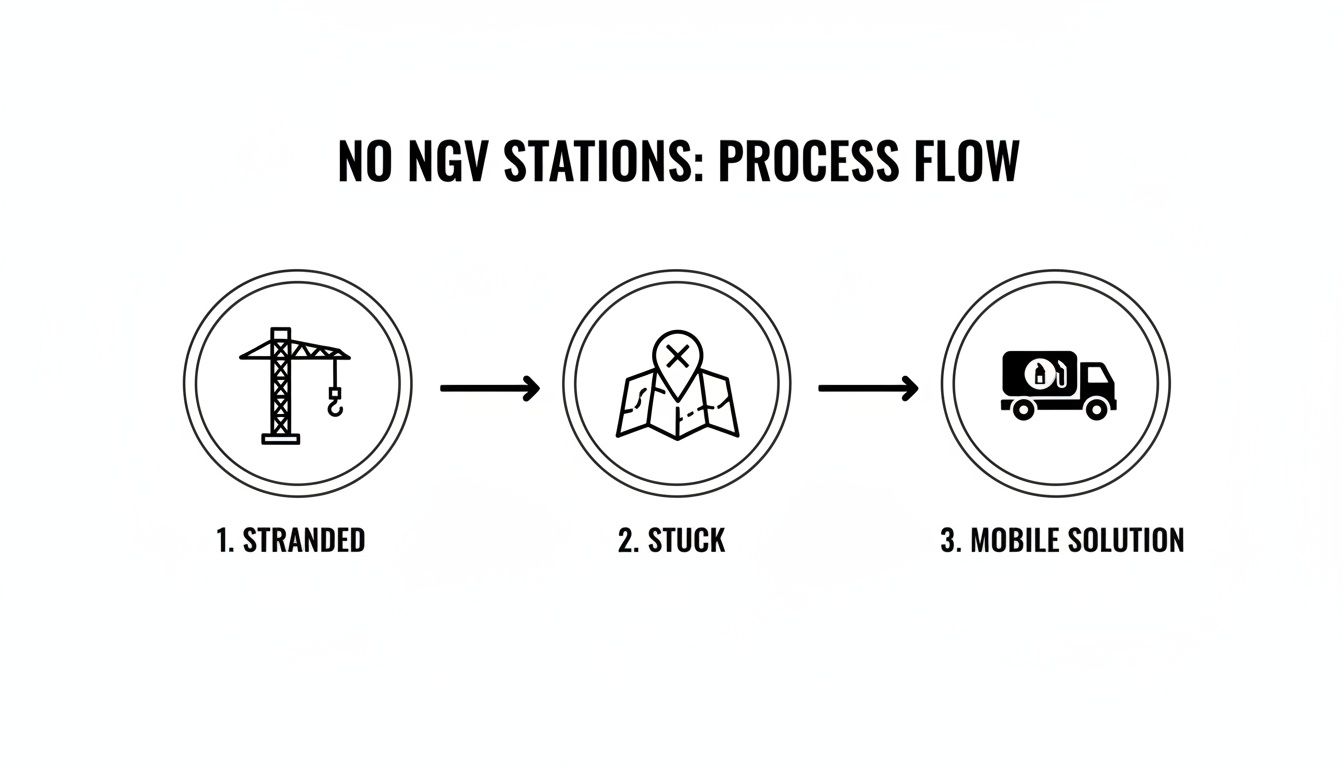
The big takeaway here is that a lack of fixed stations doesn't have to mean shutting down your operation. A mobile unit can bridge that infrastructure gap whenever you need it.
Practical Site and Safety Considerations
Bringing a temporary natural gas supply to your job site involves a lot more than just parking a truck. Safety and regulatory compliance are non-negotiable. The provider takes care of the technical side, making sure every connection is secure and meets all industry safety standards before any gas starts flowing.
Your main job is getting the site ready. This usually boils down to a few key things:
- Designating a Safe Zone: You'll need to mark off a clear, level, and accessible area for the mobile unit. It needs to be well away from heavy traffic, potential ignition sources, and any overhead obstructions.
- Ensuring Clear Access: Think about the path the delivery vehicle will take. It needs to be able to safely enter, position the unit, and leave your site without any trouble.
- Coordinating on Permitting: While the mobile fuel provider handles the heavy lifting on permits, they'll need your help. You'll likely need to provide site plans and other necessary documentation to keep things moving.
Mobile fueling is a partnership. The provider brings the certified equipment and technical know-how, and you provide a safe, accessible site. Good communication is what makes the setup fast, compliant, and—most importantly—safe for everyone on your team.
One of the biggest advantages is scalability. Whether you need to power a single piece of equipment or an entire asphalt plant, the solution can be scaled to your exact demand. This ensures you’re only paying for the capacity you actually use.
Knowing the right time to call for a mobile unit versus planning around a fixed station is key. This table breaks down some common situations.
Mobile vs. Fixed NGV Station Scenarios
| Scenario | Best Solution | Reasoning |
|---|---|---|
| Daily fleet fueling in a metro area | Fixed Station | Consistent, high-volume need makes a permanent, public station the most cost-effective and efficient choice. |
| Remote construction site | Mobile Solution | No permanent infrastructure exists. A mobile unit provides the necessary power for equipment without logistical headaches. |
| Emergency pipeline maintenance | Mobile Solution | A temporary, on-demand supply is needed to bridge the gap and prevent operational shutdown for a facility. |
| Seasonal agricultural processing | Mobile Solution | The need is intense but temporary (e.g., crop drying). A mobile unit avoids the cost of a permanent station that sits idle most of the year. |
| Piloting a new NGV fleet | Mobile Solution | Allows a company to test NGV vehicles in a real-world setting before committing to the capital expense of a permanent station. |
Ultimately, a mobile service like Blue Gas Express transforms what could be a major logistical nightmare—no nearby NGV stations—into a straightforward, manageable solution. It delivers the energy security you need to keep your projects on track, no matter where you are.
Your Top NGV Fueling Questions, Answered
Even with the best planning, real-world questions always come up when you're managing an NGV fleet. Whether you've been running on natural gas for years or are just making the switch, getting straight answers is key to keeping things moving.
Let's dive into some of the most common questions we hear from site supervisors and fleet managers in the field.
How Reliable Are the Online NGV Station Finders?
For the most part, tools like the AFDC station locator are incredibly reliable. They're updated frequently and serve as a fantastic starting point. But—and this is a big but—you shouldn't treat them as gospel. Information can lag, and things like temporary maintenance closures or broken equipment don't always show up in real-time.
Here’s the single most important tip I can give you: Always call a station before sending a truck for the first time. A two-minute phone call can confirm they’re open, have fuel, and can actually handle your vehicle's size. It’s the easiest way to prevent a driver from wasting hours on a dead-end trip.
Trust me, that quick confirmation call is worth its weight in gold.
What's the Real Difference Between CNG and LNG?
It all comes down to the physical state of the gas, which dictates how it's best used.
CNG (Compressed Natural Gas) is kept in its gaseous form but under intense pressure, usually around 3,600 psi. Think of it as the perfect fuel for vehicles that stick to a routine, like waste haulers or local delivery fleets that come back to the yard every night to refuel.
LNG (Liquefied Natural Gas) is natural gas that's been chilled way down until it becomes a liquid. This process makes it incredibly dense, so you can pack a lot more energy into the same amount of space. This is why LNG is the go-to for long-haul trucks that need maximum range between fill-ups.
Can My Trucks Use RNG at Any CNG Station?
Absolutely. From a chemical standpoint, Renewable Natural Gas (RNG) is identical to conventional natural gas. This means any vehicle that runs on CNG can fill up with RNG without a single modification.
The challenge isn't about compatibility; it's purely about availability. While more and more stations are starting to offer RNG to help fleets hit their sustainability goals, it's not everywhere yet. The AFDC locator is great for this—it has a filter that lets you specifically search for stations dispensing RNG, making it much easier to stick to your carbon-reduction plan.
If I Need a Mobile Fueler, How Fast Can It Get Here?
Speed is the whole point of a mobile fueling solution. When your search for "NGV stations near me" comes up empty, you need a Plan B that doesn't involve waiting for weeks.
At Blue Gas Express, we're built for speed. In many cases, we can have a temporary CNG or LNG fueling unit delivered, set up, and ready to pump within a matter of hours after you call us. Of course, the exact timing depends on your location and site specifics, but our entire operation is designed to solve your fuel problem fast and prevent a lack of infrastructure from derailing your project.
When a permanent station is just too far away, don't let it shut down your operation. Blue Gas Express delivers mobile CNG and LNG fueling right where you need it, keeping your project on track. Learn more about our rapid deployment services and how we can help.