

If you're a fleet manager, you know the drill. Diesel costs are a constant headache, and emissions regulations just keep getting tighter. It feels like you're caught in a vise. That's why so many are taking a hard look at natural gas for trucks. It's not some far-off, futuristic idea; it's a proven, ready-to-go solution that can slash fuel costs and clean up your fleet's environmental footprint right now.
Why Fleets Are Making the Jump to Natural Gas
The pressure is on from all sides. Unpredictable diesel prices can wreck a budget overnight, while environmental standards demand cleaner performance. Fleet managers need a power source that tackles both of these problems head-on, without sacrificing the reliability their operations depend on. Natural gas has emerged as that practical, powerful answer.
While some alternative fuels are still years away from being practical for heavy-duty use, natural gas is already a mature, dependable option. It offers a clear path to lowering your operational spending and hitting those tough emissions targets today, not a decade from now.
The Real Reasons Behind the Switch
This shift toward natural gas isn't just a passing trend—it's a smart, strategic move driven by real-world pressures. The numbers back it up, too. The global market for natural gas trucks was valued at around $15 billion in 2025 and is on track to hit a staggering $45 billion by 2033. That kind of growth shows a massive vote of confidence from the industry. For a deeper dive into these figures, check out the analysis from Archive Market Research.
So, what's pushing fleet managers to make the change? It boils down to a few key motivators:
- Serious Fuel Cost Savings: On a gallon-equivalent basis, natural gas is consistently less expensive than diesel. For fleets that rack up a lot of miles, those savings add up fast.
- Cleaner Air: Natural gas engines pump out significantly less nitrogen oxide (NOx) and particulate matter. This helps fleets not just meet, but often beat, current and future air quality standards.
- Price Stability: Natural gas is primarily a domestic resource, which means it isn't tied to the wild price swings of the global oil market. That translates to more predictable and stable fuel costs for your business.
"Switching to natural gas isn't a leap of faith anymore; it's a calculated business decision. When you can cut your fuel bill by a huge margin and boost your company's green credentials at the same time, the argument for it becomes pretty hard to ignore."
What You'll Learn in This Guide
Making a smart decision means knowing all the angles. We've designed this guide to walk you through the entire natural gas ecosystem, piece by piece. We'll start with the fundamentals and build up to the more advanced logistics and applications, so you can see the full picture.
First, we'll break down the crucial differences between Compressed Natural Gas (CNG) and Liquefied Natural Gas (LNG) to help you figure out which one fits your routes and operations. Then, we'll get into the nuts and bolts of vehicle options, fueling infrastructure—including flexible mobile solutions for when you're in a pinch—and how to calculate your potential return on investment. By the end, you'll have the practical knowledge you need to confidently map out a natural gas strategy for your fleet.
Understanding CNG vs. LNG for Your Operations
When you're looking at natural gas for your trucks, the first big question is always the same: CNG or LNG? They're both methane at their core, but how they're stored and used makes them two completely different animals. Picking the right one for your fleet's unique rhythm is the foundation of a smart natural gas strategy.
Think of it this way: CNG is like the air in a scuba tank—it’s a gas squeezed under immense pressure. LNG, on the other hand, is more like liquid nitrogen. The natural gas is cryogenically chilled to a frosty -260°F (-162°C) until it turns into a dense liquid. This single difference changes everything, from a truck's range and fueling time to the kind of routes it can run.
This decision tree breaks down the common pressures—like rising fuel costs and tightening emissions rules—that are pushing fleet managers to consider natural gas in the first place.
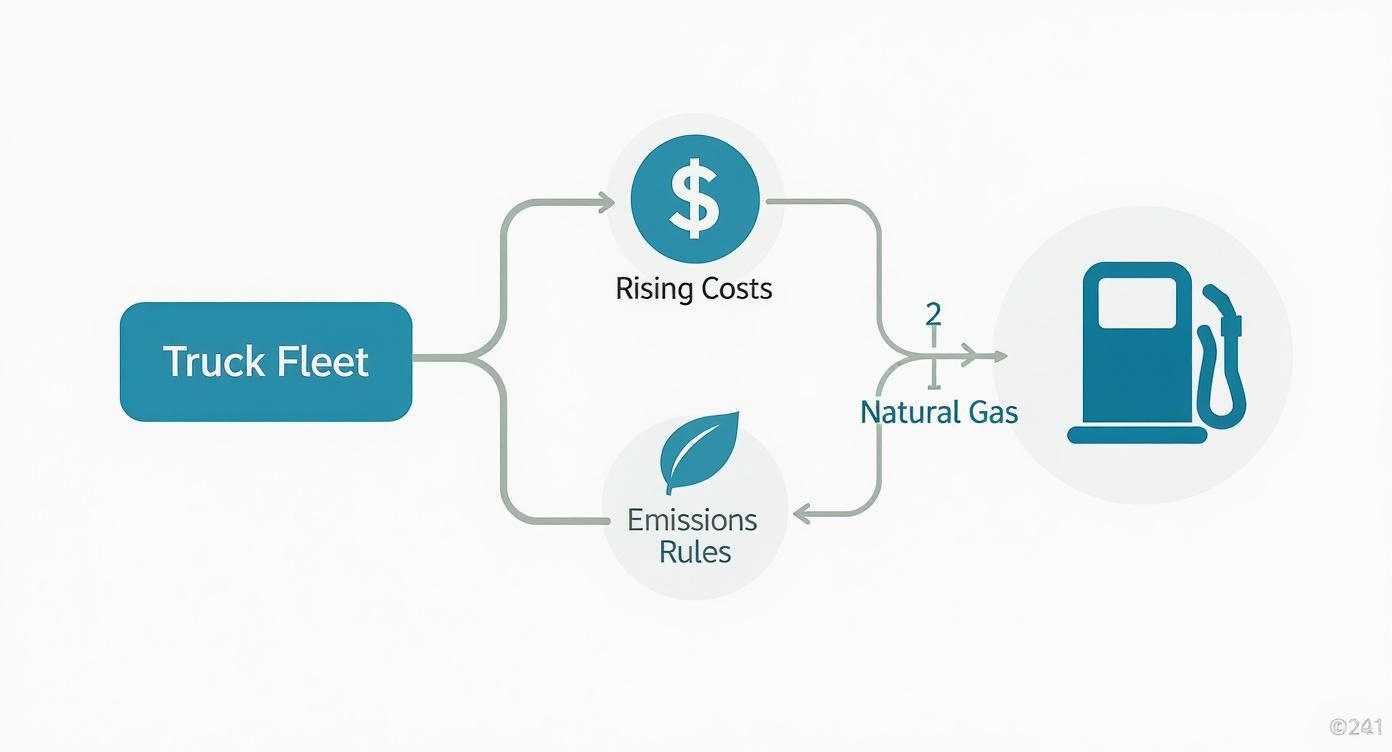
As you can see, whether your main headache is the bottom line or staying compliant, natural gas offers a compelling answer to both.
CNG vs. LNG At a Glance for Trucking Fleets
To make sense of the practical differences, it helps to put them side-by-side. This table breaks down what fleet managers really need to know when comparing CNG and LNG head-to-head.
| Attribute | Compressed Natural Gas (CNG) | Liquefied Natural Gas (LNG) |
|---|---|---|
| Physical State | Gaseous, stored under high pressure (3,600 psi) | Liquid, stored at extremely cold temperatures (-260°F) |
| Best Use Case | Return-to-base, predictable routes (regional haul, refuse) | Long-haul, over-the-road trucking with unpredictable routes |
| Onboard Storage | Heavier, bulkier tanks for a given range | More compact, energy-dense tanks |
| Vehicle Range | Typically 200-400 miles | 600+ miles, comparable to diesel |
| Fueling Time | Slower "time-fill" (overnight) or faster "fast-fill" (10-15 min) | Fast, typically 10-15 minutes |
| Infrastructure | Simpler; can be set up at a central depot | More complex and expensive cryogenic stations |
| Driver Training | Minimal; similar process to gasoline/diesel but with a sealed nozzle | Requires specialized training and PPE due to cryogenic temps |
The takeaway is clear: the right choice depends entirely on your daily operations. CNG is built for routine, while LNG is built for the open road.
Compressed Natural Gas: The Return-to-Base Champion
CNG is the workhorse for fleets that run predictable, local routes. Because it's a gas, it needs larger, heavier tanks to store enough fuel, which eats into your potential payload and range. But for the right job, that's a trade-off worth making.
The fueling process is simple and feels a lot like filling up with diesel, just with a secure, sealed connection. This makes CNG a perfect match for certain operations:
- Regional Haulers: Trucks that stay within a few hundred miles of home base and are back every night.
- Refuse Fleets: Garbage trucks run the same routes daily and can refuel overnight at a central yard.
- Transit and School Buses: These vehicles run fixed loops and always return to the same depot.
The real magic of CNG is its synergy with a private, central fueling station. You can install your own setup and use a "time-fill" approach, letting trucks refuel slowly and cheaply overnight. This ensures every vehicle is 100% ready to go by morning.
Liquefied Natural Gas: The Long-Haul Powerhouse
Where CNG hits its limit, LNG takes over. By chilling natural gas into a liquid, you pack a massive amount of energy into a smaller space. An LNG tank can hold about three times more fuel than a CNG tank of the same size.
This energy density gives LNG-powered trucks a driving range that's right on par with diesel—often 600 miles or more on a single tank.
This makes LNG the obvious choice for tough, over-the-road jobs where drivers are gone for days. The fueling process is a bit more involved, requiring special cryogenic equipment and personal protective gear for the driver, but it’s incredibly quick. A full tank takes just 10-15 minutes.
For fleets running coast-to-coast or on long, unpredictable routes, LNG provides the necessary range and energy density to compete directly with diesel, making it the premier natural gas for trucks in heavy-duty, long-distance logistics.
The industry is clearly taking notice. The global market for natural gas vehicles is projected to hit $15.64 billion in 2025 and is expected to more than double to $31.06 billion by 2035. This growth is being driven almost entirely by commercial trucking, which shows how much confidence fleets are placing in both fuels. You can dig into the numbers in a detailed report from Future Market Insights.
Ultimately, the debate isn't about which fuel is "better." It's about which fuel is better for your routes, your trucks, and your business.
Integrating Natural Gas Trucks Into Your Fleet
So, you've figured out whether CNG or LNG makes the most sense for your routes. Now comes the real question: how do you actually get natural gas trucks on the road? This isn’t a one-size-fits-all deal. You've basically got two options when it comes to adopting natural gas for trucks: buy brand-new, purpose-built vehicles or convert the diesel trucks you already own.
Each path comes with its own set of trade-offs, mostly boiling down to upfront cost versus long-term performance and simplicity. The right call really depends on your fleet's budget, how often you replace your trucks, and your bigger-picture business strategy.
Purchasing New OEM Natural Gas Trucks
The most direct route is to buy new trucks straight from an Original Equipment Manufacturer (OEM). All the major truck makers now have factory-built CNG and LNG models that come off the assembly line ready to hit the ground running, backed by a full manufacturer's warranty.
Going this route gives you the best possible integration and reliability. When the engine, fuel system, and chassis are all designed to work together from day one, you’re going to get better performance and a longer lifespan. Plus, you get the peace of mind that comes with a comprehensive OEM warranty covering the entire vehicle.
Yes, this path has a higher sticker price—often 15-30% more than a similar diesel truck—but it completely sidesteps the headaches of aftermarket modifications. For fleets that need maximum reliability and want to keep operational hiccups to a minimum, buying new is almost always the way to go.
When you buy a purpose-built natural gas truck, you're investing in an asset that was engineered for that specific fuel. Every component is optimized, which translates to better performance, fewer maintenance headaches, and a clear, simple warranty process.
Retrofitting Existing Diesel Trucks
If you're trying to keep that initial investment down, converting your existing diesel trucks to run on natural gas can look very attractive. The process involves installing a certified conversion system that lets a diesel engine run on either a mix of natural gas and diesel (dual-fuel) or on natural gas alone.
The big win here is cost. A conversion can be a whole lot cheaper than buying a new truck, which means you can switch over more vehicles for the same amount of money. But this path isn't without its own set of things to watch out for.
- Certified Systems Are Key: Don't even think about using anything but an EPA-certified conversion kit. And make sure it’s installed by qualified technicians to stay compliant and safe.
- Warranty Implications: Be aware that a conversion can void your original engine warranty. You need to be crystal clear on what the conversion company’s warranty covers.
- Vehicle Age and Condition: Retrofitting makes the most sense for newer trucks with low mileage. You want to be sure you’ll get a good return on that investment before the truck is ready for retirement.
This approach can be a fantastic way to run a pilot program or transition part of your fleet without having to make a massive capital investment all at once.
Preparing Your Operations for the Switch
Getting natural gas trucks into your fleet is about more than just the vehicles. You’ve got to think about your maintenance routines and what your technicians know.
Your shop might need some updates to meet safety codes for working with natural gas, and your techs will definitely need specialized training on the new fuel systems and engines. Planning for these operational shifts is absolutely critical for a smooth transition. To make it all work, you need to align this change with your broader operational goals, like the ones covered in the 10 Fleet Management Best Practices for 2025. That’s how you make sure your new assets are managed well from the start.
Solving the Natural Gas Fueling Challenge
For many fleet managers, the biggest question mark hanging over the switch to natural gas for trucks isn't about the vehicles themselves—it’s about the fuel. The fear of a truck running empty with no station in sight, often called "range anxiety," is a real and valid concern.
But the fueling landscape is far more flexible than most people realize. It's a mix of permanent infrastructure and creative, on-demand solutions that can solve almost any operational puzzle you throw at it.
The traditional approach, of course, is permanent stations. These are the bedrock of the natural gas network, providing reliable, high-volume fueling for fleets that run along established corridors or out of a central depot.
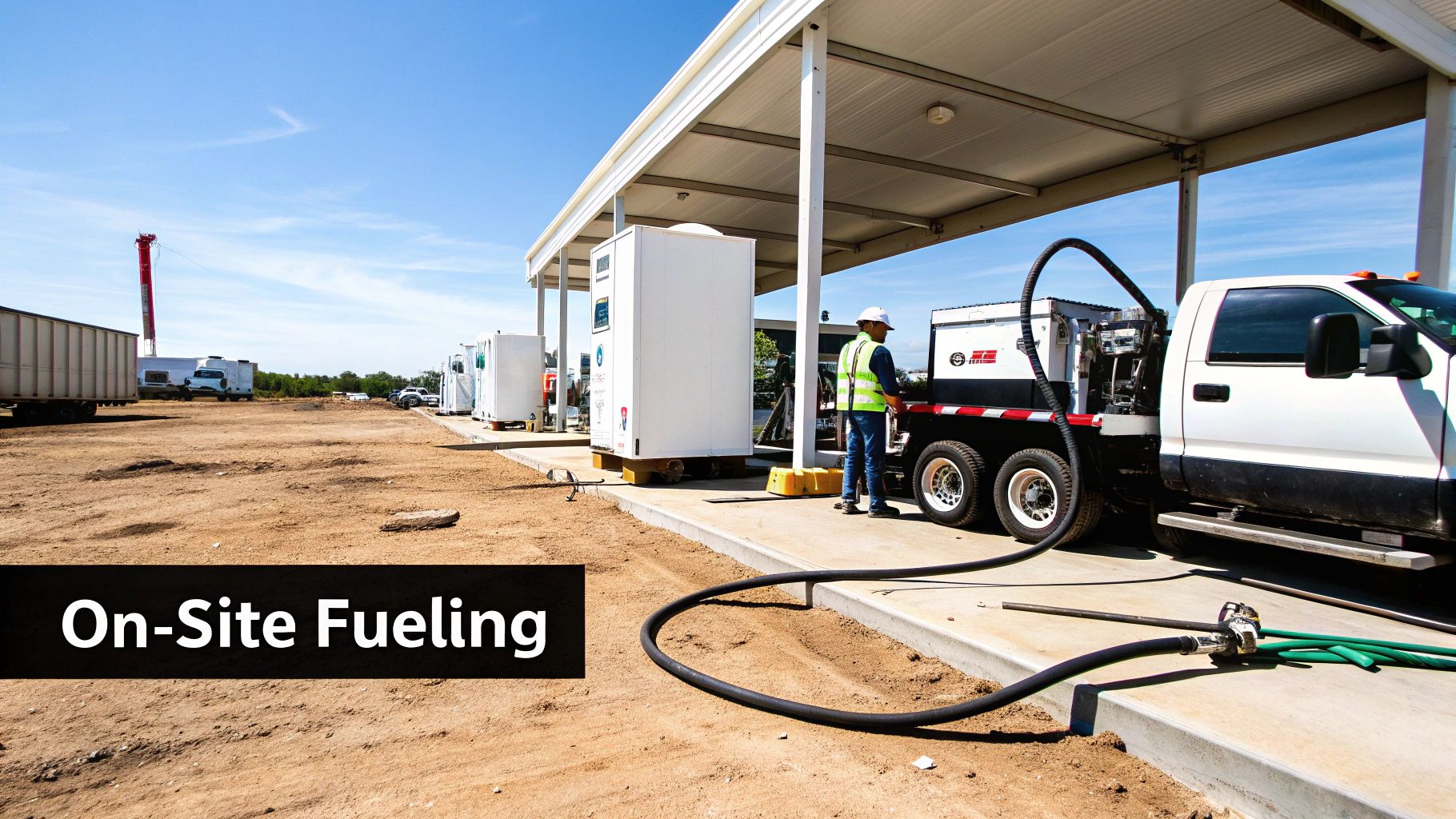
Permanent Fueling Stations
When you look at permanent stations, they really come in two main flavors. Each one serves a distinct purpose, and understanding the difference is the first step in building a smart fueling strategy.
- Public Stations: Think of these as the natural gas equivalent of a public gas station. You'll find them along major highways and in industrial hubs, forming a growing network for long-haul LNG trucks and regional CNG fleets.
- Private Stations: This is where CNG really shines for return-to-base operations. Building a private fueling station right at your own depot is a total game-changer. It opens the door for slow, overnight "time-filling," which is not only less expensive but ensures every truck starts the day with a full tank.
While the network of permanent stations is getting better every year, it doesn’t cover every corner of the map. This is where the real innovation in natural gas fueling comes into play, offering an agility that fixed infrastructure just can't match.
The Power of Mobile and Temporary Fueling
What happens when you need fuel somewhere with no pipeline or station? Or when you're waiting for your own permanent station to be built? This is the exact gap where mobile and temporary fueling providers, like Blue Gas Express, create incredible value. They literally bring the fuel directly to you, wherever and whenever you need it.
This "fuel on wheels" approach solves several critical problems:
- Bridging Infrastructure Gaps: If your private station is under construction, a mobile fueler can supply your fleet in the meantime. That means zero operational downtime.
- Supporting Remote Projects: Think about industries like construction or mining, where projects are often in off-grid locations. Mobile fueling delivers CNG or LNG right to the job site, letting you use cheaper, cleaner fuel anywhere.
- Enabling Pilot Programs: A mobile solution lets you test natural gas trucks on your actual routes without committing millions to a permanent station. It’s the ultimate try-before-you-buy scenario.
Mobile fueling transforms natural gas from a fixed-infrastructure fuel into a dynamic, adaptable resource. It removes the "what if" from the equation, giving fleet managers the confidence to adopt natural gas even if their operations don't fit the traditional mold.
This kind of flexibility is a key reason for the boom in adoption worldwide. Just look at China, where the natural gas truck market has seen explosive growth, largely supported by a rapidly expanding and adaptable fueling network. In the first three quarters of 2024, sales of LNG-powered trucks in China hit approximately 150,000 units. That accounted for 35% of all heavy-duty truck sales—a massive jump from just 4% in 2022. You can discover more about this global trend and what it means for natural gas demand.
Designing a Hybrid Fueling Strategy
The smartest fleets don’t pigeonhole themselves into a single fueling method. Instead, they build a hybrid strategy that blends the reliability of permanent stations with the agility of mobile solutions. This creates a resilient and cost-effective fuel supply that can adapt to whatever comes next.
For example, a regional delivery fleet might rely on its private, overnight station for 90% of its needs. But when a new, temporary distribution center opens for the busy holiday season, they can bring in a mobile fueler to support the extra trucks without any permanent investment.
By blending permanent and temporary solutions, your fleet is never held back by fuel availability. It’s what makes the switch to natural gas for trucks a practical and scalable reality.
The Financial and Environmental ROI: Does It Pencil Out?
When it comes down to it, switching a fleet to natural gas really boils down to two core questions: will it save us money, and is it actually better for the environment? To get a real answer, you have to look past the initial sticker shock and dig into the Total Cost of Ownership (TCO) and the hard data behind the environmental claims.
Let's be upfront: a new natural gas truck usually costs more than its diesel equivalent. But that initial expense is just one line item in a much bigger financial story. The true value emerges over the life of the vehicle, where significant savings on fuel and maintenance can quickly turn that initial investment into a smart financial move.
Breaking Down the Total Cost of Ownership
To really see how natural gas stacks up against diesel, you need to look at the entire financial picture—from the day you buy the truck to the day you take it out of service. And the single biggest variable in that equation is almost always fuel.
Natural gas is usually sold in Diesel Gallon Equivalents (DGEs), which is just a simple way to compare apples to apples on energy content. Historically, natural gas has been consistently cheaper than diesel on a DGE basis, and often by a wide margin. This price stability, thanks to a robust domestic supply, makes budgeting for fuel far more predictable.
For a high-mileage fleet, the fuel savings alone can be enough to cover the higher truck price in just 18 to 36 months. Factor in the various federal and state incentives available, and that payback period can get even shorter.
But it’s not just about the fuel. Maintenance costs also add up. Because natural gas burns much cleaner than diesel, you get less soot and carbon gunking up the engine. This often means you can go longer between oil changes and see less wear and tear on certain parts, which chips away at your overall maintenance budget over time.
The Environmental Payoff: Clear and Measurable
While the financial argument is compelling, the environmental benefits are just as powerful. Making the switch to natural gas delivers an immediate and significant drop in harmful emissions right from the tailpipe. We're not talking about a small tweak here; this is a major leap forward for air quality in the communities your trucks drive through every day.
Compared to standard diesel engines, natural gas powerplants deliver some impressive reductions in the worst offenders:
- Nitrogen Oxides (NOx): These smog-creating pollutants are slashed by over 90%.
- Particulate Matter (PM 2.5): Soot, the fine particle pollution linked to serious health problems, is also cut by more than 90%.
- Greenhouse Gases: You can see a reduction in carbon dioxide (CO2) emissions of up to 20%.
These numbers aren't just for show. They help fleets get ahead of tightening air quality regulations, essentially future-proofing their operations against stricter environmental rules down the road.
The Ultimate Goal: Carbon-Negative Operations with RNG
The environmental story gets even more compelling when you bring Renewable Natural Gas (RNG) into the picture. RNG isn't a fossil fuel. It's biogas that’s captured from organic waste at places like landfills, dairy farms, and water treatment plants. That raw methane is cleaned up and becomes chemically identical to conventional natural gas.
Using RNG is where things get truly game-changing. Because this fuel comes from methane that would have otherwise just leaked into the atmosphere as a potent greenhouse gas, running your trucks on it can actually result in a carbon-negative footprint. Think about that: your fleet could be actively removing greenhouse gases from the environment. For any company serious about its sustainability goals, RNG offers a direct, powerful, and practical way to get there.
Real-World Applications of Natural Gas Fleets
All the data and theory in the world can't tell you what a fuel is really made of. To see what natural gas for trucks can do, you have to look at where the rubber meets the road. Fleets across the country have made the switch not just for the savings or the emissions numbers, but because it simply makes sense for their daily grind.
From the organized chaos of city ports to the wide-open interstate, natural gas is earning its keep. The secret isn't just picking natural gas; it's about matching the right fuel—CNG or LNG—and the right fueling setup to the specific job. Get that right, and what was a good idea on paper becomes a serious advantage on the ground.
Return-to-Base Operations Thriving on CNG
For any fleet that runs predictable routes and brings its trucks home every night, Compressed Natural Gas (CNG) is a game-changer. This "return-to-base" model is a perfect fit for CNG, especially when you have your own private fueling station right on site. It creates a closed-loop system that’s efficient, reliable, and incredibly cheap to run.
You can really see this model shine in two specific areas:
- Port Drayage: Think about the trucks that shuttle containers from a busy port to a local warehouse. They’re running short, repetitive trips in a tight geographic bubble. They come back to the same yard every night, making them ideal candidates to plug in and refuel while the driver is at home.
- Refuse Fleets: Garbage trucks are the textbook example. They run the exact same routes every single day. Their constant stop-and-go driving and guaranteed return to the depot make them perfect for a slow, overnight "time-fill" on CNG. It’s a simple, cost-slashing formula.
For these kinds of jobs, CNG isn't just a diesel alternative; it's often a flat-out better way to operate.
Long-Haul Fleets Conquering the Highway with LNG
When you’re talking about crossing state lines, range is everything. That’s where Liquefied Natural Gas (LNG) comes into play. Because it’s so much denser than CNG, it gives a truck the legs it needs—we’re talking 600 miles or more on a single tank. That puts it right up there with diesel and gets rid of any range anxiety for the driver.
The big over-the-road carriers rely on LNG's staying power, tapping into a growing web of public truck stops along major freight corridors. This gives them the freedom to run hard and meet tight schedules without worrying about where their next fill-up is coming from. For long-haul trucking, LNG is the only natural gas solution that doesn't force a compromise on range.
"The choice between CNG and LNG isn't about which fuel is better overall, but which fuel is precisely right for the job. Regional fleets win with CNG's cost-effective simplicity, while long-haul fleets depend on LNG's diesel-like range to keep America's supply chain moving."
Specialized Applications in Off-Grid Environments
But what happens when your operation is nowhere near a pipeline or a public station? This is where the true flexibility of natural gas shines, thanks to mobile fueling solutions. You’re no longer stuck with diesel just because you’re working in a remote location.
Here are a couple of great examples of this in action:
- Construction Sites: Big projects like new highways or energy facilities are often built out in the middle of nowhere. Mobile fuelers can bring LNG or CNG right to the job site, powering everything from haul trucks to heavy equipment with a cheaper, cleaner fuel from the very start.
- Emergency Response: After a hurricane or other disaster, the local infrastructure is often wiped out. Temporary natural gas supplies can be trucked in to power generators, emergency vehicles, and critical equipment, keeping relief efforts running when the grid is down.
With a mobile supply, industries from construction to disaster relief can tap into the benefits of natural gas no matter where they are. It proves that with a smart strategy, you can overcome almost any logistical hurdle, making natural gas for trucks a real-world solution for just about any fleet.
Got Questions About Natural Gas Trucks? We've Got Answers.
Switching up your fleet is a big move, and it's bound to come with a lot of questions. When fleet managers start looking at natural gas for their trucks, the same concerns always pop up: Is it safe? Does it perform? And does the math actually work out? Let's tackle those head-on so you can move forward with confidence.
Are Natural Gas Trucks Safe to Operate?
Yes, absolutely. Natural gas trucks are built to meet—and often surpass—the same tough safety standards as traditional diesel vehicles. The entire fuel system is designed to be incredibly durable.
Take CNG fuel cylinders, for instance. They're built like tanks, engineered to handle severe impacts without a problem. LNG, on the other hand, isn't stored under high pressure; it's kept in double-walled, vacuum-insulated tanks at very low pressure.
Plus, natural gas has a higher ignition temperature than diesel, which means it’s less likely to ignite in a crash. The industry is also guided by strict safety codes from organizations like the National Fire Protection Association (NFPA), ensuring every part of the operation is locked down and secure.
How Does the Engine Performance Stack Up Against Diesel?
Today's natural gas engines are right on par with their diesel counterparts in both horsepower and torque. The performance gap you might have heard about from a decade ago? It's gone. Modern engine technology has completely closed that gap.
These engines have all the muscle needed for tough, heavy-duty jobs. In fact, many drivers say they prefer them. They tell us natural gas engines run noticeably quieter and create far less vibration, making for a much smoother and more comfortable day behind the wheel.
"The ROI for switching to natural gas trucks generally falls between 18 and 36 months. However, this timeline is influenced by the price gap between natural gas and diesel, annual mileage, vehicle purchase costs, and available government grants or tax credits."
Can I Use Natural Gas for Temporary or Off-Grid Projects?
You bet—and this flexibility is one of the biggest advantages of natural gas. Thanks to mobile fueling services, your fleet can get natural gas almost anywhere, whether there’s a pipeline nearby or not.
This is a game-changer for all kinds of work:
- Remote Construction: Powering heavy equipment on job sites miles from the nearest town.
- Mining Operations: Fueling massive haulers in completely off-grid locations.
- Disaster Relief: Supplying crucial fuel for emergency vehicles and generators when the local power grid is down.
Mobile fueling means you can tap into the cost savings and environmental benefits of natural gas without being tied to a fixed location. You never have to sacrifice efficiency, even when your projects are in the middle of nowhere.
Ready to explore how temporary or mobile fueling can bridge your fleet's energy gaps? The experts at Blue Gas Express specialize in delivering on-demand CNG and LNG solutions to keep your projects on track. Learn how we can support your operations.