

A hot tap weld is the critical first step in one of the most ingenious procedures in pipeline maintenance. It's the highly specialized welding process used to attach a new fitting to a live, pressurized pipeline, setting the stage for a connection to be made without ever shutting down service. This isn't just regular welding; it's a precision technique that guarantees a perfect, permanent seal on an active system.
The Foundation of Uninterrupted Service
Imagine a major hospital that depends on a constant flow of natural gas for heating, sterilizing equipment, and generating power. Now, let's say a new wing is built and needs its own gas line. The old-school method would demand a complete shutdown of the hospital's gas supply. Think of the consequences: canceled surgeries, disrupted patient care, and chaos for hours, if not days. This is precisely the kind of crisis a hot tap weld is designed to prevent.
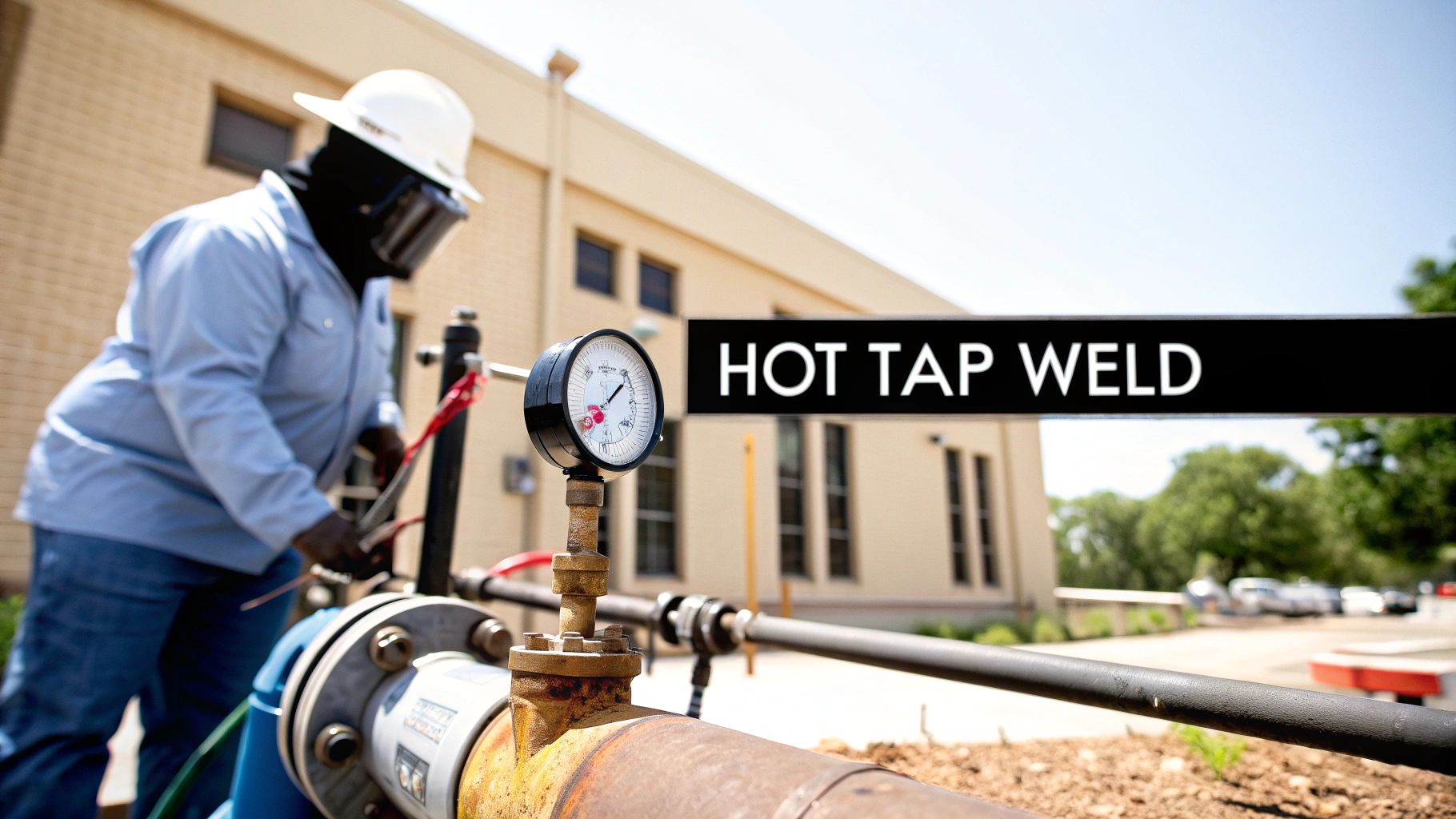
You can think of it like a surgeon performing a bypass on a patient's artery without stopping the heart. A new connection is grafted onto an existing, pressurized pipeline while it remains fully operational. This masterful approach sidesteps costly downtime, prevents frustrating service interruptions, and keeps critical infrastructure running without a hitch.
Deconstructing the Hot Tap Process
While "hot tapping" covers the entire operation, the hot tap weld is the specific, foundational step that makes it all possible. It’s not just about melting metal; it's a meticulously planned procedure that has to be absolutely flawless. The whole process really boils down to three key phases:
- The Fitting: First, a specially engineered saddle or split-tee fitting is positioned over the existing pipe right where the new connection is needed. This piece will become the new branch of the pipeline.
- The Weld: This is where the real skill comes in. A certified welder executes the hot tap weld, permanently fusing the fitting to the live pipeline. The goal is to create an incredibly strong, leak-proof seal—all while gas or liquid is flowing just inches away.
- The Tap: Once the weld cools and a valve is bolted onto the fitting, a specialized hot tapping machine is mounted. This machine drills through the open valve and cuts a hole into the pipeline wall, allowing the product to finally flow into the new branch. The piece of pipe that was cut out, known as the "coupon," is neatly retrieved back through the valve.
It's vital to remember that the mechanical cutting—the "tap"—is only safe and effective because of the absolute integrity of that initial weld. The weld is the bedrock of the entire operation.
A hot tap weld transforms what would be a massive logistical headache into a controlled, routine engineering task. It turns a system-wide problem into a localized solution, preserving operational continuity and saving significant revenue.
Hot Tap Weld vs Traditional Shutdown
The real-world benefits of hot tapping become crystal clear when you compare it to the traditional alternative: a full system shutdown for a "cold" tie-in. The differences in cost, time, and overall impact are dramatic.
Here's a quick look at how the two approaches stack up.
| Aspect | Hot Tap Weld (Live) | Traditional Shutdown (Cold) |
|---|---|---|
| Operational Impact | Zero downtime. Service continues uninterrupted for the entire procedure. | Complete shutdown required. All operations downstream of the connection are halted. |
| Cost | Higher upfront cost for specialized labor and equipment, but avoids revenue loss. | Lower direct costs for the tie-in, but high indirect costs from lost production and service. |
| Safety Risks | Risks are managed with strict procedures, thermal analysis, and certified welders. | Involves draining, purging, and refilling the line, which introduces its own set of hazards. |
| Project Timeline | Faster overall completion since no time is lost waiting for shutdowns or restarts. | Slower due to the extensive time needed for shutdown, draining, work, and repressurizing. |
Ultimately, the choice to hot tap isn't just about convenience—it's a strategic decision that prioritizes safety, efficiency, and financial stability. By keeping the system live, you protect revenue streams and prevent the cascading delays that always come with a full shutdown.
Where Modern Hot Tap Welding Came From
Welding on a live, pressurized pipeline might sound like a daredevil stunt, but it wasn't an idea that appeared out of thin air. It was born from a very real, very expensive problem: the enormous cost and hassle of shutting down critical infrastructure just to make a simple modification.
Before the 1970s, adding a new connection meant a "cold connection." It was the only way. For any pipeline operator, this was a scenario to be avoided at all costs. The entire line had to be depressurized, drained, and purged of every last bit of flammable material before a single welder could even think about striking an arc. This didn't just disrupt service; it kicked off a logistical nightmare and staggering financial losses.
The Million-Dollar Problem of Going Cold
Picture a major natural gas transmission line that needs a new branch. To install it, you'd have to halt the flow of millions of cubic feet of gas. Every minute the line was down, money was vanishing into thin air.
This wasn't just a theoretical headache. Before hot tap welding became a reliable, trusted practice, operators were bleeding cash for what should have been routine work. A company like TransCanada, for instance, could easily lose over $1 million Canadian in revenue from a single cold connection. And that's before you even start to tally up the costs for labor, equipment, or the environmental impact of venting all that gas.
This painful reality created intense pressure to find a better way. The industry desperately needed a method to perform surgery on the "arteries" of its infrastructure without stopping the heart from beating. That need kicked off a deep dive into the science of welding under the most challenging conditions you can imagine.
Battelle’s Breakthrough: Taming Two Big Dangers
The real game-changer came in the late 1970s, thanks to the groundbreaking research done by Battelle. They were the ones who developed the first thermal analysis models specifically designed for welding on live pipelines. This work single-handedly transformed the hot tap weld from a high-stakes art form into a predictable science.
Their models tackled the two biggest fears that made in-service welding so risky:
- Burnthrough: This is the most obvious and terrifying risk—the welding arc simply melting straight through the pipe wall, leading to a catastrophic failure.
- Hydrogen Cracking: A sneakier but just as lethal threat. The product flowing inside the pipe acts like a giant heat sink, sucking heat away from the weld far too quickly. This rapid cooling can make the steel brittle and prone to cracking, creating a weak point that could fail later.
Battelle's models gave engineers the power to predict exactly how the heat from a welding arc would behave. By plugging in key variables like pipe thickness, flow rate, and welding parameters, they could finally map out a procedure that was both safe and reliable.
This scientific leap proved that a hot tap weld wasn't a gamble. It was a meticulously controlled engineering procedure, shifting the entire industry's focus from simply avoiding danger to scientifically managing it.
A Legacy of Getting Better and Safer
Those thermal models became the bedrock upon which all modern hot tap safety standards are built. They gave us the framework to understand and control the incredibly complex thermal dynamics at play. The evolution of this process has also been shaped by broader lessons learned in safeguarding workers in industrial environments.
Understanding this history—from million-dollar shutdowns to science-backed procedures—is key. It explains why today's standards are so incredibly strict and why a modern hot tap weld is now seen as a safe, essential tool for keeping our energy infrastructure running without missing a beat.
Understanding Key Safety Standards
So, how do you weld onto a live, pressurized pipeline without disaster? It's not magic, and it's certainly not guesswork. The answer lies in a combination of hardcore science and strict, globally recognized safety standards that turn a potentially dangerous job into a predictable, controlled engineering procedure.
Think of these standards as the non-negotiable rulebook for everyone involved. From the engineer designing the fitting to the welder on the ground, these codes dictate every move, leaving zero room for interpretation.
In North America, two codes are absolutely foundational:
- API 1104: This is the bible for welding on pipelines, especially within the oil and gas industry. It sets incredibly stringent requirements for qualifying welders and their specific procedures, proving they have the skill to handle the immense pressures of working on a live line.
- CSA Z662: This is Canada's comprehensive standard for all oil and gas pipeline systems. It provides a similar framework to API 1104, laser-focused on safety and integrity for the entire life of the pipeline, including any in-service welding.
These codes establish the baseline for quality. But the real confidence comes from pairing them with advanced scientific modeling.
The Power of Thermal Analysis
Imagine trying to cook a perfect steak. You wouldn't just throw it on the grill and hope for the best; you'd use a thermometer to know exactly what's happening inside. Thermal analysis is like a super-sophisticated thermometer for a hot tap weld.
Specialized software models act as a digital crystal ball, predicting exactly how the heat from the welding arc is going to behave. It crunches all the numbers—the pipe's wall thickness, the type of gas or liquid flowing inside, the flow rate, and the specific welding parameters—to map out the entire thermal event before a single spark flies.
This is critical for managing the two biggest risks: burnthrough (melting a hole in the pipe) and hydrogen cracking (the weld becoming brittle and failing later). By precisely calculating how quickly the weld will cool, engineers can ensure the metal stays strong and doesn't become compromised.
Thermal analysis takes the "what if" out of a hot tap weld. By simulating the weld's entire thermal journey, it provides a clear, science-backed roadmap for a safe and successful connection, guaranteeing the pipeline's integrity is never compromised.
Evolving Models for Greater Precision
The science here is always getting better. A major focus has been perfecting how these models predict weld cooling rates to prevent hydrogen cracking. We've seen incredible progress.
For instance, the PRCI Thermal Analysis Model for Hot-Tap Welding V4.2 delivers impressively accurate predictions across a huge range of conditions. Older models had a flaw: they were often too relaxed for thin-walled pipes but overly cautious for thick ones, which could force unnecessary and expensive shutdowns.
Today’s PRCI model, however, gives consistently reliable results no matter the wall thickness, a huge step forward that's been backed up by extensive real-world data. If you want to dive into the numbers, you can read the full research on modern thermal modeling.
Of course, safety doesn't stop at the weld itself. A truly safe operation requires a holistic view, which includes things like adhering to comprehensive hose safety standards for all connected equipment.
It's this powerful combination—unwavering adherence to codes like API 1104 plus the predictive power of thermal analysis—that allows us to confidently and safely work on our vital energy infrastructure while it keeps the lights on.
When Does Hot Tap Welding Make Sense for Your Project?
Knowing what a hot tap is is one thing. Knowing exactly when to use it is what separates a smooth-running project from a logistical headache. This technique isn't just a last-resort fix; it's a strategic move that can save an incredible amount of time, money, and operational disruption when used correctly. The whole decision boils down to one simple question: can you really afford to shut everything down?
For a lot of operations, the answer is a hard no. Picture a manufacturing plant running around the clock. Shutting down the entire natural gas supply just to add a new connection for a facility expansion could bring production to a grinding halt for days. The financial hit from that lost output would make the cost of a specialized hot tap weld look like a rounding error.
It’s the same story for a large commercial development trying to connect to a city gas main. A full shutdown could cut off service for hundreds of nearby businesses and residents—a public relations nightmare no utility company wants to deal with. In these situations, hot tapping isn't just another option; it's the only practical way forward.
Common Scenarios Where Hot Tapping Shines
Hot tap welding really proves its value in a handful of common, high-stakes situations where keeping the gas flowing is non-negotiable.
Here are a few classic examples where a hot tap is the clear winner:
- Industrial Plant Expansions: A factory is adding a new production line with gas-hungry equipment. A hot tap allows them to install and weld the new branch line without ever interrupting existing operations. No lost production, no downtime.
- Commercial Property Tie-Ins: A new office building or shopping center needs to tap into the municipal gas line. Hot tapping avoids cutting off service to neighboring businesses and homes, preventing a major inconvenience for the community.
- Infrastructure Upgrades: A city needs to add a new monitoring sensor or a bypass loop to an older pipeline for maintenance. The hot tap weld allows these critical upgrades to happen while the system stays fully pressurized and in service.
A hot tap's real magic is its ability to turn a massive, system-wide shutdown into a small, manageable, and localized task. It focuses all the work on a single point, letting the rest of the infrastructure run like nothing is even happening.
The Game-Changer: Pairing Hot Taps with Temporary Gas
One of the smartest ways to use hot tapping is to combine it with a temporary natural gas service, like the CNG and LNG solutions from Blue Gas Express. This one-two punch creates a seamless bridge for projects that are stuck waiting on the utility, ensuring you hit your construction milestones without costly delays.
Think about a new housing development. The homes are built, but the permanent gas main hookup is weeks or even months behind schedule. Without gas, the builders can't test the furnaces, fire up the water heaters, or even keep the pipes from freezing in the winter. The entire project stalls, and certificates of occupancy get pushed back.
This is where you can get ahead of the game. By working with the gas utility early on, a hot tap fitting can be welded onto the main line well in advance. While everyone waits for the final connection, a temporary CNG or LNG unit can be brought in to supply the gas needed to keep the project moving.
This proactive approach pays off in a few huge ways:
- No More Downtime: Construction and commissioning work can continue right on schedule, fueled by the temporary gas supply.
- Ready for Go-Time: The hot tap weld and valve are already installed and waiting. When the utility is finally ready, the final tie-in is quick and straightforward.
- A Seamless Switch: Once the permanent line is live, the transition from the temporary service is incredibly fast, minimizing any final disruption.
By pairing the readiness of a hot tap with the flexibility of temporary gas, project managers can take control of their timelines and sidestep the expensive consequences of just sitting around and waiting.
Making the Right Call on Your Project
Choosing between a hot tap and a full-blown shutdown isn't just a technical detail—it's a massive business decision that pits cost, risk, and operational uptime against each other. When you get down to it, the central question is brutally simple: can your operation afford to stop?
For countless businesses, downtime isn't measured in minutes or hours. It's measured in lost production, stalled construction schedules, and broken promises to customers. A hot tap weld might seem like the more complicated option on paper, but its real value shines when you start adding up the crippling costs of going dark. It demands meticulous planning, but it's often the smartest, most cost-effective way to get the job done.
Your Essential Decision Checklist
Before you commit to one path, your project managers and engineers need to walk through a practical checklist. This isn't just about the pipe itself; it’s about the entire ecosystem surrounding the work. A good, hard look at the facts ensures your final call is safe, strategic, and easy to defend.
Use these questions to kickstart the conversation with your contractors and utility partners:
- What’s the true cost of a shutdown? Don't just think about labor. You need to calculate the lost revenue, the ripple effects on your supply chain, and any potential penalties for every single hour your system is offline.
- Is the pipeline material even a candidate? The pipe's composition, age, and overall condition are absolute deal-breakers. Certain materials, like some old cast irons or heavily corroded steel, simply can't handle a safe hot tap weld.
- Do we have the right people for the job? Can you get welders certified to standards like API 1104? Is the specialized hot tapping gear and an experienced crew actually available when you need them?
- What do the site conditions look like? Is there physically enough room for all the equipment and the crew to work safely? Sometimes, a tight or inaccessible space makes the decision for you.
An honest assessment here will quickly tell you whether hot tapping is a realistic option or if a planned shutdown is the only responsible way forward.
Weighing Your Options: Hot Tap vs. Shutdown
To make things clearer, it helps to put the two options head-to-head against the project factors that matter most. This simple comparison can quickly show you which path truly aligns with your operational and financial goals.
Decision Matrix: Hot Tap vs. Shutdown
Here's a quick-reference table to help you weigh the critical factors when choosing between a hot tap and a full system shutdown.
| Consideration | Favorable for Hot Tap | May Require Shutdown |
|---|---|---|
| Operational Continuity | Uninterrupted service is absolutely critical for revenue or safety. | Your operation can handle a planned outage without major consequences. |
| Pipeline Condition | The pipe material is known, in good shape, and has plenty of wall thickness. | The pipe’s integrity is questionable, corroded, or made of a non-weldable material. |
| Cost Impact | The cost of downtime is astronomical compared to the cost of the hot tap procedure. | The direct cost of the repair is the main concern, and downtime is affordable. |
| Project Urgency | You need the connection done quickly without planning a lengthy shutdown. | The project timeline is flexible and can easily accommodate a full system drain and purge. |
Ultimately, looking at this matrix makes one thing clear.
The decision to perform a hot tap weld is an investment in continuity. It’s an acknowledgment that for critical systems, the product flowing through the pipe is often more valuable than the cost of the procedure itself.
Verifying Pipeline Integrity Before the Weld
One of the most important steps before a hot tap is proving the pipeline is healthy right where you plan to weld. You can't just guess; you need hard data. This is where non-destructive testing (NDT) becomes your best friend.
Before a single spark flies, technicians perform these vital checks:
- Ultrasonic Thickness Measurement: This test uses sound waves to precisely measure the pipe's wall thickness. It confirms you have enough metal to handle the welding heat and contain the pressure inside.
- Dye Penetrant Testing (DPT): This is a low-tech but incredibly effective method. A special colored dye is sprayed on the surface, and if there are any tiny, invisible cracks or pinholes, the dye will bleed into them, making them obvious to the naked eye.
These tests give you the final green light. If that pipe wall is too thin or shows any signs of defects, the hot tap weld is off the table, and a shutdown becomes the only safe path forward. This rigorous, data-driven approach means every decision is backed by solid proof, protecting your people and your assets.
Successfully Coordinating Your Hot Tap Project
A successful hot tap isn't just about the work on the pipe. It’s the result of a perfectly choreographed dance between every single party involved, where everyone knows their steps and timing down to the second. Think of effective coordination as your project's roadmap—the one thing that ensures you stay safe, on schedule, and fully compliant from the first phone call to the final sign-off.
This process kicks off long before a single spark flies. Your first move, without question, should be getting the gas utility on the phone. Early contact is absolutely critical. Utilities have their own strict protocols and often surprisingly long lead times for reviewing and approving any work on their live systems. You'll need to hand over detailed engineering plans that prove every nut, bolt, and weld in your proposed hot tap meets their non-negotiable safety and technical standards.
Establishing a Coordinated Timeline
Once your plans get the green light, scheduling becomes the next big hurdle. This isn't just a matter of booking a contractor; it's a complex, multi-party synchronization. You need to build a unified timeline that works for everyone.
- The Client: To make sure the project aligns with their operational needs and keeps any on-site disruption to a bare minimum.
- The Gas Utility: To lock in dates for their mandatory inspections and the all-important final approval of the procedure.
- The Welding Contractor: To confirm their certified crew and specialized equipment are available and ready to go.
- Temporary Service Providers: If you're bringing in a temporary gas supply like Blue Gas Express, their delivery and setup have to be timed perfectly with the project's key milestones.
This flowchart shows how critical project decisions around cost, downtime, and safety should be evaluated in a logical sequence.
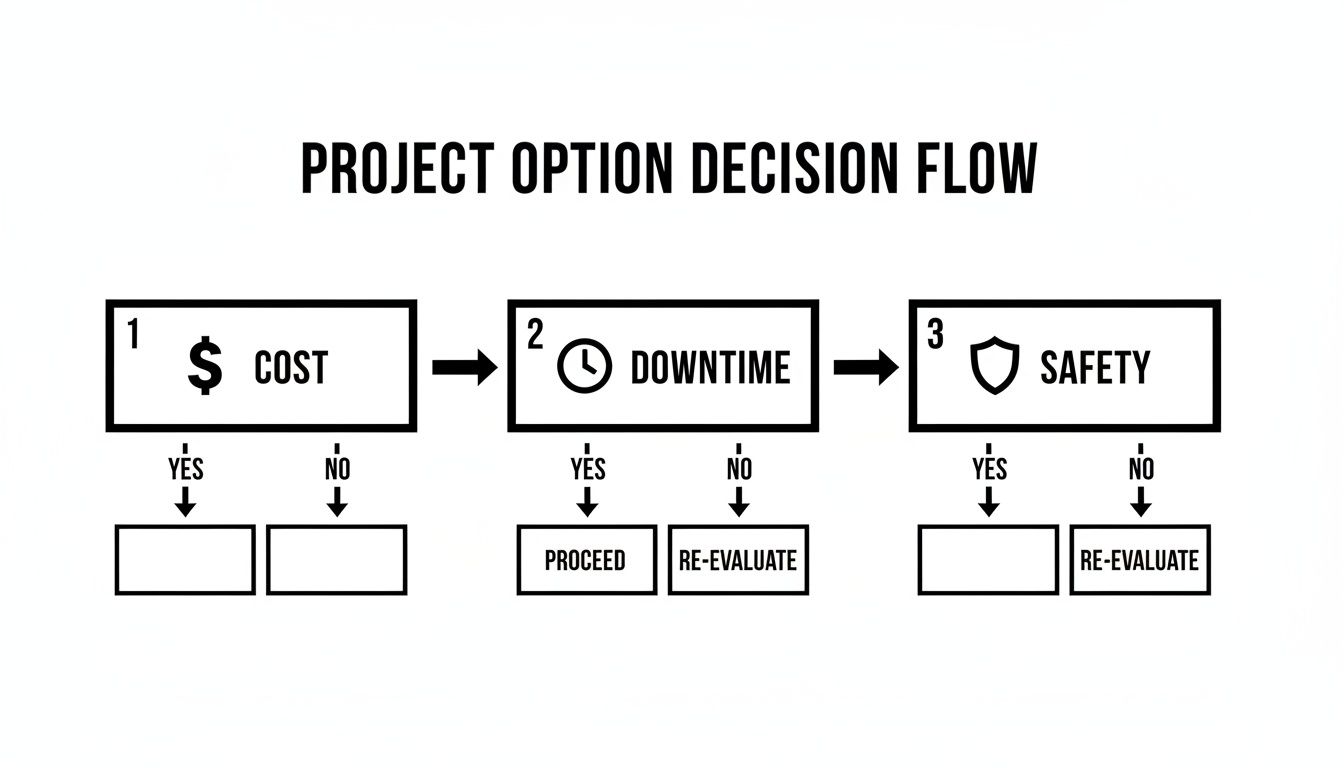
As you can see, successful coordination is all about balancing the financial realities with the unbendable rules of operational uptime and safety compliance.
Strategic partnership and proactive planning are the keys to navigating the complexities of a hot tap project. A breakdown in communication is often a bigger risk than any technical challenge, making a shared, transparent timeline essential for success.
When you treat the project as a truly collaborative effort, you can head off costly delays, make sure everyone is meeting their safety obligations, and keep your own operations running without a hitch.
Common Questions About Hot Tap Welding
Even with a solid plan, it's natural for project managers and facility operators to have questions when it comes to the nitty-gritty of hot tap welding. Getting these details ironed out beforehand is key to making sure everyone is on the same page about safety, what's possible, and what to expect. Let's walk through some of the questions we hear all the time.
What's the Minimum Pipe Wall Thickness You Can Work With?
That's a common first question, but there's no magic number that applies everywhere. The answer is always found through a detailed, case-by-case analysis. While industry codes like ASME B31.3 give us a starting point, the real green light comes from a combination of thermal analysis and an ultrasonic thickness test right at the proposed location.
This hands-on inspection is non-negotiable. It tells us if the pipe has enough "meat" to take the heat from welding without burning through. If we find the wall is too thin or has internal issues like lamination, hot tapping is off the table—it's simply not a safe bet.
Can You Hot Tap Weld on Any Kind of Pipe?
Definitely not. Hot tapping works best on materials with predictable, well-understood properties. We see the highest success and safety rates with common carbon steel pipes, like those made to ASTM A106 or API 5L standards.
On the other hand, some materials are a real headache, or just plain incompatible with this process.
- Cast Iron: It’s just too brittle. The thermal shock from welding is very likely to cause it to crack.
- Plastics and Composites: You can't weld on these materials, period.
- Heavily Corroded or Laminated Steel: If the pipe's integrity is already shot, trying to weld on it is asking for trouble. A safe weld just isn't possible.
How Do You Manage the Product Flowing Inside the Pipe?
Controlling the flow during a hot tap weld is a delicate dance. You actually need some flow to act as a coolant, pulling heat away from the welding area. This is one of the most important things we do to prevent the pipe wall from getting too hot and losing its strength, which could lead to a blowout.
But too much of a good thing can be bad. If the flow is too fast, it acts like a heat sink and quenches the weld too quickly. That rapid cooling can introduce hydrogen into the metal's structure, causing cracking that makes the weld brittle and weak. We use thermal analysis models to find that perfect "Goldilocks zone"—a flow rate that’s just right for creating a strong, secure hot tap weld.
The key takeaway is that flow isn't something to be stopped; it's a variable we have to control with absolute precision. It’s an active player in the safety game, helping us manage temperatures and ensure the final weld is metallurgically sound.
What if You Find a Leak Right Where You Plan to Weld?
Discovering a leak—even a tiny pinhole—at the exact spot for the weld is an immediate full stop for a standard hot tap. You never, ever weld directly over a known defect. It's incredibly dangerous.
That said, it doesn't always mean the project is dead in the water. In some situations, we can get creative with specialized techniques. For example, a custom-engineered pressure enclosure might be designed to clamp over the area and temporarily seal the leak. This creates a safe zone, allowing us to weld the hot tap fitting nearby and then position the tapping machine to cut out the entire flawed section of pipe.
At Blue Gas Express, we know that project timelines don't stop for pipeline modifications. If you need a dependable temporary gas supply while you sort out your next project, we've got you covered. Check out our mobile CNG and LNG solutions to see how we can help keep things moving.