

A hot tap on a pipeline is a highly controlled method for tying into a pipeline while it’s still in service, active, and under pressure. Think of it as creating a new branch or access point without having to shut everything down. This prevents incredibly expensive interruptions and the loss of whatever product is flowing through the line.
What Is a Hot Tap on a Pipeline and Why Is It So Important?
The best way to picture a hot tap is to imagine a surgeon needing to work on a major artery without stopping the body's blood flow. It’s a kind of industrial "keyhole surgery" for a live, pressurized system, whether that system is carrying natural gas, crude oil, water, or steam.
This process is a lifesaver for any project manager or facility operator who simply can't afford downtime. The old way involved a complete shutdown—draining the system, stopping production, and maybe even cutting off service to thousands of customers. Hot tapping provides a seamless, modern alternative for expansions, repairs, and upgrades on live lines.
The True Value of Uninterrupted Service
At its core, the biggest benefit is continuity. A hot tap isn't just a technical procedure; it’s a strategic business decision that keeps operations moving. Just think about the financial domino effect of taking a major utility or industrial line offline. For a large plant, a single day of shutdown could mean millions in lost revenue. For a city, it could leave homes without heat or clean water.
By sidestepping those nightmares, a hot tap on a pipeline brings some major wins to the table:
- Zero Downtime: Operations just keep running. This ensures production targets are hit and customer service commitments are met without a single hiccup.
- No Product Loss: There’s no need to drain the pipeline or vent its contents, which saves valuable resources and avoids potential environmental issues.
- Improved Safety & Efficiency: It’s a highly controlled process, which actually sidesteps the many risks that come with depressurizing and repressurizing a massive system.
This table provides a quick summary of why hot tapping is often the preferred method for pipeline modifications.
Key Benefits of Pipeline Hot Tapping at a Glance
| Benefit | Impact on Operations | Primary Beneficiary |
|---|---|---|
| Operational Continuity | Prevents system-wide shutdowns, allowing business to continue as usual. | Facility Operators, Production Managers |
| Cost Savings | Eliminates revenue loss from downtime and costs of draining/refilling the line. | Project Owners, Finance Departments |
| Reduced Environmental Impact | Avoids venting or flaring of product (e.g., natural gas) into the atmosphere. | Environmental Compliance Teams, The Public |
| Enhanced Safety | Minimizes risks associated with system shutdown and startup cycles. | Field Technicians, Site Safety Officers |
| Scheduling Flexibility | Allows maintenance and tie-ins to be scheduled without disrupting core operations. | Project Managers, Planners |
Ultimately, these benefits translate into smarter, more efficient project execution with far less risk.
A Critical Tool for Modernizing Old Infrastructure
This technique has become absolutely essential, especially as we deal with aging infrastructure. A staggering number of pipelines still in use today are 50-70 years old, and they constantly need maintenance and upgrades to stay safe and reliable. Hot tapping has completely changed the game, allowing technicians to cut into pressurized pipes and deploy tools without having to bleed the entire system dry. It’s a huge leap forward from the old shutdown methods that often required venting massive volumes of gas. You can learn how this method supports safe pipeline repairs and see just how vital the technique has become.
Simply put, hot tapping is the difference between a massive, system-wide disruption and a minor, controlled modification. It lets us proactively maintain and expand our critical infrastructure without bringing everything to a screeching halt.
For anyone managing new construction or facility upgrades, this is a game-changer. It means you can connect a new building or process line to the existing utility mains without blowing up the project schedule or budget. This ensures a much smoother and more predictable transition from construction to full operation.
The Hot Tapping Process From Planning to Completion
Think of a hot tap as a kind of high-stakes pipeline surgery. It’s a meticulously planned operation where every single move is calculated for precision and, above all, safety. This isn't just about drilling a hole; it's a complex engineering project designed to create a new, permanent connection to a live system without shutting anything down or spilling a drop of product.
The entire process hinges on an ironclad foundation of planning and verification. Long before any equipment touches the pipe, a team conducts a thorough site assessment. Honestly, this initial phase is the most important part of the entire job—get this wrong, and nothing else matters.
Stage 1: Detailed Site Assessment and Safety Planning
The first step is a deep dive into the pipeline's history and condition. Engineers and technicians gather critical data to make sure the hot tap is even possible, let alone safe. This is a forensic-level analysis, not a quick once-over.
Key activities during this planning stage include:
- Material Verification: Technicians confirm the exact material of the "parent" pipe—is it carbon steel, ductile iron, or something else? This is essential for choosing a compatible fitting and outlining the right welding procedures.
- Ultrasonic Thickness Testing: Using non-destructive methods, a team measures the pipe wall's thickness right at the proposed tap location. This test confirms the pipe is strong enough to handle the new connection and the stress of the tapping process itself.
- Flow and Pressure Analysis: The team has to know the exact operating pressure, temperature, and flow rate inside the line. This data dictates the type of equipment needed and how the cut will be performed.
Once all this information is gathered and signed off on, a detailed safety plan and work procedure are created. Every step is documented, from welding protocols to emergency shutdown plans, leaving absolutely no room for guesswork.
Stage 2: Attaching the Fitting and Isolation Valve
With the blueprint approved, the hands-on work begins. A specialized fitting, often a full-encirclement split tee or a weld-on nipple, is carefully placed over the target area on the pipeline. This fitting will become the permanent housing for the new connection.
Highly skilled welders, certified for this exact type of high-pressure work, then weld the fitting directly onto the live pipe. This is where real expertise shows. They must create a flawless, pressure-tight seal without compromising the active pipeline. After the welding is complete, the connection is rigorously tested to ensure it’s 100% sound.
Next, a permanent isolation valve is bolted onto the fitting. This valve is the gatekeeper—it stays closed during the tapping but will eventually control the flow into the new branch line.
Stage 3: Mounting the Specialized Tapping Machine
Now it’s time for the main event. A specialized hot tapping machine, which is essentially a powerful, high-pressure drill, is mounted directly onto the isolation valve. Think of it as a sophisticated, fully-sealed drilling rig built for one specific, critical task.
A crucial feature of the tapping machine is its pressure-containing design. The entire assembly—from the valve to the machine's housing—creates a closed system, ensuring that not a single drop or wisp of the pipeline's contents can escape during the procedure.
This entire setup is pressure-tested one more time to confirm its integrity before any cutting starts.
Stage 4: Executing the Precision Cut
With everything mounted and double-checked, the operator opens the isolation valve. The cutter and a pilot drill are advanced through the now-open valve until they touch the pipe wall. A key feature of the pilot drill is that it's designed to catch and hold onto the piece of pipe that's about to be cut out—what we call the "coupon."
The operator starts the machine, which uses hydraulic power to slowly and precisely drill through the pipeline wall. It's a delicate process, where the operator has full control over the cutting speed and pressure. Once the cutter makes it all the way through, the new opening is officially created.
The real-world benefits of getting this process right are huge, as you can see below.
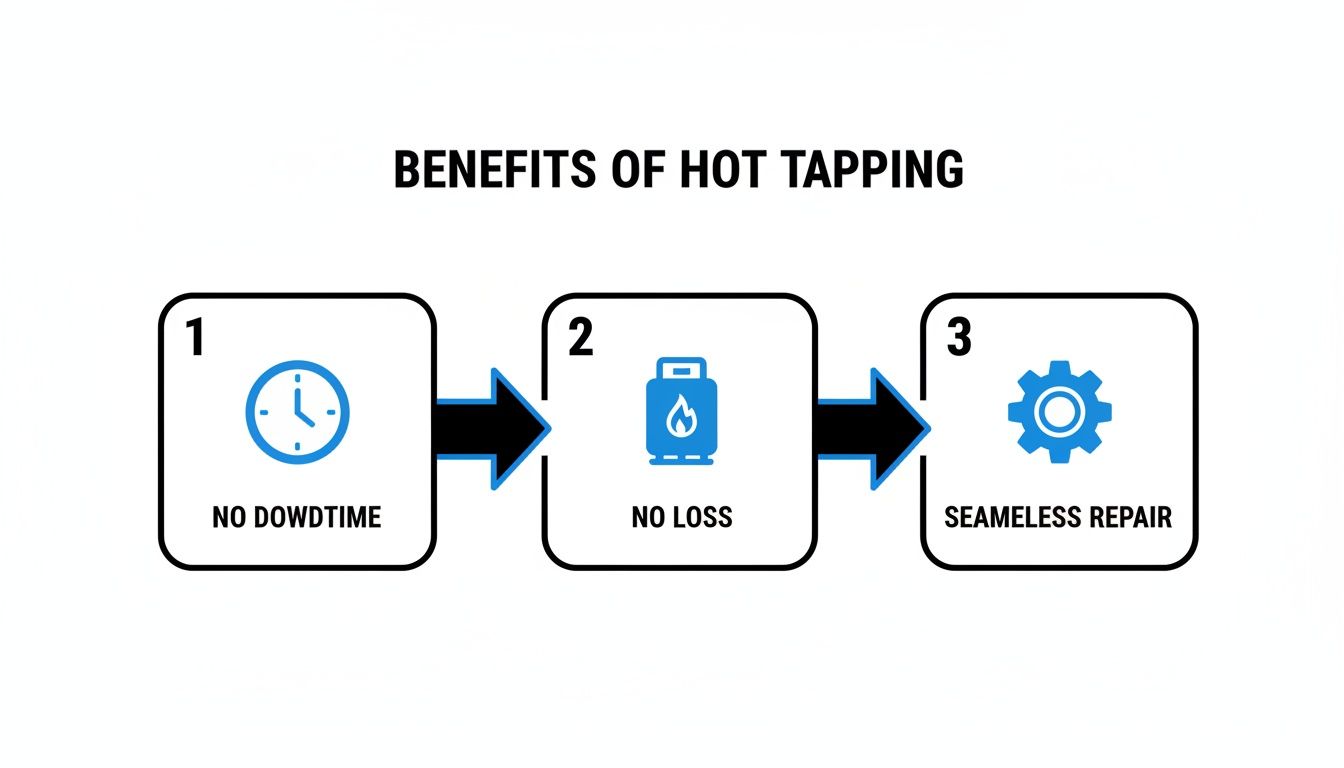
This is exactly why companies invest in hot tapping: it completely eliminates operational downtime, prevents any loss of product, and allows for seamless repairs or system expansions.
Stage 5: Retrieving the Coupon and Securing the Connection
Once the cut is finished, the operator retracts the cutter back through the valve. The pilot drill does its job perfectly, holding onto the coupon and pulling it cleanly out of the pipeline and back into the tapping machine's housing.
With the coupon safely removed, the operator closes the isolation valve, once again sealing the live pipeline. The pressure inside the tapping machine is then safely vented, and the machine is unbolted and taken away.
Just like that, the new branch line can be connected to the valve. The project is complete—a successful hot tap on a pipeline performed without a single second of service interruption.
Navigating Critical Safety Standards and Regulations
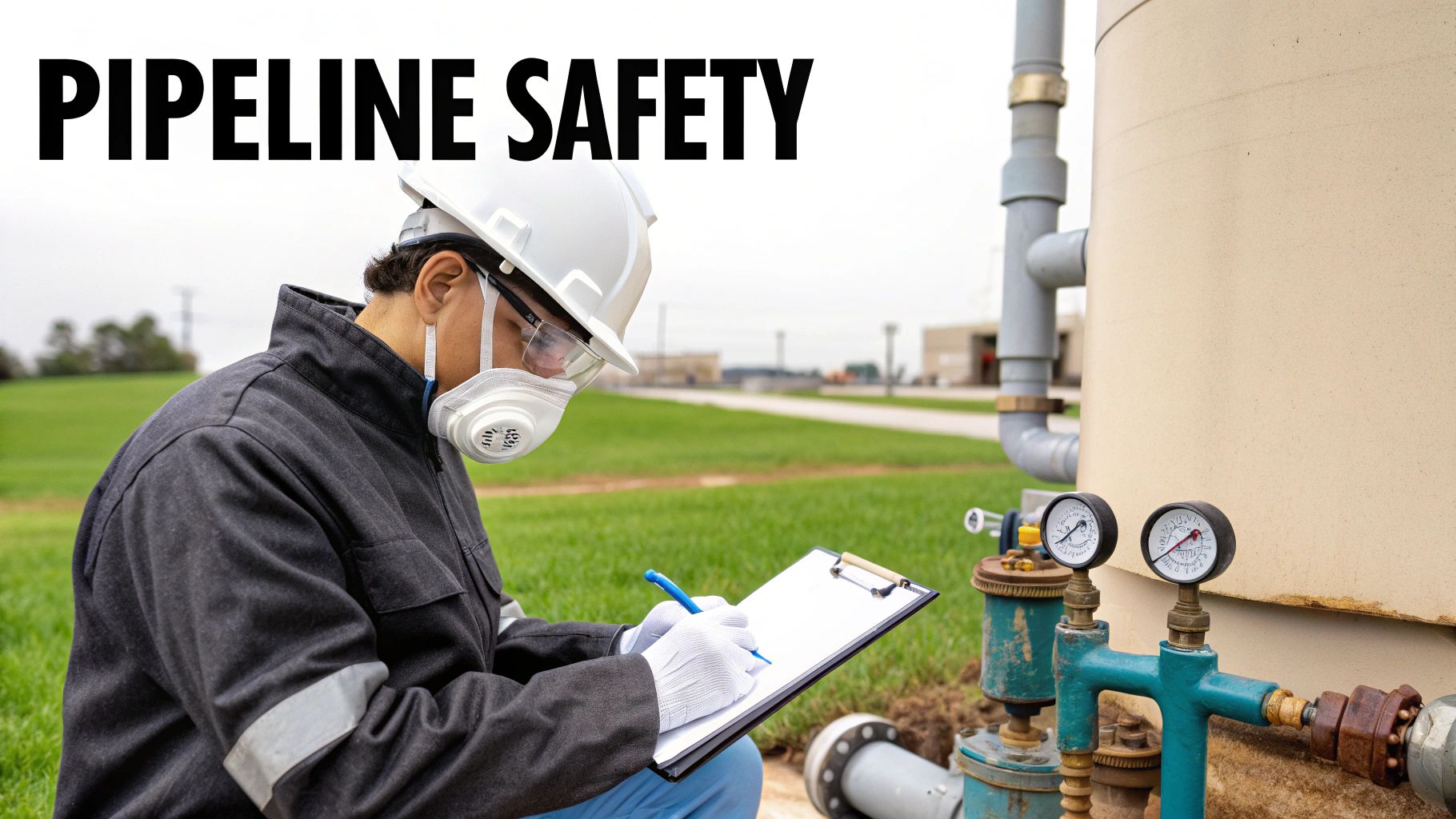
When you hot tap on a pipeline, you're not just cutting into a pipe; you're performing a delicate, high-stakes procedure on a live, pressurized system. In this world, safety isn't just a priority—it's the absolute foundation of the entire operation.
Every move is dictated by a strict set of industry standards and regulations. Think of them less as guidelines and more as non-negotiable laws of physics and engineering. They are there to prevent catastrophic failures, protect expensive assets, and most importantly, keep everyone on site safe.
This is why the whole process is built on proven engineering principles and meticulous oversight. It’s a bit like a pre-flight checklist for a pilot. Every single step is planned, documented, verified, and then executed exactly according to a plan that’s been refined over thousands of successful jobs. This methodical, almost obsessive, attention to detail is what makes hot tapping a consistently safe and reliable procedure when done right.
Core Industry Codes and Standards
At the heart of every safe hot tapping job are a few key documents that set the global standard. These aren't just suggestions; they are the authoritative rulebooks that qualified contractors live and breathe.
Two of the most important ones you'll hear about are:
- API RP 2201 (Safe Hot Tapping Practices in the Petroleum & Petrochemical Industries): This is the bible of hot tapping. It’s a comprehensive guide that covers everything from the initial planning and what gear to use, all the way through the final cut and inspection. It gets deep into the weeds on metallurgy, welding procedures, and managing pressure.
- ASME B31 Codes (Code for Pressure Piping): This family of codes, especially ASME B31.3 for process piping and B31.8 for gas lines, lays out the fundamental engineering rules for any pressurized piping system. Any fitting or weld used in a hot tap must meet these strict requirements to ensure it can handle the stress.
Following these standards isn’t optional. It’s the bare minimum for any professional outfit.
Key Safety Protocols in Action
Beyond the books, there are several hands-on safety protocols that are absolutely essential for every hot tap. These are the real-world checks and balances that mitigate risk before, during, and after the work is done.
Any qualified contractor will insist on performing these critical steps:
- Material Verification: Technicians use tools for Positive Material Identification (PMI) to confirm the exact metal alloy of the existing pipe. This ensures the new fitting and welding materials are a perfect match, preventing weak points.
- Wall Thickness Measurement: Before any welding starts, the crew uses non-destructive ultrasonic testing to measure the pipe wall. They’re looking for a thick enough spot, free from hidden corrosion or defects, to safely perform the tap.
- Pressure and Temperature Monitoring: Throughout the job, the pipeline’s vitals are watched like a hawk. The team needs to be sure the pressure and temperature stay within the safe limits calculated during the engineering phase.
- Weld Inspection: Once the fitting is welded onto the pipe, the weld itself undergoes intense scrutiny. Technicians often use methods like magnetic particle or dye penetrant testing to hunt for any microscopic flaws that could compromise the connection.
Key Takeaway: The safety of a hot tap is never left to chance. It's the direct result of a systematic process: verify everything, follow the established codes to the letter, and have certified professionals execute the plan flawlessly. No detail is too small.
For operations as critical as this, understanding Safety Integrity Level (SIL2) is also crucial for ensuring your equipment and procedures meet the highest functional safety standards. This level of diligence dramatically improves outcomes. In fact, data shows that controlled interventions like hot tapping help mitigate risks like external interference, which is a leading cause of pipeline failures. It's a precise solution that improves the overall safety of the entire system.
Hot Tapping in Action: Solving Real-World Problems on the Ground
The technical details of a hot tap on a pipeline are impressive, but where this technique really proves its worth is out in the field, solving messy, real-world problems. For anyone managing a construction site, running a plant, or working for a utility, hot tapping isn't just a clever engineering trick—it's a critical tool for navigating logistical nightmares that would otherwise blow up schedules and budgets.
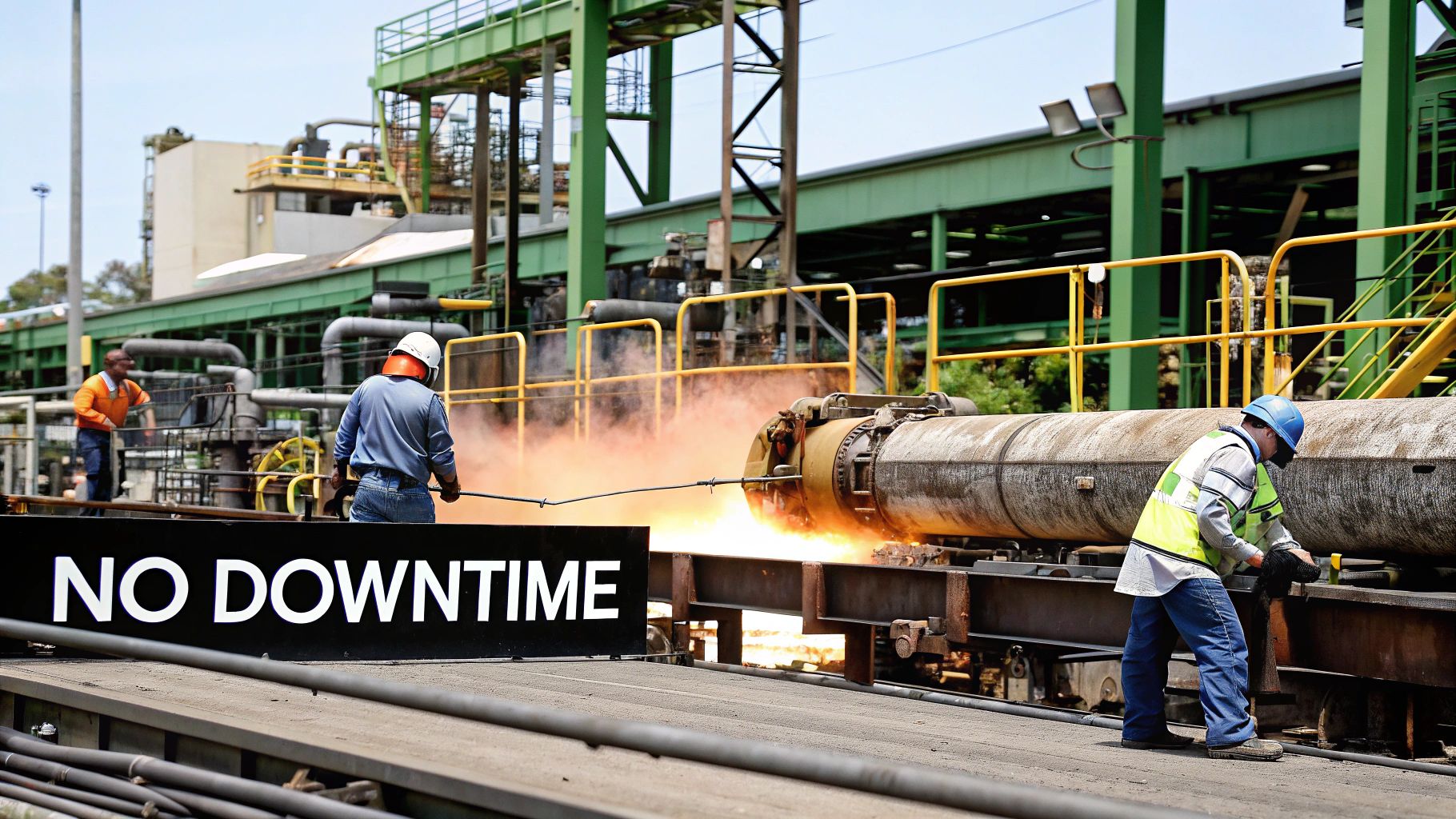
Think about a massive manufacturing plant that needs to boost its production capacity. The old-school approach would mean a complete shutdown. We're talking about stopping the entire operation, draining lines, and losing millions in revenue just to connect a new process line. Hot tapping turns that entire scenario on its head, letting crews weld, drill, and tie in the new connection while the plant keeps humming along.
This is about more than just convenience; it's about business survival. The power to make live modifications means projects keep moving, deadlines are met, and the bottom line stays protected.
Keeping Construction Projects on Track
One of the most common places you'll see hot tapping save the day is on a new construction project. Picture this: a developer has just finished a beautiful new apartment building, but it’s the middle of a brutal winter. The building is ready for tenants, but the utility's permanent natural gas line won't be commissioned for another month.
No gas means no heat. And no heat means they can't get the final inspection needed for a Certificate of Occupancy. The result? Dozens of empty units, unhappy future tenants, and a huge loss of income.
This is a textbook case for hot tapping. A specialized crew can perform a hot tap on the nearby gas main, creating a temporary service line directly to the building. Just like that, the heat is on, the inspectors sign off, and tenants can start moving in, all while the utility takes its time finishing the permanent hookup.
Upgrading Live Facilities Without Missing a Beat
Industrial plants and manufacturing facilities are always evolving. They’re constantly adding new equipment, tweaking production lines, or installing new sensors to get better data. The big challenge is making these changes without shutting everything down.
Hot tapping is the go-to solution for these kinds of live upgrades. Here are a few everyday examples:
- Installing New Sensors: A refinery needs to add new pressure gauges or temperature sensors to a live pipeline for better process control. A small, precise hot tap allows them to install the new instruments with zero downtime.
- Creating Sample Points: A city water treatment plant needs to add a new port to test water quality. Hot tapping creates that access point safely without ever interrupting the water supply to the community.
- Adding New Branch Lines: A food processing plant is expanding and needs to tie into the existing steam and water lines. A hot tap makes the connection seamlessly, avoiding a costly and disruptive plant-wide shutdown.
By enabling these live connections, hot tapping often saves facilities an estimated 40% or more compared to a full shutdown. It completely eliminates the costs tied to draining systems, losing product, and stopping production.
Expanding Utility Grids Without Interrupting Service
For gas and water utilities, maintaining and growing a massive network that serves thousands of homes and businesses is a constant juggling act. A service outage, even a planned one, is a logistical headache and a PR nightmare waiting to happen.
This is why hot tapping has become standard operating procedure for utilities. It helps them:
- Expand the System: When a new neighborhood pops up, utilities use hot tapping to connect the new mains to the existing grid, so current customers never even know it’s happening.
- Reroute Pipelines: If a road-widening project means a pipeline has to be moved, crews create a temporary bypass line using hot taps. Flow is diverted through the bypass while the old section is safely removed and the new one is installed.
- Install New Valves: Adding isolation valves gives utilities better control over their network. Hot tapping allows these critical components to be installed on live lines, enhancing system integrity without a shutdown.
The table below breaks down how hot tapping directly answers the unique challenges faced by different industries, providing a clear solution where one is desperately needed.
Hot Tapping Applications vs. Industry Needs
| Industry | Common Challenge | How Hot Tapping Solves It |
|---|---|---|
| Commercial Construction | Needing temporary heat or power to pass inspections before permanent utilities are active. | Creates a temporary tie-in to a live gas main, enabling timely project completion and occupancy. |
| Industrial Manufacturing | Expanding production lines or adding new equipment without halting plant operations. | Allows new branch lines and sensor ports to be added to live systems, avoiding revenue loss from downtime. |
| Municipal Utilities | Extending water or gas service to new developments without disrupting existing customers. | Enables the connection of new mains to the live grid, ensuring uninterrupted service for the community. |
| Oil and Gas | Needing to repair or modify a section of a high-pressure transmission pipeline. | Facilitates the creation of bypasses, allowing for safe repairs on an isolated section while flow continues. |
As you can see, the application of hot tapping is incredibly practical. It's a problem-solving technique that keeps the modern world running smoothly, from our homes to the factories that produce our goods.
When to Consider Alternatives to Hot Tapping
While a hot tap on a pipeline is an incredibly useful tool for expansion and repair, it’s not the right answer for every single job. An experienced project manager knows that every technique has its limits. Sometimes, the physical state of the pipeline, the materials it’s made of, or the pressures it's under make hot tapping either too risky or flat-out impossible.
Knowing when to pump the brakes is critical for project safety and success. For instance, trying to weld a fitting onto a pipe with heavy internal corrosion or known structural weakness is just asking for trouble. The intense, focused heat could easily be the final straw that leads to a catastrophic failure.
It's also a matter of materials. Hot tapping works beautifully on carbon steel, but it's a non-starter for older pipelines made of brittle materials like cast iron or certain plastics. They simply can’t handle the stress of welding and cutting. Honestly, knowing when to say "no" to a hot tap is just as important as knowing how to do one right.
Identifying Scenarios Unsuitable for Hot Tapping
Certain red flags should immediately tell you to look for another way forward. These are situations where the potential risks are so high that they completely outweigh the benefit of avoiding a shutdown.
Here are some key factors that can make a hot tap a no-go:
- Poor Pipeline Condition: If ultrasonic testing reveals extensive corrosion, cracks, or a pipe wall that’s just too thin, the project stops. A hot tap absolutely requires a structurally sound parent pipe to be done safely.
- Incompatible Materials: Brittle materials are a major hazard. Things like cast iron, concrete, or some internally lined pipes can’t be safely welded or cut while under pressure—the risk of the pipe shattering is just too great.
- Extreme Operating Conditions: Sometimes, the conditions inside the pipe are just too intense. Lines operating at exceptionally high pressures or temperatures, or those carrying particularly volatile substances, often demand the controlled environment of a full shutdown.
- Lack of Physical Access: This one is pure logistics. If you can't get the tapping machine and your crew into the location with enough room to work safely, the operation is off.
In these cases, you don't push it. The priority has to shift from avoiding downtime to guaranteeing the integrity of the system and, most importantly, the safety of your crew.
The Rise of Mobile Energy Solutions
So, when a direct tie-in is off the table, how do you keep the gas flowing and the project on schedule? This is where temporary mobile energy solutions, often called "virtual pipelines," come into play. Instead of tapping into the existing line, you bring the energy directly to the site.
The most common approach involves trucking in Compressed Natural Gas (CNG) or Liquefied Natural Gas (LNG). A mobile regasification unit is set up right on the job site, providing a steady, reliable supply of natural gas. This can be used to provide heat for a new building, commission generators, or keep a critical process running until a permanent connection can be safely made.
This strategy is a game-changer, especially in the construction world. As the global market for hot tapping machines grows—projected to hit $2.387 billion by 2033—so does the need for flexible workarounds. North America is leading this trend, with its vast, aging infrastructure requiring constant upgrades without service interruptions. Temporary gas solutions are the perfect complement, giving builders the energy they need to hit deadlines and secure occupancy permits without costly delays. You can find out more about the growth of the hot tapping market and its drivers.
Ultimately, a virtual pipeline disconnects your project's timeline from the utility's schedule. It puts you back in control, ensuring you can meet critical milestones without being dependent on an immediate, physical connection to the main.
How to Choose a Qualified Hot Tapping Partner
Picking the right company for a hot tap on a pipeline is the single most important decision you'll make. This isn't a job you can hand off to just any contractor. It demands a highly specialized skill set, a proven track record, and a non-negotiable commitment to safety. The stakes are simply too high to get it wrong.
When you're choosing a partner, you have to look past the price tag and dig into the qualifications that actually matter. You're trusting them with the integrity of your live, pressurized system—their expertise, or lack of it, will make or break your project.
Verifying a Rock-Solid Safety Record
In this line of work, safety isn't just a talking point; it's a hard, verifiable number. Before you even start discussing the scope of work, ask for a contractor’s safety stats. These numbers tell a story that no sales pitch can.
There are two key metrics you need to see:
- Experience Modification Rate (EMR): The insurance industry uses this number to rate a company's past safety performance. An EMR of 1.0 is the industry average. Anything lower is great, but a number above 1.0 is a serious red flag.
- Total Recordable Incident Rate (TRIR): This is an OSHA metric that tracks work-related injuries per 100 full-time workers. A consistently low TRIR is proof that a company walks the walk when it comes to safe practices every single day.
Any qualified hot tapping partner will be proud to show you their safety metrics. If a company gets defensive or can't produce these numbers, walk away. There is simply no substitute for a documented history of keeping people safe.
Experience and Documented Procedures
Beyond the safety numbers, you need proof that they’ve done this before—and that they have a plan. A contractor who has successfully completed dozens of jobs just like yours brings experience that you can't put a price on. They’ve seen what can go wrong and have refined their process to get it right every time.
When evaluating a hot tapping partner, look for the same qualities you'd want in a top-tier underground pipe repair contractor: deep expertise, proven reliability, and an unwavering focus on safety.
Ask them to show you the proof:
- Project Portfolio: Have them provide case studies or references for jobs that match your pipe's size, material, and operating pressure.
- Certified Technicians: Make sure their welders and technicians hold current certifications, especially for procedures that fall under ASME B31 codes and API standards.
- Written Procedures: A true professional will have detailed, written procedures for every single step, from the initial site walk-down to the final coupon retrieval.
Essential Business Qualifications
Finally, make sure the contractor has their business in order. A hot tap is a high-stakes operation, and you need to know your partner is fully insured and can provide the necessary engineering to back up the work.
Here are the non-negotiables to confirm:
- Comprehensive Liability Insurance: Ask for a certificate of insurance. It should show they have enough coverage to protect you and your assets if something goes wrong.
- Detailed Engineering Plans: The contractor must have an in-house engineer or a trusted partner who can provide stamped, approved plans for the procedure. This ensures every calculation is made for a safe and successful outcome.
Common Questions About Hot Tapping
Even after seeing how it works, it's completely normal to have a few questions about a procedure as precise as a hot tap on a pipeline. Let's tackle some of the most common ones to clear things up.
Is Hot Tapping Actually Safe?
Absolutely. When a certified team follows strict industry standards like API RP 2201, hot tapping is a safe and controlled, routine procedure. It’s not a gamble; it's a calculated engineering task.
The entire process is built around multiple layers of verification. Technicians do everything from ultrasonic testing to confirm the pipe wall is thick enough to pressure-testing the new fitting before ever making a cut. Every step is meticulously planned and executed to ensure the pipeline’s integrity is never at risk.
Can You Hot Tap Any Pipe?
While it’s an incredibly useful technique, hot tapping isn’t a one-size-fits-all solution. The deciding factors are always the pipe’s material and its current condition.
Hot tapping works great on materials that weld well, like carbon and stainless steel. However, it’s usually a no-go for:
- Brittle materials, like cast iron, which can easily crack under the stress.
- Certain plastics or composite pipes that can't withstand the heat or mechanical forces.
- Internally lined pipes, because cutting through them would destroy the protective lining inside.
That's why a thorough engineering assessment is always the first, non-negotiable step.
The rule of thumb is simple: if there's any doubt about the pipe's integrity during the procedure, the job doesn't happen. Safety is the top priority, period.
What's the Real Advantage Over a Shutdown?
In a word: continuity. A planned shutdown can set off a costly and disruptive chain reaction, and hot tapping lets you sidestep all of it.
By opting for a hot tap, you keep your operations running and avoid the revenue loss that comes with downtime. You also don't have to purge (and waste) the product already in the pipeline. For utilities, it means no service interruptions for customers. It's a strategic move that keeps business moving forward while you expand or maintain your infrastructure.
Are you facing project delays due to utility hookup schedules? Blue Gas Express provides temporary CNG and LNG solutions to keep your construction site powered and on track. Get the energy you need, when you need it, by visiting us at https://bluegasexpress.com.