

When you hear "natural gas," you probably think of the fuel that heats your home or cooks your food. But what happens when you take that same gas, clean it up, and squeeze it into a tank at high pressure? You get Compressed Natural Gas, or CNG—a powerful, clean-burning alternative to gasoline and diesel.
Think of it like this: you're essentially taking a roomful of air and compressing it into a small scuba tank. That's the basic idea behind CNG. This compression process packs a huge amount of energy into a small space, making it a viable fuel for everything from city buses to heavy-duty industrial equipment.
What Is CNG And Why Does It Matter?
In a world searching for cleaner, more efficient energy, understanding our options is key. You've likely heard a lot of acronyms thrown around—CNG, LNG, LPG—and it's easy to get them mixed up. They're all different, with their own unique properties and uses.
This guide is all about CNG. We'll break down exactly what it is, how it works, and where it's making a real difference.
The magic happens when natural gas is compressed to less than 1% of its volume at standard atmospheric pressure. This transformation turns it into a dense, potent fuel source. It’s this high-pressure storage that allows a truck or a piece of machinery to hold enough fuel to run for hours on end.
The Foundation Of CNG
At its heart, CNG is mostly methane. As the simplest hydrocarbon around, its clean chemical makeup is the secret to its success. When it burns, it releases far fewer harmful emissions—like carbon monoxide and nitrogen oxides—than more complex fuels like gasoline or diesel.
This clean-burning profile is a huge reason why so many industries are making the switch, aiming to shrink their environmental footprint and meet stricter emissions standards.
We're going to cover all the bases, from the science to the real-world logistics:
- The Science: How we turn regular natural gas into a high-pressure fuel.
- Practical Benefits: The real cost savings and environmental pluses that make CNG so attractive.
- Real-World Applications: Where you can see it in action, from public transit to powering machinery on remote construction sites.
- Safety and Storage: A look at the incredibly tough, well-engineered tanks that keep CNG stored safely.
- Modern Delivery: How mobile fueling services from companies like Blue Gas Express are changing the game by bringing CNG directly to job sites, completely bypassing the need for permanent pipelines.
This guide is your roadmap to understanding CNG. We'll start with the basics and build up to how it's being used today, showing you not just what it is, but why it’s becoming such an important part of our energy mix.
How Natural Gas Becomes a Vehicle Fuel
Ever wonder how the same natural gas that heats your home can also power a massive construction vehicle? It's the exact same stuff—mostly methane—but the secret lies in one critical step: compression. Turning this everyday resource into a potent vehicle fuel is a fascinating process that boils down to cleaning it up and squeezing it down.
First, the raw natural gas is purified. This step is all about removing impurities like water vapor and other hydrocarbons that could interfere with performance. It's a bit like filtering water before you drink it; you’re just making sure you get the purest, most energy-dense product possible.
Once it's clean, the real magic happens. The gas is funneled into powerful compressors that crank up the pressure to an incredible 3,000 to 3,600 pounds per square inch (psi). This intense pressure shrinks the gas down to less than 1% of its original volume. Imagine taking a huge balloon and compressing all the air inside it into a tiny, solid cube—that’s the kind of density we're talking about. This process packs a massive amount of energy into a surprisingly small space.
This simple journey from the ground, through compression, and into a vehicle's tank is what makes CNG so practical.
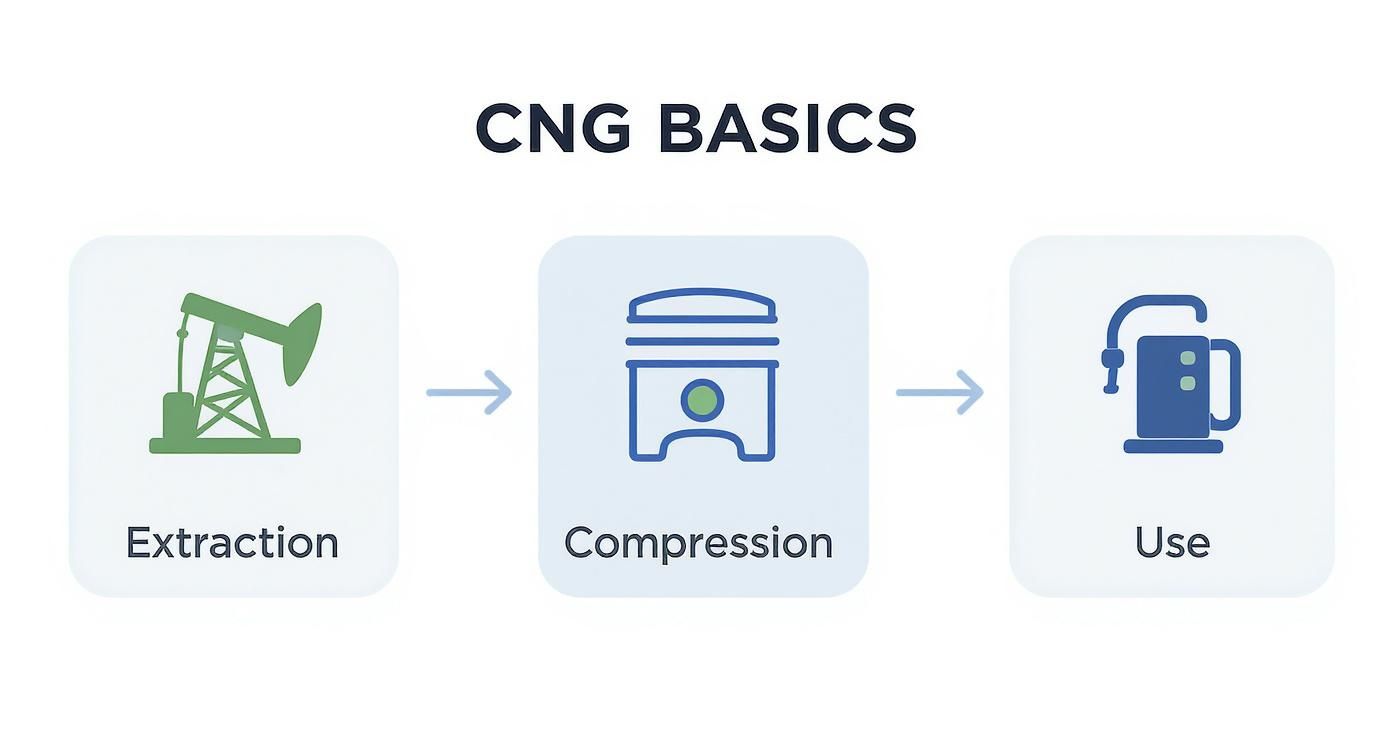
As you can see, compression is the bridge between raw gas and usable fuel. It's this high pressure that allows a truck or piece of equipment to carry enough fuel on board to get the job done, all stored safely in tough, reinforced tanks.
How CNG Stacks Up Against Other Fuels
So, where does CNG natural gas fit in with familiar fuels like gasoline, diesel, or even its cousin, LNG? The main difference isn't what it's made of, but how it's stored.
The core difference isn't just about what the fuel is made of; it's about how it's stored. CNG remains a gas under immense pressure, while gasoline, diesel, and LNG are all stored as liquids.
This simple distinction changes everything, from the fuel tank design to the vehicle's range.
- Gasoline and Diesel: We all know these. They’re liquids at room temperature, which makes them easy to store in simple, unpressurized tanks. They pack a lot of energy, but they also produce more emissions.
- CNG (Compressed Natural Gas): This is natural gas kept in its gaseous state, but it’s packed tightly into incredibly strong, thick-walled cylindrical tanks built to handle the constant high pressure.
- LNG (Liquefied Natural Gas): This is the same methane as CNG, but it’s been chilled to a frigid -260°F (-162°C) until it turns into a liquid. It has to be stored in special cryogenic tanks that work like a thermos to keep it from boiling away.
While CNG and LNG are both natural gas, their physical states make them better suited for different jobs. CNG is often the go-to choice for regional fleets and industrial sites because the fueling process is simpler. LNG, on the other hand, is more energy-dense, so you'll often see it used in long-haul trucking where maximum range is key. It all comes down to what you need the fuel to do.
The Real Benefits of Using CNG Fuel
So, what’s the real story behind switching to CNG natural gas? It’s not just about adopting new tech for the sake of it. Businesses and fleet managers are making a smart move that delivers tangible wins in three key areas: cost savings, environmental impact, and day-to-day operational efficiency.
The first thing most people notice is the impact on their fuel budget. Simply put, CNG almost always costs less per gallon equivalent than gasoline or diesel. While conventional fuel prices can feel like a rollercoaster ride tied to global oil markets, natural gas prices have a history of being much more stable. That kind of predictability makes budgeting a whole lot easier, especially for companies running large fleets or heavy equipment.
A Greener Footprint and Quieter Operations
The financial perks are just the beginning. A major reason companies embrace CNG is its much smaller environmental footprint, which ties into broader strategies to stop water pollution and air quality initiatives. When you compare it to gasoline and diesel, CNG burns incredibly cleanly, producing far fewer harmful emissions. This helps businesses stay ahead of tightening environmental regulations and sends a positive message to customers who care about sustainability.
When you burn CNG, it releases up to 90% less carbon monoxide and 25% less carbon dioxide than gasoline. That’s a huge drop in greenhouse gases and a big reason why city buses and delivery services are making the switch.
But the environmental benefits aren't just about what comes out of the tailpipe. CNG engines are noticeably quieter than diesel engines. For construction crews in residential zones or fleets making early-morning deliveries, this is a massive plus. It means you can often work longer hours without getting noise complaints from the community.
Enhanced Performance and Reduced Maintenance
Making the move to CNG doesn't mean you have to compromise on power or reliability. In many cases, it actually improves how your equipment runs. Because CNG is a gas, it doesn't leave behind the gunk and carbon deposits that are notorious for bogging down gasoline and diesel engines. This cleaner burn directly translates to better longevity and less time in the shop.
Here are a few of the performance perks you can expect:
- Longer Engine Life: With less gunk building up, there's less wear and tear on internal components. Your engines simply last longer.
- Reduced Maintenance: Cleaner combustion means spark plugs stay in good shape for longer, and you don’t have to change the oil as often.
- High Octane Rating: CNG boasts an octane rating of around 130, which helps the engine run smoothly and eliminates the "knocking" you can get with lower-quality fuels.
This isn't just a niche trend; it's a rapidly growing movement. The North American compressed natural gas market is on a serious growth trajectory, expected to climb from USD 91.11 billion in 2024 to USD 132.32 billion by 2035. That kind of growth shows a massive surge in confidence from businesses that see CNG as a smart, reliable, and clean fuel for the future. You can learn more from the global CNG market forecast.
When you hear “CNG natural gas,” you might picture a city bus or a delivery truck. But its real muscle is shown in some of the toughest industrial environments out there. From sprawling construction sites to massive factories, CNG is quickly becoming the go-to fuel for heavy-duty jobs that demand reliable, affordable, and cleaner energy.
Picture a huge construction project right in the middle of a city. The constant drone of diesel generators and the exhaust from heavy machinery can cause major headaches, from angry neighbors to regulatory fines. CNG offers a fantastic solution. It allows crews to power their excavators, generators, and everything in between with a fuel that’s not only quieter but also a whole lot cleaner.
This isn’t just about being environmentally friendly, though. It’s a smart financial move. Companies get to shrink their carbon footprint, meet tough emissions rules, and often slash their fuel budget all at once.
Powering Construction and Development
On any busy construction site, reliable power is everything. Projects can come to a screeching halt if the main power grid connection is delayed or the natural gas pipeline isn't hooked up yet. This is where mobile CNG delivery becomes an absolute lifesaver.
Think of it like a "virtual pipeline" on wheels. A specialized trailer pulls up to the site and plugs directly into the project's energy system, delivering on-demand fuel to keep critical systems online without a hitch.
Here are just a few ways construction crews put it to work:
- Temporary Site Heating: Essential for keeping materials from freezing and letting work continue through the cold winter months.
- Powering Heavy Equipment: Fueling a wide range of machinery, from forklifts and excavators to large industrial generators.
- Drying and Curing: Supplying the steady, consistent heat required for curing concrete or drying out a building after painting.
For a home builder waiting for the utility company to show up, a mobile CNG unit can be the key to hitting a deadline instead of dealing with expensive delays. It provides the clean power they need to get through inspections and secure an occupancy permit right on schedule.
Fueling Industrial and Manufacturing Processes
Away from the construction site, industrial facilities are using CNG for all sorts of high-heat processes. Think about plants that make glass or steel—they need a tremendous amount of thermal energy. CNG delivers a clean, efficient flame perfect for their furnaces, ovens, and boilers.
You'll also see it in warehouses and distribution centers, where entire fleets of forklifts now run on CNG. It's a huge improvement over propane, which involves swapping out heavy, cumbersome tanks. CNG systems can be refilled quickly and safely from a single point, which not only clears the air inside the facility but also keeps the equipment running with less downtime.
Many industrial parks are built far from established gas mains, making a traditional pipeline connection either impossible or incredibly expensive. For these off-pipeline businesses, CNG natural gas isn't just a nice alternative; it's the primary fuel that keeps production lines moving. This kind of flexibility means a company’s location no longer limits its energy choices.
A Closer Look at CNG Storage and Safety
So, is a tank packed with highly compressed gas actually safe? It’s a perfectly reasonable question, and the answer is a resounding yes, thanks to the impressive engineering built into every CNG natural gas storage system. We're not talking about simple metal cans here; these are sophisticated pressure vessels where safety is the number one design principle.
Imagine the materials used for an airplane's body—incredibly strong, resilient, and built to handle extreme stress. CNG tanks are engineered to a similar, demanding standard. They’re typically built from a combination of high-strength steel and advanced composites like carbon fiber. This construction allows them to comfortably contain pressures of 3,600 psi and resist impacts far more effectively than a typical gasoline tank.
Built-In Layers of Protection
Beyond the tough exterior, every CNG system is packed with automatic safety features that work together to prevent problems before they can even start. These components ensure the gas stays put until the engine needs it.
Here are some of the key safety players:
- Automatic Shut-Off Valves: Think of these as instant gatekeepers. If a leak or a sudden pressure drop from a collision is detected, these valves immediately cut off the gas flow from the tank.
- Pressure-Relief Devices (PRDs): In the rare event of a fire, extreme heat could cause pressure to build. PRDs are designed to safely and controllably vent the gas, preventing the tank from rupturing.
- Durable, Leak-Proof Fuel Lines: All the lines and fittings that carry the gas are made from corrosion-resistant materials and are tested relentlessly to ensure a tight, leak-proof seal for the long haul.
One of the biggest safety wins for CNG comes from its basic physics. Unlike gasoline or propane, which are heavier than air and can pool on the ground creating a serious fire hazard, CNG is lighter than air.
This is a crucial difference. If a leak ever did happen, the CNG natural gas would just rise and disperse harmlessly into the atmosphere. This simple property drastically cuts the risk of ground-level fires, making CNG one of the safest fuels you can use. The entire system is also a closed loop, meaning no fuel is lost to spills or evaporation during fill-ups—a common problem with liquid fuels.
Bringing the Fuel to You: The Shift to Mobile CNG
So, what do you do when your project could really benefit from the clean, cost-effective power of CNG natural gas, but the nearest pipeline is nowhere in sight? For a long time, this was a major roadblock for anyone working on remote construction sites, off-grid industrial plants, or even fleet depots far from a public station.
That logistical headache sparked an incredibly practical solution, one that's completely changing how businesses get their energy.
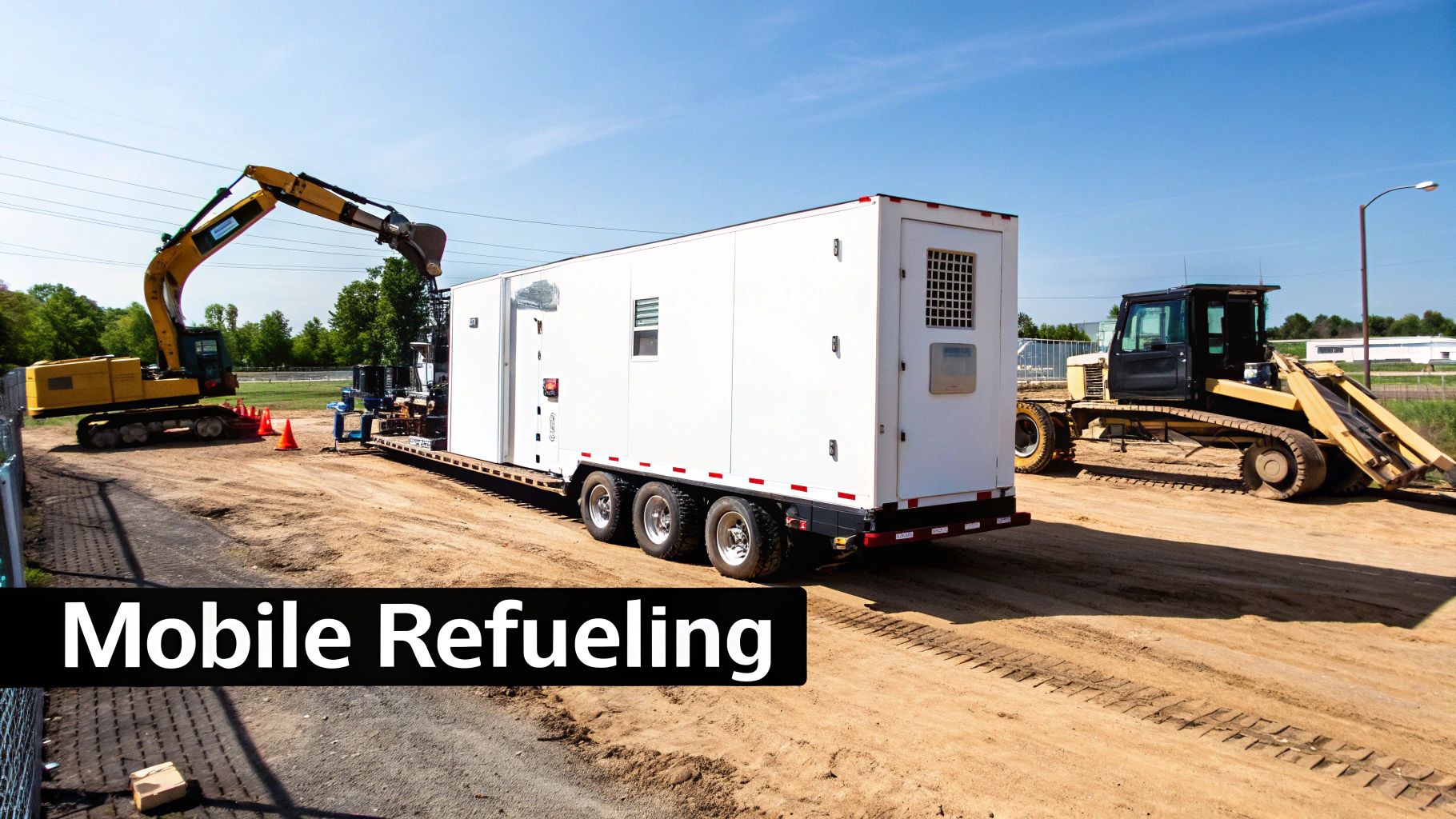
This is where mobile CNG fueling comes in. Think of it as a "virtual pipeline"—we bring the fuel directly to your doorstep. Instead of being tethered to fixed infrastructure, specialized trailers packed with high-capacity CNG tanks are sent right to your location. It’s a direct, on-demand connection to natural gas, wherever you need it.
How On-Demand CNG Works in the Real World
The whole process is surprisingly simple but incredibly effective. Companies like Blue Gas Express deliver these mobile units to create a steady, dependable fuel supply for operations that can't afford downtime. It’s all about bridging that infrastructure gap, making CNG a real possibility for businesses just about anywhere.
This mobile approach is perfect for solving a few common problems:
- Remote Power: Firing up generators and heavy equipment on construction sites long before they're connected to the grid.
- Temporary Supply: Keeping the gas flowing during pipeline maintenance or for short-term industrial jobs.
- Fleet Fueling: Setting up a refueling point—temporary or permanent—for a fleet of CNG vehicles at their home base.
Mobile fueling essentially brings the gas station to you. It eliminates the enormous upfront cost and time required to build permanent pipelines, offering unmatched flexibility for projects with shifting energy demands.
This flexibility is a huge reason the market is taking off. The global compressed natural gas market hit about USD 92.21 billion in 2024 and is expected to climb to USD 121.42 billion by 2032, growing at a solid 3.50% rate. You can read more about the CNG market's growth to see the trend for yourself. By knocking down geographical barriers, mobile CNG solutions are making cleaner, more affordable energy accessible to everyone.
Answering Your Top Questions About CNG
When you're thinking about switching to a cleaner fuel like CNG, it’s natural to have a few practical questions. How far can I go on a tank? Where do I fill up? Let's dive into some of the most common queries to give you a clear picture of how CNG works in the real world.
How Far Can I Drive on a Tank of CNG?
This is usually the first question on everyone's mind. The short answer is that a CNG vehicle's range is typically a bit shorter than a similar gasoline or diesel one. This is because even though the gas is highly compressed, the tanks store less energy by volume compared to a tank of liquid fuel.
But here's the thing: for most local and regional fleets—think delivery trucks, municipal buses, or construction vehicles that return to a home base—the range is more than enough for a full day's work. Plus, tank technology is always improving, closing that gap every year.
Can I Convert My Current Vehicles to Run on CNG?
Absolutely. It’s very common to convert existing gasoline and diesel engines to run on CNG. The process involves fitting a specialized fuel system, which includes high-pressure storage tanks, new fuel lines, and injectors.
While there's an upfront cost for the conversion, the significant savings on fuel often mean the investment pays for itself pretty quickly.
Where Do I Find CNG Fueling Stations?
This is a big one. It's true that the network of public CNG stations isn't as vast as the one for traditional gas stations, but it's growing fast, especially along major transportation corridors and in cities.
The global demand for CNG is exploding. The market was valued at USD 159.87 billion in 2023 and is expected to more than double to USD 344.59 billion by 2030. You can see the full details in these CNG market growth trends.
But what if you’re not near a public station? That’s where mobile fueling completely changes the game. We bring the refueling station directly to your job site or vehicle yard, so you never have to worry about finding fuel.
This on-demand delivery model takes infrastructure challenges and range anxiety right out of the equation. It makes CNG a practical, reliable choice for almost any operation, no matter where you're located.
Is your project facing delays due to a lack of natural gas access? Blue Gas Express delivers mobile CNG and LNG solutions directly to your site, keeping your operations powered and on schedule. Get your temporary natural gas solution today.