

Picture this: you pull into your driveway after a long day, plug a nozzle into your car, and head inside. The next morning, you wake up to a full tank of fuel without ever having to stop at a gas station. That’s the reality with a home CNG fueling station—it turns your garage into your personal refueling hub.
This setup offers incredible convenience and can lead to some serious cost savings over the long haul.
How a Home CNG Fueling Station Works
Think of a home CNG station as being similar to an EV charger, but for a natural gas vehicle (NGV). Instead of electricity, it uses the natural gas line already running to your house for your furnace or stove. The whole idea is pretty straightforward: refuel your car slowly and safely overnight.
The core of the system is a compact appliance, usually mounted on a wall in your garage. This unit taps into your home's low-pressure natural gas supply and gets to work. It’s essentially a powerful, specialized compressor designed to safely pressurize that gas all the way up to 3,600 psi—the pressure needed to fill your vehicle's tank.
The Overnight Refueling Process
The slow-fill approach is what makes these systems so practical for home use. Unlike the fast-fill pumps you see at public stations, a home unit takes its time, typically filling your tank over eight to ten hours. This gentle, overnight process is less stressful on the equipment and guarantees you start every day with a full tank.
It's completely automated. You just connect the hose when you get home in the evening and disconnect it before you leave in the morning. Easy as that.
This infographic breaks down the simple journey from your home's gas line to your vehicle's tank.
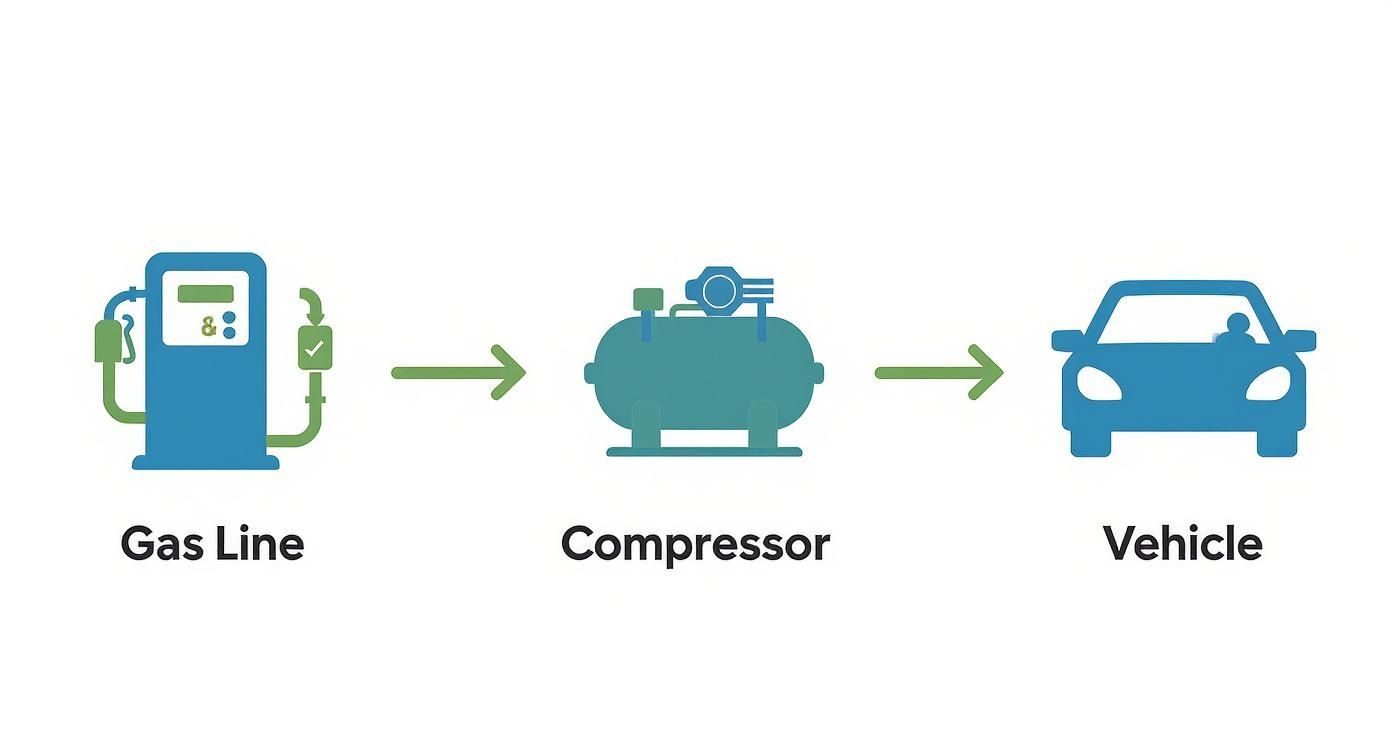
As the graphic shows, it’s a direct, three-stage process that makes managing your fuel needs incredibly efficient. This is what makes owning a home CNG fueling station such a game-changer for anyone driving an NGV.
The real beauty of it is that you’re turning a utility you already have—natural gas—into a vehicle fuel. You’re no longer dependent on public stations for your daily commute, giving you more freedom and the potential for big savings by using a cheaper energy source.
To give you a clearer picture, let’s quickly compare refueling at home versus at a public station.
Home CNG Fueling vs Public Stations at a Glance
| Feature | Home CNG Fueling | Public CNG Station |
|---|---|---|
| Convenience | Refuel overnight while you sleep. | Requires a specific trip to a station. |
| Refueling Time | 8-10 hours (slow-fill). | 5-10 minutes (fast-fill). |
| Fuel Cost | Typically lower, based on residential gas rates. | Higher, reflects commercial and operational costs. |
| Upfront Cost | Initial investment for the appliance and installation. | No upfront cost for the user. |
| Availability | Always available 24/7 in your garage. | Limited by station locations and operating hours. |
| Equipment Wear | Slower fill is gentler on vehicle and station parts. | Faster fill can cause more wear over time. |
Ultimately, while public stations offer speed, the consistency, cost-effectiveness, and sheer convenience of a home unit are hard to beat for day-to-day driving.
What's Inside a Home CNG Fueling Station?
At first glance, a home CNG fueling station can look pretty intimidating. But once you pull back the curtain, you’ll find it’s really just three key parts working together. It’s a beautifully simple system, really.
Think of it as a tiny, automated fuel refinery sitting quietly in your garage. You have a compressor, a dryer, and a fueling hose. That's it. Each one has a specific job, and understanding them takes all the mystery out of how your home's natural gas becomes fuel for your car.
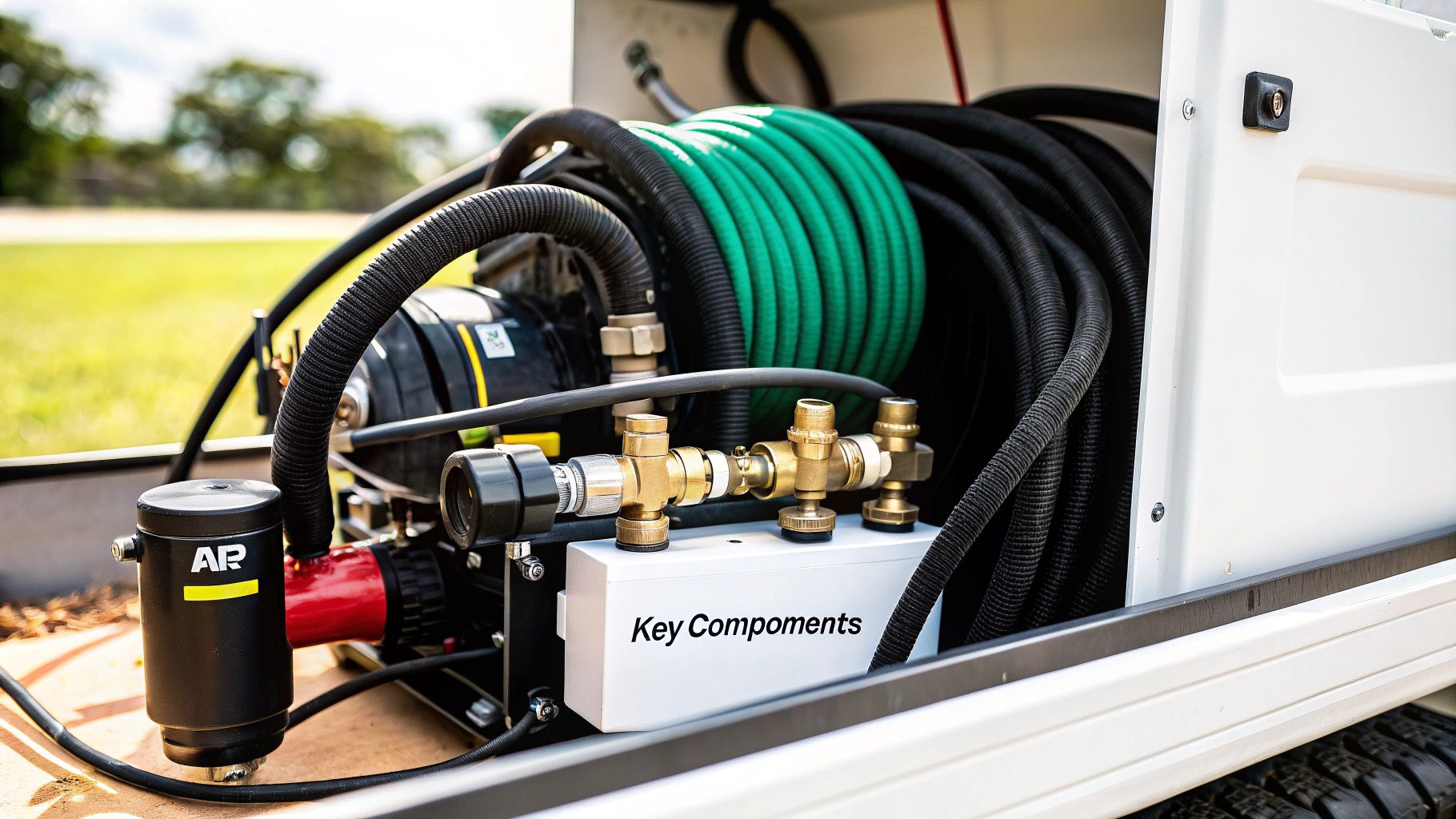
Let's walk through what each component does and see how they turn your standard utility gas into a clean, convenient transportation fuel while you sleep.
The Compressor: The Heart of the System
The compressor is the real workhorse of the entire operation. It has one critical mission: to take the natural gas supplied to your house and crank up the pressure. A lot.
Your home's utility line delivers gas at a very low pressure, usually less than 1 psi (pounds per square inch). That's great for your furnace, but it won't get your car very far. The compressor methodically squeezes this gas in stages, boosting it all the way up to 3,600 psi—the standard pressure for a CNG vehicle tank.
Think of the compressor as the engine of the whole system. It does all the heavy lifting, transforming low-pressure utility gas into a dense, energy-packed fuel. Without it, the whole concept just wouldn't work.
The Dryer: Protecting Your Investment
After the gas is compressed but before it gets anywhere near your vehicle, it has to pass through the dryer. This step is absolutely crucial for the long-term health of your car and the fueling station itself.
Why? Because the natural gas from the utility pipe contains tiny amounts of water vapor. Under normal household pressures, it's no big deal. But when you pressurize that gas to 3,600 psi, that moisture becomes a major problem. The dryer acts like a high-tech filter, using a special material called a desiccant to pull that water vapor out.
This prevents two big issues:
- Corrosion: High-pressure gas mixed with water is a recipe for rust. The dryer stops corrosion from forming inside your fueling station, your car's tank, and your engine components.
- Freezing: In cold weather, any leftover moisture could freeze inside the system. This could form ice blockages, damaging delicate valves and regulators and potentially stopping the fuel flow entirely.
Simply put, the dryer is cheap insurance. It keeps the gas pure and protects your equipment from expensive damage down the road.
The Fueling Hose and Nozzle: The Final Connection
The last piece of the puzzle is the fueling hose and nozzle. This isn't your average garden hose. It’s a highly specialized piece of equipment built to handle the immense pressure of 3,600 psi day in and day out without failing.
The hose itself is heavily reinforced to prevent any chance of ruptures or leaks. At the end, the nozzle is designed to form a perfect, airtight seal with your vehicle's fuel port. It has a built-in safety mechanism that locks it in place, ensuring gas will only flow when it's securely connected.
This final link in the chain makes sure all that high-pressure gas gets from the station into your tank safely and efficiently, finishing the refueling process.
The Financial Breakdown: Upfront Costs vs. Long-Term Savings
Let's talk numbers. Installing a home CNG fueling station is a serious investment, but it’s one that can pay for itself surprisingly fast. To really understand the value, you have to look past the initial price tag and see the bigger picture of what you'll save down the road.
The total cost breaks down into three main parts. The appliance itself is the biggest piece of the puzzle, typically running anywhere from $4,500 to over $10,000, depending on the model’s speed and features. Next, you have professional installation, which is absolutely essential for safety. This usually adds another $2,000 to $4,000 to the budget.
Finally, your home might need a few tweaks to be ready. This could mean running a new electrical circuit or making minor adjustments to your existing natural gas line, which could tack on a few hundred to over a thousand dollars.
Calculating Your Payback
This is where the investment really starts to shine. The moment you start filling up at home, you stop buying expensive gasoline and start using the much cheaper natural gas you already have piped to your house. The key is the difference between the price of gasoline and the price of a "gasoline gallon equivalent" (GGE) of natural gas.
A GGE is simply the amount of natural gas that gives you the same energy as one gallon of gasoline. The cost for a GGE from your home’s utility line is almost always dramatically lower than what you’d pay at the pump—often by 50% or more.
Here's a quick example:
- Gasoline at the pump: $3.50 per gallon
- Your home's natural gas cost: $1.50 per GGE
- Your savings: $2.00 on every "gallon"
If you drive to work every day, those savings stack up in a hurry. For many drivers, the system pays for itself in just a few years.
Thinking Through the Full Investment
When you're budgeting, make sure to account for all the setup costs. It can be helpful to look at how other home energy systems are priced. For example, understanding EV charger installation costs can offer some good perspective on what goes into a professional home fueling installation.
It’s also worth noting that this isn't some niche technology. The global market for CNG compressors—the heart of these systems—was valued at around USD 3.7 billion in 2023 and is expected to hit USD 5.6 billion by 2032. That kind of growth signals real confidence in the long-term viability and savings of CNG.
In essence, a home CNG station turns your monthly utility bill into your personal fuel source. The upfront cost is your ticket to unlocking massive savings by tapping into a cheaper, more stable energy supply that’s already connected to your house.
And don't forget to look for incentives! Many federal and state programs offer tax credits or rebates for installing alternative fuel systems. These can take a huge chunk out of the initial cost and make your break-even point arrive even sooner.
Ensuring a Safe and Compliant Installation
When you're dealing with natural gas at high pressures, safety isn't just a priority—it's everything. Installing a CNG home fueling station is definitely not a weekend DIY project. It’s a specialized job that demands deep knowledge of high-pressure gas lines, complex electrical work, and the maze of local building codes.
Trying to tackle this yourself is more than just a bad idea; it's incredibly dangerous. You’d also immediately void your manufacturer's warranty. The only person who should be touching this equipment is a licensed and certified professional who can guarantee every connection is leak-proof and every safety measure is in place.
Key Installation Requirements
A professional installer's first step is to thoroughly evaluate your property. They’re looking for a few critical things to ensure a safe, long-lasting setup. A crucial part of this process involves a deep understanding fire risk assessments to proactively identify and handle any potential hazards from day one.
Here’s what a proper installation focuses on:
- Proper Ventilation: Your compressor needs to breathe. It must be installed in a well-ventilated space, like a garage or a secure outdoor shed. Natural gas is lighter than air, so good airflow ensures that if any gas were to escape, it would dissipate harmlessly instead of building up.
- Dedicated Electrical Circuit: These compressors are powerful and pull a lot of electricity. They require their own dedicated circuit, just like a major appliance or an EV charger, to prevent overloading your home’s electrical system and creating a fire hazard.
- Adherence to Safety Codes: A certified installer lives by the book—specifically, national standards like those from the National Fire Protection Association (NFPA). These strict codes dictate everything from where the unit can be placed to the specific materials used for plumbing and wiring.
The goal of a professional installation isn't just to make the system work—it's to make it work safely for years. A certified technician guarantees that your fueling station is compliant with all regulations, protecting your family, your home, and your investment.
By putting this job in the hands of a qualified expert, you get the peace of mind that comes with knowing your CNG home fueling station will be reliable and, most importantly, completely safe every single time you refuel.
Who Benefits Most from Fueling at Home
Beyond the nuts and bolts of the hardware, who really stands to gain the most from putting a CNG home fueling station in their garage? While the tech is impressive, its true value shines in specific, real-world situations. It’s for anyone ready to take charge of their fueling schedule, slash their transportation budget, and shrink their environmental footprint—all without leaving home.
The most obvious candidate is the daily commuter. If you drive a significant distance to and from work every day, this is for you. A home fueling station completely changes the game. No more weekly trips to the gas station. Instead, you're filling up with cheap natural gas overnight. The savings on fuel alone can easily add up to thousands of dollars a year, which helps that initial investment pay for itself surprisingly quickly.

It’s a similar story for small business owners running one or two CNG-powered work vehicles. Think of plumbers, electricians, or local delivery services where fuel is a massive chunk of their operating costs. A home station guarantees their vans or trucks are topped off and ready to roll every single morning. This boosts productivity by eliminating wasted time at public stations and brings down overhead in a big way.
Conquering Range Anxiety and Scarcity
Let's be honest—one of the biggest things holding people back from buying a natural gas vehicle (NGV) is "range anxiety." It’s that nagging fear of not being able to find a public fueling station when you’re running low. And in many places, that’s a legitimate worry.
A home fueling station completely solves this problem for daily driving. It effectively gives your vehicle a full tank every morning, making your daily commute and local errands entirely independent of public station availability. You start each day with maximum range.
This kind of independence is a game-changer. As of 2024, the U.S. has around 700 public CNG fueling stations. What's often overlooked is that this number is only about half of the total fueling points; the rest are private fleet stations you can't access. This spotty public network makes CNG home fueling stations a vital part of the equation for individual NGV owners. It bridges the infrastructure gap and makes clean fuel a practical, everyday choice. You can get a better sense of the NGV infrastructure landscape by reading up on the industry's latest consumer trends.
Which User Profile Benefits Most from Home CNG Stations
To make it even clearer, the table below breaks down the specific advantages for different types of users who are thinking about installing a home fueling station. It helps illustrate how the benefits line up with various lifestyles and professional needs.
| User Type | Primary Benefit | Example Scenario |
|---|---|---|
| The High-Mileage Commuter | Rapid Return on Investment | A sales professional driving 100+ miles daily sees massive fuel savings that quickly offset the system's cost. |
| The Small Business Owner | Lower Operational Costs & Efficiency | An HVAC company fuels its two service vans overnight, avoiding employee downtime at public pumps and cutting fuel expenses by 40%. |
| The Environmentally-Conscious Driver | Practical Sustainability | A family committed to reducing their carbon footprint can seamlessly integrate a cleaner fuel source into their daily routine. |
| The Self-Sufficient Homeowner | Energy Independence | Someone who values being prepared and off-grid can produce their own vehicle fuel, protecting them from price hikes or fuel shortages. |
In the end, these stations are perfect for anyone whose typical driving fits within the daily range of their NGV. It’s what transforms a niche vehicle into a practical, cost-effective, and incredibly convenient daily driver.
The Future of CNG and Home Refueling
Putting a CNG fueling station at your home is about more than just convenience. It’s a smart play that puts you right in line with the global push for cleaner, more sustainable energy. The entire transportation world is shifting away from traditional fuels, thanks to tougher environmental rules and people simply demanding better options that cut down on our carbon footprint. Your investment in a home CNG system places you at the leading edge of this powerful change.
This isn't just some fleeting trend. It's a fundamental pivot in how we think about energy, and it's getting a lot of backing from government initiatives. You'll see more and more incentives for alternative fuels as policymakers wake up to the upsides of natural gas. By choosing to fill up at home, you're not just following the trend—you're getting ahead of it on your own terms.
A Market on the Move
The momentum building behind CNG is impossible to ignore, and the numbers back it up. The global market for Compressed Natural Gas, which includes infrastructure like home fueling stations, was already valued at around USD 159.9 billion in 2023.
But here's where it gets interesting: forecasts predict that figure will more than double, rocketing to USD 344.6 billion by 2030. That’s a powerful growth rate of 11.8% every year, driven by a worldwide hunger for cleaner energy. You can dig deeper into the future of the CNG market on Grandviewresearch.com.
When you adopt home CNG refueling technology, you're not just buying another appliance. You're investing in a sustainable, long-term energy solution. It turns a personal convenience into a savvy financial and environmental decision, securing your place in the future of transportation.
Ultimately, a home station solidifies the value of your natural gas vehicle, making it an incredibly practical and forward-thinking choice. It takes CNG from a niche solution to a common-sense adaptation for where the world is headed, making sure you're ready for the cleaner energy landscape of tomorrow.
Common Questions About Home CNG Stations
Diving into the world of CNG home fueling stations always kicks up a few practical questions. It's one thing to understand the technology, but it's another to picture how it fits into your day-to-day life. People often wonder about the little things—like fill times and insurance—and getting solid answers is the best way to feel confident about making the switch.
Let's walk through some of the most common questions we hear. Getting these details ironed out will help you see exactly what owning a personal CNG station is all about.
How Long Does Overnight Refueling Take?
This is usually the first thing people ask. A home unit isn't like the high-pressure pumps at a public station; it’s designed for a slower, steadier fill that's much easier on your equipment.
For a typical CNG car, you're looking at about eight to ten hours for a full tank. The whole process is designed to fit perfectly into your evening routine. You pull in, connect the nozzle, and head inside. By the time you wake up, your car is fully fueled and ready to go. This slow-and-steady approach is not only convenient but also helps ensure the system runs safely and efficiently for years.
Does a Home Station Affect My Insurance?
This is a big one, and the answer is yes—you absolutely need to loop in your insurance provider. Think of it like adding any other major appliance to your home. It’s crucial to call your home insurance company before you start the installation process.
Most insurance carriers are familiar with professionally installed CNG fueling systems. They will likely require documentation from your certified installer confirming that the unit complies with all local building codes and national safety standards, such as those from the NFPA. Providing this proof is typically all that's needed to ensure your policy remains fully in effect.
Giving them a heads-up and showing that everything is installed by the book is usually all it takes to keep your coverage seamless.
Can Any House Accommodate a CNG Station?
While many homes are great candidates, not every property is a perfect match right out of the gate. The biggest prerequisite is having a natural gas line with enough pressure and volume, which is pretty standard for most homes. After that, a few other logistical details need to be sorted out.
A professional installer will need to check your property for a few key things:
- Adequate Space: You'll need a good spot for the unit, usually in a garage or a protected shed, with plenty of clearance around it.
- Proper Ventilation: The area has to be well-ventilated so that in the unlikely event of a leak, the gas can disperse safely.
- Electrical Access: The compressor needs its own dedicated electrical circuit to handle the power load safely, much like an EV charger.
Ultimately, a thorough site visit from a certified technician is the only way to know for sure if your home is ready and to pinpoint any small upgrades that might be needed.
At Blue Gas Express, we understand the critical need for reliable natural gas solutions. While we specialize in mobile CNG and LNG for commercial and industrial needs, we champion the adoption of natural gas technology at every level. If your project requires temporary natural gas to keep operations running, explore our mobile fueling solutions to see how we can help.