

The drywall is finished, the mechanical inspector is booked for Thursday, and the utility just called to push your permanent gas main tie-in back another six weeks. You open a search tab, type LNG near me, and get a map full of highway truck stops that won't help your building pass an occupancy check or keep a generator running through commissioning.
Finding nearby liquefied natural gas for a jobsite works differently than finding fuel for a fleet. According to the U.S. Energy Information Administration LNG overview, the United States shifted from importing a peak of 770.8 billion cubic feet (Bcf) of LNG in 2007 down to 15.24 Bcf in 2023, while U.S. LNG exports averaged 11.90 Bcf per day to 43 countries in 2023. Because domestic supply now moves through regional liquefaction plants, trucking fleets, and portable storage rather than a handful of coastal import terminals, getting gas to a site comes down to matching the right delivery format to your load and passing a siting review before a single truck rolls.
Match Your Need to the Right LNG Supply
The first decision changes your entire search: a public LNG fueling station dispenses fuel into heavy trucks, while delivered LNG supplies a building, generator, or industrial process. A highway map can show a retail station three miles from your project and still offer zero practical way to feed a commercial boiler or a pipeline outage.
| Supply option | Best for | Site requirements | Main limit |
|---|---|---|---|
| Public LNG fueling station | Fueling vehicles on a route | Vehicle fueling only, no site installation | Not built for generators or building supply |
| Delivered LNG container system | Temporary supply during a pipeline delay or outage | Container, vaporizer, regulator, pipe and an emergency plan | Needs siting review and approvals before delivery |
| Mobile gas unit on a 16 ft trailer | Building, generator or commissioning load | Plugs into an existing meter or regulator and parks in one space | Run time is bounded by gas on board, so long gaps need swap units |
| Natural Gas Box | Smaller, steady loads | Connected to the building and operational within minutes | Smaller gas storage, so less run time between refills |
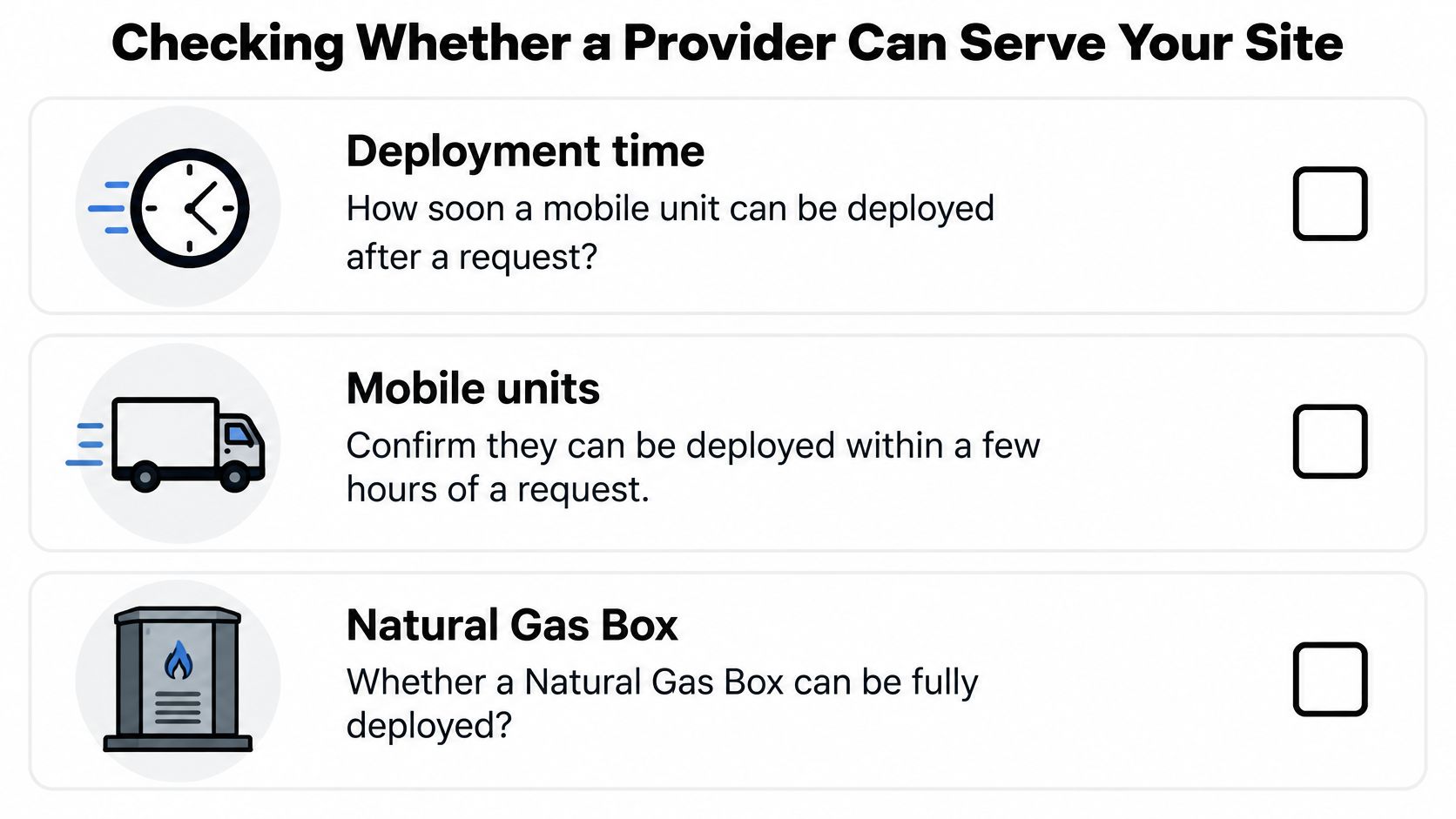
At Blue Gas Express, we rent mobile natural gas for buildings and pipelines while crews wait on a permanent gas line or work in areas without pipeline service. Our standard mobile gas units arrive on 16 ft long trailers that are 8 ft wide, occupying a single parking lot space. For lighter loads, a Natural Gas Box uses the same delivery technology at a lower rental cost because it holds less storage volume, and we refill it on site with a trailer unit that plugs straight into the box without moving it.
Three Questions That Sort Your Site
Most project teams land in the right row of that table after answering three practical questions before calling anyone:
- Which appliances must run: List every boiler, rooftop unit, temporary heater, or generator that needs fuel right now, not just the building's full design load.
- How many days the gap lasts: A three-day commissioning window favors a single mobile trailer, while a multi-month utility delay usually points toward scheduled trailer swaps or a larger delivered LNG container setup.
- Whether a meter or regulator is already installed: If the mechanical contractor has set the building's meter bar or service regulator, a mobile unit can tie in directly instead of waiting on temporary yard piping.
Start your search with the U.S. Department of Energy's Alternative Fuels Data Center station locator if you're routing LNG vehicles, because that public directory tracks retail fueling locations. For construction heat, freeze protection, or building supply, search separately for delivered temporary gas providers. As the International Energy Agency report on global gas markets notes, even LNG truck sales remain constrained by refueling infrastructure that hinges on local buildout and gas economics. Public station maps don't track emergency dispatch, vaporization hardware, or service continuity.
Shortlist three delivered-gas providers whose service radius covers your jobsite, then test each one on deployment speed, hookup compatibility, and site clearance. A short supply gap for a building awaiting permanent gas points straight to delivered supply, while vehicles running a highway corridor belong at a public fueling station.
How to Request LNG Delivery Step by Step
Sending a supplier an email that only lists a city name and "need temporary gas next week" guarantees two days of back-and-forth calls. Quotes come back inaccurate when load, pressure, and site access aren't pinned down upfront.
- Write down the connected load and delivery pressure. List every piece of equipment you plan to fire, such as generators, makeup air units, or commissioning boilers, along with their total gas demand and required inlet pressure. Missing load figures are the single most common reason a provider sizes the wrong trailer or quotes the wrong vaporization capacity.
- Record the outage duration plus a schedule buffer. Write down the target date for the permanent utility tie-in or pipeline repair, then add realistic margin for weather, inspection holds, or trenching delays. Leaving out duration forces the supplier to guess whether you need a single drop or a continuous refill schedule.
- Confirm the exact connection point on site. Identify the building meter, pipeline regulator, pipe diameter, and physical location where the gas line terminates, and verify that technicians can reach it without climbing over scaffolding or trench boxes. Forgetting regulator details often stalls hookup day because crews show up missing the right flange or adapter.
- Measure parking, truck access, and setbacks. Check turning radii for delivery trucks, confirm whether a level parking space sits near the regulator, and note distances to occupied structures and property lines. A tight urban lot with overhead power lines changes equipment placement immediately.
- Submit the full package through the provider's intake channel. At Blue Gas Express, we deliver mobile natural gas units anywhere in the United States and provide full service across North Carolina, South Carolina, Tennessee, and Virginia, and we ask customers who need temporary gas to reach out through our contact page. Sending complete site notes on that first submission lets our engineers size the hardware right away instead of chasing basic specs.
- Request a written deployment window and full-service scope. Ask the supplier to put mobilization timing, physical tie-in responsibilities, ongoing gas monitoring, refill logistics, and final demobilization in writing before you issue a purchase order. Verbal promises on delivery speed rarely hold up when a cold snap hits the region.
Before you hit send on a quote request, review the core capabilities a supplier must confirm for your specific setup.
What a Complete One-Page Request Looks Like
I always recommend putting the entire inquiry onto a single summary sheet accompanied by four or five smartphone photos. Keep the sheet strictly operational: total BTU or hourly flow demand, required ounces or PSI at the regulator, expected start and end dates, and a pin drop of the jobsite entrance.
Attach clear wide-angle photos showing the meter bar, the closest parking pad, the driveway entrance from the main road, and any fences or gates blocking truck entry. A supplier reviewing that one-page packet can confirm feasibility in hours instead of burning a week scheduling a preliminary site walk.
Checking Whether a Provider Can Serve Your Site
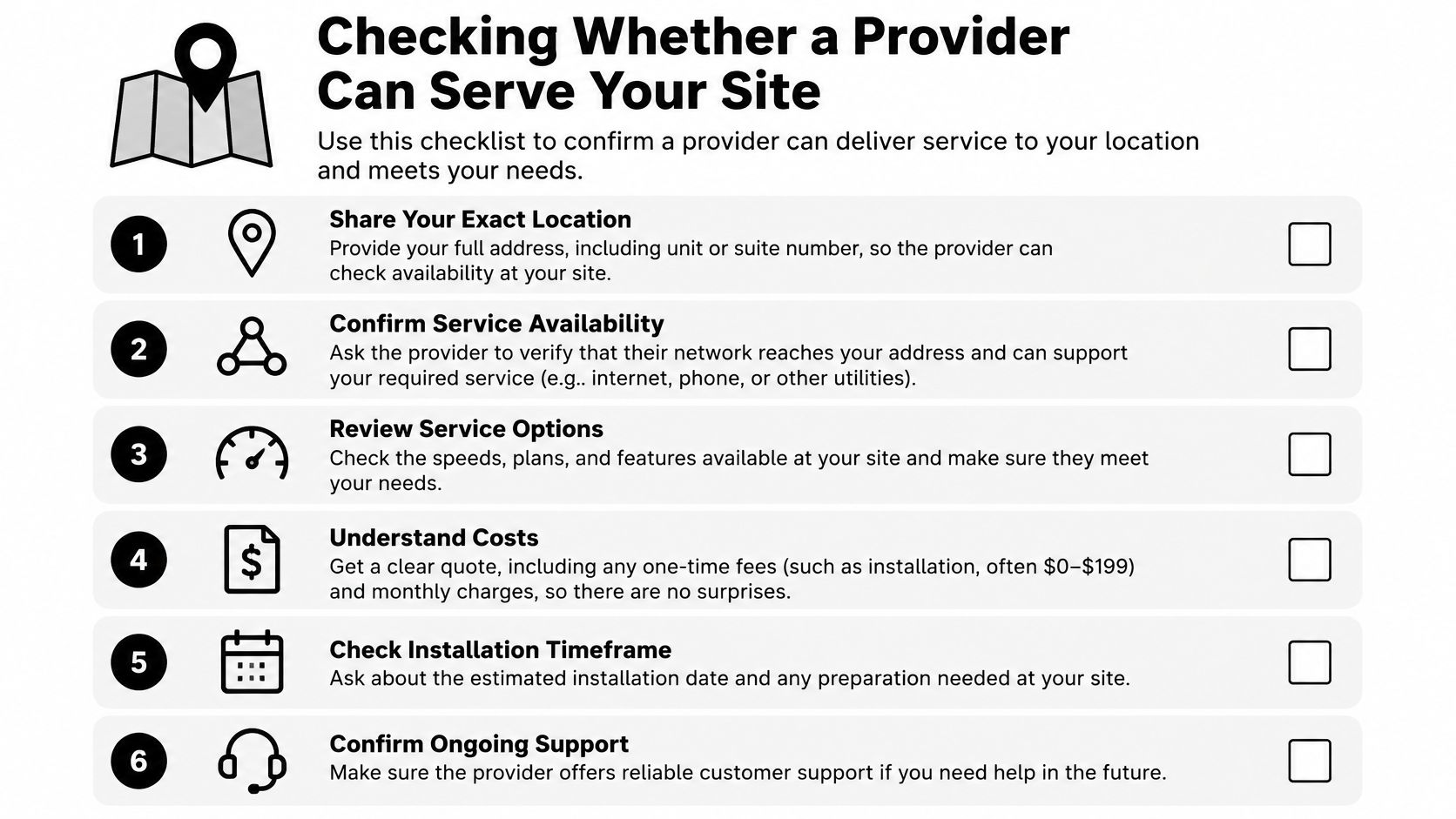
A map pin or directory listing proves a facility exists, not that a supplier can keep your heating plant online through a Friday night freeze. Once you have three providers on the phone, work through a concrete set of operational questions and insist on getting every answer in writing.
Deployment Speed and Physical Hookup
Start by pinning down how quickly hardware leaves the yard after you sign off. Our mobile gas units can be deployed within a few hours of a customer's request, and once on site, the connection uses flexible line inside rigid conduit so the system becomes operable quickly. Ask every competing vendor whether they dispatch crews after business hours or on weekends, and confirm if they enforce minimum order volumes that would force you to pay for gas your project won't burn.
Next, verify connection compatibility so your mechanical contractor doesn't end up fabricating custom manifolds at the last minute. Mobile units should plug directly into any standard residential, commercial, or industrial natural gas meter or regulator. If a provider tells you your plumber has to source specialty reducers or temporary headers, factor that labor and lead time into your schedule.
Monitoring, Freeze Protection, and Testing
Running out of gas mid-pour or during an occupancy inspection wrecks a project timeline, so ask how the supplier tracks inventory on site. Our units use proprietary remote monitoring over the cellular network that texts gas-level readings straight to any phone and estimates when a trailer will empty, letting us dispatch a hot-swapping mobile unit before pressure ever drops.
Cold weather also exposes weak temporary gas setups when moisture or pressure drops freeze regulators shut. Confirm that the unit includes active thermal controls. Our mobile gas units run actively heated, computer-controlled gas flow systems that switch smart heating on and off automatically to prevent freeze-ups. Finally, check who owns startup safety checks: we provide connection equipment, gas flow testing, and leak testing on a service contract basis so your superintendent isn't left guessing whether the temporary line is tight.
Practical verification rule: Never accept "we usually handle that" on a phone call. Before issuing a purchase order, require three items in writing: a site-specific hookup confirmation, a guaranteed mobilization response window, and a named backup protocol if a scheduled swap truck gets delayed in traffic.
Apply that three-part filter consistently across your shortlist:
- Site-specific confirmation: Written acknowledgment of your exact regulator pressure, parking footprint, and truck access route.
- Written response time: A documented mobilization window covering both initial delivery and emergency service calls.
- Named swap backup: Clear confirmation of how the vendor prevents an outage if weather or highway closures slow down a refill trailer.
Site Siting and Safety Screening Before Delivery
A supplier close to your zip code may still be the wrong fit if the site cannot support a temporary LNG setup. Public LNG fueling stations are built for vehicle access. Delivered LNG for a building or jobsite is different: the tank, vaporizer, regulator, transfer points, and truck route all have to fit a reviewed site plan.

The Four-Step Siting Screen
Run this screen before you clear a laydown area or promise a delivery date to the general contractor. According to the PHMSA LNG plant requirements FAQ, temporary facilities that rely on NFPA 59A spacing tables must calculate facility spacing using the aggregate capacity of all LNG containers on site. Treating several smaller tanks as independent units is a common permitting error.
First, map the full site inventory on a scaled plot plan. Show aggregate LNG container volume, liquid transfer points, vaporizers, occupied buildings, property boundaries, open ignition sources, and storm drainage paths where a cryogenic spill could flow. This is the drawing the fire marshal and provider should both be able to read without guessing.
Second, calculate separation distances and thermal exclusion zones before fixing the pad location. The PHMSA FAQ addresses the federal thermal exclusion requirement for LNG facilities, so keep that requirement tied to the delivered LNG setup rather than treating it as a station-siting issue. For NFPA 59A spacing, do not use a single fixed number. Separation distances depend on equipment type, total capacity, and the locally adopted code. Vaporizer arrangements, container capacity, and site boundaries can move the approved pad farther from the building than the shortest hose run suggests.
Third, verify local sign-off early. Contact the municipal fire marshal, building department, environmental office, and serving gas utility. Zoning, setbacks, access, and operational approvals can all affect where the unit sits and when it can be placed in service. A clean provider quote does not replace those approvals.
Fourth, complete a documented hazard review before the first LNG trailer enters the property. Confirm emergency egress routes, fire extinguisher placement, vehicle crash protection around the tank, and clear shutoff access. The review should also name who operates the site during delivery, who monitors the system, and who has authority to stop work if conditions change.
Who Coordinates Plans and Fire Marshals
A project engineer should not have to write an LNG emergency dossier from scratch while managing the rest of the construction sequence. A full-service supplier should own the regulatory coordination alongside the equipment.
Blue Gas Express creates the mandatory Emergency Management Plans, brings in personnel and monitoring technology to operate and monitor the LNG site, and interacts with Fire Marshals and other regulatory bodies. Ask any provider to walk the four-step siting sequence with you before the pad location is locked on the site plan. The practical test is simple: the exact spot, access route, and equipment layout must be acceptable to both the supplier and the local authorities before the order is placed.
Ventilation and Leak Mistakes That Stall Projects
Many site superintendents assume natural gas leaks announce themselves with a rotten-egg smell. That assumption fails with liquefied natural gas. According to the U.S. Department of Energy Alternative Fuels Data Center natural gas safety guide, LNG is stored at roughly -260°F and is odorless in its natural state, which makes relying on human smell an unreliable safety control.
| Mistake | Why it fails | Fix |
|---|---|---|
| Relying on odor to detect leaks | LNG is odorless in its natural state | Install and verify gas detection at both low and high elevations |
| Mounting detectors only at ceiling height | Cold LNG vapor can be heavier than air and pool near the ground | Add floor-level detection and ventilation |
| Parking LNG equipment in an enclosed area | Equipment may vent after extended unused storage | Use an approved outdoor or well-ventilated parking plan |
| Skipping pre-operation inspection | Hoses, couplings or shutoffs can fail during transfer | Inspect hoses, couplings, gauges, level indicators and emergency shutoffs before each operation |
The physics behind those fixes catches crews off guard when they're used to ambient pipeline gas. While warm methane rises, initially cold LNG vapor can be heavier than air, allowing gas to sink and pool near floor drains, pits, or low-lying areas where it creates both fire and asphyxiation hazards.
Storage hold times also create false confidence during holiday shutdowns or weather delays. LNG tanks are typically built to hold fuel for a week or more without venting, yet extended unused storage can still cause tanks or LNG vehicles to release vapor as pressure builds. Hold-time ratings never replace active ventilation or an approved outdoor parking area.
Six-Point Field Readiness Check
Before starting any cryogenic transfer or parking mobile LNG hardware near a structure, confirm these six operational controls on site:
- Cryogenic transfer procedures: Verify that both delivery drivers and site safety leads follow written cold-transfer protocols and wear cryogenic personal protective equipment.
- Dual-elevation gas detection: Confirm active methane detectors are calibrated and mounted at both floor level and ceiling height inside any enclosed space.
- Floor and ceiling ventilation: Provide mechanical or engineered natural airflow at both low and high elevations in maintenance bays or enclosed storage areas.
- Active exclusion zones: Rope off liquid transfer areas to keep unauthorized trades away from cold-contact hazards and potential vapor clouds.
- Pre-transfer hardware inspection: Check flexible hoses, cryogenic couplings, pressure gauges, liquid-level indicators, and emergency shutoff valves prior to every hookup.
- Documented standby parking: Record where trailers or LNG-fueled equipment will sit during idle shifts, keeping them outdoors away from building air intakes.
Weigh Cost and Continuity Before You Commit
The lowest quote usually belongs to the option that assumes everything goes to plan. Delivered gas pricing moves with global supply, shipping lanes, weather spikes, and regional logistics. In the first half of 2025, the International Energy Agency Q3 2025 Gas Market Report noted that global LNG supply rose 4% year over year while European and Asian LNG spot prices averaged 40% and 28% above the same period in 2024, respectively. North America was projected to supply roughly 85% of incremental global LNG output in 2025, yet geopolitical disruptions still leave delivered fuel exposed to volatility.
That matters because temporary gas is bought to protect a schedule. A fuel premium can be cheaper than a delayed commercial certificate of occupancy, liquidated damages on a delayed handover, or tenants waiting on heat during winter commissioning. Price the whole service, not just the fuel callout.

| Option | One-week gap | Three-month gap | Hidden cost |
|---|---|---|---|
| Delivered LNG container system | High mobilization share relative to short runtime | Spreads setup across months for high-demand sites | Delivery, vaporization and minimum volume |
| Diesel generators | Fast deployment for power loads, poor fit for direct gas heat | Escalating refueling labor and exhaust management | Fuel deliveries and runtime |
| Pipeline gas | Impractical if main extension isn't already complete | Lowest running energy rate once connected | Connection lead time |
| CNG | Strong fit for compact building heat and commissioning loads | Requires scheduled trailer swaps to maintain pressure | Pressure and cylinder logistics |
| Temporary electric generation | Useful for small electrical loads without gas appliances | Heavy panel upgrades and high rental burn | Generator rental and noise |
The practical comparison is per usable day on site. Delivered LNG container systems can cover direct gas heat and appliance commissioning, but mobilization carries more weight during a one-week gap. Over three months, the setup is easier to justify on a high-demand site, provided the quote includes delivery, vaporization, and minimum volume terms. Diesel suits electrical loads, not gas-fired equipment, and brings refueling labor plus exhaust management. Pipeline gas looks cheap once connected, but lead time controls the decision. CNG works well for compact building heat and commissioning loads, then depends on trailer swaps to keep pressure stable. Temporary electric generation may fit small electrical loads, but panel upgrades, rental burn, and noise can erase the apparent savings.
A supplier that sizes equipment properly protects the schedule as much as the budget. Blue Gas Express temporary natural gas equipment scales from small boxes and 16 ft trailers to semi-truck loads, which avoids staging an oversized unit for a light commissioning load. Their mobile gas units plug into standard residential, commercial, or industrial natural gas meters or regulators. Mobile gas units usually arrive in 16 ft trailers that are 8 ft wide, so they occupy one parking lot space. A Natural Gas Box uses the same technology with smaller gas storage capacity and a lower rental cost, and refills from a trailer unit that plugs directly into the box without moving it.
Before signing a temporary gas agreement, ask four questions that expose continuity risk:
- Single-source exposure: Does the supplier depend on one liquefaction terminal, or can they use another loading point if a plant goes down for maintenance?
- Late swap contingency: What dispatch backup exists if highway closures or winter storms delay a scheduled trailer swap?
- Contract lock-in: What is the minimum rental term, and can the term extend week-to-week if the serving utility slips its tie-in date again?
- Standby billing: Who pays for trailer standby time if bad weather halts construction and gas burn drops close to zero?
Continuity also depends on equipment behavior after connection. Smart heating on mobile gas units turns on and off automatically to prevent equipment from freezing. Remote monitoring estimates when a trailer will run out of gas, so another hot-swapping mobile unit can be dispatched before that happens. Connection equipment, gas flow testing, and leak testing are available on a service contract basis. I would treat those items as part of the operational plan, because a cheap unit without monitoring, freeze protection, or a clear swap trigger can still interrupt commissioning.
Your Three-Step Action Plan Before Signing
- Build a true all-in daily cost sheet. Put delivered LNG, CNG, diesel, and temporary electric side by side on a per-day basis. Include mobilization, freight, vaporization or regulator rental, and idle standby charges in every column.
- Collect written quotes tied to your operational checklist. Require each shortlisted supplier to confirm response timing, monitoring, freeze protection, siting compliance, and backup swap coverage inside the written proposal.
- Send your complete site packet through the provider's contact page before committing. Share your one-page load summary, duration buffer, and meter photos upfront so the provider can confirm sizing and approval timelines before a contract is signed.
When a delayed utility tie-in, pipeline outage, or commissioning deadline puts a schedule at risk, Blue Gas Express provides Mobile Gas Units, a Natural Gas Box, and Liquefied Natural Gas (LNG) for temporary service. The company rents mobile natural gas while customers wait for a permanent gas line or in areas not served by gas pipelines. It provides mobile gas units anywhere in the US and full service in North Carolina, South Carolina, Tennessee, and Virginia. Its headquarters is at 2528 Schieffelin Road, Apex, NC 27502, USA. Use the contact page to request temporary mobile natural gas and provide the load details and site layout needed for sizing.