

Crews are booked, the pumps need to run, and the utility still hasn't confirmed an energization date. A rental generator looks like the obvious fix until someone asks where its exhaust will go after the building is enclosed, or whether the air agency needs to approve it before delivery.
Temporary power for construction is a scheduling decision before it's an equipment purchase. Start with the loads and the date they must operate, then work backward through permits, placement, distribution and utility coordination. The cheapest available unit isn't a bargain if you can't legally or safely energize it.
Temporary Power Options at a Glance
No single option wins everywhere. The right choice depends on the load, when power is needed and whether permanent service has a confirmed completion date. Also distinguish electricity from fuel: a temporary natural gas supply serves gas-fired equipment, but it doesn't produce electricity unless it feeds a generator.
Temporary power options compared
| Option | Typical deployment | Capacity range | Main constraint | Best fit |
|---|---|---|---|---|
| Rental generator, diesel or natural gas | Same day to a few days after order, subject to availability and approvals | Few kW to multi-MW | Fuel delivery, emissions permits, exhaust placement | Early phases, tools, lighting, short-duration loads |
| Temporary natural gas, CNG or LNG units | Hours to days, subject to provider availability and site readiness | Small boxes to trailer or semi-load sizes | Gas supply capacity matched to the load and utility coordination | Heating, gas appliances, commissioning, delayed gas mains |
| Grid tie-in, temporary utility service | Weeks to months, set by the utility | Set by the utility service size | Utility design, inspection and meter scheduling | Long-duration loads once energization is approved |
| Hybrid, generator with gas, battery or grid source | Set by the longest-lead source | Sized to peak load plus backup | More equipment, distribution and commissioning steps | Phased sites with mixed loads or noise and emissions limits |
Treat the deployment entries as planning windows, not delivery commitments. Deployment means the interval from order to an energized, usable installation, not merely a truck arriving. Have each bidder confirm that interval in writing, including approvals and site preparation.
The capacity column describes the equipment's practical scale, not a sizing recommendation. The best-fit column identifies suitable uses. The main constraint column deserves the closest attention because that item can hold up the schedule regardless of equipment availability.
Compare the complete installed cost
Generator quotes should include rental duration, fuel consumption at the expected load, delivery, collection, standby charges and applicable air-permit fees. Ask whether distribution panels, cable, maintenance and refueling support are included. A low rental rate can conceal an expensive operating package.
For temporary gas, compare unit size, supply volume, delivery arrangements and applicable utility connection charges. A short gas-service bridge can cost less than keeping a generator operating throughout a prolonged delay, but only if the gas supply serves the loads you need.
Temporary utility service can involve design, inspection and meter fees, installation work and eventual removal. Request written quotes using the same load list, operating dates and scope boundaries rather than comparing unrelated unit rates.
Shortlist rule: List the total connected load, mark the first required operating date, and check whether permanent service has a confirmed date.
Those answers should narrow the table to the options worth pricing and permitting. Don't pay to develop every possible arrangement when one unresolved utility milestone already determines the practical choice.
Sizing Load and Meeting Jobsite Electrical Rules
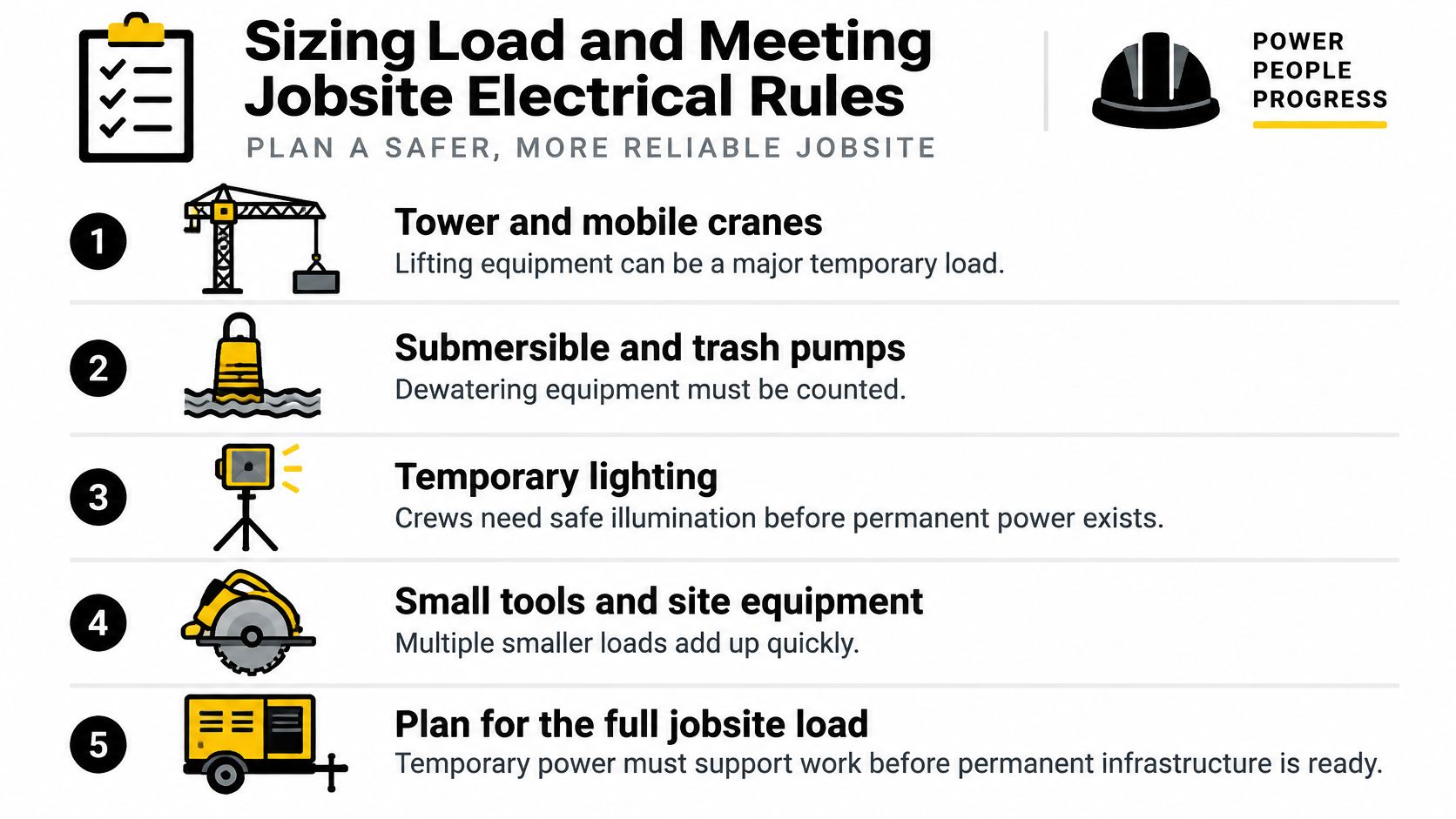
Start with a working load register: tower and mobile cranes, submersible and trash pumps, temporary lighting, ventilation fans, heaters, small tools, site security and early commissioning equipment. Separate essential loads, such as dewatering, from loads that crews can interrupt or sequence.
A motor's starting demand can substantially exceed its running demand. If the supplier sizes only from running kilowatts, a pump or crane start can cause unacceptable voltage drop or trip protection while the rest of the site is operating.
Build the load schedule before selecting equipment
- Record every load's nameplate rating and duty cycle. Photograph equipment plates and identify which loads operate continuously, intermittently or only during commissioning.
- Capture motor starting requirements and sequence. Give the supplier starting-method information, not just horsepower. Identify equipment that might restart together after an outage.
- Choose voltage and phase. Confirm compatibility across the generator, distribution panels and connected equipment. An adapter won't resolve an unsuitable supply.
- Record when each load arrives. Groundwork, enclosure and commissioning require different combinations of equipment. Size against credible simultaneous demand rather than adding unrelated project phases together.
- Set the required availability date. Include time for installation, testing and acceptance before the trade needs to start work.
Have a qualified electrical designer check cable lengths, voltage drop, protective-device coordination and the generator's response to the largest credible load step. For background when discussing panel configuration, ATEK Distribution's industrial panel guide provides a useful reference alongside the project's electrical design.
Treat the installation as a system
OSHA's construction electrical standards, 29 CFR 1926.402 through 1926.408, apply to temporary and permanent jobsite power and lighting installations and specifically include portable and vehicle-mounted generators supplying jobsite equipment.
The framework addresses suitable equipment, protection from damage, grounding, safe distribution and protection against contact with energized parts. A generator on a delivery ticket doesn't establish any of those conditions by itself.
Identify who installs the panels, who protects cable crossings and who accepts the completed installation. Include weather exposure, access for maintenance and changes in work areas in that review. The requirement list, not the kilowatt rating of a single unit, defines what the rental or service must deliver.
Rental Generators Work Fast but Need Careful Placement
A rental generator can be on site and running within days, which is why it remains the default answer when permanent service lags the schedule. It powers tools and lighting, follows the work as phases advance, and asks nothing of the utility. The trade-off is that speed of delivery hides the two things that slip schedules with generators: where the unit can legally sit, and whether the placement decision was made before the building changed around it.
Fuel access is the first constraint most plans underestimate. The delivery route that works during excavation may be blocked by concrete placement, crane picks or stored material within weeks. Noise limits where a unit can run near occupied neighboring buildings or during interior work when crews rely on verbal communication. And the unit itself has a performance envelope: run oversized and it burns extra fuel at low load, run undersized and motor starts produce trips and unstable voltage. None of these problems appear on a rental quote.
Placement changes as the building changes
Keep generators outdoors, with exhaust directed away from structures, occupied areas and air intakes. Window openings, temporary poly enclosures and negative-air equipment can all draw exhaust indoors, and a winter enclosure can convert an open yard into a carbon-monoxide exposure risk without anyone moving the unit.
Consider a site where the generator sits in open yard space during groundwork. Weeks later, crews close the nearby façade and commission a ventilation intake facing that same yard. The generator never moved. Its relationship to the building did, and the location that passed review no longer passes it.
An acceptable location during excavation isn't automatically an acceptable location during interior fit-out.
Schedule a placement review after every enclosure milestone and whenever ventilation arrangements change. Assign one named coordinator for that decision. If responsibility is split between the rental company, the mechanical contractor and the superintendent, the review never happens.
Use a phase-based placement check
- Confirm exhaust direction. Check the actual discharge point against occupied areas, openings and planned structures, not just the outline of the generator enclosure.
- Locate air intakes. Include temporary ventilation, negative-air discharge points and openings that demolition or fit-out work may uncover.
- Reassess weather protection. Review conditions after tarps, temporary walls or winter enclosures go up.
- Exclude enclosed operating locations. Don't operate generators in framed spaces, lift baskets or partly enclosed work areas.
- Verify the electrical arrangement after relocation. Have the qualified installer review grounding, bonding, cable protection and disconnect access before re-energizing.
OSHA's construction electrical standards, 29 CFR 1926.402 through 1926.408 cover grounding and bonding for portable generators used on jobsites, so confirm those requirements with the qualified installer before energizing.
Keep the approved location on the logistics plan with its refueling access and cable routes marked. When another trade claims that space, resolve the relocation before its work starts, not during. The generator is cheapest to move before the building closes around it. After fit-out begins, a placement problem costs a shutdown, an emergency relocation and a schedule conversation nobody wants to lead.
Temporary Natural Gas and Utility Tie-Ins Compared
If a delayed gas connection is holding up heating or gas-appliance commissioning, temporary natural gas can bridge that gap. If the load is electrical only, gas supply alone won't help. You need a compatible generator or temporary electrical service.
Compressed natural gas, CNG, stores gas under pressure. Liquefied natural gas, LNG, stores it as a cryogenic liquid that must be converted back to gas for use. Both require equipment selected for the site's consumption, delivery access and required outlet conditions.
Match the bridge to the missing service
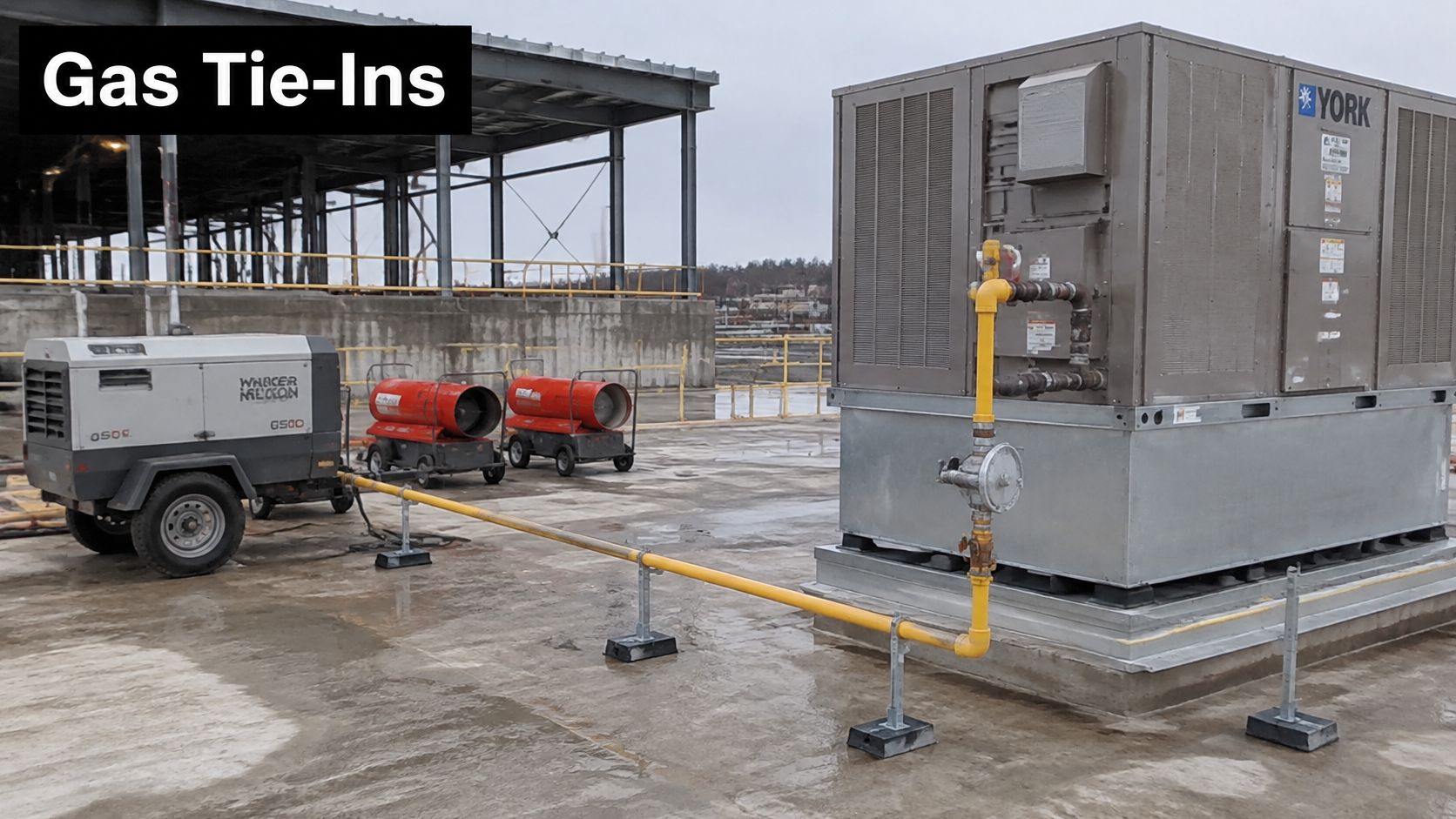
Temporary gas can serve rooftop units, ambient heaters and gas-fired generators while a main is delayed, being extended or undergoing maintenance. It avoids diesel storage for those gas-fired loads, but it still requires replenishment planning. Match delivery capacity and usable supply to consumption during peak operation.
A grid tie-in follows a different approval path: utility design review, site readiness, inspection and meter installation. Ask the utility which prerequisite remains unresolved and who owns it. A target energization date isn't a confirmed release to operate.
Before choosing, get written answers covering:
- Timing and capacity. What service can be available by the required date?
- Continuity. What happens during a supply interruption?
- Transition. Who coordinates conversion to permanent service?
- Cost boundaries. Which connection, delivery and utility fees are included?
Compare quotes against identical loads and dates. Otherwise, a cheaper proposal may exclude the work needed to make it usable.
Permits and Air Rules to Clear Before Mobilization
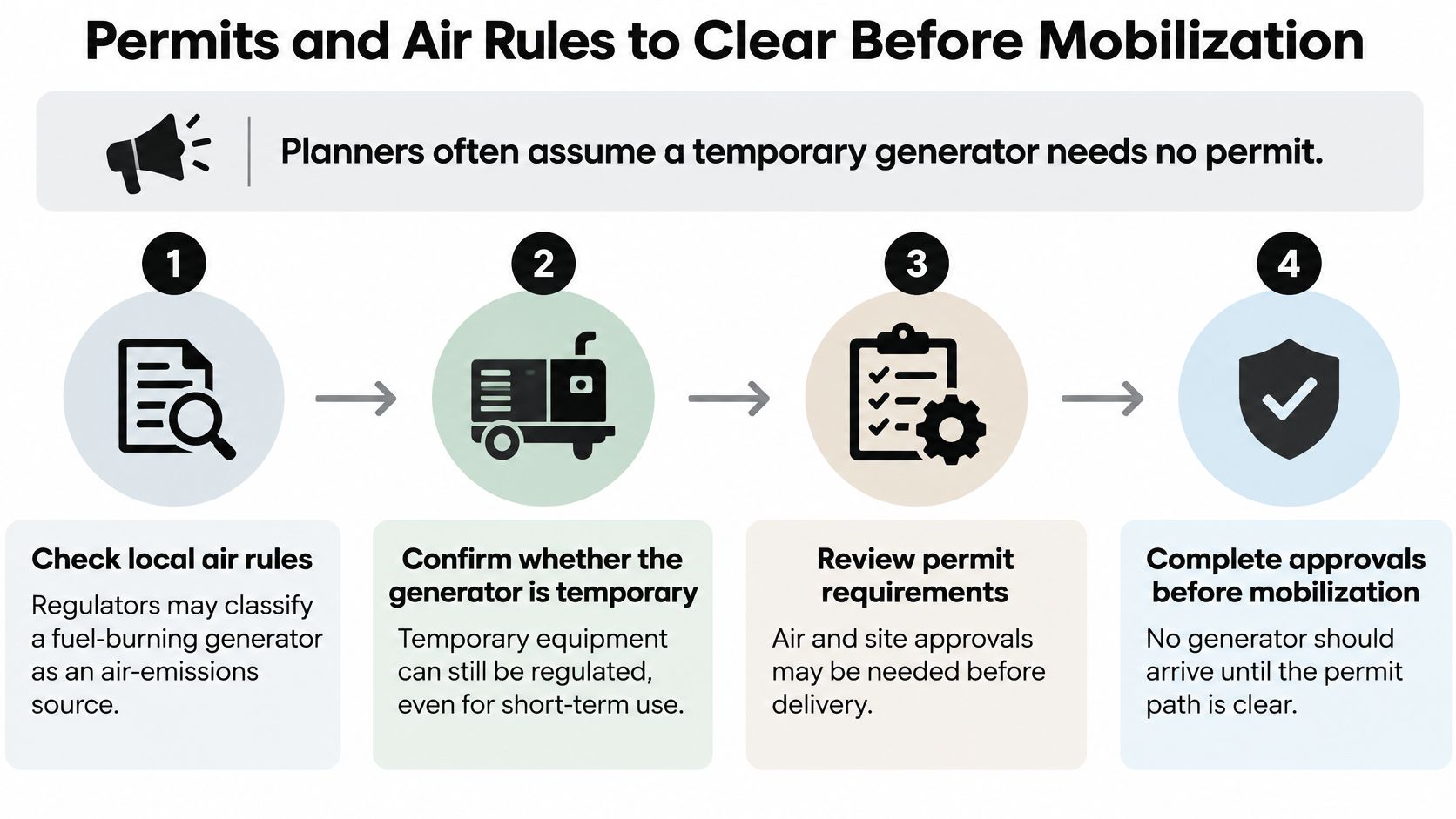
Temporary doesn't mean permit-exempt. A regulator can treat a fuel-burning generator as an air-emissions source even when the contractor plans to remove it after construction. Ordering the unit before screening the permit pathway can leave expensive equipment sitting idle.
A Delaware air-permit notice issued in 2026 concerned a portable 1,825-kW generator, required a temporary construction permit and projected annual emissions of 4.75 tons of nitrogen oxides and 0.13 tons of particulate matter. Those are project-specific projections, not emission factors to apply to another generator.
Screen the proposed operating duty
The important questions are the jurisdiction, engine size, fuel, operating schedule and classification. A unit used routinely because utility service isn't ready shouldn't automatically be described as emergency equipment. Ask the authority how it classifies the proposed use.
Include other engines and emissions sources on the property in the screening discussion. The agency may need to consider cumulative site emissions, local air-quality thresholds or an existing facility permit. Changing from diesel to natural gas doesn't remove the need for that review.
Use this sequence before committing the mobilization date:
- Identify the responsible air agency. Establish whether the state, local district or another authority administers the approval.
- Confirm engine details and planned hours. Obtain the engine identification, emissions documentation, fuel specification and realistic operating schedule.
- Determine emergency or non-emergency status. Describe actual use, including testing and routine construction operation.
- Submit required applications before mobilization. Confirm whether approval is required before delivery, installation or operation. Don't assume those milestones are interchangeable.
- Schedule post-installation requirements. Establish which inspections, operating approvals, records and notifications must be completed before use.
Put approval ownership on the schedule
Assign the permit application to a named person and record the agency's information requests alongside equipment procurement milestones. Ask whether construction approval and operating approval are separate, and obtain the answer for the actual jurisdiction rather than borrowing another state's process.
Schedule protection: Reserve equipment against a documented approval path, not an assumption that portability creates an exemption.
The fuel supplier can provide equipment and fuel information. The rental company can provide engine documentation. Neither decides compliance. The responsible authority determines the applicable requirements, and the project team must allow time to satisfy them before committing crews to powered work.
Hybrid Setups and Which Option Wins by Situation
Most projects don't need the same source throughout construction. Use the site situation to select the primary supply, then decide whether another source solves a specific operating problem.
Best temporary power option by site situation
| Situation | Best fit | Why it fits | Watch-out |
|---|---|---|---|
| Early groundwork with no utility service yet | Rental generator | Fast to bring in and covers tools and lighting | Permits and exhaust placement before the envelope closes |
| Heat or gas appliances needed before the permanent main is finished | Temporary natural gas | Serves gas-fired equipment without diesel storage | Gas capacity must match the connected load |
| Long-duration electrical load with a confirmed utility date | Grid tie-in | Lowest long-term operating burden once energized | Utility schedule slips can extend interim supply |
| Noise-sensitive or emissions-limited area near occupied space | Hybrid with battery or gas buffer | Can reduce main-generator runtime when properly designed | Each source needs appropriate distribution and commissioning |
| Phased building handover with one building operating | Hybrid, gas for heat and generator for tools | Separates loads by building and phase | Separate supply systems to label, inspect and disconnect |
Add sources to solve defined problems
Early groundwork favors a movable supply because the work fronts change. A delayed gas main creates a different problem: electrical capacity doesn't operate a gas-fired rooftop unit without its fuel supply. Once utility electrical service is accepted, long-duration loads can move off the interim arrangement.
A generator-and-battery system can serve low overnight loads from stored energy and run the generator when charging or larger loads justify it. That can help near occupied buildings, but the battery must have adequate usable capacity and a workable charging strategy. Don't promise quiet operation without defining which loads remain energized and for how long.
A gas supply paired with a generator is a fuel-and-generation arrangement, not necessarily redundant electrical service. If both rely on the same generator, a generator failure still interrupts the electrical loads. Fuel diversity and electrical redundancy aren't the same thing.
Make handovers explicit
During phased occupancy, separate construction loads from building-operation loads wherever practical. Draw the supply boundaries on the single-line diagram and identify which disconnect controls each area.
Every added source brings coordination work: switching arrangements, protection, labeling, commissioning and isolation procedures. Prevent unintended backfeed, and require qualified personnel to approve any transfer arrangement. Adding another source without defining those interfaces can make restoration harder rather than easier.
First secure the option that removes the longest-lead constraint. Add batteries, gas supply or another electrical source only where the load profile, continuity requirement or site restrictions justify the additional equipment.
Lock In Your Temporary Power Plan Before Mobilization
Turn the selected arrangement into an executable plan with named owners and acceptance criteria. A supplier's availability confirmation isn't enough if the site still lacks an approved location or a complete distribution package.
- Set the first required operating date for each load. Include commissioning and testing, not just the date crews arrive.
- Identify the longest-lead item. Assign responsibility for the utility service, gas-main completion or generator permit, and establish the fallback trigger.
- Obtain written regulatory answers. Keep permit determinations and air-quality screening with the project records.
- Specify the distribution package. Include the applicable ground-fault protection arrangement, NRTL-approved protective devices, weather-suitable enclosures, circuit identification, continuity verification and an accessible disconnect.
- Document placement and removal. Name who reviews changing site conditions and who removes temporary wiring when its purpose ends.
Make protection part of acceptance
OSHA's construction electrical safety guidance requires GFCI protection or an assured equipment-grounding-conductor program for covered 120-volt, single-phase, 15- and 20-ampere receptacles used by employees that aren't part of permanent building wiring. Extension-cord receptacles remain covered even when supplied from permanent power.
Don't accept an improvised distribution arrangement merely because the generator has spare capacity. A smaller, correctly coordinated system can be safer and easier to commission than a larger unit feeding unsuitable panels and cords.
If the gas main is the unresolved item, we can deploy mobile gas units within a few hours of a customer's request, subject to site coordination. Our equipment ranges from small boxes and 16ft trailers to semi truck loads, and gas boxes provide quick backup for utility disruptions lasting more than an hour.
Bring the connected gas-load list, required operating date and expected service duration to that conversation. Confirm backup coverage and the transition to permanent service before scheduling commissioning.
Blue Gas Express provides temporary CNG and LNG supply for construction heating, gas-fired equipment commissioning and interruptions before permanent gas service is ready. Visit Blue Gas Express with your load list and required start date to discuss deployment timing, suitable unit sizes and continuity during the utility-service gap.