

Your mechanical contractor finished setting the boilers last week, the standby generator sits ready on its concrete pad, and your occupancy inspection is three weeks away. Then the local gas utility calls with bad news: the main extension is backed up, and permanent pipeline service won't reach the meter until next quarter.
If you're a project manager, facility director, or builder trying to figure out how to buy natural gas under schedule pressure, you can't treat permanent utility service and temporary delivered fuel as separate worlds. Both decisions belong on the same spreadsheet. A cheap commodity quote means nothing if it misses your inspection date, stalls generator commissioning, or leaves a building vulnerable to winter freeze damage.
Buying gas for a commercial or construction site comes down to two tests: total delivered energy cost and verified site readiness. When you size your load accurately, normalize every bid to a single energy unit, lock down contract risk, and clear safety approvals before a truck ever rolls onto the property, you protect both your budget and your schedule.
Choosing Between Pipeline, CNG and LNG Supply
Before you call suppliers, match your site to the right physical supply channel. Four distinct routes move gas from production basins to commercial and industrial burners, and each one changes who holds scheduling, pressure, and equipment risk.
| Supply route | Typical buyer | How gas arrives | Key contract question |
|---|---|---|---|
| Utility pipeline service | Homes and small commercial buildings | Pipeline gas delivered to the meter by the local distribution company | Which rate schedule applies and what fixed charges are billed |
| Direct transport plus separate supply | Large industrial plants and power generators | Pipeline transport contracted separately from gas supply | Firm or interruptible capacity, nomination deadlines and balancing rules |
| Compressed natural gas (CNG) by truck | Temporary or short-haul sites without a pipeline | Compressed gas delivered by trailer and connected to a regulator | Pressure, storage autonomy and refill schedule |
| Liquefied natural gas (LNG) by truck or ship | Higher-volume sites, temporary or remote | Liquefied gas delivered, then regasified and odorized on site | Vaporization capacity, exclusion zones and permit status |
How Permanent Pipeline Service Works
The interstate pipeline network moves dry natural gas from producing regions to local distribution companies (LDCs), power plants, storage fields, and major industrial buyers. According to the FERC Energy Markets Primer, interstate pipelines make up roughly two-thirds of U.S. natural-gas pipeline mileage, while more than 1,300 LDCs deliver retail gas through distribution mains to customer meters.
For most small commercial buildings, utility service is the cleanest path because the LDC buys the gas, moves it to the citygate, and delivers it straight to your meter. Large industrial facilities and power generators often unbundle that transaction, buying the molecule from a marketer and contracting pipeline capacity separately while managing daily nominations, storage, peak-day demand, and balancing rules.
No matter which pipeline path you take, the quoted commodity price is only one slice of the invoice. Transportation, distribution, demand fees, storage, balancing charges, taxes, and meter or line-extension fees all sit on top of the fuel itself. Call your local utility first and ask in writing for the confirmed connection date, exact meter and regulator location, and any deposit or application requirements.
When Temporary CNG or LNG Bridges the Gap
Permanent lines don't always arrive on your construction timeline, and planned utility maintenance can interrupt active facilities. When a pipeline isn't available yet, truck-delivered CNG or LNG keeps heating, process loads, and commissioning on track. Blue Gas Express rents mobile natural gas for buildings and pipelines while customers wait for a permanent gas line or operate in areas without pipeline service, offering Mobile Gas Units, a Natural Gas Box, and Liquefied Natural Gas (LNG) setups scaled to the job.
Apply one simple deciding test before requesting bids. If the utility commits in writing to a permanent hookup inside your project window, buy utility service; if the line will miss your deadline or an outage is scheduled, shortlist CNG or LNG and size your demand right away.
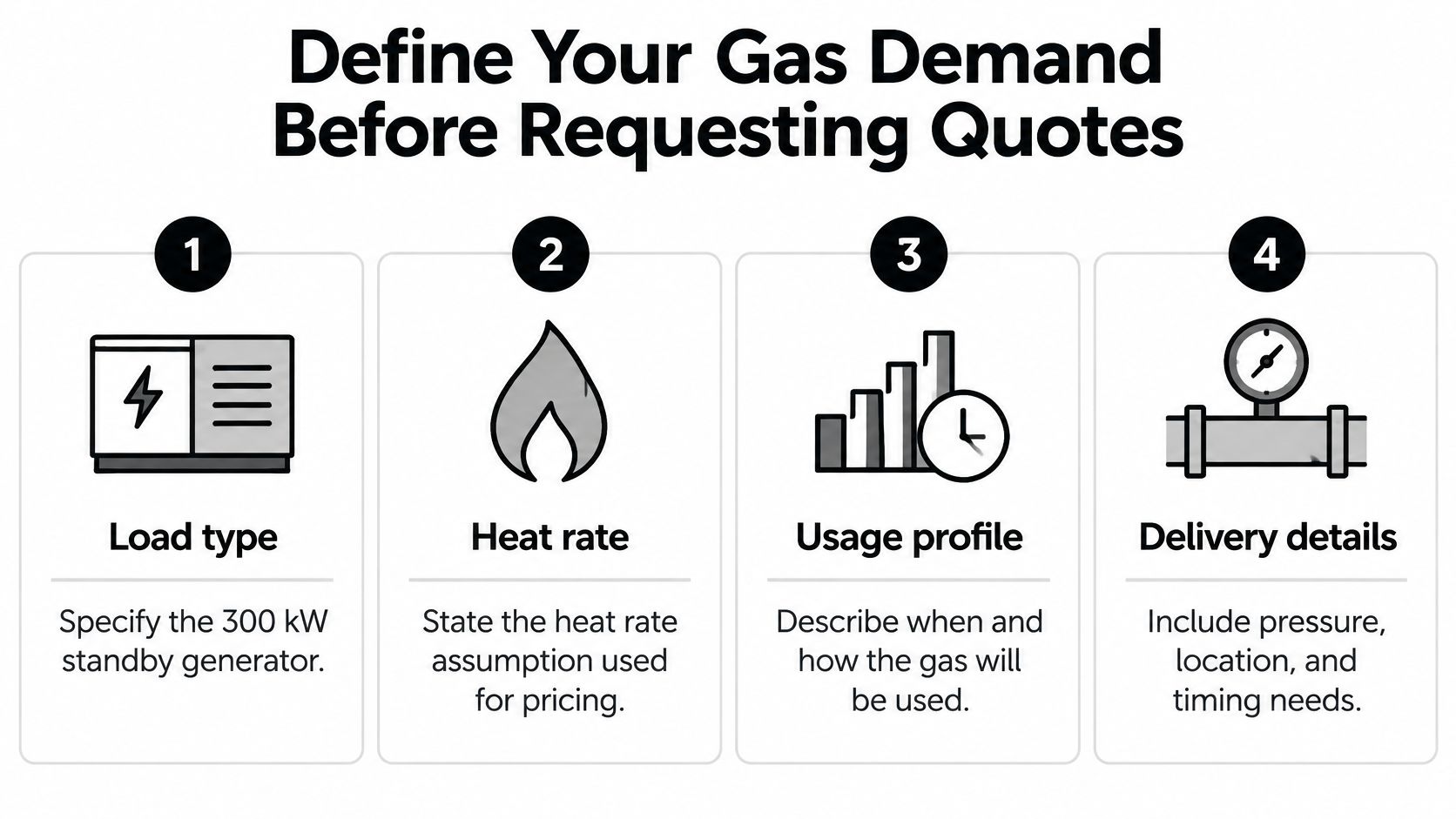
Define Your Gas Demand Before Requesting Quotes
Suppliers can only price the operating profile you hand them. If you ask for "gas for a new commercial building" without hourly flow, pressure, and schedule numbers, bidders either pad their quotes with wide contingencies or under-size the equipment and fail during startup. A thin specification also hides the true cost of the decision, because a cheap per-unit quote means nothing if the gas arrives after your occupancy inspection or generator commissioning date.
Procurement complexity varies sharply across customer classes. A restaurant firing a few burners buys differently than a plant running process heat around the clock, and supply structure is shifting for every buyer: global LNG trade surpassed 500 billion cubic meters by 2023 and is projected to represent around 60% of total natural-gas trade by 2040, according to the IEA natural gas market overview. Whether your facility plugs into a regulated distribution main or brings in a mobile trailer, a written demand specification lets you compare permanent and temporary supply on identical operational terms, which is the only honest way to weigh total delivered cost against site readiness.
Sizing a Load From Equipment Nameplates
Start with the connected equipment nameplates rather than rough square-footage guesses. Say a facility needs to commission and run a 300 kW standby generator with an assumed heat rate near 10,000 Btu per kWh. Multiplying 300 kW by 10,000 Btu/kWh gives 3,000,000 Btu per hour, or 3 MMBtu per hour.
That single number drives everything downstream: tank or trailer volume, refill frequency, regulator sizing, and the price per unit a supplier can commit to. If your building also runs commercial kitchen appliances, rooftop makeup-air units, or water heaters, pull each burner's Btu/hr rating before totaling the peak load. Reviewing a commercial gas equipment guide helps hospitality and food-service operators verify burner ratings and manifold sizing before locking in a fuel specification.
For smaller buildings with low consumption, or when commissioning equipment that draws minimal gas, our Natural Gas Box handles the load without over-sizing storage. For larger loads, our mobile natural gas systems plug into any commercial, industrial, or residential natural gas line of any size or quantity, connecting directly to any standard natural gas meter and regulator.
Six Steps to Build Your One-Page Specification
Follow these six steps in order so every bidder prices the exact same job:
- Convert rated input into hourly and daily volume: Take that hypothetical 300 kW generator burning 3 MMBtu per hour and divide by the heating value you write into your spec. At 1,020 Btu per standard cubic foot, that works out to about 2.9 Mcf per hour (roughly 71 Mcf over 24 hours), so the supplier can size tank volume and refill frequency accurately.
- State minimum inlet pressure and peak flow rate: List the generator's required inlet pressure at the regulator alongside its 2.9 Mcf/hr peak draw, because regulator capacity and meter sizing fail if either number drops below spec.
- Specify gas form and heating-value limits: Name whether you want pipeline gas, CNG, or LNG and state acceptable composition limits. Federal fuel definitions in 40 CFR Part 60 Subpart KKKKa specify at least 70% methane by volume and a heating value of 950 to 1,100 Btu per standard cubic foot, a useful reference band so you pay for predictable heat output rather than a gas stream of unknown quality.
- Lock in operating hours and delivery windows: Specify that the generator will run 12 hours a day during daytime commissioning or 24 hours continuously during an outage, because delivery windows determine how often a trailer must arrive on site.
- Define storage autonomy in hours: Set a minimum backup buffer, such as 12 or 24 hours of continuous generator runtime, so a delayed truck or weather event won't trip your equipment offline.
- Assign equipment, metering, and compliance ownership: Write down who supplies the regulator, runs the meter, schedules refills, and manages safety compliance for the generator tie-in, because unassigned responsibilities turn into change orders.
Add a documented design margin, such as a stated 15% buffer above nameplate peak flow, instead of asking suppliers to bake in a vague contingency. A stated margin can be priced, verified, and compared cleanly across bids.
Compile all six items onto a single specification sheet and send that exact page to every supplier, permanent and temporary alike. When the utility quote and the mobile gas quote both price the same flow, pressure, autonomy, and schedule, the comparison finally reflects what matters: what you pay per unit of delivered energy, and whether gas is flowing on the day your project needs it.
Comparing Quotes on Delivered Energy Cost
The most common procurement mistake in commercial gas buying is comparing a raw commodity rate quoted in one unit against a delivered service quote written in another. Before you rank a single proposal, convert every number to dollars per MMBtu (million British thermal units).
| Unit | Equivalent energy |
|---|---|
| 1 therm | One-tenth of an MMBtu (standard thermal billing unit) |
| 1 MMBtu | One million British thermal units (standard benchmark unit) |
| 1 thousand standard cubic feet (Mcf) | Based on the EPA average of approximately 1,020 Btu per standard cubic foot |
| 1 gallon of LNG | Supplier's stated conversion basis in Btu or MMBtu per gallon |
Look Past the Henry Hub Benchmark
In the United States, Henry Hub serves as the primary reference point for spot and futures pricing, and the EIA natural gas data portal publishes both Henry Hub spot prices and NYMEX futures so you can stress-test quotes against seasonal volatility. Still, a national benchmark isn't what shows up on your invoice.
For example, the EIA Short-Term Energy Outlook projects the U.S. Henry Hub benchmark at $3.37 per MMBtu in 2026, while forecasting U.S. LNG exports to grow from 15.1 billion cubic feet per day in 2025 to 19.0 billion cubic feet per day in 2027. Rising export flows and global disruptions can swing domestic forward curves quickly, and small-volume or temporary buyers pay far more than Henry Hub once compression or liquefaction, trailer mobilization, vaporization, storage, balancing, local distribution, and taxes are added.
Request at least three bids using a transparent formula, such as an indexed gas benchmark plus fixed logistics and equipment charges. Require every bidder to state the billing unit (standard cubic feet, therms, gallons of LNG, or MMBtu) and the exact conversion factor applied on the invoice. Right-sizing the hardware matters too: our temporary natural gas equipment scales from small boxes and 16-foot trailers to semi-truck loads, and a Natural Gas Box uses the same core technology as our mobile gas units at a lower rental cost because its storage capacity is smaller.
A Worked Monthly Bid Comparison
Suppose a construction site requires 1,000 Mcf over a 30-day heating cycle, which equals 1,020 MMBtu at the typical 1,020 Btu/scf heating value. Two suppliers submit quotes:
- Quote A ($9.80/MMBtu plus $4,000 fixed monthly trailer fee): Multiply 1,020 MMBtu by $9.80 to get $9,996 for fuel, then add the $4,000 trailer charge for a total of $13,996, or $13.72 per MMBtu delivered.
- Quote B ($10.90/MMBtu all-in): Multiply 1,020 MMBtu by $10.90 for a total of $11,118, or $10.90 per MMBtu delivered.
Quote B wins by a wide margin over the month despite carrying a higher headline commodity rate on paper. As a retail point of reference, the EIA U.S. commercial natural gas price history reported an average commercial-sector price of $10.95 per Mcf in December 2025 (about $10.74 per MMBtu), though a national utility average reflects permanent piped service rather than mobilized trailer delivery.
Decision rule: The lowest dollars-per-MMBtu quote wins only if it also meets the minimum inlet pressure, storage-autonomy, and response-time requirements in your specification.
Contract Terms That Change What You Pay
Choosing the lowest quoted rate on a non-firm contract can become the most expensive decision on your project if deliveries are curtailed during a cold snap or commissioning week. Price per MMBtu tells you what gas costs when everything goes right; the contract terms tell you what you'll pay when demand spikes or a pipe backs up.
Firm Versus Interruptible Service and Filed Tariffs
In larger commercial and industrial procurement, buyers often separate the fuel contract from pipeline delivery. As the EIA explanation of natural gas contracting outlines, power plants typically hold one supply agreement with a producer or marketer and a separate delivery agreement with a pipeline operator, selecting between firm and interruptible (nonfirm) service.
Firm arrangements obligate the supplier and pipeline to deliver when requested and carry top priority during tight supply conditions. Interruptible arrangements rank lower, are often booked for short periods such as next-day delivery, and cost less precisely because the operator can cut your flow when higher-priority customers need the line.
That reliability comes with fixed overhead on interstate pipes. Under 18 CFR § 284.7, a pipeline providing firm transportation may charge a reservation fee as a condition of holding capacity, which means you pay to reserve your maximum daily contract demand even on days you don't burn it. Always verify the reserved daily volume, the reservation rate, and the contract's effective and expiration dates before signing.
Interstate rates aren't informal quotes either. Under 18 CFR Part 154, FERC-jurisdictional natural-gas companies must file and post gas tariffs containing effective rate schedules, classifications, service-agreement forms, and rules. Request the exact tariff and rate schedule up front so you can inspect every fee mechanism before execution.
Eight Clauses That Hide Real Money
Read past the cover sheet and check how your agreement handles these eight provisions:
- Price indexation: An open-ended monthly index with no cap shifts winter price spikes straight onto your project budget.
- Substitution rights: If the agreement bars the supplier from switching between CNG and LNG during a terminal outage, or forces you to pay spot rates for substitute fuel, a minor disruption becomes a major surcharge.
- Minimum-take penalties: Take-or-pay floors force you to pay for gas you never burned if construction slips or warm weather cuts heating demand.
- Balancing and imbalance charges: Burning noticeably more or less than your daily nominated volume on a pipeline triggers cash-out penalties that erase commodity savings.
- Fuel retention: Interstate pipelines retain a percentage of your transported gas to run compressor stations, reducing the delivered volume you receive at the meter.
- Nomination deadlines: Missing a daily scheduling cutoff can bump your order out of firm space into costlier spot supply or leave your plant short overnight.
- Emergency replenishment responsibility: Without a defined maximum response time and named dispatch owner, an unexpected cold snap can drain temporary storage before a backup trailer arrives.
- Over-forecast volume pricing: Burning above your contracted daily ceiling frequently triggers punitive overrun rates unless you negotiate a tiered overrun band in advance.
When negotiating temporary or backup supply, write an explicit curtailment remedy directly into the purchase order:
If supply is curtailed, Supplier shall give written notice within [agreed hours] and deliver replacement gas by trailer at the contract price, with no minimum-take charge for the affected period.
Site Readiness and Safety Gates Before Delivery
Treating "fuel delivered" as equivalent to "fuel usable" sinks more temporary gas deployments than pricing errors ever do. A trailer can arrive on time, park cleanly, and still leave your boiler or generator dead because pressure drop across undersized piping, inadequate vaporization capacity, or missing fire clearances stops continuous operation.
Treat site acceptance and regulatory sign-off as procurement gates before you issue a purchase order, not post-award chores. Use the checklist below and secure written sign-off on every line before mobilization.
| Requirement | What to verify | Who signs off |
|---|---|---|
| Truck access and turning radius | Route, unloading point and turning space for the delivery vehicle | Site owner and carrier |
| Separation distances and exclusion zones | Clearances for the CNG or LNG setup as drawn and coded | Owner's engineer and local authority having jurisdiction |
| Pressure and flow at the connection | Peak demand against regulator capacity and meter size | Gas supplier and owner's engineer |
| Emergency shutdown and fire protection | Shutdown locations, alarms, ventilation and fire controls | Local fire marshal |
| Trained operators and monitoring | Named personnel, emergency plan and monitoring method | Site owner and gas supplier |
Federal Codes, Clearances and Footprint Planning
In the United States, LNG facilities governed by federal pipeline-safety regulations fall under PHMSA LNG regulatory requirements tied to 49 CFR Part 193, covering siting, design, construction, equipment, operations, personnel qualification, fire protection, and security. Those federal rules incorporate NFPA 59A thermal-exclusion-zone requirements for LNG containers and transfer systems.
Temporary deployments aren't exempt from formal procedure. Federal rules in 49 CFR Part 193 explicitly recognize mobile and temporary LNG facilities used for pipeline maintenance, peak shaving, and other short-term work, and require written procedures for safe LNG transfers. On active industrial or construction jobsites, integrating fuel-transfer sign-offs into your existing permit to work system keeps hot-work controls, electrical classifications, and area isolation aligned before trucks enter the gate.
Request equipment drawings, code basis, pressure-relief settings, inspection records, transfer procedures, certificates, and a commissioning checklist from every bidder. Footprint planning is straightforward once you know the hardware: our mobile gas units are typically deployed on 16-foot-long by 8-foot-wide trailers, taking up roughly one standard parking space, while a Natural Gas Box rolls off a flatbed trailer and anchors directly to the ground with spikes that replace its wheels. On LNG jobs, Blue Gas Express builds the mandatory Emergency Management Plans, supplies the trained personnel and technology to operate and monitor the site, and coordinates directly with Fire Marshals and other regulatory bodies.
Equipment Checks and the Pre-Use Acceptance Test
Equipment verification splits by fuel state. For CNG, verify cylinder certifications, maximum allowable working pressure, pressure-reduction stages, overpressure protection, hose ratings, and breakaway protection. For LNG, add boil-off-gas management, cryogenic personal protective equipment, spill containment, and controlled exclusion zones.
Never wait until inspection morning to discover a faulty regulator. Run a witnessed acceptance test before the connected equipment is needed, verifying six live behaviors:
- Full-system leak checks across every joint, hose, and manifold at operating pressure.
- Emergency shutdown actuation from both local and remote stations to confirm instant fuel isolation.
- Alarm and telemetry verification so pressure drops or gas-detection alerts trigger the right response.
- Regulator stability at peak flow with the connected boiler, burner, or generator running at full load.
- Meter accuracy confirmation against the billing basis written into your purchase order.
- Restart after a simulated interruption to prove the system recovers cleanly without manual workarounds.
File the signed acceptance test sheet alongside your safety approvals; you'll need it when transitioning back to permanent utility gas.
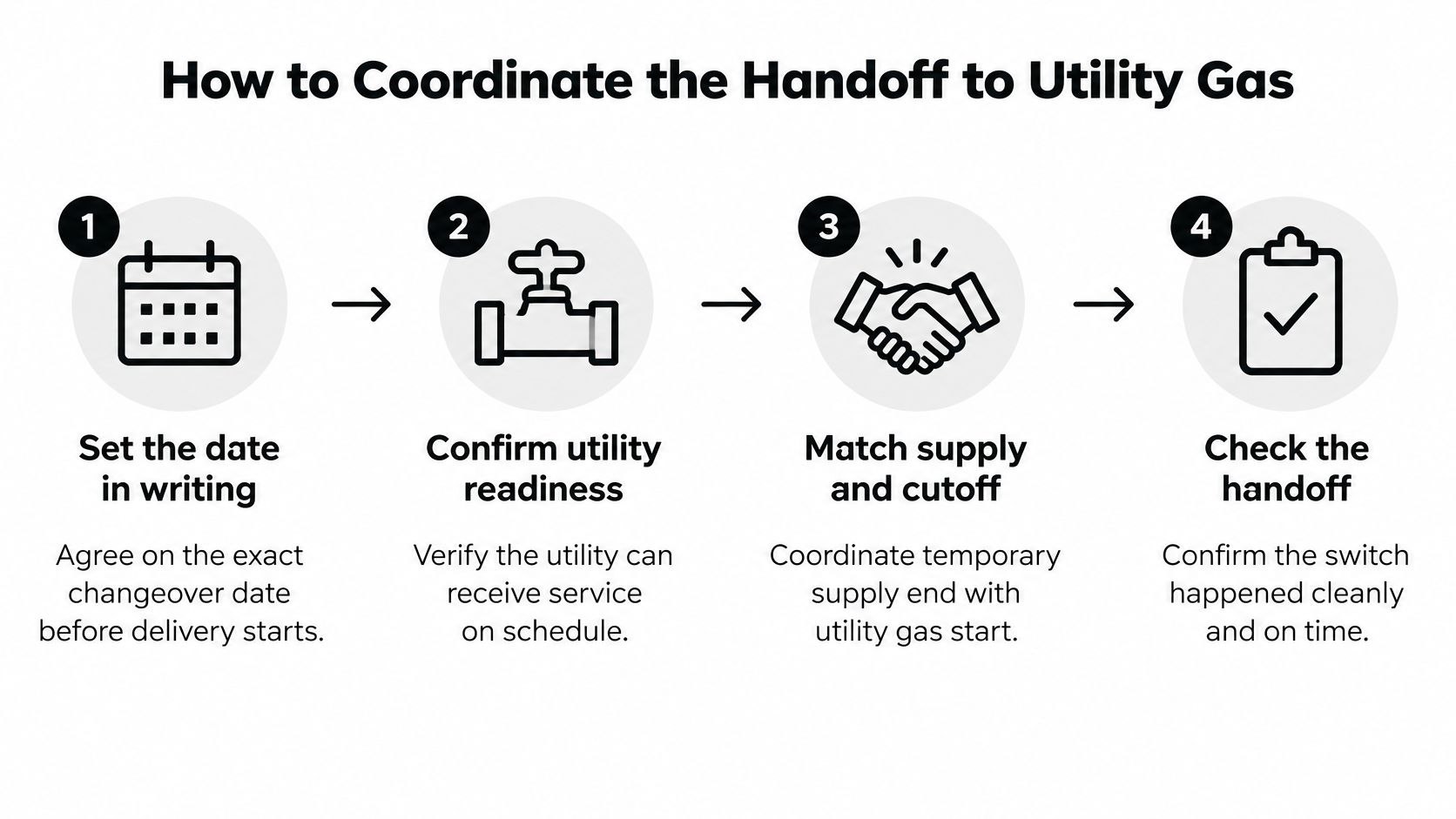
How to Coordinate the Handoff to Utility Gas
Temporary supply rarely fails during the middle of a rental. It breaks down during the changeover to permanent utility service, almost always because no one put the cutover date and overlap window in writing. The savings from a cheap per-unit gas quote evaporate fast when a botched handoff pushes back your occupancy inspection or generator commissioning, so treat the transition as part of the purchase, not an afterthought.
Managing Refills and Utility Partnerships Before Cutover
Smooth handoffs start weeks before the utility crew sets the permanent meter. For gas utilities, our Natural Gas Boxes give project teams assurance that gas will be live on the exact date promised for a new customer hookup, and we partner directly with utilities to align the move from temporary supply to permanent pipeline service.
During the interim period, refills shouldn't interrupt building operations. We refill a Natural Gas Box by plugging a trailer unit directly into the box without moving it, and remote monitoring on our mobile units estimates when a trailer will run low so a hot-swapping replacement can be dispatched before the site ever loses pressure.
That redundancy is what you pay for in the final weeks. A site that runs dry three days before the permanent tie-in faces the same frozen pipe risk or commissioning delay it rented the equipment to avoid.
Seven Steps to Switch Without Downtime
Run the physical transition in this exact sequence:
- Get the utility's written hookup date and meter location: Lock in the utility's firm tie-in date and confirm the exact meter and regulator placement in writing, so every trade works toward one fixed cutover target.
- Write down the overlap window with both providers: Agree on the exact handoff date with the utility and your temporary gas supplier while documenting a short overlap period, so both fuel sources remain available during the physical switch.
- Maintain the refill trigger right through cutover week: Keep your replenishment schedule active until permanent gas passes testing, so storage never drops below the autonomy window in your specification if the utility crew hits a trenching delay.
- Confirm matching pressure and gas quality: Verify that the incoming utility delivery pressure and heating-value basis align with the temporary supply settings, so connected burners and generators don't need emergency recalibration.
- Pressure-test and leak-check the new line first: Isolate the permanent line from the temporary supply with closed and locked-out valves, then pressure-test and leak-check it to the utility's specification. Only tie the temporary unit back in after the new line passes, so test pressure never reaches the temporary system or connected equipment.
- Cut over and watch one full peak-demand cycle: Transfer the load to the utility meter and monitor pressure stability through the first peak heating or process cycle before shutting down the temporary supply, so you have immediate backup if pressure sags.
- Schedule demobilization and close out billing in writing: Coordinate removal of the trailer or box and collect written confirmation of the final meter reading and pickup timestamp, so standby fees and equipment liability end cleanly on that day.
Keep one closing document in the project binder: the signed handoff record showing the final temporary meter read, permanent meter activation timestamp, and confirmed equipment removal. That single page is what closes out the temporary supply contract without stray rental days or disputed meter reads, and it is the proof your finance team needs when the final invoice arrives.
Confirm the Order Before You Sign
Before issuing a purchase order, turn your procurement package into a final pre-signing gate. Every item below needs a written answer attached to the contract file:
- Active connection status and timeline: Confirmed utility hookup date, or documented mobilization date for temporary CNG or LNG supply.
- Guaranteed flow and pressure: Written commitment matching your peak hourly demand, minimum inlet pressure, and design margin.
- Normalized delivered pricing: Dollars per MMBtu with the billing unit, conversion factor, and every fixed or variable fee itemized.
- Service priority and fee exposure: Confirmation of firm versus interruptible status, applicable reservation fees, and filed tariff or surcharge terms.
- Dispatch and outage ownership: Named parties responsible for daily scheduling, replenishment triggers, and emergency trailer replacement.
- Signed safety approvals: Written sign-off from your engineer, local fire marshal, and local authority having jurisdiction on site layout and clearances.
- Demobilization and closeout mechanics: Written overlap terms, removal notice period, and final billing trigger.
Aligning these order terms with your finance team's invoice-matching workflow prevents billing surprises later. If your operations and accounting teams still reconcile fuel tickets manually, take a few minutes to compare accounts payable process steps so meter readings, purchase orders, and supplier invoices match cleanly from day one.
The best quote is the one that delivers usable gas on the date you need it, at a stated cost per unit of energy.
When a permanent pipeline is delayed or an outage threatens your schedule, Blue Gas Express delivers mobile natural gas units anywhere in the United States and provides full service across North Carolina, South Carolina, Tennessee, and Virginia. Gather your one-page demand specification and site-readiness checklist, then reach out through our website's contact page so we can build a precise, apples-to-apples quote for your site.
Blue Gas Express supplies mobile CNG units, Natural Gas Boxes, and complete LNG systems so builders, utilities, and industrial facilities keep projects moving during pipeline delays and planned outages. Whether you need short-term gas for an occupancy inspection, generator commissioning, or freeze protection, our team handles delivery, monitoring, and utility coordination from mobilization through demobilization. Visit Blue Gas Express to request mobile natural gas service and get a detailed delivered-cost quote for your site.