

The permanent gas line is weeks behind schedule. The project manager has occupancy milestones to protect, a generator waiting to be commissioned, and a mobile CNG unit expected on site next week. The immediate question is where to put it. The harder one is who needs to approve the layout, which equipment records must be checked, and what the crew should do if a hose is damaged.
Mobile CNG safety isn't governed by one checklist. NFPA 52 addresses fuel systems and fueling facilities; federal vehicle and pipeline rules apply to specific equipment and infrastructure; OSHA requirements shape worker protection; and the local fire marshal or other authority having jurisdiction (AHJ) decides how adopted codes apply at the site. Treat the installation as a connected system, not a truck parked beside a building.
The Real-World Situation Driving Mobile CNG Safety
A delayed utility connection often turns a construction site into a temporary fuel operation. The mobile unit may supply a building, support generator commissioning, or maintain heat while permanent service work continues. Those uses put high-pressure gas equipment beside workers, vehicles, ignition sources, and sometimes occupied spaces. A safe deployment starts with planning those interactions, not with unloading equipment and hoping the available space works.
Before delivery, identify who controls each decision. The gas provider can supply equipment information and operating procedures. The site owner or general contractor controls access, work sequencing, and coordination with other trades. The AHJ determines which locally adopted fire-code provisions and NFPA edition apply. The carrier and equipment operator need clear instructions for delivery, connection, shutdown, and departure.
The code framework also changes over time. The NFPA 52 standard-development page identifies the 2026 edition, while ANSI listings still show 2023 and earlier editions. Don't assume the newest edition automatically governs your job. Ask the AHJ which edition the jurisdiction has adopted and record the answer before the unit is mobilized.
Start with the site, not the truck
Walk the proposed location with the people responsible for site safety, gas operations, and fire-code approval. Map the unit's position against buildings, occupied work areas, generators, traffic routes, ventilation conditions, emergency access, and the planned hose-transfer path. A location that looks convenient to the delivery driver may conflict with crane operations, public access, or the fire marshal's expectations.
That review should happen before dispatch. A mobile unit can solve a schedule problem, but it doesn't remove the need for an approved operating plan. The practical objective is to keep the temporary supply controlled, accessible for emergency response, and separated from the activities that could damage equipment or ignite released gas.
How CNG Safety Standards Are Structured
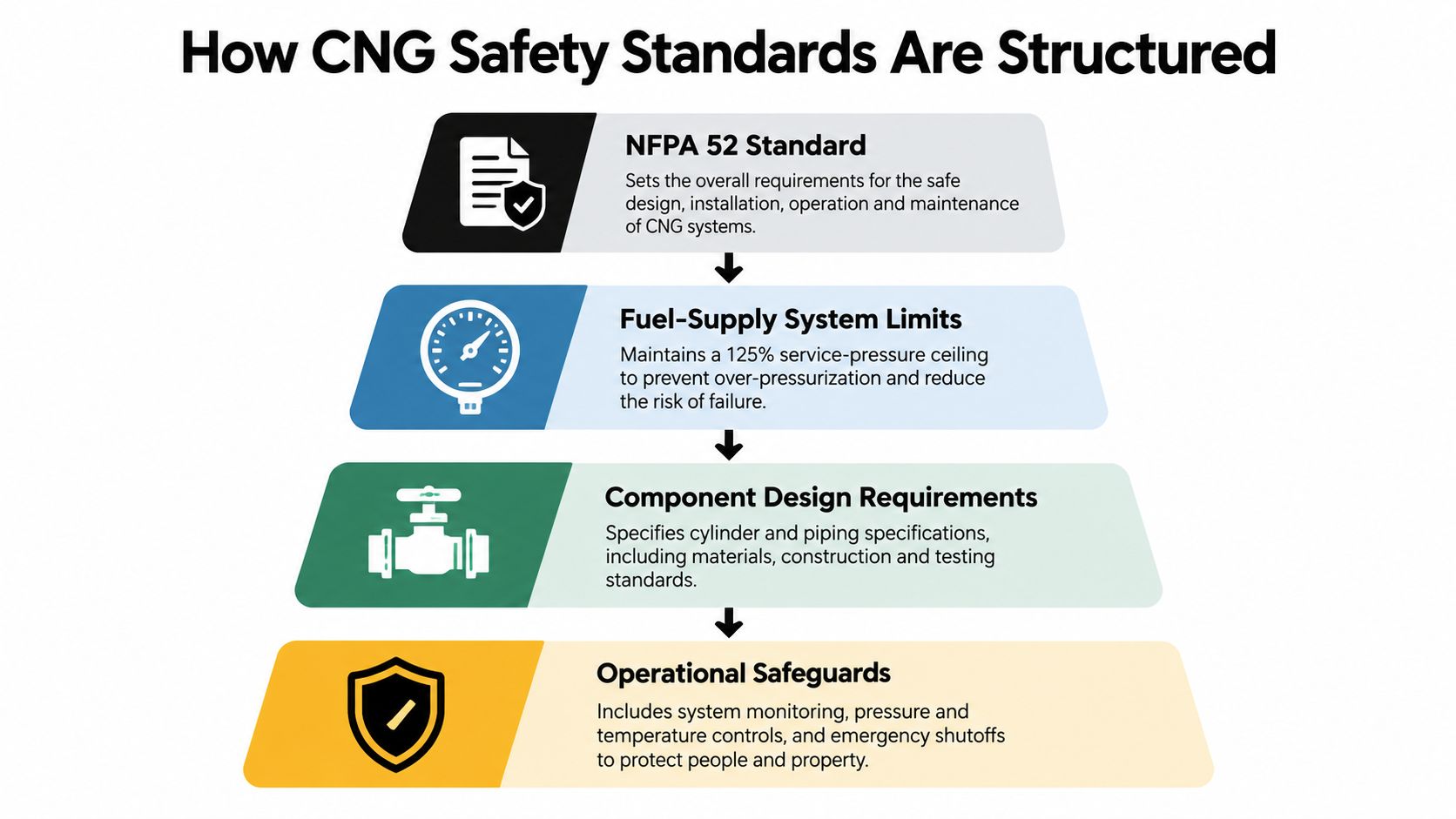
NFPA 52 builds protection in layers. A compliant mobile unit limits pressure, relieves it automatically when those limits are reached, runs on listed components, and gives the operator a way to spot abnormal conditions before they become failures.
Work from pressure limits outward
Start with the container markings. Service pressure on the cylinder label is the baseline for every other limit in the system, so confirm it against equipment documentation before the unit is dispatched.
NFPA 52 requires CNG fuel-supply containers not to be exposed to pressure exceeding 1.25 times service pressure. The standard caps each compression stage at the maximum allowable working pressure of its associated cylinder and piping, and it requires gauges that read above that ceiling so a crew member sees rising pressure before equipment reaches its design limit. Treat these as engineered boundaries. The operating envelope sits well inside them.
Take a 3,600 psi service-pressure cylinder as an example. Multiply by 1.25 and you get 4,500 psi. That arithmetic shows where the ceiling sits. It gives no one permission to fill or run toward it. Follow the approved operating limits and the equipment instructions, and never treat a gauge reading as authorization to push past working pressure.
Then verify the hardware that makes those limits real. NFPA 52 identifies pressure-relief devices, gauges, regulators, valves, hoses and hose connections, vehicle fueling connections, gas-detection alarms, and fire-protection equipment as items requiring listing or approval. A compliant cylinder plumbed into unlisted hoses or unapproved protection is a failed system.
Turn the layers into operating controls
On a jobsite, those layers become a short field discipline: prevent overpressure with engineered limits, relieve dangerous pressure automatically, inspect on schedule, and isolate faults before they spread. Every operator on shift should answer three questions without hesitation. Which gauge am I watching? Which shutoff kills the flow? Who has authority to stop the operation?
Drivers and transport personnel carry separate obligations around dangerous-goods handling, and what you need for DG licence is a practical training reference for that side of the work. Use it to supplement your site's CNG operating procedures. Equipment-specific instruction still governs the job.
The Governing Codes and What Each One Covers
A single mobile CNG drop can sit under four rulebooks at once: the vehicle-container standard, the fueling-system code, pipeline regulations, and workplace safety law. The expensive mistake is applying a rule to equipment it doesn't govern. The dangerous one is assuming a temporary installation escapes the rules attached to whatever it connects to.
| Standard | Scope | Applies to |
|---|---|---|
| NFPA 52 | CNG and LNG fuel systems, fueling facilities, storage, dispensing, and related safety controls | Fueling equipment and site arrangements, subject to the edition adopted by the jurisdiction |
| FMVSS No. 304 | Fatigue and burst resistance for CNG fuel containers in U.S. motor vehicles | Vehicle fuel containers, not the complete jobsite installation |
| 49 CFR Part 192, Subpart I | Corrosion control for regulated gas pipelines | Covered buried pipeline infrastructure, not simply a vehicle fill operation |
| OSHA requirements | Worker protection and workplace safety | Employers, workers, and work practices on the construction site |
| UNECE Regulation No. 110 | Approval of specified CNG components and vehicle installations | Relevant international and vehicle-approval frameworks |
For U.S. motor-vehicle cylinders, the federal FMVSS No. 304 standard requires hydrostatic cycling between service pressure and no more than 10% of service pressure for 13,000 cycles, followed by testing at service pressure and burst testing at no less than 2.25 times service pressure. Those tests prove a container survives repeated filling. They say nothing about separation, leak detection, emergency isolation, or transfer procedures on your site.
That pattern repeats across the whole table. Component standards certify hardware. Site safety still falls to the locally adopted edition of NFPA 52 plus OSHA's employer obligations. On a temporary deployment you are assembling compliant parts into an arrangement no single standard pre-approves, and the AHJ judges the whole assembly. If two codes could plausibly claim the same piece of equipment, treat both as live until the AHJ rules one out.
Know when pipeline rules enter the picture
Under 49 CFR Part 192, Subpart I, gas pipelines installed after July 31, 1971 generally must have a suitable coating and cathodic protection (CP). A pipeline operating under CP must be tested at least once each calendar year, with no interval longer than 15 months, to confirm it continues to meet 49 CFR §192.463. These requirements matter when temporary equipment interfaces with regulated pipeline infrastructure. They don't turn every mobile vehicle fill into a corrosion-control project.
Required CP and voluntary CP carry different oversight. PHMSA's interpretation explains that a pipeline with voluntarily installed anodes faces a separate reevaluation duty rather than automatically inheriting the annual monitoring rule. For unprotected segments, reevaluation is required at least every three years, with no interval exceeding 39 months, and operators must identify active corrosion through an electrical survey and add CP where active corrosion is found. See PHMSA's guidance on corrosion evaluation of unprotected pipelines.
UNECE Regulation No. 110 takes a systems approach to approved CNG components and vehicle installations. The UNECE vehicle regulations document covers container integrity, pressure relief, protected venting, shutoff valves, and excess-flow control. A temporary skid tied into utility infrastructure raises different questions from a vehicle being filled. Have the utility and the AHJ tell you where one regime ends and the other begins, and get that boundary in writing before the first fill.
Siting a Mobile CNG Unit on a Construction Site
A safe location is one that protects the equipment, keeps gas away from ignition sources and occupied areas, and lets workers and responders reach controls without crossing the hazard zone. There isn't a universal layout that works for every site. The project team must confirm the applicable clearances and operating conditions with the AHJ.
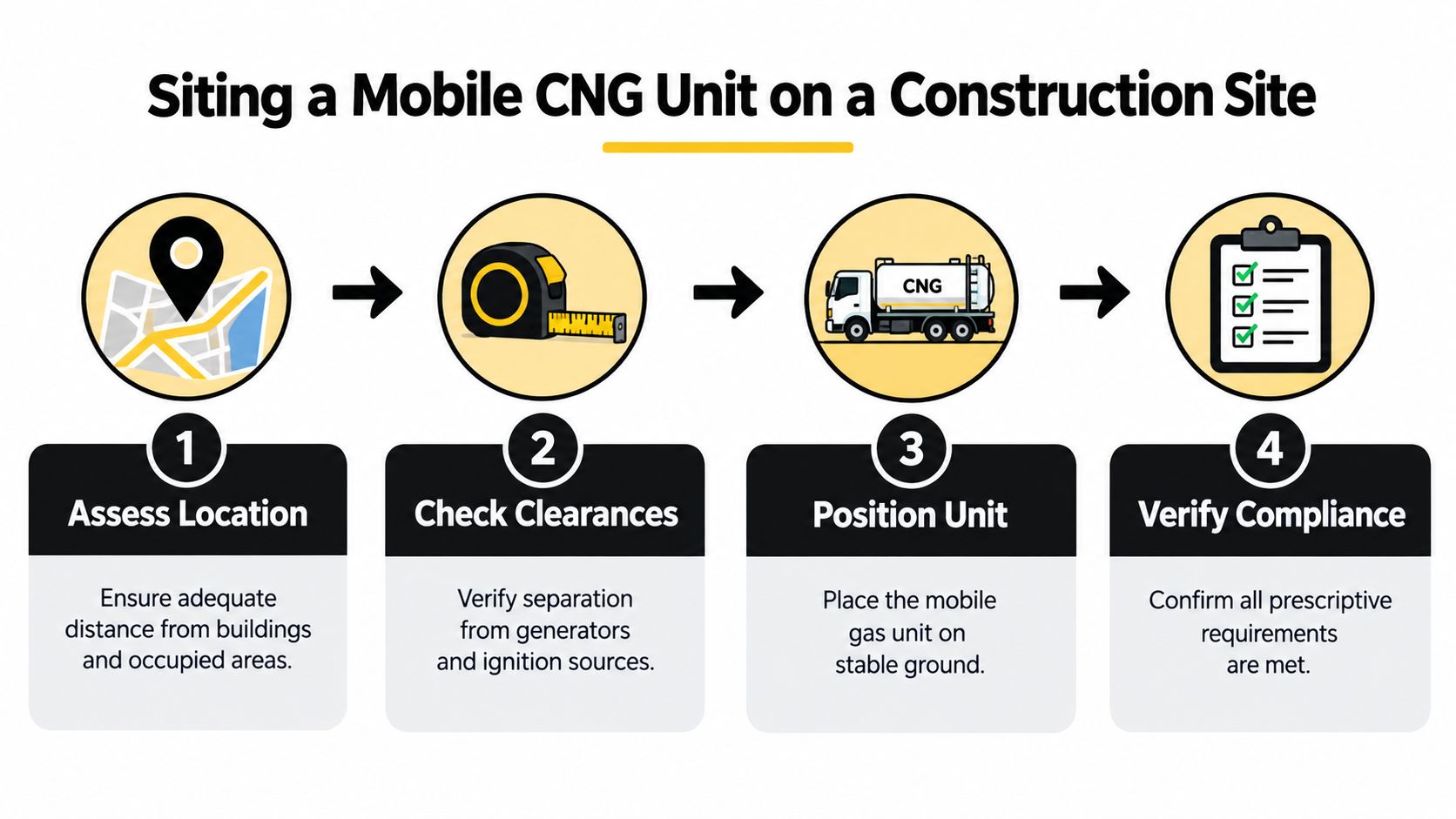
Before mobilization, share a site plan with the gas provider and AHJ. Mark buildings, occupied work areas, generators, vehicle paths, pedestrian routes, delivery access, ventilation conditions, gas-detection equipment, emergency shutdown locations, and the transfer route. Ask directly which adopted NFPA 52 edition and local fire-code provisions apply.
Then inspect the proposed spot in person. Confirm the unit can sit on stable ground and won't be exposed to avoidable vehicle impact, construction traffic, or mechanical damage. Check where exhaust, vents, and potential gas discharge could travel. Keep emergency access and shutdown devices clear, and make sure workers can identify them without relying on a supervisor who may be off site.
Field rule: Don't let schedule pressure make the site layout a last-minute decision. Get the AHJ's position and the gas provider's operating requirements in writing before delivery.
Some sites need a second review after trades, barriers, or equipment move. A generator may be relocated, a new work enclosure may restrict airflow, or temporary fencing may block emergency access. Treat those changes as a reason to recheck the layout, not as harmless adjustments.
Prescriptive Setbacks Versus Documented Performance Equivalents
Use the adopted code edition first. Prescriptive setbacks give inspectors a clean baseline and give crews a layout they can hold while trades, fencing, and material routes shift. If the pad can meet them, meet them. Do not spend engineering hours solving a problem the site does not have.
Some jobsites cannot make the standard layout work: a tight urban lot, a generator pad already fixed beside the only delivery lane, or a winter enclosure needed to keep valves from freezing. That is the point to consider a documented equivalent, not a verbal workaround. NFPA 52's 2026 materials allow alternative distances, operating requirements, and equipment locations when qualified experts with demonstrated competence validate the proposal. Put the judgment in writing and move it through the approval route before the trailer arrives.
Put the alternative on paper
A submission that gets reviewed quickly usually identifies:
- The adopted edition and approval route. Confirm which NFPA 52 edition the AHJ enforces and what local fire-code provisions change the submission.
- The experts and qualifications. Name competence in mechanical, electrical, gaseous-storage, cryogenic, fire-protection, and gas-detection systems where the proposal touches them.
- The hazards. Tie the request to real constraints: ignition sources, traffic paths, ventilation limits, occupied areas, blocked access.
- The substitute controls. Show how barriers, monitoring, operating limits, relocated access, or shutdown changes reduce the same exposure.
- The sign-off chain. Record review by the qualified expert, gas provider, site owner, and AHJ as required.
FMVSS No. 304 cylinder testing helps establish the container's fatigue and burst-resistance basis. The FMVSS No. 304 text cited earlier concerns vehicle-container performance, not alternative jobsite siting, so it cannot shorten a separation distance or stand in for AHJ review.
Decide who pays for engineering before anyone sketches a deviation. That cost may sit with the project owner, gas provider, or contractor under the agreement. Price it against a rejected layout, a forced relocation after delivery, and a crew standing down while the answer gets rebuilt. A performance equivalent is disciplined engineering with accountability. Treat it as an approval path, not a favor.
Inspection Cycles, Training, and the Paper Trail
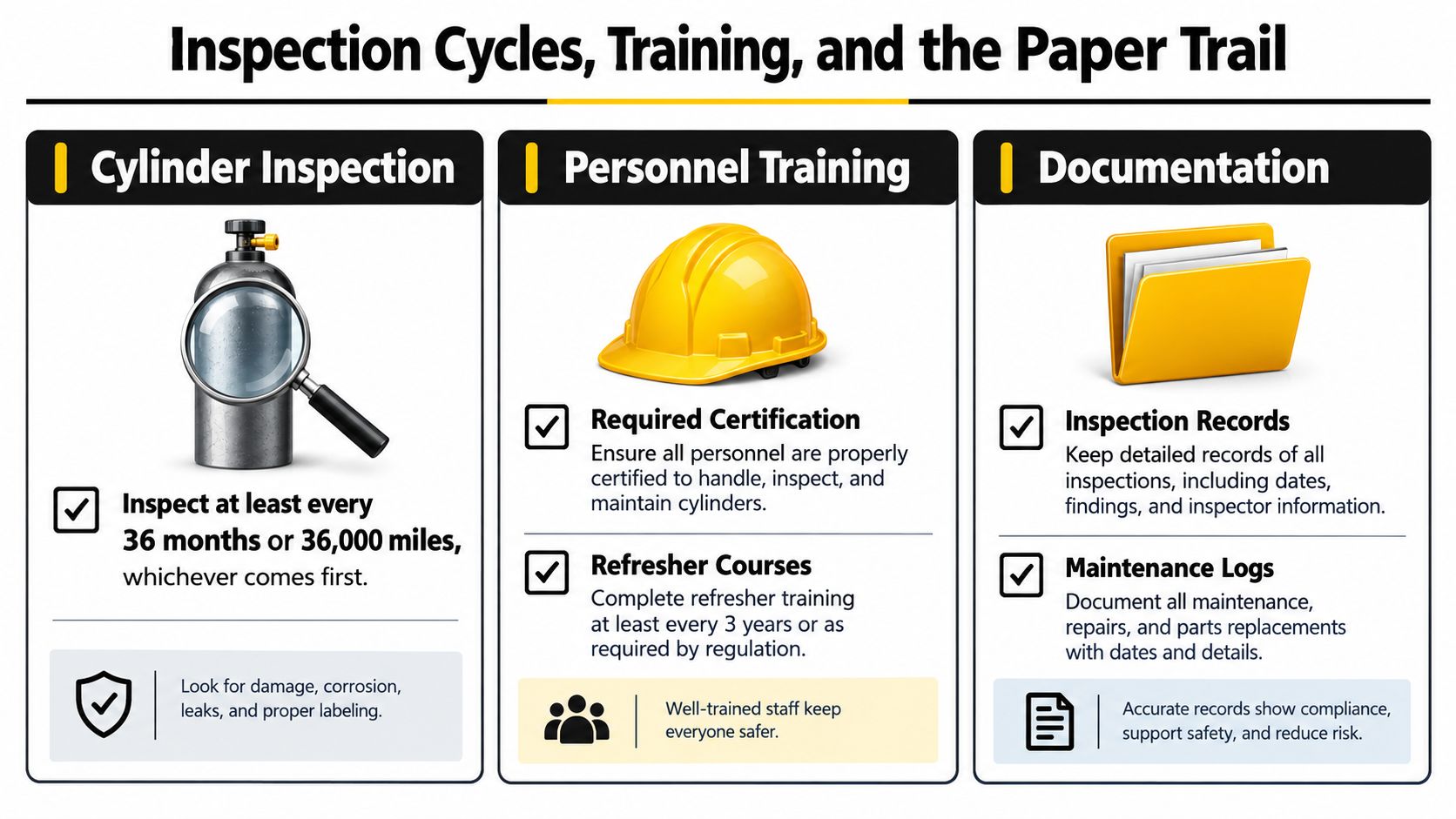
The fastest way to get a mobile CNG unit benched is a missing inspection record. When the gas provider or the AHJ asks for cylinder status, you produce it in minutes or the unit sits idle until you can. Assemble the records package before the trailer arrives: cylinders certified, service-life markings legible, inspection status current, and no unreported exposure to an event that requires further evaluation.
The inspection framework cited earlier calls for CNG cylinders to be inspected at least every 36 months or 36,000 miles, whichever comes first, and after any crash, fire, or dispenser malfunction that pushes pressure above 125% of service pressure. Construction-site cylinders rarely accumulate road miles, so the calendar interval usually governs. Track it per cylinder, not per trailer.
Make the records operational
A checklist only works if someone owns it. Name the person who verifies each check before the unit goes live:
- Cylinder status: Record certification and service-life markings, inspection dates, and any documented damage or abnormal event.
- Leak checks: Complete the provider's required leak check before connecting or transferring gas, and log who performed it.
- Shutdown controls: Confirm the crew can locate and operate the emergency shutdown and knows who may restart the system.
- Training: Brief operators, supervisors, and workers on access controls, ignition-source rules, alarm response, and site emergency contacts.
- Handoffs: Keep the gas provider's procedures, the site emergency plan, inspection records, and AHJ approvals together, accessible to whoever needs them.
Quarantine any cylinder exposed to a crash, fire, visible damage, or a qualifying pressure event until it gets evaluated. A container that passed an earlier inspection does not earn a pass after an incident. Teams building short, repeatable worker briefings can create OSHA videos with VideoLearningAI to communicate jobsite expectations, but training materials must still match the actual equipment and the approved site procedures.
Documentation isn't paperwork added after safety work. It's how the next shift knows what was checked, what changed, and what must stay out of service.
Emergency Response Roles and Field Procedures
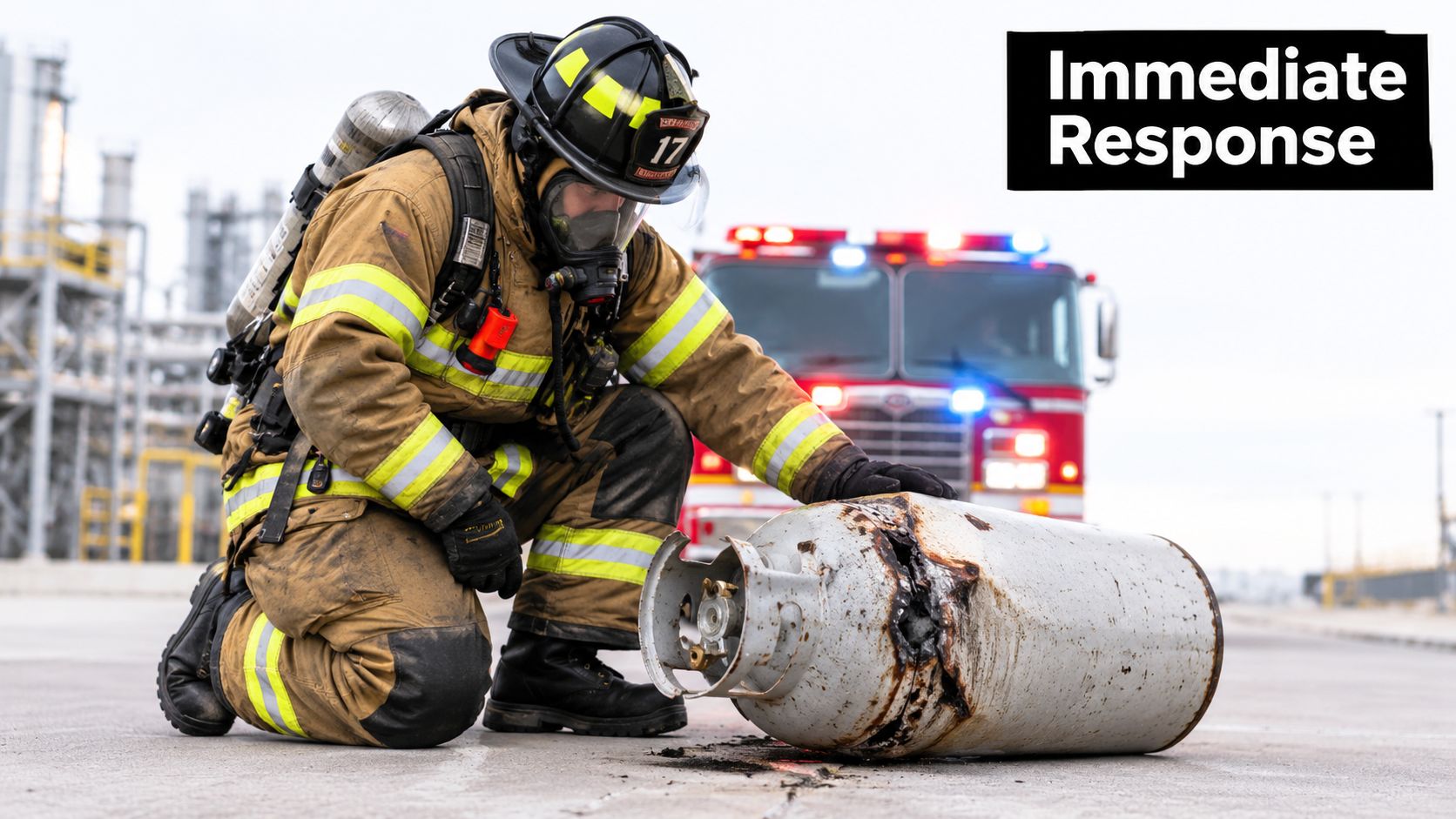
After impact, fire, or suspected cylinder damage, stop work and treat the cylinder as pressurized. NHTSA guidance calls for eliminating ignition sources, using combustible-gas monitoring, and ventilating without creating sparks. Responders should maintain an 80 to 100 foot perimeter consistent with NFPA recommendations. NHTSA's responder guidance also warns against applying water to CNG cylinders. Cooling can prevent pressure-relief devices from activating and may contribute to catastrophic cylinder failure.
The first person who identifies the incident should raise the alarm, stop nearby work, and keep people away. The site owner or designated incident lead controls evacuation and site access. The gas provider gives equipment-specific shutdown and isolation guidance. The carrier supplies transport and unit information. The AHJ directs fire-code response and determines what approvals are needed before the site resumes operations.
Don't assume that turning off ignition or shutting down the unit has stopped a leak. Residual gas may continue to escape. Trained responders should use combustible-gas monitoring and manage ventilation without introducing sparks. Keep the area controlled until qualified personnel determine the hazard has ended.
Do not apply water to the cylinder. Keep the perimeter in place and don't let ordinary maintenance staff attempt repairs or defueling. A qualified CNG technician must assess the equipment, manage any defueling, and document repairs or replacement before the unit returns to service.
After the incident, record what happened, who isolated the system, what monitoring was performed, and who authorized release. Notify the gas provider, carrier, site owner, and AHJ as the response plan requires. Returning equipment to service without a documented technical assessment is not an acceptable schedule recovery strategy.
A Practical Readiness Checklist for Your Next Mobile Deployment
Run this checklist before the truck rolls, then keep a copy with the site emergency plan. Every item below has stopped at least one deployment I have reviewed, so treat each line as required, not advisory.
- Pre-deployment: Confirm the locally adopted NFPA 52 edition and get written AHJ approval before equipment ships. Verify cylinder certification, service-life markings, inspection records, and approved components, then walk the delivery route and site plan against the approved layout.
- On site: Check stable placement, separation distances, ignition-source control, ventilation, gas detection, and emergency access before the first transfer. Post shutdown instructions where operators can see them, and brief both site workers and the responders who might be called to the address.
- After an incident: Stop work, isolate the area, monitor for gas, and hold the responder perimeter. The unit stays out of service until qualified technicians assess it and the AHJ clears its return.
- For connected pipeline infrastructure: Determine whether 49 CFR Part 192 applies and who owns the corrosion-control records before you tie in.
The failures repeat. A vehicle-cylinder inspection gets treated as site approval. Equipment gets moved without anyone reassessing the layout. A verbal exception exists that nobody wrote down. Any one of these will stop a job cold the moment the AHJ looks at it, so confirm site-specific decisions with the local AHJ and the project's qualified CNG expert before delivery day. International rules covered earlier in this guide, including UNECE Regulation No. 110, push in the same direction: pressure relief, excess-flow control, shutoffs, and protected vent routing on every unit.
If your project needs temporary natural gas while permanent service is delayed or offline, review the site layout, access, and operating plan with the people responsible before delivery. Blue Gas Express provides mobile CNG and LNG delivery for construction, commercial, residential, and industrial needs across North Carolina, South Carolina, Tennessee, and Virginia.