

A gas line installation is behind schedule, the occupancy date is approaching, and the site still needs dependable fuel. The immediate question is whether to bring in compressed natural gas (CNG) or liquefied natural gas (LNG). The right answer depends less on which fuel sounds more powerful and more on how much gas you need, how long you need it, and what the site can safely receive and use.
For temporary supply, storage density matters, but it isn't the whole job. Delivery access, equipment, gas pressure, replenishment and fuel-cycle emissions can all change the decision. Here's the practical comparison.
| Decision point | CNG | LNG |
|---|---|---|
| Stored state | Gas under high pressure | Cryogenic liquid |
| Main operating challenge | Pressure-rated vessels and equipment | Insulation, extreme cold and vapor management |
| Storage advantage | Avoids cryogenic handling | More energy per unit of tank volume |
| Often suits | Shorter-duration or smaller-volume needs where ambient-temperature handling helps | Larger fuel inventories where space is constrained and cryogenic infrastructure is available |
| Main site question | Can the footprint and replenishment plan support the required gas volume? | Can the site support cryogenic equipment, transfer and vapor management? |
What Sets CNG and LNG Apart at the Physical Level
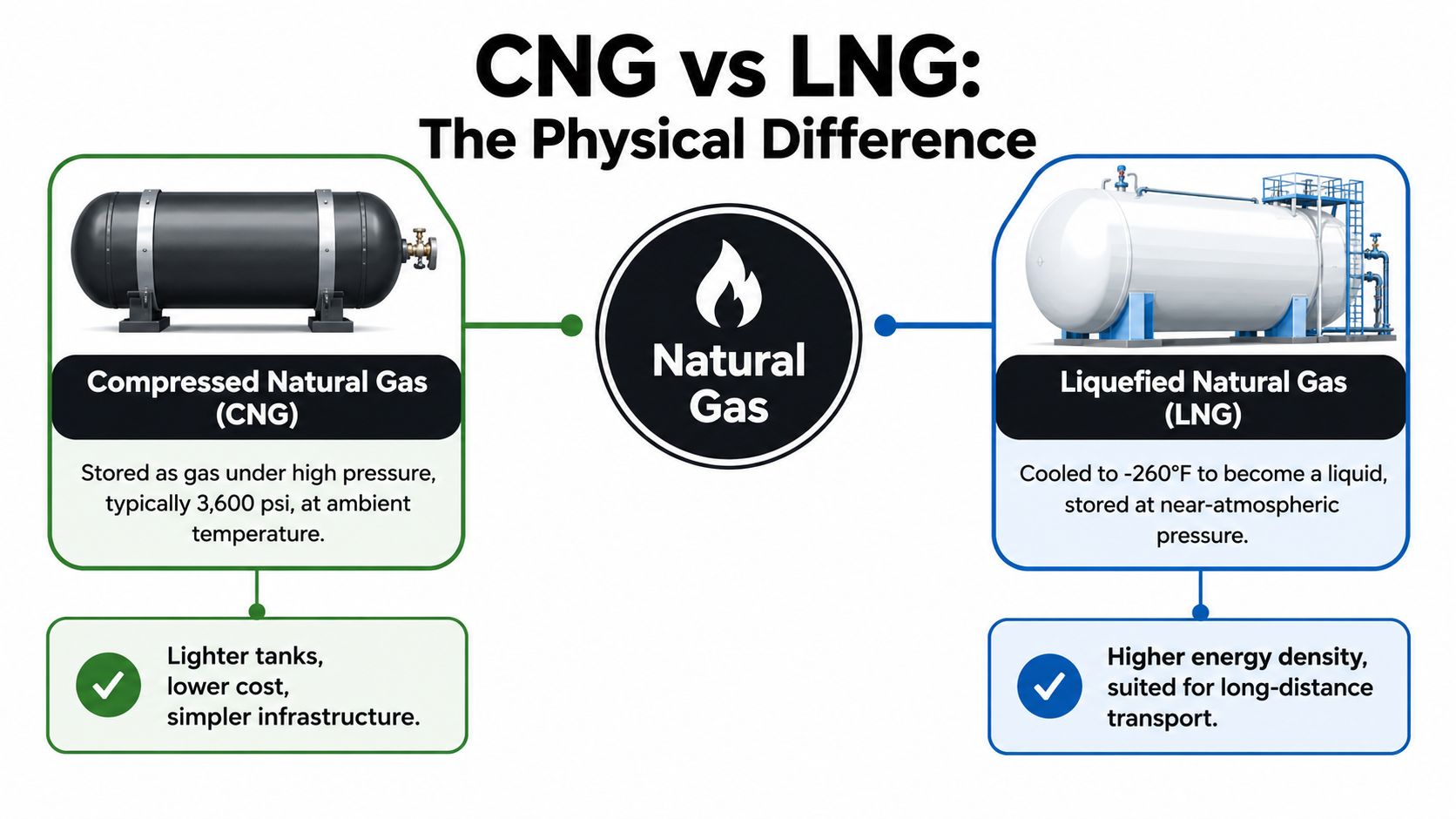
A temporary gas system's first constraint is the fuel's physical state. CNG remains gaseous and is compressed into high-pressure cylinders or vessels. LNG is natural gas cooled until it becomes a liquid, then kept in insulated tanks. Both fuels are natural gas, but their storage and delivery equipment serve different site needs.
The U.S. Department of Energy's Alternative Fuels Data Center overview of natural gas describes LNG as purified natural gas cooled to about −260°F (−162°C) and stored in double-wall, vacuum-insulated vessels. CNG, by contrast, can be compressed to 3,600 psi (approximately 248 bar). The DOE overview also notes that LNG occupies about one-six-hundredth of its gaseous volume, making it compact for transport and storage.
CNG makes gas more compact by applying pressure. LNG makes it more compact by cooling it into a liquid.
For a project manager, that physical difference affects the delivery plan. CNG requires pressure-rated storage and equipment suited to high-pressure gas. LNG requires cryogenic containment, insulated vessels, controlled transfer, and a plan to vaporize the liquid when the end use needs gas. The systems and operating procedures are not interchangeable.
Match the fuel system to the site before dispatch. Confirm that delivery vehicles can reach the setup area, that the available space fits the storage equipment, and that the crew can operate the controls. If the temporary supply serves equipment that uses gas, include the steps needed to deliver gas at the required pressure. Those practical constraints shape whether a compact liquid inventory or a pressurized gas supply fits the job.
Pressure Versus Temperature as the Core Engineering Trade-Off
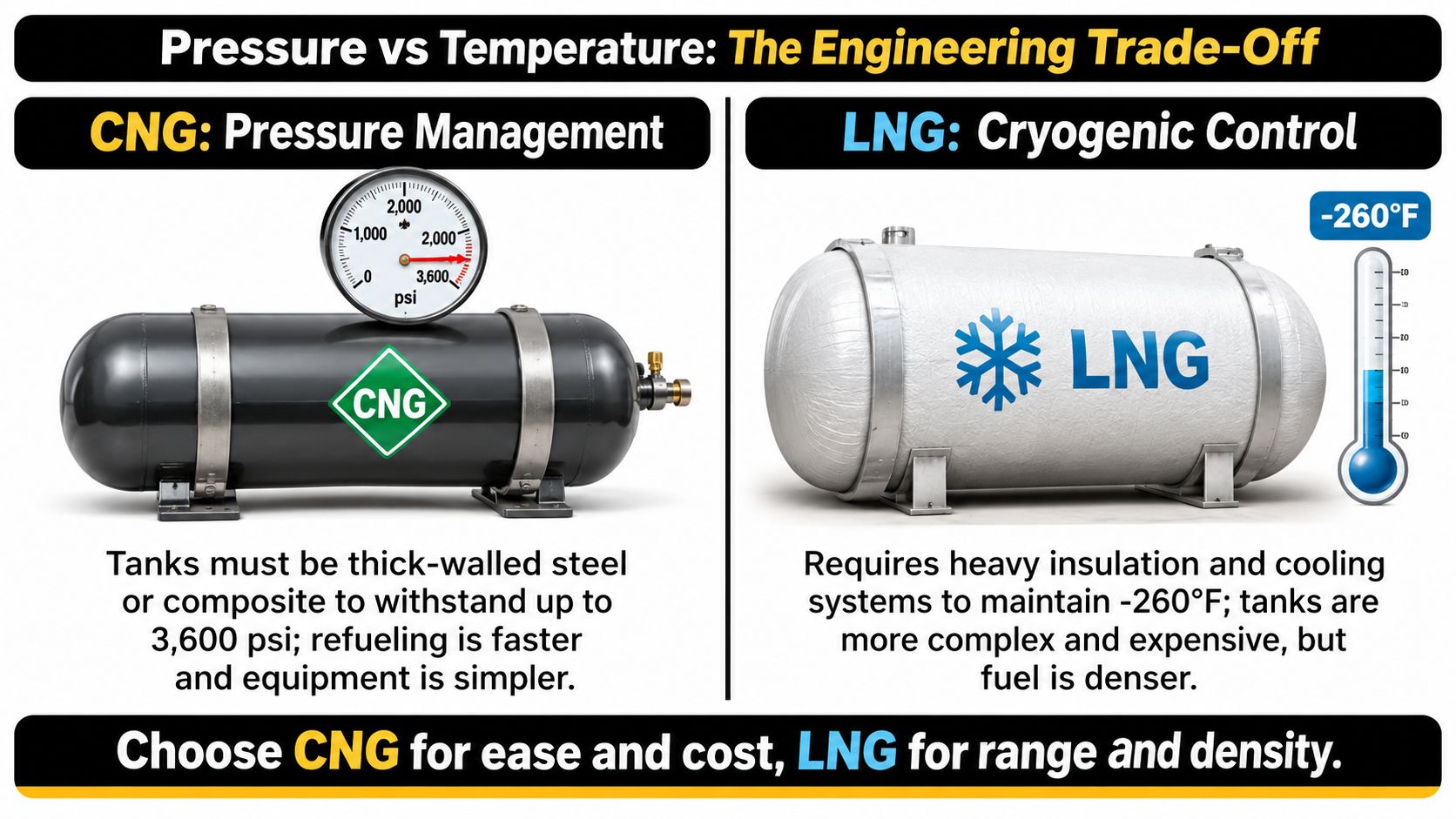
The engineering choice is straightforward to describe: CNG puts the challenge on pressure management; LNG puts it on cryogenic control. That difference affects tanks, fittings, instrumentation, crew procedures and maintenance planning. Treating either option as a simple swap can leave a project with the wrong equipment for the job.
Typical CNG storage operates at approximately 180–250 bar, or about 2,600–3,600 psi, in heavy, thick-walled tanks. LNG is stored at low pressure relative to CNG, but its vessels need vacuum insulation to limit heat transfer and evaporation. The technical comparison of CNG and LNG storage describes this as a trade-off between pressure-rated storage for CNG and cryogenic, insulated storage for LNG.
CNG equipment focuses on pressure integrity. That means the storage vessels, valves, regulators, connections and dispensing equipment must be suited to high-pressure service. LNG systems demand a different set of controls: insulated tanks, cryogenic-compatible transfer equipment, vapor management and careful handling of extremely cold liquid.
Don't assume that a crew or a service setup prepared for one fuel can manage the other. A pressure-rated CNG manifold and an LNG vapor-handling arrangement solve different problems. Equipment selection, operating procedures and maintenance support all need to match the fuel state.
The decision also changes the site plan. CNG avoids the need to maintain cryogenic conditions, but the storage footprint may be larger for the same energy inventory. LNG packs more energy into a smaller volume, but its cold-temperature controls and transfer requirements add operational complexity. The best choice is the one your site can support reliably, not the one that looks simpler on a fuel spec sheet.
Energy Density, Weight, and Storage Footprint Compared
At a crowded job site, storage volume can decide whether a fuel system fits without disrupting equipment access or work areas. LNG has the advantage on energy per tank volume. A technical comparison reports 9.2 MJ/L for CNG stored at 25 MPa and 22.2 MJ/L for LNG at roughly 110 K and 0.1 MPa, or around 2.4 times the energy per unit of tank volume for LNG (Argonne National Laboratory's CNG and LNG comparison).
That density can favor LNG when a temporary supply must hold substantial fuel in a restricted footprint. CNG remains a practical option for smaller or shorter-duration demand when the site has room for storage and a dependable replenishment plan. For project managers, the choice is about matching inventory, delivery access, and usable space.
| Metric | CNG | LNG |
|---|---|---|
| Volumetric energy density in the cited comparison | 9.2 MJ/L at 25 MPa | 22.2 MJ/L at roughly 110 K and 0.1 MPa |
| Relative energy per tank volume | Baseline in comparison | Around 2.4 times CNG |
| Fuel mass per gasoline-gallon equivalent | About 5.66 lb | About 5.37 lb |
The mass figures are listed in the Alternative Fuels Data Center's natural gas overview. They describe equivalent fuel energy by weight, while the MJ/L figures compare energy held in a given storage volume. The cited comparison reports standard gas volume per GGE for CNG only, so that measure is left out of the table rather than presented as a side-by-side comparison.
Before selecting a mobile supply, estimate peak consumption and the time between deliveries. Then check whether the site can fit the required storage without blocking access or work areas. A compact LNG inventory can help where space is tight, provided the site can support its handling requirements. Where room is available, CNG may suit the job if its storage capacity and delivery schedule meet demand.
Lifecycle Emissions and the Methane Leakage Question
LNG isn't automatically the lower-emission choice just because it stores more energy in a smaller tank. A fair comparison has to look beyond combustion and include the full fuel path: gas production, processing, liquefaction, transport, possible regasification and end use. CNG avoids liquefaction and regasification, but its emissions still depend on the source gas and delivery chain.
For LNG, liquefaction takes energy, and long-distance transport can add more steps. Both CNG and LNG also depend on methane controls across production and delivery. If gas leaks along the supply chain, the climate impact of the fuel can change. That makes a fuel label alone a poor basis for an emissions decision.
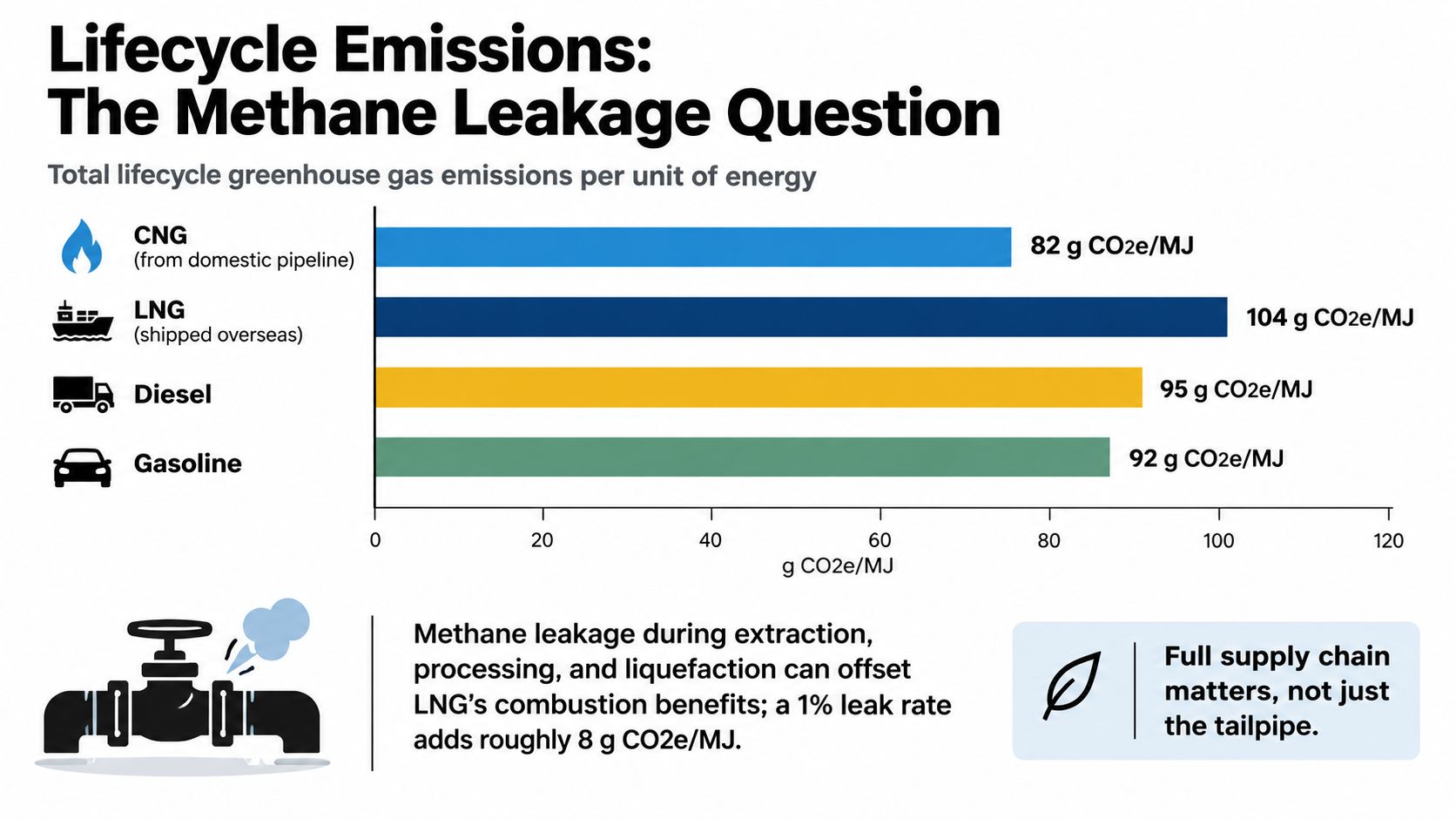
A measurement-informed study found that greenhouse-gas intensity for a U.S. LNG supply chain from the Permian Basin to the United Kingdom was 42% higher than the comparable Marcellus-to-UK pathway (the study in ACS Sustainable Chemistry & Engineering). The finding is a useful warning against treating all LNG supply chains as equivalent. Production basin and leakage performance can influence the outcome, as can delivery distance and the equipment used along the route.
For a temporary job, ask what the supply chain looks like. If CNG can meet a short-distance demand without liquefaction and regasification, it may avoid some stages of the LNG chain. For a large, remote or high-throughput site, LNG's storage density may make the delivery plan more practical despite those extra stages. Neither conclusion applies automatically. Compare the source gas, transport route, methane controls and end-use requirements, not just the fuel name.
Real-World Use Cases for Temporary Mobile Gas
A large customer doesn't automatically need LNG, and a small customer doesn't automatically need CNG. The right choice depends on the work pattern. A short outage at a site with workable access may suit a straightforward CNG deployment. A constrained site with a high demand for stored energy may make LNG worth considering, even for a temporary project.
I'd start with the operating conditions, not the customer's size. A residential builder waiting for a gas line may need a temporary supply to support commissioning or keep work moving. An industrial facility facing an outage may have a different peak load, duration and space limitation. Freeze prevention, generator commissioning and occupancy schedules each put different pressure on the delivery plan.
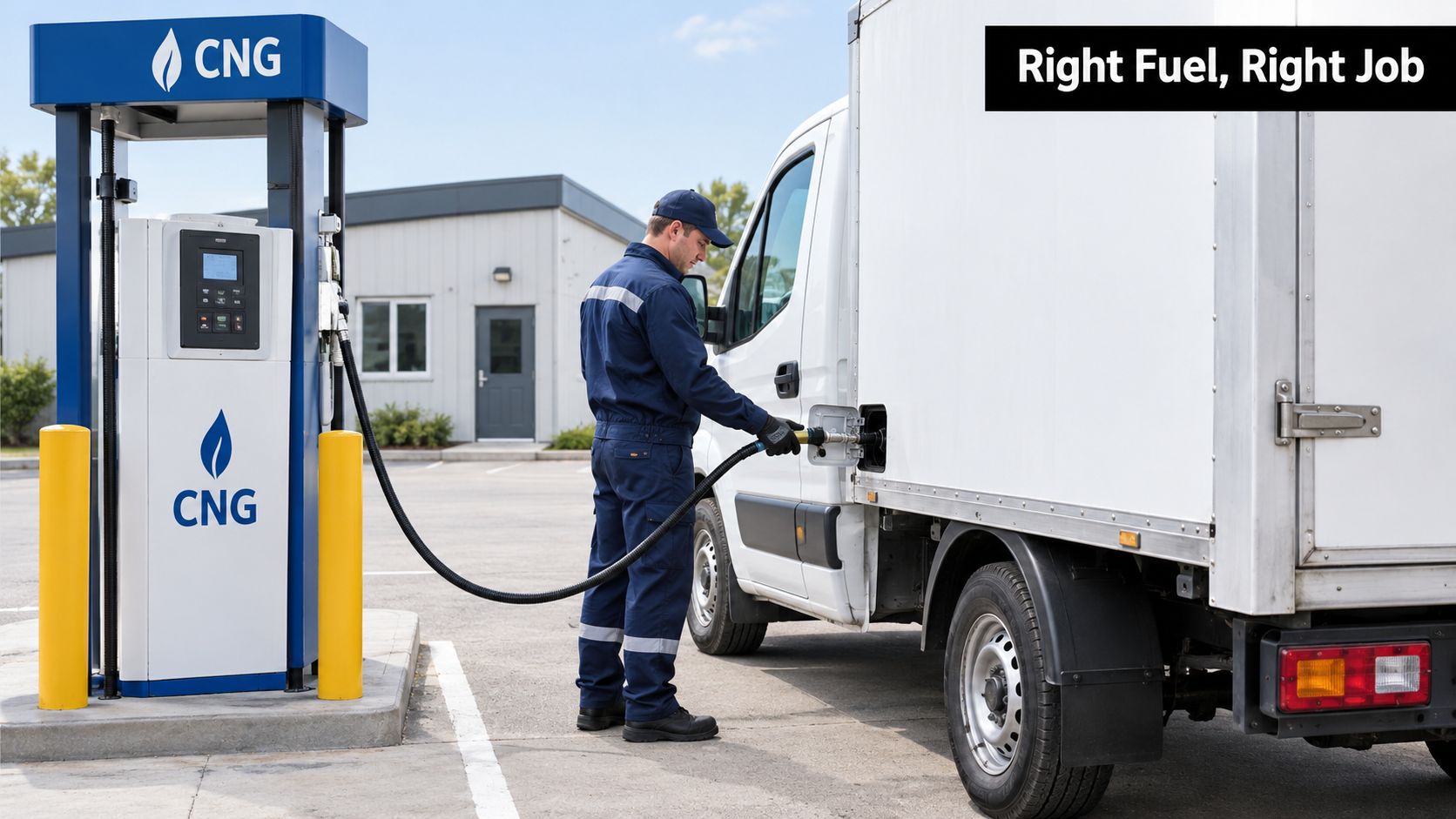
Field rule: Match the fuel and equipment to the site's demand curve, access and replenishment plan. Don't choose by customer size alone.
Peak demand can make a smaller job operationally demanding, while a larger project with steady consumption and generous space may work well with CNG. Delivery access can reverse the apparent choice, too. A site that can't accommodate the required vehicle movements or tank placement may not be able to use the option that looks best on paper.
Fuel availability matters, but availability doesn't solve site constraints. The IEA projected global LNG production to increase by more than 7%, or over 40 billion cubic meters, in 2026, as new liquefaction capacity expands (IEA Gas Market Report Q1 2026 executive summary). That forecast may improve supply availability, but project teams still need to check local access, equipment, permits and delivery timing.
For crews sorting basic site needs alongside the fuel plan, a budget-friendly fire pit for tradespeople can be a practical resource for a separate jobsite amenity. Keep that kind of accessory decision distinct from the temporary natural-gas system: it doesn't replace a properly sized CNG or LNG supply.
Costs, Hazards, and Regulatory Frameworks Side by Side
Fuel price is only one part of the temporary-supply cost. For CNG, project planners need to account for pressure-rated storage and connected equipment, as well as delivery frequency if the required inventory takes more space. LNG brings costs tied to liquefaction, insulated cryogenic equipment, transfer systems and vapor management. Delivery distance, site access and how long the system needs to operate all affect the overall plan.
The hazards differ because the fuels are stored in different states. LNG requires controls for extreme cold, cryogenic liquid containment, vapor management and fire protection. CNG requires careful management of high-pressure vessels and connections, including protection against release, ignition and overpressure. Neither should be treated as ordinary low-pressure gas equipment.
In the United States, LNG facilities covered by federal rules are regulated under 49 CFR Part 193. The Pipeline and Hazardous Materials Safety Administration's LNG regulatory documents describe requirements covering siting, design, construction, equipment, operations, personnel qualification and training, fire protection, and security. PHMSA also identifies NFPA 59A as a foundational consensus standard incorporated into LNG regulation.
| Planning issue | CNG emphasis | LNG emphasis |
|---|---|---|
| Equipment | Pressure-rated vessels, connections and regulation | Cryogenic-compatible vessels, insulation and transfer equipment |
| Operating controls | Pressure integrity, isolation and overpressure protection | Cold-liquid containment and vapor management |
| Cost considerations | Storage footprint and delivery cadence | Liquefaction, insulated storage and vapor handling |
| Compliance planning | Confirm requirements for the pressure equipment and site | Check applicable LNG facility rules and standards |
Bring safety and compliance into the decision early. Don't wait until equipment arrives to discover that the site layout, operating procedures or approval process doesn't fit the chosen system. Ask the provider what equipment is being deployed, what controls it requires and what site preparations must be complete before delivery.
A Practical Decision Framework for Project Planners
Use the site conditions to make the call. Before choosing a fuel, write down the expected demand and the operating constraints that could prevent a system from working as planned. A practical comparison should cover outage duration, peak demand, storage footprint, delivery access and required gas pressure.
| Site variable | What to check | How it can guide the choice |
|---|---|---|
| Outage duration | How long must the temporary supply operate? | A longer duration makes inventory and replenishment planning more important. |
| Peak demand | What is the highest expected gas draw? | High throughput may favor greater storage density if the site can handle LNG equipment. |
| Available footprint | Where can tanks, equipment and vehicle access fit? | Limited space can favor LNG's compact storage, but only if cryogenic controls are workable. |
| Delivery access | Can delivery vehicles reach, place and service the units? | Site restrictions may rule out an option regardless of storage density. |
| Required gas pressure | What pressure does the connected equipment need? | The selected system has to supply gas in a form and pressure suitable for the end use. |
Start with the pressure requirement. If the connected equipment's needs aren't clear, ask the equipment owner or gas utility before selecting a temporary system. Next, estimate the peak demand and duration, not just average use. That's what determines whether the planned inventory and delivery cadence are realistic.
Then assess the physical site. Measure usable space, identify delivery paths and note any restrictions on vehicle access or equipment placement. Finally, check whether the operating team can manage the fuel-specific procedures. LNG's compactness doesn't make it suitable if the site can't support cryogenic handling; CNG's ambient-temperature operation doesn't make it a fit if the storage footprint is unavailable.
Decision rule: Pick the fuel your site can receive, operate and replenish safely at the required pressure and demand. Storage density is one input, not the verdict.
Choosing the Right Mobile Gas Provider for Your Project
A temporary gas unit arrives at the site, but the connection is not ready or the delivery plan cannot meet demand. Prevent that disruption by giving providers the operating details before requesting a quote: site address, expected load and duration, required pressure, available space, gas-line status, schedule, and access or regulatory constraints.
Ask the provider to explain how it will size and replenish the supply, and what the site must prepare. For CNG, confirm the pressure-rated equipment and delivery schedule can serve the expected load. For LNG, discuss cryogenic equipment, transfer procedures, and vapor management. In both cases, establish who monitors the system, responds to problems, and coordinates changes to the project schedule.
Speed matters when a line installation is delayed or an outage interrupts service. It does not replace suitable equipment or clear operating procedures. Before delivery, have the project team, utility, and provider agree on connection requirements and site responsibilities.
For projects in the Carolinas, Tennessee, and Virginia, Blue Gas Express mobile natural gas services offers scalable mobile gas units, with deployment within hours of request for delayed natural-gas line installations and maintenance outages. Give the provider your site constraints and operating requirements at the outset so it can assess whether CNG or LNG fits the temporary deployment.
If a line delay or maintenance outage is holding up work, gather your load, duration, pressure, and site-access details before choosing a provider. Confirm the equipment and delivery plan against the project's schedule and operating needs.