

Project delays and utility outages can bring operations to a grinding halt, and the costs add up fast. That’s where a temporary CNG gas company becomes an absolute lifeline, delivering mobile natural gas right to your site. It’s the perfect workaround when you’re dealing with construction, emergencies, or commissioning phases and a permanent pipeline connection just isn't an option yet.
When Your Project Needs a Temporary CNG Gas Company
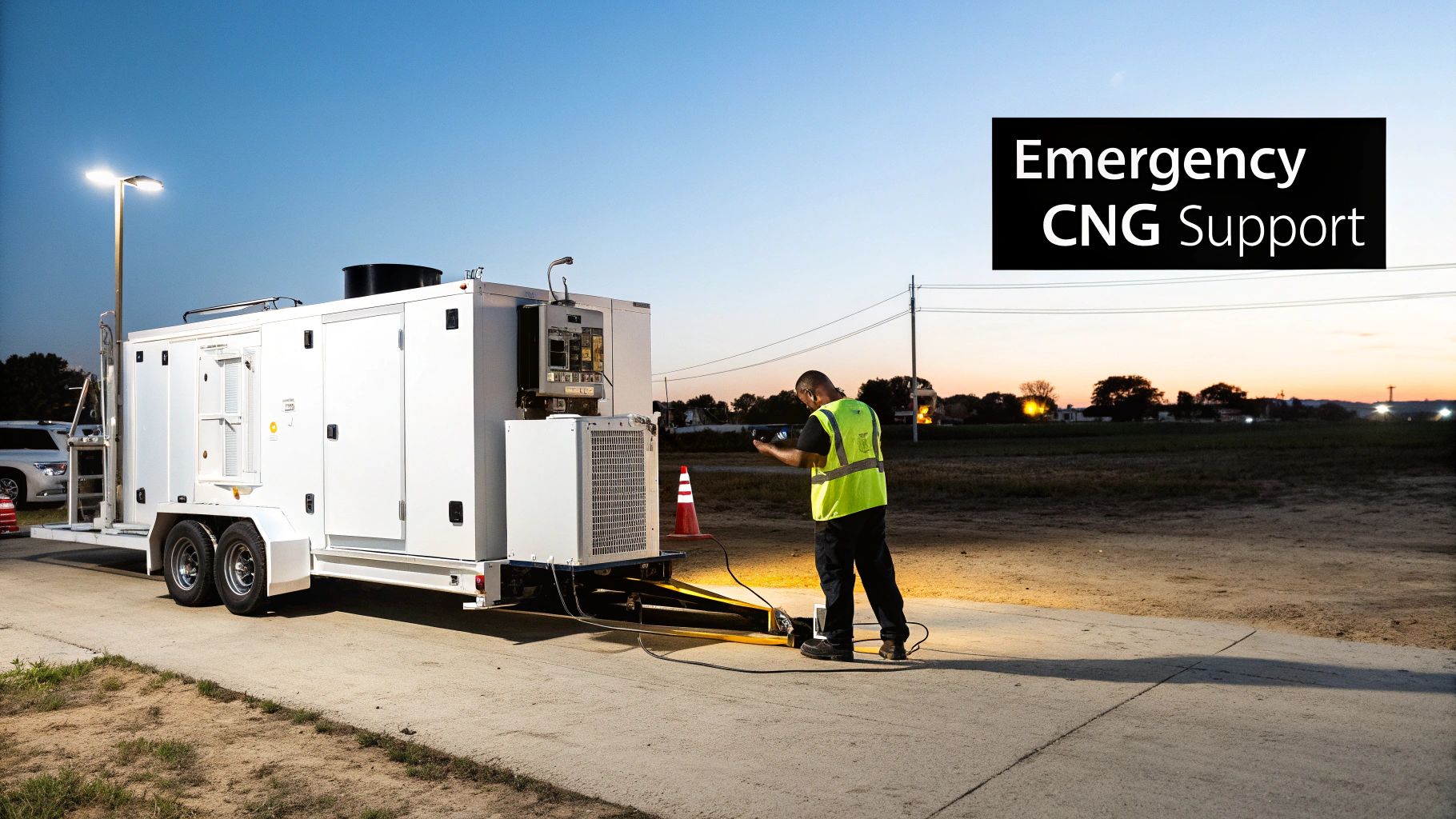
Knowing when to call in a mobile CNG provider can be the make-or-break decision that keeps your project on schedule and avoids costly penalties. While the need often feels like a last-minute emergency, I've seen a few common scenarios pop up time and time again.
These aren't just situations of convenience; they are critical moments where a temporary gas supply is the only thing standing between you and a major operational failure. The most common trigger? Your permanent utility connection is delayed. We’ve all been there. Maybe your new residential development is move-in ready, but the local utility is weeks behind on laying the gas lines. Without gas, you can't get that all-important certificate of occupancy. A temporary CNG setup bridges that gap, letting you heat the homes and test appliances to hit your handover dates.
Quick Guide to Temporary CNG Use Cases
Here’s a quick rundown of some common situations where a mobile CNG provider is the perfect solution. I've put this together based on the calls we get most often.
| Project Scenario | Common Problem | How Temporary CNG Solves It |
|---|---|---|
| New Residential/Commercial Build | The local utility's gas line installation is delayed, holding up occupancy permits. | Powers boilers and HVAC systems, allowing for final inspections and on-time tenant move-in. |
| Cold-Weather Construction | Freezing temperatures threaten to stop work, damage materials, and freeze pipes. | Fuels portable heaters, ensuring concrete cures properly and work continues through the winter. |
| Critical Facility Commissioning | A new hospital or data center needs to test backup generators before opening. | Provides a reliable fuel source to run full-load tests without a permanent gas connection. |
| Planned Utility Maintenance | The gas utility schedules a multi-day shutdown for system upgrades or repairs. | A mobile unit is brought in to backfeed the system, ensuring seamless service for customers. |
| Emergency Pipeline Interruption | A pipeline is damaged unexpectedly, cutting off gas supply to a facility or community. | Provides an immediate emergency fuel source, keeping essential services running until repairs are done. |
As you can see, the applications are pretty diverse, but they all solve the same core problem: keeping the gas flowing when the pipeline can't.
Keeping Timelines on Track
Delays with permanent infrastructure are a classic headache in construction. Having a reliable temporary CNG provider on your contacts list means your project doesn't have to grind to a halt while you wait on the utility company.
Think about these real-world examples I've seen play out:
- Securing Occupancy Permits: For a new apartment complex, a mobile CNG unit can fire up the boilers and heating systems. This is often all it takes to satisfy the municipal inspector and get the green light for residents to start moving in.
- Preventing Winter Work Stoppages: On a job site in the dead of winter, temporary gas is a game-changer. It can fuel the big portable heaters needed to keep concrete from curing improperly or, worse, prevent pipes from freezing and bursting. This simple step can save you thousands in damage and lost workdays.
- Commissioning Critical Equipment: Imagine a brand-new data center or hospital. You absolutely have to test the backup power generators under a full load before you can go live. A mobile CNG or LNG supply provides the clean, reliable fuel to run those tests without waiting for the permanent gas line.
A proactive approach is always better than a reactive one. Identifying potential gas supply gaps early in the project planning phase allows you to vet a CNG gas company and have a plan ready, turning a potential crisis into a manageable logistical step.
Driving Growth and Meeting Demand
The need for natural gas solutions is absolutely booming. Just look at the United States compressed natural gas market—it generated USD 13,434.2 million in revenue and is projected to nearly double to a staggering USD 26,616.7 million by 2030.
This explosive growth is driven by record-high consumption, which really highlights the need for flexible energy solutions. You can find some great analysis on these U.S. market growth trends from Grand View Research.
This expanding market proves just how vital adaptable gas solutions have become. Whether you're planning for a utility maintenance outage or dealing with an unexpected pipeline issue, having a temporary CNG provider on standby is just smart business. It ensures you can keep operations running smoothly, protecting both your revenue and your reputation.
A Practical Checklist for Vetting CNG Providers
Choosing the right temporary gas provider is about more than just getting the lowest price. It’s about finding a partner you can count on, someone whose equipment, safety standards, and team are a perfect match for your project's needs.
Think of it like finding the right web development company; a deep dive into their past work and capabilities is what separates a good outcome from a costly mistake. A methodical approach is your best defense against project delays and safety issues.
Operational Capabilities and Response Times
First things first: can they actually get the job done when and where you need them? A cheap quote means nothing if the gas shows up a day late.
Start with the basics. Ask them point-blank about their service area and whether they have a solid history of deploying in your state. Then, get into the critical details. What’s their guaranteed emergency response time? A top-tier provider should be able to get a unit on-site within hours, not days, especially when you’re dealing with an unexpected pipeline outage.
Drill down with these questions:
- What’s your real-world deployment timeline for both planned projects and emergency calls to my location?
- How large is your mobile fleet and what’s its total capacity? This tells you if they can handle your job without stretching their resources too thin.
- Can you show me a few case studies from projects similar to mine? You want to see examples that mirror your industry, scale, and specific challenges.
Safety Protocols and Certifications
When it comes to high-pressure natural gas, safety is non-negotiable. Any experienced CNG provider will have an ironclad safety program and be completely transparent about it. Don't be afraid to dig deep here.
Ask about their technicians' qualifications. Are they certified for this kind of work? Do they follow a strict, documented process for site assessments, installation, and routine safety checks? A reputable company won't just tell you they’re safe—they’ll show you the paperwork to prove it.
Never just assume a provider meets industry safety standards. Always ask for proof. A company that truly prioritizes safety will see your detailed questions as a sign of a diligent client, not a hassle.
Key safety areas to verify:
- Technician Training and Certification: Confirm that every person they send to your site has current, relevant certifications for handling high-pressure gas.
- Equipment Maintenance Records: Ask for logs showing how often their trailers, regulators, and hoses are inspected and tested.
- Emergency Shutdown Procedures: They must have a clear, documented plan for what to do if something goes wrong.
Equipment Specifications and Technical Expertise
The provider's equipment has to be a perfect technical match for your project. A mismatch in pressure, flow rate, or even the type of connection fitting can bring your entire operation to a halt. This is where a company’s hands-on expertise really comes into play.
Come to the conversation prepared with your required gas pressure (PSI) and flow rates (CFH). Their team should be able to confirm on the spot if their equipment can meet those demands. More importantly, they should ask you questions to understand the nuances of your application. A lack of curiosity on their part is a huge red flag.
The checklist below will help you compare potential partners and make an informed decision.
Vetting Your CNG Gas Company Checklist
Use this table as a scorecard to evaluate each provider you're considering. It forces you to look past the sales pitch and focus on what really counts for a successful, safe partnership.
| Evaluation Criteria | What to Look For | Why It Matters |
|---|---|---|
| Response Time & Service Area | Guaranteed deployment within hours; clear evidence of service in your state. | Ensures they can prevent downtime during an emergency or project crunch. |
| Safety Certifications & Training | Documented safety protocols, certified technicians, and a strong safety record. | Protects your site, your team, and your liability from preventable accidents. |
| Technical Expertise & Equipment | Ability to match PSI/CFH needs; modern, well-maintained equipment. | Guarantees the provided solution will actually work with your systems without issue. |
| Client References & Case Studies | Positive testimonials from similar industries; proven success on complex projects. | Verifies their real-world performance and reliability beyond their marketing claims. |
In the end, vetting a CNG company is all about building confidence. By thoroughly checking their operational readiness, safety culture, and technical know-how, you can find a partner who feels like a true extension of your own team. That diligence is what turns a temporary gas supply into a seamless solution instead of another project headache.
Getting Technical and Safety Requirements Right
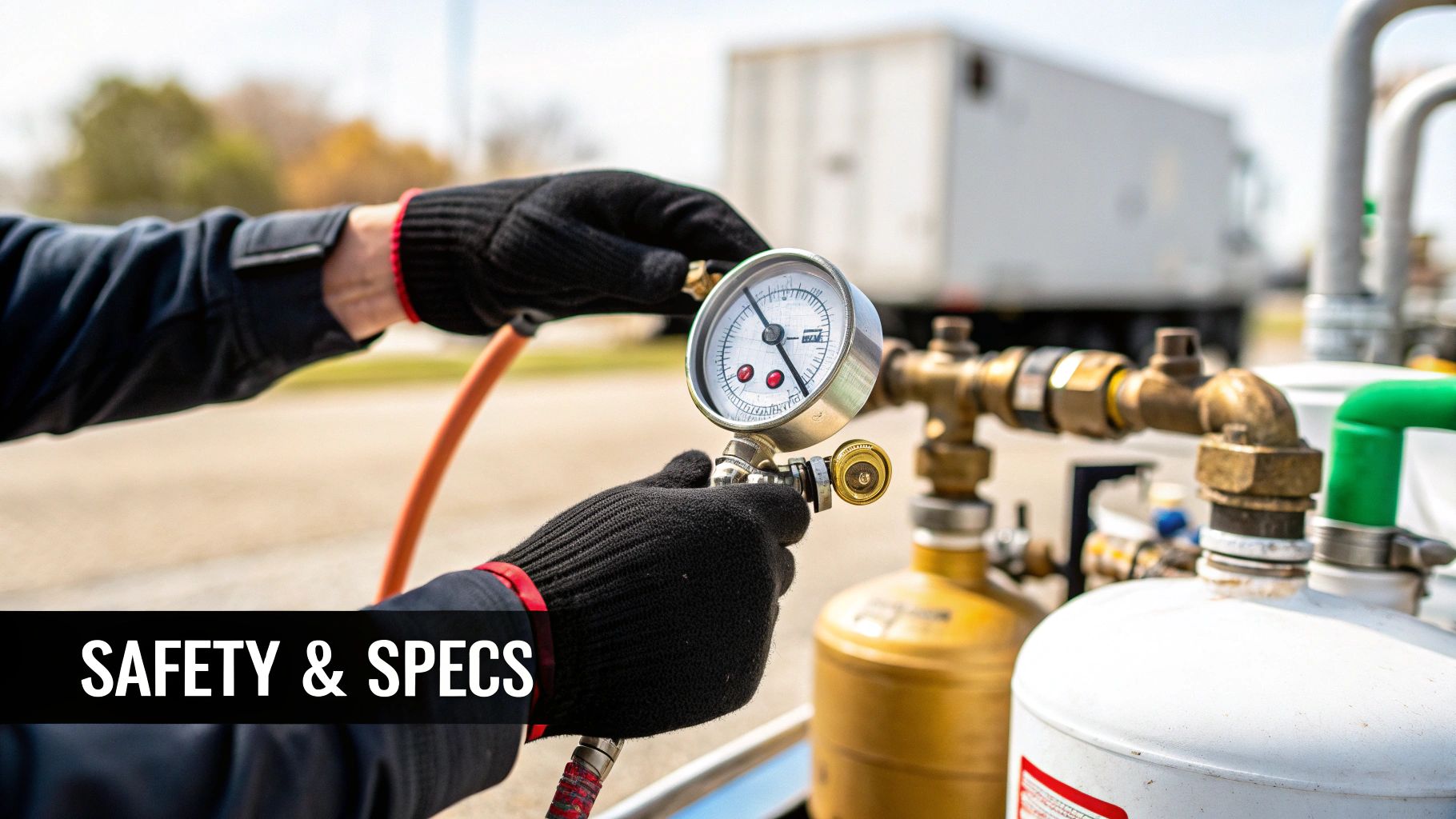
When you're setting up a temporary natural gas supply, this is where the rubber really meets the road. The success of your project hinges on getting the technical and safety details perfect. It’s not just about pumping gas to your site—it’s about delivering it at the exact specifications needed, all while keeping your people, property, and project on track.
This all starts with a thorough site assessment. I can't stress this enough: a professional provider will insist on walking your site before they even think about giving you a plan. This isn't just a box to check; it’s the most critical step for spotting hazards, figuring out the best place for the mobile unit, and nailing down your equipment’s technical needs.
Decoding the Technical Specifications
Before a single wrench turns, your provider needs to know precisely what your systems demand. It boils down to two key numbers: gas pressure, measured in Pounds per Square Inch (PSI), and flow rate, measured in Cubic Feet per Hour (CFH).
Getting the pressure wrong is just as bad as having no gas. Too low, and your equipment sputters out. Too high, and you're risking catastrophic damage or a serious safety event. Any good CNG provider will use specialized regulators to bring the high pressure from their mobile unit down to the exact PSI your system is designed for.
For instance, a massive commercial boiler might need a consistent supply at 2 PSI, but a bank of construction heaters could require something much lower. A competent provider will always confirm these specs with your on-site facility manager or mechanical contractor to guarantee a perfect handshake between their equipment and yours.
Site Prep and Finding the Right Spot
Once the technical details are locked in, it's time to figure out the physical setup. The mobile CNG unit, which is usually a large trailer, has some very specific needs for where it can be parked safely.
During the site assessment, your provider will be looking for a few key things:
- A Firm, Level Surface: The ground has to be solid and compacted. It needs to support the immense weight of a fully loaded tractor-trailer without any risk of sinking or shifting over time.
- Plenty of Clearance: They'll need a good amount of open space around the unit, well away from buildings, overhead power lines, and any potential ignition sources, all according to local fire codes.
- Easy Access: The provider needs a clear, unobstructed path to deliver the trailer and, crucially, to swap it out for a new one later without shutting down your entire operation.
Think of this assessment as a team effort. Your job is to provide accurate information about your site and equipment. The CNG company brings the expertise to design a temporary fuel solution that is both effective and, most importantly, safe.
The initial site walk is non-negotiable. If a potential provider seems willing to skip this step, that’s a massive red flag that they're cutting corners on safety. This assessment is your first and best chance to head off problems before they start.
Upholding Rigorous Safety Protocols
Safety is everything in a temporary gas operation. Natural gas is an incredibly safe and reliable fuel, but it demands respect. Your provider absolutely must have an ironclad commitment to safety, supported by documented procedures and highly trained, certified technicians.
A huge piece of this is proper ventilation and monitoring. Even though the setup is outdoors, you have to ensure any vented gas can dissipate safely without pooling. A professional crew will also have clear, well-rehearsed emergency shutdown procedures and will walk your own team through them before a single cubic foot of gas flows.
Thinking through every angle of the operational environment is key. For example, considering essential communication solutions for gas and mining industries shows a provider is thinking about the full picture of operational safety, not just the gas itself.
Your provider should be able to hand you their safety plan, covering everything from the first connection to daily checks and emergency response. This isn't just a verbal promise; it should be a documented process. Ask to see it in writing. It’s your right and their responsibility.
Breaking Down Your Contract Costs and Billing
Let's talk money. The financial side of bringing in a temporary CNG provider can feel a bit opaque at first, but it really boils down to a few key components. Getting a firm grip on the contract and how you'll be billed is critical for keeping your project on budget and avoiding any nasty surprises down the road.
Think of it like renting a car for a road trip. You've got the daily rate for the car itself, and then you pay for the gas you actually use. Most temporary gas providers structure their pricing the exact same way. Your bill will have two main parts: the equipment rental and the cost of the gas you consume.
Decoding the Equipment Rental Fees
The equipment rental fee is usually the most straightforward part of your invoice. This is a fixed charge—often daily or weekly—for having the mobile CNG unit, regulators, hoses, and all the other necessary gear parked on your site.
When you're comparing quotes, you need to dig into the details of these rental terms:
- The Billing Cycle: Are they charging you by the day, week, or month? Daily rates are common for quick jobs, but if you need service for a week or more, a weekly rate should offer a better deal.
- Minimum Rental Periods: Always ask if there's a minimum rental period. It’s common for providers to have, say, a one-week minimum, even if your pipeline is only down for three days. You don't want to get caught off guard by that.
- What's Included: Does that daily or weekly fee cover routine safety checks and maintenance? A good, reputable provider will bundle these essential services right into the rental cost, not nickel-and-dime you for them later.
Nailing down these details helps you lock in the fixed costs of your project. This part of your bill gives you a stable baseline to build your budget around, regardless of how much gas you end up using.
Analyzing Your Natural Gas Consumption Charges
Now for the variable part of your bill: the gas itself. This is where you pay for what you use, and you'll typically see it billed per hundred cubic feet (CCF) or per thousand cubic feet (MCF). The price for the gas can move up and down with the market, just like the price at the pump.
This is a key conversation to have with any potential provider. Ask them how they price the actual commodity. Some will offer a fixed rate for your entire contract period, which is great for budget certainty. Others might use an indexed rate that’s tied to a market benchmark. That could save you money if market prices dip, but it also means you’re exposed to potential price spikes.
A transparent contract will always separate the equipment rental from the gas consumption charges. If you get a quote that just has one big, vague "service fee," push back. You have every right to ask for a detailed breakdown so you can see exactly what you’re paying for.
Why Your Service Level Agreement (SLA) is Non-Negotiable
Beyond the dollars and cents, your contract must include a solid Service Level Agreement (SLA). This is, quite simply, the provider's written promise to you about their performance and reliability. A weak or missing SLA is a massive red flag.
A proper SLA should spell out a few critical things in black and white:
- Guaranteed Uptime: What percentage of the time do they promise the gas will be flowing without interruption? The industry standard to look for is 99.9% or higher.
- Emergency Response Time: If something goes wrong, how fast will a certified technician be on your site? This needs to be defined in hours, not vague promises.
- Refueling Protocol: How do they make sure you never run out of gas? The SLA should outline their remote monitoring process and their proactive refueling schedule.
The SLA is your best friend when it comes to accountability. It turns all those sales pitches and promises into legally binding obligations, giving you the confidence that your operation won't be left high and dry. Honestly, this document is just as important as the price sheet.
The Onboarding Journey from First Call to Gas Flow
You've picked your temporary gas provider and signed on the dotted line. Now what? Knowing how things unfold from here is key to a smooth, surprise-free project. Getting from that first phone call to a live gas flow is a carefully coordinated effort between your team and your provider, and it's designed to get you running safely and fast.
It all starts with that initial consultation. This isn't just a sales call; it's a deep dive into your project's needs. A good provider will ask pointed questions about your required gas volume, pressure, and timeline. They’re not just trying to give you a price—they're figuring out if they have the right equipment and technical know-how for your specific job.
After that conversation, we get to what is arguably the most important part of the whole process: the site survey. A technician will come out to your location to walk the ground, pinpoint the best spot for the mobile unit, and identify exactly where they’ll tie into your system. Any reputable company will tell you this step is non-negotiable.
From Site Plans to Permitting
With the site survey done, the provider’s engineers get to work. They’ll draft a detailed site plan that maps out everything—the trailer’s precise footprint, the path of every hose, and the location of all safety gear. This document becomes the blueprint for the entire installation.
This is also when the permitting gears start to turn. While you’re the one ultimately responsible for securing local permits, a top-tier provider is your best asset here. They’ll hand over all the technical drawings, equipment specs, and safety documentation that fire marshals and city officials need to see. Their experience navigating these local codes can save you from a world of delays.
Expert Tip: Assign a single point of contact on your team to work with the CNG provider. Having one person who knows the site and can coordinate access for technicians is the single best thing you can do to speed up the entire process, from planning to commissioning.
The demand for these mobile energy solutions is exploding. The global compressed natural gas market hit USD 211.06 billion and is expected to reach USD 333.94 billion by 2029. This growth highlights just how critical an efficient, well-managed onboarding process is. You can dig into the numbers yourself in this global market expansion report from Research and Markets.
Equipment Delivery and Final Commissioning
Once the permits are approved, it's go-time. The provider will schedule the delivery of the mobile CNG unit, and your job is to make sure the designated area is clear, accessible, and ready. Think of it as prepping a landing pad—the easier you make it for their truck to get in and set up, the faster you’ll have gas.
When the trailer is on-site, certified technicians take over. They handle the full installation, which includes:
- Securing the Unit: Anchoring and stabilizing the trailer for its stay.
- Connecting Hoses: Running the high-pressure lines from the mobile unit to your system’s tie-in point.
- Setting Regulators: Dialing in the pressure regulators to deliver gas at the exact PSI your equipment needs to run properly.
The last thing before gas starts flowing is a battery of safety checks. Technicians will run leak tests, double-check every connection, and walk your team through the emergency shutdown plan. They won't open the valve until they're 100% certain the system is locked down and safe. In a true emergency, a great provider can get this entire process—from first call to gas flow—done in just hours. It's a logistical feat.
Once you’re up and running, your invoices will typically break down costs into a few key areas, as shown in the diagram below.
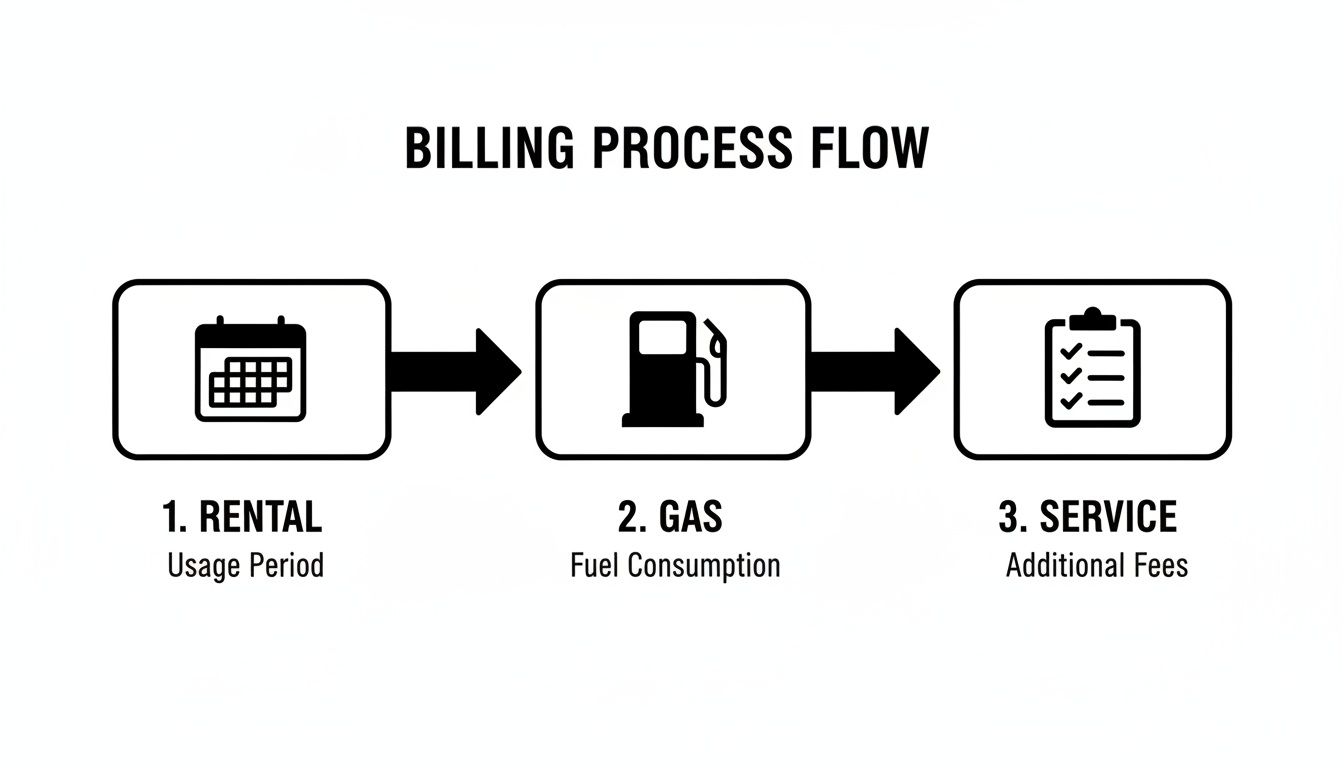
Seeing the costs separated like this—fixed rental fees versus variable gas consumption—makes it much easier to track your project's budget.
Answering Your Key Questions About Temporary CNG
Even the best-laid plans come with questions. When you're bringing in a temporary CNG provider, those questions usually circle around three things: how fast, how safe, and how complex is the whole process? Getting straight answers is the only way to make a good decision and keep your project on track.
Over the years, we've heard just about every question from project managers, facility operators, and construction supers. Let's walk through the most common ones so you can move forward with confidence.
How Fast Can a Temporary CNG Unit Get to My Site?
This is almost always the first question, especially when you're dealing with an unexpected outage. The short answer? In an emergency, top-tier providers can often get a mobile CNG unit on-site within hours of your call, especially if you're in their main service area. When every minute of downtime costs you money, that speed is everything.
Of course, the exact timeline hinges on a few practical details:
- Site Access: Can a full-sized tractor-trailer actually get to where the unit needs to be?
- Permitting: Are there local permits that need to be squared away first?
- The Connection: Are we looking at a simple tie-in, or is the hookup more involved?
For any planned outage or project, scheduling ahead is the best way to guarantee a smooth setup. That said, any CNG company worth its salt is built from the ground up for rapid emergency response.
What Does a Mobile CNG Unit Need On-Site?
The site requirements really boil down to safety and simple logistics. The mobile CNG unit itself is typically mounted on a large trailer, so it needs a firm, level spot that can handle that kind of weight. Think about a space roughly the size of a standard semi-truck.
But it’s not just about finding a parking spot. The location has to have proper clearance from buildings, any potential ignition sources, and overhead power lines. These aren't suggestions—they're strict requirements based on local fire codes. Your provider will perform a detailed site survey to find the perfect spot that's both safe and efficient for connecting to your system.
"A thorough site survey isn't just a formality; it's the foundation of a safe and successful temporary gas installation. It’s where professional expertise identifies potential hazards before they become real problems, ensuring the entire operation runs smoothly from day one."
An experienced technician will see things a project manager might miss. This collaborative step is absolutely critical.
Who Is in Charge of Getting Permits?
Handling permits is usually a team effort, but a good CNG provider takes the lead. While the property owner or general contractor holds the ultimate responsibility, a seasoned partner knows exactly what the local fire marshals and authorities need to see.
They'll come prepared with all the technical specs, engineering drawings, and safety documentation needed for the application. Honestly, this is one of the biggest advantages of working with an experienced provider. They've been through this process hundreds of time and can help you sidestep common pitfalls and bureaucratic delays that could otherwise throw your project off schedule.
How Does Refueling Work Without Shutting Us Down?
This is a great question. The refueling process is designed to be completely invisible to your operations. The provider handles it all, ensuring you have zero interruption to your gas supply. The mobile units are equipped with real-time monitoring systems that constantly track gas levels from a remote location.
Long before the supply gets low, their logistics team gets an automatic alert and dispatches a tanker to refuel the on-site unit. For jobs where even a second of downtime is not an option, providers offer a "dual-pack" system. This means they bring a second, full CNG trailer to the site before the first one runs out. The switchover is instantaneous, guaranteeing 100% uninterrupted flow for your operations. It's the go-to solution for critical facilities like hospitals and large-scale manufacturing plants.
At Blue Gas Express, we know that project delays aren't an option. We provide rapid, reliable mobile CNG and LNG solutions across the Carolinas, Tennessee, and Virginia to keep your operations running. If you're facing a utility delay or a planned outage, learn how we can deliver a temporary gas solution to your site in hours. Visit us to secure your project's energy needs.