

When you're running a construction project in Houston, getting natural gas hooked up is a major milestone. You're faced with a classic dilemma: do you wait for the permanent utility connection, or do you bring in a temporary mobile solution to keep things moving? The right answer really boils down to your project's timeline, budget, and what you need the gas for right now. Figuring this out early is the secret to dodging expensive delays and keeping your build on track.
Your Project Roadmap for Houston Gas Service
For any builder or project manager in the Houston area, gas service is about more than just fuel—it’s about momentum. If you can't get gas, you can't pass inspections. You can't protect your materials from a surprise freeze. Your entire project can grind to a halt, all because of one decision made weeks or months earlier. Do you wait for the permanent hookup, or do you find a way to bridge the gap?
Making the right call means taking a hard look at your project's needs and understanding what each option truly involves.
This whole decision process can be broken down into a simple, three-step roadmap.
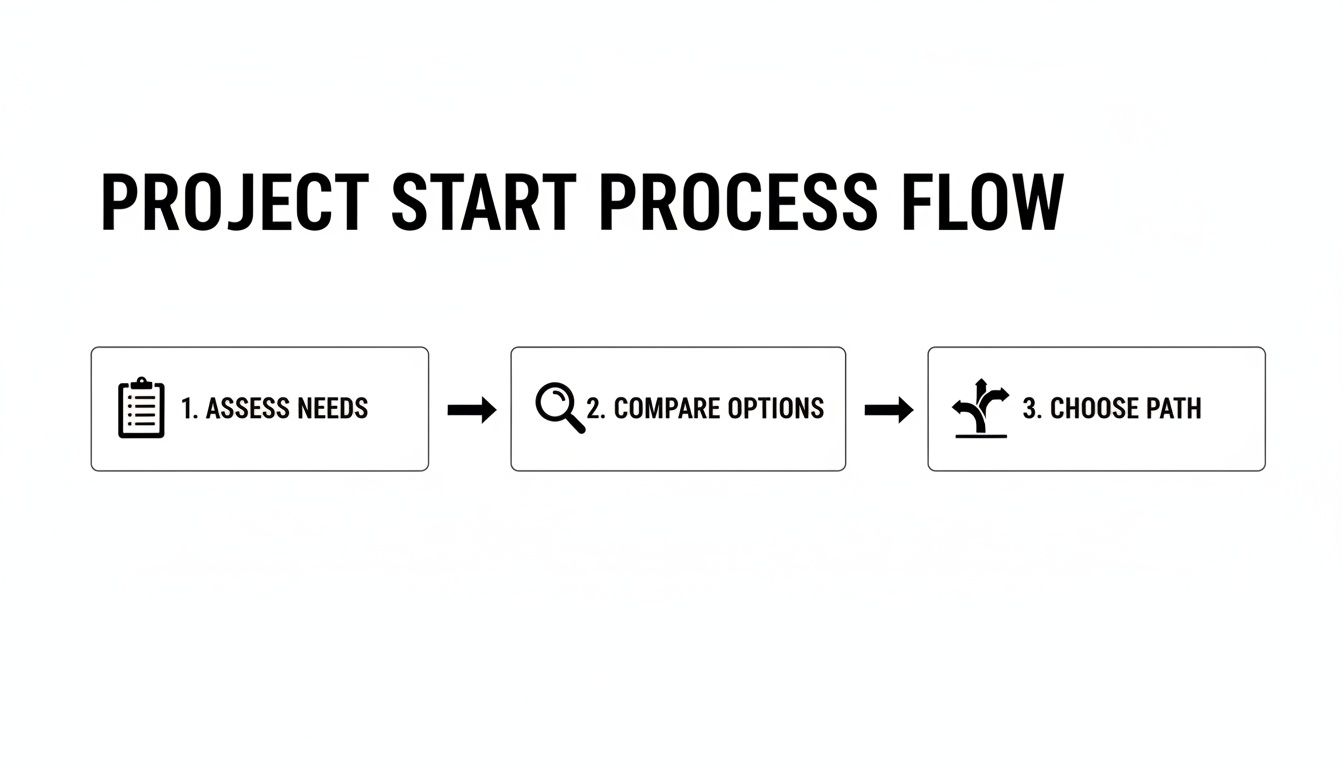
As you can see, the first move is always to nail down what you need. From there, you can realistically evaluate your options and commit to a strategy that makes sense.
Assess Your Immediate Energy Needs
Before you even think about picking up the phone, you need a crystal-clear picture of why you need gas. Are you trying to fire up a massive HVAC system to get that final sign-off? Or is an unexpected cold snap threatening to burst your pipes and you just need temporary heat to cure drywall?
We see this all the time. Common needs on a job site include:
- HVAC Commissioning: Firing up rooftop units and heating systems is non-negotiable for passing inspections and getting your Certificate of Occupancy.
- Freeze Protection: You need consistent heat to protect plumbing, fire suppression systems, and newly installed finishes from costly damage.
- Generator Testing: The only way to know if your natural gas backup generators work is to run them under a real load.
- Process Heat: Sometimes you need fuel for specific tasks, like drying out materials or running industrial heaters to keep the work going.
Comparing Permanent and Temporary Gas Paths
Once you know exactly what you're trying to accomplish, it's time to compare the two main ways to get Houston gas service. The permanent route, which usually goes through CenterPoint Energy in this area, is the end goal. But it's a process that comes with some serious lead times. On the flip side, a temporary mobile gas solution is all about speed and flexibility, filling the gap while you wait for the utility company.
The core difference isn't just where the gas comes from; it's the timeline. One is a marathon of permits, trenching, and utility crew schedules. The other is a sprint, designed to solve your immediate problem in a matter of days, not months.
Your choice here will have a direct impact on both your budget and your schedule. Waiting for a permanent meter can easily add 3 to 6 months (or even longer) to your project, racking up holding costs and pushing back your revenue date. A temporary solution costs money upfront, but it often pays for itself by wiping out those exact same delays.
Permanent vs Temporary Gas: A Strategic Comparison
Here’s a quick look at the core differences between waiting for a permanent utility hookup and using a temporary mobile gas solution for your Houston project.
| Factor | Permanent Utility Gas Service | Temporary Mobile Gas Solution |
|---|---|---|
| Timeline | 3-6+ months on average | Days to 1-2 weeks typically |
| Process | Involves permits, trenching, meter sets, and utility schedules | Minimal site prep, delivery of self-contained unit, quick hookup |
| Best For | The final, long-term energy source for the completed building | Bridging gaps, meeting tight deadlines, emergency needs |
| Flexibility | Rigid process with little control over the utility's schedule | Highly flexible; service can be started, stopped, or scaled as needed |
| Control | You are dependent on the utility's timeline and availability | You control the schedule and deployment entirely |
Ultimately, this comparison isn't about which option is "better" in a vacuum. It's about which one is the right strategic fit for your project's immediate reality.
Getting Your Permanent Gas Line Connected
Ultimately, the goal is to switch from a temporary setup to a permanent one. When it comes to getting a permanent Houston gas service line, it's a marathon, not a sprint. This isn't just about filling out a form; it's a detailed process involving engineering reviews, careful site prep, and a whole lot of coordination. You have to be patient and stay on top of it.
The whole thing kicks off with a formal application to the local utility, which for most of us in Houston means CenterPoint Energy. This isn't just a simple form with your name and address. You'll need to hand over detailed site plans, architectural drawings, and, critically, a load letter. This is a document from your mechanical engineer that spells out the total gas demand—in BTUs or CFH—for every piece of equipment in the building.
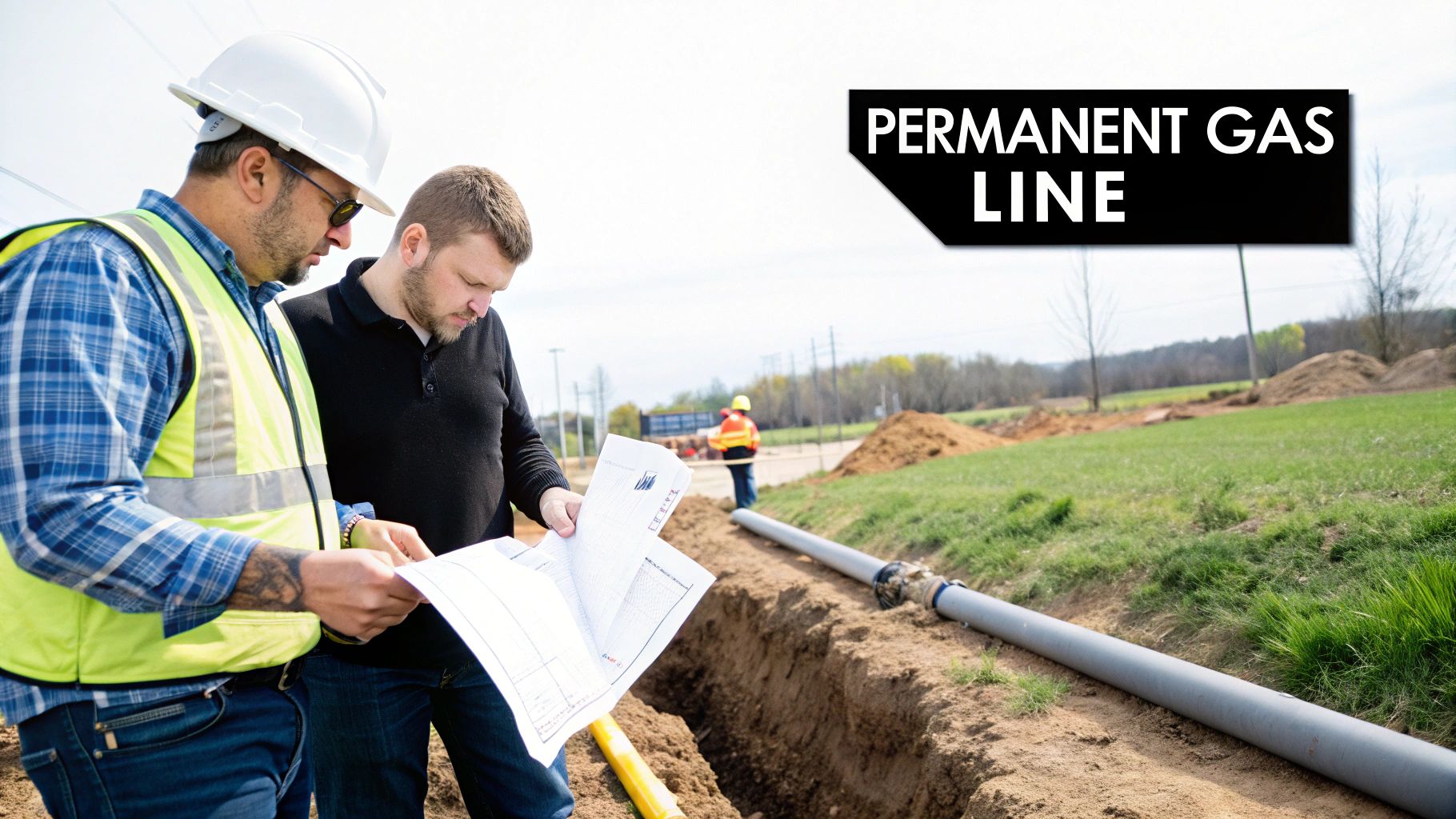
Once they have your package, the utility's engineers get to work. They'll look at what you need and compare it to their existing pipes in the ground to see if the local main can handle the new demand or if they'll need to do some upgrades.
From Paperwork to Pipeline
After your application gets the green light, the real work begins on-site. The utility maps out the route for the new service line, and this is where things can get complicated. As the property owner or contractor, it’s your job to make sure the path is completely clear.
This means tackling a few critical tasks:
- Easement Verification: The utility needs a legal right-of-way to install and later access the gas line. If the path they've planned cuts across a neighbor's property, you're looking at a negotiation to secure an easement. This alone can add weeks, or even months, to your project.
- Site Surveying: You'll need a precise survey to mark property lines and, just as importantly, locate any other utilities already buried underground. Getting this wrong is not an option—it’s both expensive and incredibly dangerous.
- Trenching and Installation: In most cases, your crew will be responsible for digging the trench from the building all the way to the property line. The utility’s team then takes over to make the final connection, or "tap," into their main gas line.
When you're digging around existing utility lines, you have to be smart about it. Non-destructive methods are key; learning about techniques like hydro excavation is crucial for doing the job safely and precisely. Using the wrong approach can cause catastrophic damage and bring your entire project to a screeching halt with safety violations.
The Final Stretch: Meter Set and Inspection
With the line tapped and run to the building, you're in the home stretch. This final phase involves getting the meter set and passing inspection. The utility company won't even think about installing the meter until all of your interior gas piping is finished, pressure-tested, and officially signed off by a city inspector.
Here's a pro tip: Communication is everything. Don't just submit your paperwork and hope for the best. A quick, weekly check-in call with your utility coordinator can give you a heads-up on crew schedules or document requests. It’s the best way to keep small issues from snowballing into major delays.
From the day you submit your application to the day you have a live meter, you should realistically plan for three to six months. If major infrastructure upgrades are needed on the utility's end, it can take even longer. This is exactly why a temporary gas solution isn’t just a nice-to-have; it's a fundamental part of managing a modern construction project in Houston.
Using Temporary Gas to Bridge the Utility Gap
So, your project is ready to go. The building is up, the crews are on standby, but there's a major hold-up: you're still waiting on the utility company to set a gas meter. It’s an incredibly common—and expensive—headache for project managers in Houston, and it’s precisely where a temporary gas service transforms from a simple backup plan into a project-saving tool.
Instead of hitting pause for weeks or even months, a mobile gas provider can step in and fill that gap. The service is straightforward: a self-contained unit, usually filled with Compressed Natural Gas (CNG), is brought directly to your site and hooked into your building's existing gas piping. It's like having a portable power bank for your project's energy needs, ready to go when the grid isn't.
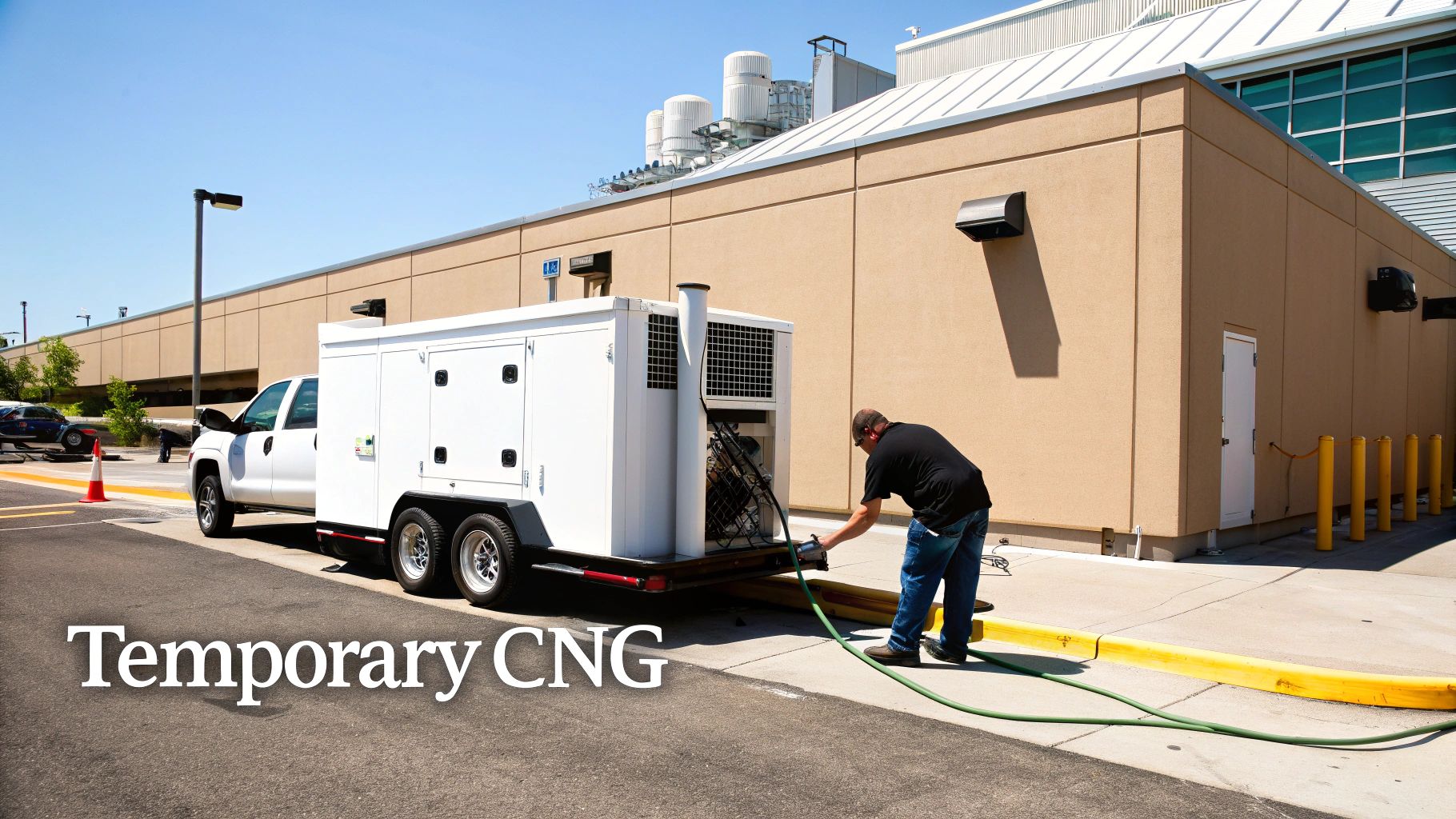
This approach gives you a reliable fuel source exactly when you need it. You can prevent costly downtime and keep your project schedule on track, without being at the mercy of the utility's timeline.
When Mobile Gas Becomes a Project Saver
The real value of temporary gas becomes crystal clear in a few critical situations that can easily derail a construction timeline. This isn't just about convenience; it's about avoiding real financial losses that stack up with every day of delay.
Here are a few scenarios where I've seen it make all the difference:
- Passing Final Inspections: You can't get that all-important Certificate of Occupancy until an inspector sees the HVAC systems, water heaters, and kitchen appliances fire up and run properly. Temporary gas lets you commission and test everything to nail that final walkthrough.
- Emergency Freeze Protection: A surprise Houston cold snap can spell disaster for a nearly finished building. It can damage fresh drywall, ruin finishes, and even burst water lines or fire-suppression pipes. Mobile gas can power temporary heaters immediately to protect your investment.
- Commissioning Backup Generators: You absolutely have to test your natural gas backup generators under a real load to prove they'll work during an outage. A temporary supply provides the fuel needed to run those essential tests.
In these moments, waiting simply isn't an option. A mobile gas provider like Blue Gas Express can often get a unit deployed within hours or days, turning a potential crisis into a manageable task.
How a Temporary Gas Service Works on Your Site
Getting a temporary gas solution integrated into your job site is a surprisingly simple process. Once you call a provider, their team will work with you to figure out exactly what you need—the amount of gas (your load), how long you'll need it, and at what pressure.
The technology itself is both robust and safe. A typical on-site setup involves:
- A Mobile CNG Trailer: A specialized trailer holding pressurized natural gas is delivered to your site.
- A Pressure Regulation Skid: This is the key piece of equipment that safely steps down the gas pressure from the trailer to match what your building's system is designed for.
- Secure Connection: A certified technician makes the final connection from the regulation skid directly to your building's main gas inlet.
The whole system operates as a closed loop, constantly monitored for safety and performance. When one CNG trailer starts running low, the provider simply swaps it out with a full one. This means you get an uninterrupted supply with zero effort from your crew.
Of course, a temporary solution comes with a cost, but it's crucial to weigh it against the alternative. While Houston's utility piped natural gas prices have stayed fairly stable—the average price per therm is around $1.49, which you can track on the Federal Reserve Economic Data website—the cost of a stalled project quickly eclipses it. When you factor in idle labor, extended financing, and lost revenue, temporary fuel often proves to be the far more economical choice.
Conquering Houston's Permitting and Inspection Maze
Getting your Houston gas service project across the finish line means navigating a world of permits and inspections. Let's be honest, this isn't just about paperwork. It's the final gatekeeper that determines if your project wraps up smoothly or gets bogged down in frustrating delays.
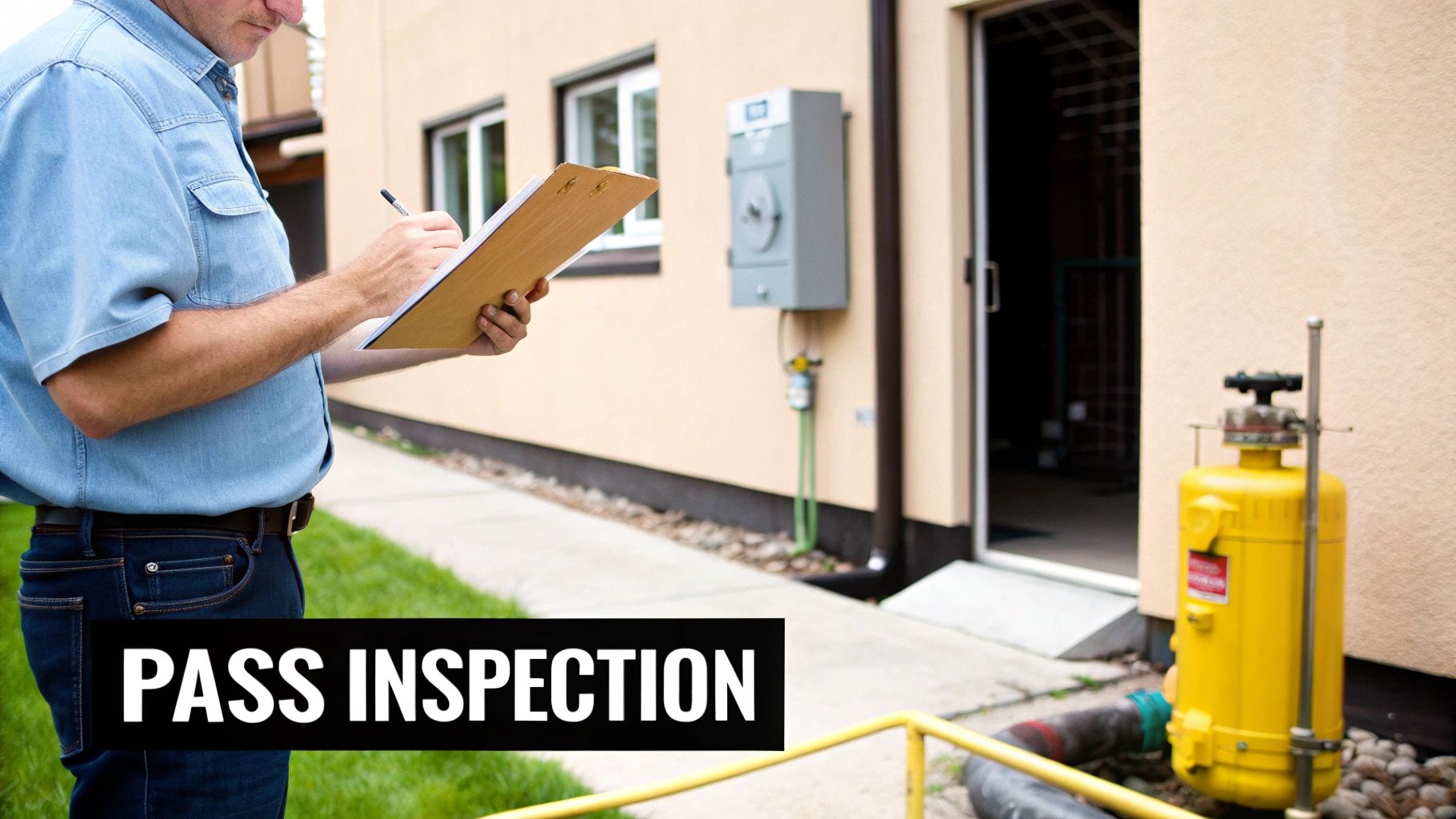
It doesn't matter if you're setting up a permanent utility connection or a temporary mobile gas solution—both are under intense scrutiny from city officials. For a permanent installation, you're looking at a mechanical permit for the gas piping and often another one for the meter set location. Temporary solutions like mobile CNG units operate under different rules, usually overseen by the Houston Fire Marshal's office, where the focus is squarely on public safety and proper placement.
What Inspectors Are Really Looking For
When an inspector walks onto your site, they have a mental checklist they're running through. The number one priority for your building's internal gas piping is the pressure test. Your entire system gets pressurized with air, and it absolutely must hold that pressure for a set amount of time without any drop. It’s the definitive proof that you have a leak-free system.
But they don't stop there. They're also giving the physical installation a hard look:
- Proper Fittings: Are all connections made with approved materials and torqued down correctly?
- Correct Clearances: Is there enough space between your gas lines and any electrical wiring or other utilities?
- Support and Labeling: Is the gas line properly secured and clearly marked?
Understanding the local code is critical. Knowing the specific rules for things like gas cooktop installation permits and checks can save you a world of headaches. While the fine print might change from one city to another, the core principles of safety and solid workmanship are universal.
The inspector's job is to prevent future problems. Think of them not as an obstacle, but as a final quality control check that ensures the safety of the building and its future occupants. Passing the first time saves everyone time and money.
Avoiding Common Inspection Failures
A failed inspection costs more than just a re-inspection fee; it costs you time. Those delays can create a domino effect, throwing your entire project schedule and budget out of whack. A gas service hold-up can be as unpredictable as fuel costs. Think back to 2004, when Houston unleaded gas prices were about $1.667 per gallon. By late 2005, they had skyrocketed over 42% to $2.368 per gallon, a stark reminder of how quickly outside factors can inflate project expenses. You can dig into those historical fuel price shifts on the EIA website.
To make sure you pass on the first go, meticulously check these common trip-up points before scheduling your inspection:
- Improper Pipe Dope or Tape: Using the wrong sealant or applying it incorrectly is the top reason for those tiny, hard-to-find leaks that will fail a pressure test.
- Incorrect Appliance Connectors: Those flexible connectors aren't a one-size-fits-all solution; they have very strict limits on length and where they can be used.
- Missing Shut-off Valves: Every single gas appliance needs its own accessible shut-off valve. No exceptions.
- Failure to Protect Piping: Any line that runs through concrete or masonry has to be properly sleeved to guard against corrosion.
By getting out in front of these details, you can transform the inspection from a potential bottleneck into a smooth final step on the path to project completion.
Planning Your Budget and Timeline for Gas Service
If you're managing a project, you know that surprises are rarely good, especially when it comes to the budget. Getting a handle on the real-world costs and timelines for your Houston gas service is one of the most important things you can do to keep your project on track and avoid those costly surprises.
When you're tying into the permanent utility grid, the final bill can be all over the map. The biggest cost drivers are pretty straightforward: how far is your building from the main gas line? What kind of terrain do we have to cross to run the pipe? And what are the city's impact fees going to be? The longer the run and the more complicated the trenching, the more you can expect to pay.
What Does a Temporary Gas Solution Really Cost?
Figuring out the budget for a temporary mobile gas setup is much more predictable, which is a huge relief for most project managers. The pricing usually boils down to three core components, so you know exactly what you’re paying for.
- Deployment and Setup: Think of this as the initial, one-time charge. It covers getting the CNG unit delivered to your site and having a certified tech handle the professional, safe hookup to your building’s plumbing.
- Equipment Rental: This is your ongoing fee for having the CNG trailer and the necessary pressure regulation gear on-site. It's typically billed on a daily, weekly, or monthly schedule, depending on your needs.
- The Gas Itself: Simple enough—you only pay for the natural gas you actually burn. This is measured in Cubic Feet (CF) or British Thermal Units (BTUs) and will fluctuate based on your day-to-day operations.
It might feel a bit strange to add a "temporary fuel" line item to your budget, but it's a smart, strategic play. The cost of bringing in a temporary gas solution is almost always a drop in the bucket compared to the money you lose from construction delays, crews standing around with nothing to do, and pushing back your opening day.
It really comes down to a simple calculation: what's the daily cost of your project being dead in the water versus the daily cost of a temporary gas service? Nine times out of ten, the ROI on keeping the work moving forward is massive.
Getting Real About Timelines and Market Swings
Time is money, and knowing your project's timeline is just as critical as knowing the costs. If you're going the permanent route with a utility meter, you need to brace for a 3-6 month wait from the day you apply to the day the gas is flowing—and that’s if everything goes smoothly. On the flip side, a temporary mobile gas provider can often get you fired up and running in just a few days to a week.
You also have to keep an eye on the bigger picture. The price of natural gas is one thing, but volatility in the broader energy market can throw a wrench in your overall project budget. For example, we've seen significant swings in local gasoline prices; the Consumer Price Index for unleaded regular in Houston dropped by about 7.4% over one recent 12-month period. You can dig into these kinds of numbers on the U.S. Energy Information Administration data portal. Fluctuations like that just underscore why it's so important to lock in predictable costs wherever you can. Building these variables into your schedule from the start is what separates a well-managed project from a chaotic one.
Your Houston Gas Service Questions Answered
When you're knee-deep in a complex construction project, the last thing you need is guesswork. Getting Houston gas service set up can throw a wrench in the tightest of schedules, and I’ve seen it stall more than a few jobs. Let's cut through the noise and tackle the questions I hear most often from project managers on the ground.
How Long Does It Really Take to Get a New Gas Meter in Houston?
This is the million-dollar question, isn't it? The honest answer is: it depends.
If you're lucky—meaning a straightforward commercial job with easy access to the main line and every piece of paperwork perfectly in order—you could be looking at a new meter in as little as 4 to 8 weeks after the utility signs off.
But let's be realistic. That's the best-case scenario. More often than not, something complicates things. Maybe your project needs a main line extension, or you hit a snag with an easement on a neighboring property. In those cases, the timeline can stretch out to 3 to 6 months, and frankly, I've seen it take longer when the utility crews are swamped. This is precisely why a temporary gas plan has become a non-negotiable part of smart project management in Houston.
What's the Number One Cause of Utility Gas Line Delays?
While a missing form can slow you down at the start, the biggest delays are almost always things you have zero control over. The single biggest bottleneck? The utility's own crew schedule. There are only so many qualified crews available to run taps and set meters. In a city growing as fast as Houston, demand often burns through that supply, creating a serious backlog.
The other major chokepoint is securing legal easements. If the gas line has to cross someone else's property, you need a signed legal agreement. That process alone can add months of negotiations to your timeline before you can even think about breaking ground.
A seasoned project manager never just hopes for the best. They build their schedule assuming the utility will take the maximum estimated time, not the minimum. It's about planning for reality, not the ideal.
Can I Really Use Temporary Gas for My Final Building Inspection?
Yes, you absolutely can. In fact, this is one of the smartest ways to use a mobile gas service.
Think about it: an inspector can't issue a Certificate of Occupancy (CO) until they see the building's essential systems—HVAC, water heaters, backup generators—fire up and run properly. If you’re waiting on that permanent meter, your entire project grinds to a halt right at the finish line.
A temporary mobile gas solution completely bypasses this holdup. A CNG unit hooks right into your building’s plumbing, feeding every appliance just like a permanent line would. This lets you commission all the equipment, schedule your final inspections, and get that all-important CO. You can hand the keys over to the owner without being at the mercy of the utility's schedule.
When delays just aren't an option, you need a partner who can bridge that gap. For immediate and reliable temporary gas solutions across the Houston area, Blue Gas Express is ready to help. We deliver the fuel you need to keep your project moving and protect your budget. Find out more about our rapid deployment services.