

At its core, an energy data management solution is a system that gathers, organizes, and analyzes all your energy usage information, turning a flood of raw numbers into clear, practical insights. Think of it less like a spreadsheet and more like a smart dashboard for your entire energy footprint. It gives you a complete picture of how, when, and where your operation is using energy.
This clarity is what allows you to make smarter decisions, cut down on waste, and make your energy supply far more reliable.
Why Energy Data Is Your Most Valuable Asset
Picture this: you're managing a major construction project on a tight schedule, and an unexpected delay with the natural gas line threatens to halt everything. This is a classic example of a huge challenge many industries face—energy uncertainty. When you don't have a solid grasp of your energy needs and consumption patterns, you're essentially operating in the dark. You're vulnerable to disruptions that can blow up timelines and budgets.
This is where energy data management solutions come in. They turn that uncertainty into a real strategic advantage. Instead of just reacting to problems as they pop up, you can get ahead of them and manage your resources with confidence. These platforms become your single source of truth, pulling in data from every corner of your operation, whether it's a mobile generator on a job site or a permanent meter in a factory.
Turning Raw Data into Strategic Advantage
The real magic happens when these systems translate abstract data points into tangible improvements on the ground. They deliver the kind of insights that help you keep projects moving, avoid expensive overruns, and maintain momentum. For example, the data might uncover an inefficiency you never knew you had, or it could help you forecast future energy needs with impressive accuracy.
This kind of foresight helps businesses:
- Optimize Resource Allocation: Pinpoint exactly how much temporary energy you need and for how long, so you're not paying for fuel you don't use.
- Enhance Predictive Maintenance: Keep an eye on equipment performance to catch potential failures before they cause costly downtime.
- Improve Budgeting and Forecasting: Leverage past data to build incredibly accurate energy budgets for upcoming projects.
This move toward data-driven energy decisions isn't just a fleeting trend; it's a major shift in the market. The global energy management systems market is expected to grow to an incredible USD 84.34 billion by 2029, largely because of rising energy costs and the urgent need for better efficiency. In North America alone, the market is projected to capture a 32.80% share by 2026, which points to a massive opportunity for companies to get ahead of the curve. You can discover more insights about this growing market and its impact on energy solutions.
By putting your energy data to work, you can transform a potential crisis into a predictable, manageable part of the plan. This creates the kind of stability needed to succeed in demanding fields like construction, manufacturing, and utility operations.
In the end, it's about shifting from a reactive, crisis-management mode to a proactive, strategic one. It’s what keeps your projects on track and on budget, no matter what hurdles you face.
Deconstructing an Energy Data Management Solution
To really get what an energy data management solution is, think of it as the central nervous system for your entire operation. It’s not just one piece of software; it's a living system that senses what's happening, remembers the past, processes information, and helps you act.
Each part of this system has a specific job, working together to turn raw numbers into a serious advantage. This is how you maintain operational continuity, get a handle on costs, and keep your projects moving. Let’s pull back the curtain and look at the five building blocks that make it all work.
The Five Core Components of Energy Management
This framework shows you the journey data takes from a sensor in the field to a decision-maker's screen, becoming more valuable at every stage.
Data Acquisition (The Senses): This is where it all begins—gathering the raw energy data right from the source. Think of this layer as the eyes and ears of your operation. It pulls in real-time information on consumption, flow rates, and pressure using tools like SCADA systems on heavy machinery, Advanced Metering Infrastructure (AMI) for utility grids, or IoT sensors on mobile gas units.
Data Storage (The Memory): Once you've collected all this information, it needs a safe, organized place to live. This is the system's long-term memory. It could be a dedicated on-premise data warehouse if you need total control, or a flexible cloud repository that your team can access from anywhere. The whole point is to create a single source of truth for all your energy data, both past and present.
Data Processing (The Spinal Cord): Let's be honest: raw data is messy. It's often inconsistent, full of gaps, or just plain wrong. The processing stage acts like the spinal cord, cleaning up the signals before they reach the brain. Here, the data is scrubbed, standardized, and structured, turning a chaotic flood of numbers into a clean, coherent format that's actually ready for analysis. Without this step, your insights would be built on a shaky foundation.
Data Analytics (The Brain): This is where the magic happens. The analytics engine is the brain of the operation, using algorithms, AI, and machine learning to dig into your processed data. It finds the hidden patterns, flags anomalies, forecasts future demand, and points out efficiency gains a person could never spot on their own. For example, it could predict a looming fuel shortage for a temporary generator, triggering a proactive delivery from a provider like Blue Gas Express.
Data Visualization (The Voice): All those brilliant findings are useless if no one can understand them. Visualization gives the system its voice. It translates complex datasets into simple dashboards, charts, and reports that make perfect sense. This gives facility managers and executives a quick, at-a-glance view of what's happening, so they can spot trends and make smart decisions without needing a Ph.D. in data science.
The diagram below shows how getting these components right gives you a strategic edge, boosting continuity, cost control, and overall momentum.
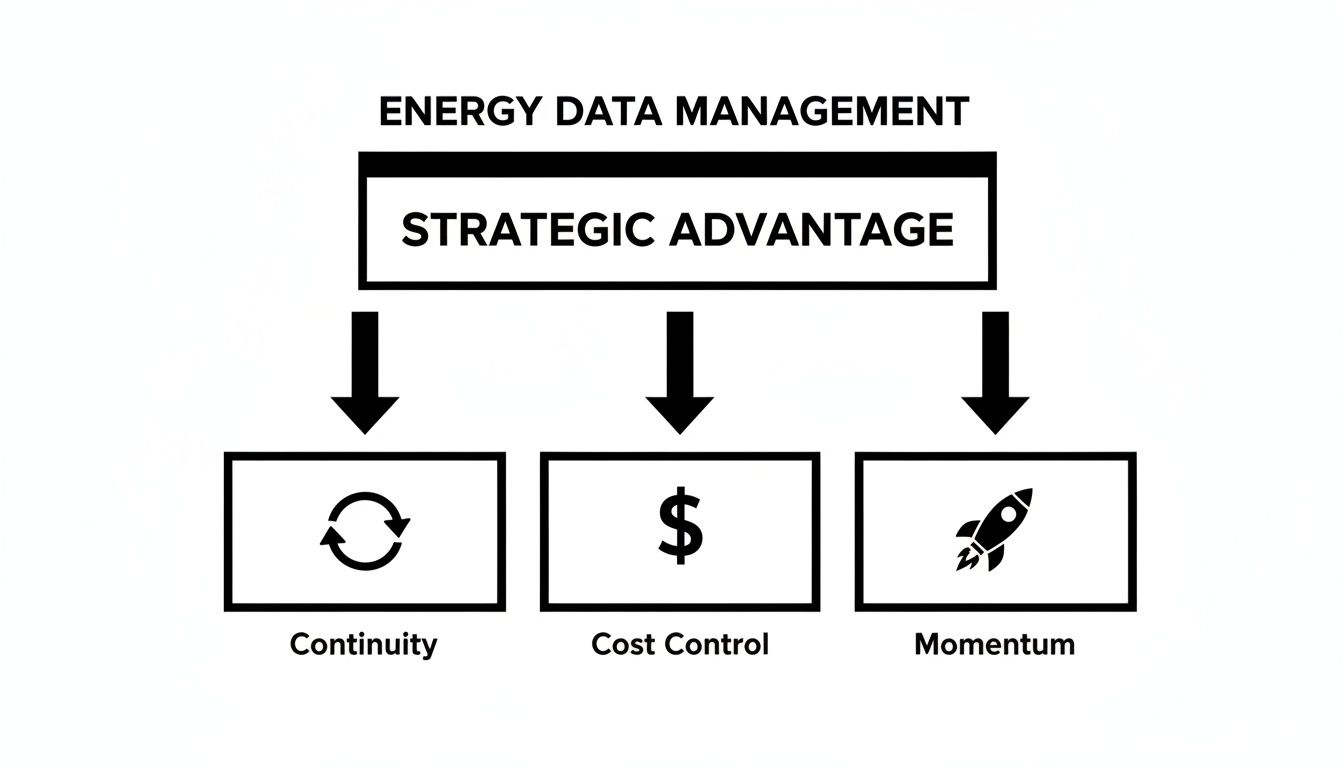
This really drives home the point that the goal isn't just to hoard data. It's about turning that data into real business outcomes that keep your projects on schedule and within budget.
A well-built energy data management solution creates a clear path from raw input to strategic action. It’s not about drowning your team in numbers; it's about getting the right insights to the right people at the right time.
By understanding these five pillars, you can see how an energy data management solution works as a complete, cohesive system. It’s built to empower your organization, giving you the clarity and foresight to manage the tricky world of modern energy supply and demand.
What Really Matters: The Features That Deliver a Payback
Knowing the nuts and bolts of an energy data management solution is one thing, but the real magic happens in its features. These are the tools that actually turn raw data into smart decisions, moving you from just watching your energy use to actively controlling it. Think of it this way: the components are the engine, but the features are the steering wheel, accelerator, and brakes—they give you control.
This is where your ROI comes from. These features are the workhorses that save you money, head off disasters before they happen, and make your entire operation run smoother day in and day out.
Going From Watching to Predicting
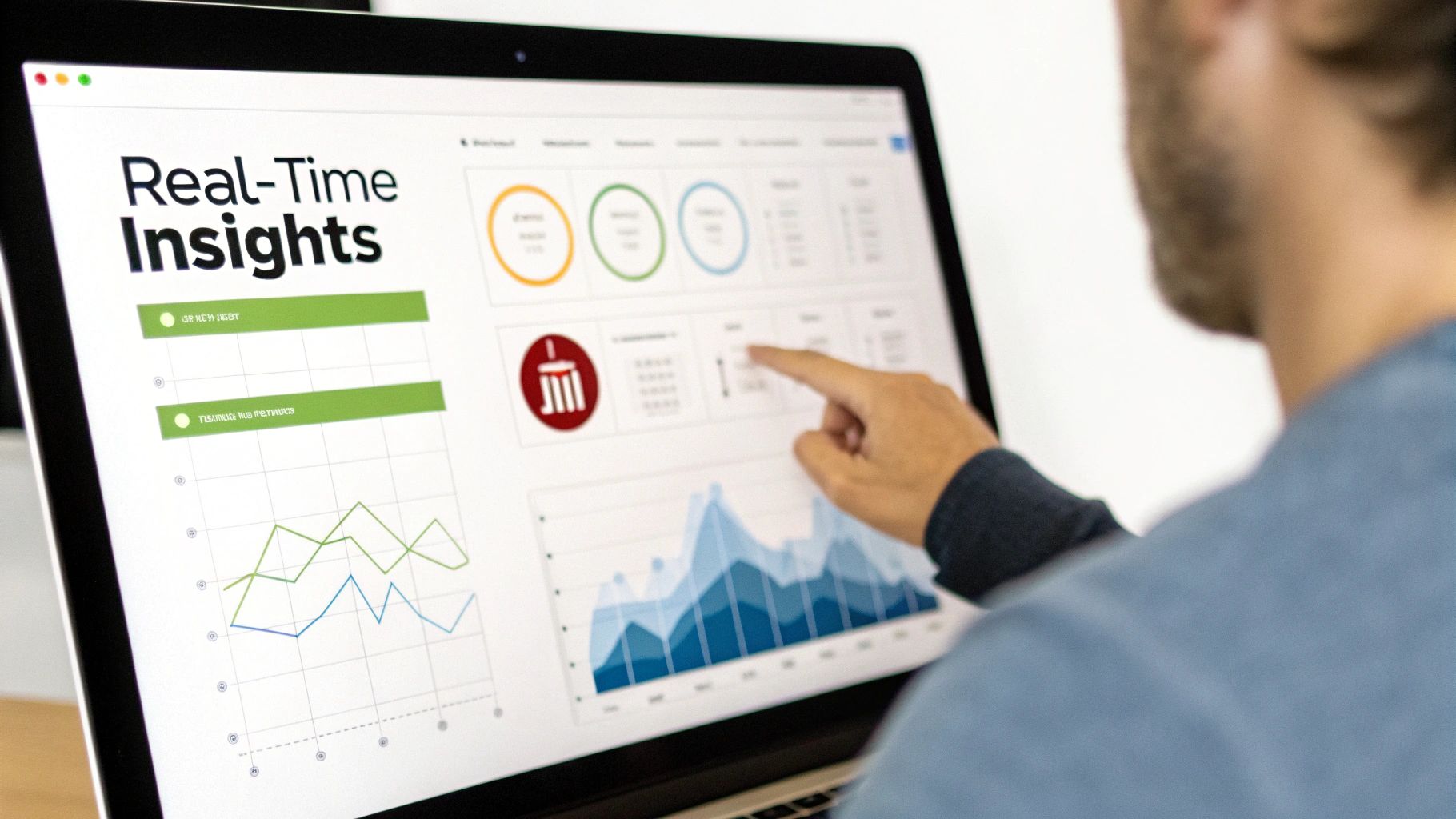
At its most basic level, every good system starts with real-time monitoring. This is your live dashboard, showing you exactly what’s happening with your energy consumption right now. Without it, you’re flying blind and only find out about problems long after the damage is done and the money is spent.
The next step up is automated alerts, which act like a built-in watchman. If a generator on a construction site suddenly starts guzzling fuel or a piece of equipment goes haywire, the system instantly pings the right person. This allows a project manager to step in and fix a minor issue before it balloons into a major expense.
The most sophisticated platforms take it even further with predictive analytics. By analyzing past data with AI, these systems can forecast what you’ll need tomorrow, next week, or next month. For a gas utility planning pipeline repairs, this means anticipating a temporary spike in demand and arranging a mobile LNG delivery well in advance, ensuring customers never even notice a hiccup.
The move from simply monitoring to actively predicting is the key to unlocking real control. It’s the difference between reacting to problems and preventing them altogether.
Keeping Score and Tracking What Counts
You can't improve what you don't measure. That’s where benchmarking tools come in. They let you compare performance across different job sites, facilities, or even against industry-wide averages. This is how you answer crucial questions like, "Is our new residential development more energy-efficient than our last one?"
This naturally leads to tracking specific Key Performance Indicators (KPIs) that tell a much deeper story than just dollars and cents. These are the metrics that reveal the true health of your energy operations.
- Energy Use Intensity (EUI): A classic metric that measures energy consumption per square foot, giving you an apples-to-apples way to compare different buildings.
- Peak Demand Reduction: This tracks how well you’re shifting energy use away from the most expensive times of the day, which can have a massive impact on your utility bills.
- Carbon Footprint: More than just a number, this tracks your environmental impact, which is critical for meeting sustainability goals and complying with regulations.
The demand for these tools is exploding for a reason. The energy management software market is expected to jump from USD 16.9 billion in 2025 to a staggering USD 40.5 billion by 2035. Why? Because the results are undeniable—some systems have been shown to slash utility bills by 25–40%. To make sure you get those kinds of results, it's vital to build your system using solid data engineering best practices for scalable systems.
Must-Have vs. Nice-to-Have Features by Industry
Not every feature is critical for every industry. A construction firm has different priorities than a large industrial plant or a gas utility. This table breaks down what’s essential versus what’s a helpful extra for different sectors.
| Feature | Construction & Residential | Industrial Facilities | Gas Utilities |
|---|---|---|---|
| Real-Time Monitoring | Must-Have | Must-Have | Must-Have |
| Automated Alerts | Must-Have | Must-Have | Must-Have |
| Predictive Analytics | Nice-to-Have | Must-Have | Must-Have |
| Benchmarking | Must-Have | Nice-to-Have | Nice-to-Have |
| Carbon Tracking | Nice-to-Have | Must-Have | Must-Have |
| Mobile Access | Must-Have | Nice-to-Have | Nice-to-Have |
| API Integration | Nice-to-Have | Must-Have | Must-Have |
Focusing on the "Must-Have" features for your specific industry ensures you invest in a solution that addresses your most pressing operational challenges first, delivering the fastest and most meaningful return.
How Real Businesses Get Tangible ROI
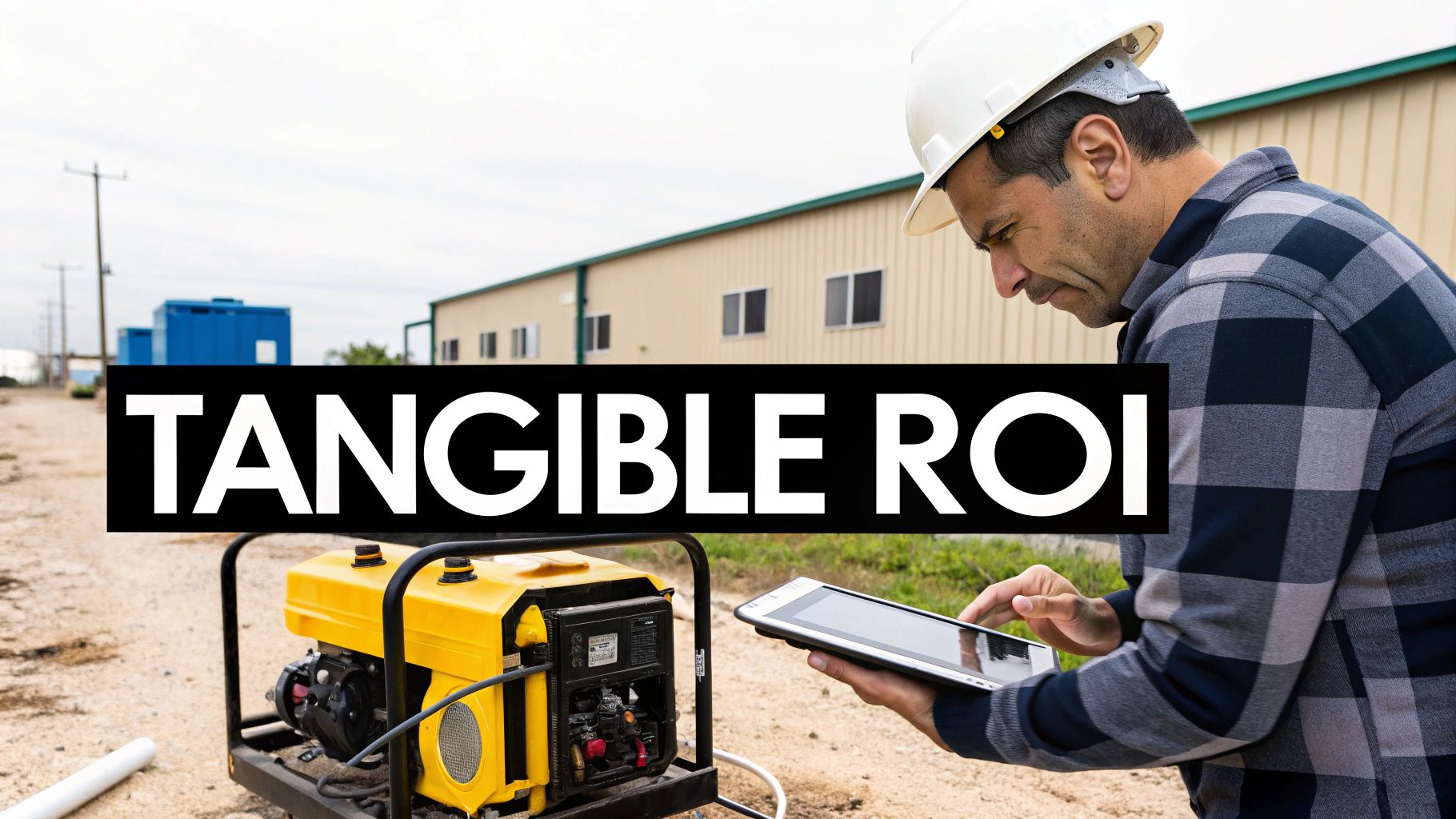
It's one thing to talk about the theory of energy data management solutions, but it’s another to see how they actually make a difference on the ground. This is where the data on a screen translates into real-world outcomes—dollars saved, deadlines met, and costly disruptions avoided.
The return on investment isn't some abstract concept. It's found in the day-to-day grind of optimizing resources and preventing problems before they start. Let's look at a few real-world scenarios where companies are using energy data to get a serious competitive edge.
Case Study 1: Keeping a Construction Project on Track
Picture a large residential developer. They're in the final stretch of building a new community, but there's a problem. An unexpected utility delay means the natural gas line won't be installed for weeks, but they need gas now to commission the generators. Without that, they can't get their occupancy permit, and the whole project grinds to a halt.
This is a classic situation where a smart energy data platform, paired with a temporary energy provider, saves the day.
- The Challenge: Get a temporary gas supply to commission all equipment and secure the occupancy permit without derailing the project timeline.
- The Data-Driven Solution: Instead of guessing, the developer uses their management platform to calculate the precise energy load needed for commissioning. They share this data with a mobile gas provider like Blue Gas Express, who can then deploy a perfectly sized temporary CNG (Compressed Natural Gas) unit.
- The Tangible ROI: The developer monitors the CNG unit's performance in real time, ensuring a smooth, uninterrupted commissioning process. They get the occupancy permit on schedule, avoiding tens of thousands of dollars in delay penalties and lost revenue.
This is a perfect example of risk mitigation. The cost of the data platform and temporary energy is a tiny fraction of what a stalled project would have cost them.
Case Study 2: Sidestepping Peak Demand Charges in Manufacturing
Think of a manufacturing plant in the Southeast, where summer heatwaves can make or break their budget. The local utility announces a peak demand event—electricity prices are about to go through the roof for a few hours in the afternoon. Shutting down means lost production, but running through the peak event would incinerate their profit margin.
Fortunately, their energy management system saw this coming. By analyzing historical usage and weather forecasts, the system flagged the high-risk period days in advance.
- The Challenge: Avoid crippling peak demand charges without halting the production line.
- The Data-Driven Solution: The analytics platform forecasts the exact energy shortfall needed to get through the peak event. The plant proactively schedules a mobile LNG (Liquefied Natural Gas) delivery to supplement their power, seamlessly switching over to reduce their pull from the grid.
- The Tangible ROI: The plant completely avoids the sky-high tariffs, saving a small fortune on its utility bill. Even better, it prevents hours of costly downtime, keeping production humming and customer orders on schedule.
This kind of proactive strategy is quickly becoming the new normal. The utility analytics market is expected to explode from USD 3.84 billion in 2024 to an incredible USD 20.46 billion by 2035. This growth is all about demand for tools that provide second-by-second data for peak shaving and coordinating power sources to ensure zero interruptions. You can learn more about these investment trends in the utility analytics market.
Case Study 3: Ensuring Uninterrupted Utility Service
A regional gas utility has to perform critical maintenance that requires shutting down a primary pipeline for a few days. In the past, this would have meant cutting off service to an entire commercial district, triggering a flood of angry customer calls and maybe even regulatory fines.
Today, they manage the entire operation through a centralized data platform. The system models the exact energy demand of every affected customer, allowing the utility to deploy a fleet of temporary mobile gas units across the area. This effectively creates a virtual pipeline that keeps everyone online.
By monitoring consumption at each temporary unit, the utility can ensure a balanced and reliable supply until the main pipeline is back in service. What used to be a high-stakes, high-risk project is now a routine, zero-impact event.
Selecting and Implementing the Right Solution
Picking the right energy data management solution isn’t really about finding a single perfect piece of software. It’s about finding the right partner for your specific operational goals. A system that’s a game-changer for a massive industrial campus would likely be total overkill for a series of temporary construction sites.
To make the right call, you need a clear framework for weighing your options and a solid plan for putting the new system into action. The whole process starts with asking the right questions. Before you even sit through a product demo, your team needs a crystal-clear picture of what success looks like. This is where a detailed checklist becomes your best friend, making sure you cover all the bases, from technical specs to long-term support.
Your Essential Selection Checklist
Think of this as an interview for your potential technology partner. Their answers will tell you more than just what the software does; they’ll reveal how it will actually fit into your daily workflow and grow with you down the road. A huge part of this is figuring out how to choose the right Energy Management Solution for the unique world you operate in.
Here are the key questions to put to every vendor:
- Scalability: Can this system grow with us? Will it handle data from five temporary gas units today and fifty next year without breaking a sweat?
- Integration: How well does it play with others? Can it pull data from our SCADA systems, smart meters, and mobile IoT sensors without needing a massive IT project?
- Security: How are you protecting our data? You need to ask about encryption, who can access what, and how they comply with industry security standards.
- Support: What happens when something goes wrong? Is help available 24/7? What’s the real-world response time for a critical issue?
- User Experience: Is this thing actually easy to use? Can a site manager pull a quick report without needing a degree in data science?
Getting straight, confident answers here will help you cut through the marketing fluff and find a solution that’s truly built to solve your problems.
A Four-Phase Implementation Roadmap
Once you’ve made your choice, the real work begins. A phased implementation is, without a doubt, the best way to ensure a smooth rollout, minimize disruption, and get your team on board from day one. Trying to rush it is a classic recipe for poor user adoption and squandered potential.
A successful implementation isn’t just about flipping a switch. It’s a methodical process of aligning technology with your people and your goals, ensuring the solution delivers real value from the start.
Breaking the project down into manageable stages makes the whole thing feel less overwhelming and dramatically increases your odds of success.
Phase 1: Assessment and Goal Setting
Before a single piece of hardware is installed, you need a baseline. Get your key people in a room—from IT specialists to on-site project managers—to map out current energy use, pinpoint the biggest headaches, and define what you’re actually trying to achieve. Are you looking to slash fuel waste on job sites, dodge peak demand charges, or get better at forecasting temporary energy needs? Clear, measurable goals set here will be your North Star for the entire project.
Phase 2: Vendor Selection and Pilot Program
Using your checklist, narrow the field and pick your partner. But before you go all-in, launch a pilot program at a single site. This controlled test run is your chance to work out any kinks, prove the system’s value, and get honest feedback from the frontline folks who will be using it every day.
Phase 3: Full-Scale Rollout and Integration
Armed with lessons from the pilot, you can now move forward with confidence. This is where you deploy the solution across all targeted locations and connect it with your other essential business systems. Solid project management and constant, open communication between your team and the vendor are absolutely critical to keeping everything on track.
Phase 4: Team Training and Ongoing Optimization
A tool is only as good as the person using it. This final phase is all about thorough training, making sure everyone on your team understands how to get the most out of the new system. But remember, implementation isn't a one-and-done deal. It’s a living process. You’ll need to regularly review your KPIs, listen to user feedback, and work with your vendor to keep refining the solution to meet your ever-changing business needs.
So, What's the Next Step on Your Energy Journey?
We've walked through how modern energy management is so much more than just trimming your utility bill. It’s about taking the reins, building in reliability, and getting your entire operation ready for whatever comes next. The main takeaway is simple: good data turns energy from a wild, unpredictable cost into an asset you can actually manage.
For any business wrestling with energy uncertainty—whether it's a construction project facing delays or a facility dealing with an unstable grid—the smart play is to combine data-driven solutions with flexible energy sources. Think about it: pairing a powerful energy data management solution with on-demand mobile gas from a provider like Blue Gas Express gives you a truly resilient system. It's a setup that can handle almost any curveball, making sure you have the power you need, right when and where you need it, all while giving you the insights to use it as efficiently as possible.
Turning Information into Real-World Action
The real magic happens when you move from just looking at data to making confident, proactive decisions. When you can monitor your temporary fuel sources in real time and accurately predict what you'll need tomorrow or next week, you can sidestep the very disruptions that sink timelines and blow up budgets. This isn't a "nice-to-have" feature anymore; it’s a core part of smart operational planning.
Ultimately, this is about getting out of a reactive mindset. A solid energy data solution gives you the foresight to manage your resources strategically, giving you a serious operational and financial leg up on competitors still fumbling in the dark.
This is the perfect moment to take a hard look at your current energy strategy. Ask yourself how a dedicated data solution could help you nail your biggest operational goals. By making data the foundation of your energy management, you're not just securing project continuity and optimizing costs—you're building a more resilient, competitive, and successful business for the long haul.
Frequently Asked Questions
When you start digging into energy data management solutions, a lot of practical questions pop up. It's one thing to understand the theory, but what about the real-world nuts and bolts? Let's tackle some of the most common questions we hear about cost, timelines, and how these systems work with on-the-ground operations.
We'll clear up the details so you can see the path forward.
What Is the Typical Cost of an Energy Data Management Solution?
There’s really no one-size-fits-all price. The cost depends entirely on the scale of your operation and what you need the system to do. Most platforms today are offered as a subscription service (SaaS), so you're typically looking at a recurring monthly or annual fee, which avoids a massive upfront capital investment.
But here’s the most important part: the sticker price is less important than the return on investment (ROI). A system might seem expensive, but if it helps you slash fuel waste, prevent a single costly shutdown, or sidestep expensive peak demand charges, it can pay for itself many times over.
Don't get fixated on the line-item cost. Think of it as an investment in efficiency and resilience. The right platform isn't just an expense; it’s a tool that generates a clear financial payback.
Framing it this way helps you see the real value you're buying—smarter operations and a healthier bottom line.
How Long Does Implementation Take?
This all comes down to complexity. If you're running a pilot program at a single construction site, you could be up and running in a matter of weeks. It’s a great way to kick the tires and see how the system works in a controlled environment before going all-in.
A full-scale rollout across a dozen sites or an entire utility network is a different beast. That’s a project that could take several months. It involves plugging into all your existing systems—like SCADA or billing software—and training your team. That's why starting with a pilot is almost always the smartest move; it ensures the company-wide launch goes off without a hitch.
Can These Systems Integrate with Temporary Energy Sources?
Yes, absolutely. In fact, this is one of the most critical features for anyone who needs a complete, uninterrupted view of their energy usage. Modern energy data management platforms are built to be flexible, which means they can easily connect with temporary or mobile sources, like the CNG or LNG units used for pipeline maintenance or at construction sites.
How does it work? It's all about IoT telemetry. We place sensors on the mobile gas units that continuously report back on fuel levels, consumption rates, and equipment health in real-time. That data flows right into your central dashboard alongside everything else, giving you a single, unified view of both your permanent and temporary energy assets. You get a true 360-degree picture of your entire energy ecosystem.
Ready to gain complete control over your project's energy needs? Blue Gas Express provides the reliable, temporary natural gas solutions that integrate seamlessly with modern data management strategies, ensuring your operations never miss a beat. Discover how our mobile gas solutions can keep your project on schedule.