

Why do procurement teams spend weeks haggling over fifty cents per MMBtu in a gas pricing formula, only to sign take-or-pay and diversion clauses that can cost ten times as much during a single plant outage? That blind spot shows up across utilities, industrial plants, and large construction projects alike. Buyers treat the headline fuel price as the whole deal, while treating the rest of the contract as legal boilerplate.
An LNG supply agreement doesn't work that way. Every major clause functions like a checklist line with a direct volume, cost, or liability consequence attached to it. A low index multiplier won't protect your budget if you're locked into paying for gas you can't burn, absorbing demurrage charges at a congested port, or missing a regulatory methane filing because your supplier never guaranteed asset-level emissions data.
Reading each clause for its real commercial impact turns a dense contract into a clear risk ledger. Whether you're evaluating a multi-decade bulk cargo deal or arranging mobile fuel for a delayed utility hook-up, the headline price is only one line on the sheet.
Core Terms in an LNG Supply Agreement
An LNG supply agreement is a long-term contract in which a seller commits to deliver a set annual quantity of liquefied natural gas to a buyer under agreed timing, price, and delivery rules. These deals run for years because buyers need reliable fuel security and sellers need bankable volume commitments to finance capital-intensive liquefaction plants.
Market activity shows how strongly buyers still lean on multi-year commitments. According to the International Energy Agency's Global Gas Security Review 2024, contracts lasting at least 10 years represented approximately 85% of LNG volumes contracted globally from the beginning of 2023. The scale of individual deals has climbed alongside contract length: in 2023, agreements larger than 4 billion cubic meters per year accounted for 57% of contracted LNG volumes, the largest share for contracts of that size since 2017. Long commitments remain standard in new procurement as well, illustrated by a Cheniere Energy announcement detailing Petrobras's 2026 agreement to purchase approximately 0.8 million tonnes per annum of LNG from Cheniere Marketing under a 22-year free-on-board supply agreement.
The Seven-Line Commercial Checklist
Before you compare competing offers, map every term onto a single reference sheet so nothing hides behind an attractive base price.
| Term | What it sets | What the buyer should check |
|---|---|---|
| Annual contract quantity | Volume the seller must deliver each year | Whether volume can be reduced, made up, or carried forward |
| Take-or-pay percentage | Share of annual volume the buyer pays for even if it doesn't lift the LNG | The payment floor, downward tolerance, and make-up terms |
| Pricing formula | How the delivered LNG price is calculated | The index, slope or percentage, fixed adder, averaging period, and fallback method |
| Delivery point and risk transfer | Where title, custody, and risk pass to the buyer | Who bears demurrage, loss-of-cargo, and scheduling risk |
| Destination rights | Whether cargoes can be redirected to another market or terminal | Notice periods, diversion charges, profit-sharing, and terminal compatibility |
| Term length | How long the supply commitment runs | Whether the term matches the project timeline and the buyer's exit options |
| Emissions data | Evidence of upstream methane performance | Audit rights, reporting evidence, late-data remedies, and whether environmental attributes transfer |
Treat this seven-row grid as your master checklist for evaluating any draft contract. Each row ties directly to cash flow or operational continuity, and the pricing formula is just one of seven lines that decide what your gas costs.
Volume Commitments and Take-or-Pay Obligations
A take-or-pay obligation works like an annual gym membership paid every month whether you walk through the doors or stay home. You are reserving supply, but you are also guaranteeing the seller revenue. That guarantee is why the clause deserves the same attention as the quoted commodity price.
In long-term LNG contracting, a buyer agrees to an annual contract quantity (ACQ) paired with a minimum payment floor. Buyers are commonly required to pay for most of that annual quantity. Some agreements set the requirement at 100%, even when the buyer does not lift the cargo. Sellers use that structure because it shifts demand and use risk to the buyer, giving lenders revenue certainty for liquefaction trains, LNG carriers, and regasification terminals. In practical terms, the headline price answers one question. Take-or-pay answers a different one: what you owe when your facility, terminal, or market need falls short.
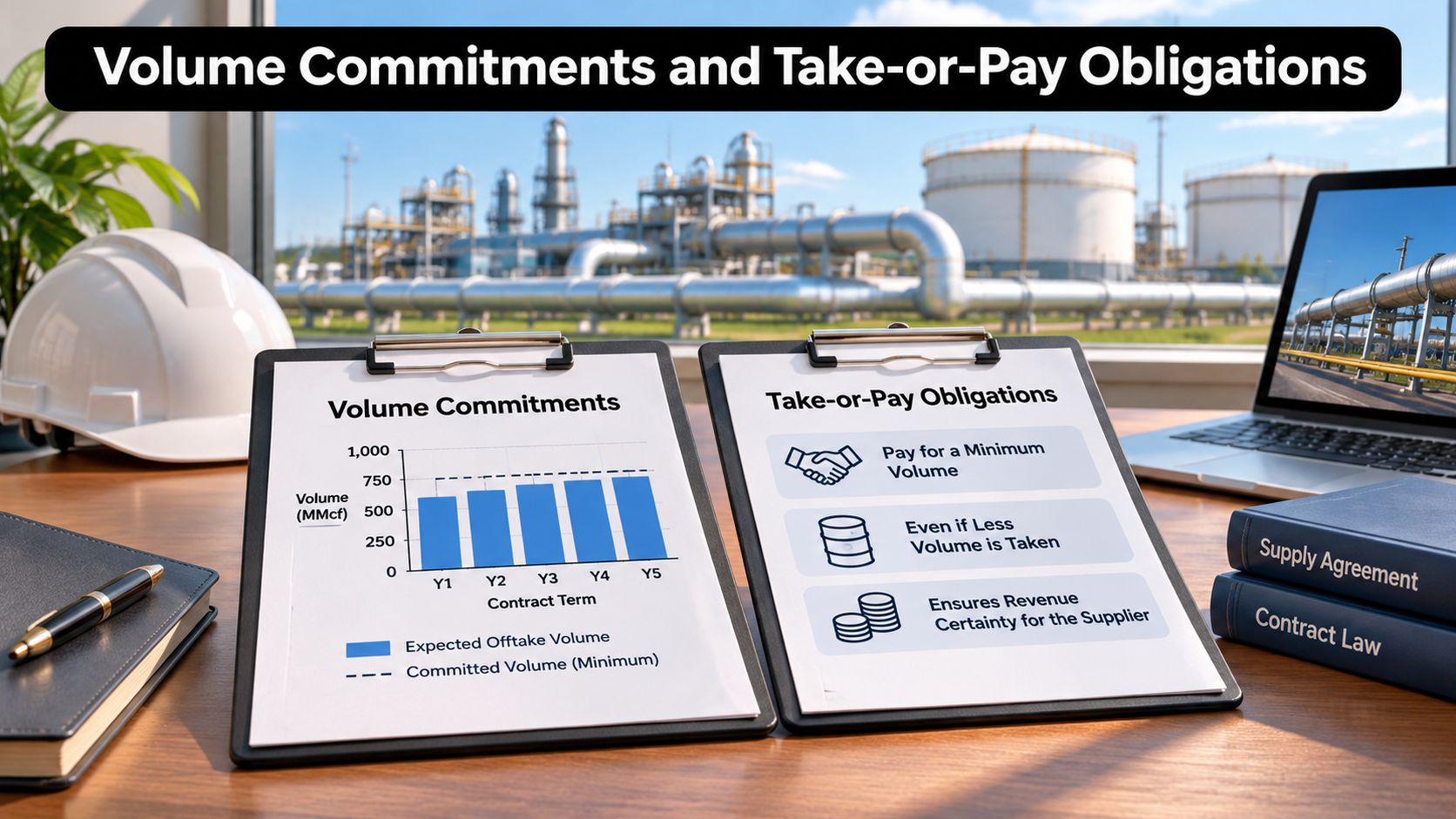
How an Outage Tests Your Volume Relief Clauses
Consider a manufacturing facility or regional utility that signs a multi-year contract, then suffers an unplanned 12-month equipment outage that cuts gas consumption in half. Without strong relief language, the buyer can face a bill for fuel it cannot receive, store, or burn. The contract has now turned physical disruption into a cash obligation.
Four mechanics decide whether that outage becomes a temporary cash-flow timing issue or a permanent financial loss:
- Annual downward tolerance: Lets you trim scheduled annual intake within a negotiated band before take-or-pay charges apply. It creates room during mild winters or slower production runs.
- Make-up rights: Allows you to take gas you already paid for in a later contract year once operations return to normal, instead of forfeiting the payment.
- Carry-forward provisions: Credits excess volumes lifted in a high-demand year against future minimums, smoothing demand swings across years.
- Permitted resale or diversion rights: Gives you a legal path to send an unwanted cargo to another terminal or buyer. The contract must set notice windows, diversion fees, profit-sharing splits, and terminal compatibility.
The delivery point and shipping basis sit next to volume risk. Where title and custody hand over decides who pays demurrage when a vessel waits outside a terminal, who absorbs cargo loss in transit, and who bears scheduling penalties when a berth slips. Those lines can matter as much as the commodity charge, because they convert delays, mismatches, and operational friction into defined costs.
Practical rule: A slightly lower headline gas price rarely offsets a rigid take-or-pay floor paired with no make-up rights. Run your worst-case facility downtime scenario before you accept the annual quantity.
Volume Questions to Ask the Seller
Before locking in an ACQ, put five direct questions on the table during negotiations:
- How many contract years do we have to claim make-up gas after paying a take-or-pay invoice?
- Does make-up gas come at zero extra commodity charge, or do we pay the price difference if the index rises later?
- How far in advance must we notify you to exercise downward quantity tolerance or shift a delivery window?
- If we divert an unlifted cargo to another buyer, do you take a share of any resale margin?
- At which exact flange or port boundary do title, custody, and demurrage liability pass to us?
Read each answer as a checklist line with a volume, price, or liability consequence attached. Together, they show whether the supply deal fits your real operating pattern or only looks attractive before disruptions arrive.
Oil-Linked and Henry Hub-Linked Pricing Formulas
An LNG pricing formula doesn't just set today's bill. It picks which global commodity market drives your fuel budget for the next decade or two.
Most long-term agreements anchor the commodity charge to either crude oil or a natural gas trading hub. Market reporting from S&P Global Commodity Insights shows oil-linked contracts using a percentage slope to Brent crude, such as roughly 11.3% to 11.5% in one reported long-term procurement, while Henry Hub-linked structures commonly price at roughly 121% of Henry Hub plus a fixed adder near $4 to $4.30 per MMBtu. Major global buyers continue to sign hub-based deals at scale: according to a Cheniere Energy press release, QatarEnergy agreed in 2026 to purchase 4 mtpa of LNG from Cheniere under long-term agreements running through 2054, priced against Henry Hub plus a fixed fee.
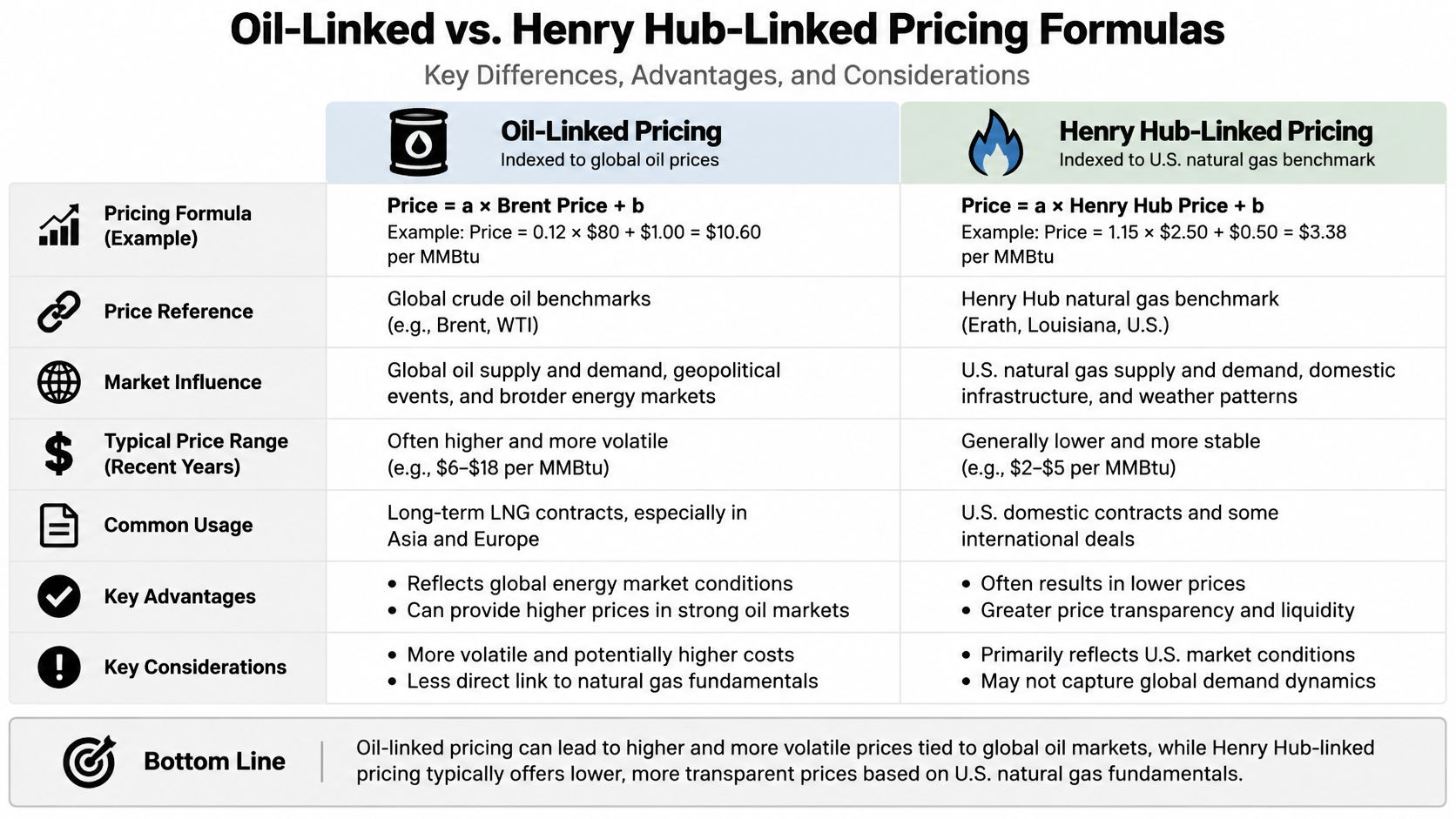
Side-by-Side Comparison of the Two Pricing Models
Putting the two formulas next to each other makes the risk trade-off obvious.
| Pricing feature | Oil-linked formula | Henry Hub-linked formula |
|---|---|---|
| Primary market driver | Brent crude oil prices | U.S. natural gas benchmark prices |
| Typical structure | Negotiated percentage slope multiplied by Brent | Percentage multiplier on Henry Hub plus a fixed liquefaction adder |
| Fixed cost cushion | Embedded inside the crude slope and any constant | Explicit fixed fee covering liquefaction capacity |
| Volatility profile | Moves with global oil supply shocks and OPEC policy | Moves with U.S. gas production, weather, and export feedgas demand |
| Best fit for buyer | Buyers whose revenues or competing fuels track oil | Buyers wanting direct exposure to North American gas fundamentals |
Look at how the math behaves in practice. Under a representative formula of 121% x Henry Hub + $4 per MMBtu, a $4.50 per MMBtu Henry Hub price produces an indicated LNG price of roughly $9.45 per MMBtu before any additional contractual adjustments. Because of the 121% multiplier, every $1 rise or drop in Henry Hub shifts your indicated LNG cost by $1.21 per MMBtu. Under an oil-linked contract, U.S. gas prices could sit flat all year while an oil rally pushes your delivered gas bill sharply higher.
Five Pricing Mechanics the Contract Must Nail Down
A clean formula still leaves room for expensive disputes if the supporting definitions are vague. Make sure the agreement explicitly specifies:
- The index publication: Name the exact reporting agency, ticker, or settlement price series so neither side argues over which benchmark quote applies.
- The averaging period: State whether the contract averages daily, monthly, or multi-month index prices prior to cargo loading or delivery.
- The fallback methodology: Define what replaces the primary index if a publication stops publishing or changes its calculation method mid-contract.
- Quality adjustments: Set heating value (BTU) tolerances and price adjustments if off-spec gas requires blending or nitrogen injection at the receiving terminal.
- Shipping and regasification treatment: State plainly whether ocean freight, boil-off gas, port fees, and regasification are bundled into the formula or passed through as separate line items.
Don't evaluate competing offers using today's forward curve alone. Run both formulas through multi-variable stress cases that move Henry Hub, Brent crude, ocean freight rates, liquefaction fees, and exchange rates at the same time so you see where your budget breaks first.
Flexibility Clauses and What They Really Cost
What does "flexible" cost you per MMBtu? Procurement teams often treat delivery options as free safety, asking for destination freedom and open scheduling without ever pricing who pays for those privileges. Every flexibility clause is a checklist line with a dollar figure attached, and the headline commodity price is only one line of that risk picture.
The market puts a measurable price on optionality, and it flows in both directions. According to a December 2025 GaffneyCline report prepared for the ACCC, buyers in South Korea and other markets in 2025 reportedly secured short-term LNG contracts at discounts of approximately $0.20 to $0.50 per MMBtu below the full-month JKM average, partly because they gave sellers flexibility over delivery dates and volumes. That same report shows a structural shift in how U.S. cargoes are contracted: 56% of U.S. LNG volumes sold in 2025 were indexed to Henry Hub, down from 67% in 2024, while more than 90% were sold under free-on-board (FOB) terms that push shipping and destination-management duties onto the buyer. Industry analysts broadly expect destination-free contracting and hub-indexed or hybrid pricing structures to keep gaining ground over pure oil indexation in the years ahead, so the flexibility question will only grow sharper for buyers.
Comparing Three Supply Structures on All-In Cost
The right question is not whether a contract looks flexible on paper. The right question is where the operational costs land once the ink dries.
- Fixed-destination delivered supply (DES): The seller arranges the vessel, manages ocean transit, and delivers LNG straight to your named terminal. You pay a higher headline commodity price and give up easy diversion rights, yet you avoid chartering LNG carriers, managing marine insurance, or absorbing transit delays yourself.
- FOB destination-flexible supply: You take ownership right at the export terminal loading arm and can send the cargo anywhere your terminal slots allow. The lower headline price can disappear fast once you layer in vessel chartering, boil-off losses, regasification fees, port balancing charges, diversion costs, and local destination-compliance paperwork.
- Portfolio-mediated supply: A global aggregator sources LNG from multiple liquefaction plants rather than a single export facility. You pay a portfolio margin for that cushion, which buys smoother cargo swaps when one plant trips offline, though you still need clear language on who absorbs incremental freight when the seller swaps a nearby cargo for a distant one.
A cheaper FOB quote isn't a bargain if your team lacks the shipping desk, terminal capacity, and balancing credit needed to move a cargo when freight rates spike.
Stress-Testing Whether You Can Use Your Options
Treat flexibility like an insurance policy you may never be able to cash in. Before paying extra for it, or accepting a discount in exchange for handing flexibility to your seller, work through three practical checks.
First, verify who owns each option in the exact contract language. A seller-held scheduling option can land cargoes at your terminal when your storage tanks are already full, converting the seller's convenience into your demurrage and balancing costs. Second, price the option explicitly by comparing all three structures on an all-in, risk-adjusted cost basis that includes freight, regasification, balancing, and potential take-or-pay exposure. The line items in the bullets above are exactly where that comparison should bite.
Third, test whether your right to divert or reschedule works under stress. Destination freedom looks great during a calm shoulder season, yet it loses value fast during terminal congestion, force majeure events, export-authorization limits, or tight shipping markets where spare LNG carriers aren't available at any reasonable charter rate. An option you cannot exercise is not flexibility. It is a premium you paid for nothing.
Emissions Data Clauses Buyers Now Negotiate
Two weeks before a statutory filing deadline, a regional gas utility holds a winter's worth of clean-burning cargoes and zero verified upstream methane measurements. Its supply contract contains only a two-line sustainability pledge: no deadlines, no audit rights, no financial recourse. The gas arrived. The data did not, and the compliance problem lands entirely on the buyer.
The lesson is simple: an LNG buyer now purchases two deliverables, the molecules and the measurement record behind them. The headline price covers only the first. According to an Oil & Gas News report on global LNG methane accountability, European Union methane rules require LNG importers to submit methane-related disclosures starting in May 2025, covering exporter identities, measurement and reporting methods, and mitigation practices, with new or renewed contracts importing into the EU required to meet equivalent monitoring standards at the OGMP 2.0 Level 5 benchmark once the regulation's contract-level obligations take effect. Because U.S. LNG exports play a growing role in European supply, those standards spill straight into global contract drafting. Even a cargo marketed as "lower-carbon" carries sharp commercial exposure if its carbon-intensity certificate rests on generic desktop estimates rather than independently verified, asset-level measurement. Non-compliance can jeopardize cargo admissibility, project financing covenants, insurance underwriting, and regulatory standing, none of which appear in the per-MMBtu quote you negotiated.
Six Emissions Clauses Buyers Are Adding to Drafts
Procurement teams no longer accept best-efforts wording. Treat each of the following six protections as a checklist line, and ask what volume, price, or liability consequence attaches if the line is missing:
- Audit rights: Contractual authority for the buyer or an accredited third party to inspect upstream measurement records and verify that reported numbers match field data. Without this line, the liability consequence is that you certify figures you cannot check.
- Measurement warranties: Binding representations from the seller that emissions figures follow an agreed methodology such as OGMP 2.0 Level 5 rather than unverified industry averages. A warranty converts a data error from your problem into a breach claim.
- Emissions-intensity thresholds: Hard numeric ceilings on methane slip or lifecycle greenhouse gas intensity per delivered unit. The volume consequence is direct: cargoes breaching the cap fail to count as conforming deliveries, so the seller still owes you compliant gas.
- Replacement cargo rights: The right to reject non-compliant cargoes or require the seller to substitute compliant supply. The price consequence sits in one phrase worth fighting for: the seller absorbs the extra freight and spot-market spreads, not you.
- Indemnities: Explicit allocation of financial liability covering regulatory fines, border adjustments, or administrative penalties caused by inaccurate or missing seller data. Vague wording here means the buyer self-insures the seller's reporting failures.
- Termination rights: An exit ramp if repeated monitoring failures leave the buyer unable to meet statutory import rules. This is the final liability ceiling, capping how long you remain chained to a non-compliant supplier.
Bridging Upstream Data to Downstream Reporting
Even if your facility sits downstream of the import terminal, connect upstream data duties to your own compliance calendar before signing. Write three specifics directly into the agreement.
First, name the exact documentation required for your regulatory reporting, including format and delivery deadline, because a certificate that arrives after your filing date is commercially worthless. Second, define the concrete financial or operational remedy when upstream data arrives late, whether that is a price credit, a delivery shortfall credit, or a suspension of your own reporting representations to authorities. Third, state unambiguously whether environmental attributes transfer alongside the physical LNG molecules or stay with the seller. That single line decides whether you can claim lower-carbon gas in your own disclosures or merely bought ordinary molecules with a marketing story attached.
Force Majeure, Termination and Dispute Terms
Everything runs smoothly while liquefaction plants stay online and ships arrive on time. The clauses at the back of an LNG supply agreement decide who absorbs the financial hit the day supply stops.
Consider a buyer whose scheduled cargo is held back for three weeks by a major mechanical failure at an export liquefaction plant. The buyer's immediate question isn't abstract legal theory. It's whether take-or-pay billing pauses automatically during the outage or keeps accruing until a formal notice window closes.
Five Back-End Clauses That Reshape Financial Exposure
Review these five provisions side by side before finalizing any long-term contract:
- Force majeure scope and billing impact: Spell out which events qualify, including export restrictions, liquefaction plant outages, and severe weather, and exclude routine economic hardship or poor maintenance. For a closer look at how courts interpret excusable delays, see Kons Law's force majeure clause explained, then verify whether your LNG draft explicitly suspends take-or-pay obligations while supply is halted.
- Notice timelines and long-stop exits: Set strict clock limits on how quickly the affected side must notify the other party after an event starts, and define how long a continuous disruption can last before either party gains the right to walk away without penalty.
- Termination triggers and cure periods: List objective default events such as missed invoices, sustained underdelivery, trade sanctions, and change-in-law events that make performance illegal. Pair each trigger with a realistic cure period so an administrative banking glitch doesn't accidentally terminate a multi-year supply chain.
- Price reopeners: Define the specific conditions and calendar intervals that allow either party to request a review of the pricing formula when market structures shift materially. Include a clear tie-breaker, such as binding expert determination or arbitration, so a stalled price review doesn't drag on indefinitely.
- Governing law and dispute resolution: Choose a predictable governing law and neutral arbitration seat, and state whether commercial disputes head to international arbitration or national courts. Arbitration is common in cross-border LNG deals because awards are easier to enforce across jurisdictions.
Never review force majeure language in isolation. A seller-friendly definition of excusable plant outages paired with tight buyer force majeure rules can quietly double your practical take-or-pay exposure during a severe weather season.
Cross-check every back-end clause directly against your volume commitments and pricing formulas. If the dispute, notice, and suspension language contradicts your take-or-pay relief terms, the back of the contract will override the protections you fought for up front.
Temporary and Mobile LNG Supply Terms
Not every buyer needs a multi-decade ocean cargo contract. Construction firms, industrial plants, commercial property owners, and gas utilities frequently turn to temporary mobile LNG when a permanent natural gas line installation is delayed, an active pipeline shuts down for scheduled maintenance or repairs, or a facility sits outside existing pipeline service.
A temporary supply agreement shifts the contracting focus in three fundamental ways. First, it governs on-site equipment deployment and recurring fuel delivery rather than locking you into a decade-long bulk volume obligation. Second, equipment sizing has to match the exact gas capacity and flow speed of the boilers, generators, or heating systems you're running, because an undersized vaporizer starves burners even when the storage tank is full. Third, the agreement has to map out physical site planning, clearances, and regulatory coordination before the first truck rolls onto the lot.
Comparing Temporary Equipment Options
Temporary natural gas systems scale from compact footprints up to full continuous-flow industrial setups, and each tier requires specific language in your service agreement.
| Equipment | Scale | How it is supplied | Terms to specify |
|---|---|---|---|
| Natural Gas Box | Small box | Refilled by a trailer unit that plugs into the box without moving it | Refill timing and the upgrade path to several boxes or a mobile unit |
| 16ft trailer unit | 16ft trailer | Confirm delivery and refill method with the supplier at the quote stage | Sizing to the gas capacity and flow speed of the equipment being supplied |
| Semi-truck LNG delivery | Tractor-trailer load of 8,000 to 10,000 gallons | Loads refuel the on-site fuel containers for continuous flow | Delivery schedule, on-site container capacity, and refuel frequency |
A site doesn't have to guess its peak winter load on day one and overpay for oversized hardware. Many projects start with a single Natural Gas Box for early-phase heat or commissioning and upgrade to several boxes or a full mobile unit as building demand ramps up.
Site Planning, Safety, and Must-Have Service Terms
Physical site readiness is where temporary gas schedules slip if responsibilities stay fuzzy. In our turn-key LNG service, we manage site-preparation planning, coordination, and on-site management so crews aren't left sorting out pad access or tie-in logistics at the last minute. We also create the mandatory Emergency Management Plans, bring in the personnel and technology to operate and monitor the LNG site, and coordinate directly with Fire Marshals and other regulatory bodies.
Before approving a temporary LNG agreement, lock four operational details into writing:
- Refill schedule: Define trigger levels for automatic resupply and confirm how weekend, holiday, or severe-weather deliveries are handled.
- Upgrade path: Set clear notice rules and pricing mechanics for adding boxes or stepping up to a larger mobile unit as site demand expands.
- Delivery window: Nail down guaranteed mobilization timing and arrival windows so occupancy permits, generator commissioning, or freeze-prevention schedules stay on track.
- Site readiness ownership: Specify exactly who handles ground clearance, truck turnarounds, fencing, permits, and connection tie-ins before deployment day.
Confirm These Terms Before You Sign
Once a draft LNG supply agreement lands on your desk, review it in priority order rather than reading page one to page eighty without a filter. Working from the largest cash-flow risks downward keeps negotiations focused on clauses that move your bottom line.
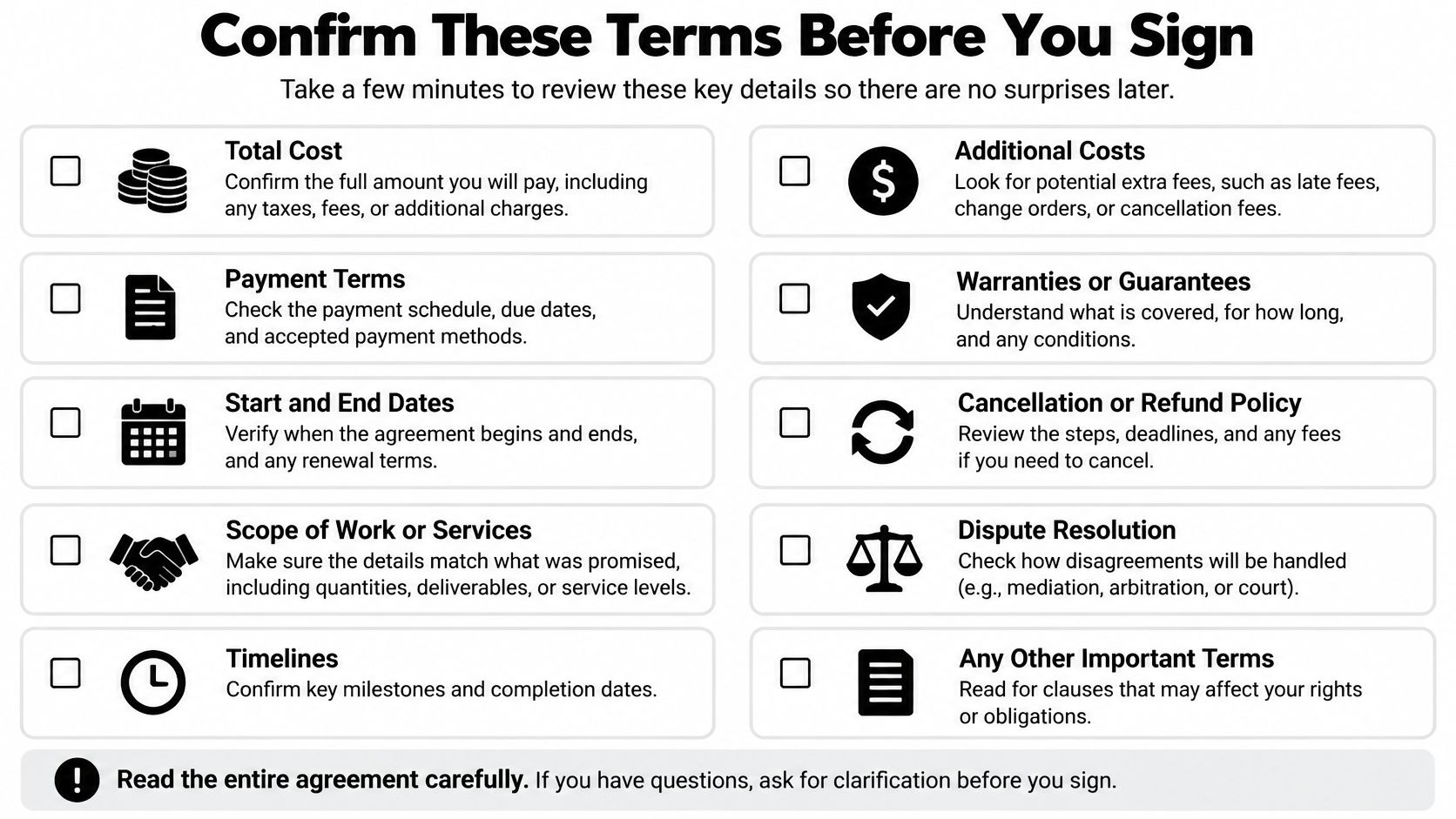
Priority Sign-Off Sequence for Long-Term Buyers
Work through these four checkpoints in sequence before approving final commercial terms:
- Volume and take-or-pay: Confirm the exact annual contract quantity, the payment floor percentage, downward quantity tolerance, and carry-forward or make-up rights if your facility faces an extended shutdown.
- Pricing stress tests: Model the proposed formula under at least two simultaneous stress cases, shifting commodity benchmarks, freight, liquefaction fees, and currency together rather than testing one variable at a time.
- Flexibility and logistics ownership: Fix exactly who pays ocean freight, port charges, and regasification, and put hard numbers on destination rights, diversion notice periods, and fee schedules.
- Emissions compliance: Verify that the contract specifies the exact upstream evidence needed for statutory reporting, sets an enforceable remedy when data arrives late, and clarifies ownership of environmental attributes.
Clear drafting eliminates gray areas before they turn into expensive arbitration filings. Reviewing Miles Hansford Law Firm's guide on contract clauses that prevent disputes alongside your commercial checklist is a solid way to spot ambiguous obligations, weak notice mechanics, and missing remedies while edits are still cheap.
Practical Next Steps for Temporary and Mobile Supply
If your project needs temporary or mobile LNG rather than a bulk terminal contract, start by agreeing on the delivery window and documenting who owns site readiness from pad preparation through tie-in. Put together a short one-page brief listing your equipment's gas capacity, required flow rate, and expected project timeline.
Our Sales team can provide a custom quote for a mobile unit once you're ready to walk through those site needs. Connection equipment, gas flow testing, and leak testing are also available on a service contract basis, letting you keep commissioning and fuel delivery aligned under a single operational scope.
Before anyone signs the final copy, put legal counsel and your gas operations team in the same room to review the draft together. Lawyers catch liability gaps, while operations engineers catch flow-rate, terminal, and scheduling bottlenecks that legal language alone won't reveal.
When pipeline delays, maintenance outages, or off-grid construction schedules call for dependable mobile gas without multi-decade bulk commitments, Blue Gas Express delivers turn-key temporary LNG and CNG systems engineered around your exact flow rate and timeline. From site planning, Emergency Management Plans, and Fire Marshal coordination to continuous tractor-trailer refueling and service-contract leak and flow testing, our team keeps projects running safely until permanent service takes over. Visit Blue Gas Express to share your site specifications and request a custom quote.